
Constitution: Why and How? | CBSE Class 11 Political Science Notes
On this page
Your study route
Class 11 · Political Science
NCERT: Indian Constitution at Work · Chapter 1
What does a constitution do?
Explore the five functions
Sets the ground rules for living together
-
Coordination
Agree on common rules
How it works
People can cooperate when they know what to expect from one another.
-
Decision-making
Decide who may do what
How it works
Institutions receive defined powers and responsibilities.
-
Limits
Protect people from misuse of power
How it works
Rights and checks constrain what a government may do.
-
Aspirations
Enable a fairer society
How it works
Shared goals guide action towards justice and well-being.
-
Identity
Define shared political commitments
How it works
People constitute themselves as a political community.
Keep these five functions in mind as you read. A constitution both grants power and limits its use.
Explore the making of the US Constitution. Who gets a voice when a society writes its fundamental rules? About this animation.
This note covers the meaning and functions of a constitution, coordination and decision-making, limits on government, social aspirations, collective identity, constitutional authority, the formation and working of the Constituent Assembly, the Objectives Resolution, balanced institutions and provisions adapted from other constitutions.
What is a constitution, and why does society need basic rules?
Definition: A constitution sets out the fundamental principles by which a state is formed and governed. It establishes the framework for public power and the basic terms of collective life.
How do common rules make cooperation possible?
A society contains people with different religions, occupations, abilities, incomes, ages and interests. Their preferences need not agree. People may disagree about property, education, security, public spaces or discrimination, yet still depend on one another and need to live together.
Basic rules provide a shared starting point. Without them, individuals cannot be sure what others may do or which claims others will recognise. This uncertainty makes even ordinary cooperation difficult. Agreement on some rules allows people to coordinate despite differences.
These rules must be publicly known. A rule cannot guide shared conduct effectively if people do not know it. The rules must also be enforceable, so that each person has a reason to expect others to follow them.
Legal enforceability supplies assurance: those who break the rules can face punishment. If individuals expect everyone else to ignore a rule, their own incentive to follow it weakens. Common knowledge and enforcement therefore support each other.
The first function of a constitution is to provide basic rules enabling a minimum level of coordination. It does not require everyone to share the same interests. It makes cooperation possible among people who continue to disagree about many matters.
Must every constitution be a single document?
In most countries, a constitution is a compact document containing articles about the state and its governing norms. The United Kingdom differs: a collection of documents and decisions together performs constitutional functions. A constitution therefore need not take the form of one document.
Nor are constitutions confined to democracies. The allocation of authority may favour a monarch, a single party or the people. To understand a constitution, examine both the existence of basic rules and the kind of power those rules establish.
How does a constitution decide who can make decisions?
People can disagree about which law would be best. Before settling the content of a law, a society must settle a more basic question: who has the authority to decide? The constitution answers this by allocating decision-making power.
Why does democratic choice need a procedure?
Saying that the people should decide does not settle how they will decide. People might vote directly on issues, or they might elect representatives. If representatives act for them, rules must establish how those representatives are chosen and how their institutions are organised.
The second function of a constitution is therefore to specify who can make decisions and how government is constituted. Different constitutional arrangements can give the same basic question very different answers.
| Constitutional arrangement | Where decision-making power lies |
|---|---|
| Monarchical constitution | A monarch exercises the authority to decide. |
| The old Soviet Union | A single party was given decision-making power. |
| Democratic constitution | The people broadly hold decision-making authority, exercised through defined procedures. |
| Indian constitutional arrangement | In most instances, Parliament decides laws and policies within its constitutional authority. |
Why is the Constitution more fundamental than Parliament?
In India, Parliament is organised according to constitutional provisions. Its law-making authority does not arise merely because its members want to make laws. The Constitution establishes the institution and gives it the authority to act.
This explains why constitutional authority is higher than parliamentary authority. The reason is the relationship between the two: the Constitution defines how Parliament is formed and what it may do. It is not simply that constitution-making happened earlier.
Clear allocation also identifies the responsibilities of institutions. A citizen seeking to understand a law must know which body was authorised to make it. Constitutional rules provide the framework within which particular decisions and policies acquire public authority.
Why must a constitution limit the powers of government?
A government may be established through accepted procedures and still make unjust decisions. The existence of an authorised decision-maker is therefore insufficient. A constitution must also address what that authority is permitted to impose on the people.
What dangers arise from unrestricted authority?
A government might prevent people from practising their religion, arbitrarily arrest them or discriminate against a group. Such actions would remain unjust even if the government had originally been formed according to the prescribed procedure.
The third constitutional function is to limit government power. A constitution draws boundaries around public authority, so that creating government does not amount to giving rulers unrestricted control over citizens.
A common method is to recognise fundamental rights. These rights protect citizens against specified abuses. They are constitutional limits on the government, rather than benefits that depend entirely on the wishes of those currently holding office.
Basic protections commonly include safeguards against arbitrary arrest and liberties relating to speech, conscience, association and trade or business. The precise content and interpretation of rights differ between constitutions.
How should limits on rights be understood?
Rights should not be described as unrestricted in every circumstance. Constitutions may provide for limitations during a national emergency and specify the circumstances in which rights can be withdrawn. The constitutional framework governs such limitations too.
Note: Creating a government and limiting that government are distinct constitutional tasks. A government can have lawful authority to make decisions while remaining bound by rights and other constitutional restrictions.
The important relationship is between power and restraint. Authority enables collective decisions; constitutional limits protect people against misuse of that authority. Both are needed to understand why a constitution does more than describe the machinery of government.
How does a constitution help society pursue justice and welfare?
Restraining government is important, but it does not by itself remove entrenched inequalities. A society also needs institutions capable of acting against deprivation and discrimination. A constitution can therefore provide an enabling framework for positive government action.
Why are enabling provisions necessary?
The fourth function of a constitution is to help government fulfil social aspirations and create conditions for a just society. This connects constitutional arrangements to the kind of collective life people want to build.
India's aspiration to overcome caste discrimination requires government to have powers to pursue that goal. Similarly, South Africa's history of racial discrimination made action against such discrimination an important constitutional responsibility.
The framers of India's Constitution envisaged conditions in which each individual could enjoy dignity and social self-respect. These included minimum material well-being and education. Positive welfare measures help express that commitment; some such measures are legally enforceable.
The Preamble supports these aspirations. Enabling provisions also appear in Fundamental Rights, while the Directive Principles of State Policy direct government towards fulfilling the aspirations of the people.
| Country | Examples of enabling constitutional commitments |
|---|---|
| India | Action against caste discrimination and welfare measures supporting dignity, material well-being and education. |
| South Africa | Nature conservation, protection against unfair discrimination, and progressive provision of adequate housing and health care. |
| Indonesia | A national education system and government care for the poor and destitute children. |
How do enabling and limiting functions differ?
A limiting provision asks what government must not do to people. An enabling provision identifies purposes that government should be equipped to pursue. The two functions belong together: government requires both sufficient authority for collective welfare and boundaries that protect freedom.
A constitution consequently contains more than a list of prohibitions. Its principles can authorise efforts to change unequal social conditions, making it a framework for social improvement as well as an arrangement for political rule.
How does a constitution express the identity of a people?
A constitution helps establish a collective political identity. People already possess many identities, but agreement about basic norms of government brings them together as members of a political community. The agreement concerns both how they are governed and who belongs within that community.
What are political and moral identity?
Political identity arises through common constitutional membership. People need not abandon their different religious or social identities to accept shared rules. Their collective identity rests on agreement about the basic terms of political life.
A constitution also expresses moral identity. It sets the framework within which individuals pursue goals and freedoms, and identifies fundamental values that public life should respect. Constitutional restraints therefore convey a view of acceptable conduct, as well as a distribution of power.
Most modern constitutions create a form of government that is democratic in some respects, and most claim to protect certain basic rights. Yet they can differ in their conceptions of national identity and in the way they bring different groups together.
What is significant about Indian citizenship?
The Indian Constitution does not make ethnic identity a criterion for citizenship. Indian citizenship is not confined to one race, caste or religion. This is central to understanding its conception of the people as a political community.
The relationship between different regions and the central government also contributes to national identity. Constitutional arrangements determine how these parts form a political whole and how authority is shared within it.
Thus, a constitution is not merely an instruction manual for officials. It helps define membership, common values and the framework for shared aspirations. Its identity-forming role connects decisions about citizenship and institutions with the question of what holds a diverse people together.
What gives a constitution authority and public acceptance?
A constitution may exist on paper without effectively shaping public life. Understanding its authority therefore requires more than checking whether a document has been written. Its effectiveness depends partly on its origins and on whether people have reasons to accept its provisions.
Why does the mode of promulgation matter?
Mode of promulgation refers to how a constitution comes into being. The credibility of its makers matters. Leaders unable to command public respect may produce a constitution that lacks effective support, even when its formal language appears impressive.
Constitutions in India, South Africa and the United States followed popular national movements. In India, the Constitution drew legitimacy from the nationalist movement's capacity to bring together different sections of society.
Its makers possessed public credibility, experience of negotiation and the ability to persuade people that constitution-making was not a means of expanding their personal power. The document reflected a broad national consensus.
Some countries use a referendum, allowing people to vote directly on whether a constitution is desirable. India's Constitution was not put to such a referendum. It nevertheless gained public authority through popular leaders' support and people's acceptance of its provisions.
Why do substantive provisions matter?
Substantive provisions concern what a constitution actually establishes and protects. A successful constitution gives everyone in society some reason to accept its provisions. Permanent oppression of minorities or systematic privilege for a small group undermines those reasons.
No constitution by itself produces perfect justice. It must, however, offer a credible framework for pursuing basic justice. Protection of freedom and equality strengthens the likelihood of success because people can recognise a place for themselves within the constitutional order.
The authority of the makers and the fairness of the provisions are related but distinct. Public respect for leaders cannot replace the need for arrangements that protect people and give their hopes a place in political life.
How does balanced institutional design protect a constitution?
Constitutions are often undermined by small groups seeking greater power. Balanced institutional design reduces this risk by distributing authority so that a single institution cannot easily acquire a monopoly over government.
How do checks and balances work?
The Indian Constitution distributes power across institutions such as the legislature, executive and judiciary. The Election Commission also forms part of the wider arrangement of institutions. If one institution exceeds its proper authority, others can check that action.
This is the principle of checks and balances. Constitutional protection depends partly on how institutions relate to one another, rather than solely on the good intentions of particular rulers. Distribution of power makes unilateral attempts to undermine the Constitution more difficult.
The framers also developed a federal arrangement sharing governmental authority between the States and the central government. Alongside the parliamentary form, this helped shape a balanced structure of public power.
Why must stability coexist with change?
Institutional design involves another balance: a constitution must preserve authoritative values while allowing adaptation to new circumstances. Excessive rigidity can leave it unable to respond to change. Excessive flexibility can destroy the security and predictability that constitutional rules should provide.
| Arrangement | Constitutional difficulty or benefit |
|---|---|
| Too rigid | Unable to adapt adequately to changing needs and circumstances. |
| Too flexible | Unable to provide sufficient security, predictability and a stable identity. |
| Balanced | Preserves core values while permitting adaptation within constitutional limits. |
The Indian Constitution is described as a living document because it combines possibilities for change with limits on those changes. Its authority can endure while its operation responds to new needs.
Credible makers, acceptable substantive provisions and balanced institutions together help explain constitutional effectiveness. None should be confused with a guarantee that every decision will be just or every office-holder will act well.
How was the Constituent Assembly formed, and what happened when?
The Constituent Assembly formally made India's Constitution. It was initially constituted for undivided India, and its broad composition followed the Cabinet Mission plan. Provincial representatives were chosen indirectly through Provincial Legislative Assemblies established under the Government of India Act, 1935.
How were representatives selected?
- Provinces and Princely States or groups of States received seats roughly in proportion to population, at approximately one seat per ten lakh people. Provinces were to elect 292 members; Princely States were allotted a minimum of 93 seats.
- Provincial seats were divided among Muslims, Sikhs and the general category in proportion to their populations.
- Members of each community in a Provincial Legislative Assembly elected their representatives through proportional representation using the single transferable vote.
- The method for selecting representatives of Princely States was to be settled through consultation.
These arrangements describe the selection scheme. They should not be confused with the Assembly's membership after Partition, or with the number of members who later signed the Constitution.
What is the sequence of major events?
| Date | Event |
|---|---|
| 9 December 1946 | The Constituent Assembly held its first sitting. |
| 3 June 1947 | The Partition plan provided the setting for the departure of members elected from territories that became Pakistan. |
| 14 August 1947 | The Assembly reassembled as the Constituent Assembly for divided India. |
| 26 November 1949 | The Constitution was adopted. |
| 24 January 1950 | The 284 members present signed the Constitution as finally passed. |
| 26 January 1950 | The Constitution came into force. |
After Partition, the Assembly's membership fell to 299. Constitution-making proceeded amid immense pressure and violence. The framers nevertheless committed themselves to citizenship in which minorities would be secure and religious identity would not determine citizenship rights.
Adoption, signing and commencement are separate events. Keeping them distinct is essential to understanding the sequence through which the completed Constitution became the operative framework of government.
How representative was the Constituent Assembly?
The Assembly was not elected through universal suffrage. Its indirect method of selection is an important limitation to acknowledge. It does not, however, settle the separate question of whether different social groups and political views found representation within it.
What diversity existed within the Assembly?
There was a serious effort to make the Assembly representative. Members of all religions were represented, and the Assembly included twenty-eight Scheduled Caste members. Its composition brought a range of social experiences into constitution-making.
After Partition, Congress held eighty-two per cent of the seats. This dominance did not mean that every member held the same views. Congress itself accommodated almost all shades of opinion, which contributed to diversity within the Assembly.
The Assembly was therefore broadly, though not perfectly, representative. Its authority also depended on how members used their positions. Representation mattered, but reasoned discussion of the interests of the whole nation mattered too.
Why was universal suffrage significant?
Universal suffrage means that citizens reaching the required age are entitled to vote without exclusion on grounds such as religion, caste, education, gender or income. Its introduction was accepted with virtually no debate in the Assembly.
This demonstrated a strong democratic commitment. The absence of universal suffrage in the Assembly's own selection must not be confused with opposition to universal suffrage in the constitutional system it created.
Other foundational issues received extensive debate, including centralisation, relations between the Centre and States, judicial powers and property rights. The combination of broad representation and serious deliberation helps explain the Assembly's authority.
A careful assessment therefore avoids two extremes: describing the Assembly as perfectly representative, or dismissing it as wholly unrepresentative simply because all citizens did not directly elect its members.
How did deliberation and committee procedures shape the Constitution?
The Assembly's authority came partly from its commitment to public reason. Members were expected to explain their positions through arguments that others could consider, rather than merely demand advantages for their own communities or interests.
What made disagreement constructive?
Members often disagreed on principles. Centralisation, the powers of courts and protection of property were serious questions. Explaining reasons encouraged members to move beyond narrow interests and consider the implications for the whole nation.
Major leaders also differed from one another. B.R. Ambedkar had criticised Congress and Gandhi over their approach to the upliftment of Scheduled Castes. Nehru and Patel disagreed on several issues. These differences did not prevent their cooperation in constitution-making.
How did the Assembly conduct its work?
The Assembly had eight major committees on different subjects. Jawaharlal Nehru, Rajendra Prasad, Sardar Patel and B.R. Ambedkar usually chaired these committees. Ambedkar chaired the Drafting Committee, while Rajendra Prasad was President of the Constituent Assembly.
- Committees usually prepared particular constitutional provisions for consideration.
- The entire Assembly debated the provisions, examining their implications and the reasons offered for them.
- Members generally tried to reach consensus, seeking arrangements acceptable across different interests.
- Some provisions were decided by voting when necessary.
- Arguments, questions and concerns received careful responses in writing.
The Assembly met for 166 days over two years and eleven months. Its sessions were open to the press and public. Public discussion and written engagement made its procedures an important source of constitutional authority.
Consensus did not mean that disagreement was absent, or that every provision passed unanimously. It describes the effort to build broad agreement through discussion. Voting formed part of the process, but persuasion and consideration of objections were central to its character.
How did the nationalist movement and Objectives Resolution guide constitution-making?
The Constitution drew on principles developed during the long struggle for freedom. The nationalist movement had debated the form of government, the values India should uphold and the inequalities it should overcome. The Assembly gave institutional form to this inheritance.
What did the Objectives Resolution propose?
Nehru moved the Objectives Resolution in 1946. It defined the aims of the Assembly and brought together the aspirations behind the Constitution. Its main points were:
- India would be an independent, sovereign republic.
- The Union would include British Indian territories, Indian States and other territories willing to join it.
- Territories within the Union would be autonomous units, exercising governmental and administrative powers except those assigned to the Union.
- All authority of independent India and its Constitution would derive from the people.
- People would receive social, economic and political justice; equality of status, opportunity and before law; and freedoms of speech, expression, belief, faith, worship, vocation, association and action, subject to law and public morality.
- Minorities, backward and tribal areas, depressed classes and other backward classes would receive adequate safeguards.
- The Republic's territorial integrity and sovereign rights over land, sea and air would be maintained in accordance with justice and the law of civilised nations.
- India would contribute willingly to world peace and human welfare.
Why do these principles go beyond administrative rules?
The commitments include equality, liberty, democracy, sovereignty and a cosmopolitan identity. They connect domestic political life with concern for the wider world. The Constitution thus expresses moral purposes as well as governing procedures.
Ambedkar also stressed that political democracy needed a foundation in social democracy. Liberty, equality and fraternity belong together. For Ambedkar, liberty without equality would produce the supremacy of the few over the many; equality without liberty would kill individual initiative; without fraternity, liberty and equality could not become a natural part of life.
The nationalist inheritance provided a shared basis for deliberation. It did not remove the need to make difficult choices about institutions. The Assembly still had to translate broad commitments into workable arrangements.
Why did the framers adapt provisions from other constitutions?
The framers studied other countries' constitutional experience while designing arrangements for India. Their willingness to learn showed a broad outlook. Adaptation involved judging whether a provision would address Indian problems and aspirations, rather than accepting it merely because another country used it.
Which provisions were adapted?
| Constitutional tradition | Provisions adapted |
|---|---|
| British | First Past the Post; parliamentary government; the rule of law; the institution and role of the Speaker; law-making procedure. |
| United States | A charter of Fundamental Rights; judicial review and independence of the judiciary. |
| Irish | Directive Principles of State Policy. |
| French | Liberty, equality and fraternity. |
| Canadian | A quasi-federal system with a strong central government; residual powers. |
What the figure shows
Provisions adapted from different constitutions
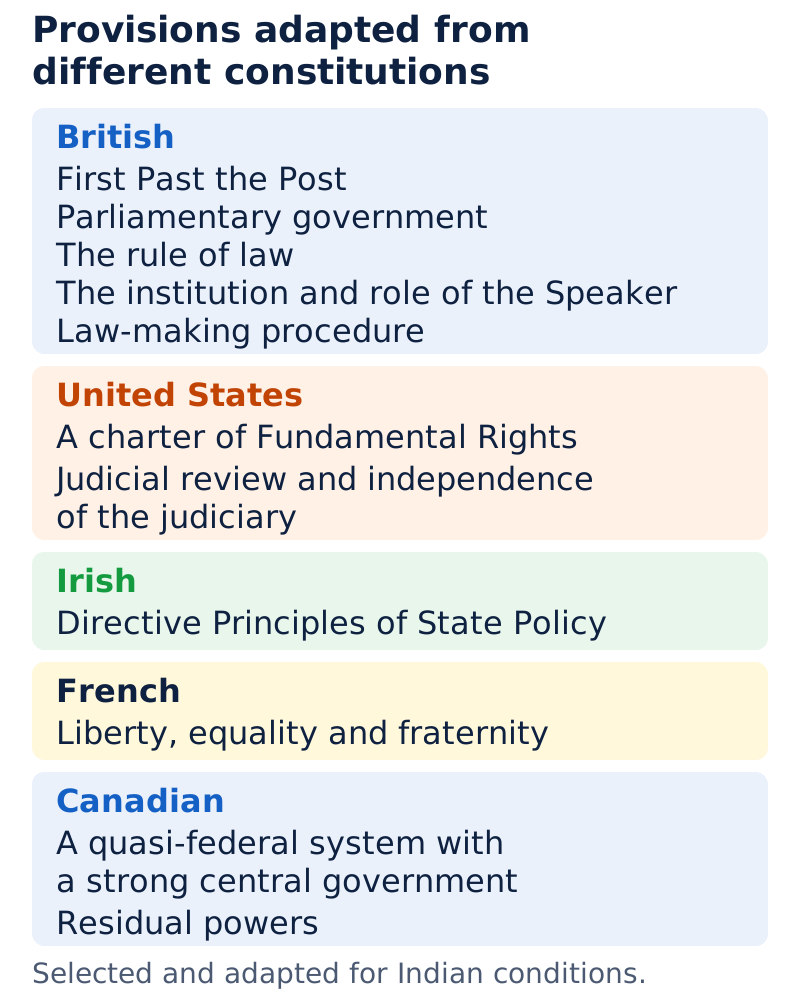
Five overlapping coloured circles carry labels for the British, United States, Irish, French and Canadian constitutions. Each contains the provisions associated with that constitutional tradition, as listed in the table.
Drawn by One Young India. Reference: NCERT Class 11, page 22, unnumbered chart
Why was this more than imitation?
Each provision needed a justification rooted in Indian conditions. The relevant question was whether it would serve India's needs. Learning from an existing institution could therefore coexist with originality in selecting, adapting and combining arrangements.
Ambedkar emphasised the significance of variations that corrected defects and accommodated a country's needs. A constitution written after many earlier experiments could draw on that experience while developing its own response to local problems.
The resulting institutions aimed to balance democratic government with public welfare. The parliamentary and federal arrangements distributed power within government and between the Centre and States. These choices linked constitutional learning to the broader aim of creating a durable system.
Calling the Constitution merely borrowed overlooks both the reasoning involved in adaptation and the values that guided it. Its authority rests on the suitability of its arrangements, its public purposes and the process through which those arrangements were debated and accepted.
Glossary
- Constitution — Fundamental principles establishing a state, organising its government and setting the basic framework for collective political life.
- Coordination — The ability of people to cooperate through common rules despite differences in their interests, identities and preferences.
- Fundamental rights — Basic rights whose constitutional protection limits the power that government may exercise over citizens.
- Enabling provisions — Constitutional arrangements empowering government to pursue collective welfare and help overcome social inequalities or deprivation.
- Political identity — Shared membership of a political community formed through agreement about basic norms and arrangements of government.
- Mode of promulgation — The manner in which a constitution comes into existence, including the role and authority of its makers.
- Referendum — A direct popular vote that may be used to seek public acceptance of a proposed constitution.
- Checks and balances — Institutional arrangements distributing authority so that different bodies can check attempts by others to exceed their powers.
- Constituent Assembly — The representative body responsible for deliberating upon and framing the Constitution of India.
- Universal suffrage — Voting entitlement for citizens reaching the required age, without exclusion based on religion, caste, education, gender or income.
- Public reason — Discussion in which participants justify their positions through principled arguments that other people can examine and consider.
- Objectives Resolution — The resolution moved by Nehru in 1946 setting out the Constituent Assembly's aims and underlying constitutional aspirations.
- Social democracy — A way of life recognising liberty, equality and fraternity as interconnected principles supporting political democracy.
- Living document — A constitution that preserves its fundamental values while allowing adaptation to changing needs within limits on change.
Common errors and misconceptions
- Misconception: Every country must have a single written constitutional document. Correct: The United Kingdom's constitution consists of documents and decisions that together perform constitutional functions.
- Misconception: A constitution only restricts government. Correct: It also creates institutions, allocates powers, expresses identity and enables action towards social justice and welfare.
- Misconception: An elected government may pass any law it wishes. Correct: Its authority remains subject to constitutional limits, including protections for citizens' rights.
- Misconception: Indirect election made the Assembly wholly unrepresentative. Correct: Its selection had limitations, but it included diverse communities and opinions and sought to deliberate for the whole nation.
- Misconception: The Constitution was adopted on 26 January 1950. Correct: It was adopted on 26 November 1949, signed by the members present on 24 January 1950 and came into force on 26 January 1950.
- Misconception: Broad consensus meant there were no serious disagreements. Correct: The Assembly debated major questions of principle, sought agreement and sometimes used voting to decide provisions.
- Misconception: Adapting foreign provisions removed all originality. Correct: The framers defended provisions in terms of Indian needs and aspirations, making adaptation a reasoned constitutional choice.
- Misconception: Having a constitution guarantees perfect justice and good rulers. Correct: A constitution provides a framework for pursuing justice and organising power; it does not itself guarantee those outcomes.
Exam-style questions with model answers
Q1. Members of a diverse society need common rules that are publicly known and legally enforceable. Explain how these two features support cooperation. [2 marks]
- Publicly known rules give members a shared understanding of expected conduct.
- Legal enforceability provides assurance that violations can be punished, encouraging people to follow rules because they expect others to follow them too.
Q2. The Constitution specifies how Parliament is formed and gives it law-making powers. Explain why this makes constitutional authority more fundamental than parliamentary authority. [2 marks]
- Parliament's authority comes from the Constitution, which creates its institutional framework and defines its powers.
- Parliament therefore acts within a constitutional framework; it is not the source of the authority that originally establishes it.
Q3. A constitution recognises rights against arbitrary arrest, enables welfare measures and distributes authority among the legislature, executive and judiciary. Explain the constitutional purpose of each arrangement. [3 marks]
- Protection against arbitrary arrest limits government power and safeguards citizens against unjust use of public authority.
- Welfare measures enable government to pursue collective aspirations and address deprivation, helping create conditions for dignity and social justice.
- Distribution among institutions supports checks and balances. It reduces the danger of a monopoly of power by allowing other institutions to check an institution that exceeds its authority.
Q4. The Assembly was indirectly selected, included members of all religions and twenty-eight Scheduled Caste members, and had a Congress majority of eighty-two per cent after Partition. Congress accommodated varied opinions. Assess the claim that the Assembly was wholly unrepresentative. [4 marks]
- Indirect selection means that the Assembly was not elected by all citizens through universal suffrage. Its representativeness therefore had limitations.
- Representation of different religions and twenty-eight Scheduled Caste members shows that social diversity was taken seriously.
- Congress held a large majority, but diversity of opinion within Congress prevents equating party dominance with complete uniformity of thought.
- The evidence supports describing the Assembly as broadly, though not perfectly, representative. The claim that it was wholly unrepresentative overlooks its composition and internal diversity.
Q5. Committees drafted provisions; the Assembly debated them, sought consensus, sometimes voted and answered concerns in writing. Sessions were open to the press and public. Explain how these procedures strengthened constitution-making. [5 marks]
- Committee preparation allowed particular provisions to be developed before the entire Assembly considered them. The committee stage formed part of a wider deliberative process.
- Full Assembly debate exposed proposals to scrutiny and required members to explain the reasons for their positions.
- The search for consensus encouraged arrangements that different interests could accept, while voting provided a way of deciding some provisions.
- Written responses treated arguments and concerns seriously. This supported public reason by making justification an essential part of the process.
- Open sessions made deliberation accessible to the press and public. Together, these procedures gave the Constitution authority beyond the mere existence of a drafting body.
Q6. The Objectives Resolution proposed popular sovereignty, justice and equality, fundamental freedoms, safeguards for vulnerable groups, and contributions to world peace. Explain how these aims show that constitution-making involved moral commitments as well as governmental rules. [5 marks]
- Popular sovereignty places the people at the foundation of political authority. Government is thereby connected to a principle about the legitimate source of power.
- Justice and equality state the kind of society that political arrangements should help create, extending constitutional purpose beyond administrative efficiency.
- Fundamental freedoms recognise the value of individual liberty and identify interests that public authority must respect.
- Safeguards for vulnerable groups express concern that political arrangements should protect those who might otherwise face disadvantage or exclusion.
- Commitment to world peace extends the vision beyond national institutions. Taken together, these aims make the Constitution an expression of shared values and aspirations, not merely a procedure for selecting rulers.
Q7. The Constitution was adopted on 26 November 1949, signed by 284 members present on 24 January 1950 and brought into force on 26 January 1950. Explain the distinction among the three events and correct the claim that adoption occurred on 26 January 1950. [3 marks]
- Adoption on 26 November 1949 marked the Assembly's acceptance of the Constitution. It was the decision approving the constitutional document.
- Signing on 24 January 1950 involved the 284 members present appending their signatures to the Constitution as finally passed.
- Commencement on 26 January 1950 brought the Constitution into force. The claim confuses this commencement date with the earlier adoption date; the events represent different stages.
Q8. The framers adapted parliamentary government from the British tradition, Fundamental Rights and judicial review from the United States, and Directive Principles from Ireland. Every provision had to be defended as suitable for Indian problems and aspirations. Evaluate the claim that this was merely imitation. [4 marks]
- The listed arrangements show that the framers learnt from existing constitutional experience rather than working without reference to other countries.
- However, the requirement of suitability made Indian needs the basis of selection. Foreign origin alone did not justify including a provision.
- Adaptation involved reasoning about how arrangements could serve the country's problems and aspirations. This allowed learning to coexist with originality.
- The claim is therefore inadequate: it recognises the external influences but overlooks the judgement and justification involved in making them part of India's constitutional framework.
Key takeaways
- A constitution provides common rules, allocates decision-making power, limits government, enables social aspirations and expresses a collective political identity.
- Public knowledge of rules and assurance of enforcement allow cooperation among people whose interests and identities differ.
- Constitutional authority depends on credible origins, provisions people can accept, and institutions that distribute power and permit appropriate change.
- The Constituent Assembly was indirectly selected and broadly representative, with its authority strengthened by public reason and national commitments.
- The Constitution was adopted on 26 November 1949 and came into force on 26 January 1950.
- Committee work, debate, consensus, voting and written responses enabled the Assembly to turn disagreements into considered constitutional decisions.
- The Objectives Resolution connected constitution-making with popular sovereignty, justice, equality, liberty, safeguards and concern for world peace.
- Provisions adapted from other constitutions were assessed for Indian needs, making their incorporation a process of reasoned adaptation.
Test yourself
Why are publicly known rules insufficient without enforceability?
People need assurance that others will follow the rules. Enforceability provides consequences for violations and strengthens that assurance.
What question does the allocation of decision-making power answer?
It answers who has authority to make collective decisions and how the institutions exercising that authority are constituted.
How does an enabling provision differ from a restriction on government?
An enabling provision equips government to pursue collective welfare. A restriction places boundaries on what government may impose on people.
Was India's Constitution approved through a referendum?
No. Its public authority rested on other grounds, including credible leaders, broad consensus and people's acceptance of its provisions.
What was the Assembly's membership after Partition?
Its membership fell to 299 after members from territories that became Pakistan ceased to belong to it.
What does public reason require of participants in a debate?
Participants should offer principled reasons others can consider, moving beyond demands based solely on their own narrow interests.
Which constitutional tradition influenced the Directive Principles of State Policy?
The Irish Constitution provided the influence for India's Directive Principles of State Policy.
Why is a balance between constitutional stability and flexibility necessary?
Stable values provide security and predictability, while flexibility allows adaptation to changing circumstances without abandoning the constitutional framework.
Put an idea to work
Three situations. What would you change?
These fictional communities face questions that can arise anywhere. Choose an approach, check its reasoning and consider what it leaves unresolved.
Situation 1
Who decides about shared water?
On an imaginary island, several councils share a freshwater reservoir. They agree that access should be fair, but each claims the final say over rationing.
Read the full explanation
Specifying the responsible institution and a review procedure directly addresses the disputed authority. A commitment to fairness answers what the councils hope to achieve. A clear allocation of power answers who may act and through which process. Both can be useful, but they perform different functions.
Take it further: What further safeguard would help if the institution used its rationing power to favour its own supporters?
Situation 2
Can an elected council silence criticism?
An elected council in a fictional republic proposes closing residents’ meetings whenever speakers criticise its decisions.
Read the full explanation
Protecting peaceful criticism and providing independent review directly constrain the proposed use of power. Voting procedures and published reasons can also matter, but they do not replace substantive safeguards. In an actual constitution, the scope of a freedom and any permitted restrictions must be examined carefully.
Take it further: Why might the right to criticise a decision matter most to people who lost the last election?
Situation 3
What would help a promise of learning?
A fictional community protects personal liberty, but many neighbourhoods have no accessible learning spaces. Its constitution-makers want this concern to guide future public action.
Read the full explanation
A commitment to fair access gives public institutions a shared goal to pursue. Allocating responsibility and protecting freedom can support that goal, but neither automatically creates learning spaces. A constitution can enable action while people continue to debate the best policies and assess whether they work.
Take it further: What evidence would help residents judge whether access was becoming fairer?
Rules for a game or group are an analogy, not a national constitution. The useful connection is learning to balance authority, safeguards and the possibility of change.