
Judiciary | CBSE Class 11 Political Science Notes
On this page
Watch & explore
Start with a few high-quality watches, then dive into the notes below.

This note covers judicial independence, appointment and removal of judges, the court hierarchy, Supreme Court jurisdiction, judicial activism, public interest litigation, fundamental rights, judicial review, relations between the judiciary and Parliament, legal services and environmental disputes.
Why does democracy need an independent judiciary?
What does the rule of law require?
The judiciary is the organ of government that settles disputes according to law, protects rights and interprets the Constitution. Its work includes disputes between individuals, between groups, and between individuals or groups and the government. It also performs political functions.
Definition: The rule of law means that all individuals are subject to the same law, regardless of wealth, gender or caste. The judiciary protects the supremacy of law.
An independent body must settle disputes without political pressure. Otherwise, powerful individuals or groups could override the rights of others. The judiciary safeguards individual rights and helps ensure that democracy does not give way to individual or group dictatorship.
Since 1950, the Indian judiciary has played an important part in interpreting and protecting the Constitution. Courts therefore do more than arbitrate private disagreements. They also determine the meaning of constitutional provisions and protect the limits within which government must function.
Does independence remove accountability?
Judicial independence means that the executive, which implements laws, and the legislature, which makes laws, must not restrain courts so that they cannot do justice. These organs should not interfere with judicial decisions. Judges must perform their functions without fear or favour.
Independence does not mean arbitrariness, or acting according to personal whim. Nor does it mean the absence of accountability. The judiciary remains accountable to the Constitution, democratic traditions and the people because it belongs to the democratic political structure.
Note: Independence protects the ability to decide fairly. It does not put judges outside the constitutional system or free them from responsibility to the people.
How does the Constitution protect judicial independence?
What safeguards protect judges?
The Constitution uses several safeguards together. Legal knowledge matters in appointments, judges enjoy security of office, and their salaries and allowances do not depend on legislative approval. These arrangements reduce opportunities for other organs to exert pressure over judicial decisions.
| Safeguard | How it supports independence |
|---|---|
| Appointment process | The legislature is not involved. It was believed that this would keep party politics out of appointments. |
| Legal competence | A judge must have experience as a lawyer and/or be well versed in law. Political loyalty should not determine selection. |
| Security of tenure | Judges hold office until retirement and may be removed only in exceptional cases through a difficult procedure. |
| Financial independence | Judges' salaries and allowances are not subject to approval by the legislature. |
| Protection against unfair criticism | The power to punish contempt of court protects judges against unfair criticism. |
| Restriction on parliamentary discussion | Parliament cannot discuss judges' conduct except during proceedings for removal. |
Tenure means the period for which a person holds office. Security of tenure lets judges act without fear that an unpopular decision will cost them their position. The Constitution's difficult removal procedure was intended to provide this security.
How are protection and responsibility connected?
Contempt of court concerns conduct that the court treats as an offence against its authority. The judiciary can penalise those found guilty of it. This authority is seen as effective protection against unfair criticism, while judicial accountability to constitutional principles remains.
These safeguards should be understood together with the duties of judges. Political opinions or loyalty should not be appointment criteria. Independence is meant to support impartial decisions, rather than turn the judiciary into a body exercising unlimited power over the other organs.
How are judges appointed, and why has appointment been controversial?
Why does the choice of judge matter?
Judicial appointments have never been free from political controversy. Judges' political philosophies and views about an active or restrained judiciary affect how they interpret the Constitution and legislation. The Council of Ministers, Governors, Chief Ministers and Chief Justice of India influence appointments.
A convention developed under which the senior-most Supreme Court judge became the Chief Justice of India (CJI), the head of the Supreme Court. A convention is an established practice. This seniority convention was broken twice.
| Year | Appointment example |
|---|---|
| 1973 | A. N. Ray became Chief Justice of India, superseding three senior judges. |
| 1977 | Justice M. H. Beg was appointed, superseding Justice H. R. Khanna. |
Other Supreme Court and High Court judges are appointed by the President after consultation with the CJI. Initially, this meant that final appointment decisions rested with the Council of Ministers. The meaning and force of consultation became an important constitutional dispute.
How did collegiality develop?
The issue repeatedly reached the Supreme Court between 1982 and 1998. The Court first treated the Chief Justice's role as purely consultative. It then took the view that the President must follow the Chief Justice's opinion.
The Court subsequently suggested that the Chief Justice recommend names after consulting the Court's four senior-most judges. This established collegiality, meaning collective recommendations by a group of senior judges, rather than a recommendation resting on one person's opinion.
In this arrangement, the group of senior Supreme Court judges carries greater weight in appointments. Both the Supreme Court and Council of Ministers play important roles. The absence of legislative participation should therefore not be confused with the absence of political controversy.
How can a judge be removed from office?
What makes removal difficult?
A Supreme Court or High Court judge can be removed only for proven misbehaviour or incapacity. Misbehaviour concerns improper conduct; incapacity concerns inability to perform the duties of office. Charges must support a removal motion, which requires a special majority in both Houses of Parliament.
A special majority here requires two-thirds of members present and voting together with a majority of the total membership of the House. Meeting only the first condition is insufficient. The difficulty of securing broad parliamentary agreement helps protect judicial independence.
- Removal must concern proven misbehaviour or incapacity, rather than ordinary disagreement with a judicial decision.
- A motion must contain the charges against the judge.
- The motion must receive the required special majority in each House of Parliament.
- Without the necessary parliamentary consensus and majorities, the removal motion cannot succeed.
The executive plays a crucial part in appointments, while the legislature has removal powers. This distribution supports both a balance of power and judicial independence. Security of office does not eliminate accountability, but makes removal an exceptional process.
What happened in the V. Ramaswami case?
In 1991, 108 Members of Parliament signed the first-ever motion to remove a Supreme Court judge. Justice V. Ramaswami was accused of misappropriating funds during his tenure as Chief Justice of the Punjab and Haryana High Court.
In 1992, an inquiry commission consisting of Supreme Court judges found serious misuse of office, use of public funds for private purposes and disregard of statutory rules. The commission's findings did not themselves complete parliamentary removal.
The motion secured the required two-thirds majority among those present and voting. However, Congress members abstained, and it lacked the required majority of the House's total strength. Ramaswami was not removed. This example shows why both majority requirements matter.
How is India's single integrated judicial system organised?
What does integration mean?
India has a single integrated judiciary: courts at different levels belong to one connected judicial system. Unlike some other federal countries, India does not have separate State court systems. This does not mean that India has no courts functioning within States.
The structure is pyramidal. The Supreme Court is at the top, followed by High Courts, District Courts and Subordinate Courts. Lower courts work under the direct superintendence, or supervision, of higher courts. The Supreme Court's decisions bind all courts.
An appeal asks a higher court to reconsider a lower court's decision. Fundamental rights are rights protected by the Constitution that courts can restore when violated. A writ is a special court order used for such protection.
| Court | Functions and position |
|---|---|
| Supreme Court of India | Its decisions bind all courts. It can transfer High Court judges, move cases to itself and transfer cases between High Courts. |
| High Court | Hears appeals from lower courts, issues writs to restore fundamental rights, deals with cases within the State and supervises courts below it. |
| District Court | Deals with district cases, considers appeals from lower courts and decides cases involving serious criminal offences. |
| Subordinate Courts | Consider civil and criminal cases: disputes concerning civil matters and cases concerning criminal offences. |
What the figure shows
Structure of the judiciary
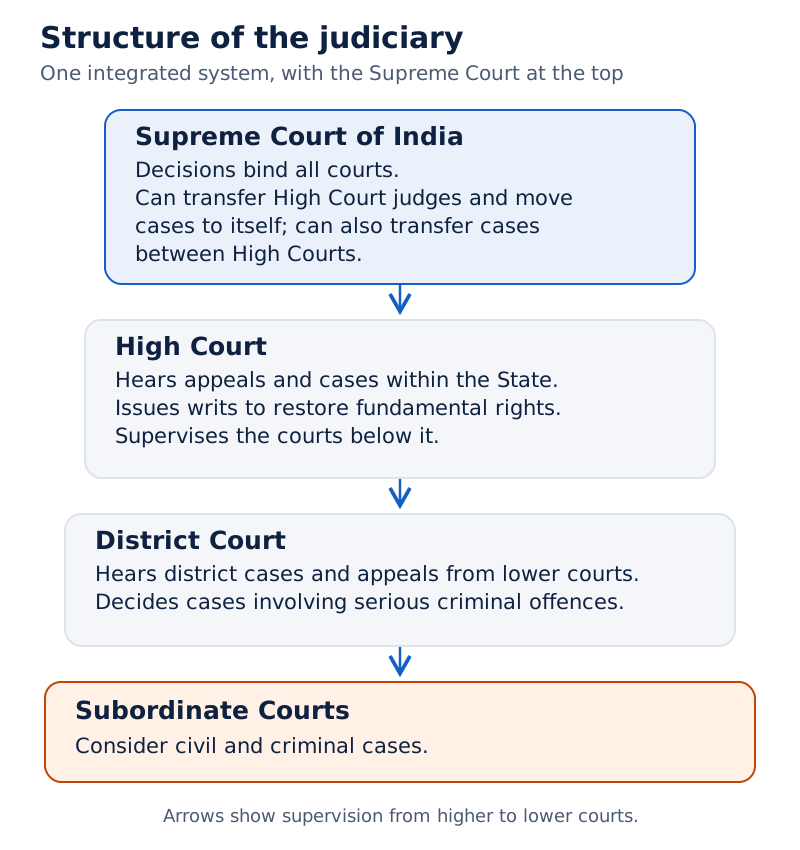
Four labelled boxes descend from Supreme Court of India to High Court, District Court and Subordinate Courts. Connecting arrows link higher levels with lower courts; each box lists functions.
Drawn by One Young India. Reference: NCERT Class 11, page 130, unnumbered
The diagram links institutional position with powers. It helps distinguish the court hierarchy from a collection of disconnected courts. For example, an appeal from a District Court in Haryana goes to the High Court, while a Union-State dispute belongs to the Supreme Court's original jurisdiction, its power to consider such a dispute directly.
How do the Supreme Court's different jurisdictions compare?
What is jurisdiction?
Jurisdiction means the scope of a court's powers. The Supreme Court is one of the very powerful courts in the world, but its functions and responsibilities remain defined and limited by the Constitution. Its powers operate through several different kinds of jurisdiction.
| Jurisdiction | Meaning | Distinctive feature |
|---|---|---|
| Original | Direct consideration of disputes between the Union and States or among States. | These federal disputes belong to the Supreme Court alone. |
| Writ | Special orders protecting an individual's fundamental rights. | The affected person may approach the Supreme Court directly or approach a High Court. |
| Appellate | Reconsideration of lower-court decisions and legal issues. | Appeals may concern civil, criminal or constitutional cases. |
| Advisory | Advice sought by the President on public importance or constitutional interpretation. | Giving and accepting the advice are both optional. |
| Special powers | Permission called special leave to appeal from a court's judgement or matter. | The Supreme Court can decide whether to admit an appeal. |
Original jurisdiction makes the Supreme Court an umpire in federal relations, meaning relations between the Union and States and among States. It settles disputes and interprets the constitutional powers of these governments. High Courts and lower courts cannot decide these original federal disputes.
Under writ jurisdiction, an individual whose fundamental right has been violated can directly seek a remedy. Habeas Corpus, Mandamus, Prohibition, Certiorari and Quo warranto are the five named forms of these special orders. Courts may direct the executive to act or refrain from acting.
How do appeals and advice differ?
A High Court must certify that a case is fit for appeal because it involves a serious question of legal or constitutional interpretation. The Supreme Court can also admit an appeal even when the High Court does not allow it.
In criminal cases, a death sentence by a lower court can be appealed to the High Court or Supreme Court. When reconsidering a case, the Supreme Court may change the ruling and give a different interpretation of the relevant law or constitutional provision.
Under advisory jurisdiction, the President may request advice, but the Court need not provide it and the President need not accept it. Advice can help the government assess a proposed action, make suitable changes and may prevent unnecessary litigation, meaning court proceedings.
What the figure shows
Jurisdiction of the Supreme Court
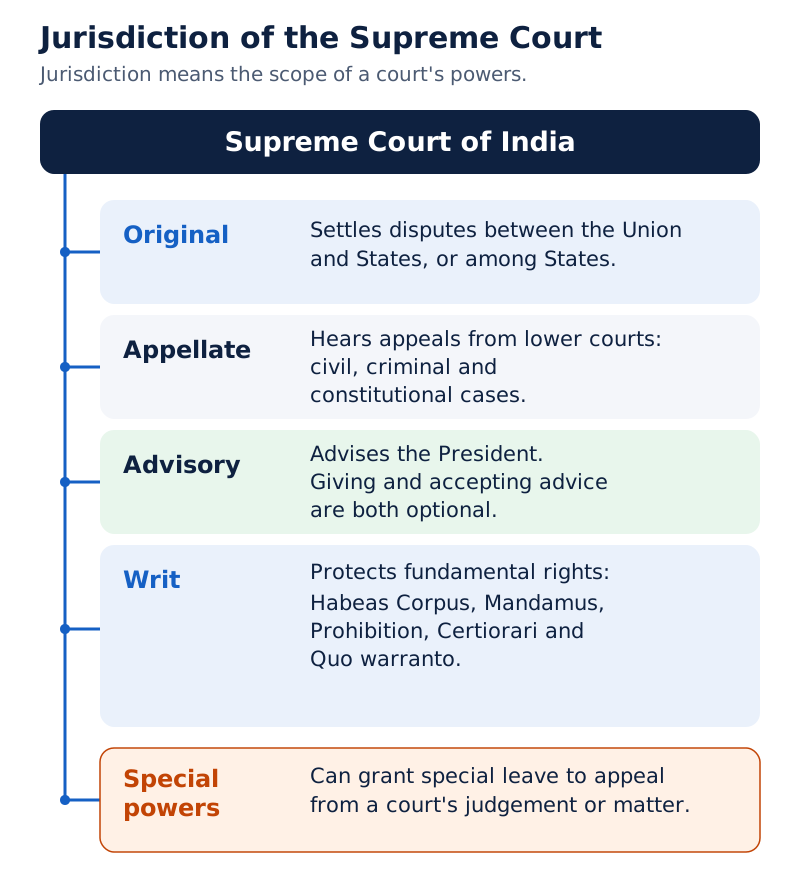
A central circle connects to boxes labelled Original, Appellate, Advisory and Writ. A separate box at the bottom describes Special Powers to grant special leave to appeal.
Drawn by One Young India. Reference: NCERT Class 11, page 131, unnumbered
How do writs and judicial review protect rights?
Which constitutional provisions matter?
The Constitution gives courts powers to restore rights and examine laws. A writ can direct action to remedy a violation. Judicial review examines whether a law conforms to the Constitution; an inconsistent law can be declared unconstitutional and inapplicable.
| Article | Power or requirement |
|---|---|
| Article 32 | The Supreme Court can issue writs to restore fundamental rights. |
| Article 226 | High Courts also have power to issue such writs. |
| Article 13 | The Supreme Court can declare a law violating fundamental rights unconstitutional and non-operational. |
| Article 137 | The Supreme Court has power to review its own judgements and orders. |
| Article 144 | All civil and judicial authorities in India must act in aid of the Supreme Court. |
Article 32 and Article 226 concern writ remedies. Article 13 supports protection against unconstitutional laws. Together, writs and review make courts protectors of rights and interpreters of the Constitution, while performing different kinds of legal work.
Article 137 concerns reconsideration of the Supreme Court's own decisions. This differs from testing a law's constitutionality. Supreme Court decisions bind other courts, its orders are enforceable across India, and it decides cases involving contempt of itself.
What can judicial review examine?
Perhaps the most important Supreme Court power is judicial review. The term is not expressly mentioned in the Constitution. However, a written Constitution and the power to strike down laws violating fundamental rights implicitly provide this authority. High Courts also exercise judicial review.
Review also protects the constitutional distribution of powers. Suppose the Union makes a law on a subject that some States consider part of the State list, the allocation of subjects to State law-making. The States can challenge the law before the Supreme Court.
If the Court agrees with the States, it declares the law unconstitutional. Review therefore covers violations of fundamental rights and violations of the federal distribution of powers. It extends to laws passed by State legislatures as well as those passed by Parliament.
How did public interest litigation encourage judicial activism?
How did access to courts change?
Public Interest Litigation (PIL), also called Social Action Litigation (SAL), allows public-spirited persons or organisations to seek judicial protection for others. It became the chief instrument of judicial activism, the judiciary's active intervention to protect rights and address public concerns.
In the normal course, a person approaches a court because that person is directly involved in a dispute or has suffered a rights violation. Around 1979, courts began hearing cases brought by others on behalf of affected people.
The Supreme Court also began considering matters through newspaper reports and postal complaints. Public-spirited citizens and voluntary organisations sought protection of rights, improvements in poor people's living conditions and environmental protection. PIL became the most important vehicle of judicial activism.
| Case and year | What happened | Significance |
|---|---|---|
| Hussainara Khatoon vs. Bihar, 1979 | Newspaper reports described Bihar prisoners awaiting trial whose imprisonment exceeded the possible punishment for their alleged offences. An advocate petitioned the Court. | The Court heard the petition, making it one of the early PILs. |
| Sunil Batra vs. Delhi Administration, 1980 | A Tihar inmate sent Justice Krishna Iyer a scribbled account of prisoners' physical torture. The judge converted it into a petition. | It pioneered PIL, although the Court later abandoned the practice of considering letters. |
| Bandhua Mukti Morcha vs. Union of India, 1984 | Justice Bhagwati stressed that poor people's problems required a different judicial approach. | Blindly following the adversarial procedure would prevent them from enforcing fundamental rights. |
Undertrials are prisoners awaiting trial rather than serving a sentence after conviction. The Bihar example connects their inability to obtain timely justice with the importance of allowing others to act for them. Access depends on more than the formal existence of rights.
The adversarial procedure is the ordinary contest between opposing sides in a case. Justice Bhagwati's argument was that the poor faced qualitatively different problems. He argued that if courts blindly followed the adversarial procedure in cases involving the poor, they would never be able to enforce their fundamental rights.
What benefits and limitations follow from judicial activism?
How has activism widened protection?
Through PIL, courts expanded the idea of rights to include clean air, unpolluted water and decent living for society. Individuals could seek justice when these rights were violated. Public-spirited citizens, lawyers and social organisations could act for the needy and deprived.
This helped courts consider violations affecting people unable easily to approach them. Examples included police blinding of jail inmates, inhuman working conditions in stone quarries and sexual exploitation of children. The right against exploitation prohibits forced labour, trafficking in people and children's employment in hazardous work.
Judicial activism has democratised access by opening courts to groups as well as individuals and has forced executive accountability. It has also made an attempt to make elections much more free and fair.
Courts required election candidates to file affidavits, written statements confirmed by oath or affirmation, about assets, income and educational qualifications. This enabled voters to choose representatives with more accurate knowledge. It should not be mistaken for a claim that all electoral problems were solved.
Why can activism create tension?
Large numbers of PILs have overburdened courts. Activism has also blurred distinctions between the judiciary and the executive and legislature. Reducing air or sound pollution, investigating corruption and carrying out electoral reform are matters for administration under legislative supervision.
Some people feel that activism has made the balance among the three organs very delicate. It may be creating strains on the democratic principle that each organ should respect the others' powers and jurisdiction. These are concerns about limits, not a denial of rights protection.
A public-interest exercise illustrates the tension: citizens seek removal of slums to beautify a city and attract investors, while residents argue that removal threatens their right to life. Their competing claims require examination; describing a request as public interest does not settle it.
Comparable activism exists in many courts, particularly in South Asia and Africa. South Africa's bill of rights incorporates PIL: citizens have a fundamental right to bring violations of other people's rights before its Constitutional Court.
Why have Parliament and the judiciary come into conflict?
How do checks and balances work?
Limited separation of powers gives each organ a distinct area of work. Checks and balances prevent power from becoming unlimited: Parliament makes laws and amends the Constitution, the executive implements them, and the judiciary settles disputes and tests laws against constitutional provisions.
Judicial activity has extended to powers of the President and Governors previously considered outside review. Courts also directed the investigative agency CBI to investigate politicians and officials in the hawala case, the Narasimha Rao case and the illegal allotment of petrol pumps case.
Early conflict concerned the right to property. Parliament sought restrictions to implement land reforms. Courts held that Parliament could not restrict fundamental rights in this way and then held that constitutional amendment could not abridge a fundamental right either.
From 1967 to 1973, disputes became serious. They involved land reforms, preventive detention, job reservations, acquisition of private property for public purposes and compensation. Preventive detention means detention aimed at preventing anticipated activity; acquisition means taking private property for a public purpose.
What did Kesavananda Bharati decide?
In the Kesavananda Bharati case, 1973, the Supreme Court ruled that nobody, including Parliament acting through amendment, could violate the Constitution's basic structure, its foundational features. The Court reserved the authority to determine which matters form part of that structure.
The Court also held that the disputed right to property did not belong to the basic structure and could be suitably abridged. This case is perhaps the best example of judicial interpretation of the Constitution. Removal of property from fundamental rights in 1979 also changed institutional relations.
Questions remain about judicial protection against punishment for breach of parliamentary privileges, the legislature's special powers to protect its functioning, and against legislative discipline of members. The legislature regulates itself; judicial intervention can therefore create disputes about institutional authority.
On 23 November 1949, Alladi Krishnaswami Ayyar emphasised that judicial independence must not turn courts into a super-legislature or super-executive. The continuing lesson is that both Parliament and the judiciary must function within constitutional limits and respect one another's authority.
How do environmental cases show the interaction of courts and government?
What happened in Dahanu?
A report dated 24 March 2005 described a Supreme Court order for Reliance Energy to pay ₹300 crore to chikoo farmers in Dahanu, 150 km from Mumbai, following their petition against pollution from a thermal power plant.
The plant began operating in 1989; the next year brought the area's first crop failure. The report described the loss of 70 per cent of the crop, closed fisheries and reduced forest cover. Farmers and environmentalists attributed pollution of groundwater and the ecosystem to fly ash.
The Dahanu Taluka Environment Protection Authority ordered a pollution-control unit to reduce sulphur emissions. Despite Supreme Court backing, it had not been installed by 2002. Reliance acquired the station in 2003 and resubmitted an installation schedule in 2004.
The authority also requested a bank guarantee, a financial assurance, of ₹300 crore because installation of the pollution-control unit remained incomplete.
What did the Delhi fuel dispute reveal?
A report dated 23 September 2001 described cooperation between the Centre and Delhi Government over CNG, compressed natural gas used as vehicle fuel. They sought a dual-fuel policy, meaning permission for more than one fuel, rather than dependence on CNG alone.
They proposed 0.05 per cent low-sulphur diesel for buses and permission for commercial vehicles meeting Euro-II, the vehicle-emission standard named in their proposal. Separate affidavits would contain common points. Delhi Chief Minister Sheila Dikshit met Union Petroleum and Natural Gas Minister Ram Naik.
Dikshit sought more time to convert the 10,000-odd buses. A committee under Dr R. A. Mashelkar was expected to report on an Auto Fuel Policy within six months. The governments raised queues, fuel requirements and vulnerability to disruption of pipeline supplies.
The Court had refused to relax the CNG-only rule for buses but said it had never insisted on CNG for taxis and auto-rickshaws. The example distinguishes judicial directions from the executive's responsibility to work out policy and implementation arrangements.
How do legal services make access to justice practical?
What support do legal services authorities provide?
The National Legal Services Authority (NALSA) is the national-level institution shown in the Legal Services Day poster dated 09-11-2018. The poster connects protection of legal rights with practical help for people who may otherwise struggle to use the justice system.
Its listed aims include free legal aid and advice, legal awareness, Lok Adalats, settlement of disputes through alternative methods, and compensation for victims of crime. Lok Adalats are forums for resolving disputes; alternative dispute resolution means methods of settling disputes outside ordinary court litigation.
Free legal services cover matters before civil, criminal and revenue courts, tribunals and other bodies exercising judicial or quasi-judicial functions. Tribunals are adjudicating bodies, and quasi-judicial functions involve deciding matters through powers resembling those exercised by courts.
Who can seek these services?
The poster lists women and children, members of Scheduled Castes or Scheduled Tribes, industrial workmen, persons with disabilities, people in custody and victims of human trafficking or begar, meaning forced labour. It also lists victims of natural disasters, ethnic or caste violence, and industrial disaster.
Another category is persons with annual income below ₹1,00,000, or the amount notified by the Central or State Government. This is the criterion displayed in the 2018 poster, including its qualification about notified amounts.
The listed institutions operate at national, State, district, taluk or subdivision, High Court and Supreme Court levels. They include legal services authorities and committees. The poster directs people seeking help towards the nearest legal services institution and front-office assistance.
Note: The Legal Services Day poster places aims, eligibility and institutions in three columns beneath a commitment to protecting legal rights. It complements PIL by showing organised assistance through which people can seek access to justice.
Glossary
- Rule of law — The principle that all individuals are subject to the same law, irrespective of wealth, gender or caste.
- Judicial independence — Freedom of courts from interference that prevents judges from deciding cases without fear or favour.
- Security of tenure — Protection of a judge's period in office through retirement provisions and a difficult removal procedure.
- Collegiality — Collective recommendations for judicial appointments made through consultation between the Chief Justice and senior judges.
- Integrated judiciary — A connected court system in which lower courts function under higher courts and Supreme Court decisions bind all courts.
- Jurisdiction — The scope of powers within which a court can consider and decide matters.
- Original jurisdiction — Power to hear cases directly, including the Supreme Court's exclusive authority over specified federal disputes.
- Writ — A special court order through which courts can provide remedies for violations of fundamental rights.
- Appellate jurisdiction — Authority to reconsider decisions and legal issues arising from cases decided by lower courts.
- Advisory jurisdiction — The Supreme Court's power to advise the President on public importance or constitutional interpretation without compulsory acceptance.
- Judicial review — Power to examine a law's constitutionality and declare it inapplicable if inconsistent with the Constitution.
- Public Interest Litigation — Proceedings through which public-spirited persons or organisations seek judicial intervention to protect others' rights and public interests.
- Judicial activism — An active judicial role in addressing rights violations, public concerns and accountability through expanded access and intervention.
- Basic structure — Foundational features of the Constitution that Parliament cannot violate even through a constitutional amendment.
- Undertrials — Prisoners awaiting trial whose position differs from that of people serving sentences after conviction.
Common errors and misconceptions
- Misconception: An independent judiciary is accountable to nobody. Correct: It remains accountable to the Constitution, democratic traditions and the people.
- Misconception: Excluding Parliament from appointments eliminates political controversy. Correct: Appointments remain politically significant because judges' views affect constitutional interpretation.
- Misconception: Two-thirds of those present and voting is sufficient to remove a judge. Correct: The required majority of total membership must also support the motion in each House.
- Misconception: A single integrated judiciary means that High Courts do not exist. Correct: High Courts and lower courts form parts of the connected judicial hierarchy.
- Misconception: Only the Supreme Court can issue writs. Correct: High Courts also issue writs; a person whose fundamental right is violated can approach either court.
- Misconception: Supreme Court advice must be given and accepted. Correct: Giving advice under advisory jurisdiction and accepting it are both optional.
- Misconception: PIL requires the affected person to file every case personally. Correct: Public-spirited persons and organisations can seek protection on behalf of others.
- Misconception: Parliament can change every constitutional feature without restriction. Correct: The Kesavananda Bharati ruling prevents amendments that violate the basic structure.
Exam-style questions with model answers
Q1. Courts must decide without interference from the executive or legislature, but remain accountable to the Constitution, democratic traditions and the people. Using these facts, distinguish judicial independence from absence of accountability. [2 marks]
- Judicial independence protects courts from interference so that judges can decide cases without fear or favour.
- It does not remove accountability: judges remain responsible to the Constitution, democratic traditions and the people.
Q2. Removal requires two-thirds of members present and voting and a majority of total membership in each House. The motion against Justice V. Ramaswami obtained the first majority but lacked the second because Congress members abstained. Explain the outcome in three points. [3 marks]
- The motion secured the required two-thirds majority among members present and voting, so it met that part of the special-majority requirement.
- Congress members abstained, and the motion failed to secure the necessary majority of the House's total membership, which was a separate requirement.
- Ramaswami was therefore not removed. Support among voting members alone could not replace the full special majority needed for a successful removal motion.
Q3. Original jurisdiction covers direct federal disputes; writ jurisdiction remedies violations of fundamental rights; appellate jurisdiction reconsiders lower-court decisions; advisory jurisdiction provides advice requested by the President. Classify: a Bihar-Union dispute, a direct rights petition, an appeal against a High Court ruling, and a presidential request for constitutional advice. [4 marks]
- The Bihar-Union dispute falls under original jurisdiction because it concerns federal relations and can be brought directly before the Supreme Court.
- The direct petition seeking protection of a fundamental right falls under writ jurisdiction, through which special orders can remedy rights violations.
- The challenge to a High Court ruling falls under appellate jurisdiction because it asks the Supreme Court to reconsider a lower-court decision.
- The President's request falls under advisory jurisdiction because it seeks advice about constitutional interpretation rather than a decision on an appeal.
Q4. Article 32 enables Supreme Court writs; Article 226 enables High Court writs; Article 13 supports declaring rights-violating laws unconstitutional; Article 137 permits review of Supreme Court decisions; Article 144 requires authorities to aid that Court. Explain these five provisions, distinguishing review of laws from review of judgements. [5 marks]
- Article 32 allows the Supreme Court to issue writs that remedy fundamental-rights violations. It provides an individual with a means of seeking constitutional protection.
- Article 226 gives High Courts power to issue such writs too. Protection of fundamental rights through writs is therefore available through more than one judicial level.
- Article 13 concerns unconstitutional laws violating fundamental rights. Judicial review tests the law itself and can make that law non-operational when it conflicts with the Constitution.
- Article 137 permits the Supreme Court to reconsider its own judgement or order. This concerns an earlier judicial decision, rather than the constitutionality of legislation.
- Article 144 requires civil and judicial authorities to aid the Supreme Court. It supports the Court's authority and the enforcement of its orders throughout India.
Q5. In 1979, an advocate petitioned after reports showed Bihar undertrials jailed longer than their possible punishments. In 1980, Justice Krishna Iyer converted a Tihar inmate's account of torture into a petition; the Court later abandoned considering letters. Explain three ways these examples clarify PIL. [3 marks]
- The Bihar example shows that an advocate could seek justice for prisoners rather than requiring each affected prisoner to bring the case personally.
- The Tihar example shows a court responding to a prisoner's account of torture by converting the communication into a petition about rights protection.
- The later abandonment of considering letters limits the conclusion: the example explains an early approach to PIL, not a permanent guarantee that every letter becomes a petition.
Q6. Judicial activism widened access for groups and the deprived, expanded attention to clean air and water, forced executive accountability and required election candidates' asset, income and education declarations. Large numbers of PILs overburdened courts and blurred institutional boundaries. Explain four benefits and two limitations. [6 marks]
- Wider access enabled groups and deprived people to obtain judicial attention through others acting on their behalf, making the judicial system more accessible.
- Attention to clean air and unpolluted water broadened the protection of rights to concerns affecting society, rather than limiting attention to isolated private disputes.
- Judicial intervention forced executive accountability by requiring the administration to respond to concerns brought before courts instead of leaving those concerns without scrutiny.
- Declarations of candidates' assets, income and educational qualifications gave voters information for choosing representatives, contributing to an attempt to make elections more free and fair.
- The large number of public-interest cases overburdened courts, adding to their work and creating a limitation on the expansion of judicial intervention.
- Intervention in administrative or legislative matters blurred institutional boundaries. This may strain the principle that each democratic organ should respect the powers of the others.
Q7. The 1973 Kesavananda Bharati ruling held that Parliament cannot violate the Constitution's basic structure through amendment, that property was not part of that structure, and that the Court would decide which matters belonged to it. Explain the significance of each finding. [3 marks]
- Parliament's amendment power has a constitutional limit: even an amendment cannot validly destroy or violate the basic structure identified in the ruling.
- Because the right to property was not part of that structure, it could be suitably abridged, changing the basis of the earlier institutional conflict.
- The Court retained authority to determine which matters form part of the basic structure, giving constitutional interpretation a continuing role in relations between Parliament and the judiciary.
Q8. A 23 September 2001 report says the Centre and Delhi Government sought more time to convert 10,000-odd buses to CNG and proposed 0.05 per cent low-sulphur diesel as an alternative. They feared pipeline disruption. The Supreme Court maintained CNG-only buses but said it had never required CNG for taxis or auto-rickshaws. Identify the governments, their implementation concern, their fuel-security concern and the scope of the Court's direction. [4 marks]
- The governments were the Union government, referred to as the Centre, and the Delhi Government. They coordinated their approach to the Supreme Court.
- The implementation concern was the time required to convert the 10,000-odd bus fleet to CNG within the prescribed period, prompting a request for an extension.
- The fuel-security concern was dependence on pipeline supplies. Disruption could affect public transport, supporting their proposal for low-sulphur diesel as an alternative fuel.
- The Court maintained the CNG-only requirement for buses, while clarifying that it had never insisted on CNG for taxis and auto-rickshaws.
Key takeaways
- Judicial independence protects impartial decision-making while retaining accountability to the Constitution, democratic traditions and the people.
- Security of tenure, financial safeguards and a difficult removal procedure help judges work without fear or favour.
- India's integrated judicial hierarchy connects the Supreme Court, High Courts, District Courts and Subordinate Courts.
- Original, writ, appellate and advisory jurisdictions give the Supreme Court different routes for exercising constitutionally limited powers.
- Judicial review can invalidate laws that violate fundamental rights or the constitutional distribution of legislative powers.
- PIL enables people and organisations to seek judicial protection for others, especially those unable easily to approach courts.
- Judicial activism has widened rights protection and accountability, but court workloads and institutional boundaries remain concerns.
- The basic-structure principle limits constitutional amendment and makes mutual respect between Parliament and the judiciary essential.
Test yourself
Why should judicial appointments depend on legal competence rather than political loyalty?
Judges must interpret and apply law without fear or favour. Political loyalty should not determine appointments because courts need independence from political pressure.
How many senior judges does the Chief Justice consult when recommending appointments in the collegial procedure?
The Chief Justice consults the four senior-most Supreme Court judges, making recommendations a collective process.
What two grounds can justify removal of a Supreme Court or High Court judge?
The grounds are proven misbehaviour or incapacity, with the required special majority in both Houses of Parliament.
Can a High Court hear an original dispute between the Union and a State?
No. Such federal disputes fall within the Supreme Court's exclusive original jurisdiction.
Why can optional advisory jurisdiction still be useful?
It provides legal opinion before government action, may prevent unnecessary litigation and can guide changes to proposed actions or legislation.
What distinguishes a writ remedy from judicial review of a law?
A writ is a special order providing a remedy; judicial review tests whether a law conforms to the Constitution and can make an inconsistent law inapplicable.
What happened to the Court's practice of considering letters after early cases such as Sunil Batra?
Although a prisoner's communication became a petition in that case, the Court later abandoned the practice of considering letters.
Who decides whether a matter belongs to the Constitution's basic structure?
In the Kesavananda Bharati ruling, the Supreme Court reserved that interpretative authority to itself.