
The Philosophy of the Constitution | CBSE Class 11 Political Science Notes
On this page
This note covers constitutional values, democratic transformation, the Constituent Assembly debates, individual freedom, social justice, community rights, secularism, universal franchise, federalism, national identity, procedural achievements, criticisms and limitations of the Indian Constitution.
What does the philosophy of the Constitution mean?
The philosophy of the Constitution is the moral vision underlying its laws, values and institutional arrangements. A Constitution is more than a collection of legal rules. Understanding it involves asking what kind of society its provisions seek to create and why those objectives deserve support.
Not all laws have a moral content, but many connect closely with deeply held values. A law prohibiting discrimination on grounds of language or religion expresses equality, the idea that such differences should not justify unequal treatment.
How does a political philosophy approach work?
A political philosophy approach examines constitutional concepts, relates them to a coherent social and political vision, and justifies the values involved. Its three connected tasks are:
- Clarify concepts: examine the possible meanings of constitutional terms rather than assuming that their meanings are obvious.
- Connect ideals: work out a coherent vision of society and political life from an interpretation of those concepts.
- Justify values: read the Constitution together with the debates of the Constituent Assembly, the body that framed it, to understand the reasons behind its choices.
A value is not fully examined merely by naming it. We must ask why the framers selected it. Many of their reasons may not have been fully explained, so philosophical understanding also involves bringing underlying reasons into clearer view.
Why do competing interpretations matter?
Constitutional ideals are debated in legislatures, political parties, the press, schools and universities. Sometimes they are deliberately manipulated for short-term partisan interests. Different institutions may also interpret the same ideal differently.
The Constitution has considerable authority and can help arbitrate, or settle, conflicts between interpretations. A political philosophy approach is needed to evaluate its moral claims and possibly use them in such disputes. It also asks whether public practice has become disconnected from constitutional ideals.
Definition: Constitutional philosophy connects the meaning of constitutional values with the reasons for accepting them and the social vision they express.
How can a Constitution bring democratic transformation?
A Constitution restricts the exercise of power. Modern states are excessively powerful and are believed to have a monopoly over force and coercion, meaning the use of force or compulsion. Institutions established for public safety can turn against people if that power is abused.
Experience shows that most states are prone to harming the interests of at least some individuals and groups. Constitutional rules continuously check this tendency and prevent government from becoming tyrannical, or oppressive in its use of power.
How does restraint connect with empowerment?
Constitutions also provide peaceful, democratic means of social transformation, or change in social relationships and structures. They can empower vulnerable people who have traditionally been deprived of power and enable them to pursue the collective good.
For people emerging from colonial rule, constitution-making expresses political self-determination: deciding their own political arrangements without external interference. Nehru argued that only a Constituent Assembly of elected Indian representatives had the right to frame India's Constitution.
He saw the Assembly as a nation remaking its political and possibly social structure. The Indian Constitution was designed to break traditional social hierarchies, or arrangements that rank groups unequally, and begin an era of freedom, equality and justice.
| Constitutional purpose | What it makes possible |
|---|---|
| Restriction of power | Basic rules check the state's tendency to harm individuals and groups. |
| Democratic transformation | Peaceful methods enable social change and the empowerment of vulnerable people. |
| Self-determination | A formerly colonised people chooses its own political arrangements. |
What does Japan's example show?
The Japanese Constitution of 1947 is popularly called the peace constitution. Its preamble, the introductory statement of its vision, expresses a desire for lasting peace. This illustrates how the circumstances of constitution-making shape constitutional ideals.
Article 9, a numbered constitutional provision, renounces war as a sovereign right and the threat or use of force to settle international disputes. Its second paragraph provides that land, sea and air forces, and other war potential, will not be maintained to achieve this aim.
Why should we revisit the Constituent Assembly debates?
The Constituent Assembly debates reveal the intentions, concerns and arguments behind constitutional arrangements. Revisiting them helps recover the purposes of practices that may now be taken for granted. This is especially important when those practices are challenged.
Does studying the past mean ignoring change?
The American Constitution was written in the late eighteenth century. Applying that era's values and standards directly to the twenty-first century would be absurd. In India, however, the world of the original framers and our present world may not have changed so drastically.
Our values, ideals and conceptions have not separated us from the world of the Assembly. In this sense, constitutional history remains connected to the present. The debates can explain why constitutional practices matter without requiring us to deny changed circumstances.
When practices work smoothly, forgetting their underlying reasons may be harmless. When they are threatened, neglect of those principles can be harmful. Understanding present practices may require returning to the debates and perhaps even further back to the colonial era.
What kind of vision emerges?
The Indian Constitution resists a single label. It is liberal, protecting individual freedom; democratic, committed to rule based on people's participation; and egalitarian, committed to equality. It also accommodates communities, protects disadvantaged groups and seeks a common national identity.
Its vision combines freedom, equality, social justice, meaning action against entrenched social injustice, and some form of national unity. The method matters too: there is a clear emphasis on peaceful and democratic measures for putting these commitments into practice.
Cartoon: Democracy as umpire (NCERT Class 11, p. 225, unnumbered cartoon). Shankar's cartoon shows a cricket game with figures labelled “CAPITALISM”, “BLACK MARKET” and “PROVINCIALISM”. The umpire in the foreground has “DEMOCRACY” written on his coat. There are no speech bubbles. Caption: “While all ideas unfold on this playfield, democracy is the ‘Umpire’.” The cartoon is dated 26 January 1950.
The cricket image connects different ideas with a shared democratic setting. The constitutional vision allows disagreement while maintaining a common basis on which political activity can proceed.
How does the Constitution connect individual freedom with social justice?
Individual freedom protects a person's liberty, including expression, freedom from arbitrary arrest and freedom of conscience. Arbitrary arrest means arrest without a proper basis; freedom of conscience concerns an individual's convictions. These freedoms give the Constitution a strong liberal character.
How did the demand for liberty develop?
This commitment grew from continuous intellectual and political activity over well over a century. At the beginning of the nineteenth century, Rammohan Roy opposed British restrictions on press freedom. He argued that a responsive state must let individuals communicate their needs through publication.
The demand for a free press continued throughout British rule. The national movement also strongly opposed the Rowlatt Act, which sought to deny freedom from arbitrary arrest. For over forty years before constitutional adoption, every Congress resolution, scheme, bill and report treated individual rights as non-negotiable.
Why was formal equality insufficient?
Social justice involves addressing entrenched social injustices rather than merely declaring equal rights. Classical western liberalism privileges individual rights over social justice and community values. Indian constitutional liberalism linked freedom with social justice and openly acknowledged the value of communities.
Merely granting equality could not overcome the age-old injustices suffered by Scheduled Castes and Scheduled Tribes, the historically disadvantaged groups discussed here, or give real meaning to their vote. Special measures were needed to advance their interests.
Reservations are special provisions setting aside opportunities for these groups. The Constitution provided reserved legislative seats and made reservation of public sector jobs possible. These measures connect equal citizenship with action against inherited disadvantage.
Affirmative action means special measures to advance disadvantaged groups. In the United States, affirmative action programmes began after the Civil Rights Act, 1964, almost two decades after such measures were constitutionally entrenched in India.
| Constitutional concern | Illustration |
|---|---|
| Individual liberty | Expression, conscience and protection from arbitrary arrest. |
| Social justice | Reservations for Scheduled Castes and Scheduled Tribes. |
| Liberty alongside justice | Advancing disadvantaged groups without compromising individual liberties. |
In In Defence of Liberalism (1962), K. M. Panikkar distinguished Roy's emphasis on individual rights, particularly women's rights, from another stream. K. C. Sen, Justice Ranade and Swami Vivekananda introduced social justice within orthodox Hinduism; for Vivekananda, liberal principles were necessary to reorder Hindu society.
Why are diversity and minority rights important?
The Constitution encourages equal respect between communities. Achieving this is difficult because communities tend to have hierarchical relationships, as with caste, and, when they see one another as equals, they also tend to become rivals, as with religious communities.
The challenge was to make communities liberal in their approach and encourage mutual respect under conditions of inequality or intense rivalry. Simply refusing to recognise communities, as most western liberal constitutions do, would have been unworkable and undesirable in India.
How are people connected with communities?
A cultural community shares values, traditions, customs and language. Individuals everywhere belong to such communities. People in France and Germany, for example, are deeply attached to their linguistic communities. Community attachment is therefore not something unique to Indians.
India differs by acknowledging the value of communities more openly and by containing multiple linguistic and religious communities. It was important to prevent any one community from systematically dominating others. This required recognition of community-based rights, rights held by communities rather than individuals alone.
Minority rights protect the interests and cultural life of religious and linguistic minorities. Recognising group rights allows cultural particularity, meaning a community's distinctive cultural identity, to find expression. This commitment was made against a background of conflict between communities.
What is the educational example?
Religious communities have the right to establish and run their own educational institutions. These institutions may receive government money. Religion is therefore not treated merely as a private matter concerning an isolated individual.
A person's freedom and self-respect depend directly on the status of their community. Domination of one community by another makes its members significantly less free. Equal relations between communities support individual dignity, self-respect and freedom.
This concern anticipates multiculturalism, the recognition of different cultural communities and their rights. Respect for communities is connected to individual freedom rather than being a reason to neglect it.
How does Indian secularism differ from strict separation?
Secularism concerns the relationship between religion and the state in protecting freedom and equality. Although the word was not initially mentioned, the Indian Constitution has always been secular. Its approach differs from the prevalent western conception of strict separation.
What does mutual exclusion mean?
Mutual exclusion means that religion and the state stay out of one another's internal affairs. The state does not interfere in religion, and religion does not dictate state policy or conduct. The state should neither help nor hinder religious organisations.
The purpose is to protect individual freedom. State support can make religious organisations powerful enough to control individuals' religious lives. Yet state directions about how religious organisations should manage themselves can also threaten religious freedom. Strict separation seeks to avoid both dangers.
Why did India adopt a different relationship?
Two considerations shaped the Indian approach. First, equality between communities matters alongside equality between individuals. Freedom of religion therefore belongs to individuals and communities, including their right to establish and maintain educational institutions.
Second, some religiously sanctioned customs, such as untouchability, denied basic dignity and self-respect. These practices were so deeply rooted and widespread that active state intervention was necessary to dissolve them. Separation could not therefore mean complete non-interference.
Intervention need not be negative. The state may also help religious communities by aiding their educational institutions. Whether it helps, restrains or stays apart depends on which action promotes freedom, equality and social justice.
Definition: Principled distance allows the state to remain distant from all religions while intervening or abstaining according to which better promotes liberty, equality and social justice.
| Aspect | Prevalent western conception | Indian approach |
|---|---|---|
| State and religion | Strict separation through mutual exclusion. | Separation through principled distance. |
| Religious organisations | The state should neither help nor hinder them. | Help or restraint is possible according to constitutional values. |
| Religious freedom | Separation safeguards individual freedom. | Freedom belongs to individuals and communities. |
| Illustration | Avoid state support that strengthens religious control over individuals. | Intervene against untouchability or aid community educational institutions. |
Note: Principled distance does not mean that the state can act according to religious favouritism. The reason for intervention or abstention is the promotion of liberty, equality and social justice.
Why was universal franchise a significant achievement?
Universal adult franchise, also called adult suffrage, means voting rights for all adults. The constitutional commitment was significant in a society where traditional hierarchies were widely believed to be fixed and more or less impossible to eliminate.
It was also significant because stable western democracies had only recently extended voting rights to women and the working class. India's commitment expressed confidence that democratic self-government should rest on the will of every member of society.
How did nationalism support the right to vote?
Once the idea of a nation took root among the elite, democratic self-government followed. Indian nationalism, the movement and commitment to an Indian national political community, conceived a political order based on everyone's will. Universal franchise belonged within this understanding.
| Document or statement | Contribution to political participation |
|---|---|
| Constitution of India Bill, 1895 | The first non-official constitutional drafting attempt declared that every citizen, understood there as anyone born in India, could participate in the country's affairs and enter public office. |
| Motilal Nehru Report, 1928 | Reaffirmed this conception of citizenship and voting entitlement for every person of either sex who had attained twenty-one. |
| Alladi Krishnaswami Ayyar, 23 November 1949 | Explained adult franchise through faith in the common person, democratic rule and the promotion of well-being. |
The age of twenty-one belongs here to the proposal in the 1928 report. Its importance is the report's inclusion of both sexes in political participation and its recognition of voting as an expression of national will.
From very early on, universal franchise was regarded as the most important and legitimate instrument for expressing that will. The Assembly's acceptance therefore carried forward a major commitment of the national movement, rather than appearing suddenly during constitutional drafting.
How do federalism and national identity accommodate diversity?
Federalism concerns the relationship between the central government and the constituent units of a federation. India's Constitution created a strong centre, but also allowed differences in the legal status and powers of units to meet their particular needs.
What is asymmetric federalism?
Asymmetric federalism means that units within the same federation can have constitutionally recognised differences in status and powers. This differs from the constitutional symmetry of American federalism. A strong centre does not remove these special relationships within India's constitutional design.
The provisions associated with Article 371 illustrate this approach to the North-East. Under Article 371A, Nagaland received special status: recognition of pre-existing laws and protection of local identity through restrictions on immigration. Many other States also benefit from special provisions.
The comparison involving Articles 370 and 371 concerns attention to the requirements of particular regions. The underlying principle is that differential treatment within a federation can respond to specific needs rather than violate the constitutional commitment to equality.
India became a multilingual federation, politically recognising major linguistic groups and treating them as equals, although this was not originally envisaged. Democratic and linguistic federalism combines national unity with cultural recognition. A fairly robust political arena permits multiple identities to complement one another.
Why were separate electorates rejected?
National identity, a shared sense of belonging to the nation, can coexist with regional, religious and linguistic identities. The Constitution sought a balance, although it preferred common identity under certain conditions.
Separate electorates organise electoral representation through distinct religious communities. They were rejected because they endangered a healthy national life, rather than simply because they preserved religious differences or threatened a simple idea of unity.
The aim was fraternity, a sense of shared belonging, rather than forced unity. This was dear to Dr. Ambedkar. In the Assembly on 25 May 1949, Sardar Patel expressed the long-term objective of evolving one community.
Diagram
Unity with diverse identities
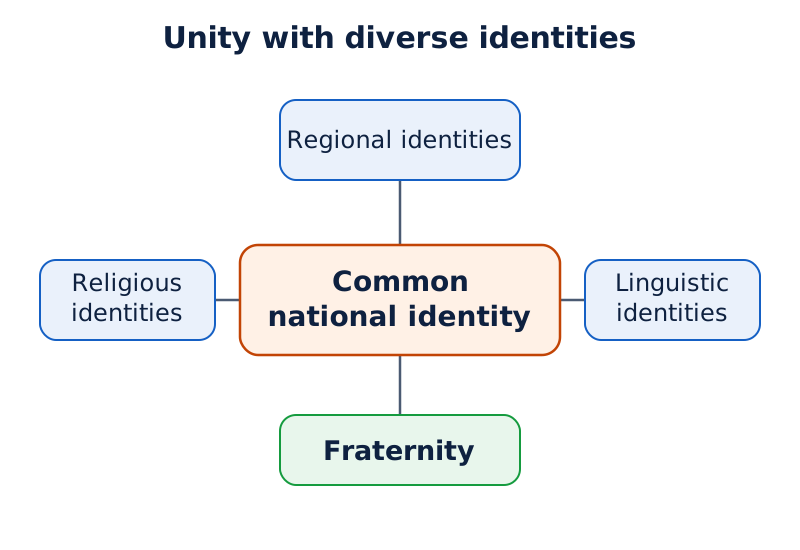
Draw a central box labelled “Common national identity”. Connect it to boxes labelled “Regional identities”, “Religious identities” and “Linguistic identities”. Add “Fraternity” beneath the centre to show the desired basis of shared national life.
Drawn by One Young India.
What are the Constitution's substantive and procedural achievements?
Substantive achievements concern the values and arrangements secured by the Constitution. Five core achievements are liberal individualism, social justice, group rights, universal franchise and asymmetric federalism. Liberal individualism emphasises a person's freedom and autonomy, meaning their ability to direct their own life.
These achievements matter in their social context. Community values are often indifferent or hostile to individual autonomy. Caste disadvantage requires action for justice, while conflict between communities makes the recognition of group rights especially important.
Procedural achievements concern the way constitutional decisions were reached. The Constitution reflects faith in deliberation and a spirit of compromise and accommodation. Its significance therefore lies both in its commitments and in the methods used to agree on them.
What makes deliberation valuable?
Political deliberation is discussion in which people justify their positions through reasons and remain willing to modify their preferences. Many groups and interests were not adequately represented in the Assembly. Nevertheless, its debates show an effort to be as inclusive as possible.
Reasoned discussion recognises creative value in difference and disagreement. Outcomes are justified by reasons rather than merely by self-interest. This openness is itself an achievement, even though the composition of the Assembly had limitations.
When is compromise defensible?
Compromise and accommodation involve adjusting competing claims so that important values can be secured together. Giving up a value for mere self-interest is objectionable. Partially trading one value for another through free deliberation among equals can be morally defensible.
- Bring differing interests and opinions into an inclusive discussion.
- Give reasons for proposals rather than relying only on self-interest.
- Remain willing to revise preferences and acknowledge value in disagreement.
- Seek agreement that accommodates important values, aiming at consensus on the most important issues.
Consensus means reaching agreement rather than settling the issue merely through a majority vote. The commitment to consensual decisions on the most important matters is morally commendable. Securing something of several important values need not be blameworthy because no single value is secured completely.
How strong are the criticisms that the Constitution is unwieldy and unrepresentative?
The Constitution is criticised as unwieldy, meaning excessively large or difficult to manage, and unrepresentative, meaning insufficiently reflective of the people. Both criticisms require distinctions rather than simple acceptance or rejection.
Must a Constitution fit into a compact document?
The size criticism assumes that a country's entire Constitution must be contained in one compact text. Even the United States has other written documents with constitutional status and important constitutional practices outside its compact constitutional document.
India includes many such details and practices within a single document, making it somewhat large. Provisions concerning the election commission and civil service commission illustrate matters that many countries do not include in their principal constitutional document.
How do voice and opinion differ?
Adult franchise had not yet been granted when the Assembly was formed, and most members came from advanced sections of society. Restricted franchise means that voting participation is limited rather than universal. Selection on this basis creates a real problem of representation.
| Dimension of representation | Meaning | Assessment of the Assembly |
|---|---|---|
| Voice | People are recognised in their own language or voice rather than through the language of their masters. | It was indeed unrepresentative in this respect because members were chosen through restricted franchise. |
| Opinion | The concerns and interests of different social sections enter the discussion. | It may not have been altogether lacking in representativeness because a vast range of issues and opinions was raised. |
The claim that almost every shade of opinion appeared in the Assembly may be a trifle exaggerated, but may have something to it. Members discussed perceived interests of different social groups as well as their own individual concerns.
Statues of Dr. Ambedkar holding the Constitution express more than symbolic tribute. They communicate a feeling among Dalits, the people referred to here in connection with caste disadvantage, that the Constitution reflects many of their aspirations.
Note: Acknowledging broad discussion of opinions does not erase the limitation of restricted franchise. Voice and opinion are separate dimensions of representation.
Was the Constitution an alien document or a creative adaptation?
The third major criticism calls the Constitution alien, or foreign to Indian conditions and cultural life. It alleges that provisions were borrowed article by article from western constitutions and did not fit the cultural outlook of Indian people.
On 17 November 1949, K. Hanumanthaiya expressed this concern in the Assembly by contrasting the desired music of the veena or sitar with an English band. He argued that the resulting Constitution differed from what Mahatma Gandhi had wanted.
Why is modern or western not the same as alien?
The Constitution is modern and partly western, but its borrowing was innovative. Many Indians adopted modern ways of thinking and made them their own. For some, westernisation became a means of protesting against objectionable elements within their own traditions.
Rammohan Roy began this trend, and Dalits continued it. As early as 1841, Dalit people in northern India were observed using the newly introduced legal system to bring suits against landlords. Modern law became an instrument for pursuing dignity and justice.
What does selective adaptation mean?
Selective adaptation means choosing and reshaping ideas in relation to local concerns. Interaction between western modernity and local cultural systems produced something like a hybrid culture, possibly through creative adaptation. It did not simply reproduce either system.
Alternative modernity describes these different modern forms emerging as non-western societies sought freedom from both their own past practices and an imposed version of western modernity. Constitutional drafting tried to combine western and traditional Indian values through this process.
The adoption of parliamentary government does not by itself establish that a Constitution is alien. The struggle against British rule opposed the principle of colonialism. It did not require rejecting every form of government associated with Britain, wherever that form originated.
The relevant issue is therefore how ideas are adapted and what purposes they serve. A modern legal instrument can be used by people themselves to challenge injustice within their own society.
What limitations remain, and why does the constitutional vision endure?
The Constitution is not a perfect or flawless document. The social conditions and pressures of its making left controversial matters and areas requiring careful revision. Recognising these limitations is compatible with appreciating its core philosophy.
What are the three principal limitations?
| Limitation | Precise concern |
|---|---|
| Centralised national unity | The Constitution has a centralised idea of national unity. |
| Gender justice | It appears to have glossed over some important issues of justice between genders, particularly within the family. |
| Basic socio-economic rights | It is not clear why certain basic rights concerning social and economic life were placed in Directive Principles rather than made integral to Fundamental Rights in a poor developing country. |
Directive Principles are constitutional guiding principles concerning the direction of state action. Fundamental Rights are the Constitution's basic protected rights. The criticism concerns the placement of certain socio-economic rights in the former section rather than the latter.
The concern about family life includes unequal rights of women regarding family property and children. It does not require the claim that the Constitution neglected every aspect of women's rights. The qualification that it “appears to have glossed over” some issues matters.
Answers to these limitations may be possible: explaining why they arose or finding ways to overcome them. The limitations are not serious enough to jeopardise the constitutional philosophy. Criticism can coexist with commitment to its basic vision.
How does the Preamble connect people with the Constitution?
The Constitution is a living document, expressing a core vision while institutional arrangements depend on society's needs and adopted philosophy. That vision emerged through the independence struggle and was stated, refined and given legal and institutional form in the Assembly.
The Preamble identifies the people themselves as makers and adopters of the Constitution. Democracy is their means of shaping the present and future. The common aspiration is to live and prosper together through equality, liberty and fraternity despite political and institutional disagreements.
Constitution-making was a great achievement in 1950. Keeping its philosophical vision alive may be an important achievement in its own right. Constitution Day is observed on 26 November, providing an occasion to engage with that vision.
Diagram
Constitutional vision and practice
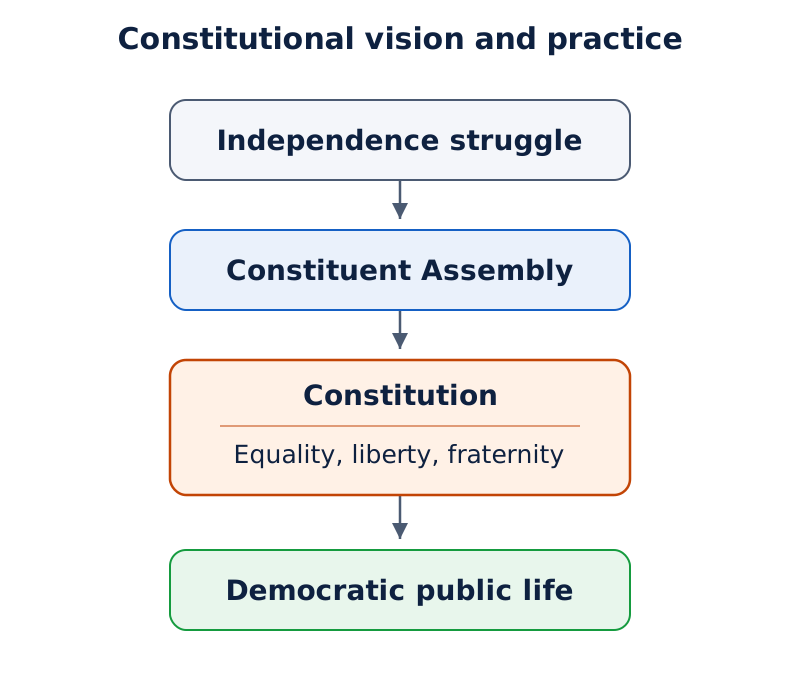
Draw linked boxes labelled “Independence struggle”, “Constituent Assembly”, “Constitution” and “Democratic public life”. Under the Constitution, write “Equality, liberty, fraternity”. Show the vision emerging through struggle, receiving constitutional form and continuing in shared political life.
Drawn by One Young India.
Glossary
- Constitutional philosophy — The moral vision connecting constitutional provisions, their underlying values and the reasons for choosing them.
- Political self-determination — A people's capacity to frame their own political arrangements without external interference.
- Liberal individualism — An approach that gives importance to individual freedom and autonomy in social and political life.
- Social justice — A commitment to addressing entrenched social injustices, including those suffered by historically disadvantaged groups.
- Affirmative action — Special measures to advance disadvantaged groups, illustrated by reservations for Scheduled Castes and Scheduled Tribes.
- Community-based rights — Rights recognising communities, including religious communities' freedom to establish and maintain educational institutions.
- Mutual exclusion — Strict separation under which religion and the state stay out of one another's internal affairs.
- Principled distance — Separation allowing state intervention or abstention according to what better promotes liberty, equality and social justice.
- Universal adult franchise — Voting rights for all adults, enabling the people's will to find political expression.
- Asymmetric federalism — Constitutional differences in the legal status and powers of units within the same federation.
- Fraternity — Shared belonging among people, supporting a common national life without requiring forced unity.
- Political deliberation — Reasoned discussion in which participants can revise preferences and acknowledge value in disagreement.
- Procedural achievements — Achievements concerning how decisions are reached, including deliberation, compromise and accommodation.
- Selective adaptation — The process of choosing and reshaping ideas by bringing western and traditional Indian values together.
- Alternative modernity — A different modern form emerging through interaction between western modern and local traditional cultural systems.
Common errors and misconceptions
- Misconception: A Constitution contains laws and therefore has nothing to do with morality. Correct: Not all laws have moral content, but many express values such as equality. Constitutional philosophy examines and justifies those values.
- Misconception: Constitutional rules exist simply to limit government. Correct: They also enable peaceful democratic transformation and empower people traditionally deprived of power.
- Misconception: Indian secularism requires the state to avoid every religious matter. Correct: Principled distance permits intervention or abstention according to liberty, equality and social justice.
- Misconception: Recognising community rights means abandoning individual freedom. Correct: A person's freedom and self-respect depend directly on their community's status. Equal relations between communities support individual dignity.
- Misconception: Federal equality requires identical status for every unit. Correct: Asymmetric federalism recognises differences in status and powers to meet particular regional needs.
- Misconception: The Assembly was either fully representative or completely unrepresentative. Correct: Restricted franchise limited voice, while its debates included a vast range of opinions and perceived social interests.
- Misconception: Borrowing western ideas made the Constitution entirely alien. Correct: Ideas were selectively adapted, and Indians used modern practices to pursue dignity and justice.
- Misconception: The Constitution completely ignored gender justice. Correct: The qualified criticism is that it appears to have glossed over some important issues, particularly within the family.
Exam-style questions with model answers
Q1. A law prohibits discrimination on grounds of language or religion. Identify its underlying value and explain how it connects law with morality. [2 marks]
- The underlying value is equality: differences of language or religion should not justify discriminatory treatment.
- The prohibition expresses a moral commitment through law, showing that many legal rules are connected with deeply held values.
Q2. A formerly colonised people frames basic rules to check harmful state power, enable peaceful social change by empowering vulnerable groups, and determine its political arrangements without external interference. Explain these three constitutional purposes. [3 marks]
- Limiting state power protects individuals and groups against harm. Basic constitutional rules check the danger that powerful public institutions may become oppressive.
- Peaceful democratic transformation allows social relationships to change. A Constitution can empower vulnerable people who have traditionally been deprived of power.
- Political self-determination allows a formerly colonised people to choose its own arrangements. Constitution-making becomes an exercise of collective political freedom without external interference.
Q3. Strict separation requires the state neither to help nor hinder religions. India recognises community educational rights, permits aid to their institutions and allows intervention against customs such as untouchability that deny dignity and self-respect. Explain four features of India's alternative approach, using liberty, equality and social justice as its guiding values. [4 marks]
- Indian secularism recognises religious freedom for communities as well as individuals, illustrated by the right to establish and maintain educational institutions.
- The state can help religious communities, including by providing aid to their educational institutions. Separation does not rule out every form of support.
- The state can intervene against religiously sanctioned practices such as untouchability when these deny people's dignity and self-respect.
- Principled distance makes liberty, equality and social justice the basis for deciding whether intervention or abstention is more appropriate.
Q4. The Constituent Assembly was selected through restricted franchise before adult franchise was granted; most members came from advanced social sections. Its debates nevertheless covered a vast range of issues and perceived interests of different social groups. Assess its representativeness in five points, distinguishing voice from opinion. [5 marks]
- The voice dimension asks whether people are recognised through their own voices rather than through those of socially dominant sections.
- Restricted franchise meant that the Assembly was not chosen through universal suffrage. In the voice dimension, this makes it indeed unrepresentative.
- The predominance of members from advanced social sections reinforces the concern that different people did not have equal opportunities to speak for themselves.
- The opinion dimension concerns the range of views and interests discussed. A vast range of issues appeared, including perceived concerns of different social groups.
- The Assembly may therefore not have been altogether lacking in representativeness of opinion. This qualified judgement does not remove the separate limitation concerning voice.
Q5. The Constitution protects autonomy against hostile social pressures, uses reservations against age-old injustice, recognises cultural group rights that support individual dignity, adopts universal franchise and allows regional differences through asymmetric federalism. Its making valued reasoned deliberation, revised preferences and accommodation between values. Explain these six achievements, separating substantive commitments from procedure. [6 marks]
- Individual liberty is a substantive achievement because it protects personal freedom and autonomy, including against social pressures hostile to a person's independence.
- Social justice is substantive because reservations advance historically disadvantaged groups. It recognises that merely declaring equal rights cannot overcome age-old injustices.
- Community rights are substantive because they protect cultural expression and equal respect between groups. This also supports members' freedom and self-respect.
- Universal franchise is substantive because voting by all adults enables the nation's will to be expressed through democratic political participation.
- Asymmetric federalism is substantive because differences in constitutional status and powers allow particular regional needs to be accommodated within a federation.
- Deliberation and accommodation are procedural achievements. They concern reaching decisions through reasons, openness to revised preferences and defensible compromises between important values.
Q6. The Constitution is modern and partly western. Rammohan Roy used modern thinking to challenge tradition; by 1841, Dalit people in northern India were using the new legal system against landlords. Interaction between western modernity and local cultural systems led to the emergence of something like a hybrid culture, possibly through creative adaptation. Give four reasons why “partly western” does not establish “entirely alien”. [4 marks]
- Indians could adopt modern ideas and make them their own. Roy's challenge to objectionable traditional practices illustrates such an active use.
- The legal example from 1841 shows Dalit people using modern law for their own concerns, making it an instrument of dignity and justice.
- Interaction between western modernity and local culture could produce something different from either source, rather than simply copying a foreign system.
- Selective adaptation combines and reshapes ideas for local purposes. A partly western origin therefore does not establish that the resulting Constitution is entirely alien.
Q7. Assess these three concerns as constitutional limitations: a centralised idea of national unity; apparent neglect of some gender justice issues, particularly within families; and the placement of certain basic socio-economic rights in Directive Principles rather than Fundamental Rights in a poor developing country. Preserve the qualifications. [3 marks]
- The Constitution has a centralised idea of national unity. This identifies a concern about the way common national belonging is conceived around central authority.
- It appears to have glossed over some important gender justice issues, particularly within the family. The criticism is qualified, rather than a claim of total neglect.
- It is not clear why certain basic socio-economic rights were placed in Directive Principles rather than made integral to Fundamental Rights, given the country's poverty and development needs.
Q8. Contrast giving up a value for mere self-interest with partially trading one value for another through free deliberation among equals. Why is every compromise not objectionable? [2 marks]
- Sacrificing a value for mere self-interest is compromise in the objectionable sense.
- Partially accommodating competing values through free deliberation among equals can secure something of each important value and is not morally blameworthy.
Key takeaways
- Constitutional philosophy examines the meaning, coherence and justification of the values embodied in constitutional arrangements.
- A Constitution checks harmful state power while enabling peaceful democratic transformation and empowering vulnerable people.
- The Constituent Assembly debates help recover reasons behind practices whose importance may become clearer when they are threatened.
- Indian constitutional liberalism combines individual freedom with social justice and recognition of the value of communities.
- Principled distance permits intervention or abstention according to which better promotes liberty, equality and social justice.
- Universal franchise and asymmetric federalism connect democratic participation with recognition of different social and regional needs.
- Restricted franchise limited representation of voice, while a vast range of opinions entered the Assembly's deliberations.
- The Constitution's limitations do not jeopardise its philosophy, whose continuing aspiration joins equality, liberty and fraternity.
Test yourself
What three tasks form a political philosophy approach to the Constitution?
Clarify constitutional concepts, connect them into a coherent vision, and justify values through engagement with the Constituent Assembly debates.
What constitutional ideal does Japan's 1947 Constitution illustrate?
Peace: its Article 9 renounces war and the threat or use of force to settle international disputes.
Why were equal rights alone insufficient for Scheduled Castes and Scheduled Tribes?
They could not by themselves overcome age-old injustices or give real meaning to the right to vote.
How can community equality support individual freedom?
A person's freedom and self-respect depend directly on their community's status; domination of the community makes its members less free.
What voting proposal appeared in the Motilal Nehru Report of 1928?
Every person of either sex who had attained twenty-one was entitled to vote for the House of Representatives or Parliament.
What does asymmetric federalism permit?
It permits constitutionally recognised differences in the legal status and powers of units within the same federation.
Why were separate religious electorates rejected?
They endangered a healthy national life; the objective was true fraternity rather than forced unity.
What are the three principal constitutional limitations discussed here?
A centralised idea of national unity; apparent neglect of some gender justice issues within families; and the unclear relegation of certain basic socio-economic rights to Directive Principles.