
Composition and Structure of Atmosphere | CBSE Class 11 Geography Notes
On this page
This note covers the atmosphere, the air surrounding the earth; its gases, water vapour (water in gaseous form) and dust (small solid particles); its layers and their heights; temperature (how hot or cold air is); weather (atmospheric conditions at a place and time); and climate (their longer-term pattern).
What is the atmosphere, and how does its composition change with height?
Definition: The atmosphere is the mixture of different gases that surrounds the earth on all sides. Its composition includes gases, water vapour, meaning water in gaseous form, and small solid particles.
Air is essential for the survival of organisms. Humans may survive for some time without food and water, but cannot survive even a few minutes without breathing air. Oxygen is a life-giving gas for humans and animals, while carbon dioxide is important for plants.
Air is colourless and odourless, and can be felt only when it blows as wind, or moving air. It is an integral part of the earth's mass. The atmosphere therefore belongs to the earth even though air cannot ordinarily be seen.
Where is atmospheric mass concentrated?
Altitude means height above the earth's surface. A kilometre, written as km, is a unit of distance. As much as 99 per cent of the atmosphere's total mass is confined within a height of 32 km from the surface.
This statement concerns the distribution of atmospheric mass. It does not identify 32 km as the atmosphere's upper boundary. The higher layers continue beyond the region containing this large share of its mass.
What changes in the higher layers?
The proportion of gases changes in the higher atmosphere. Oxygen is almost in negligible quantity at 120 km. Carbon dioxide and water vapour are found only up to 90 km from the earth's surface. These are different statements about different constituents.
| Feature | Height | Meaning |
|---|---|---|
| Total atmospheric mass | Within 32 km | Contains 99 per cent of the total mass |
| Oxygen | 120 km | Almost in negligible quantity |
| Carbon dioxide and water vapour | Up to 90 km | Found only up to this height |
Composition describes what the atmosphere contains. Structure describes how it is arranged in layers. Keeping these ideas separate helps distinguish a gas's distribution from the height or characteristics of an atmospheric layer.
Why is carbon dioxide important for atmospheric heating?
Carbon dioxide is important in meteorology, the study of the atmosphere and weather. Its significance comes from its behaviour towards incoming and outgoing radiation. Radiation here means energy travelling from the sun or from the earth.
Solar radiation is radiation received from the sun. Terrestrial radiation is radiation given out by the earth. Carbon dioxide is transparent to incoming solar radiation, meaning that it lets it pass, but opaque to outgoing terrestrial radiation, meaning that it obstructs its passage.
How does it help retain heat?
Carbon dioxide absorbs a part of terrestrial radiation and reflects back some part towards the earth's surface. It is largely responsible for the greenhouse effect, the retention of heat associated with this interaction between the atmosphere and outgoing radiation.
- Incoming solar radiation passes through carbon dioxide because the gas is transparent to it.
- The earth gives out terrestrial radiation, to which carbon dioxide is opaque.
- Carbon dioxide absorbs a part of this outgoing terrestrial radiation.
- Some part is reflected back towards the earth's surface, contributing to the greenhouse effect.
The direction and source of the radiation matter. Solar radiation is incoming from the sun; terrestrial radiation is outgoing from the earth. Reversing these two terms also reverses the explanation of carbon dioxide's role.
Why has its volume risen?
The volume of carbon dioxide has risen in the past few decades, mainly because of the burning of fossil fuels. Fossil fuels are fuels formed from the remains of past organisms. This increase has also increased air temperature.
The word mainly identifies the principal cause without turning it into the sole cause. Likewise, carbon dioxide being largely responsible for the greenhouse effect does not mean that it is the atmosphere's only heat-retaining constituent. Water vapour also preserves the earth's radiated heat.
Note: Distinguish a gas's importance from its abundance. Carbon dioxide's role in retaining heat is explained through its interaction with radiation, rather than through a numerical percentage of the atmosphere.
How does ozone protect life, and where is it found?
Ozone is an atmospheric gas that acts as a filter for the sun's ultra-violet rays. Ultra-violet radiation is a form of solar radiation whose intense energy can harm life. Ozone absorbs these rays and prevents them from reaching the earth's surface.
Ozone is found between 10 and 50 km above the earth's surface. This height range describes its atmospheric occurrence. Its protective function is the absorption of ultra-violet radiation, so the location and the function should be learnt together.
What is the ozone layer?
The ozone layer is the ozone-containing part of the stratosphere, the atmospheric layer above the lowest layer. The stratosphere's ozone absorbs ultra-violet radiation and shields life from this intense, harmful form of energy.
Ozone and carbon dioxide are both important gases, but the explanations of their importance differ. Ozone filters ultra-violet rays from the sun. Carbon dioxide absorbs a part of radiation given out by the earth and reflects back some part towards its surface.
| Gas | Radiation involved | Importance |
|---|---|---|
| Ozone | Ultra-violet radiation from the sun | Filters and absorbs it, shielding life |
| Carbon dioxide | Outgoing terrestrial radiation | Absorbs a part and reflects back some part towards the surface |
How can the protective role be represented?
Diagram
Ozone as a protective filter
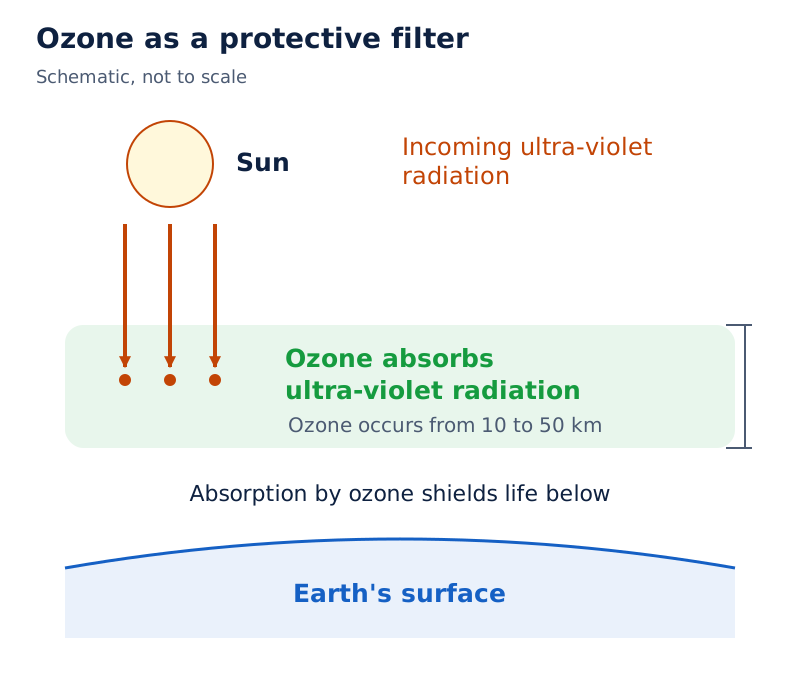
Draw the earth's surface below an ozone-containing band. Label ozone as found between 10 and 50 km. Draw incoming ultra-violet rays from the sun towards the band and label their absorption there.
Drawn by One Young India.
Keep the diagram focused on absorption by ozone. The essential connection is between the sun's ultra-violet radiation, the ozone-containing region and the protection of life at the surface. The full sequence of atmospheric layers can be shown separately in a structure diagram.
How does water vapour vary, and why is it important?
Water vapour is a variable gas in the atmosphere. Its amount decreases with altitude, and it also decreases from the equator towards the poles. The equator is the imaginary line dividing the earth into northern and southern halves; the poles are its northern and southern ends.
The tropics are the regions around the equator. In the warm and wet tropics, water vapour may account for four per cent of air by volume. In dry and cold areas of desert and polar regions, it may be less than one per cent.
Case study: How does water vapour differ between tropical and polar regions?
By volume means the share of the space occupied by air that is accounted for by water vapour. These values describe contrasting conditions. They are not a single fixed percentage that can be applied to the entire atmosphere.
| Conditions | Water vapour by volume | Qualification to retain |
|---|---|---|
| Warm and wet tropics | May account for four per cent | A possible share under these conditions |
| Dry and cold areas of desert and polar regions | May be less than one per cent | Less than one per cent, not exactly one per cent |
There are two directions of change to remember: upwards with increasing altitude, and from the equator towards the poles. Both describe a decrease in water vapour. The regional percentages add another way of recognising its variable distribution.
Diagram
Regional variation in water vapour
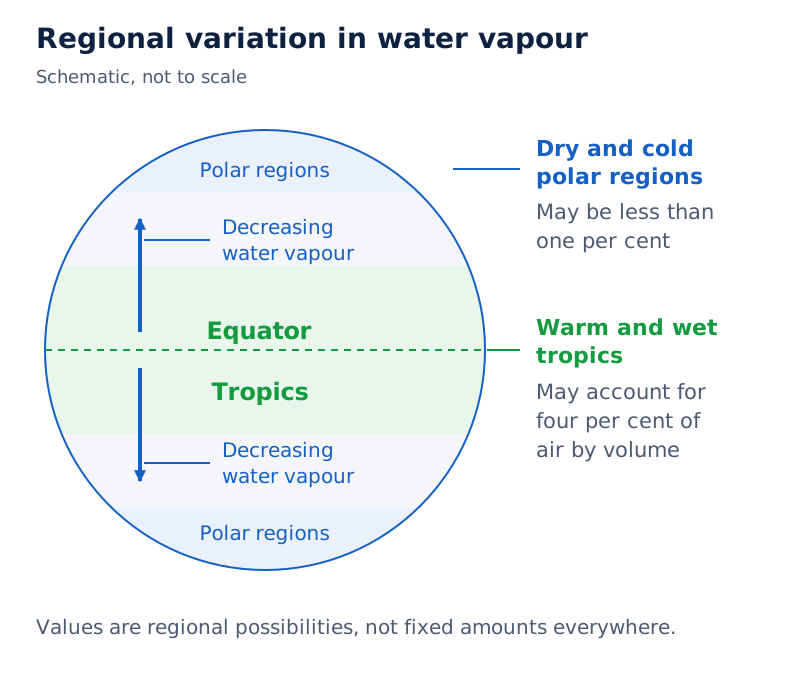
On a schematic world outline, label the equator, tropics and polar regions. Add arrows from the equator towards both poles labelled “decreasing water vapour”.
Annotate the warm and wet tropics with “may account for four per cent of air by volume” and the dry and cold polar regions with “may be less than one per cent”. These annotations describe regional contrasts, not fixed values everywhere.
Drawn by One Young India.
How does water vapour act like a blanket?
Water vapour absorbs parts of insolation, meaning incoming solar radiation. It also preserves the earth's radiated heat. In this way it acts like a blanket, allowing the earth neither to become too cold nor too hot.
Water vapour also contributes to stability and instability in the air. These terms concern whether air resists vertical movement or tends to undergo it. Its significance therefore includes both the retention of heat and the behaviour of air.
Note: Keep “may” with both regional water-vapour values. “May account for four per cent” and “may be less than one per cent” do not establish exact, unchanging percentages for every place in those regions.
Where do dust particles occur, and how do they help clouds form?
Dust particles are small solid particles that the atmosphere can keep suspended. They may originate from different sources. The examples include sea salts, fine soil, smoke-soot, ash, pollen, dust and disintegrated particles of meteors. Here, meteor particles refer to the fragments contributing solid material to the air.
The range of examples matters because atmospheric dust is not restricted to soil. Salt particles, combustion residues such as soot and ash, and pollen from plants all belong to the small solid particles described here.
Case study: Why do subtropical and temperate regions have more atmospheric dust?
Dust particles are generally concentrated in the lower layers of the atmosphere. However, convectional air currents may transport them to great heights. Convectional currents are movements of air that transport heat vertically.
A higher concentration of dust occurs in subtropical and temperate regions because of dry winds, compared with equatorial and polar regions. Subtropical regions lie beyond the tropics, while temperate regions lie between the tropical and polar parts of the earth.
This comparison concerns the concentration of particles in broad regions. It does not mean that dust is absent from equatorial or polar air. Similarly, a general concentration near the surface does not prevent particles from being carried higher.
Diagram
Regional contrasts in atmospheric dust
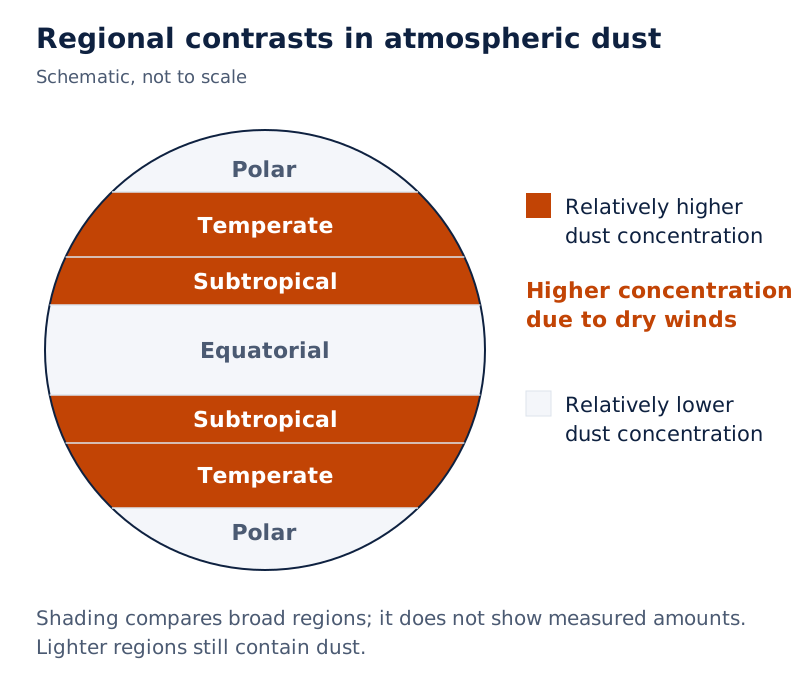
On a schematic world outline, label equatorial, subtropical, temperate and polar regions. Use a key with darker shading for relatively higher dust concentrations and lighter shading for relatively lower concentrations.
Shade subtropical and temperate regions darker than equatorial and polar regions. Annotate the darker regions with “higher dust concentration due to dry winds”. The shading represents the regional comparison, not measured quantities or an absence of dust in lighter areas.
Drawn by One Young India.
What are hygroscopic nuclei?
Hygroscopic nuclei are particles around which water vapour condenses. Condensation means water vapour changing into liquid water. Dust and salt particles act as these nuclei, around which condensation produces clouds.
- The atmosphere holds small solid particles from different sources.
- Dust and salt particles provide hygroscopic nuclei.
- Water vapour condenses around these nuclei.
- This condensation around particles produces clouds.
Diagram
Particles and cloud formation
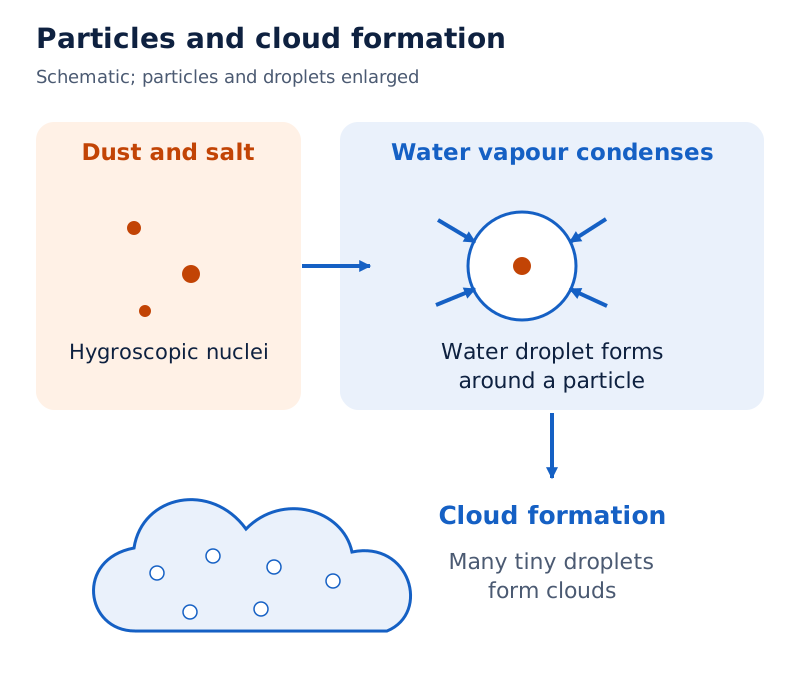
Draw small particles labelled “dust and salt”. Around them, indicate water vapour condensing. Add the label “hygroscopic nuclei” to the particles and show the connection between this condensation and cloud formation.
Drawn by One Young India.
Water vapour and dust therefore have connected roles. Vapour supplies the water that condenses, while dust and salt supply the nuclei. Describing either component alone leaves out part of this explanation of cloud formation.
How is the atmosphere divided into layers?
The atmosphere contains layers with different density and temperature. Density means mass in a given volume. It is highest near the earth's surface and decreases as altitude increases. The thermal structure, or arrangement by temperature conditions, provides the basis for naming five layers.
From the earth upwards, the five layers are the troposphere, the lowest layer; the stratosphere above it; the mesosphere above the stratosphere; the thermosphere above the mesosphere; and the exosphere, the outermost layer above the thermosphere.
How should the structure diagram be read?
What the figure shows
Structure of atmosphere
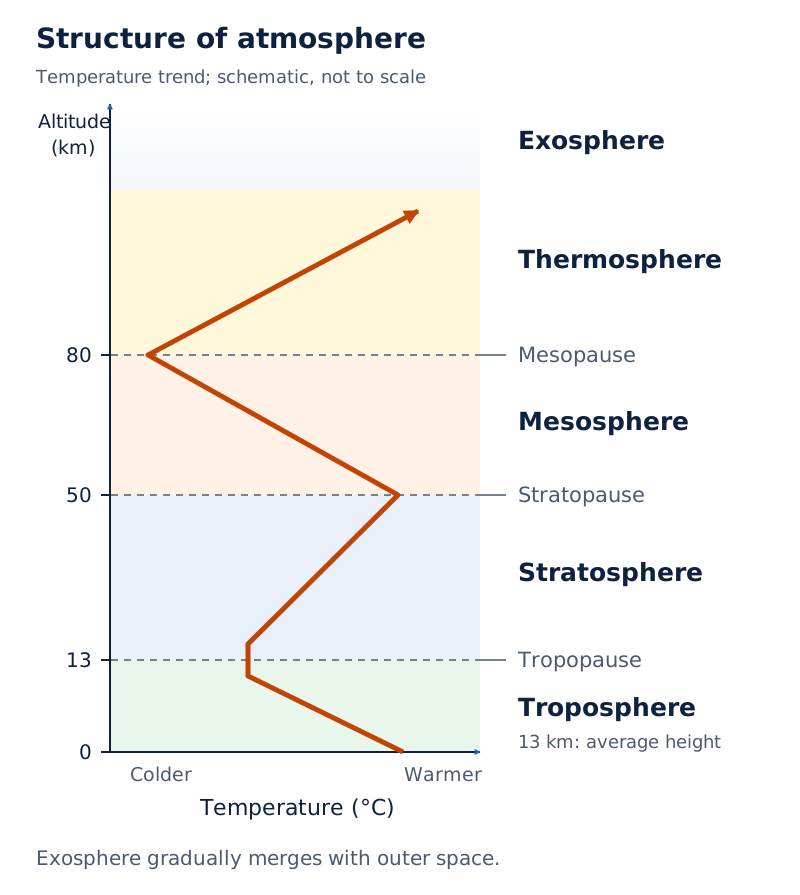
The vertical axis shows altitude in km, and the horizontal axis shows temperature in degrees Celsius, written as °C. The drawing labels troposphere, stratosphere, mesosphere, thermosphere and exosphere, with a line showing temperature changes through the layers.
Drawn by One Young India. See Fig. 7.1 in your NCERT textbook
The figure also labels the tropopause, the zone between troposphere and stratosphere; the stratopause, the boundary between stratosphere and mesosphere; and the mesopause, the upper limit of the mesosphere. Dashed horizontal lines mark these divisions in the drawing.
The line moves towards lower temperatures through the troposphere, towards higher temperatures through the stratosphere, towards lower temperatures through the mesosphere, and towards higher temperatures in the thermosphere. Reading the line means following temperature as altitude changes.
Which distinctions make the diagram clearer?
Layer names identify regions; boundary names identify divisions between regions. The troposphere and tropopause therefore do not mean the same thing. Nor should the mesosphere, a layer, be confused with the mesopause, its upper limit.
The ionosphere is the upper atmospheric region containing ions, or electrically charged particles. It reflects radio waves transmitted from the earth back towards the earth. Keep the five temperature-based layer names in their stated order when drawing the atmospheric column.
The diagram brings together height, temperature and layer names. A complete explanation should connect these labels to the characteristics of the layers, especially weather in the lowest layer and protection by ozone in the stratosphere.
Why is the troposphere the most important layer for biological activity?
The troposphere is the lowermost atmospheric layer and the most important for biological activity, meaning the activities of living organisms. It contains dust particles and water vapour. All changes in climate and weather take place in this layer.
Weather refers to atmospheric conditions at a place and time, while climate refers to their longer-term pattern. The changing elements of weather and climate influence human life. The main elements of weather and climate are temperature, pressure, winds, humidity, clouds and precipitation.
How does its thickness vary?
The troposphere has an average height of 13 km. It extends roughly to 8 km near the poles and about 18 km at the equator. Its thickness is greatest at the equator because strong convectional currents transport heat to great heights.
| Tropospheric feature | Value | How to read it |
|---|---|---|
| Average height | 13 km | An average for the layer |
| Height near the poles | Roughly 8 km | Keep the approximation |
| Height at the equator | About 18 km | Greatest thickness occurs here |
| Temperature decrease with height | 1°C for every 165 m | m stands for metre, a unit of distance |
The reason for greater equatorial thickness is heat transport by strong convectional currents. This links a difference in layer height to a process within the atmosphere, rather than treating the two regional heights as unrelated facts.
What happens at the tropopause?
The tropopause separates the troposphere from the stratosphere. Air temperature there is about minus 80°C over the equator and about minus 45°C over the poles. “Minus” indicates a temperature below zero degrees Celsius.
The temperature at the tropopause is nearly constant. This is distinct from the decrease with increasing height within the troposphere. It is also distinct from the difference between the stated equatorial and polar tropopause temperatures.
Note: Preserve the distinction between an average and a regional approximation: 13 km is the average height, roughly 8 km applies near the poles, and about 18 km applies at the equator.
The troposphere contains dust and water vapour and is where weather changes occur. Its water vapour and dust connect with cloud formation, its temperature decreases upwards, and its weather and climate changes make it especially significant for living organisms.
What characterises the layers above the troposphere?
The stratosphere begins above the tropopause and extends up to 50 km. Its important feature is the ozone layer, which absorbs ultra-violet radiation and shields life from intense, harmful energy. Its lower position is described relative to the tropopause.
What happens in the mesosphere?
The mesosphere lies above the stratosphere and extends up to 80 km. Temperature once again starts decreasing as altitude increases, reaching up to minus 100°C at 80 km. The upper limit of this layer is the mesopause.
“Once again” connects the mesospheric decrease with the earlier decrease in the troposphere. The layers are therefore not described by a single, uninterrupted decrease of temperature from the ground to the outer atmosphere.
Why are ions important in the upper atmosphere?
The ionosphere is described above the mesopause, in the 80 to 400 km region. Its electrically charged particles give it its name. Radio waves, the waves used for radio transmission, sent from the earth are reflected back to the earth by this layer.
Temperature starts increasing with height here. Keep this temperature trend together with the two other identifying features: electrically charged particles and the reflection of radio waves. These distinguish the ionosphere's description from that of the mesosphere below.
| Layer or region | Height information | Key characteristic |
|---|---|---|
| Stratosphere | Above the tropopause, up to 50 km | Contains the protective ozone layer |
| Mesosphere | Above the stratosphere, up to 80 km | Temperature decreases, reaching up to minus 100°C |
| Ionosphere | 80 to 400 km region above the mesopause | Contains ions and reflects radio waves |
| Exosphere | Above the thermosphere | Extremely rarefied contents; gradual merging with outer space |
What is known about the exosphere?
The exosphere is the highest atmospheric layer, above the thermosphere. Very little is known about it. Its contents are extremely rarefied, meaning thinly spread, and it gradually merges with outer space.
The upper atmosphere thus includes different kinds of information: temperature changes, electrically charged particles, the behaviour of radio waves and the gradual merging into space. Although all layers must be exercising influence on us, geographers are concerned with the first two layers, the troposphere and stratosphere.
What are the main elements of weather and climate?
The main atmospheric elements that change and influence human life are temperature; pressure, atmospheric force per unit area; winds, moving air; humidity, water-vapour content; clouds, collections of tiny water droplets or ice particles; and precipitation, water falling from the atmosphere to the surface. These describe atmospheric conditions. They should be distinguished from gases, water vapour and dust, which describe what the atmosphere contains.
What does each element describe?
- Temperature describes how hot or cold the air is. Temperature conditions also provide the basis for dividing the atmosphere into five layers.
- Pressure refers to atmospheric force acting on a unit area. It is one of the changing elements that influence life.
- Winds are movements of air. Air can be felt when it blows as wind, despite being colourless and odourless.
- Humidity is the water-vapour content of air. Water vapour varies with altitude and from the equator towards the poles.
- Clouds are collections of tiny water droplets or ice particles in the atmosphere. Dust and salt provide nuclei for condensation that produces clouds.
- Precipitation is water falling from the atmosphere to the earth's surface. It belongs to the list of changing atmospheric elements.
How are composition, structure and atmospheric conditions connected?
Composition identifies the materials present, including gases and solid particles. Structure arranges the atmosphere into layers with different density and temperature conditions. Weather and climate elements describe changing atmospheric conditions that affect human life.
Water vapour connects composition with humidity and heat retention. Dust and salt connect solid particles with condensation and cloud formation. The troposphere connects the vertical structure with changes in weather and climate. Together, these relationships explain why both composition and structure matter.
A description of atmospheric conditions needs the full six-element list. A description of atmospheric composition needs gases, water vapour and dust particles. A description of atmospheric structure needs the ordered layers and their characteristics. Each answers a different question about the same atmosphere.
Glossary
- Atmosphere — The mixture of different gases surrounding the earth, also containing water vapour and dust particles.
- Terrestrial radiation — Radiation given out by the earth, partly absorbed by atmospheric carbon dioxide.
- Greenhouse effect — Atmospheric retention of heat associated with absorption and return of outgoing terrestrial radiation.
- Ozone — Atmospheric gas that absorbs ultra-violet rays from the sun and protects life at the surface.
- Water vapour — Water in gaseous form, varying in amount with altitude and geographical location.
- Insolation — Incoming solar radiation, parts of which are absorbed by atmospheric water vapour.
- Hygroscopic nuclei — Particles such as dust and salt around which water vapour condenses to produce clouds.
- Troposphere — The lowest atmospheric layer, containing dust and water vapour and supporting changes in weather and climate.
- Tropopause — The zone separating troposphere from stratosphere, where temperature is nearly constant.
- Stratosphere — The layer above the tropopause, extending up to 50 km and containing the ozone layer.
- Mesosphere — The layer above the stratosphere, extending up to 80 km, with temperature decreasing as altitude increases.
- Mesopause — The upper limit of the mesosphere, above which the ionosphere is described.
- Ionosphere — The region containing electrically charged particles that reflects radio waves back towards the earth.
- Exosphere — The highest layer above the thermosphere, with extremely rarefied contents, gradually merging with outer space.
Common errors and misconceptions
- Misconception: The atmosphere ends at 32 km. Correct: The 32 km statement concerns the concentration of 99 per cent of its total mass, not its outer limit.
- Misconception: Carbon dioxide blocks incoming solar radiation in the same way as outgoing terrestrial radiation. Correct: It is transparent to incoming solar radiation but opaque to outgoing terrestrial radiation.
- Misconception: Water vapour makes up exactly four per cent of air everywhere. Correct: It may reach four per cent in warm and wet tropics and may be less than one per cent in dry and cold desert and polar areas.
- Misconception: Dust occurs only near the ground. Correct: It is generally concentrated in lower layers, but convectional air currents may carry it to great heights.
- Misconception: The troposphere is 13 km thick at every location. Correct: Its average height is 13 km; it extends roughly to 8 km near the poles and about 18 km at the equator.
- Misconception: Tropopause and troposphere are two names for one layer. Correct: The troposphere is the lowest layer; the tropopause is the zone separating it from the stratosphere.
- Misconception: Temperature decreases continuously through every atmospheric layer. Correct: It decreases in the troposphere and mesosphere, while it starts increasing with height in the ionosphere.
- Misconception: The exosphere has a sharply defined outer edge. Correct: Its contents are extremely rarefied, and it gradually merges with outer space.
Exam-style questions with model answers
Q1. Air surrounds the earth as a mixture of gases, water vapour and dust. Of the atmosphere's total mass, 99 per cent lies within 32 kilometres (km) of the surface. Define the atmosphere and explain what the height statement describes. [2 marks]
- The atmosphere is the mixture of gases surrounding the earth on all sides; it also contains water vapour and dust particles.
- The height statement describes the concentration of atmospheric mass within 32 km. It does not identify the atmosphere's outer boundary.
Q2. Carbon dioxide lets incoming solar radiation pass but obstructs outgoing terrestrial radiation. It absorbs a part of terrestrial radiation and reflects back some part towards the surface, being largely responsible for the greenhouse effect. Its volume has risen in the past few decades mainly through fossil-fuel burning, increasing air temperature. Explain its climatic importance in four points. [4 marks]
- Carbon dioxide is transparent to incoming solar radiation, allowing radiation from the sun to pass through it towards the earth.
- It is opaque to outgoing terrestrial radiation and absorbs a part of the radiation given out by the earth.
- It reflects back some part towards the surface and is largely responsible for the greenhouse effect, helping retain heat.
- Its volume has risen mainly because of fossil-fuel burning in recent decades, and this has also increased air temperature.
Q3. Water vapour may form four per cent of air by volume in warm and wet tropics, but may be less than one per cent in dry and cold desert and polar areas. It decreases with altitude and from the equator towards the poles. Describe three patterns, retaining the qualifications. [3 marks]
- In the warm and wet tropics, water vapour may account for four per cent of air by volume. This is a qualified regional value.
- In dry and cold areas of desert and polar regions, it may be less than one per cent, rather than exactly one per cent.
- Water vapour decreases in two directions: with increasing altitude and from the equator towards the poles. Its proportion therefore varies through the atmosphere.
Q4. Dust is generally concentrated in lower atmospheric layers, though convectional currents may carry it to great heights. Dry winds produce higher dust concentrations in subtropical and temperate regions than in equatorial and polar regions. Dust and salt act as nuclei around which water vapour condenses to produce clouds. Explain distribution and importance in three points. [3 marks]
- Dust is generally concentrated in the lower layers, but convectional air currents may transport it to great heights. Its distribution is not restricted to the ground.
- Subtropical and temperate regions have higher concentrations than equatorial and polar regions because of dry winds, giving a regional contrast in dust distribution.
- Dust and salt act as hygroscopic nuclei. Water vapour condenses around them to produce clouds, connecting atmospheric solid particles with cloud formation.
Q5. The troposphere is the lowest layer, averaging 13 kilometres (km), roughly 8 km near the poles and about 18 km at the equator. Strong convectional currents transport heat high above the equator. The layer contains dust and water vapour, has all weather and climate changes, and is most important for biological activity. Temperature decreases by 1 degree Celsius (°C) per 165 metres (m). Describe it in five points. [5 marks]
- The troposphere is the lowermost atmospheric layer. Its average height is 13 km, so this value describes an average rather than an identical thickness everywhere.
- Its thickness varies geographically: it extends roughly to 8 km near the poles and about 18 km at the equator.
- It is thickest at the equator because strong convectional currents transport heat to great heights, linking the greater thickness with vertical heat transport.
- It contains dust and water vapour, has all changes in weather and climate, and is the most important layer for biological activity.
- Temperature decreases upwards through this layer at the stated rate of 1°C for every 165 m of increase in height.
Q6. The troposphere contains weather changes and ends at the tropopause. The stratosphere above it extends to 50 kilometres (km) and contains ozone that absorbs harmful solar ultra-violet radiation, protecting life. The mesosphere extends to 80 km, where temperature reaches up to minus 100 degrees Celsius (°C), ending at the mesopause. The thermosphere lies above it; the ionosphere has ions (electrically charged particles), reflects radio waves and has temperature increasing with height. The exosphere above the thermosphere has extremely rarefied contents and gradually merges with space. Describe the five temperature-based layers in ascending order. [5 marks]
- The troposphere is the lowest layer and contains changes in weather. Its upper separating zone is the tropopause, above which the stratosphere begins.
- The stratosphere extends up to 50 km and contains ozone. This gas has a protective role for life by absorbing harmful ultra-violet radiation.
- The mesosphere extends up to 80 km, where temperature reaches up to minus 100°C. Its upper limit is called the mesopause.
- The thermosphere lies above the mesosphere. The upper ionosphere contains electrically charged particles, reflects radio waves and has temperature increasing with height.
- The exosphere lies above the thermosphere and is the highest layer. Its contents are extremely rarefied, and it gradually merges with outer space.
Q7. Ozone occurs between 10 and 50 kilometres (km) and absorbs solar ultra-violet radiation, shielding life. The stratosphere extends above the tropopause to 50 km and contains the ozone layer. State ozone's location and explain its protective role. [2 marks]
- Ozone occurs between 10 and 50 km above the surface, and the stratosphere contains the ozone layer.
- It absorbs ultra-violet radiation from the sun, preventing these rays from reaching the surface and shielding life from intense, harmful energy.
Q8. The changing elements influencing human life are temperature, pressure, winds, humidity, clouds and precipitation. Temperature is the hotness or coldness of air; pressure is atmospheric force per unit area; winds are moving air; humidity is water-vapour content; clouds contain tiny droplets or ice particles; precipitation is water falling to the surface. Identify and explain the six elements. [6 marks]
- Temperature describes how hot or cold the air is. It is one of the atmospheric conditions that changes and influences human life.
- Pressure describes atmospheric force acting on a unit area. It belongs to the set of changing atmospheric elements influencing people.
- Winds are movements of air. They describe moving air as an atmospheric condition rather than a separate substance in atmospheric composition.
- Humidity is the water-vapour content of air. It connects the water present in gaseous form with descriptions of atmospheric conditions.
- Clouds are collections of tiny water droplets or ice particles in the atmosphere. They are included among the changing atmospheric elements.
- Precipitation is water falling from the atmosphere to the earth's surface. It completes the six-element list of changing conditions given here.
Key takeaways
- The atmosphere contains gases, water vapour and dust; 99 per cent of its total mass lies within 32 km of the surface.
- Carbon dioxide is transparent to incoming solar radiation but opaque to outgoing terrestrial radiation, making it important for heat retention.
- Ozone occurs between 10 and 50 km and absorbs ultra-violet radiation, shielding life from intense, harmful energy.
- Water vapour decreases with altitude and towards the poles, absorbs parts of insolation and preserves the earth's radiated heat.
- Dust is generally concentrated in lower layers, while dust and salt provide nuclei for condensation that produces clouds.
- The troposphere averages 13 km in height, extends roughly to 8 km near the poles and about 18 km at the equator.
- The five temperature-based layers, from lowest upwards, are troposphere, stratosphere, mesosphere, thermosphere and exosphere.
- Temperature, pressure, winds, humidity, clouds and precipitation are the changing atmospheric elements that influence human life.
Test yourself
What does the figure of 99 per cent within 32 km describe?
It describes the concentration of the atmosphere's total mass near the surface, not the height of its outer boundary.
How does carbon dioxide treat incoming solar and outgoing terrestrial radiation differently?
It is transparent to incoming solar radiation but opaque to outgoing terrestrial radiation, absorbing a part and reflecting back some part.
Which two directions are associated with decreasing water vapour?
Water vapour decreases with increasing altitude and from the equator towards the poles.
Why are dust and salt particles called hygroscopic nuclei?
They provide particles around which water vapour condenses to produce clouds.
Why is the troposphere thickest at the equator?
Strong convectional currents transport heat to great heights above the equator, giving the troposphere its greatest thickness there.
What are the tropopause temperatures over the equator and poles?
They are about minus 80°C over the equator and about minus 45°C over the poles.
What gives the ionosphere its name, and what happens to radio waves there?
It contains electrically charged particles called ions. Radio waves transmitted from the earth are reflected back by this layer.
What characterises the exosphere's contents and outer transition?
Its contents are extremely rarefied, and the layer gradually merges with outer space.
Write about it
Turn a question from this chapter into a paper.
The Writing Studio has a structure guide, a rubric and citation tools for 15 formats, from essays to research papers. Drafting is free with an account. Learnacy Essential adds feedback from an AI writing coach and submission to The OYI Review.
Learnacy Essential is ₹1,499 for the year. Publication depends on review and is not guaranteed.