
Electrostatic Potential and Capacitance | CBSE Class 12 Physics Notes
On this page
Watch & explore
Start with a few high-quality watches, then dive into the notes below.

Learnacy Labs Try it hands-on: open the Electrostatics lab
This note covers electrostatic potential, potential difference, point charges and dipoles, equipotential surfaces, electrostatic potential energy, conductors, dielectrics and polarisation, capacitance, parallel plate capacitors, capacitor combinations and stored electric energy.
What are electrostatic potential and potential difference?
Electrostatic force is conservative. The work it does in moving a charge depends on the initial and final positions, rather than the path followed. This makes it possible to associate potential energy with the position of a charge in an electrostatic field.
Imagine moving a small test charge slowly against the electric force. An external force balances the electric force at each point, so the charge gains no kinetic energy. The external work is stored as a change in potential energy.
Definition: Electrostatic potential difference between two points is the work done per unit positive test charge by an external force in moving the charge between them without acceleration.
Let be the test charge, its electrostatic potential energy and the electrostatic potential at its position. Let and denote work done by the external force and the electric field, respectively. For motion from a reference point to a final point, the relationships are:
How is the zero of potential chosen?
Potential difference has direct physical significance. The zero of potential can be chosen conveniently; for an isolated charge configuration, it is usually chosen at infinity. Potential at a point then measures the external work per unit positive charge in bringing it from infinity.
The test charge must be sufficiently small to avoid changing the source configuration, or the source charges must be held fixed. Potential describes the field configuration; the potential energy of a test charge also depends on that charge.
The SI unit of potential is the volt, with . The SI unit of electrostatic potential energy is the joule. A negative potential does not mean that potential is undefined: it expresses the sign of the work relative to the chosen reference.
Note: The work formula assumes that the external force balances the electric force. If kinetic energy changes, external work need not equal the change in potential energy alone.
How is potential calculated for a point charge?
A point charge produces a potential that depends on its charge and the distance from it. Because work is path independent, a radial path can be chosen when calculating the external work needed to bring a positive test charge from infinity.
Derivation: potential due to a point charge
Let the source charge be , and let be the distance of the observation point. Set .
- Let be an intermediate radial distance from the source, the radial component of the electric field there, and the permittivity of vacuum. Coulomb's law gives
- External work per unit charge over an infinitesimal radial displacement is
- Integrate from infinity to the observation point:
- Evaluate the integral:
Result: Point-charge potential is positive for a positive source charge and negative for a negative source charge. Its magnitude decreases inversely with distance; the corresponding field magnitude decreases inversely with the square of distance.
Use , with , in the calculations below. The formula applies away from the point charge. Potential at the location of the point charge itself is not finite.
How are potential and work used together?
Worked example 1. A charge of is from a point. Find the potential and the work required to bring from infinity to that point.
Formula: , .
Answer: Convert the distance before substituting.
- Substitute:
The external work is positive because the test charge is brought against repulsion. It is the same for every path between the stated endpoints.
How do potentials add for several charges and a spherical shell?
Superposition of potential means adding the scalar contributions from individual charges algebraically. Keep the sign of every charge. Unlike electric fields, potentials require no vector resolution, even when charges lie in different directions from the observation point.
For point charges , let be the observation point and the distance from charge to , where labels a charge. The potential is
Each denominator is the distance from the corresponding charge to the observation point. For a continuous distribution, divide the charge into small elements, find their potential contributions and integrate over the whole distribution.
What happens inside a uniformly charged spherical shell?
Outside a uniformly charged spherical shell, the potential is the same as if its total charge were concentrated at its centre. Inside, the electric field is zero, so moving a test charge requires no work and the potential remains constant.
| Region | Potential for shell charge and radius | Reason |
|---|---|---|
| Outside, | The external field equals that of a central point charge. | |
| Inside, | There is no potential change within the shell. |
The potential is continuous at the surface, although the electric field changes across the charged surface. Zero electric field in the interior therefore does not imply zero potential there.
Worked example 2. Charges and are separated by . Locate the finite points of zero potential on their joining line.
Answer: Put the positive charge at the origin and take the positive x-axis towards the negative charge, which is at . Let be the coordinate of a required point. At each required point, .
- Between the charges, the common Coulomb factor cancels:
- Cross-multiplication gives
- Beyond the negative charge, the condition becomes
- Thus
Both positions lie on the side of the negative charge as measured from the positive charge. On the opposite side, the larger positive charge is also nearer, so cancellation is impossible.
What is the potential due to an electric dipole?
An electric dipole contains equal and opposite charges separated by a small distance. Its dipole moment points from the negative charge towards the positive charge. For charge magnitude and separation , its magnitude is .
The SI unit of electric dipole moment is the coulomb metre, written . Although the dipole has zero total charge, its charges occupy different positions, so their potentials do not cancel at every point.
What the figure shows
Dipole geometry
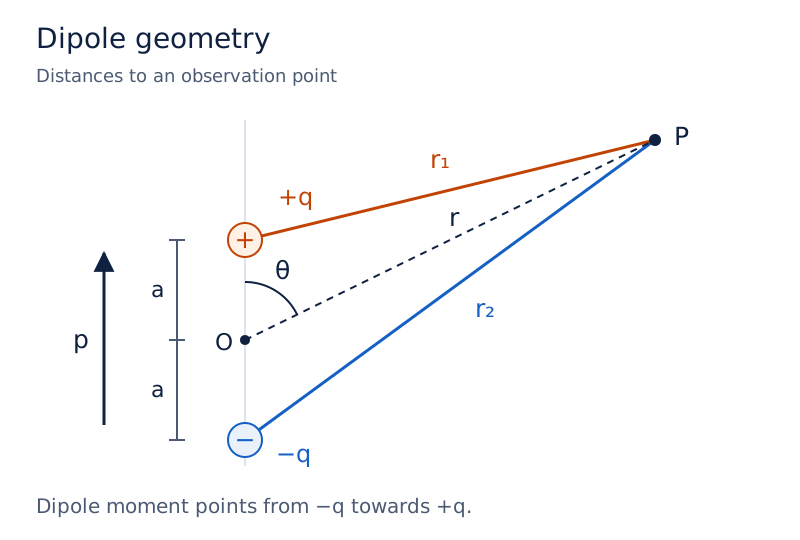
The charges and lie above and below the midpoint . Lines to are labelled , and ; the angle is between the dipole axis and the midpoint-to-point line.
Drawn by One Young India. See Fig. 2.5 in your NCERT textbook
Derivation: potential far from a dipole
Take the origin at midpoint . Let and be the distances of observation point from and , respectively, and let . The dipole moment vector is , and is the unit vector from towards . Assume , retaining terms only to first order in .
- Add the two potentials:
- Use the geometry:
- Expand the reciprocal distances to first order:
- Subtract and use the dipole moment:
Result: Dipole potential depends on both distance and orientation. The expression is approximate for a finite dipole far away, and exact for an ideal point dipole.
On the positive axial side, and in this approximation. On the opposite axial side, and . In the equatorial plane, the distances to both charges are equal and the potential is exactly zero.
The distance dependence is also different: point-charge potential varies as , whereas distant dipole potential varies as for a fixed direction. Zero dipole potential in the equatorial plane does not require a zero electric field there.
How do equipotential surfaces connect potential with electric field?
An equipotential surface has the same potential at every point. Moving a test charge along it involves no change in potential energy and requires no work against the electrostatic field. The shape depends on the charge distribution producing the field.
For a point charge, all points at the same distance have the same potential, so the surfaces are concentric spheres. In a uniform field, they are planes perpendicular to the field direction.
What the figure shows
Equipotentials in a uniform field
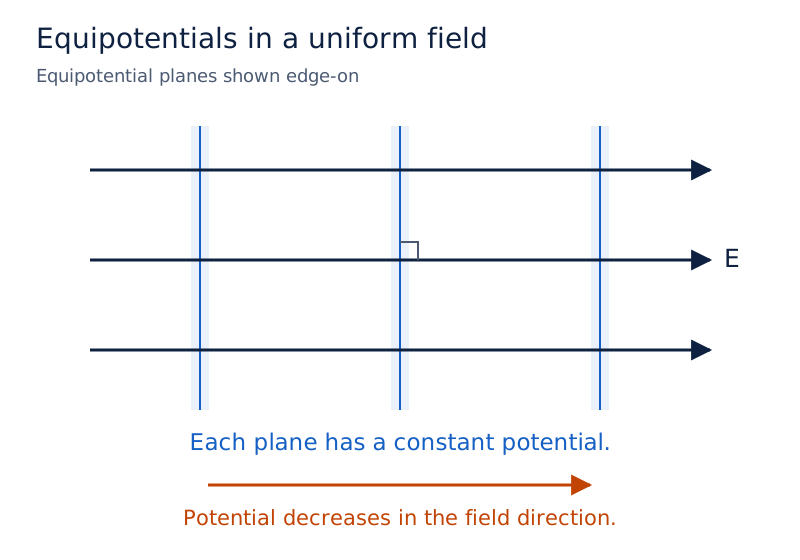
Parallel horizontal field arrows point to the right. Several parallel planes cut across them, showing equipotential surfaces perpendicular to the electric field.
Drawn by One Young India. See Fig. 2.10 in your NCERT textbook
Why must the field be normal to an equipotential?
If a nonzero electric field had a tangential component, work would be needed to move a positive charge against that component along the surface. This contradicts the absence of potential difference. The field must therefore be perpendicular to the surface wherever the field is nonzero.
Derivation: field from a change in potential
Take a small displacement normal to closely spaced equipotentials, in the direction of the electric field.
- The field does work on a positive charge:
- The change in potential energy is the negative of that work:
- Divide by charge and displacement:
Result: Electric field points in the direction of the steepest decrease of potential. Its magnitude is the potential change per unit normal distance, taken in magnitude.
The SI unit of electric field is the volt per metre, equivalently the newton per coulomb: . The negative sign in the field-potential relation gives direction; it does not make the field magnitude negative.
Note: A zero value of potential at a point is different from a zero spatial change of potential. The field depends on how potential changes between neighbouring points.
How is the potential energy of a system of charges found?
Configuration energy is the external work required to assemble charges from infinity into their final positions. With no pre-existing external field, bringing the first charge costs no work. Bringing the next charge involves work against the field already established.
Derivation: assembling three charges
Keep charges at their assigned positions after bringing them in, and choose zero energy when all separations are infinite. Let be the separations of charge pairs 1 and 2, 1 and 3, and 2 and 3, respectively. Let denote the external work in bringing in charge .
- Bring the first charge:
- Bring the second charge into the potential of the first:
- Bring the third charge into the combined potential of the first two:
- Add the work:
Result: Each distinct pair contributes once. The final energy depends on the final arrangement, not on the order of assembly, because electrostatic force is conservative.
For two charges, . Like charges have positive interaction energy relative to infinite separation. Unlike charges have negative interaction energy, and positive external work is needed to separate them to infinity.
What changes in an external field?
For a charge at position vector , let be the potential produced there by the external sources; its potential energy is . For two charges at position vectors and , include both external interactions and their mutual interaction:
The external potential excludes the potential of the charge whose energy is being calculated. The source charges producing that external field are assumed not to be significantly disturbed.
Worked example 3. Charges and are at positions and on one axis. Find their energy and the work needed to separate them infinitely.
Formula: , .
Answer: The relevant separation is the distance between the charges.
- Substitute:
The positive separation work is consistent with attraction between the unlike charges.
What happens to an electric dipole in a uniform external field?
A dipole in a uniform electric field has no net force, because its two charges experience equal and opposite forces. However, those forces generally form a couple and exert a torque that tends to turn the dipole.
The torque is , with magnitude . Here the angle is between the dipole moment and the field. Torque vanishes for parallel and antiparallel orientations.
Derivation: dipole potential energy
Rotate the dipole slowly with an external torque that balances the electric torque, and choose zero energy at the perpendicular orientation.
- The external work for an infinitesimal increase of angle is
- Integrate between the initial and final orientations:
- Set the reference angle to :
Result: The dipole's orientation energy is lowest when it points along the field and highest when it points opposite to the field. This expression concerns its interaction with the external field.
| Orientation | Angle | Potential energy |
|---|---|---|
| Parallel | ||
| Perpendicular | ||
| Antiparallel |
Alignment needs care: torque by itself can produce oscillations about the field direction. A dissipative mechanism is required for those oscillations to die away and for the dipole eventually to settle along the field.
What are the electrostatic properties of conductors?
Metallic conductors contain mobile electrons. When an electric field acts, these electrons can drift. In electrostatic equilibrium, their distribution has adjusted so that there is no continuing charge motion and the electric field inside the conducting material is zero.
Which equilibrium properties follow?
- No internal electrostatic field: a nonzero field would exert forces on free charges and cause motion.
- No tangential surface field: such a component would move charges along the surface. The field just outside is normal to it.
- No excess bulk charge: a Gaussian surface wholly inside the conducting material has zero flux and encloses no net charge.
- Constant potential: the interior and surface of a connected conductor have the same potential, since moving a test charge between them requires no work.
Different conductors can have different constant potentials. A conductor's potential need not be zero merely because its interior field is zero. Excess charge resides on its surfaces in the static situation.
Derivation: field just outside a conductor
Choose a very short Gaussian pillbox crossing the surface. Let its face area be and the local surface charge density be . Let be the outward unit normal, the signed outward field component, the total electric flux through the pillbox and its enclosed charge.
- The inside face contributes no flux; the outside face gives
- The enclosed charge is
- Gauss's law gives
Result: The field points outward for positive surface charge and inward for negative surface charge. The normal component carries the sign of the surface charge density.
What the figure shows
Gaussian pillbox at a conductor
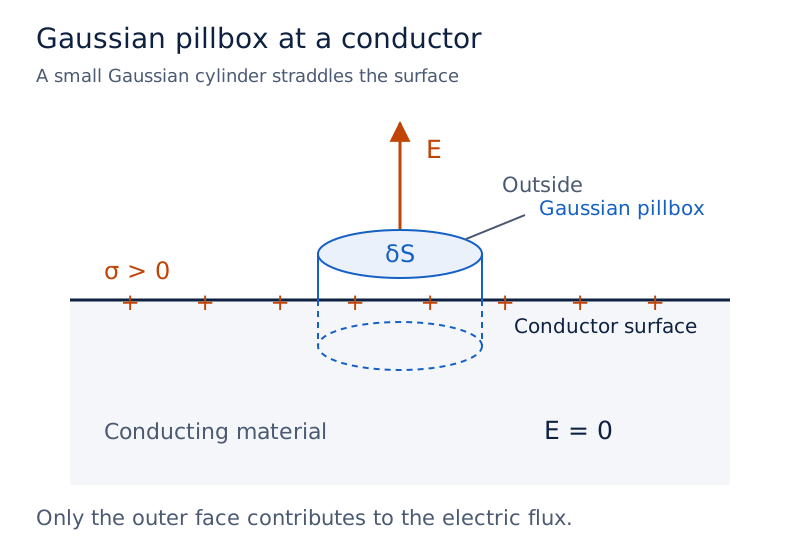
A short cylinder straddles a shaded conducting surface. Its face is labelled , the surface charge density is , and the field arrow points normally out of the surface.
Drawn by One Young India. See Fig. 2.17 in your NCERT textbook
How does electrostatic shielding work?
A charge-free cavity inside a conductor has zero electrostatic field, irrespective of its shape and the external electrostatic arrangement. This shielding can protect sensitive instruments from external electrical influences. The absence of charges inside the cavity is an essential condition for this statement.
How do dielectrics become polarised?
Dielectrics are non-conducting materials with no, or negligibly few, mobile charge carriers. Their charges cannot redistribute freely as in a conductor. Instead, an external field stretches molecular charge distributions or tends to reorient existing molecular dipoles.
What distinguishes polar and non-polar molecules?
| Feature | Non-polar molecules | Polar molecules |
|---|---|---|
| Charge centres without a field | Positive and negative centres coincide. | Positive and negative centres are separated. |
| Permanent dipole moment | No permanent dipole moment. | A permanent dipole moment exists. |
| Examples | O₂ and H₂. | HCl and H₂O. |
| Main field response | Opposite displacements induce a dipole moment. | Permanent dipoles tend to align with the field. |
In a non-polar molecule, displacement stops when the external electric force is balanced by internal restoring forces. In a polar material without an external field, thermal agitation leaves molecular dipoles randomly oriented, so their combined dipole moment is zero.
An applied field favours alignment, while thermal motion disrupts it. Polar molecules can also acquire induced dipole moments, although the alignment contribution is generally more important for them.
What are polarisation and susceptibility?
Polarisation, denoted by the vector , is dipole moment per unit volume. For a linear isotropic dielectric, it is parallel and proportional to the electric field inside the material:
The material constant is its electric susceptibility. The SI unit of polarisation is the coulomb per square metre, .
In a uniformly polarised slab, neighbouring dipoles leave no net charge in the bulk, but bound charges remain on the opposite faces normal to the field. Their field opposes the applied field. Unlike free-charge redistribution in a conductor, this response reduces the internal field without completely cancelling it.
What determines the capacitance of a parallel plate capacitor?
A capacitor consists of two conductors separated by an insulator. In the usual arrangement, the conductors carry equal and opposite charges. The charge of the capacitor means the magnitude of charge on one conductor, rather than its total net charge.
Definition: Capacitance is the ratio of the charge on either conductor to the potential difference between the conductors: .
For a fixed geometry and dielectric, potential difference is proportional to charge, so capacitance is independent of either separately. It depends on conductor shape, size, separation and the insulating medium. The SI unit of capacitance is the farad: .
Common smaller units are , and . A large capacitance allows substantial charge storage at a relatively small potential difference.
Derivation: vacuum parallel plate capacitance
Take plate area , separation and charges and . Assume , and neglect edge effects.
- The surface charge density magnitude is
- The two sheet fields add between the plates and cancel outside:
- The uniform internal field gives
- Divide charge by potential difference:
Result: Increasing plate area increases capacitance, while increasing separation decreases it. For finite plates, the field bends near the edges; this is called fringing. The uniform-field approximation applies sufficiently far from those edges.
What the figure shows
Parallel plate capacitor
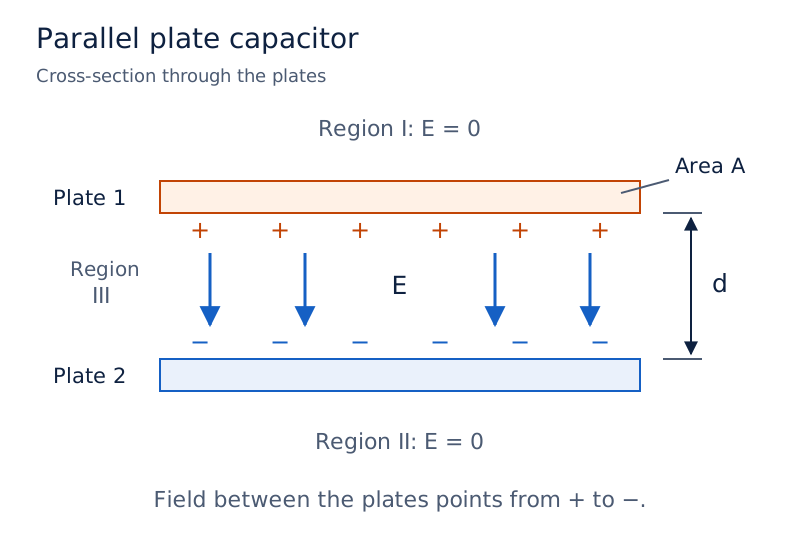
Plate 1 lies above plate 2, with positive charge on the upper facing surface and negative charge on the lower one. Downward field arrows occupy region III between them; area , separation and the outer regions I and II are labelled.
Drawn by One Young India. See Fig. 2.25 in your NCERT textbook
Dielectric strength is the maximum electric field an insulating material withstands before breakdown. For air it is about . A sufficiently strong field can ionise air, allowing charge to leak between the conductors.
Worked example 4. A parallel plate capacitor has air between plates of area , separated by . Find its capacitance and the charge on each plate with a supply, treating air approximately as vacuum.
Formula: , .
Answer: The supply fixes the potential difference at .
- Substitute:
The plates carry equal and opposite charges of this magnitude; their total charge is zero.
How does a dielectric change capacitance?
When a dielectric completely fills the space between capacitor plates, polarisation charges produce a field opposing the field of the free plate charges. At unchanged free charge, the total field and potential difference decrease, so the capacitance increases.
Derivation: capacitance with a complete dielectric filling
Let the vacuum capacitance be , and let the dielectric constant be . Let , and denote the field magnitude, potential difference and free plate charge magnitude before insertion. Let denote the magnitude of the bound polarisation charge per unit area on either dielectric face, and let be the dielectric permittivity.
- With no dielectric,
- For fixed free charge, polarisation reduces the field:
- The potential difference becomes
- Hence
Result: The permittivity is , and the dielectric constant is . It is dimensionless; vacuum has , while the dielectrics considered here have .
Why does the battery connection matter?
An isolated capacitor retains its free plate charge when a dielectric is inserted. A capacitor still connected to a battery retains its potential difference instead; additional charge flows from the battery. In both cases, complete insertion changes the capacitance by the same factor.
| Condition during complete insertion | Quantity held fixed | Result |
|---|---|---|
| Battery disconnected | Free charge | , |
| Battery remains connected | Potential difference | , |
What if the slab fills only part of the separation?
For a slab of the same area as the plates and thickness , an air or vacuum gap of thickness remains. At fixed free charge, add the potential drops across the two regions.
- The drops combine as
- Using the original voltage gives
- At unchanged free charge,
The remaining gap is why the increase is smaller than for complete filling. The thickness of the slab must therefore be considered before using the full-filling formula.
How are capacitors combined, and how much energy do they store?
A network can be replaced by an equivalent capacitance when it stores the same terminal charge at the same applied potential difference. The connection pattern determines which charges or potential differences are shared.
Derivation: series and parallel combinations
Let , and be the capacitance, potential difference and plate charge magnitude of capacitor . Let and be the equivalent capacitances of the series and parallel combinations, respectively.
- In series, each capacitor carries the same charge magnitude, and voltages add:
- Use the equivalent capacitor relation:
- In parallel, each capacitor has the same voltage, and terminal charges add:
- Divide by the common voltage:
Result: Series capacitors share charge magnitude; parallel capacitors share potential difference. Do not interchange these conditions when reducing a mixed network.
What the figure shows
Mixed capacitor network
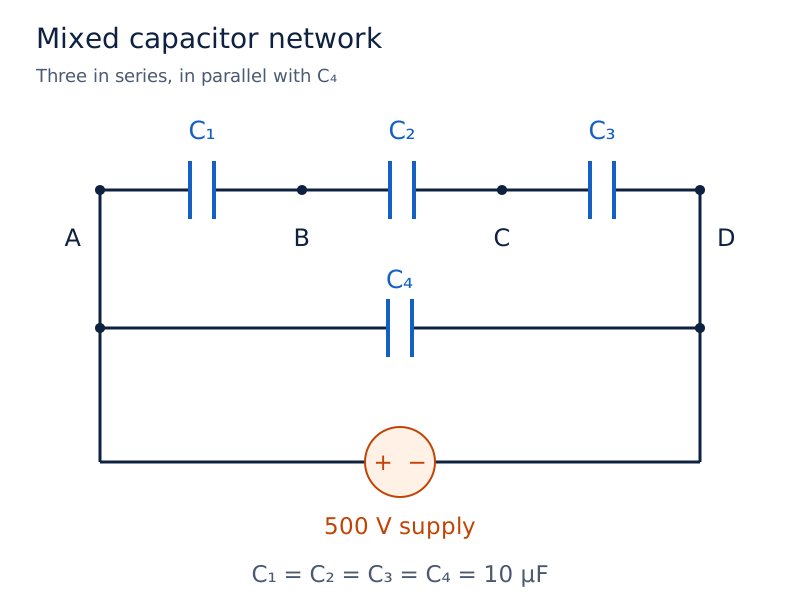
Capacitors , and lie successively along the path from through and to . Capacitor connects directly across and , with the supply across those endpoints.
Drawn by One Young India. See Fig. 2.29 in your NCERT textbook
Worked example 5. Four capacitors of each form this network: three in series, with the fourth in parallel across the series branch. Find equivalent capacitance and capacitor charges for a supply.
Formula: for three equal series capacitors, , .
Answer: Each complete branch has across it.
- Substitute:
- The charge magnitude on each series capacitor is
- The fourth capacitor carries
Derivation: energy stored during charging
Start with an uncharged capacitor. As charge is transferred from one conductor to the other, the potential difference rises, so successive equal charge transfers require progressively more work.
- At intermediate plate charge magnitude , the potential difference is
- The small additional external work is
- Integrate over the charging process:
- Use the final charge-voltage relation:
Result: The factor of one half accounts for the rising voltage during charging. Multiplying the final voltage by all the transferred charge would overestimate the stored energy.
For a vacuum parallel plate capacitor, the energy can be associated with the electric field occupying the volume between the plates. The following numbered substitutions give the energy density.
- Insert the capacitance and voltage:
- Divide by the field volume:
The SI unit of energy density is the joule per cubic metre, . The vacuum field-energy density relation applies more generally than this particular capacitor geometry.
Worked example 6. A capacitor is charged by a battery. It is disconnected from the battery and connected in parallel to an identical uncharged capacitor, with each plate joined to one plate of the other capacitor. Find the initial and final stored energies.
Formula: , , .
Answer: Total free charge is conserved during sharing.
- Substitute:
- Both capacitors together store
- The decrease is
Charge is conserved, but stored electrostatic energy decreases. During the transient current, energy is transferred into heat and electromagnetic radiation.
Glossary
- Electrostatic potential — External work per unit positive test charge brought without acceleration from the chosen zero-potential reference.
- Potential difference — Difference in potential between two points, equal to external work per unit charge for slow transfer.
- Conservative force — Force whose work between two positions is independent of the path followed between them.
- Equipotential surface — Surface with equal potential at every point, requiring no electrostatic work for motion along it.
- Electric dipole — Pair of equal and opposite charges separated by a small distance from one another.
- Dipole moment — Vector directed from negative to positive charge, with magnitude equal to charge magnitude multiplied by separation.
- Electrostatic shielding — Protection of a charge-free conducting cavity from external electrostatic influences, with zero electric field inside.
- Dielectric — Non-conducting material whose molecular charge distributions can become polarised in an applied electric field.
- Polarisation — Electric dipole moment per unit volume of a dielectric material.
- Capacitance — Ratio of charge magnitude on either capacitor conductor to the potential difference between the conductors.
- Dielectric constant — Dimensionless ratio of a medium's permittivity to vacuum permittivity, also giving the capacitance increase on complete filling.
- Dielectric strength — Maximum electric field a dielectric can withstand without breakdown of its insulating property.
- Energy density — Energy stored per unit volume in a region containing an electric field.
Common errors and misconceptions
- Misconception: Potential and potential energy are interchangeable. Correct: Potential describes the field configuration; a charge's potential energy is and depends on that charge.
- Misconception: Zero potential implies zero electric field. Correct: Field depends on spatial change of potential. A dipole's equatorial plane has zero potential but need not have zero field.
- Misconception: Potential inside a charged conductor must be zero. Correct: It is constant throughout the conductor, but the constant depends on the configuration and reference.
- Misconception: The distant dipole potential formula is exact at every distance for a finite dipole. Correct: It assumes ; use the separate charge potentials when that approximation is unsuitable.
- Misconception: Adding a dielectric always reduces the capacitor voltage. Correct: Voltage falls for fixed free charge; a connected battery holds voltage fixed and supplies additional charge.
- Misconception: Series capacitors have equal voltages, while parallel capacitors have equal charges. Correct: Series capacitors share charge magnitude; parallel capacitors share voltage. Other equalities require suitable capacitances.
- Misconception: Capacitor energy is . Correct: It is , since the potential difference increases from zero while the initially uncharged capacitor is charged.
- Misconception: Conserved charge guarantees conserved capacitor energy during charge sharing. Correct: Stored electrostatic energy can decrease, with energy appearing as heat and electromagnetic radiation.
Exam-style questions with model answers
Q1. Define electrostatic potential and state its SI unit. [2 marks]
- Electrostatic potential is the external work per unit positive test charge in bringing it without acceleration from infinity to a point, taking infinity as zero potential.
- Its SI unit is the volt: .
Q2. Explain why a nonzero electric field is perpendicular to an equipotential surface. [3 marks]
- An equipotential surface has the same potential everywhere, so transferring a test charge along it changes no potential energy.
- A tangential field component would require external work to move a positive test charge against that component. This would imply a potential difference between points on the surface.
- That contradicts the definition. The tangential component must vanish, leaving the nonzero electric field normal to the equipotential surface.
Q3. Derive the potential far from a finite electric dipole, stating the approximation. [5 marks]
- Place the origin at the midpoint of charges and , separated by . Let the observation point have distance and angle to the dipole moment. Assume .
- Add scalar potentials, retaining their signs:
- The geometry gives and . To first order,
- Subtract and use : This shows that potential depends on orientation as well as distance. Higher powers of the small separation-to-distance ratio have been neglected. On the positive axial side the potential is positive; on the opposite axial side it is negative. In the equatorial plane the two charge potentials cancel exactly.
Q4. State and explain three electrostatic properties of a conductor. [3 marks]
- The electric field within the conducting material is zero in electrostatic equilibrium. Otherwise its mobile charges would experience forces and drift, contradicting the static condition.
- Excess charge lies on surfaces. Any Gaussian surface entirely within the material has zero electric flux and therefore encloses no net charge.
- Potential is constant throughout the conductor and on its surface. There is no internal field or tangential surface field to require work when moving a test charge between such points.
Q5. Derive vacuum parallel plate capacitance and explain the effect of complete dielectric filling. [5 marks]
- Consider two plane conducting plates of area , separation , and charges and . Assume and neglect fringing sufficiently far from the edges.
- Surface charge density is . The sheet fields reinforce inside and cancel outside:
- The uniform field gives the potential difference:
- Divide charge by voltage: Thus the capacitance is determined by the geometry and vacuum permittivity.
- Complete dielectric filling reduces the field and voltage by at fixed free charge. Therefore . If the battery remains connected instead, its fixed voltage causes extra charge to flow onto the plates.
Q6. Derive the capacitance of two capacitors connected in series. [3 marks]
- Each capacitor carries the same charge magnitude . Their potential differences are and .
- The terminal voltage is the sum of these drops:
- The equivalent capacitor has . Substituting and dividing by the common charge gives Equality of charge, rather than equality of individual voltages, is the condition used in this derivation.
Q7. Derive the energy stored in a capacitor and explain the factor of one half. [5 marks]
- Start with an uncharged capacitor of fixed capacitance . Transfer positive charge gradually from one conductor to the other, so the potential difference increases during charging.
- At an intermediate charge , the voltage is . Moving an additional charge requires external work
- Integrate from zero to the final charge:
- Since , equivalent expressions are . The factor of one half arises because the voltage was not at its final value throughout charging. This external work becomes stored electrostatic potential energy, which can be released on discharge.
Key takeaways
- Electrostatic potential difference measures external work per unit positive charge, with the charge moved without acceleration.
- Add point-charge potentials algebraically, preserving charge signs and using each charge's distance from the observation point.
- A distant dipole's potential depends on orientation and distance; its equatorial plane has exactly zero potential.
- Electric field is normal to equipotential surfaces and points towards the steepest decrease in potential.
- A conductor in electrostatic equilibrium has zero internal field, constant potential and excess charge on its surfaces.
- Dielectric polarisation opposes the applied field and increases capacitance; the battery connection determines which electrical quantity stays fixed.
- Series capacitors share charge magnitude, while parallel capacitors share voltage; apply these conditions before calculating a network's capacitance.
- Capacitor energy reflects the full charging process, and charge sharing can transfer stored energy into heat and radiation.
Test yourself
Why is the path irrelevant when calculating electrostatic work?
Electrostatic force is conservative, so its work depends only on the initial and final positions.
What is the potential throughout the interior of a uniformly charged spherical shell?
It equals the surface potential, , because the interior field is zero.
Which direction defines the electric dipole moment?
It points from the negative charge towards the positive charge, with magnitude equal to charge magnitude times separation.
Does zero torque guarantee that a dipole has minimum potential energy?
No. Torque also vanishes when the dipole is antiparallel to the field, where its orientation energy is maximum.
What condition is essential when stating that a conducting cavity has zero field?
The cavity must contain no charges, and the conductor must be in electrostatic equilibrium.
What does the charge of a capacitor mean?
It means the charge magnitude on one conductor; the two conductors carry equal and opposite charges.
What stays fixed when a dielectric is inserted after disconnecting the battery?
The free charge on the plates stays fixed. Capacitance increases and the potential difference decreases.
Where does the missing electrostatic energy go during capacitor charge sharing?
The transient current transfers energy into heat and electromagnetic radiation while total charge remains conserved.