
Indian Economy and Issues of Development | ISC Class 11 Economics Notes
On this page
Watch & explore
Start with a few high-quality watches, then dive into the notes below.
Try an idea before you read. Step into the role of an economic analyst advising on regional development and labor productivity challenges in India. Explore →
This note covers economic growth and development, per capita income, human development, planning, economic reforms, agriculture, industry, foreign trade, poverty, rural development, human capital, unemployment and environmental sustainability.
How does economic development differ from economic growth?
Economic growth means an increase in a country's real national income. It involves expansion of productive capacity through more capital, better supporting services or greater efficiency. Economic development concerns improvement in people's lives as well as expansion of production.
Gross Domestic Product (GDP) is the market value of final goods and services produced within a country during a year. An increase in real output provides resources for improving living standards, but the distribution and use of those resources also matter.
Why is a larger economy not sufficient?
People seek regular work, adequate income, education, health, security, equal treatment and freedom. Higher output can coexist with poverty if its benefits remain concentrated. Development therefore asks whether people can live healthier lives, acquire knowledge and exercise meaningful choices.
| Basis | Economic growth | Economic development |
|---|---|---|
| Main concern | Expansion of real income and output | Improvement in living conditions and opportunities |
| Nature | Primarily a quantitative change | Includes qualitative improvements |
| Assessment | Changes in production and real income | Income, health, education and people's choices |
| Distribution | Higher output alone does not establish equitable sharing | Who benefits is central to judging progress |
Human development puts people at the centre of this assessment. Mahbub-ul-Haq's approach emphasised enlarging choices; Amartya Sen emphasised freedom and capabilities. Education is valuable both because it can increase productivity and because it enables people to pursue lives they value.
Can development goals conflict?
They can. Industrialists may favour dams that provide electricity, while people whose land would be submerged may oppose displacement. Similarly, landless labourers seek better wages, whereas prosperous farmers may seek cheaper labour. National development must consider these competing interests.
Note: Development requires a combination of goals. An increase in income does not establish an improvement in every aspect of well-being, and one group's gain may impose costs on another group.
What does per capita income measure, and what does it hide?
Per capita income is average income per person. Comparing total incomes alone can mislead because countries have different populations. Dividing income by population makes allowance for population size, although it does not describe the circumstances of every resident.
Per capita income = total income ÷ total population
Use income and population relating to the same country or group and period. An average is a summary, not a claim that everyone receives the same amount. It must be considered alongside the distribution of income and access to public facilities.
How can equal averages conceal inequality?
| Country | Monthly incomes of its five citizens | Total monthly income | Average monthly income |
|---|---|---|---|
| A | ₹9,500; ₹10,500; ₹9,800; ₹10,000; ₹10,200 | ₹50,000 | ₹10,000 |
| B | ₹500; ₹500; ₹500; ₹500; ₹48,000 | ₹50,000 | ₹10,000 |
Worked example 1. Calculate average monthly income for countries A and B using the five incomes in each row above.
Answer: A has ₹9,500 + ₹10,500 + ₹9,800 + ₹10,000 + ₹10,200 = ₹50,000. B has four incomes of ₹500 plus ₹48,000 = ₹50,000. Each average is ₹50,000 ÷ 5 = ₹10,000 per month. Distribution is much more unequal in B.
In A, incomes are clustered around the average. In B, four people have very low incomes while one receives most of the total. Consequently, identical per capita income does not demonstrate identical living standards for most people.
Diagram
Equal averages, unequal incomes
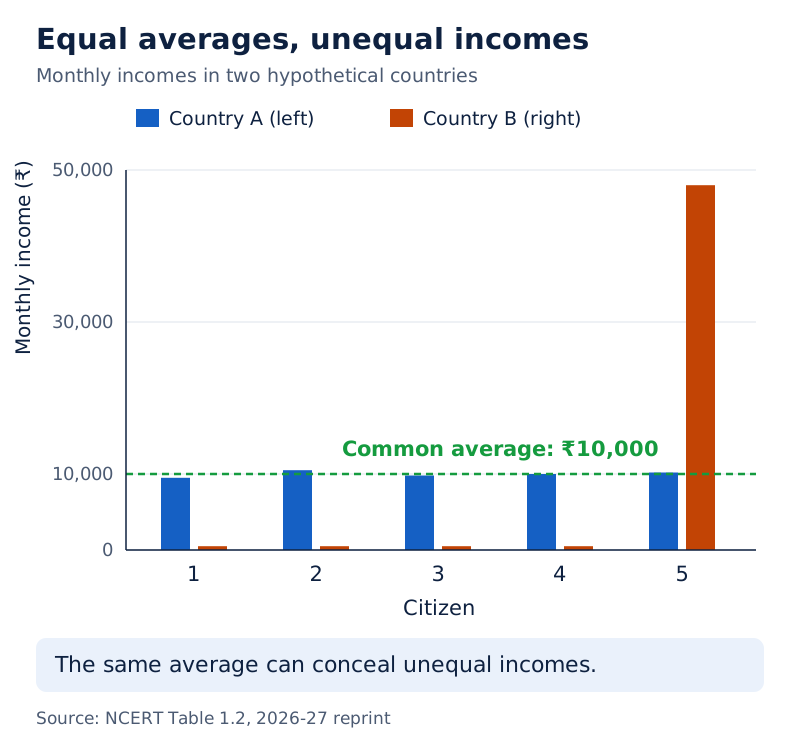
Draw grouped bars for citizens 1 to 5, with monthly income in rupees on the vertical axis. Use the two rows of income data above. Mark the common average of ₹10,000 with a horizontal line.
Drawn by One Young India.
How is a missing income calculated?
Total income = average income × number of income units
Worked example 2. Four families have an average income of ₹5,000. Three family incomes are ₹4,000, ₹7,000 and ₹3,000. Find the fourth income.
Answer: Total family income = ₹5,000 × 4 = ₹20,000. The three stated incomes total ₹14,000. The fourth income is ₹20,000 − ₹14,000 = ₹6,000. Here the average is across four families; calculating income per person would also require their family sizes.
Income also omits important collective conditions. A higher personal income does not by itself provide clean surroundings, reliable public health protection or schools accessible to all. Such facilities require social and public action as well as purchasing power.
How does the Human Development Index broaden the assessment?
The Human Development Index (HDI) combines achievements in health, education and living standards. The United Nations Development Programme (UNDP) publishes Human Development Reports. The index shifts attention from the size of an economy to the capabilities and opportunities of its people.
What enters its construction?
| Dimension | Indicator used in the modern HDI | Meaning |
|---|---|---|
| Health | Life expectancy at birth | Expected length of life for a newborn under prevailing mortality conditions |
| Education | Mean years and expected years of schooling | Schooling already attained by adults and schooling expected for a child |
| Living standards | Gross National Income per person adjusted for purchasing power | Command over resources, allowing for differences in purchasing power |
Construction involves converting indicators into comparable dimension indices. The two schooling indices are averaged to form the education index. Income is treated logarithmically, so an additional amount of income has a diminishing contribution. The three dimension indices are combined using their geometric mean.
Let H mean the health index, E the education index and I the income index. These are dimensionless normalised indices, not raw years or money amounts.
HDI = (H × E × I)¹ᐟ³
A value nearer one indicates greater average achievement. The geometric mean also makes an imbalance between dimensions matter: strong income performance does not fully compensate for weak health or education. The index is broader than income alone, but it still summarises national averages.
What do the reported figures show for India?
The Human Development Report 2025 gives India an HDI value of 0.685 and rank 130. China's corresponding value is 0.797 and rank 78; Pakistan's is 0.544 and rank 168. These are report-specific figures, not timeless rankings.
HDI does not reveal every inequality within a country. Regional, gender and income-group differences require further examination. Nor does its value alone establish environmental sustainability. A sound assessment therefore combines the index with distributional evidence and attention to future opportunities.
Why did India adopt planning, and what were its major objectives?
After independence on 15 August 1947, India chose a mixed economy: public and private activity would both contribute to development. Planning set priorities for scarce resources, particularly where essential infrastructure and large industrial investments could not be left entirely to private enterprise.
The Planning Commission was established in March 1950 by a government resolution, with the Prime Minister as chairperson. It had an advisory role. Five-Year Plans specified objectives for a period of five years, within a longer perspective of development.
What goals guided the plans?
| Goal | Meaning | Developmental purpose |
|---|---|---|
| Growth | Increase productive capacity and output | Provide more goods and services |
| Modernisation | Adopt better technology and progressive social attitudes | Raise efficiency and recognise equal opportunities |
| Self-reliance | Reduce dependence on imports that domestic production can replace | Limit vulnerability to external pressure |
| Equity | Share prosperity and reduce inequalities | Enable people to meet basic needs |
The plans did not give every goal equal weight. Resources were limited and objectives could conflict. For example, machinery could increase output while reducing the labour required for a particular operation. Planning required choices about priorities and their social consequences.
How did priorities change across the plans?
| Plan and period | Principal emphasis |
|---|---|
| First, 1951 to 1956 | Agriculture, irrigation and rehabilitation of the economy |
| Second, 1956 to 1961 | Heavy industry and a stronger industrial base |
| Third, 1961 to 1966 | A self-reliant and self-generating economy |
| Fourth, 1969 to 1974 | Growth with stability and progressive self-reliance |
| Fifth, 1974 to 1979, terminated early | Poverty removal and self-reliance |
| Sixth, 1980 to 1985 | Address poverty and unemployment through growth and modernisation |
| Seventh, 1985 to 1990 | Food, work and productivity |
| Eighth, 1992 to 1997 | Human development, employment and modernisation |
| Ninth, 1997 to 2002 | Growth with social justice and equity |
| Tenth, 2002 to 2007 | Faster growth with monitorable social-development targets |
| Eleventh, 2007 to 2012 | Faster and more inclusive growth |
| Twelfth, 2012 to 2017 | Faster, more inclusive and sustainable growth |
The Second Plan was strongly associated with P. C. Mahalanobis. The Industrial Policy Resolution 1956 gave the state a leading role in strategic industries. Planning helped diversify production, but persistent poverty and insufficient movement of workers out of agriculture remained major concerns.
What is NITI Aayog's role?
NITI Aayog, the National Institution for Transforming India, replaced the Planning Commission on 1 January 2015. Its role centres on policy advice, strategic thinking, cooperation with states, and monitoring and evaluation of development initiatives.
Its objectives include developing a shared national development vision, promoting cooperative federalism and strengthening planning from the local level. It is a policy institution rather than a continuation of the old system of allocating plan funds to states.
How did agricultural policy address growth and equity?
At independence, low agricultural productivity, dependence on rainfall and unequal land ownership constrained development. Policy addressed both the organisation of ownership and the techniques of production. Land reforms and the Green Revolution pursued related but different objectives.
What did land reforms attempt?
Abolishing intermediaries aimed to connect cultivators directly with the state and give tillers stronger incentives to improve the land. Land ceilings fixed a maximum area that an individual could own, seeking to reduce concentration of ownership.
Implementation was uneven. Landlords used legal loopholes, transfers to relatives and eviction of tenants to avoid restrictions. Landless labourers did not automatically obtain land. Kerala and West Bengal achieved more success where governments were committed to the policy of land to the tiller.
What changed with the Green Revolution?
High Yielding Variety (HYV) seeds, especially for wheat and rice, raised foodgrain production when combined with appropriate fertilisers, pesticides and reliable water. Seeds alone were insufficient: access to irrigation, finance and research support mattered.
The first phase, approximately the mid-1960s to mid-1970s, was concentrated in better-equipped regions. During the second phase, from the mid-1970s to mid-1980s, the technology spread more widely. Higher output supported foodgrain self-sufficiency and public stocks.
Marketed surplus is the portion of agricultural produce sold by farmers. More output benefits the wider economy when sufficient produce reaches markets, helping supply consumers and enabling government procurement for periods of shortage.
Why are subsidies debated?
Supporters emphasise risk, small farmers' limited resources and access to inputs. Critics argue that benefits may concentrate among richer farmers and fertiliser producers, strain public finances and encourage wasteful resource use. The issue is therefore both efficiency and the distribution of support.
Post-liberalisation challenges include pressure from imports, higher input costs and inadequate investment in irrigation, roads, research and market connections. Agriculture's development requires productive investment alongside measures that protect vulnerable cultivators and conserve resources.
Why were economic reforms introduced in 1991?
India's 1991 economic crisis involved difficulties meeting external payment obligations, dwindling foreign exchange reserves and rising prices. Imports had grown without a matching rise in exports, while government borrowing had become increasingly difficult to sustain.
India approached the World Bank and the International Monetary Fund (IMF). The resulting reform programme sought a more competitive economy through liberalisation, privatisation and globalisation. These policies changed the balance between state controls, markets and international integration.
How do stabilisation and structural reform differ?
Stabilisation measures address immediate imbalances, including inflation and the shortage of foreign exchange. Structural reforms seek longer-term improvements in efficiency and international competitiveness by changing institutions, regulations and incentives.
| Reform | Meaning | Important measures or effects |
|---|---|---|
| Liberalisation | Relaxation of restrictions on economic activity | Reduced industrial licensing, trade barriers and controls |
| Privatisation | Withdrawal of government ownership or management | Greater scope for private capital and management |
| Globalisation | Greater integration with the world economy | Expanding international flows and production or service links |
What were the main policy changes?
- Industrial reforms removed many licensing requirements and reduced restrictions on private participation.
- Financial reforms sought greater operational freedom while retaining safeguards. The Reserve Bank of India (RBI) remained important to banking regulation.
- Tax reforms pursued simpler procedures, lower rates in several areas and improved compliance.
- External-sector reforms included rupee devaluation in 1991 and reductions in import restrictions and tariffs.
Disinvestment means selling government equity in public enterprises. It is associated with privatisation, but selling some shares does not necessarily transfer management control. Its assessment involves efficiency, the valuation of public assets and the use of sale proceeds.
In 2016, a constitutional amendment enabled the Union and states to enact laws for Goods and Services Tax (GST). The reform sought a more integrated national market. Trade liberalisation also included removing quantitative restrictions on specified manufactured consumer and agricultural imports from April 2001.
Reforms should be assessed through several outcomes: production, employment, distribution and public services. Faster output growth is significant, but it does not by itself show that agriculture, small producers and low-income households benefited equally.
How did liberalisation affect industry, trade and farm incomes?
Before liberalisation, import substitution encouraged domestic production in place of imported goods. Tariffs made imports more expensive; quotas restricted quantities. Protection was intended to give developing industries time to establish themselves and conserve foreign exchange.
Public investment helped build a diversified industrial base. Industry's share of GDP rose from 13 per cent in 1950-51 to 24.6 per cent in 1990-91. However, protection could weaken pressure to improve quality, lower costs and respond to consumers.
Diagram
Industry's changing GDP share
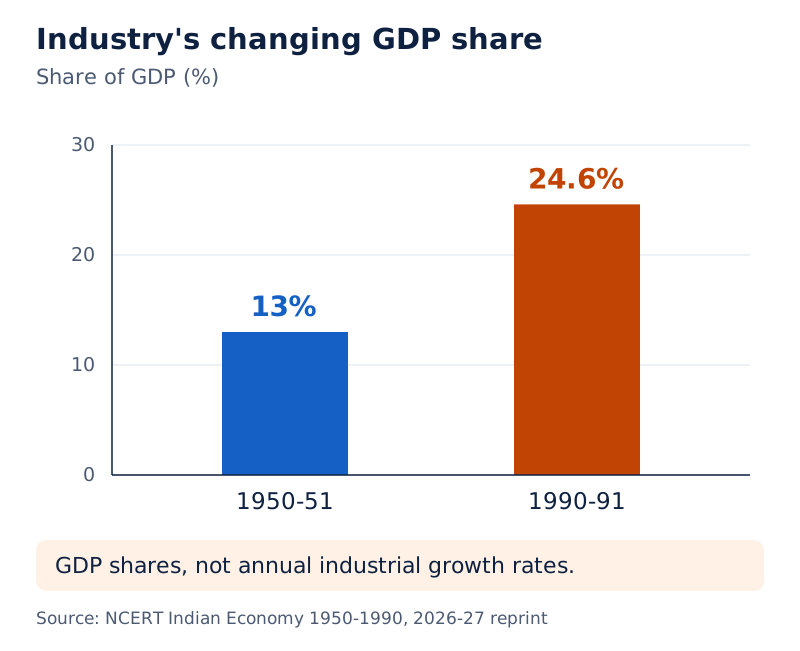
Draw two bars labelled 1950-51 and 1990-91. Use percentage share of GDP on the vertical axis and bar heights of 13 and 24.6 respectively. These figures are shares, not annual industrial growth rates.
Drawn by One Young India.
What opportunities and pressures followed?
Opening markets offered access to foreign technology, investment and customers. Outsourcing expanded links in services such as accountancy, software and customer support. India became an important destination because of skilled labour and relatively low costs.
The World Trade Organisation (WTO), founded in 1995, sought a rules-based system for international trade. Nevertheless, market access and the distribution of benefits remained disputed. Domestic producers faced competition, and weak infrastructure could prevent them from taking advantage of new opportunities.
What does Mahadeva's example show?
Mahadeva grew groundnut on half an acre in drought-prone Anantpur, Andhra Pradesh. His cultivation cost included seeds, fertilisers, labour, bullock power and machinery. Reduced support, crop disease and competition from cheap imported edible oils later placed pressure on his earnings.
Sales revenue = quantity sold × price per unit
Net return = sales revenue − stated cultivation cost
Worked example 3. Mahadeva spends ₹10,000 cultivating groundnut, obtains two quintals and sells each quintal for ₹7,000. Calculate sales receipts and the amount remaining after the stated cost.
Answer: Sales receipts = 2 × ₹7,000 = ₹14,000. Net return over the stated cost = ₹14,000 − ₹10,000 = ₹4,000. ₹14,000 is the gross receipt, not the amount left after cultivation expenses.
This example connects trade policy with farm-level conditions. A cultivator's position depends on both selling prices and production costs. Better irrigation, research, extension and marketing can therefore be as important as access to wider markets.
Why can poverty persist despite growth?
Absolute poverty means inability to meet a defined minimum level of basic needs. Relative poverty concerns deprivation in comparison with the living standards of others. A country may experience rising average income while substantial differences in opportunities remain.
What is the vicious circle of poverty?
Low incomes leave little capacity to save. Weak savings and limited access to finance restrict investment. Low investment can keep productivity and earnings low, reproducing the original shortage of income. Poor health and limited education can reinforce this process.
Diagram
Vicious circle of poverty
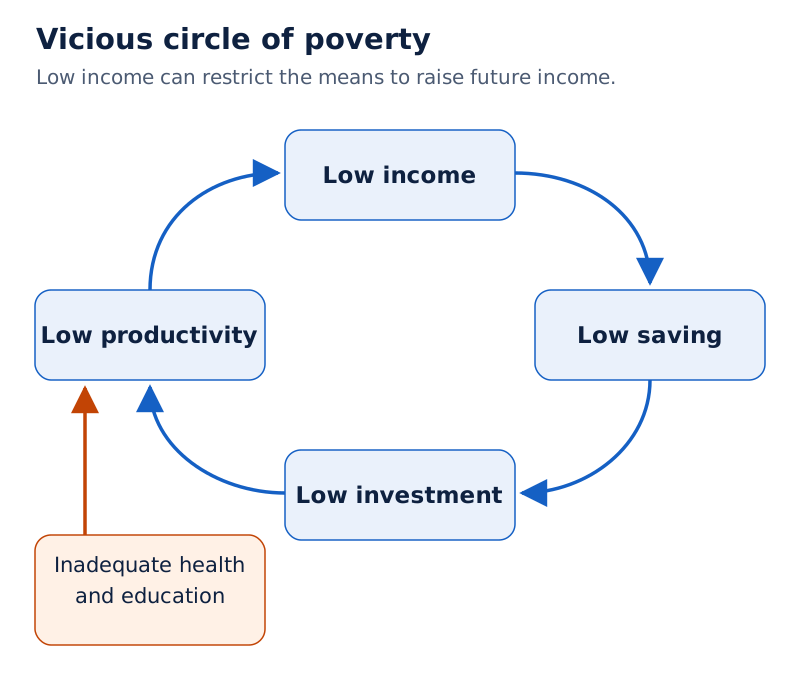
Connect low income, low saving, low investment and low productivity in a circular sequence, returning to low income. Add a separate link from inadequate health and education to low productivity.
Drawn by One Young India.
Poverty also involves inadequate access to productive assets, regular work, credit and public facilities. Rural households may face insecure earnings while being unable to finance better equipment or training. A low income can therefore restrict the means needed to raise future income.
How can policy interrupt the cycle?
Poverty alleviation combines employment opportunities, assistance for income-generating assets and basic services. Programmes providing drinking water, nutrition, education, health, housing and sanitation address dimensions of deprivation that an income increase alone may not resolve.
The Mahatma Gandhi National Rural Employment Guarantee Act 2005 established a guarantee of at least 100 days of wage employment in every financial year for each rural household whose adult members volunteer for unskilled manual work. This is a household entitlement under that framework, not 100 days for each household member separately.
Self-help groups support small savings and access to credit. Kerala's Kudumbashree illustrates community-based poverty reduction involving women. Such approaches can strengthen the ability to undertake income-generating activity and participate in decisions.
How should poverty programmes be assessed?
Assess access, productive opportunities and the services actually delivered. Credit cannot be assumed to remove poverty if households cannot invest it productively. Weak infrastructure, inadequate market links and exclusion from formal finance can limit results, so complementary measures are necessary.
Growth and targeted programmes work through different routes. Higher production can expand opportunities, while targeted action seeks to ensure that people with fewer assets or capabilities can participate. Equity requires attention to who receives the benefits.
How do rural credit, marketing and diversification support development?
Rural development includes improving human capabilities, productive resources, infrastructure and livelihoods. It extends beyond crop output to education, sanitation, health, employment and opportunities outside farming. Credit and marketing connect production decisions with the income farmers can obtain.
Why do rural households need credit?
Costs arise before harvest income is received. Farmers borrow for seeds, fertilisers, implements and household needs during this interval. Dependence on moneylenders can expose borrowers to high interest charges and manipulated accounts.
Institutional sources include commercial banks, regional rural banks, cooperatives and land development banks. The National Bank for Agriculture and Rural Development (NABARD) was established in 1982 to coordinate institutions involved in rural finance.
Self-help groups pool members' small savings and lend to members in need, usually with repayment in instalments. They can help households excluded by collateral requirements. However, access to a loan does not establish that it will be used for productive investment.
How can agricultural marketing improve?
Agricultural marketing covers assembling, storing, processing, transporting, packaging, grading and distributing produce. Faulty weighing, weak price information and inadequate storage can force farmers to sell on unfavourable terms.
- Regulated markets seek orderly and transparent transactions.
- Roads, warehouses, cold storage and processing facilities reduce physical barriers to marketing.
- Cooperative marketing can strengthen producers' ability to obtain fair prices, as milk cooperatives in Gujarat illustrate.
- Minimum support prices, buffer stocks and the Public Distribution System link farmer support with food access.
Direct channels include Apni Mandi in Punjab, Haryana and Rajasthan, and Rythu Bazars in Andhra Pradesh and Telangana. The e-National Agriculture Market portal, launched in 2016, connected markets electronically.
Why diversify and adopt organic farming?
Diversification means changing cropping patterns and expanding allied or non-farm work. Dairying, fisheries, horticulture and food processing can supplement seasonal crop earnings. They also require finance, infrastructure and reliable market connections.
Organic farming seeks to restore and maintain ecological balance using organic methods. It can substitute locally available inputs for costly purchased inputs and generate labour demand. Initial yields may be lower, while marketing difficulties, shorter shelf life and limited off-season production can impede adoption.
The Tamil Nadu Women in Agriculture project began in the late 1980s, training women in improved techniques and organic farming. Women's groups used vermicompost production and small savings to support income-generating activities, linking skills, organisation and credit.
How does human capital formation improve development?
Human capital formation develops people's productive knowledge, skills and health. Education, healthcare, training, migration and information can all contribute. People become a productive resource through capabilities that allow them to use opportunities and improve the quality of their work.
What are the main sources?
| Source | Contribution |
|---|---|
| Education | Builds knowledge and skills and supports learning |
| Health | Reduces interruptions from illness and supports productive work |
| On-the-job training | Develops abilities directly relevant to work |
| Migration | Can connect workers with better opportunities, while involving costs |
| Information | Improves decisions about jobs, education and healthcare |
Formal education is organised learning through structured institutions and courses. Informal education develops through everyday experience and interaction outside such a formal programme. Both can contribute to knowledge, although they differ in organisation and certification.
The human-development perspective regards education and health as valuable in themselves. Their importance is not limited to additional earnings. People should be able to read, participate in society and lead healthy lives even where an investment's immediate productivity return is small.
What progress and gaps are visible?
Government education expenditure rose from 0.64 per cent of GDP in 1952 to 4.47 per cent in 2020, with uneven movement during the intervening years. Differences between states and between social groups remain important to educational opportunity.
The Education Commission of 1964 to 1966 recommended spending at least 6 per cent of GDP on education. The Right of Children to Free and Compulsory Education Act 2009 addressed free education for children aged 6 to 14.
Worked example 4. In the rural Uttar Pradesh educational data, 85 per cent of boys and 82 per cent of girls aged 10 to 14 attend school. Calculate the percentage not attending in each group.
Answer: Boys not attending = 100% − 85% = 15%. Girls not attending = 100% − 82% = 18%. The difference is 18 − 15 = 3 percentage points. These are complements within each group, not numbers of children.
Government involvement is needed because education and health create wider social benefits, consumers may lack reliable quality information, and poorer households may be unable to pay. Expanding access therefore requires both adequate finance and dependable service quality.
What forms of unemployment require attention?
Unemployment involves people seeking or available for work under prevailing conditions but unable to obtain it. A person outside employment is not automatically unemployed: willingness and availability matter. Employment assessment must also consider whether existing work fully uses people's productive capacity.
How do the main forms differ?
| Form | Meaning | Illustration |
|---|---|---|
| Open unemployment | People seeking work cannot find it | A jobseeker unable to obtain employment |
| Disguised unemployment | More people work than are required for the existing output | Surplus workers engaged on a family farm |
| Seasonal unemployment | Work is unavailable during part of the year | Agricultural workers without work between busy farming periods |
Consider a four-acre farm that needs the farmer and two workers but instead engages five workers and additional family members. The visible presence of many people on the farm does not establish that all are necessary for its output. This illustrates disguised unemployment.
Seasonal unemployment is different: the worker may be fully occupied at harvest but lack work at another time. Limited irrigation and insufficient non-farm opportunities can make rural employment particularly irregular.
Why can output grow without enough jobs?
Jobless growth describes a situation in which output expansion is not accompanied by sufficient employment expansion. Technology, the composition of production and the limited absorption of workers outside agriculture affect the connection between growth and jobs.
Public action generates employment directly when government departments or enterprises hire people. It can also generate employment indirectly: an increase in a public steel enterprise's output can support expansion and employment in firms using that steel.
The employment guarantee established in 2005 is an important post-2000 example. Rural infrastructure, support for productive assets, skills, health and education also affect people's ability to obtain sustainable work. Creating opportunities and improving the quality of work are connected objectives.
Informalisation is another concern. A person may have work yet lack dependable social protection or secure conditions. Evaluating employment therefore requires more than counting whether some income-generating activity occurs.
How can development protect resources and future generations?
Sustainable development meets present needs while preserving future generations' ability to meet theirs. It connects growth with equity and environmental responsibility. The economy depends on nature for resources, waste absorption, life-supporting systems and the enjoyment of landscapes.
What happens when environmental limits are exceeded?
Carrying capacity requires resource extraction to remain compatible with regeneration and waste to remain within the environment's assimilative capacity. Renewable resources are not immune to overuse. Groundwater can decline when extraction exceeds replenishment through rainfall.
Non-renewable resources, including fossil fuels, have finite stocks. Pollution also imposes costs through ill health, damaged land and water, and the need for restoration or new technologies. Development that ignores these costs can weaken the conditions supporting future production and life.
What is global warming?
Global warming is the rise in the Earth's average lower-atmosphere temperature associated with an increase in greenhouse gases. Burning fossil fuels and deforestation add to the problem. Effects can include melting ice, rising seas, coastal flooding and disruption of water supplies and ecosystems.
A climate conference at Kyoto in 1997 produced an agreement calling for reductions in industrialised countries' greenhouse-gas emissions. The United Nations adopted 17 Sustainable Development Goals in 2015, intended for achievement by 2030.
Which actions support sustainability?
- Keep extraction of renewable resources within their capacity to regenerate.
- Develop renewable substitutes as non-renewable resources are depleted.
- Use technologies that save inputs rather than simply consuming more resources.
- Control pollution and account for its economic and social costs.
- Protect future opportunities while meeting the basic needs of poorer people.
Solar and wind energy, biogas, better use of organic inputs and suitable changes in transport fuels are important options. They need to be evaluated with attention to local conditions, costs and resource requirements. Sustainable development also requires institutions and public participation.
The Central Pollution Control Board was established in 1974. Pollution control boards monitor pollution, set relevant standards, support research and provide technical guidance. Effective environmental protection depends on implementation as well as stated policies.
The Appiko movement offers a community example. On 8 September 1983, people in Salkani forest in Karnataka hugged trees to stop felling. The movement linked forest protection to livelihoods and the consequences of commercial exploitation.
Future well-being is not secured merely by producing more today. It requires preserving natural assets, improving health and education, and creating livelihoods that can continue without imposing unacceptable costs on those who follow.
Glossary
- Economic growth — An increase in real national income and the economy's capacity to produce goods and services.
- Economic development — Improvement in people's living conditions, capabilities and opportunities, extending beyond an increase in output.
- Per capita income — Total income divided by population, providing an average that does not reveal distribution.
- Human Development Index — A composite index combining achievements in health, education and command over economic resources.
- Mixed economy — An economic system in which government and markets both influence production and resource allocation.
- Equity — Fair access to opportunities and a wider sharing of the benefits of development.
- Liberalisation — Relaxation of restrictions on economic activity to expand participation, competition and decision-making freedom.
- Privatisation — Withdrawal of government ownership or management from an enterprise in favour of private participation.
- Disinvestment — Sale of government equity in public enterprises, which need not transfer management control.
- Globalisation — Increasing integration of national economies through international connections in production, trade, investment and services.
- Absolute poverty — Inability to meet a defined minimum standard of basic needs and living conditions.
- Human capital — Productive knowledge, skills and health embodied in people through investment and experience.
- Disguised unemployment — Employment of more people than are required to produce the existing level of output.
- Marketed surplus — The part of agricultural production that farmers sell in the market rather than retain.
- Sustainable development — Development meeting present needs while preserving future generations' ability to meet their own needs.
Common errors and misconceptions
- Misconception: Growth and development mean the same thing. Correct: Growth concerns real output; development also concerns distribution, capabilities and living conditions.
- Misconception: Per capita income is what every person earns. Correct: It is an average and can conceal substantial income differences.
- Misconception: HDI is an average of raw income and years of life or schooling. Correct: Comparable dimension indices are constructed before aggregation.
- Misconception: Modernisation means machinery alone. Correct: It also involves changes in social outlook, including recognition of equal rights and opportunities.
- Misconception: Every disinvestment transfers an enterprise to private control. Correct: Selling part of government equity need not transfer management control.
- Misconception: Everyone working on a farm is fully employed. Correct: Disguised unemployment exists where more workers are engaged than the output requires.
- Misconception: Organic farming immediately guarantees higher yields. Correct: Initial yields may be lower, and infrastructure and marketing difficulties can affect adoption.
- Misconception: Renewable resources cannot be exhausted by use. Correct: Extraction exceeding regeneration can deplete resources such as groundwater.
Exam-style questions with model answers
Q1. Define per capita income and state one limitation. [2 marks]
- Per capita income is total income divided by the population.
- It conceals distribution: the same average can arise where incomes are fairly equal or where most income belongs to a small group.
Q2. Country A has five monthly incomes of ₹9,500, ₹10,500, ₹9,800, ₹10,000 and ₹10,200. Country B has five monthly incomes of ₹500, ₹500, ₹500, ₹500 and ₹48,000. Calculate both averages and explain the limitation illustrated. [4 marks]
- Country A's total is ₹50,000, so its average monthly income is ₹50,000 ÷ 5 = ₹10,000.
- Country B's total is also ₹50,000, giving the same monthly average of ₹10,000.
- A's incomes are close to the average. In B, four people earn very little and one earns most of the total.
- Equal averages therefore conceal very different distributions and do not demonstrate equal living standards for most citizens.
Q3. Explain the four common objectives of India's Five-Year Plans and one possible conflict between them. [5 marks]
- Growth aimed to expand productive capacity and output, providing more goods and services for the population.
- Modernisation involved better technology and changes in social attitudes, including greater recognition of women's opportunities.
- Self-reliance sought to reduce dependence on imports that could be replaced by domestic production, limiting vulnerability to foreign influence.
- Equity aimed to spread development benefits, reduce inequalities and enable poorer people to meet basic needs.
- These objectives could conflict. A new technology might increase output while reducing labour requirements. Planners therefore needed to balance productivity gains with employment and distributional consequences instead of giving every objective identical priority.
Q4. Distinguish liberalisation, privatisation and globalisation. [3 marks]
- Liberalisation relaxes restrictions on economic activity, such as industrial licensing or barriers to imports, allowing greater freedom and competition.
- Privatisation involves government withdrawal from ownership or management of enterprises, increasing the role of private ownership or control.
- Globalisation is increasing integration with the world economy through cross-border trade, investment, production and service connections. The policies are related but describe different changes.
Q5. Mahadeva spends ₹10,000 on a half-acre groundnut crop, harvests two quintals and sells each quintal for ₹7,000. Calculate gross receipts and net return over the stated cost. Explain why gross receipts are not net return. [3 marks]
- Gross receipts equal output sold multiplied by price: two quintals × ₹7,000 per quintal = ₹14,000.
- Net return over the stated cultivation cost equals ₹14,000 − ₹10,000 = ₹4,000.
- Gross receipts measure the money obtained from sales before deducting cultivation expenditure. The ₹10,000 cost must be subtracted before describing the amount remaining from this crop; no additional costs or receipts are assumed.
Q6. Explain four measures for improving agricultural marketing and why marketing matters for rural development. [5 marks]
- Regulated markets seek transparent and orderly transactions, addressing problems such as unfair weighing and manipulation.
- Better roads, storage, cold chains and processing facilities improve the movement and preservation of produce, reducing pressure to sell immediately on unfavourable terms.
- Cooperative marketing helps producers act together and obtain fairer prices. Its effectiveness depends on participation, sound management and links with processing.
- Minimum support prices, buffer stocks and public distribution connect producer support with food access for consumers.
- Marketing matters because higher production does not automatically generate adequate farm income. Farmers also need reliable information, facilities and channels through which they can sell their produce on reasonable terms.
Q7. Explain why investment in education and health is important even when its immediate effect on output is small. [4 marks]
- Education and health improve capabilities, enabling people to learn, participate in society and pursue valued goals.
- The human-development approach treats well-being as an end in itself, rather than judging people solely by their productive contribution.
- Education and health create social benefits: educated people can participate more effectively in democratic life, while better hygiene helps prevent the spread of disease.
- They can improve productivity over time by supporting learning, innovation and the adoption of new technologies, so a small immediate effect on output understates their longer-term value.
Q8. Explain sustainable development, two environmental pressures created by development, and three corrective strategies. [6 marks]
- Sustainable development meets present needs while protecting future generations' capacity to meet their needs. It combines concern for livelihoods, resource availability and environmental quality.
- Extraction can exceed regeneration, as when groundwater is withdrawn faster than rainfall replenishes it.
- Pollution can also exceed the environment's capacity to absorb waste, damaging health and ecosystems.
- Keep renewable resource use within regeneration limits and develop renewable substitutes for depleting non-renewable resources.
- Adopt input-saving technologies and suitable cleaner energy options to reduce pressure on natural assets.
- Control pollution through effective standards, monitoring and corrective measures. These strategies protect future opportunities while allowing development to address present deprivation.
Key takeaways
- Economic growth enlarges real output, while development also examines people's health, education, opportunities and share in prosperity.
- Per capita income permits population-adjusted comparisons but conceals inequality and does not capture every public facility or freedom.
- HDI combines health, education and living standards; its national average still requires examination alongside distribution and sustainability.
- India's planning goals combined growth, modernisation, self-reliance and equity, with different priorities across successive plans.
- The 1991 reforms expanded market participation and international connections, but their benefits and costs differed across sectors.
- Rural development needs credit, marketing, infrastructure, skills and livelihood diversification, alongside improvements in agricultural production.
- Human capital supports productivity, while human development values education and health as important ends in themselves.
- Sustainable development links present livelihoods to resource conservation, pollution control and the opportunities available to future generations.
Test yourself
Why is total national income insufficient for comparing average living standards?
Countries have different populations. Dividing total income by population provides a comparable average, although distribution must still be examined.
Can two countries have the same average income but different poverty conditions?
Yes. Income may be widely shared in one country and highly concentrated in another, despite an identical average.
What three dimensions enter the HDI?
Health, education and living standards, represented by life expectancy, schooling and purchasing-power-adjusted income measures.
What is the difference between a tariff and a quota?
A tariff is a tax on imported goods; a quota limits the quantity that can be imported.
Why do cultivators need credit before harvesting?
They must pay for seeds, fertilisers, implements and other needs before they receive income from selling the crop.
How does disguised unemployment differ from seasonal unemployment?
Disguised unemployment involves surplus workers for existing output. Seasonal unemployment involves absence of work during particular periods of the year.
Why can groundwater use be unsustainable even though groundwater is renewable?
Extraction may exceed replenishment through rainfall, causing the stock to fall despite its capacity for natural renewal.
Why is ₹14,000 of sales not ₹14,000 of net return when cultivation costs ₹10,000?
Sales are gross receipts. Deducting the stated cultivation cost leaves ₹4,000 as the net return over that cost.
Try it
Navigating Structural Issues in the Indian Economy
Step into the role of an economic analyst advising on regional development and labor productivity challenges in India.
1In an agrarian district, agricultural output remains completely unchanged after 3 out of 10 workers on a family plot migrate to an urban hub. How should this labor situation be analyzed?
Correct! The text states that disguised unemployment occurs when more workers are engaged than technically necessary, such that withdrawing surplus workers leaves total output unchanged because their Marginal Physical Product of Labor approaches zero.
Incorrect. Structural unemployment arises from a mismatch between skills taught by the educational ecosystem and the dynamic technical requirements of modern industries, not surplus workers on a farm whose withdrawal does not affect output.
Incorrect. The text highlights that economic growth is a necessary but not sufficient condition for economic development; a nation can experience growth while still enduring issues like inequality and malnutrition (growth without development).
2The district now seeks to monetize its demographic dividend—where the working-age population (15–59 years) exceeds dependents. Which strategy aligns with the requirements of Human Capital Formation (HCF)?
Incorrect. According to the text, physical capital remains idle and unproductive without human capital to operate and innovate it.
Correct! The text explains that India's demographic dividend can only be monetized if accompanied by robust investments in human capital formation, whose key determinants include education, health, training, migration, and information.
Incorrect. Relative poverty reflects income disparities, whereas addressing rural credit market failures requires institutional credit mechanisms such as RRBs, NABARD, and Self-Help Groups (SHGs).
You have successfully analyzed core development issues, disguised unemployment, and human capital requirements grounded in the analytical framework of the Indian economy.