
Machines | ICSE Class 10 Physics Notes
On this page
Watch & explore
Start with a few high-quality watches, then dive into the notes below.

This note covers simple machines, load and effort, mechanical advantage, velocity ratio, work input and output, efficiency, the principle and classes of levers, levers in the human body, and single fixed, single movable, and block-and-tackle pulley systems.
What does a simple machine do?
A simple machine is a device that makes a task easier by changing the magnitude or direction of the force applied. Force is a push or pull. Its magnitude tells us how large it is; its direction tells us which way it acts.
The effort, represented by E, is the force applied to a machine. The load, represented by L, is the resistance or force the machine overcomes. Both are forces. A load being raised has weight, the gravitational force acting on it.
Definition: A force multiplier is a machine that overcomes a load greater than the effort applied to it. The machine changes the force required; it does not create energy.
Energy is the capacity to do work. In physics, work is done by a force when it produces displacement in its direction. Displacement describes a change in position. A machine can reduce effort while requiring the effort to act through a greater distance.
Why can a machine be useful without multiplying force?
A fixed pulley allows a downward pull to raise a load upwards. A pulley is a wheel with a groove that guides a rope. Changing the direction of the effort makes lifting more convenient even when there is no increase in force.
A lever is a rigid bar that can rotate about a fixed point. Rigid means that the bar is treated as retaining its shape. Levers are often used to lift heavy objects, but their usefulness depends on where the effort, load and fixed point lie.
Do not identify a machine solely by whether the effort is small. Examine the whole action: the force applied, the force overcome, their directions and their distances of movement. These features distinguish force multiplication from a change of direction or a gain in movement.
How are load, effort and mechanical advantage related?
Mechanical advantage, abbreviated MA, is the ratio of load to effort. It compares the force overcome with the force supplied. Use the magnitudes of the two forces in this ratio, even when the forces act in different directions.
MA = L/E
The SI, or International System of Units, supplies the standard units used here. The SI unit of force is the newton, symbol N. Consequently, load and effort should both be expressed in newtons before their ratio is calculated.
Mechanical advantage has no unit because the units of force cancel. It is not measured in newtons, joules or per cent. Rearranging its definition gives two useful expressions for an unknown load or effort.
L = MA × E
E = L/MA
| Mechanical advantage | Comparison of forces | Meaning |
|---|---|---|
| Greater than one | Load exceeds effort | The machine multiplies force. |
| Equal to one | Load equals effort | There is no multiplication of force. |
| Less than one | Load is smaller than effort | A greater effort acts to overcome a smaller load. |
Why must mass and load be distinguished?
Mass measures the inertia of a body, meaning its resistance to changes in motion. Mass is measured in kilograms, symbol kg. Weight is a force. For a body of mass m in a gravitational field with acceleration g, its weight is mg.
Here g means acceleration due to gravity; acceleration is the rate of change of velocity. Velocity is speed with a specified direction. The symbol m in mg represents mass, whereas m after a numerical distance is the unit metre. Context distinguishes the quantity from the unit.
For a vertically supported load, L = mg. Do not divide a mass in kilograms by an effort in newtons and call the result mechanical advantage. Convert the mass to weight using the value of g supplied, unless gravitational factors cancel in a ratio.
What does velocity ratio tell us about movement?
Velocity ratio, abbreviated VR, compares the distance moved by the effort with the distance moved by the load during the same time interval. Let dₑ be the effort distance and dₗ the load distance, each measured along its own direction of movement.
VR = dₑ/dₗ
The SI unit of distance is the metre, symbol m. Both distances must use the same unit. Their ratio has no unit. Velocity ratio describes the movement imposed by the arrangement of the machine, rather than the ratio of its forces.
Let Vₑ and Vₗ represent the respective speeds of the effort and load. Speed is distance travelled per unit time. Since both distances refer to the same time interval, dividing each distance by that interval leaves their ratio unchanged.
VR = Vₑ/Vₗ
How does a gain in force relate to movement?
When an ideal machine multiplies force, the effort moves farther than the load. An ideal machine transfers all the work supplied to it into useful work on the load. There is no energy loss in this model.
For a lever, points farther from its fixed turning point travel through larger arcs during the same rotation. An arc is part of a circular path. Thus the relative distances of the effort and load from that point determine their relative movements.
A speed multiplier makes the load move faster and farther than the effort. Its velocity ratio is less than one. For an ideal machine, this benefit is accompanied by a mechanical advantage less than one: the effort is greater than the load.
Note: Velocity ratio uses effort distance divided by load distance. Mechanical advantage uses load divided by effort. The orders differ, so label the quantities before substituting them into either ratio.
How do work input, work output and efficiency fit together?
For a constant force acting along the displacement, let W be the work done, F the force and s the displacement in the force direction. The relationship is:
W = F × s
The SI unit of work is the joule, symbol J. One joule is the work done by a force of one newton acting through one metre in its direction: 1 J = 1 N × 1 m. The SI unit of energy is also the joule.
Work input, Wᵢ, is the work supplied by the effort. Useful work output, Wₒ, is the work delivered to the load. For steady operation with constant effort and load acting along their respective displacements, Wᵢ = E × dₑ and Wₒ = L × dₗ.
Efficiency, represented by the Greek letter η, pronounced eta, is useful work output divided by work input. It measures the fraction of the supplied work that becomes useful output.
η = Wₒ/Wᵢ
As a percentage, efficiency is (Wₒ/Wᵢ) × 100%. As a fraction, an ideal machine has η = 1. Its percentage efficiency is 100%. Keep these two forms distinct when using a formula.
Derivation: efficiency in terms of mechanical advantage and velocity ratio
- Start with the definition η = Wₒ/Wᵢ, using efficiency as a fraction.
- Substitute useful output L × dₗ and input E × dₑ, giving η = (L × dₗ)/(E × dₑ).
- Separate the force and distance ratios: η = (L/E)/(dₑ/dₗ).
- Recognise L/E as mechanical advantage and dₑ/dₗ as velocity ratio.
η = MA/VR
Equivalently, percentage efficiency is (MA/VR) × 100%. This derivation explains why knowing the force ratio alone does not establish efficiency. The distance ratio must also be known, or the input and useful output must be measured directly.
Why are practical machines less efficient than ideal machines?
A practical machine has energy losses, so its useful output is smaller than its input. Friction, a force opposing relative motion or its tendency between surfaces, is one cause. Work done against friction transfers energy into internal energy, the energy associated with particles within the interacting bodies.
This is not destruction of energy. The law of conservation of energy states that energy cannot be created or destroyed, although it can change form. Some supplied energy becomes unavailable as the useful work intended for the load.
For all practical machines, η < 1 and MA < VR. The second inequality follows from η = MA/VR, provided the machine is operating with positive input and useful output. For the corresponding ideal model, η = 1 and MA = VR.
| Feature | Ideal machine | Practical machine |
|---|---|---|
| Useful output compared with input | Equal | Smaller |
| Efficiency as a fraction | One | Less than one |
| Mechanical advantage compared with velocity ratio | Equal | Smaller |
| Energy losses | Neglected | Present |
What does friction change in a pulley calculation?
For a given load, friction increases the effort required compared with the ideal case. The actual mechanical advantage therefore decreases. For an unchanged arrangement with an inextensible rope, the velocity ratio remains fixed by how the rope and pulleys move.
Inextensible means that the rope does not stretch. This assumption lets us connect effort distance with load distance. It does not by itself remove friction or make the pulleys weightless; those are separate idealisations that must be stated.
Note: A reduction in effort does not mean a reduction in the useful work required to raise the same load through the same height. Ignoring friction, the work put in equals the useful work done on the load.
Check a calculated efficiency before accepting it. A result exceeding 100% for an ordinary lifting machine indicates inconsistent data, a reversed ratio or a calculation error. Check that the same lifting operation supplies both the input and output measurements.
How does the principle of moments explain a lever?
The fixed turning point of a lever is its fulcrum. The effort arm is the perpendicular distance from the fulcrum to the line of action of the effort. The load arm is the corresponding perpendicular distance for the load.
A force's line of action is the straight line along which it acts. For forces perpendicular to a straight lever, the arms equal the distances along the lever from its fulcrum. For slanting forces, use perpendicular distances to the force lines.
The moment of a force is its turning effect about a point. Let τ, the Greek letter tau, represent the magnitude of the moment, and r the perpendicular distance from the point to the force's line of action.
τ = F × r
The SI unit of moment is the newton metre, written N m. A moment is described as clockwise or anticlockwise according to its turning direction. Clockwise follows the direction of clock hands; anticlockwise is the opposite direction.
The principle of moments states that, for rotational equilibrium, total clockwise moment equals total anticlockwise moment about the same point. Rotational equilibrium means there is no unbalanced turning effect. A balanced lever remains at rest when its other forces are also balanced.
Derivation: mechanical advantage of an ideal lever
Let aₑ be the effort arm and aₗ the load arm. Consider a light lever in equilibrium with a frictionless pivot. Light means its own weight is negligible, and the pivot is its turning support.
- Take moments about the fulcrum. The support force acts through this point and has zero moment about it.
- Equate the opposing moments: E × aₑ = L × aₗ.
- Divide by E × aₗ to obtain L/E = aₑ/aₗ.
- Replace L/E with mechanical advantage.
MA = aₑ/aₗ
For the usual straight lever with perpendicular forces, the effort and load move through the same angle. Their travelled distances are proportional to their arms, so VR = aₑ/aₗ. The ideal mechanical advantage and velocity ratio agree.
What the figure shows
A lever lifting a rock
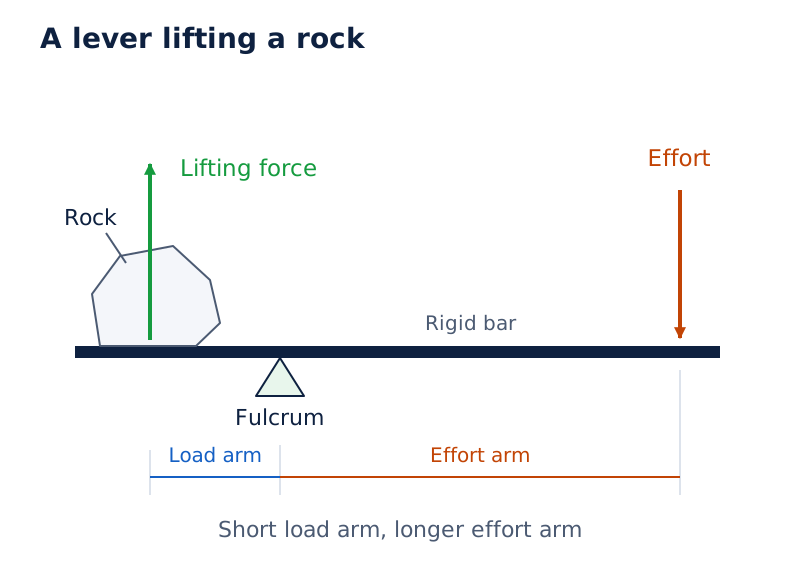
The drawing shows a long bar with its fulcrum near the rock, a short load arm and a longer effort arm. Arrows mark the downward effort and upward lifting force on the rock.
Drawn by One Young India.
How do the three classes of levers differ?
Lever classes depend on the relative positions of fulcrum, effort and load. Identify the item between the other two before deciding the class. The class does not depend simply on whether the lever is drawn horizontally or tilted.
| Class | Middle position | Examples | Ideal force and movement ratios |
|---|---|---|---|
| First class | Fulcrum | Scissors, pliers, balance scale, seesaw | MA and VR may be greater than, equal to or less than one. |
| Second class | Load | Lemon squeezer, wheelbarrow, bottle opener | MA and VR exceed one. |
| Third class | Effort | Tweezers, broom | MA and VR are less than one. |
What determines the advantage of each class?
In a first-class lever, the fulcrum lies between effort and load. Either arm can be longer, or they can be equal. Therefore, do not assign one fixed mechanical advantage to every first-class lever. Compare the actual arms.
In a second-class lever, the load lies between fulcrum and effort. In the usual straight-lever arrangement with parallel forces, the effort arm is longer. The ideal lever multiplies force, while the effort travels farther than the load.
In a third-class lever, the effort lies between fulcrum and load. The effort arm is shorter. The ideal lever requires an effort greater than the load, while the load moves farther and faster. This provides a gain in movement.
These arm-ratio statements describe the ideal model. In a practical lever, use the actual forces to find mechanical advantage and allow for losses when calculating efficiency. Classifying the lever does not supply a numerical efficiency.
Diagram
The three classes of lever
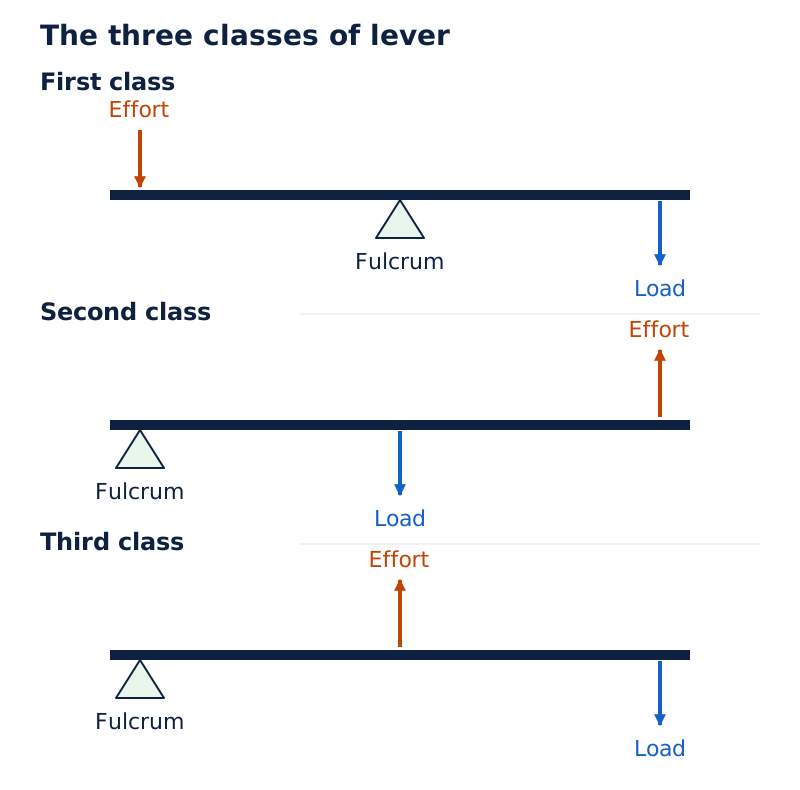
Draw three straight bars. Put the fulcrum between load and effort for the first, the load between fulcrum and effort for the second, and the effort between fulcrum and load for the third. Label every position in words.
Drawn by One Young India.
In scissors, bringing a hard object closer to the fulcrum shortens the load arm. With the effort arm unchanged, the ideal force ratio increases. Explain the effect through the arm ratio rather than by claiming that the machine supplies extra energy.
Where are levers found in the human body?
In a simple lever model of the body, a bone acts as the lever, a joint provides the fulcrum, and a muscle supplies effort. The load is the resistance being moved or supported. The arrangement must be identified for the particular action.
A joint is a place where bones meet. Muscles produce pulling forces, transmitted to bones through tendons. A tendon is the tissue attaching a muscle to a bone. Locate where this pull acts before deciding which lever class applies.
Which actions illustrate the three classes?
The vertebral column is the backbone supporting the head and trunk. The Achilles tendon connects calf muscles to the heel. The biceps is the upper-arm muscle whose pull can bend the elbow. The forearm is the part between elbow and wrist.
| Action and class | Fulcrum | Effort | Load |
|---|---|---|---|
| Balancing the head, first class | Joint between skull and vertebral column | Pull of muscles at the back of the neck | Weight of the head acting in front of the joint |
| Rising onto the toes, second class | Ball of the foot in contact with the ground | Pull of calf muscles through the Achilles tendon at the heel | Body weight transmitted through the ankle |
| Raising a load in the hand by bending the elbow, third class | Elbow joint | Pull of the biceps on the forearm near the elbow | Resistance of the forearm and the held load |
For the head example, the fulcrum lies between the neck-muscle effort and the head's weight. For rising onto the toes, the body load lies between the ground contact and the heel effort. For the forearm example, effort acts between elbow and hand.
These are simplified mechanical descriptions of specified actions. In particular, the forearm arrangement shows why an effort larger than the load can still be useful: a relatively small movement near the joint produces a larger movement at the hand.
Use perpendicular moment arms when analysing muscle forces. A distance measured along a bone is not automatically the perpendicular distance to a muscle's line of action. Do not infer numerical mechanical advantage from the class alone.
How do single fixed and single movable pulleys work?
A single fixed pulley has an axle attached to a support, so its position stays fixed while the wheel turns. An axle is the rod or axis about which the wheel rotates. A rope passes over the wheel, with load and effort on opposite sides.
In the ideal case, the rope is light and inextensible and the pulley turns without friction. Tension, represented by T, is the pulling force transmitted along the taut rope. Its magnitude is the same along the rope in this ideal arrangement.
For steady lifting, E = T and L = T. Hence the ideal mechanical advantage is one. Pulling the effort end down through a distance raises the load through the same distance, so the velocity ratio is also one.
What the figure shows
Direct lifting and lifting with a fixed pulley
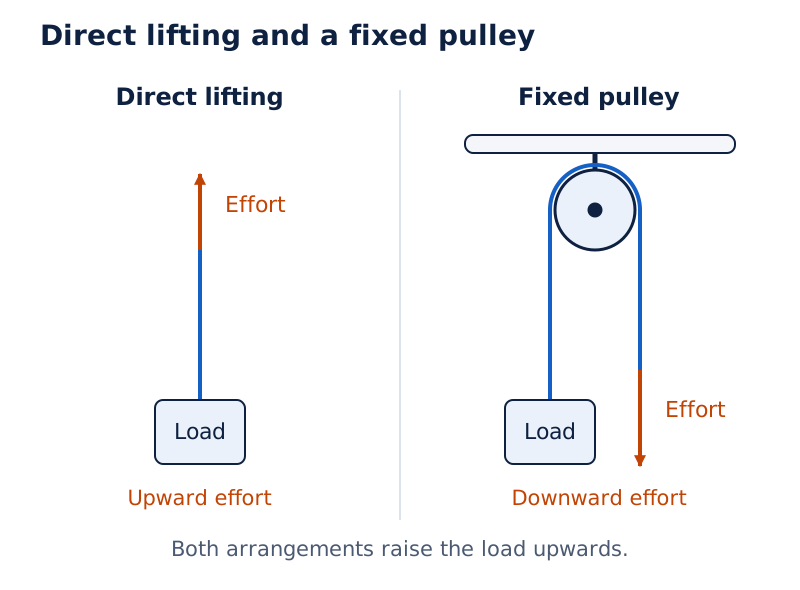
The two drawings show a load pulled directly upwards and a load raised using an overhead pulley. The effort arrow points upwards in the direct lift and downwards beside the pulley arrangement.
Drawn by One Young India.
What changes when the pulley moves with the load?
A single movable pulley carries the load on its axle and rises with it. In the simple arrangement, one rope end is fixed overhead, the rope passes below the movable pulley, and effort is applied upwards at the free end.
Assume a weightless movable pulley, a light inextensible rope, negligible friction and two vertical supporting rope sections. Each section exerts tension T upwards. During steady lifting, L = 2T, while E = T, so the ideal mechanical advantage is two.
If the load rises through dₗ, the rope section between the fixed overhead end and the movable pulley shortens by dₗ. Since the rope is inextensible, the section between the pulley and the free end must lengthen by dₗ. The pulley itself rises through dₗ, so the free end rises through 2dₗ. Thus VR = 2, and the ideal efficiency is one. A further fixed pulley can redirect the effort downwards; in that combined arrangement, both supporting sections shorten as the load rises.
For a practical fixed pulley, η = MA because VR = 1. For the stated movable arrangement, η = MA/2. These are fractional efficiencies. The actual effort includes the effects of losses and, where relevant, the movable pulley's weight.
What the figure shows
A fixed and movable pulley combination
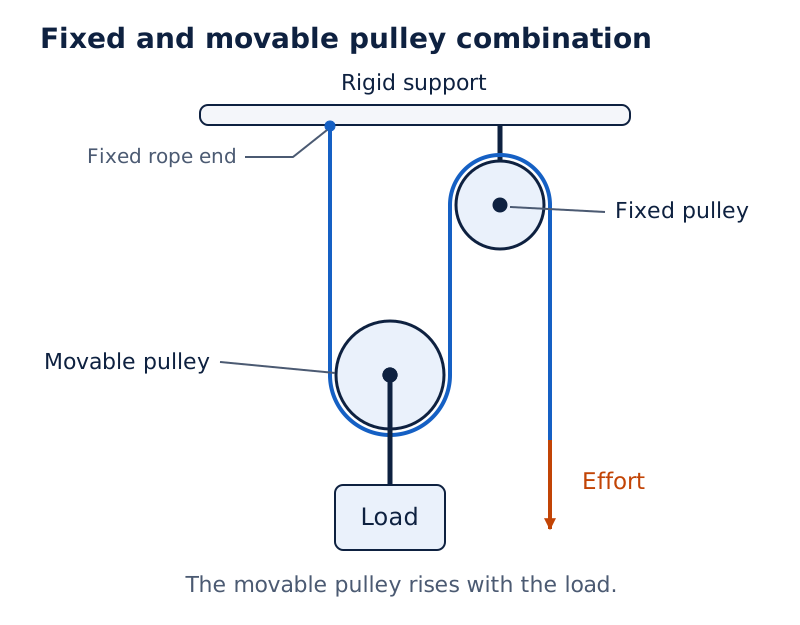
The drawing labels a rigid support, a fixed pulley, a movable pulley, the load below the movable pulley and a downward effort arrow at the free rope end.
Drawn by One Young India.
How does a block-and-tackle system multiply force?
A block and tackle combines pulleys in a fixed upper block and a movable lower block, linked by a rope. A block is the assembly holding its pulley wheels. The lower block carries the load, and effort is applied at the free rope end.
The essential count is the number of rope sections supporting the moving block. Represent this count by n. For the usual arrangement with parallel vertical supporting sections and an inextensible rope, the velocity ratio equals this number.
VR = n
Why does counting supporting rope sections work?
- Identify the block that moves with the load and trace the rope through the whole system.
- Count the rope sections whose lengths change as that block rises.
- For a rise dₗ, each vertical supporting section shortens by dₗ, so the total shortening is n × dₗ.
- The effort end supplies this rope movement: dₑ = n × dₗ. Therefore dₑ/dₗ = n.
For the ideal force calculation, neglect friction, rope weight and moving-block weight. Each supporting section then supplies the same upward tension T. Steady lifting requires L = nT, while E = T, giving ideal MA = n.
For the practical machine with this velocity ratio, η = MA/n. A useful rearrangement for efficiency expressed as a fraction is E = L/(η × n). It follows from MA = L/E and η = MA/n.
Do not substitute a percentage directly for η in that rearrangement. Convert percentage efficiency to a fraction first. Also establish whether the quoted load is the useful external load or a total weight including the movable block.
Note: Count the supporting rope sections from the actual arrangement. A fixed pulley used solely to change the pulling direction does not by itself add another upward supporting force to the moving load.
If the moving block has appreciable weight, part of the lifting force raises that block. When useful output refers to the external load alone, the work spent raising the block is not included in that useful output. Keep the chosen load definition consistent.
How should machine calculations be set out and checked?
Begin by identifying the machine and the conditions of operation. Separate forces, distances, masses and efficiencies before selecting equations. A balanced lever uses moments; a force ratio uses load and effort; an efficiency calculation compares input with useful output.
What information is needed before substitution?
- Write the given quantities with their meanings and units. If mass must become weight, record the supplied gravitational acceleration.
- State ideal assumptions when using equality between mechanical advantage and velocity ratio.
- Use distances from the fulcrum for a lever, and supporting rope sections for the specified pulley system.
- Substitute consistently, retain units through the working, and check the physical meaning of the result.
Worked example 1. A seesaw has fulcrum C and seats A and B on one side, D and E on the other. AC = EC = 2 m and BC = DC = 1 m. A child of mass 15 kg sits at A. Where should a child of mass 30 kg sit to balance a light seesaw?
Formula: opposing moments are equal. Let x be the second child's distance from C. Thus (15 kg × g) × 2 m = (30 kg × g) × x.
Substitute: cancel the common acceleration g. Then x = (15 × 2)/30 m.
Answer: x = 1 m, so the second child sits at D, on the opposite side of the fulcrum. No numerical value of g is needed because it cancels.
The heavier child sits nearer the fulcrum. Equal masses are not required for balance; equal opposing moments are required. Distances must be measured from the fulcrum, rather than between the children or from the end of the bar.
How is useful lifting work calculated?
When a mass is raised steadily through a vertical height h near the Earth’s surface, with g treated as constant, its useful gain in gravitational energy is mgh. Here h is vertical height, not the rope length pulled or the length of a lever. The lifting force balances the weight in this steady case.
Worked example 2. A weightlifter raises a mass of 75 kg vertically through 2 m. Take g = 10 m/s², where m/s² means metres per second squared, the unit of acceleration. Find the lifting work.
Formula: W = mgh. Substitute: W = 75 × 10 × 2 J.
Answer: W = 1500 J. This is the useful energy transferred in raising the mass. Finding a machine's efficiency would additionally require its work input.
Finally, check whether the question can actually be answered from the supplied data. A load alone does not establish effort unless the mechanical advantage, or equivalent machine and efficiency information, is also supplied. State the relevant relationship before calculating.
Worked example 3. A ramp rises over a step 30 cm high and has a horizontal width of 40 cm. Find its sloping length and ideal mechanical advantage. Treat the ramp as frictionless and move the object at constant speed.
Formula: let the sloping length be , the horizontal width be and the height be . By Pythagoras, . Equating effort work to lifting work gives , so .
Substitute: . Then .
Answer: the ramp length is 50 cm and its ideal mechanical advantage is approximately 1.67, with no unit. The longer effort distance allows a smaller effort than direct vertical lifting.
Worked example 4. A student of mass 50 kg is slowly lifted in an elevator to a height of 72.5 m, then later climbs the stairs to the same height. Take . Find the gain in gravitational potential energy for each ascent.
Formula: the student's weight is . The useful lifting work, equal to the gain in gravitational potential energy, is .
Substitute: . Hence .
Answer: the gain is 36250 J in the elevator and 36250 J on the stairs. The same mass reaches the same vertical height, so the gravitational energy gain is independent of the path.
Worked example 5. A goalkeeper stops a ball by applying a force of 200 N while her hand moves back through 15 cm. Calculate the work done by the goalkeeper on the ball.
Formula: , where is displacement measured in the direction of the applied force. The ball moves opposite to that force, so its displacement in the force direction is negative.
Substitute: . Thus .
Answer: the goalkeeper does −30 J of work on the ball. The negative sign indicates that the applied force opposes the ball's displacement.
Worked example 6. A weightlifter holds a barbell steady in her hands. How much mechanical work does her supporting force do on the barbell while it remains stationary?
Formula: , where is the supporting force and is the barbell's displacement in that force's direction.
Substitute: the barbell remains stationary, so . Therefore , irrespective of the magnitude of the supporting force.
Answer: 0 J. A force can support a load without doing mechanical work on it when the load has no displacement.
Glossary
- Simple machine — A device that makes a task easier by changing the magnitude or direction of an applied force.
- Effort — The force applied to a machine to overcome the load.
- Load — The resistance or force that the machine is required to overcome.
- Mechanical advantage — The ratio of the load overcome to the effort applied.
- Velocity ratio — The ratio of effort distance to load distance in the same time interval.
- Work input — The work supplied to a machine by the applied effort.
- Useful work output — The work delivered by a machine to its intended load.
- Efficiency — The ratio of useful work output to the work input supplied.
- Fulcrum — The fixed point about which a lever is able to rotate.
- Effort arm — The perpendicular distance from the fulcrum to the effort's line of action.
- Load arm — The perpendicular distance from the fulcrum to the load's line of action.
- Moment of a force — Its turning effect, equal to force multiplied by perpendicular distance from the turning point to its line of action.
- Fixed pulley — A pulley whose axle remains fixed while its wheel rotates.
- Movable pulley — A pulley that moves with the load attached to its axle.
- Block and tackle — A pulley system with fixed and movable blocks connected by a rope.
Common errors and misconceptions
- Misconception: Every useful machine multiplies force. Correct: A fixed pulley is useful because it changes the direction of the effort, even though its ideal mechanical advantage is one.
- Misconception: A machine saves work whenever it reduces effort. Correct: An ideal force multiplier requires the effort to move farther. Useful output equals input in the ideal case.
- Misconception: Mechanical advantage and velocity ratio use the same numerator. Correct: Mechanical advantage is load divided by effort; velocity ratio is effort distance divided by load distance.
- Misconception: Mechanical advantage is measured in newtons. Correct: It is a ratio of forces expressed in the same unit, so it has no unit.
- Misconception: Every first-class lever has equal arms. Correct: Its fulcrum lies between load and effort, but either arm may be longer.
- Misconception: A practical machine has mechanical advantage equal to velocity ratio. Correct: Its efficiency is below one, so mechanical advantage is smaller than velocity ratio.
- Misconception: Every pulley wheel adds a supporting force to the load. Correct: Trace the rope sections supporting the moving assembly. A direction-changing fixed pulley does not automatically add one.
- Misconception: Kilograms can be divided directly by newtons to calculate mechanical advantage. Correct: Convert a mass to its weight, or show explicitly why the common gravitational factor cancels.
Exam-style questions with model answers
Q1. Define effort and load in a simple machine. [2 marks]
- Effort is the force applied to the machine to operate it and overcome the resistance.
- Load is the resistance or force that the machine overcomes; it is a force, rather than a mass.
Q2. Derive the relation between fractional efficiency, mechanical advantage and velocity ratio for steady operation with constant effort and load acting along their displacements. Define the symbols used. [5 marks]
- Let η be fractional efficiency, Wᵢ work input and Wₒ useful work output. By definition, η = Wₒ/Wᵢ.
- Let E be effort and dₑ its distance of movement. The work supplied to the machine is Wᵢ = E × dₑ.
- Let L be load and dₗ its distance of movement. Useful work delivered to the load is Wₒ = L × dₗ.
- Substitution gives η = (L × dₗ)/(E × dₑ) = (L/E)/(dₑ/dₗ). The distances refer to the same operating interval.
- Mechanical advantage MA = L/E and velocity ratio VR = dₑ/dₗ. Therefore η = MA/VR; percentage efficiency is (MA/VR) × 100%.
Q3. A light seesaw has fulcrum C. Seats A and B are on one side, D and E on the other. AC = EC = 2 m and BC = DC = 1 m. A 15 kg child sits at A. Where should a 30 kg child sit to balance it? Ignore pivot friction and explain why a numerical value of gravitational acceleration is unnecessary. [3 marks]
- For balance, clockwise and anticlockwise moments about C must be equal. If x is the heavier child's distance from C and g is gravitational acceleration, (15 × g) × 2 = (30 × g) × x.
- The same g multiplies both sides, so it cancels. Thus x = (15 × 2)/30 = 1 m.
- The heavier child must sit on the opposite side at D, which is 1 m from C. Opposing equal moments balance the seesaw.
Q4. Compare a single fixed pulley with a single movable pulley. For both, assume steady lifting, negligible friction, a light inextensible rope and weightless pulleys. The movable pulley has two vertical supporting rope sections, one end fixed overhead and effort applied upwards at the free end. State ideal mechanical advantage, velocity ratio and utility. [4 marks]
- The fixed pulley's axle remains in place. The same ideal rope tension acts at effort and load, so its mechanical advantage is one.
- Its effort distance equals load distance, giving velocity ratio one. It allows a downward effort to lift the load upwards.
- The movable pulley rises with its load. Two supporting rope sections each supply the same tension, giving ideal mechanical advantage two.
- Its effort end moves twice the load distance, so velocity ratio is two. It multiplies force; both ideal arrangements have efficiency one.
Q5. Identify the lever class and the middle component in each action: balancing the head using the neck muscles, rising onto the toes, and raising a hand-held load by bending the elbow using the biceps. [3 marks]
- Balancing the head is first class: the skull's joint with the vertebral column lies between the neck-muscle effort and the head's weight.
- Rising onto the toes is second class: the body load transmitted through the ankle lies between the ball of the foot and the effort at the heel.
- Bending the elbow with the biceps is third class: the muscle effort on the forearm acts between the elbow fulcrum and the hand-held load.
Q6. Explain why an ideal third-class straight lever with parallel effort and load forces is a speed multiplier. State the positions, arm comparison, mechanical advantage and movement comparison. [4 marks]
- The effort acts between the fulcrum and load. The effort point is therefore closer to the fulcrum than the load point.
- The effort arm is shorter than the load arm. For an ideal balanced lever, mechanical advantage equals effort arm divided by load arm.
- Mechanical advantage is consequently less than one, meaning the effort is greater than the load in this ideal arrangement.
- During the same rotation, the load travels farther than the effort. It therefore moves faster, giving the lever its speed-multiplying utility.
Q7. A block-and-tackle system lifts steadily. It has n vertical rope sections supporting the moving block, a light inextensible rope, negligible friction and negligible moving-block weight. Derive its ideal velocity ratio, mechanical advantage and efficiency, defining any additional symbols. [5 marks]
- Let dₗ be the load's upward distance. As the moving block rises through dₗ, each of its n supporting rope sections shortens by that distance.
- The total shortening is n × dₗ. Hence the effort distance dₑ is n × dₗ, and velocity ratio VR = dₑ/dₗ = n.
- Let T be the common tension in the ideal rope and E the effort. The pull at the free end gives E = T.
- Let L be the load. Its weight is balanced by n upward tensions, so L = nT and mechanical advantage MA = L/E = n.
- Fractional efficiency η = MA/VR = n/n = 1. Thus the ideal system has percentage efficiency 100%.
Q8. A mass of 75 kg is raised steadily through a vertical height of 2 m. Take gravitational acceleration as 10 m/s². Calculate the useful lifting work, showing the weight and work calculation separately. [2 marks]
- The weight is mass multiplied by gravitational acceleration: 75 × 10 = 750 N.
- Useful lifting work is weight multiplied by vertical height: 750 × 2 = 1500 J.
Key takeaways
- A simple machine changes the magnitude or direction of the applied force; it does not create energy.
- Mechanical advantage is load divided by effort, while velocity ratio is effort distance divided by load distance.
- Fractional efficiency equals mechanical advantage divided by velocity ratio; multiply this fraction by one hundred for percentage efficiency.
- For practical machines, efficiency is less than one and mechanical advantage is smaller than velocity ratio.
- A balanced ideal lever has equal opposing moments, so its mechanical advantage equals effort arm divided by load arm.
- Classify levers by the middle component: fulcrum for first class, load for second class, effort for third class.
- An ideal fixed pulley changes effort direction; an ideal single movable pulley with two supporting sections multiplies force.
- For block and tackle, count supporting rope sections and state assumptions before calculating velocity ratio or mechanical advantage.
Test yourself
Why is mechanical advantage dimensionless?
It is the ratio of two forces expressed in the same unit, so the force units cancel.
Which distances enter velocity ratio?
The effort distance is divided by the load distance, with both measured during the same time interval.
What extra information is needed to find effort from load alone?
You need mechanical advantage, or sufficient machine and efficiency information to determine that mechanical advantage.
Why can a first-class lever have different mechanical advantages?
Its fulcrum is between effort and load, but either arm can be longer, or both arms can be equal.
What makes the forearm and biceps arrangement third class?
The biceps applies effort between the elbow fulcrum and the load carried towards the hand.
What is the ideal efficiency of a single fixed pulley?
It is one, or 100%, because its ideal mechanical advantage and velocity ratio both equal one.
Why does a movable pulley require extra effort distance?
With effort applied upwards at the free end, raising the pulley shortens the rope section attached to the fixed overhead point. The other section must lengthen by the same amount, so the free end rises through twice the distance moved by the pulley and load.
Does friction violate conservation of energy?
No. It transfers energy into forms such as internal energy, reducing useful mechanical output without destroying total energy.
Write about it
Turn a question from this chapter into a paper.
The Writing Studio has a structure guide, a rubric and citation tools for 15 formats, from essays to research papers. Drafting is free with an account. Learnacy Essential adds feedback from an AI writing coach and submission to The OYI Review.
Publication depends on review and is not guaranteed.