
Electrical Power and Household Circuits | ICSE Class 10 Physics Notes
On this page
Watch & explore
Start with a few high-quality watches, then dive into the notes below.
This note covers electrical energy and power, energy transformations, power ratings, household energy consumption, commercial units, main circuits, parallel and ring wiring, switches, staircase wiring, fuses, circuit breakers, earthing, three-pin plugs, wire colours and electrical safety.
What are electrical energy and electrical power?
Electrical energy is the energy transferred when electric charge moves through a potential difference. Electric charge is the electrical property carried by particles such as electrons. Potential difference means the work done per unit charge in moving charge between two points.
Electric current is the rate of flow of charge. A closed conducting path through which current can flow is an electric circuit. A switch opens or closes this conducting path. A source supplies energy to the circuit, and an appliance converts that energy into other forms.
Definition: Electrical power is the rate at which electrical energy is transferred or consumed. Energy tells us how much is transferred; power tells us how quickly the transfer occurs.
Which symbols and units are used?
Let W represent electrical work or energy, Q charge, V potential difference, I current, t time, P power and R resistance. Resistance is the property of a conductor that opposes the flow of charge.
| Quantity and symbol | Unit and symbol | Useful relation |
|---|---|---|
| Electrical energy, W | Joule, J | 1 J = 1 W × 1 s |
| Charge, Q | Coulomb, C | 1 C = 1 A × 1 s |
| Potential difference, V | Volt, V | 1 V = 1 J/C |
| Current, I | Ampere, A | 1 A = 1 C/s |
| Time, t | Second, s | 1 hour = 3600 s |
| Power, P | Watt, W | 1 W = 1 J/s |
| Resistance, R | Ohm, Ω | 1 Ω = 1 V/A |
SI means the International System of Units. The SI unit of electrical energy is joule. The letter W has two uses: before an equals sign it can represent work or energy; after a numerical value it represents the unit watt.
A heater converts electrical energy into heat. A motor produces motion, converting electrical energy into mechanical energy, the energy associated with motion or position. A lamp converts electrical energy into light and heat, and a loudspeaker converts it into sound. These are energy transformations. Electrons are not consumed by the appliances; the energy supplied to move charge is transferred.
How are the electrical energy and power formulae derived?
The definitions of potential difference and current connect energy transfer with charge flow. Use steady values of current and potential difference over the time considered. For a resistor, Ohm's law states that potential difference is proportional to current, provided its temperature remains the same.
V = IR
Derivation: electrical energy from charge flow
- Potential difference is work done per unit charge, so V = W/Q.
- Rearrange the definition to obtain W = QV.
- Current is charge passing per unit time, so I = Q/t and Q = It.
- Substitute Q = It into W = QV to obtain W = VIt.
W = VIt
With V in volts, I in amperes and t in seconds, the calculated energy W is in joules. This gives energy transferred during the stated interval, rather than the rate of transfer.
Derivation: power and its resistance forms
- Power is energy transferred per unit time: P = W/t.
- Substitute W = VIt, then cancel t to obtain P = VI.
- For a resistor, substitute V = IR to obtain P = I²R.
- Alternatively, substitute I = V/R into P = VI to obtain P = V²/R.
P = VI
P = I²R
P = V²/R
W = Pt
W = I²Rt
W = (V²/R)t
Choose the expression that uses the quantities supplied. If current and resistance are given, use the current-squared form. If potential difference and resistance are given, use the voltage-squared form. Both follow from the same definitions and Ohm's law.
Note: At constant current, a larger resistance gives greater heating power. At constant potential difference, a larger resistance gives smaller heating power. State what remains constant before comparing two resistors.
How does electrical energy become heat?
In a purely resistive circuit, electrical energy is dissipated entirely as heat. Let H be the heat produced, measured in joules. For steady current through a resistance, H = VIt. Using Ohm's law gives Joule's law of heating.
H = I²Rt
For a fixed resistance and duration, heat is proportional to the square of current. For a fixed current and duration, it is proportional to resistance. For a fixed current and resistance, it is proportional to the time of current flow.
How is heating useful?
Electric irons, heaters, kettles and toasters use the heating effect. Heating also occurs in appliances whose main purpose is different. A fan may use part of the supplied energy to turn its blades and expend the rest as heat.
In a filament lamp, a thin wire called the filament becomes hot enough to emit light. Most of the power consumed by the filament appears as heat; a small part is radiated as light. Thus its electrical power is not all light output.
An ammeter measures current and is connected in series, along the same current path as the component. A voltmeter measures potential difference and is connected in parallel, across the two points being compared.
What the figure shows
A purely resistive circuit
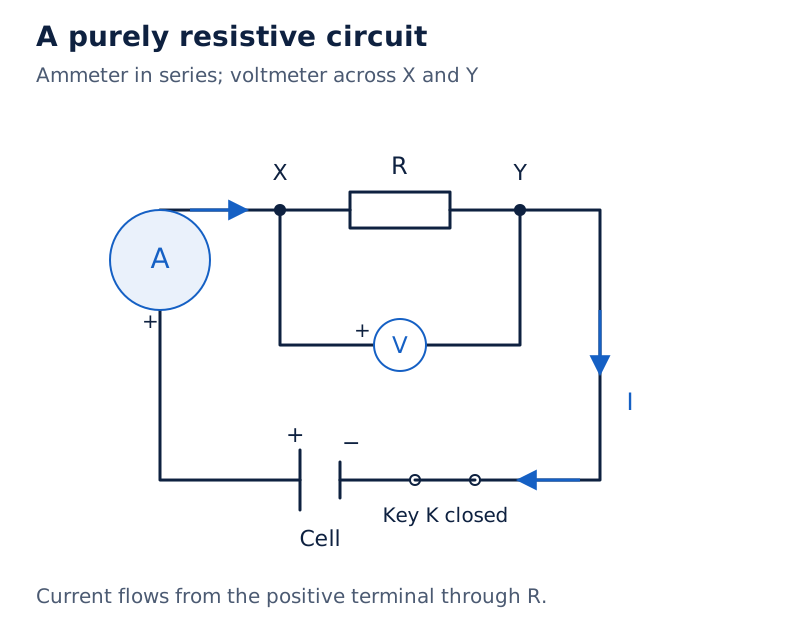
A cell and key K lie in the lower part of the circuit. The key is a switch that opens or closes the path. A resistor R lies between points X and Y. An ammeter, labelled A, is in series; a voltmeter, labelled V, is connected across X and Y. Arrows show the current direction.
Drawn by One Young India.
Worked example 1. A 4 Ω resistor produces 100 J of heat each second. Find the current and potential difference across it.
Formula: I = √(H/(Rt)); V = IR.
Substitute: I = √(100/(4 × 1)) = 5 A; V = 5 × 4 = 20 V.
Answer: The current is 5 A and the potential difference is 20 V.
What does an appliance's power rating mean?
A power rating states the power consumed when an appliance operates under its stated conditions, including the stated supply voltage. Read both values together. A power label does not, by itself, state the energy consumed over an unspecified period.
A lamp labelled 100 W, 220 V consumes electrical energy at 100 joules per second when operating at 220 V. To calculate energy consumption, its operating time is also needed. To calculate its current at the rated voltage, rearrange P = VI.
I = P/V
For a resistive appliance, its resistance at the rated operating condition follows by rearranging P = V²/R.
R = V²/P
How can voltage and current give power?
Worked example 2. A bulb with a potential difference of 220 V across it carries a current of 0.50 A. Calculate its electrical power.
Formula: P = VI.
Substitute: P = 220 × 0.50 = 110 W.
Answer: Its electrical power is 110 W, meaning an energy transfer of 110 J each second.
This calculation gives electrical input power. It does not say that the bulb produces 110 joules of light each second. Some of the supplied energy appears as heat, as with the filament lamp discussed earlier.
What if the operating voltage changes?
For a resistor whose resistance remains the same, P = V²/R shows that power changes with the square of the applied voltage. The rated power should therefore not be treated as a fixed consumption at every possible voltage.
Note: A calculation that assumes unchanged resistance when voltage changes is a constant-resistance model. It does not establish that the resistance of a real heated filament stays unchanged as its temperature changes.
When comparing rated appliances, use their specified voltages. For devices operating across the same potential difference, the higher electrical power corresponds to the larger current. This is useful when checking the load placed on a household circuit.
What is a kilowatt-hour and how is it related to a joule?
A kilowatt, symbol kW, is a unit of power equal to 1000 watts. A watt-hour is the energy transferred by a power of one watt acting for one hour. A kilowatt-hour, symbol kWh, is the energy transferred by one kilowatt acting for one hour.
The commercial unit of electrical energy is the kilowatt-hour, commonly called one unit of electricity. The word commercial means that this unit is used to measure the energy supplied for billing.
How do the units convert?
- Begin with one kilowatt-hour as the product of power and time.
- Replace one kilowatt with 1000 watts.
- Replace one hour with 3600 seconds.
- Use one watt-second = one joule to obtain 3,600,000 joules.
1 kWh = 3.6 × 10⁶ J
Use power in watts and time in seconds to obtain joules. Use power in kilowatts and time in hours to obtain kilowatt-hours. Multiplying watts by hours gives watt-hours, so divide that result by 1000 to obtain kilowatt-hours.
| Calculation | Power unit | Time unit | Energy unit |
|---|---|---|---|
| Energy in SI units | Watt | Second | Joule |
| Energy in watt-hours | Watt | Hour | Watt-hour |
| Energy for billing | Kilowatt | Hour | Kilowatt-hour |
Energy cost is the number of kilowatt-hours consumed multiplied by the stated charge per kilowatt-hour. A question must give this charge before a numerical cost can be calculated. Power and operating time alone determine energy consumption, not its price.
Note: kW and kWh measure different quantities. A kilowatt-hour is power multiplied by time, not power divided by time. The electricity bill records energy consumption, not a quantity of electrons used up.
How is household energy consumption calculated?
For each appliance, multiply its power by its actual operating time. Express the resulting energy in a common unit before adding different appliances' consumption. Total energy is the sum of these individual energy transfers.
If an appliance is used for a stated number of hours each day, multiply that daily duration by the number of days. The calculation assumes that the stated power applies throughout those operating hours.
How are energy and cost found together?
Worked example 3. A refrigerator rated 400 W operates for 8 hours each day for 30 days. Electricity costs ₹3.00 per kWh. Find its energy consumption and energy cost.
Formula: W = Pt; C = Wu, where C is energy cost in rupees and u is the charge in rupees per kilowatt-hour.
Substitute: P = 0.4 kW; t = 8 × 30 = 240 hours. W = 0.4 × 240 = 96 kWh; C = 96 × 3 = ₹288.
Answer: The refrigerator consumes 96 kWh and its energy cost is ₹288.
The letter C in this example denotes cost, while C after a numerical charge value denotes coulomb. Symbols acquire their meaning from their definitions and units. The price used here is the price given for this calculation.
Does the more powerful appliance use more energy?
Worked example 4. Compare the energy consumed by a 250 W television used for 1 hour and a 1200 W toaster used for 10 minutes.
Formula: W = Pt.
Substitute: Television energy = 0.250 × 1 = 0.250 kWh. Toaster time = 10/60 hour; toaster energy = 1.200 × 10/60 = 0.200 kWh.
Answer: The television uses more energy, 0.250 kWh compared with 0.200 kWh, because it operates for longer.
The toaster has the greater power, so it transfers energy faster while working. Its shorter operating time nevertheless makes its total energy consumption smaller in this comparison. Compare products of power and time, rather than either quantity alone.
Worked example 5. An electric motor takes 5 A from a 220 V line for 2 hours. Find its electrical power and energy consumption.
Formula: P = VI; W = Pt.
Substitute: P = 220 × 5 = 1100 W = 1.1 kW. W = 1.1 × 2 = 2.2 kWh.
Answer: The electrical power is 1100 W and the energy consumed is 2.2 kWh.
How does the main household circuit distribute electricity?
The mains is the main electricity supply entering a home, through overhead wires or underground cables. The live wire supplies the appliance circuit. The neutral wire provides its return connection. The earth wire provides a protective connection between exposed metal parts and earth, meaning the ground.
An electricity meter measures the electrical energy supplied to the house. A main switch controls the supply to the household circuits. A fuse is a protective component that melts to break a circuit when excessive current flows.
What is the arrangement at the meter board?
The supply passes through the main fuse to the electricity meter. The main switch then controls the line wires supplying separate circuits in the house. The distribution board contains the switching and protective arrangements through which these circuits receive their supply.
What the figure shows
A domestic supply circuit
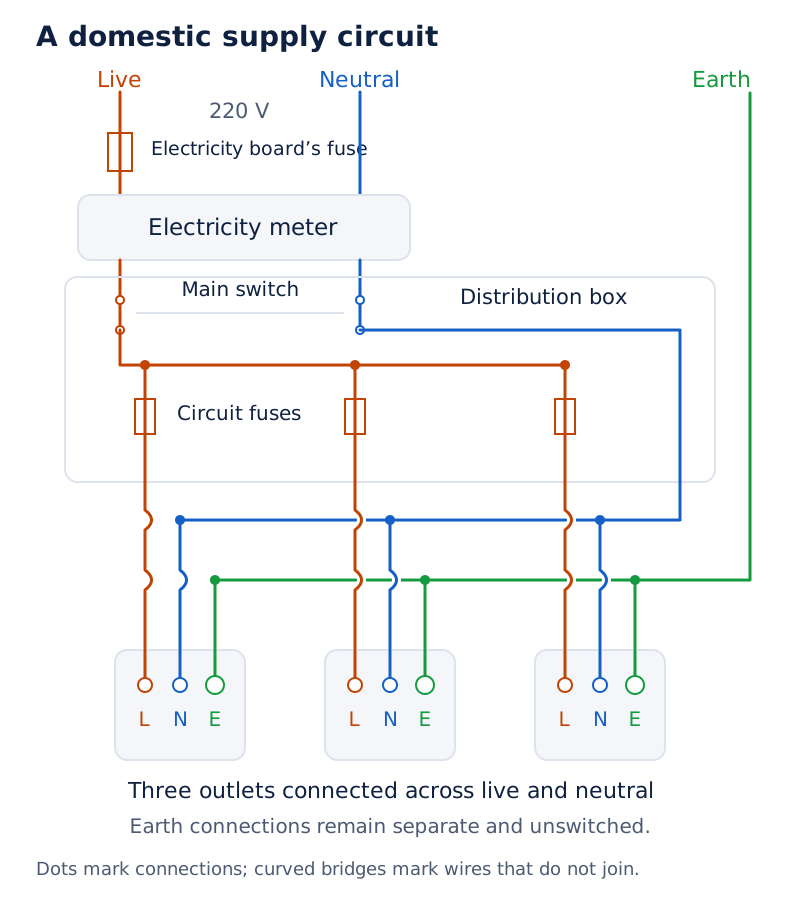
The drawing labels earth, live and neutral wires, the electricity board's fuse, the electricity meter, and a distribution box containing a main switch and fuses for each circuit. Three outlets connect across the live and neutral lines, with earth connections shown separately. The potential difference is labelled 220 V.
Drawn by One Young India.
The main switch allows the household supply to be disconnected together. A double-pole main switch opens both live and neutral connections together. The protective earth connection is not used as a switched supply path.
Often, two separate circuits are used: a 15 A circuit for appliances with higher power ratings, such as geysers and air coolers, and a 5 A circuit for bulbs and fans. These current ratings indicate the different loads the circuits serve.
The meter and fuse have different jobs. The meter records energy consumption; the fuse responds to excessive current. Neither the existence of a meter nor a low electricity bill establishes that the wiring is protected from a fault.
Why are appliances connected in parallel, and what is ring wiring?
In a parallel connection, appliances are connected across the same pair of supply wires. Each appliance has the same potential difference across it. Its current depends on its own electrical characteristics, rather than having to equal every other appliance's current.
In a series connection, components share one current path. The same current passes through them, and a break in that path interrupts the entire circuit. Appliances needing different currents are therefore unsuitable for a common series arrangement.
What advantages does a parallel circuit provide?
| Feature | Parallel household connection | Series connection |
|---|---|---|
| Potential difference | Each appliance receives the supply potential difference | The supply potential difference is shared between components |
| Current | Branches can carry different currents | The same current passes through every component |
| Switching | A branch switch controls its own appliance | Opening the common path interrupts every component |
| Broken component | Other intact branches retain conducting paths | A break stops the current throughout the circuit |
Adding another working parallel appliance increases the total current supplied by the main circuit. Independent operation does not mean unlimited capacity. The combined current must remain suitable for the circuit and its protection.
How is a ring arranged?
In the ring system, conductors run from the distribution board around a group of sockets and return to the same board, forming a ring. A socket is the fixed outlet into which an appliance's plug fits. Appliances remain connected in parallel across live and neutral.
The two sides of an intact ring provide conducting routes to the sockets. The shape of the wiring does not make the appliances a series chain. Switching one appliance affects its branch, rather than requiring the current to pass through every other appliance.
Diagram
Ring wiring
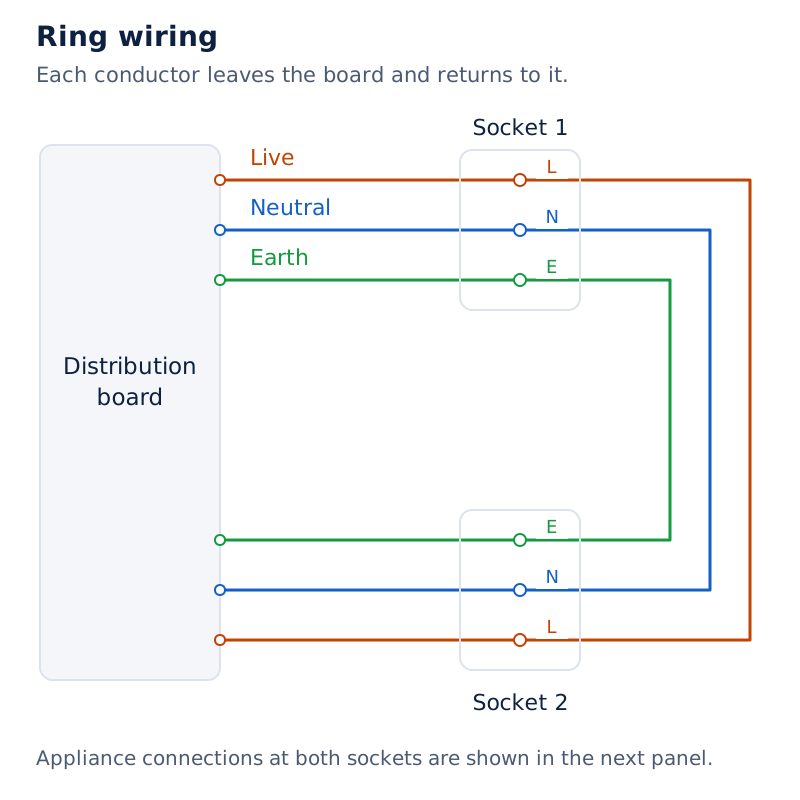
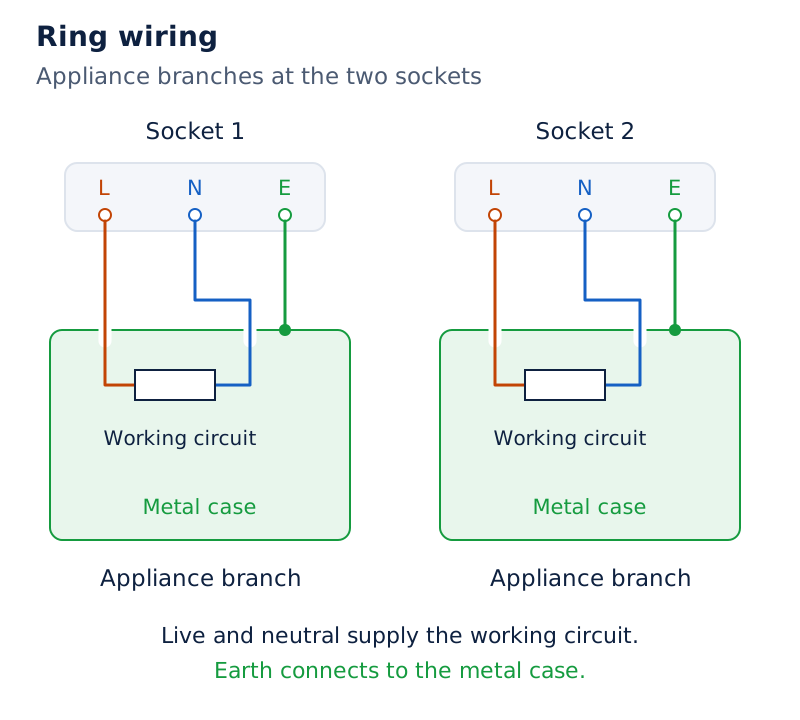
Draw separate live, neutral and earth conductors leaving and returning to the distribution board. Show socket connections along the ring. Connect each appliance between live and neutral, with its metal case connected to earth. Label the board, conductors, sockets and appliance branches.
Drawn by One Young India.
How do ordinary switches and staircase switches work?
A switch makes or breaks a conducting path. A closed switch completes the path; an open switch interrupts it. Each appliance in a household parallel circuit has its own switch, so its operation can be controlled independently.
An appliance's ordinary control switch is connected in the live wire. Opening it disconnects the appliance from the live supply. A switch placed only in neutral can stop normal current while leaving the appliance connected to live, which creates a shock hazard.
What is a two-way switch?
A two-way switch connects one common terminal to either of two other terminals. A terminal is a point where a wire connects to a component. Moving the switch changes which terminal is connected to the common terminal.
Staircase wiring uses a pair of two-way switches to control one lamp from two positions. One switch may be operated at the bottom of the stairs and the other at the top. Either switch can change the lamp from on to off or from off to on.
Diagram
Staircase switching
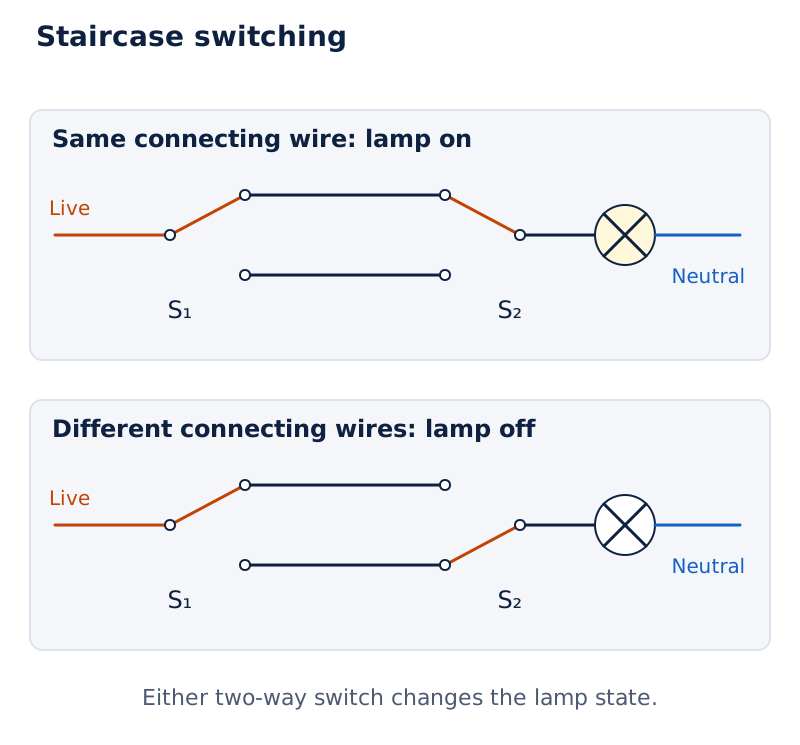
Label the two switches S₁ and S₂. Connect live to the common terminal of S₁. Join their two pairs of other terminals by two connecting wires. Connect the common terminal of S₂ through the lamp to neutral. Show each switch selecting one connecting wire.
Drawn by One Young India.
When does the lamp glow?
For the straight paired connections described above, the lamp glows when both switches select the same connecting wire. That choice completes a path from live, through both switches and the lamp, to neutral. Selecting different connecting wires breaks the path.
Operating either switch changes a complete path into an incomplete one, or the reverse. The principle is selection between two paths, rather than two ordinary switches placed in series. Two ordinary series switches would both have to be closed for the lamp to work.
How do fuses and miniature circuit breakers protect a circuit?
An excessive current can heat wiring and damage appliances. A fuse is placed in series with the protected circuit, so the circuit's current passes through it. Its wire has an appropriate melting point for its protective function.
How does a fuse operate?
- A current larger than the specified value flows through the circuit and fuse.
- The heating effect raises the temperature of the fuse wire.
- The fuse wire melts, leaving a gap in the conducting path.
- The broken path stops the current through the protected circuit.
The fuse rating is its specified current rating, stated in amperes. It must be appropriate for the appliance and circuit. A fuse wire that is too thick or has an unsuitable rating can fail to provide the intended protection.
A household fuse is placed in live so that, when it breaks, the downstream circuit is disconnected from the live supply. The fuse wire is usually enclosed in a cartridge of porcelain or similar material with metal ends.
Worked example 6. An electric iron consumes 1 kW at 220 V. Calculate its operating current and explain the use of a 5 A fuse for this example.
Formula: I = P/V.
Substitute: P = 1000 W; I = 1000/220 = 4.545… A, approximately 4.55 A.
Answer: The operating current is approximately 4.55 A. A 5 A fuse is above this normal current and is the suitable fuse specified for this example.
How does an MCB differ from a fuse?
An MCB, or miniature circuit breaker, is a protective switch that trips, meaning it opens the circuit automatically, when excessive current occurs. Unlike a fuse, it does not depend on replacing a melted wire after operation.
After the fault has been corrected, an MCB can be reset. Both devices protect against excessive current. They are not substitutes for earthing exposed metal parts, because circuit protection and maintaining a protective earth connection address different aspects of safety.
How do earthing, three-pin plugs and wire colours work together?
Earthing connects an appliance's exposed metal body to earth through a low-resistance conductor. Low resistance allows fault current a conducting path to earth. The earth wire is usually connected to a metal plate deep in the ground near the house.
Insulation is material that separates conducting parts and prevents unwanted electrical contact. If insulation fails and live touches an appliance's metal body, that body may become dangerous to touch. The earth connection helps keep its potential at that of earth, and the user may not get a severe electric shock.
What connections does a three-pin plug provide?
A three-pin plug connects an appliance's live, neutral and protective earth wires to a matching socket. The live and neutral connections serve the working circuit. The earth connection joins the exposed metal body to the protective earth path.
In the conventional socket viewed from the front, with the earth opening uppermost, earth is at the top, neutral is at the left and live is at the right. A view of the mating face of the plug reverses left and right.
The conventional earth pin is longer and thicker than the other two pins. Its greater length makes the earth connection first when inserting the plug and breaks it last when withdrawing it. Its greater thickness helps prevent insertion into the live or neutral opening.
Diagram
Three-pin socket and plug
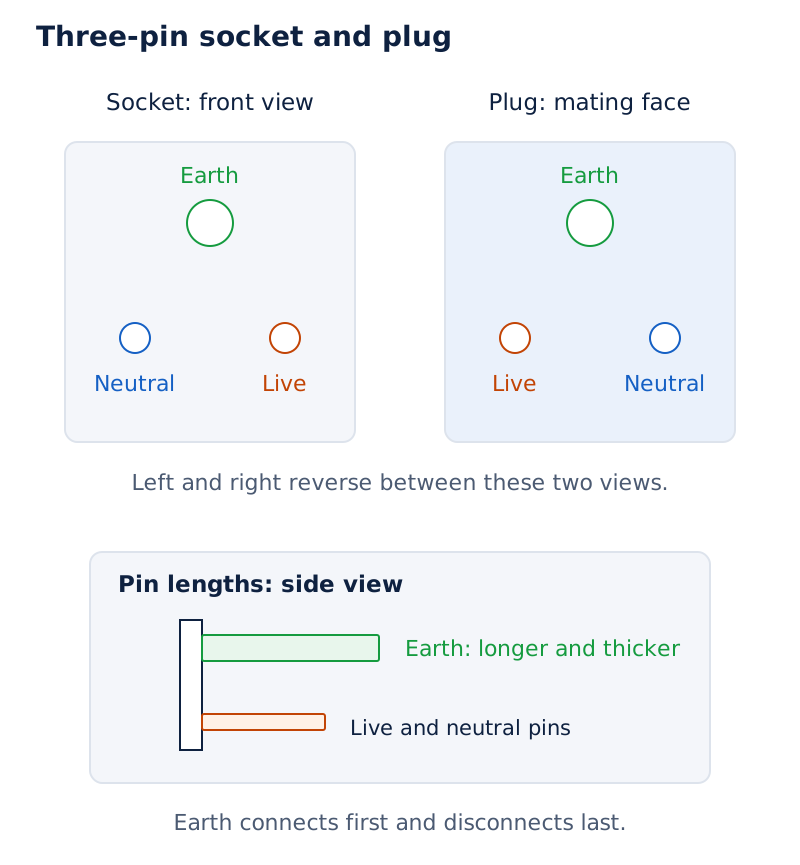
Draw the socket from the front with earth at the top, neutral on the left and live on the right. Beside it draw the plug's mating face with earth at the top, live on the left and neutral on the right. Label the viewing directions and the longer, thicker earth pin.
Drawn by One Young India.
What does the colour code indicate?
| Wire | Conventional insulation colour | Function |
|---|---|---|
| Live | Usually red | Supply connection to the appliance circuit |
| Neutral | Black | Return connection for the working circuit |
| Earth | Green | Protective connection to the exposed metal body |
These colours identify the conventional arrangement described here. Colour alone must not be treated as proof that a wire is safe to touch. The function of the earth connection is protection, rather than serving as the appliance's normal return connection.
What causes overloading and short circuits, and how can they be avoided?
Overloading occurs when a circuit carries current beyond its intended capacity. Connecting too many appliances to one socket can cause it. An accidental rise in supply voltage can also produce excessive current.
A short circuit occurs when live and neutral come into direct contact, for example because insulation is damaged or an appliance has a fault. The resulting low-resistance path causes an abrupt increase in current. The fuse or MCB should interrupt this excessive current.
How are the two faults distinguished?
| Feature | Overloading by appliances | Short circuit |
|---|---|---|
| Cause | Too much total appliance current for the circuit | Direct contact between live and neutral |
| Current path | Through the connected appliances | Through an unintended low-resistance path |
| Danger | Excessive heating from excessive current | Abruptly increased current and excessive heating |
Which precautions matter?
- Do not connect too many appliances to a single socket or exceed the circuit's current capacity.
- Use a correctly rated fuse or MCB; do not replace a fuse with an arbitrary piece of wire.
- Maintain insulation and have damaged wiring or faulty appliances repaired.
- Maintain the protective earth connection for appliances with exposed metal bodies.
- Disconnect the supply before repair or maintenance, and do not handle electrical switches or appliances with wet hands.
A high-power appliance can overload a low-current circuit even without several appliances sharing the socket. Calculate its normal current from the stated power and supply voltage, then compare it with the circuit rating.
Protection works as a system: suitable wiring carries the load, insulation separates conductors, switches control the supply, fuses or MCBs interrupt excessive current, and earthing provides a protective path for metal-bodied appliances. One measure does not make the others unnecessary.
Glossary
- Electrical energy — Energy transferred when electric charge moves through a potential difference, measured in joules or kilowatt-hours.
- Electrical power — Rate of transfer or consumption of electrical energy, measured in watts.
- Potential difference — Work done per unit charge in moving charge between two points.
- Electric current — Rate at which electric charge passes through a conductor's cross-section.
- Resistance — Property of a conductor that opposes the flow of electric charge.
- Kilowatt-hour — Energy transferred by a power of one kilowatt operating for one hour.
- Power rating — Specified power consumption of an appliance under its stated operating conditions.
- Parallel connection — Arrangement in which appliances are connected across the same two supply points.
- Ring wiring — Wiring arrangement in which conductors serve sockets and return to the distribution board.
- Two-way switch — Switch connecting a common terminal to either of two other terminals.
- Fuse — Protective component whose wire melts to break a circuit carrying excessive current.
- Miniature circuit breaker — Protective switch that automatically opens a circuit when excessive current occurs.
- Earthing — Connecting exposed metal parts to earth through a low-resistance protective conductor.
- Overloading — Condition in which the current exceeds the intended capacity of a circuit.
- Short circuit — Unintended direct contact between live and neutral producing an abrupt current increase.
Common errors and misconceptions
- Misconception: A kilowatt-hour measures power. Correct: It measures energy. A kilowatt measures power, and one kilowatt-hour equals 3.6 × 10⁶ J.
- Misconception: A more powerful appliance necessarily consumes more energy. Correct: Energy depends on both power and operating time; a lower-power appliance used longer can consume more.
- Misconception: Higher resistance necessarily gives greater heating power. Correct: This holds at constant current. At constant potential difference, heating power decreases as resistance increases.
- Misconception: Household appliances form a series chain. Correct: They are connected in parallel to receive equal supply potential difference and allow independent operation.
- Misconception: A fuse and an earth wire do the same job. Correct: A fuse interrupts excessive current; the earth wire provides a protective connection for exposed metal parts.
- Misconception: A switch in neutral makes the appliance safe when off. Correct: It can stop current while leaving the appliance connected to live. The control switch belongs in live.
- Misconception: The live pin is on the same side in every plug and socket drawing. Correct: Left and right depend on the viewing direction; label that direction explicitly.
- Misconception: A larger fuse rating gives better protection. Correct: The rating must suit the circuit and appliance. An excessive rating can allow damaging current to continue.
Exam-style questions with model answers
Q1. Define electrical power and state its SI unit. [2 marks]
- Electrical power is the rate at which electrical energy is transferred or consumed in a circuit.
- Its SI unit is the watt, equal to one joule per second.
Q2. An electric motor draws 5 A from a 220 V line for 2 hours. Calculate its electrical power and energy consumption in kilowatt-hours. [3 marks]
- The electrical input power is P = VI, where V is potential difference and I is current. Thus P = 220 × 5 = 1100 W.
- Convert this power to kilowatts: 1100 W = 1.1 kW. The operating time is already given in hours.
- The energy consumed is W = Pt = 1.1 × 2 = 2.2 kWh, using the stated power throughout the operating period.
Q3. A refrigerator rated 400 W operates for 8 hours daily for 30 days. At ₹3.00 per kWh, calculate its total operating time, energy consumption and energy cost. [4 marks]
- Convert the power to kilowatts: 400 W = 0.4 kW. This allows the energy to be calculated directly in kilowatt-hours.
- Total operating time = 8 hours per day × 30 days = 240 hours.
- Energy consumed = power × time = 0.4 × 240 = 96 kWh.
- Energy cost = 96 × ₹3.00 = ₹288, using the price per kilowatt-hour given in the question.
Q4. For a steady current I through a resistor of resistance R at constant temperature, with potential difference V across it, derive W = VIt and the three expressions for electrical power. Define W, Q, t and P. [5 marks]
- Let W be electrical work or energy, Q the charge transferred, t the time interval and P the electrical power. Potential difference is work per unit charge, giving V = W/Q and hence W = QV.
- Current is charge transferred per unit time: I = Q/t. Therefore Q = It, and substitution gives W = VIt.
- Power is energy transferred per unit time. Therefore P = W/t = VIt/t = VI.
- For the resistor, Ohm's law gives V = IR, provided its temperature remains the same. Substituting gives P = I × IR = I²R.
- Alternatively, use I = V/R in P = VI. This gives the third expression, P = V²/R.
Q5. Explain five features that make parallel connections suitable for household appliances, including one limit on adding appliances. [5 marks]
- Each appliance is connected across the same live and neutral supply wires, so every branch receives the same potential difference.
- Different appliances can draw different currents according to their electrical characteristics. A heater and a lamp are not forced to carry one common current.
- A switch in an individual branch controls that appliance without having to interrupt the current through the other branches.
- If an appliance develops a break in its own branch, other intact branches still have conducting paths and can continue working.
- The total current increases as working appliances are added. The wiring and protective devices must therefore be suitable for the combined current, and the circuit must not be overloaded.
Q6. An electric oven rated 2 kW is connected to a 220 V circuit rated at 5 A. Calculate the current and explain the consequence and protective action. [4 marks]
- Convert the power to watts: 2 kW = 2000 W. The potential difference supplied to the oven is 220 V.
- Using current = power/potential difference gives I = 2000/220 ≈ 9.09 A.
- This exceeds the circuit's 5 A rating, so the oven overloads that circuit and can cause excessive heating.
- A correctly rated protective device should interrupt the excessive current: a fuse melts, or an MCB trips and opens the circuit.
Q7. Explain how two two-way switches control a staircase lamp from either position. Assume that corresponding non-common terminals are joined by two straight connecting wires. [3 marks]
- Connect live to the common terminal of the first switch and the common terminal of the second switch through the lamp to neutral.
- When both switches select the same connecting wire, the complete path carries current through the lamp, so it glows. Selecting different wires breaks the path.
- Operating either switch changes which wire it selects. It therefore reverses the circuit condition, switching the lamp on if off, or off if on.
Q8. Explain the protective earth connection, the three-pin socket layout viewed from the front with earth uppermost, and two reasons for the earth pin's shape. [6 marks]
- The earth wire connects an appliance's exposed metal body to a low-resistance conducting path to earth, providing protection when insulation fails.
- If live contacts the metal body, the earth connection helps keep that body's potential at earth potential, reducing the risk of a severe electric shock.
- Viewed from the front with earth uppermost, the conventional socket has earth at the top, neutral at the left and live at the right.
- The live and neutral connections serve the appliance's working circuit; the earth connection provides protection for its exposed metal body.
- The longer earth pin makes the earth connection first during insertion and breaks it last during withdrawal.
- The thicker earth pin helps prevent its insertion into the live or neutral opening of the matching socket.
Key takeaways
- Electrical power measures the rate of energy transfer; electrical energy depends on both power and operating time.
- Use W = VIt for electrical energy and P = VI for power, with each symbol tied to its defined quantity.
- For a resistor, P = I²R and P = V²/R give different comparisons depending on which quantity remains constant.
- One kilowatt-hour equals 3.6 × 10⁶ joules; calculate energy cost using the stated price per kilowatt-hour.
- Household appliances connect in parallel for equal supply potential difference, different branch currents and independent switching.
- Two two-way switches control one staircase lamp by changing whether a continuous conducting path exists.
- Fuses and MCBs interrupt excessive current, while earthing provides a low-resistance protective connection for exposed metal bodies.
- State the viewing direction in plug and socket diagrams, and distinguish live, neutral and earth connections.
Test yourself
What does a power of one watt mean?
It means that one joule of energy is transferred each second.
Why is kWh a unit of energy?
It is the product of power in kilowatts and time in hours, so it measures energy transferred.
What remains constant when heating power increases with resistance?
The current remains constant, because the relevant expression is P = I²R.
Why can appliances in parallel draw different currents?
They share the same potential difference but can have different electrical characteristics, including different resistances.
What is the difference between a meter and a fuse?
A meter records electrical energy supplied. A fuse melts to break a circuit carrying excessive current.
Why is a switch connected in live?
Opening the switch disconnects the appliance from live, instead of merely interrupting its neutral return connection.
What happens when either staircase switch is operated?
It changes the conducting path, turning the lamp off if it was on, or on if it was off.
What is the purpose of earthing a metal-bodied appliance?
Earthing provides a low-resistance path to earth and helps keep the metal body at earth potential during leakage.
Write about it
Turn a question from this chapter into a paper.
The Writing Studio has a structure guide, a rubric and citation tools for 15 formats, from essays to research papers. Drafting is free with an account. Learnacy Essential adds feedback from an AI writing coach and submission to The OYI Review.
Learnacy Essential is ₹1,499 for the year. Publication depends on review and is not guaranteed.