
Refraction of Light at Plane Surfaces | ICSE Class 10 Physics Notes
On this page
Watch & explore
Start with a few high-quality watches, then dive into the notes below.
This note covers refraction at plane surfaces, refractive index, changes in speed and wavelength, glass slabs, apparent depth, triangular prisms, partial reflection, critical angle, total internal reflection and their applications.
What happens when light crosses a plane surface?
A medium is a material through which light travels. A transparent medium transmits light. A plane surface is flat, and an interface is the boundary between two media, such as air and water.
A ray is a line showing the direction in which light travels. When light meets another transparent medium, some can return into the first medium while some enters the second. These processes are reflection and refraction respectively.
Definition: Refraction is the change in direction of light travelling obliquely from one transparent medium into another because its speed changes. Oblique incidence means that the ray strikes neither perpendicularly nor along the surface.
How are the rays and angles named?
The incident ray approaches the boundary. The refracted ray travels into the next medium. The normal is a line perpendicular to the surface at the point where the incident ray meets it, called the point of incidence.
The angle of incidence, i, lies between the incident ray and the normal. The angle of refraction, r, lies between the refracted ray and the normal. The symbol ° denotes a degree, the angular unit used here.
Draw the normal before deciding whether a ray bends towards or away from it. A ray approaching the surface at a shallow angle can make a large angle with the normal. Confusing those two angles reverses the interpretation of the diagram.
At normal incidence, the incident ray lies along the normal and passes without changing direction. Its speed can still change. Thus, an undeviated ray does not prove that the two media have the same optical properties.
What are the laws of refraction?
The first law states that the incident ray, refracted ray and normal at the point of incidence lie in the same plane. A ray diagram represents that plane on the page, with the surface and its normal clearly distinguished.
The second law, Snell’s law, states that the ratio of the sine of the angle of incidence to the sine of the angle of refraction remains constant for light of a given colour and a given pair of media.
Here sin means the trigonometric sine function. For an acute angle in a right-angled triangle, it is the opposite side divided by the hypotenuse, the side opposite the right angle. Let n₂₁ denote the refractive index of medium 2 relative to medium 1.
sin i / sin r = n₂₁
This ratio form applies for incidence angles greater than 0° and less than 90° when a refracted ray exists. At normal incidence both sines are zero, so the ratio should not be evaluated by dividing them.
How does optical density determine the bending?
Optical density compares how slowly light travels in different media. The medium with the greater refractive index is optically denser; the other is optically rarer. These are comparisons between media, not descriptions of how heavy the materials are.
| Passage of light | Speed change | Direction at oblique incidence |
|---|---|---|
| Optically rarer to denser | Decreases | Bends towards the normal |
| Optically denser to rarer, with refraction | Increases | Bends away from the normal |
| Normal incidence | May change | Passes undeviated |
Note: Optical density is not mass density, which means mass per unit volume. Kerosene has a higher refractive index than water although its mass density is lower.
How does refractive index describe the speed of light?
The absolute refractive index of a medium compares the speed of light in vacuum with its speed in that medium. A vacuum is a region without matter. Let n denote absolute refractive index, c the vacuum speed and v the speed in the medium.
n = c / v
The symbol µ, read as mu, is another notation for this same refractive index. Because n is a ratio of two speeds expressed in the same units, it has no unit. A larger n corresponds to a smaller v.
In vacuum, c = 3 × 10⁸ m/s, where m/s means metres per second. In air the speed is only marginally less. Simple air-to-medium calculations commonly approximate the air speed by c; this approximation must remain distinct from exact equality.
| Medium | Absolute refractive index | Meaning for comparison |
|---|---|---|
| Air | 1.0003 | Speed is close to the vacuum value |
| Water | 1.33 | Light is slower than in air |
| Crown glass | 1.52 | Light is slower than in water |
| Diamond | 2.42 | Light is slower than in crown glass |
How are relative refractive indices related?
Let v₁ and v₂ be the speeds in media 1 and 2. Then n₂₁ = v₁ / v₂. Reversing the order gives n₁₂, the refractive index of medium 1 relative to medium 2. The order of the media is essential.
Derivation: Reciprocal refractive indices
- For travel from medium 1 into medium 2, write n₂₁ = v₁/v₂.
- Reverse the comparison: n₁₂ = v₂/v₁.
- Multiply the two ratios. The speed factors cancel, giving n₁₂n₂₁ = 1.
n₁₂ = 1 / n₂₁
Because the speed v₂ is smaller than v₁ in an optically denser medium, n₂₁ is greater than one for entry into it, and the reciprocal n₁₂ is less than one for the reverse passage. Neither result changes the absolute refractive index of either material.
How can refractive index be used in speed calculations?
Rearranging the absolute-index relation gives v = c / n. Use the refractive index stated for the material in the question. Glasses need not have identical indices: a value for crown glass must not automatically replace another supplied glass value.
How should a numerical answer be organised?
- Identify whether the given index is absolute or relative to another medium.
- Write the speed relation with the quantities defined.
- Substitute the stated index and the appropriate reference speed.
- Retain the speed unit and check that a larger absolute index gives a lower speed.
Worked example 1. Find the speed of light in water of refractive index 1.33. Take c = 3 × 10⁸ m/s.
Formula: v = c/n. Substitute: v = (3 × 10⁸)/1.33. Answer: v ≈ 226,000,000 m/s, or 2.26 × 10⁸ m/s. The symbol ≈ means approximately equal to.
Worked example 2. Find the speed of light in glass with refractive index 1.5, taking c = 3.0 × 10⁸ m/s.
Formula: v = c/n. Substitute: v = (3.0 × 10⁸)/1.5. Answer: v = 200,000,000 m/s, or 2.0 × 10⁸ m/s.
Worked example 3. Find the speed of light in diamond of refractive index 2.42. Take c = 3 × 10⁸ m/s.
Formula: v = c/n. Substitute: v = (3 × 10⁸)/2.42. Answer: v ≈ 124,000,000 m/s, or 1.24 × 10⁸ m/s.
The lower speed in diamond follows directly from its larger refractive index. Refractive index itself has no unit and must not be reported in m/s: it is the ratio of two speeds, whereas the rearranged form v = c/n gives a speed.
What changes in frequency and wavelength during refraction?
Frequency, f, is the number of complete wave oscillations per second; an oscillation is one repeated cycle of the wave. Wavelength, λ, read as lambda, is the distance between successive points in the same phase, meaning the same stage of an oscillation, such as neighbouring wave crests. A crest is a peak in the wave pattern.
For wave speed v, frequency f and wavelength λ, v = fλ. When light is refracted, its frequency remains the same. Its speed and wavelength change together: both decrease on entry into an optically denser medium and increase on entry into a rarer medium.
Which units belong to these quantities?
SI means International System of Units. The following units apply to wave quantities and the distances used in ray diagrams.
| Quantity | Unit statement |
|---|---|
| Speed | The SI unit of speed is the metre per second, m/s. |
| Frequency | The SI unit of frequency is the hertz, Hz, meaning one oscillation per second. |
| Wavelength | The SI unit of wavelength is the metre, m. |
| Depth, a perpendicular distance below a surface | The SI unit of depth is the metre, m. |
| Lateral displacement, the perpendicular sideways separation of ray paths | The SI unit of lateral displacement is the metre, m. |
A nanometre, nm, is 10⁻⁹ m. Use this conversion when a wavelength is supplied in nanometres but speed is expressed in metres per second.
Worked example 4. Light of wavelength 589 nm travels in air. Taking its speed as 3 × 10⁸ m/s, calculate its frequency.
Formula: f = c/λ. Substitute: f = (3 × 10⁸)/(589 × 10⁻⁹). Answer: f ≈ 509,000,000,000,000 Hz, or 5.09 × 10¹⁴ Hz.
Worked example 5. Light of wavelength 589 nm in air enters water of refractive index 1.33. Take the air speed as c = 3 × 10⁸ m/s. Find its wavelength in water, λw, where the suffix w identifies water.
Formula: f = c/λ; v = c/n; λw = v/f. Substitute: f = (3 × 10⁸)/(589 × 10⁻⁹), v = (3 × 10⁸)/1.33, and λw = 589/1.33 nm. Answer: λw ≈ 0.000000443 m, or 443 nm. Frequency remains unchanged.
Use unrounded values during intermediate steps. The shorter wavelength in water is consistent with the lower speed and unchanged frequency. It would be incorrect to decrease both frequency and wavelength by the same refractive-index factor.
What happens to a ray inside a rectangular glass slab?
A rectangular glass slab has opposite parallel plane faces. With air on both sides, an obliquely incident ray bends towards the normal on entering the glass and away from the normal on leaving it.
The emergent ray is the ray leaving the slab. Its angle with the normal at the exit point is the angle of emergence, e. The bending at the two parallel faces is equal and opposite, so the emergent ray is parallel to the incident ray.
The outgoing ray is nevertheless shifted sideward slightly. This is lateral displacement: the perpendicular separation between the emergent ray and the incident ray’s original direction extended forwards. It is a distance, rather than an angular change of direction.
What the figure shows
Passage through a glass slab
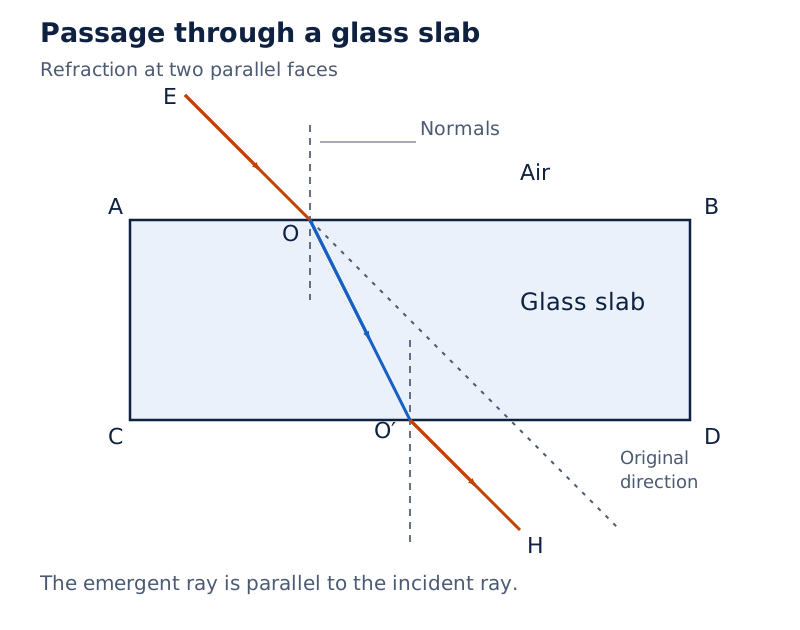
A rectangular slab is labelled ABCD. The incident ray EO enters at O, travels along OO′ and emerges along O′H. Normals are drawn at both boundaries, and a dotted extension shows the original incident direction.
Drawn by One Young India.
How can the path be traced experimentally?
- Place the glass slab on paper fixed to a drawing board and trace its outline.
- Set two pins vertically on a line inclined to one face of the slab.
- View their images through the opposite face and place two more pins in line with those images.
- Remove the slab and pins. Join the first pair of pin positions and extend that line to the entry face.
- Join the second pair of positions and extend backwards to the exit face. Join the entry and exit points.
- Draw normals at both points and compare the incident, refracted and emergent directions.
The same traced rays allow the angles to be measured. For a fixed pair of media and colour, comparing sin i/sin r for different incidence angles tests Snell’s law. Normal incidence is the undeviated case, without the sideways shift of oblique passage.
Why do submerged objects appear raised or bent?
Real depth is an object’s actual perpendicular distance below the surface. Apparent depth is the depth from which the light seems to come. Light travelling from water into air bends away from the normal before reaching an observer.
When the outgoing rays are extended backwards as straight lines, they point towards an apparent position above the actual object. This is a virtual image: the rays appear to come from that position without actually meeting there.
A coin that is just hidden from view by the rim of a bowl can become visible after water is poured in, even though the observer and coin have not moved. The coin appears slightly raised above its actual position. The water changes the path by which its light reaches the eye.
What the figure shows
Apparent depth
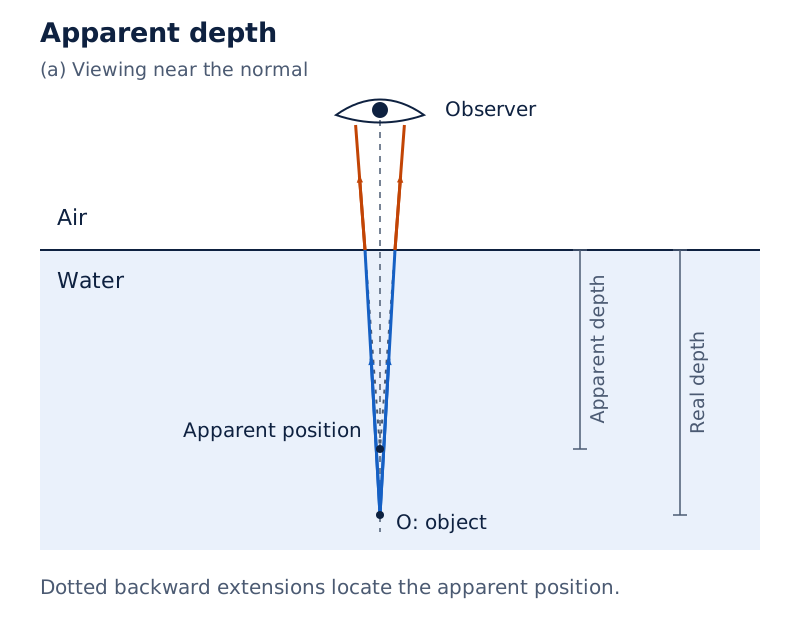
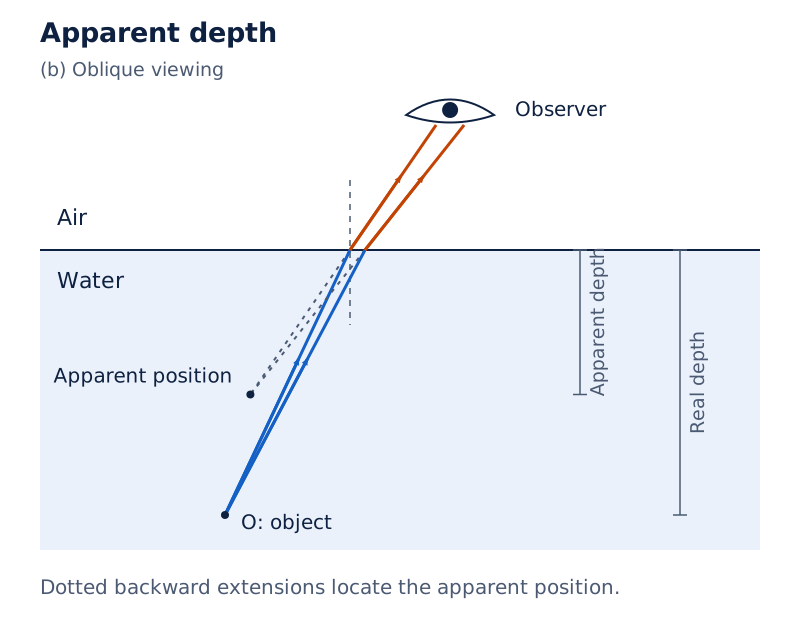
Two drawings show a submerged object O and observers above the surface. Refracted rays reach the observers; dotted backward extensions locate apparent positions above O. Drawing (a) shows normal viewing and drawing (b) shows oblique viewing; the second drawing labels real and apparent depths.
Drawn by One Young India.
When can depth be calculated from refractive index?
For viewing near the normal direction from air, let d be real depth and a be apparent depth. Taking the refractive index of the medium relative to air as n, a = d / n. This condition matters when using the formula.
Worked example 6. A needle lies at a real depth of 12.5 cm in water, and a microscope focused on it shows its apparent depth as 9.4 cm. Water is replaced by liquid of refractive index 1.63 to the same depth. For near-normal viewing, find the new apparent depth and the microscope movement needed to refocus. A centimetre, cm, equals 10⁻² m.
Formula: a = d/n; s = a₀ − a, where a₀ is the original apparent depth and s is the upward change of apparent position. Substitute: a = 12.5/1.63 cm; s = 9.4 − 12.5/1.63 cm. Answer: a ≈ 7.67 cm and s ≈ 1.73 cm. Move the microscope upwards by about 1.73 cm.
A pencil partly immersed in water appears displaced at the air-water boundary because light from its submerged part reaches the eye from a different direction. The apparent bend belongs to the image; the pencil itself has not bent.
How does a triangular prism refract light?
A triangular glass prism has two triangular bases and three rectangular lateral faces. The two refracting faces used by a ray are inclined to one another. Their included angle, A, is called the angle of the prism.
For the usual refracted path from air through glass and back into air, the ray bends towards the normal at the first face. It bends away from the normal at the second face, provided it emerges by refraction.
The angle of deviation, δ, read as delta, is the angle between the incident ray’s original direction and the emergent direction. Unlike the parallel faces of a slab, the inclined faces of a prism do not cancel the two changes in direction.
What the figure shows
Refraction through a prism
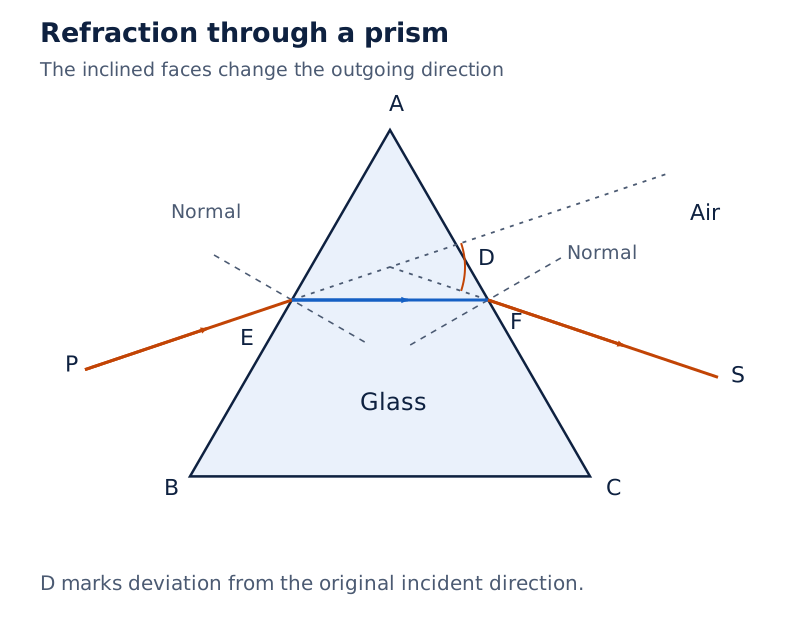
The triangular cross-section is labelled ABC. The incident path PE reaches E, the internal path EF crosses the prism, and FS emerges. Normals appear at E and F. The angle marked D shows deviation between the extended incident direction and emergent direction.
Drawn by One Young India.
How should a prism path be constructed?
- Draw the prism cross-section and mark the first point of incidence.
- Draw a normal perpendicular to the entry face and show the ray bending towards it.
- Continue the internal ray to the second face and draw a new normal there.
- For refraction into air, draw the emergent ray bending away from this second normal.
- Extend the incident direction and mark deviation against the emergent direction.
The normals belong to their respective faces. They are not interchangeable. The angle of the prism, A, is also different from an angle of incidence: incidence is measured between a ray and a normal, not between two glass surfaces.
Why can a thick glass plate or mirror show several images?
Partial reflection means that only part of the incident light returns from a boundary. The remaining transmitted part can enter the next medium. A glass surface can therefore participate in both reflection and refraction rather than behaving as a perfect mirror.
A plane mirror is a mirror with a flat reflecting surface. In a thick glass mirror with a reflecting coating behind the glass, light can reflect at the front glass surface and at the rear reflecting surface.
How do the different light paths arise?
One portion returns from the front surface without travelling through the full glass thickness. Another enters the glass, reaches the rear coating, and returns through the front surface. These portions have followed different paths before reaching the observer.
Further partial reflections inside the glass can produce additional emerging portions. Because their paths differ, their backward extensions can indicate different image positions. This accounts qualitatively for multiple images in a thick glass plate or mirror.
The important distinction is between one reflection and successive reflections at separated surfaces. A thicker transparent region separates the reflecting boundaries; treating the whole arrangement as a single reflecting plane misses these possible paths.
This explanation does not require a new law of refraction. Each transmitted portion refracts at a boundary, and each reflected portion returns into its incident medium. Keeping track of both processes explains how several paths can originate from the same object.
What are critical angle and total internal reflection?
Consider light travelling from an optically denser medium into a rarer medium. At suitable incidence angles, some light is reflected back internally while some is refracted out. The refracted ray bends away from the normal.
As the angle of incidence increases, the angle of refraction increases. Eventually the refracted ray grazes the boundary, making 90° with the normal. Critical angle, C, is the incidence angle in the denser medium corresponding to this limiting refracted direction.
Definition: Total internal reflection occurs when light travelling from an optically denser medium towards a rarer medium strikes the boundary at an incidence angle greater than the critical angle and is entirely reflected back.
| Incidence in denser medium | Behaviour at the boundary |
|---|---|
| i is less than C | Partial internal reflection and refraction occur |
| i equals C | The limiting refracted ray grazes the boundary |
| i is greater than C | Total internal reflection occurs |
What the figure shows
Critical angle and internal reflection
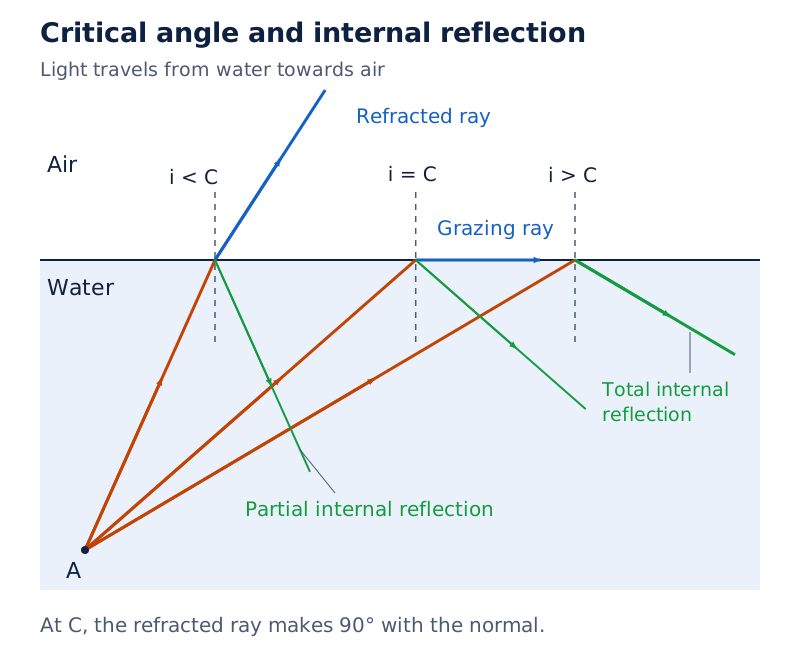
Rays from A in water strike the water-air boundary at different angles. The drawing includes refracted rays in air, partially reflected rays in water, a ray along the boundary and a totally reflected ray remaining in water.
Drawn by One Young India.
Derivation: Refractive index and critical angle
- Let n be the refractive index of the denser medium relative to the rarer medium. The reverse relative index is 1/n.
- Apply Snell’s law for passage from denser to rarer: sin i/sin r = 1/n.
- At the critical condition, i = C and r = 90°. Since sin 90° = 1, sin C = 1/n.
n = 1 / sin C
When the rarer medium is air, its index is approximated as one and n can be treated as the denser medium’s absolute index. The critical angle depends on the pair of media. Crown glass has a critical angle of about 41.14° relative to air.
Both conditions are necessary: denser-to-rarer passage and incidence greater than C. Neither the word “glass” nor a large angle by itself establishes total internal reflection. At exactly C, identify the grazing-ray condition.
How do prisms use total internal reflection to turn light?
A right-angled isosceles prism has a triangular cross-section with angles 45°, 45° and 90°. Its hypotenuse face is opposite the right angle. To obtain total internal reflection at 45°, its material must have a critical angle below 45°.
For a 90° turn, a ray enters normally through a face adjoining the right angle. It reaches the hypotenuse face at 45°, reflects internally and reaches the other short face normally. The outgoing direction is perpendicular to the incoming direction.
For a 180° turn, a suitable ray enters normally through the hypotenuse face and undergoes two internal reflections at the short faces. It emerges through the hypotenuse face in the direction opposite to its initial direction.
What the figure shows
Reflecting prisms
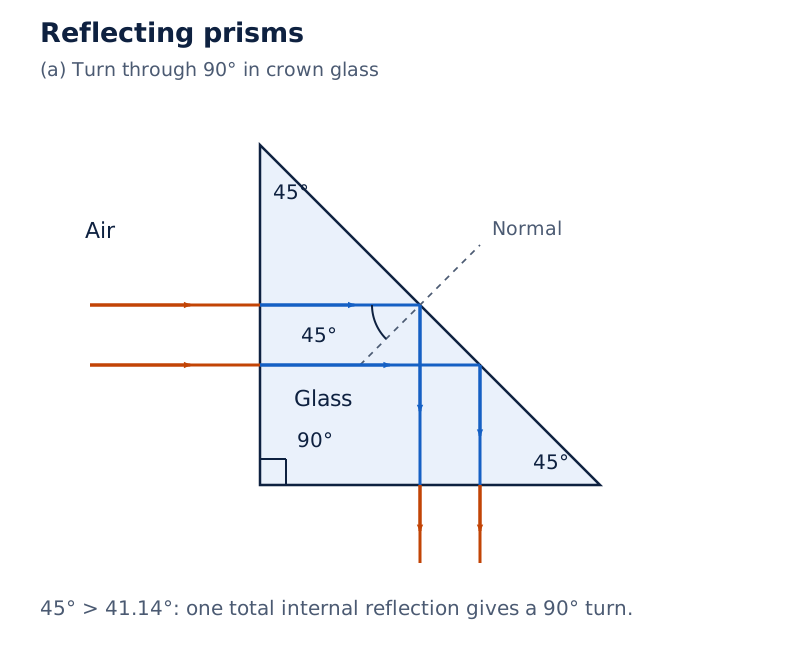
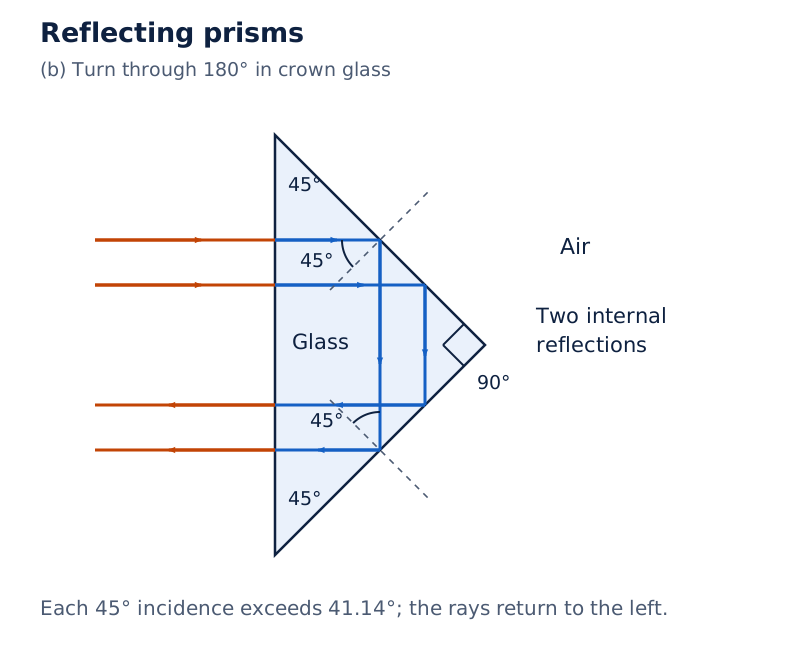
Part (a) shows horizontal incident rays turned vertically downwards by one reflection in a right-angled prism. Part (b) shows rays returning to the left after two reflections. Both drawings mark the 45° angles and the 90° vertex.
Drawn by One Young India.
How are other triangular shapes checked?
An equilateral prism has cross-sectional angles 60°, 60° and 60°. A ray entering normally through one face meets an adjacent face at 60°. For crown glass in air, this exceeds 41.14°, so total internal reflection occurs at that encounter.
In a prism with angles 30°, 60° and 90°, normal entry through a short face can give incidence of 30° or 60° at the hypotenuse face, depending on the entry face. A face adjoining the 30° vertex gives 30° incidence at the hypotenuse; the other short face gives 60°. For crown glass in air, 30° permits refraction whereas 60° gives total internal reflection.
Diagram
Checking other prism angles
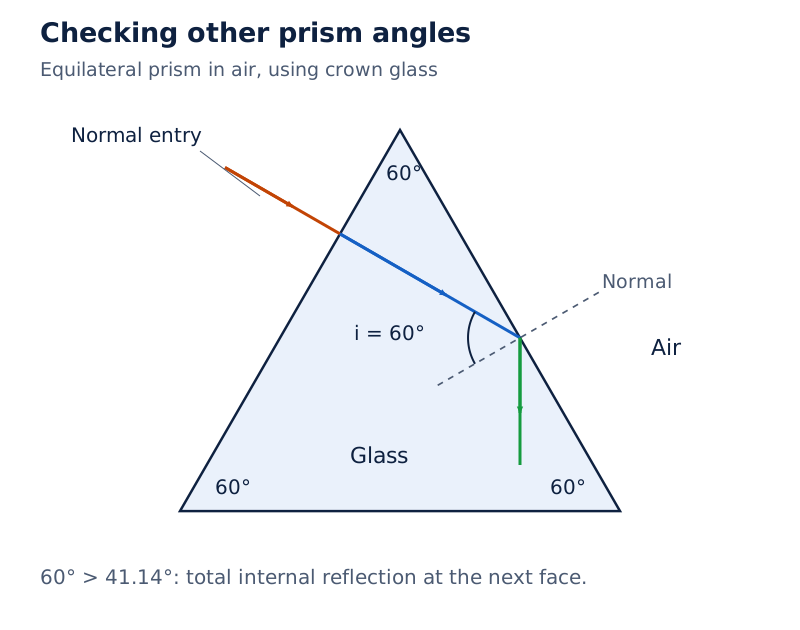
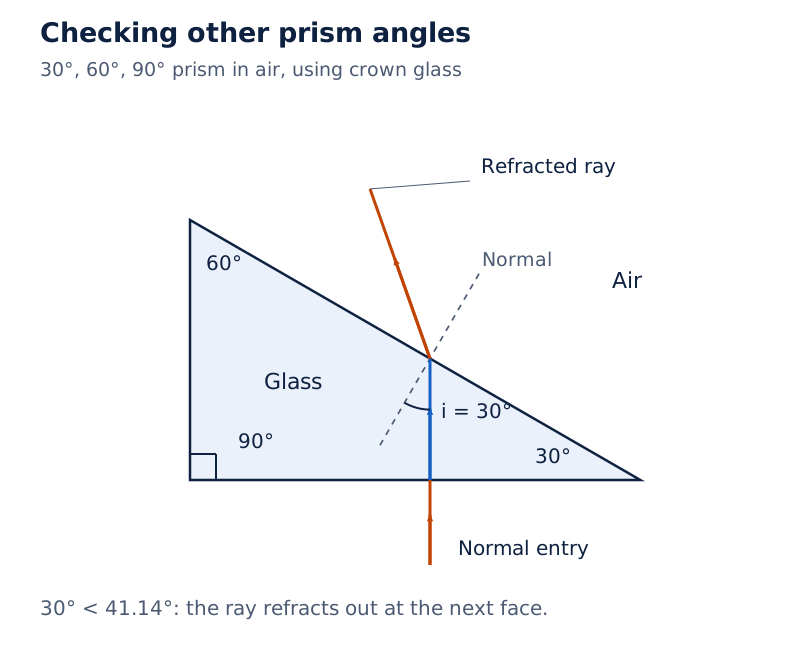
Draw separate triangular cross-sections with angles 60°, 60°, 60° and 30°, 60°, 90°. Show normal entry aimed at the next face, draw its normal and mark the internal incidence angle. Label glass inside and air outside; compare each incidence angle with the stated critical angle before choosing reflection or refraction.
Drawn by One Young India.
These results follow from the specified geometry and critical angle, not from the prism name alone. At every encounter, draw that face’s normal, find the internal incidence angle, then compare it with C before completing the ray.
How does total internal reflection compare with mirror reflection?
Both ordinary reflection and total internal reflection return light into the medium from which it approaches the reflecting surface. However, ordinary reflection does not require passage towards an optically rarer medium or incidence above a critical angle.
At an interface undergoing total internal reflection, no light is transmitted into the second medium in the ray description. Ordinary reflection need not return all the incident light. This distinction makes a suitable prism useful for redirecting a beam.
| Feature | Plane mirror reflection | Total internal reflection in a prism |
|---|---|---|
| Required arrangement | A reflecting plane surface | A denser-to-rarer boundary inside the prism |
| Critical-angle requirement | No critical-angle threshold is required | Incidence must exceed the critical angle |
| Light returned | Ordinary reflection is not necessarily complete | The incident light is totally reflected at the qualifying boundary |
How do optical fibres guide light?
An optical fibre is a thin transparent guide for light. Its inner region, the core, is surrounded by an outer layer called cladding. The core has a higher refractive index than the cladding.
Light entering at a suitable angle undergoes repeated total internal reflections along the fibre and emerges at the other end. The internal path must keep meeting the boundary at angles greater than the critical angle. A bend does not automatically prevent this guidance.
Optical fibres carry audio and video signals over long distances after conversion into light signals. They also act as light pipes for viewing internal organs. Their materials are specially prepared to keep absorption, the taking up of light energy by the material, very small.
Guidance by total internal reflection produces no appreciable loss at the repeated reflecting stages described here. This should not be turned into a claim that a real fibre absorbs no light. Low absorption remains a material requirement for long-distance transmission.
Glossary
- Refraction — Change in light’s direction on oblique passage between transparent media because its speed changes.
- Normal — Line perpendicular to the boundary at the point where a ray strikes it.
- Angle of incidence — Angle between the approaching incident ray and the normal at the boundary.
- Angle of refraction — Angle between the transmitted refracted ray and the normal in the second medium.
- Refractive index — Ratio comparing light speeds in two media, with vacuum used for an absolute index.
- Optically denser medium — Medium with a higher refractive index and lower light speed than the comparison medium.
- Wavelength — Distance between successive points in the same phase of a wave, such as neighbouring crests.
- Frequency — Number of wave oscillations per second, unchanged when light passes through a stationary refracting boundary.
- Lateral displacement — Perpendicular separation between the emergent ray and the extended incident direction after passage through a slab.
- Apparent depth — Depth below a surface from which the rays reaching an observer seem to originate.
- Angle of deviation — Angle between a ray’s original incident direction and its direction after emerging from a prism.
- Critical angle — Incidence angle in the denser medium for which the refracted ray grazes the boundary.
- Total internal reflection — Complete internal reflection at a denser-to-rarer boundary when incidence exceeds the critical angle.
- Optical fibre — Transparent light guide using a higher-index core and lower-index cladding to support repeated total internal reflection.
Common errors and misconceptions
- Misconception: Refraction angles are measured from the surface. Correct: Incidence and refraction angles are measured from the normal at the point of incidence.
- Misconception: Greater mass density means greater optical density. Correct: Optical density depends on refractive index; kerosene is optically denser than water despite its lower mass density.
- Misconception: An undeviated ray has not changed speed. Correct: At normal incidence light can change speed without changing direction.
- Misconception: Frequency decreases when light enters glass. Correct: Frequency remains unchanged; speed and wavelength decrease on entry from air into glass.
- Misconception: Parallel emergence means that a slab has had no effect. Correct: Refraction occurs at both faces, and an oblique ray is shifted sideways slightly.
- Misconception: Apparent depth equals real depth divided by index for every viewing angle. Correct: The stated depth relation requires viewing near the normal direction.
- Misconception: Total internal reflection begins at the critical angle. Correct: The critical angle gives a grazing refracted ray; total internal reflection requires a greater incidence angle.
- Misconception: Every ray entering a prism or fibre undergoes total internal reflection. Correct: The direction of travel and incidence angle at each internal boundary must satisfy both conditions.
Exam-style questions with model answers
Q1. State the two laws of refraction, including the conditions under which the sine ratio is constant. [2 marks]
- The incident ray, refracted ray and normal at the point of incidence all lie in the same plane.
- The ratio sin i/sin r is constant for a given colour and pair of media, for oblique incidence with a refracted ray. Here i and r are measured from the normal.
Q2. Light enters glass of refractive index 1.5 from air. Take the vacuum and approximate air speed as 3.0 × 10⁸ m/s. Calculate its speed in glass and state what happens to its frequency. [3 marks]
- Use n = c/v, where n is absolute refractive index, c is the vacuum speed and v is the speed in glass. Rearranging gives v = c/n.
- Substitute the supplied values: v = (3.0 × 10⁸)/1.5 = 2.0 × 10⁸ m/s. The speed is lower in glass than in air.
- The frequency remains unchanged on refraction. The decrease in speed is accompanied by a decrease in wavelength.
Q3. Light has wavelength 589 nm in air and enters water of refractive index 1.33. Take the air speed as 3 × 10⁸ m/s and 1 nm = 10⁻⁹ m. Calculate its frequency, speed in water and wavelength in water. [4 marks]
- Convert the air wavelength to 589 × 10⁻⁹ m. Frequency is f = c/λ, where c is the given air speed and λ is the air wavelength.
- Thus f = (3 × 10⁸)/(589 × 10⁻⁹) ≈ 5.09 × 10¹⁴ Hz. This frequency remains the same in water.
- Water speed is v = c/n, with n = 1.33. Therefore v ≈ 2.26 × 10⁸ m/s.
- Water wavelength is λw = v/f. Using unrounded values gives λw ≈ 4.43 × 10⁻⁷ m, or 443 nm.
Q4. Describe how to trace an oblique ray through a rectangular glass slab using four pins. Explain its bending at both faces and the relationship between the incident and emergent rays when air surrounds the slab. [5 marks]
- Fix paper on a drawing board, place the slab on it and trace its boundary. Set two pins vertically along a line inclined to the entry face.
- View these pins through the opposite face. Position two further pins so that they align with the images of the first pair.
- Remove the slab and pins. Join each pair of pin positions to the corresponding boundary, then join the entry and exit points to trace the internal ray.
- Draw normals at entry and exit. The ray bends towards the entry normal from air into glass and away from the exit normal from glass into air.
- The two parallel faces produce equal and opposite bending. The emergent ray is parallel to the incident ray but is displaced sideways slightly.
Q5. A submerged needle is 12.5 cm below a liquid surface and appears 9.4 cm deep when viewed near the normal from air. Calculate the liquid’s refractive index relative to air, and explain why the apparent position is raised. [3 marks]
- For near-normal viewing, apparent depth equals real depth divided by refractive index. Rearrangement gives the relative refractive index as real depth divided by apparent depth.
- Using the supplied depths, the index is 12.5/9.4 ≈ 1.33. The centimetre units cancel, leaving a ratio with no unit.
- Light from the needle bends away from the normal on entering air. Its backward extensions indicate a shallower position, so the needle appears raised.
Q6. A crown-glass prism in air has cross-sectional angles 45°, 45° and 90°. Its critical angle is 41.14°. A ray enters normally through one short face and reaches the hypotenuse face. Explain the entry, internal reflection, exit and final change in direction. [5 marks]
- The ray enters along the normal to the first short face. It therefore enters without changing direction, although its speed changes as it passes into glass.
- The 45°, 45°, 90° geometry makes its angle of incidence at the hypotenuse face 45°. This angle is measured from that face’s normal.
- At this boundary the ray approaches air from glass, so it is travelling from an optically denser medium towards an optically rarer one.
- Its 45° incidence exceeds the supplied critical angle of 41.14°. Both conditions for total internal reflection are satisfied, and the ray is reflected inside the glass.
- The reflected ray reaches the other short face normally and emerges undeviated there. The overall change from the incident direction to the emergent direction is 90°.
Q7. State both conditions for total internal reflection. Distinguish the ray behaviour at the critical angle from that above it. [3 marks]
- The light must approach a boundary while travelling from an optically denser medium towards an optically rarer medium. The reverse direction does not satisfy this requirement.
- The incidence angle, measured in the denser medium from the normal, must be greater than the critical angle for the two media.
- At the critical angle, the refracted ray grazes the boundary and makes 90° with the normal. Above that angle, total internal reflection occurs.
Q8. Explain why an optical fibre has a core of higher refractive index than its cladding, and describe how light entering at a suitable angle travels through it. [3 marks]
- The core is the inner guiding region, and the cladding surrounds it. Their index arrangement makes the core-to-cladding boundary a denser-to-rarer boundary for light inside the core.
- Suitable entry directs light so that its incidence angles at this internal boundary exceed the critical angle. It therefore undergoes repeated total internal reflections.
- The guided light travels along the fibre and emerges at the other end. Specially prepared materials keep absorption very small during transmission.
Key takeaways
- Measure incidence and refraction angles from the normal, and apply Snell’s law for a fixed colour and pair of media.
- Absolute refractive index compares vacuum speed with medium speed; a greater index corresponds to a lower speed of light.
- Frequency remains unchanged during refraction, while wavelength changes in the same proportion as the speed of light.
- A rectangular slab in air gives parallel emergence with a slight sideways shift for an obliquely incident ray.
- Apparent depth is smaller than real depth for a submerged object viewed from air; the simple formula requires near-normal viewing.
- A prism has inclined refracting faces, so its emergent direction generally differs from the original incident direction.
- Total internal reflection requires denser-to-rarer travel and incidence greater than the critical angle, rather than equal to it.
- Suitable prisms redirect light by internal reflection, while suitably directed light can be guided along optical fibres by repeated reflections.
Test yourself
Why does refractive index have no unit?
It is a ratio of two speeds expressed in the same units, so those units cancel.
Can light change speed without changing direction?
Yes. At normal incidence it passes undeviated across the boundary even when its speed changes.
What stays unchanged when light is refracted?
The frequency remains unchanged, while speed and wavelength can change on entering the new medium.
Why is a slab’s emergent ray parallel to the incident ray?
With the same medium outside both parallel faces, the bending at entry and exit is equal and opposite.
What condition belongs with the simple apparent-depth formula?
The observer must view near the normal direction; the stated formula is not for arbitrary oblique viewing.
Where is the refracted ray at the critical angle?
It grazes the interface, making an angle of 90° with the normal in the rarer medium.
Why must a reflecting right-angled prism have a critical angle below 45° for the described paths?
The relevant internal incidence angles are 45°. Total internal reflection requires those angles to exceed the critical angle.
Why is the cladding’s refractive index lower than the core’s?
This provides a denser-to-rarer internal boundary where suitably directed light can undergo repeated total internal reflection.
Write about it
Turn a question from this chapter into a paper.
The Writing Studio has a structure guide, a rubric and citation tools for 15 formats, from essays to research papers. Drafting is free with an account. Learnacy Essential adds feedback from an AI writing coach and submission to The OYI Review.
Learnacy Essential is ₹1,499 for the year. Publication depends on review and is not guaranteed.