
Market | ICSE Class 10 Economics Notes
On this page
Watch & explore
Start with a few high-quality watches, then dive into the notes below.

This note covers the meaning of a market, the features of perfect competition, monopoly, monopolistic competition and oligopoly, the role of product differences and entry conditions, price-taking behaviour, and comparisons between market forms.
What does a market mean in economics?
Definition: A market is a set of arrangements through which buyers and sellers exchange goods and services. It need not be a particular physical place.
Goods are tangible objects that satisfy wants, while services satisfy wants through activities rather than physical objects. A buyer purchases a good or service; a seller offers it for sale. Their interaction is central to the economic meaning of a market.
Must buyers and sellers meet?
Buying and selling can occur at a village chowk or a large city bazaar. They can also take place through the telephone or internet. The arrangements connecting buyers and sellers matter; their presence at the same physical location is not essential.
A marketplace is therefore one possible setting for a market. The word market has a wider meaning in economics. It includes arrangements that allow people to exchange products even when the buyer and seller do not meet face to face.
What role does price play?
Price is the amount of money paid per unit of a good or service. A market exchange takes place at a price agreed upon by the buyer and seller. Prices communicate information to people taking economic decisions.
For example, an increase in buyers' demand for a good can signal that more of it is wanted. Demand concerns the quantity buyers are willing and able to buy at a given price during a given period. Producers are likely to increase production when a higher price signals greater demand.
This coordination connects decisions about buying with decisions about production. It does not require every participant to know every other participant personally. Buyers and sellers can respond to information conveyed through the price of the product.
The meaning of a market must be distinguished from its form. All the forms considered here involve buying and selling, but they differ in the number of sellers, the products offered and the freedom of firms to enter.
How can market forms be identified?
A firm is a business unit producing or selling goods or services. An industry consists of firms producing the same or closely related products. A market structure, or market form, describes the conditions under which buyers and sellers interact.
The four forms are perfect competition, with many sellers of an identical product under competitive conditions; monopoly, with one seller and no close substitute; monopolistic competition, with many sellers of differentiated products; and oligopoly, with a few major sellers.
A substitute is a product that can be used in place of another. Close substitutes provide buyers with particularly similar alternatives. Product differentiation means differences that make buyers distinguish one seller's product from another's, although the products serve similar purposes.
Which features should be examined?
- Number and size of sellers: Identify whether supply comes from many small firms, one seller or a few major firms. Supply means the quantity sellers are willing to offer at a given price during a given period.
- Nature of the product: Ask whether products are identical, differentiated but substitutable, or without a close substitute.
- Entry and exit: Entry means starting to sell in the market; exit means leaving it. Check whether firms can enter and leave freely or face restrictions.
- Influence over price: Examine whether an individual firm accepts the market price or has some power to influence the price it charges.
These features should be read together. Many sellers alone do not establish perfect competition. Monopolistic competition also involves many sellers, but its products are differentiated. Product differences therefore help separate forms that otherwise share a large number of firms.
Similarly, selling a product under a distinctive name does not establish monopoly. If buyers can turn to close substitutes made by other firms, the seller still faces competition. The relevant issue is the availability of alternatives, not merely ownership of a name.
Note: Classify the market for the product being discussed. A claim about one activity or product should not automatically be extended to every activity of the organisation supplying it.
What are the defining features of perfect competition?
Perfect competition is a market form in which a large number of buyers and sellers trade a homogeneous product, firms can enter and leave freely, and information is perfect. A homogeneous product is identical across sellers, so buyers cannot distinguish it by its producer.
Why do numbers and product similarity matter?
Each individual buyer and seller is very small relative to the whole market. Consequently, no individual buyer or seller can influence the market through its size. A firm's own sales form only a small part of the total quantity exchanged.
Because the products are homogeneous, buying from one firm gives the buyer the same product as buying from another. The product itself provides no reason to pay more to a particular seller. This supports the acceptance of a common market price.
What do entry and information mean?
Free entry and exit mean that firms can readily begin or stop supplying the market. Difficult or restricted entry could leave the market with relatively few firms. Freedom of entry therefore helps explain the presence of a large number of sellers.
Perfect information means that buyers and sellers are fully informed about price, quality and other relevant details of the product and market. Buyers can recognise that another seller offers the same product at the prevailing price.
| Defining feature | Meaning | Connection with competition |
|---|---|---|
| Many buyers and sellers | Each participant is small relative to the market | No individual controls the market through its size |
| Homogeneous product | Products of different firms are identical | Buyers can switch sellers without changing the product |
| Free entry and exit | Firms can readily join or leave | Restrictions do not keep the number of firms small |
| Perfect information | Relevant market details are known | Buyers know the price and quality available elsewhere |
These conditions jointly describe the model. A crowded shopping area need not satisfy them, since its sellers may offer different products. Likewise, physical proximity is not one of the defining conditions: the economic relationships between participants determine the market form.
Why is a firm under perfect competition a price taker?
A price taker accepts the prevailing market price as given. The individual firm does not choose a higher selling price while expecting buyers to continue purchasing its identical product. Price-taking behaviour follows from the conditions of perfect competition.
What happens if a seller raises its price?
- The market contains many firms selling the same product, so buyers have alternative sellers from whom to purchase it.
- Buyers know the market price because the model assumes perfect information about relevant market conditions.
- If one firm charges more than that price, buyers can obtain the identical product from other firms at the market price.
- The higher-priced firm therefore loses its buyers under the price-taking assumptions. It accepts the market price if it wishes to sell.
The presence of many other firms matters in this reasoning. When buyers switch sellers, their purchases can be accommodated elsewhere in the market. The explanation relies on the full set of assumptions, rather than on a general claim that buyers dislike high prices.
Why does the firm not simply charge less?
Under the model, the firm believes it can sell the quantity it wishes to supply at the market price. It therefore has no reason to charge less for that quantity. Accepting the prevailing price allows it to sell without voluntarily lowering the amount received per unit.
Worked example 1. Consider the candle-market illustration: assume the market for boxes of candles is perfectly competitive and the market price is ₹10 per box. Explain the individual manufacturer's price-taking position.
Answer: The manufacturer accepts ₹10 per box. Buyers can purchase identical boxes from other sellers and know the market price. Charging more loses buyers under these assumptions; charging less is unnecessary when the desired quantity can be sold at ₹10.
This is a conditional illustration of perfect competition. It does not establish that every actual candle market satisfies the model. The assumptions about the number of firms, identical products, entry and information are essential to the conclusion.
How does price taking determine revenue?
Total revenue is the money earned from sales: . Here is the market price per unit and is the quantity sold. For candles, price is measured in rupees per box, quantity in boxes and total revenue in rupees.
Average revenue is revenue per unit sold: , for positive output. A price-taking firm therefore earns average revenue equal to the market price, measured in rupees per box in the candle example.
Marginal revenue measures the increase in total revenue per additional unit sold: . The symbol means change. In the candle example, marginal revenue is measured in rupees per box.
Under perfect competition, each extra unit sells at the unchanged market price, so . The additional revenue from selling one more unit therefore equals the price received per unit.
What the figure shows
Total revenue curve
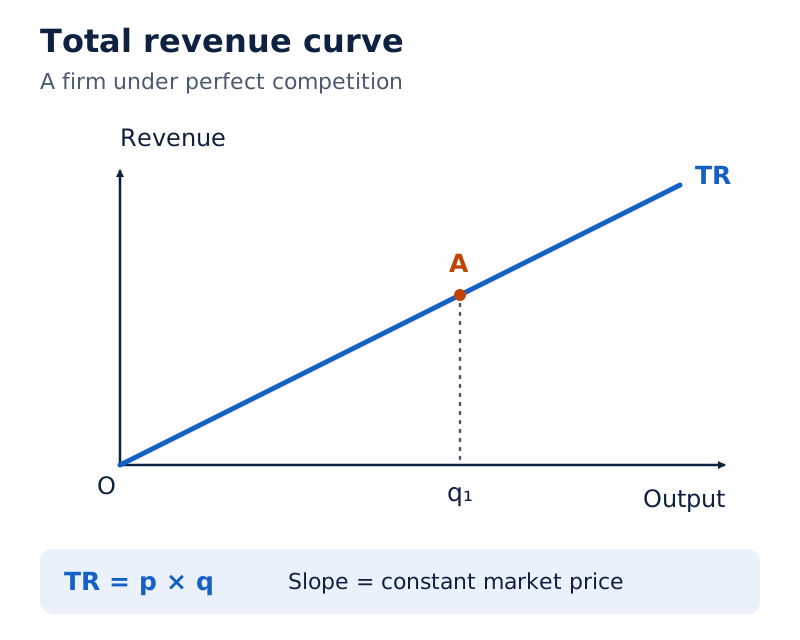
Output is on the horizontal axis and revenue on the vertical axis. The straight line labelled TR rises from the origin O. Point A lies on TR, with a dotted vertical line down to output .
The slope is the constant market price. Total revenue is zero at zero output and increases as more units are sold.
Drawn by One Young India.
What the figure shows
Price line
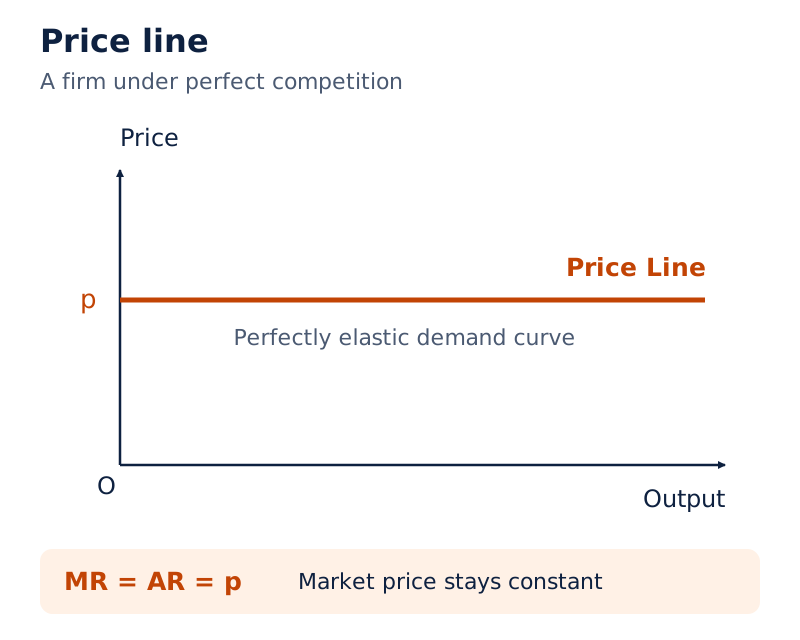
Output is on the horizontal axis and price on the vertical axis. A horizontal line labelled Price Line meets the vertical axis at , above the origin O.
This is the competitive firm's average revenue curve and its perfectly elastic demand curve. The firm can sell as many units as it wishes at the given market price.
Drawn by One Young India.
What makes a market a monopoly?
Definition: Monopoly is a market form in which a single seller supplies a product without a close substitute, and barriers prevent other firms from freely entering that market.
A monopolist is the single seller in such a market. Unlike one small seller among many, the monopolist supplies the whole market for the specified product. The absence of a close substitute limits the alternatives available to its buyers.
Why are entry barriers important?
Barriers to entry are obstacles that prevent or restrict other firms from entering a market. If other firms could freely begin selling an equivalent product, the position of the single seller would be open to competition.
Monopoly therefore involves more than observing one seller at a particular moment. The conditions that preserve that position matter. Restrictions on entry help explain why additional sellers do not simply appear and supply the same product.
The description also depends on how the product is defined. A single seller of one named version of a product may face close alternatives. Being the sole seller of that version is not sufficient to show that the broader product market is a monopoly.
Does the monopolist have unlimited pricing freedom?
A price maker has influence over the price charged, rather than accepting a price fixed outside the individual firm. A monopolist has such influence, but buyers still decide how much they are willing to purchase.
The seller cannot assume that the same quantity will be bought at any price it chooses. Its pricing power is therefore constrained by demand. Monopoly should not be defined as unlimited power to set both price and quantity independently.
Worked example 2. Monopoly of note issue is a function of the central bank, the institution at the centre of a country's banking system. Identify the activity to which the monopoly refers.
Answer: The specified monopoly concerns note issue. It should not be expanded into a claim that all banking services are supplied by a single bank. The market or activity being classified must remain clearly identified.
How does monopolistic competition combine competition and product differences?
Monopolistic competition is a market form with many firms, free entry and exit, and differentiated products. The products are similar enough to compete with one another but are not identical in the eyes of buyers.
The word “monopolistic” refers to the distinctiveness of a firm's own product. The word “competition” refers to the alternatives offered by rival sellers. Both elements are needed to understand the term; it does not mean that there is just one seller.
What does differentiation change?
Product differentiation gives a buyer a reason to prefer one seller's product over another's. Differences may concern qualities of the product or the way buyers perceive it. The products nevertheless remain close substitutes rather than entirely unrelated goods.
Because its product is distinguishable, an individual firm has some influence over its own price. It need not lose every buyer after a price increase. However, buyers can switch to competing products, so the firm's pricing freedom remains limited.
For example, different brands of soap illustrate differentiated products serving a similar purpose. A brand is a name or other identifying feature that distinguishes a seller's product. A brand alone does not make the seller the monopolist of the whole soap market.
Why does the number of sellers still matter?
Many firms compete for customers, and entry is free. A particular seller therefore faces alternatives both from existing firms and from firms that can enter the market. Its distinctive product does not remove competition.
Worked example 3. Use different brands of soap as an illustration of differentiated products. Explain why a buyer's preference for one brand does not, by itself, prove that the seller has a monopoly.
Answer: The preference distinguishes one product from others, but competing soaps can still perform a similar function. Differentiation allows some influence over price; close substitutes limit that influence. Where many firms sell such differentiated products with free entry, the form is monopolistic competition.
This form differs from perfect competition in product identity. It differs from monopoly in the presence of many competing sellers and close alternatives. Its name captures those two relationships without making it identical to either of the other forms.
What are the main features of oligopoly?
Oligopoly is a market form in which a few major firms supply the market. Each is sufficiently important for its decisions to affect other firms. The central feature is the small number of significant sellers, rather than the existence of one seller.
Why must firms consider their rivals?
Interdependence means that a firm's decisions and results depend partly on what its rivals do. In oligopoly, changing a price or the quantity offered can affect the sales of other major firms. Those firms may respond.
An individual firm must therefore consider possible reactions when deciding its own action. This differs from the position of a very small competitive firm, whose individual decisions do not influence the market price.
It also differs from monopoly. A monopolist has no other seller of the same product within the defined monopoly market. An oligopoly contains rival firms, even though there are relatively few of them.
Must oligopoly products be identical?
Oligopoly can involve homogeneous or differentiated products. Product identity alone therefore cannot identify it. The number and importance of the firms must also be considered. Entry barriers help explain why a few major sellers can remain significant.
Passenger-car manufacturing is a conventional illustration of differentiated oligopoly. Cars offered by different manufacturers can be distinguished, while a limited group of major producers competes in the market. The feature illustrated is the importance of a few major producers rather than the presence of one sole supplier.
Worked example 4. In the passenger-car illustration, explain the significance of a few major manufacturers producing differentiated vehicles. What must an individual manufacturer consider when changing its price?
Answer: A few major competing sellers indicate oligopoly, while differentiated vehicles show that oligopoly need not involve identical products. A manufacturer must consider how rivals may respond to a price change, because their responses can affect its own sales.
Interdependence does not mean that firms necessarily agree with one another. It means that each firm's choices are connected with the choices of its rivals. A response may involve competition; agreement is not part of the definition.
How do the four market forms differ?
A useful comparison applies the same criterion to every market form. Comparing the number of sellers in one form with the type of product in another does not show a clear difference. Keep seller numbers, product characteristics and pricing influence separate.
How do sellers and products compare?
| Basis | Perfect competition | Monopoly | Monopolistic competition | Oligopoly |
|---|---|---|---|---|
| Sellers | Many small sellers | One seller | Many sellers | A few major sellers |
| Product | Homogeneous across firms | No close substitute | Differentiated close substitutes | Homogeneous or differentiated |
| Entry | Free | Restricted by barriers | Free | Barriers help sustain few major sellers |
| Individual price influence | Firm is a price taker | Seller influences price, subject to demand | Some influence, limited by substitutes | Influence depends partly on rival responses |
The large number of sellers is common to perfect competition and monopolistic competition. Their difference lies in product identity. Identical goods support price-taking behaviour, while differentiated goods give an individual seller some pricing influence.
Monopoly and oligopoly both differ from the many-small-sellers structure. However, one seller and a few rival sellers are distinct situations. The need to anticipate the reactions of major competitors is especially important in oligopoly.
Which comparisons need careful wording?
A monopolist's lack of a close substitute does not mean buyers must purchase any quantity offered at any price. Demand still matters. Equally, product differentiation does not give a seller the unrestricted power associated with an exaggerated account of monopoly.
The labels describe different sets of conditions. Avoid treating the forms as descriptions of whether a business is large, successful or well known. Such descriptions do not by themselves establish the number of rivals or the availability of substitutes.
Entry conditions provide an additional check. Perfect competition and monopolistic competition allow free entry, while monopoly requires restrictions that protect the sole seller. Oligopoly is associated with conditions that allow a few major firms to retain their position.
A complete comparison therefore connects the structure with its consequence: identical products and many informed participants support price taking; differentiated alternatives limit pricing influence; a few important rivals make strategic reactions relevant.
How should market examples be interpreted carefully?
A market example illustrates particular conditions. It should not be used as a permanent label that applies to every place, product variation or activity. First identify exactly what is being bought and sold, then connect the example to the relevant features.
How can an illustration remain accurate?
The candle illustration explicitly assumes perfect competition. Its purpose is to show the position of a price-taking manufacturer. The statement about the model does not establish that all actual candle sellers trade identical products with perfect information.
The central-bank example identifies note issue as the monopoly activity. Commercial banks are institutions that accept deposits and advance loans, among other banking functions. A deposit is money placed with a bank; a loan is money advanced for repayment. It would therefore be incorrect to change the example into “all banking is a monopoly”.
Different soap brands illustrate differentiation, while the passenger-car example illustrates a market with a few major producers of differentiated products. In each case, the product characteristics must be considered alongside the number and relative importance of the sellers.
How can evidence be linked to a conclusion?
- State the product or activity under consideration, keeping its boundaries clear.
- Identify the stated number and relative importance of sellers.
- Examine whether buyers can obtain an identical product or a close substitute from another seller.
- Connect the entry conditions and pricing position to the appropriate market form.
If only differentiation is stated, that fact alone does not separate monopolistic competition from differentiated oligopoly. The number of sellers is also needed. If only many sellers are stated, product identity and the other competitive conditions still require attention.
This method prevents a familiar product name from replacing economic reasoning. A classification is strongest when the stated features support it directly. A missing feature should remain missing rather than being silently supplied through guesswork about the example.
Price influence should likewise be explained through conditions. The claim that a firm accepts price should be linked to the competitive model, while the claim that rivals matter should be linked to a few significant sellers.
How can the main distinctions be used together?
The meaning of a market, its structure and a firm's behaviour answer different questions. A market describes arrangements for exchange. Structure describes the conditions of exchange. Behaviour concerns what firms do within those conditions, including how they respond to prices and rivals.
What separates the two many-seller forms?
Begin with product identity. Under perfect competition, the product is homogeneous, buyers and sellers have perfect information, and firms enter freely. The individual firm accepts the market price. Under monopolistic competition, many firms offer differentiated close substitutes and have some pricing influence.
The distinction is not simply “competition exists” versus “competition is absent”. Both forms contain competing sellers. The difference is whether a buyer sees the products as identical or can distinguish between them while still treating them as alternatives.
What separates the one-seller and few-seller forms?
Under monopoly, one seller supplies a product without a close substitute, protected by entry barriers. Under oligopoly, a few major sellers remain rivals. Their mutual influence makes the response of other firms part of an individual firm's decision.
Both descriptions require attention to the relevant product market. A large firm need not be a monopolist if other firms supply close alternatives. Similarly, a differentiated product need not belong to monopolistic competition if the market has only a few major producers.
The safest explanation moves from the stated feature to its consequence. Many small sellers of identical products cannot individually control price under perfect competition. Differentiation gives buyers reasons to prefer a product. Few major sellers make rival reactions important.
Note: Keep three limits clear: many sellers alone do not establish perfect competition; a distinctive brand alone does not establish monopoly; and interdependence does not mean that oligopoly firms necessarily cooperate.
These distinctions also clarify examples. The assumed candle market illustrates price taking, note issue identifies a specific monopoly activity, soaps illustrate product differentiation, and passenger cars illustrate differentiated oligopoly. Each example is useful because of the condition it helps explain.
Glossary
- Market — Arrangements through which buyers and sellers exchange goods or services, without necessarily meeting at a physical location.
- Firm — A business unit that produces or sells goods or services in a market.
- Industry — A group of firms producing the same product or closely related products.
- Market structure — Conditions of a market, including seller numbers, product characteristics, entry and influence over price.
- Perfect competition — A market with many buyers and sellers, homogeneous products, free entry and exit, and perfect information.
- Homogeneous product — A product identical across sellers, so a buyer cannot distinguish it by its producer.
- Perfect information — Complete knowledge among buyers and sellers of price, quality and other relevant market details.
- Price taker — A buyer or seller that accepts the prevailing market price as given.
- Monopoly — A market with one seller, no close substitute for its product, and barriers restricting entry.
- Barrier to entry — An obstacle that prevents or restricts additional firms from entering a market.
- Close substitute — A product sufficiently similar in use to provide an alternative to another product.
- Product differentiation — Differences that distinguish sellers' products in buyers' eyes although those products serve similar purposes.
- Monopolistic competition — A market with many sellers of differentiated close substitutes and free entry and exit.
- Oligopoly — A market supplied by a few major firms whose decisions affect one another.
- Interdependence — A situation in which one firm's decisions and outcomes depend partly on its rivals' actions.
Common errors and misconceptions
- Misconception: A market must be a physical place. Correct: Buyers and sellers can also exchange through arrangements involving the telephone or internet.
- Misconception: Many sellers are sufficient to establish perfect competition. Correct: Homogeneous products, free entry and exit, and perfect information are also defining conditions.
- Misconception: Every actual candle market must be perfectly competitive. Correct: Perfect competition is an explicit assumption in the candle illustration.
- Misconception: A monopolist can sell any quantity at any chosen price. Correct: Demand constrains the quantity buyers will purchase at a particular price.
- Misconception: Monopolistic competition means one seller. Correct: It involves many sellers whose differentiated products remain close substitutes.
- Misconception: Differentiated products establish monopolistic competition by themselves. Correct: Oligopoly can also have differentiated products, so seller numbers must be considered.
- Misconception: Interdependence requires agreement between firms. Correct: It requires attention to rival reactions, which may include competing rather than cooperating.
- Misconception: Monopoly of note issue means monopoly of all banking. Correct: The statement concerns the specific activity of issuing notes, not every banking service.
Exam-style questions with model answers
Q1. Define a market and explain why a physical meeting between buyers and sellers is unnecessary. [2 marks]
- A market is a set of arrangements through which buyers and sellers exchange goods or services.
- Exchange may take place through telephone or internet arrangements, so participants need not meet at one physical location.
Q2. State and explain the four defining features of perfect competition. [4 marks]
- There are many buyers and sellers. Each participant is small relative to the whole market and cannot influence it through its size.
- The product is homogeneous. Buyers obtain the same product regardless of which firm supplies it.
- Entry and exit are free. Firms can readily begin supplying the market or leave it.
- Information is perfect. Buyers and sellers know price, quality and other relevant details about the product and market.
Q3. Assume boxes of candles are sold in a perfectly competitive market at ₹10 per box. One manufacturer proposes to charge more than ₹10. Explain why this manufacturer is a price taker. [3 marks]
- Perfect competition means that many firms supply an identical product. Buyers can therefore obtain the same boxes of candles from alternative sellers.
- Perfect information means that buyers know the prevailing price of ₹10 per box and can recognise the proposed higher price.
- Buyers switch to other sellers under these assumptions, so the manufacturer loses its buyers if it charges more. It accepts ₹10 if it wishes to sell.
Q4. Explain three features that distinguish monopoly from a market in which many firms freely sell identical products. [3 marks]
- Monopoly has one seller supplying the specified product, whereas the comparison market has many sellers offering that product.
- The monopolist's product has no close substitute. Buyers therefore lack the close alternatives available when many firms offer an identical product.
- Entry barriers protect the monopolist's position. This contrasts with the stated freedom of firms to enter the many-seller market and supply the product.
Q5. A market has many sellers, free entry and exit, and differentiated products that are close substitutes. Identify the market form and explain five further points about its features, pricing position and differences from perfect competition and monopoly. [6 marks]
- The form is monopolistic competition because the stated combination is many sellers, differentiated close substitutes, and free entry and exit.
- Product differentiation means that buyers can distinguish one firm's offering from another's, despite the products serving similar purposes.
- A seller has some influence over its own price because buyers may prefer its particular product to competing versions.
- That influence is limited: close substitutes allow buyers to switch to rival products rather than accept any price demanded.
- It differs from perfect competition because products are differentiated rather than homogeneous, so individual firms are not pure price takers.
- It differs from monopoly because there are many sellers and close substitutes, rather than a protected single seller without a close substitute.
Q6. A market has a few major sellers of differentiated products. A price change by one seller can affect the others' sales, and those sellers may respond. Identify the market form and explain interdependence. [3 marks]
- The market is an oligopoly because a few major sellers supply it. Differentiated products are compatible with this market form.
- Interdependence means that each firm's decisions and outcomes depend partly on its rivals' actions. The stated effect on other sellers' sales shows this connection.
- A seller considering a price change must anticipate possible rival responses, since those responses can affect its own sales. Interdependence does not require agreement.
Q7. Compare perfect competition and monopolistic competition in six separate points: seller numbers, entry, product identity, buyer alternatives, pricing influence, and the effect of a firm's higher price. [6 marks]
- Both forms have many sellers, so a large number of firms alone does not distinguish one form from the other.
- Both allow free entry and exit. Freedom to join or leave is therefore another shared feature of these market forms.
- Perfect competition has homogeneous products, while monopolistic competition has products that buyers can distinguish from one another.
- Competitive buyers can obtain an identical product elsewhere; buyers under monopolistic competition can choose differentiated products that are close substitutes.
- The perfectly competitive firm accepts the market price, while the monopolistically competitive firm has some pricing influence limited by substitutes.
- Under perfect competition, charging above the market price loses buyers under the model's assumptions; with differentiated products, a price increase need not lose every buyer.
Q8. A central bank has a monopoly of note issue. Explain why this statement does not establish a monopoly of all banking services. [2 marks]
- The stated monopoly applies specifically to note issue, so the activity being classified has a defined boundary.
- Banking includes other functions performed by commercial banks. The statement provides no basis for treating all those services as a single-seller activity.
Key takeaways
- A market consists of arrangements for exchange; buyers and sellers need not meet in one physical place.
- Perfect competition combines many buyers and sellers, homogeneous products, free entry and exit, and perfect information.
- A perfectly competitive firm accepts the market price because informed buyers can obtain identical products from other sellers.
- Monopoly combines one seller, no close substitute and entry barriers; demand still limits the seller's pricing freedom.
- Monopolistic competition involves many firms offering differentiated close substitutes, with free entry and limited influence over price.
- Oligopoly involves a few major sellers, whose decisions depend partly on the expected reactions of their rivals.
- Compare market forms using matching criteria: seller numbers, product characteristics, entry conditions and influence over price.
- Interpret examples within their stated assumptions and product boundaries; do not silently add missing market information.
Test yourself
Can a telephone transaction form part of a market?
Yes. Market arrangements can connect buyers and sellers without requiring them to meet at a physical marketplace.
What does a homogeneous product mean?
Products supplied by different firms are identical, so buying from another seller does not change the product obtained.
Why does perfect information matter for price taking?
Buyers know the prevailing market price and can recognise that other firms offer the identical product at that price.
What prevents monopoly from being defined simply as a distinctive brand?
A distinctive brand may face close substitutes supplied by other firms. Monopoly requires a single seller without a close substitute.
Which feature separates perfect competition from monopolistic competition most directly?
Perfect competition has homogeneous products, while monopolistic competition has differentiated products that remain close substitutes.
Can an oligopoly sell differentiated products?
Yes. Oligopoly may involve homogeneous or differentiated products; a few major sellers and their interdependence are central features.
Does interdependence mean firms necessarily cooperate?
No. It means firms must consider rival reactions, which may involve competitive responses rather than agreement.
Why is the product or activity boundary important in a market example?
A classification applies to the specified product or activity. Monopoly of note issue does not establish monopoly of all banking.
Write about it
Turn a question from this chapter into a paper.
The Writing Studio has a structure guide, a rubric and citation tools for 15 formats, from essays to research papers. Drafting is free with an account. Learnacy Essential adds feedback from an AI writing coach and submission to The OYI Review.
Learnacy Essential is ₹1,499 for the year. Publication depends on review and is not guaranteed.