
Nobel Prize in Chemistry 2001: Chiral Catalysis and Asymmetric Synthesis
On this page
What was the Nobel Prize in Chemistry 2001 awarded for?
The Royal Swedish Academy of Sciences announced the award for "their work on chirally catalysed hydrogenation reactions" (shared by William Knowles and Ryoji Noyori) and "his work on chirally catalysed oxidation reactions" (Sharpless alone).
The press release framed the whole award under one umbrella idea: the development of catalytic asymmetric synthesis.
In plain words, many molecules exist in two forms that are mirror images of each other, rather like a left hand and a right hand. Chemists call this property chirality.
The three laureates found ways to build special helper molecules, called catalysts, that speed up a reaction while pushing it to make mostly one of the two mirror-image forms instead of an equal mixture of both.
This matters enormously for medicines, because the two mirror-image forms of a drug molecule can behave completely differently inside the body.
The official name of this award is the Nobel Prize in Chemistry, and the 2001 prize was announced on 10 October 2001, worth 10,000,000 Swedish kronor in total, split one quarter each to Knowles and Noyori and one half to Sharpless.
Who are the laureates?
William S. Knowles
Knowles was born on 1 June 1917 in Taunton, Massachusetts, USA, and died on 13 June 2012 in Chesterfield, Missouri, USA.
At the time of the award he had retired, having previously worked at the Monsanto Company in St Louis, USA. He received one quarter of the prize.
In 1968 he discovered that a transition metal could be turned into a chiral catalyst capable of producing an excess of one mirror-image form during hydrogenation, a reaction in which hydrogen atoms are added to a molecule.
He went on to apply this to build the first industrial catalytic asymmetric synthesis, used to manufacture the Parkinson's disease drug L-DOPA.
Ryoji Noyori
Noyori was born on 3 September 1938 in Kobe, Japan. At the time of the award he was affiliated with Nagoya University in Nagoya, Japan, where he had been a professor of chemistry since 1972 and, since 2000, director of the Research Center for Materials Science.
He also received one quarter of the prize. Noyori extended Knowles's idea into far more general and efficient chiral hydrogenation catalysts, including the famous BINAP ligand family, usable for a much wider range of molecules.
K. Barry Sharpless
Sharpless was born on 28 April 1941 in Philadelphia, Pennsylvania, USA. At the time of the award he was affiliated with The Scripps Research Institute in La Jolla, California, USA.
He received one half of the prize for developing chiral catalysts for oxidation reactions, a separate but complementary class of chemistry to hydrogenation. Sharpless later shared a second Nobel Prize in Chemistry in 2022 for unrelated work on click chemistry.
Why does chirality matter in the first place?
Many molecules found in living things, such as amino acids, proteins, DNA and hormones, are chiral: they exist as two forms that are mirror images of one another but cannot be turned to overlap, just as a left hand cannot be rotated to match a right hand.
The Nobel Committee's background material noted that nature mostly uses only one of these two forms in its cells.
Because our own cell receptors and enzymes are themselves chiral, they often recognise only one of the two mirror-image forms, like a key that fits a lock, a comparison the Nobel site credits to the chemist Emil Fischer.
The nobelprize.org popular account used the compound limonene as an everyday example: one mirror-image form smells of oranges, the other of lemons, because the chiral receptors in our nose tell them apart.
This difference becomes critical with drugs. The sources point to the thalidomide case from the 1960s, where the drug was given to pregnant women against nausea: one mirror-image form of the molecule was reported to be beneficial while the other was linked to foetal harm, although the scientific background note added that this theory is questioned partly because the two forms of thalidomide can interconvert inside the body.
Because ordinary laboratory synthesis usually produces an equal mixture of both mirror-image forms, chemists badly needed reliable ways to make mostly one of the two pure forms, especially for industrial drug manufacture.
That need is the background against which this year's three laureates worked.
How did Knowles and Noyori's chiral hydrogenation work?
Hydrogenation is a chemical reaction in which hydrogen atoms are added across a double bond in a molecule. Before 1968, chemists did not know whether it was even possible to make this reaction asymmetric, that is, to produce much more of one mirror-image product than the other.
Knowles built on two earlier discoveries: a soluble rhodium catalyst found by Osborn and Wilkinson, and chiral phosphine molecules developed by Horner and Mislow.
His idea was to swap the non-chiral phosphine part of the Osborn-Wilkinson catalyst for a chiral one. The source material sets out the resulting reaction sequence used later in the industrial L-DOPA synthesis:
- A rhodium metal centre binds a chiral diphosphine ligand called DiPAMP to form the active catalyst.
- The catalyst simultaneously binds a hydrogen molecule (H₂) and the starting substrate molecule.
- Hydrogen atoms transfer from the metal onto the substrate's double bond, forming a new chiral intermediate.
- The chiral product is released from the catalyst, leaving the catalyst free to repeat the cycle on another substrate molecule.
- A final acid hydrolysis step converts the protected product into the finished amino acid, L-DOPA.
Studies by chemist J. Halpern explained why one mirror-image product forms faster: hydrogen can add in two possible ways, producing two different transition states that are not mirror images of each other and so have different energies, and the reaction proceeds faster through the lower-energy pathway, giving more of one product.
Diagram
Knowles's catalyst swap
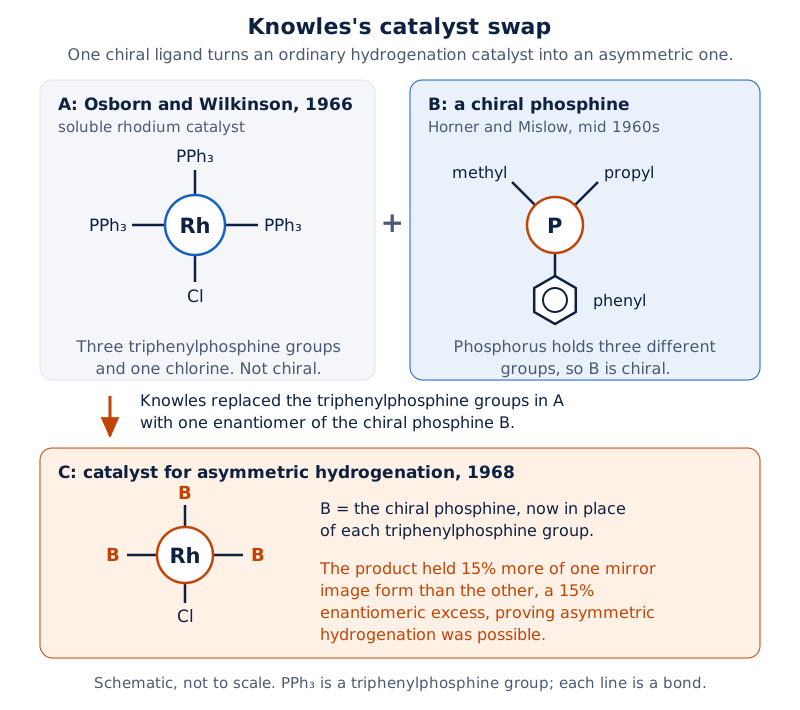
Draw the Osborn-Wilkinson rhodium complex with three triphenylphosphine groups and one chlorine around a central rhodium atom, then redraw it with one chiral phosphine (labelled B) replacing the triphenylphosphine groups, showing how this chiral swap turns an ordinary catalyst into an asymmetric one.
Drawn by One Young India.
Noyori then generalised this approach. In 1980 he and a co-worker developed the diphosphine ligand BINAP, whose rhodium complexes gave very high enantiomeric excess for certain amino acid syntheses.
He later swapped rhodium for ruthenium to make BINAP-ruthenium catalysts that worked on a much broader range of molecules, including the synthesis of the antibiotic levofloxacin and the synthesis of anti-inflammatory drugs such as naproxen that followed from this family of catalysts.
How did Sharpless's chiral oxidation catalysts work?
While hydrogenation removes the double bond character of a molecule by saturating it, oxidation reactions add new functional groups and so create new possibilities for building more complex molecules. Sharpless focused on this complementary half of the chemistry.
In 1980 he developed a practical method, now called the Sharpless epoxidation, for converting allylic alcohols into chiral epoxides with high enantiomeric excess. The source material describes the reagents and sequence involved:
- A titanium compound (titanium tetraisopropoxide) is mixed with a naturally occurring tartaric acid derivative to form a chiral titanium complex.
- This titanium complex simultaneously binds the chiral ligand, the oxidising agent (tert-butyl hydroperoxide) and the starting allylic alcohol substrate.
- Oxygen is delivered to one particular face of the molecule, controlled by which mirror-image form of the tartrate ligand is chosen.
- The chiral epoxide product, such as the compound glycidol, is released from the catalyst complex.
Glycidol made this way is used in the pharmaceutical industry to produce beta-blockers, a class of heart medicine. Sharpless also developed a related chiral dihydroxylation reaction, using cinchona alkaloid ligands together with osmium tetroxide as a catalytic oxidant, to convert alkenes into chiral diols.
| Laureate | Reaction type | Key catalyst or ligand | Example application named in the sources |
|---|---|---|---|
| Knowles | Hydrogenation | Rhodium-DiPAMP | Industrial synthesis of the Parkinson's drug L-DOPA |
| Noyori | Hydrogenation | BINAP (rhodium and ruthenium complexes) | Antibiotic levofloxacin synthesis |
| Sharpless | Oxidation (epoxidation and dihydroxylation) | Titanium-tartrate complex; osmium with cinchona ligands | Beta-blocker heart medicines via glycidol |
Diagram
Sharpless epoxidation set-up
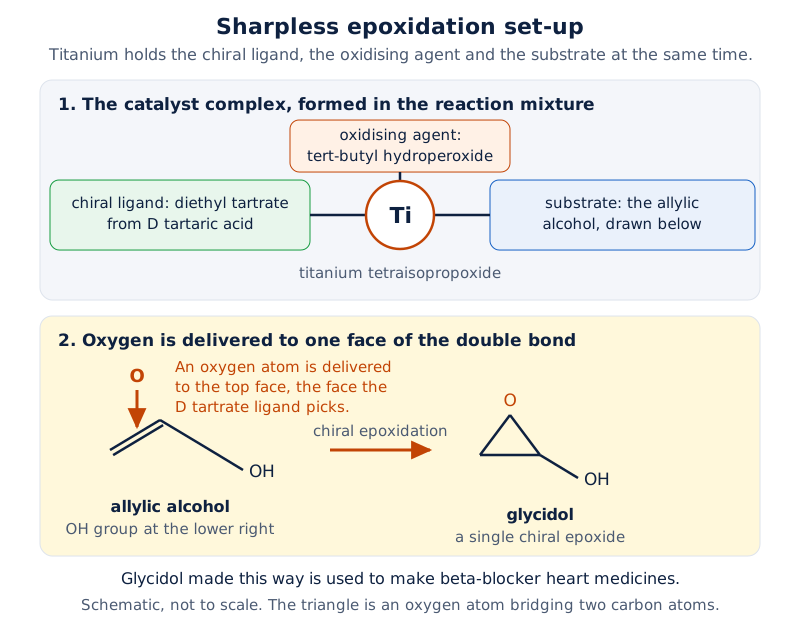
Draw an allylic alcohol molecule with the titanium-tartrate complex attached, the oxidising reagent nearby, and an arrow showing oxygen being delivered to one specific face of the molecule to give a single chiral epoxide product.
Drawn by One Young India.
How did the discovery unfold?
| Year | Event |
|---|---|
| 1966 | Osborn and Wilkinson published a soluble rhodium hydrogenation catalyst that Knowles would later adapt. |
| 1968 | William Knowles showed that a chiral transition-metal catalyst could transfer chirality to a non-chiral substrate, producing an enantiomeric excess of 15%, proving asymmetric hydrogenation was possible. |
| 1974 | The Monsanto process for L-DOPA, the first commercialised catalytic asymmetric synthesis using a chiral transition-metal complex, began operation. |
| 1980 | Ryoji Noyori and a co-worker published the synthesis of the BINAP diphosphine ligand and its use in asymmetric hydrogenation. |
| 1980 | Barry Sharpless carried out the experiments that led to the practical asymmetric epoxidation of allylic alcohols, using titanium and chiral tartrate ligands. |
| 1988 | Sharpless reported the first catalytic asymmetric dihydroxylation reaction, building on earlier stoichiometric methods. |
| 2001 | The Royal Swedish Academy of Sciences announced the Nobel Prize in Chemistry for all three laureates on 10 October. |
Why does this discovery matter?
The presentation speech by Professor Per Ahlberg made the practical importance plain: many of today's drugs depend on knowledge of chiral molecules of the kind these three laureates studied.
He pointed specifically to L-DOPA helping patients with Parkinson's disease, and to Sharpless's chiral oxidation methods being used in producing medicines for ulcers and high blood pressure.
The scientific background document also notes that Noyori's ruthenium-BINAP hydrogenation could be run reliably at scales from under 100 milligrams to over 100 kilograms, making it genuinely usable in industrial chemical plants rather than just laboratory experiments.
Beyond medicine, the sources mention applications in antibiotics, anti-inflammatory drugs, agrochemicals, flavours, fragrances and sweetening agents.
The committee's wider point, stated in the press release, was that the laureates had "opened up a completely new field of research" in which chemists can build molecules and materials with new, chosen properties rather than relying on mixtures.
This has fed back into academic research across materials science, biology and medicine, giving scientists new molecular tools to investigate questions that were previously out of reach because the right pure compounds simply could not be made efficiently.
What is the chirally catalysed hydrogenation reaction mechanism, step by step?
To understand why these catalysts are so selective, it helps to walk through the general mechanism described for rhodium-diphosphine catalysed hydrogenation of an enamide, elucidated by chemist J. Halpern.
- Solvent molecules bound to the rhodium catalyst are displaced by the substrate molecule, forming a chelate complex where the double bond and a carbonyl oxygen both interact with the rhodium centre.
- Hydrogen gas is oxidatively added to the rhodium metal, forming a rhodium(III) dihydride intermediate carrying two hydrogen atoms.
- The two hydrogen atoms are transferred, one after another, onto the carbons of the coordinated double bond through a five-membered ring intermediate.
- Because the chiral diphosphine ligand can present the substrate to either of its two faces, two different diastereoisomeric intermediates can form, leading to the two different mirror-image products.
- The intermediate formed through the lower-energy pathway reacts faster, so the final product mixture contains an excess of one particular mirror-image form.
This is why increasing the energy difference between these competing pathways, something Noyori achieved with his improved ligands, directly increases the enantiomeric excess, meaning a purer single mirror-image product with less wasted material, an important goal for industrial economy and reducing waste.
How does this connect to what you study?
This prize links directly to topics in school chemistry on stereochemistry and optical isomerism, including the idea that a molecule with four different groups attached to one carbon atom can exist as two non-superimposable mirror images.
It also connects to organic chemistry units on catalysis, since a catalyst speeding up a reaction without being consumed is a core idea taught at school level, and to biology or pharmacology discussions of why drug molecules must be tested and manufactured with care for their exact molecular shape.
The thalidomide example mentioned in the sources is commonly used to illustrate why chirality is not just an abstract laboratory idea but a matter of real-world safety in pharmaceutical chemistry.
Students studying functional groups, double bonds and addition reactions will also recognise hydrogenation and oxidation as named reaction types, here shown being controlled with remarkable precision using chiral catalysts.
Quick facts for exams
The Nobel Prize in Chemistry 2001 was awarded for the development of catalytic asymmetric synthesis, honouring work on molecules that exist as mirror-image pairs, called chiral molecules.
The prize was announced by the Royal Swedish Academy of Sciences on 10 October 2001 and split between William Knowles and Ryoji Noyori for chiral catalysed hydrogenation, and K. Barry Sharpless for chiral catalysed oxidation.
Knowles, from the USA, had worked at Monsanto Company; Noyori, from Japan, was at Nagoya University; and Sharpless, from the USA, was at The Scripps Research Institute.
Their catalysts enabled drugs such as the Parkinson's medicine L-DOPA and various antibiotics and heart medicines to be manufactured with the correct, biologically active mirror-image form.
| Fact | Detail |
|---|---|
| Prize | Nobel Prize in Chemistry 2001 |
| Announced | 10 October 2001 |
| Laureates | William S. Knowles, Ryoji Noyori, K. Barry Sharpless |
| Countries of birth | USA (Knowles, Sharpless), Japan (Noyori) |
| Affiliation at award | None, retired from Monsanto Company, residence St Louis, USA (Knowles), Nagoya University, Japan (Noyori), The Scripps Research Institute, USA (Sharpless) |
| Shares | Knowles 1/4, Noyori 1/4, Sharpless 1/2 |
| Citation | "for their work on chirally catalysed hydrogenation reactions" (Knowles, Noyori); "for his work on chirally catalysed oxidation reactions" (Sharpless) |
| Prize amount | 10,000,000 Swedish kronor |
Note: Source. The prize facts in this note are from the Nobel Prize's official site, nobelprize.org.
Glossary
- Chiral — describing a molecule that exists as two mirror-image forms that cannot be superimposed on each other, like left and right hands.
- Enantiomer — one of the two mirror-image forms of a chiral molecule.
- Catalyst — a substance that speeds up a chemical reaction without itself being used up in the process.
- Hydrogenation — a reaction in which hydrogen atoms are added across a double bond in a molecule.
- Oxidation — a reaction in which a molecule gains new functional groups, often by adding oxygen-containing groups.
- Asymmetric synthesis — a chemical process designed to produce mostly one mirror-image form of a product rather than an equal mixture of both.
- Enantiomeric excess — a measure of how much more of one mirror-image form is present compared with the other in a product mixture.
- Ligand — a molecule or ion that attaches to a central metal atom in a catalyst complex.
- BINAP — a chiral diphosphine ligand developed by Ryoji Noyori, used with rhodium or ruthenium in asymmetric hydrogenation.
- DiPAMP — the chiral diphosphine ligand Knowles used with rhodium to make the industrial L-DOPA catalyst.
- Epoxide — a chemical group formed when an oxygen atom bridges two adjacent carbon atoms, produced in the Sharpless epoxidation.
- Racemate — an equal mixture of both mirror-image forms of a chiral compound.
- L-DOPA — an amino acid drug used to treat Parkinson's disease, first produced industrially using Knowles's catalyst.
Common errors and misconceptions
- Misconception: Knowles, Noyori and Sharpless all worked on the same single reaction. Correct: Knowles and Noyori worked on chiral hydrogenation, while Sharpless separately developed chiral oxidation catalysts.
- Misconception: A catalyst is consumed during the reaction it speeds up. Correct: A catalyst speeds up a reaction without being used up, so one catalyst molecule can make millions of product molecules.
- Misconception: The two mirror-image forms of a molecule always behave identically in the body. Correct: The sources describe cases such as limonene and thalidomide where the two forms have clearly different effects.
- Misconception: Chirality is a rare, unusual property found in only a few exotic molecules. Correct: The background material states that most of life's molecules, including amino acids, proteins and DNA, are chiral.
- Misconception: Sharpless received the full prize alone in 2001. Correct: Sharpless received one half of the 2001 prize; Knowles and Noyori shared the other half between them.
- Misconception: This was Sharpless's only Nobel Prize. Correct: Sharpless was also awarded a share of the Nobel Prize in Chemistry in 2022, for different work.
- Misconception: Ordinary laboratory synthesis naturally gives pure single mirror-image products. Correct: Standard synthesis usually produces an equal mixture of both forms unless a chiral catalyst is used.
Exam-style questions with model answers
Q1. State the official citation for the Nobel Prize in Chemistry 2001. [2 marks]
- The citation reads: Knowles and Noyori were honoured "for their work on chirally catalysed hydrogenation reactions" and Sharpless "for his work on chirally catalysed oxidation reactions".
Q2. Name the three laureates of the 2001 Nobel Prize in Chemistry and their affiliations at the time of the award. [2 marks]
- William Knowles (previously Monsanto Company, USA), Ryoji Noyori (Nagoya University, Japan) and K. Barry Sharpless (The Scripps Research Institute, USA).
Q3. Explain what is meant by a chiral molecule and give one example from the sources. [4 marks]
- A chiral molecule exists as two forms that are mirror images of each other, like a left hand and a right hand, and cannot be rotated to overlap.
- Many molecules in living things, including amino acids, proteins and DNA, are chiral.
- An everyday example given in the sources is limonene: one mirror-image form smells of oranges, the other of lemons, because our nasal receptors are themselves chiral and can distinguish the two forms.
Q4. Describe, in sequence, how Knowles's rhodium-DiPAMP catalyst was used in the industrial synthesis of L-DOPA. [4 marks]
- A rhodium metal centre binds the chiral diphosphine ligand DiPAMP to form the active catalyst.
- The catalyst simultaneously binds hydrogen gas and the starting enamide substrate.
- Hydrogen atoms transfer onto the substrate's double bond, forming a chiral intermediate with one mirror-image form dominating.
- The chiral protected amino acid product is released, and a final acid hydrolysis step completes the synthesis of L-DOPA.
Q5. Why does nature's use of mainly one mirror-image form of a molecule make chiral catalysis medically important? Discuss with reference to the thalidomide case. [5 marks]
- Because cell receptors and enzymes are themselves chiral, they generally bind only to one mirror-image form of a molecule, much like a key fitting a particular lock.
- This means the two mirror-image forms of a drug can have very different biological effects inside the body, so producing the wrong form, or an unwanted mixture, can be useless or even harmful.
- The scientific background notes the case of thalidomide, prescribed in the 1960s to pregnant women against nausea, where one mirror-image form was reported to be beneficial while the other was linked to birth defects, although the source adds that this theory is questioned partly because the two forms can interconvert in the body.
- This case illustrates why pharmaceutical companies need reliable methods, such as the chiral catalysts developed by this year's laureates, to make and test pure single mirror-image forms of drug molecules rather than relying on an untested mixture of both.
Q6. Compare the reaction types developed by Knowles and Noyori on one hand and Sharpless on the other. [3 marks]
- Knowles and Noyori developed chiral catalysts for hydrogenation, where hydrogen atoms are added across a double bond, using rhodium or ruthenium complexes with chiral phosphine ligands such as DiPAMP and BINAP.
- Sharpless developed chiral catalysts for oxidation reactions, including epoxidation using a titanium-tartrate complex and dihydroxylation using osmium with cinchona alkaloid ligands.
- Hydrogenation removes the double bond character of a molecule, while oxidation adds new functional groups, so the two approaches are complementary tools for building chiral molecules.
Q7. Explain the role of a catalyst in asymmetric synthesis and why it is considered efficient. [3 marks]
- A catalyst is a substance that speeds up a chemical reaction without itself being consumed in the process.
- In asymmetric synthesis, the catalyst itself is chiral and transfers its chirality to the product, favouring one mirror-image form over the other.
- Because the catalyst is not used up, a single catalyst molecule can produce millions of product molecules, making the process efficient for industrial-scale manufacture.
Q8. Outline two industrial or medical applications of the laureates' discoveries mentioned in the sources. [2 marks]
- Knowles's catalyst enabled the industrial production of L-DOPA, used to treat Parkinson's disease.
- Sharpless's epoxidation enabled production of glycidol, used to make beta-blocker heart medicines.
Key takeaways
- The Nobel Prize in Chemistry 2001 honoured the development of catalytic asymmetric synthesis, controlling which mirror-image form of a molecule is produced.
- William Knowles and Ryoji Noyori shared one half of the prize for chirally catalysed hydrogenation reactions.
- K. Barry Sharpless received the other half for chirally catalysed oxidation reactions.
- Chiral molecules exist as two mirror-image forms, and living cells typically use mainly one form.
- Knowles's 1968 discovery with a rhodium-chiral phosphine catalyst proved asymmetric hydrogenation was possible, leading to the industrial synthesis of the Parkinson's drug L-DOPA.
- Noyori's BINAP ligand family generalised chiral hydrogenation to many more types of molecules, including antibiotic synthesis.
- Sharpless's titanium-tartrate epoxidation and osmium-based dihydroxylation extended chiral catalysis to oxidation reactions.
- The thalidomide case shows why making the correct mirror-image form of a drug can matter for patient safety.
- Sharpless later received a second Nobel Prize in Chemistry in 2022 for separate work.
Test yourself
What does the word "chiral" mean?
Chiral describes a molecule existing as two mirror-image forms that cannot be rotated to overlap, like left and right hands.
Who discovered chiral catalysed hydrogenation in 1968?
William Knowles discovered in 1968 that a chiral transition-metal catalyst could produce an excess of one mirror-image form during hydrogenation.
Where was Ryoji Noyori based at the time of the award?
Ryoji Noyori was a professor of chemistry at Nagoya University in Nagoya, Japan, at the time of the award.
What drug was Knowles's catalyst used to produce industrially?
Knowles's rhodium-DiPAMP catalyst was used to manufacture the Parkinson's disease drug L-DOPA industrially.
What share of the prize did Sharpless receive?
K. Barry Sharpless received one half of the 2001 Nobel Prize in Chemistry, for chirally catalysed oxidation reactions.
What everyday chiral example did the sources use to explain mirror-image smells?
The sources used limonene: one mirror-image form smells of oranges, the other of lemons, because nasal receptors are chiral.
What ligand did Noyori develop for more general chiral hydrogenation?
Noyori developed the chiral diphosphine ligand BINAP, used with rhodium and ruthenium for broader asymmetric hydrogenation.
What reaction did Sharpless develop in 1980 using titanium and tartrate ligands?
Sharpless developed the asymmetric epoxidation of allylic alcohols using a titanium-tartrate catalyst complex in 1980.