
Nobel Prize in Chemistry 2000: Conductive Polymers and Plastic Electronics
On this page
This note covers the Nobel Prize in Chemistry 2000: who won it, why plastics are normally insulators, how Alan Heeger, Alan MacDiarmid and Hideki Shirakawa made a plastic called polyacetylene conduct electricity like a metal, how the discovery unfolded through a famous accident and a chance meeting, why conductive polymers matter today and a quick-facts summary for exams.
What was the Nobel Prize in Chemistry 2000 awarded for?
The Royal Swedish Academy of Sciences awarded the Nobel Prize in Chemistry 2000 jointly to Alan J. Heeger, Alan G. MacDiarmid and Hideki Shirakawa "for the discovery and development of conductive polymers".
The announcement was made on 10 October 2000, and the prize money of 9,000,000 Swedish kronor was shared equally among the three laureates.
In plain words, the three scientists showed that an ordinary plastic (a polymer) could be chemically treated so that it carries electric current almost as well as a metal such as copper.
Everyday experience tells us the opposite: plastic is used to coat copper wires precisely because it normally blocks electricity.
The laureates' work, done at the end of the 1970s, overturned that assumption and created an entirely new field linking chemistry and physics, now sometimes called "plastic electronics".
The committee's press release explained the core idea in a short line: "plastic can, after certain modifications, be made electrically conductive". The rest of this note unpacks what those "modifications" were, how the discovery was made, and what it has led to.
Who are the laureates?
All three laureates shared the prize equally, each receiving one third, for the same joint citation. Here is what each contributed.
Alan J. Heeger
Alan J. Heeger was born on 22 January 1936 in Sioux City, Iowa, USA. At the time of the award he was affiliated with the University of California, Santa Barbara, where he was Professor of Physics and director of the Institute for Polymers and Organic Solids.
Heeger was the physicist in the trio: his laboratory carried out the key conductivity measurement on iodine-treated polyacetylene, which turned a chemical curiosity into a dramatic physical result. He later founded a company, UNIAX Corporation, to develop polymer-based electronics.
Alan G. MacDiarmid
Alan G. MacDiarmid was born on 14 April 1927 in Masterton, New Zealand, and died on 7 February 2007 in Drexel Hill, Pennsylvania, USA.
At the time of the award he was a Professor of Chemistry at the University of Pennsylvania, Philadelphia.
MacDiarmid had been studying another conducting material, the inorganic polymer sulphur nitride, and it was his chance meeting with Shirakawa that connected the two research lines that led to the discovery.
Hideki Shirakawa
Hideki Shirakawa was born on 20 August 1936 in Tokyo, Japan, and died on 24 August 2026 in Yokohama, Japan. At the time of the award he was a Professor of Chemistry at the University of Tsukuba, Japan.
Shirakawa was the chemist who, in the early 1970s, worked out how to make thin, silvery films of the polymer polyacetylene, a discovery that began when a laboratory mistake led to an unexpected result.
What problem were scientists trying to solve before this discovery?
Before 1977, chemists and physicists treated plastics and metals as opposites. Metals conduct electricity because their outer electrons move freely through the material. Plastics, built from long chain-like molecules called polymers, were assumed to always be insulators, which is exactly why plastic coats electrical cables to stop short-circuits.
At the same time, some scientists were exploring unusual electrical materials. MacDiarmid and Heeger were studying a metallic-looking inorganic polymer, sulphur nitride, written (SN)ₓ.
Separately, Shirakawa in Japan was working on polyacetylene, a simple hydrocarbon polymer made by joining acetylene units into a long chain.
Polyacetylene had been known since 1958, when Giulio Natta's group made it as a black, insoluble powder using a Ziegler-Natta catalyst, but it attracted little attention because it was hard to process and was not conductive.
The breakthrough that reopened the question came from an accident. In the early 1970s, a visiting researcher in Shirakawa's laboratory added roughly a thousand times too much catalyst to the reaction by mistake.
Instead of the usual dull black powder, a beautiful silvery film appeared on the walls of the reaction vessel.
The film looked metallic, but it still did not conduct electricity, so the real puzzle, why a plastic could look like a metal without behaving like one, remained open for several more years.
How does a polymer become electrically conductive?
The press release set out two conditions a plastic must meet before it can carry current like a metal.
First, its backbone must have conjugated double bonds: carbon atoms linked by alternating single and double bonds all along the chain, as in polyacetylene.
Second, the material must be doped, meaning electrons are deliberately removed from it (oxidation) or added to it (reduction) so that "holes" or extra electrons appear that can move along the molecule.
Shirakawa, MacDiarmid and Heeger found that treating a thin film of polyacetylene with iodine vapour (an oxidising agent) increased its conductivity by roughly a billion times over the undoped material, according to the scientific background document, which gives the doped conductivity as about 10⁵ siemens per metre, compared with around 10⁻⁵ to 10⁻⁷ S m⁻¹ for undoped polyacetylene.
The committee's popular account sets out the doping process as a short sequence:
- Start with a polymer whose backbone has alternating single and double carbon-carbon bonds, such as polyacetylene.
- Expose the film to an oxidising vapour such as iodine, which pulls an electron away from the chain, or to a reducing agent such as an alkali metal, which adds an electron.
- This "doping" creates a hole (if oxidised) or an extra electron (if reduced) that is not tied to one fixed atom.
- Apply an electric field; the mobile hole or electron jumps from one position to the next along the conjugated chain, and from chain to chain if the chains are packed closely together.
- The resulting flow of charge is an electric current, so the doped plastic now conducts almost like a metal.
The scientific background document writes the two doping reactions for polyacetylene, [CH]ₙ, as oxidation with a halogen (p-doping), [CH]ₙ + 3x/2 I₂ → [CH]ₙˣ⁺ + x I₃⁻, and reduction with an alkali metal (n-doping), [CH]ₙ + x Na → [CH]ₙˣ⁻ + x Na⁺.
Because the doping reaction can be run forwards or backwards by changing the applied field, the conductivity of the plastic can be switched on or off.
Diagram
a polyacetylene chain and doping
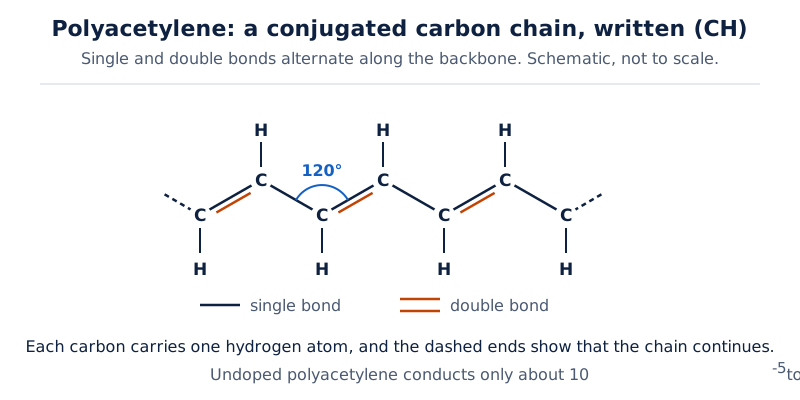
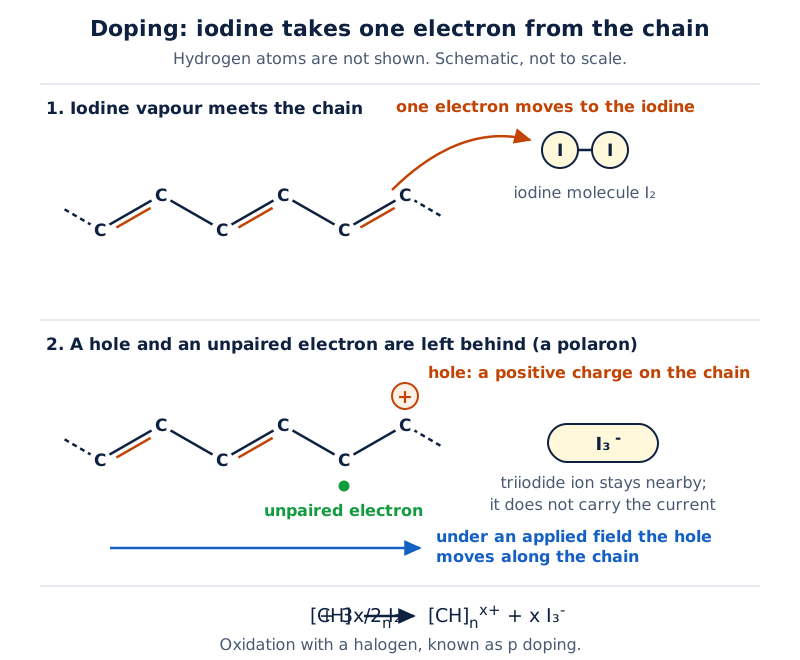
Draw a zig-zag chain of carbon atoms with alternating single and double bonds (as in the source's Figure 3 for polyacetylene), label a few carbon atoms, then draw an iodine molecule (I₂) next to one carbon, an arrow showing an electron moving from the chain to the iodine, and a "+" hole left behind on the chain to show how oxidative doping creates a mobile charge.
Drawn by One Young India.
Different materials conduct very differently, and the table below (from the scientific background document) shows where doped polyacetylene sits compared with a very poor insulator and with good metal conductors.
| Material | Conductivity (S m⁻¹) |
|---|---|
| Teflon (insulator) | about 10⁻¹⁶ |
| Undoped polyacetylene (semiconductor) | about 10⁻⁵ to 10⁻⁷ |
| Doped polyacetylene (iodine-treated) | about 10⁵ |
| Silver and copper (good metal conductors) | about 10⁸ |
What happens at the molecular level when polyacetylene is doped?
The scientific background document explains the mechanism using two chemical concepts: polarons and solitons. When iodine removes one electron from the polyacetylene chain during oxidative doping, the chain becomes a positively charged radical, called a polaron.
The unpaired electron left behind can move easily along the chain by shifting which bonds are single and which are double, while the positive charge is held back somewhat by electrostatic attraction to the slow-moving iodide ion nearby.
If the chain is heavily oxidised, two polarons can pair up to form what the document calls a soliton, a kind of mobile bond-pattern defect that carries charge both along a single chain and, importantly, between neighbouring chains.
Because a bulk plastic sample is made of many polymer chains packed together, overall conductivity depends not only on how fast charge moves along one chain but also on how easily it can "hop" from chain to chain, a process the document calls intersoliton hopping.
This is why the chains need to be reasonably well-ordered and closely packed for the doped material to conduct well.
This molecular picture also explains an odd observation: conductivity in these doped polymers falls as temperature drops, the opposite of what happens in ordinary metals such as silver.
The scientific background document notes this contrast explicitly, since it shows that doped conductive polymers behave more like semiconductors at a microscopic level even though their bulk conductivity can rival that of a metal.
What practical uses have conductive polymers found?
The press release listed early industrial uses of conductive and semi-conductive polymers that followed from the 1977 discovery. These included anti-static coatings for photographic film, shields that protect users from the electromagnetic radiation given off by computer screens, and "smart" windows that can be switched to block out sunlight.
A second generation of applications uses semi-conductive polymers rather than fully conductive ones. The popular information page describes electroluminescence, where a thin polymer layer emits light when an electric field excites it; this underlies polymer light-emitting diodes (LEDs), which the source says can be built with a conductive polymer electrode on one side, a semiconductive polymer in the middle, and a thin metal foil electrode on the other side.
Such LEDs have been explored for flat television screens, mobile telephone displays, and even light-emitting wallpaper.
Other named materials and uses from the sources include polythiophene derivatives used in anti-static treatment of photographic film and in supermarket product-marking devices, doped polyaniline used in anti-static carpets for offices and operating theatres and as a corrosion inhibitor, polyphenylenevinylene explored for mobile phone displays, and polydialkylfluorenes used in colour video screens.
The sources also mention solar cells and rechargeable batteries as further possible uses linked to the same chemistry, and note that research on conductive polymers is closely tied to the longer-term goal of molecular electronics, in which transistors and circuit components would be built from individual molecules rather than silicon chips.
How did the discovery unfold?
The popular information page tells the story of the discovery as a sequence of steps across roughly two decades, moving from the first preparation of polyacetylene to its development into a major research field with practical applications.
| Year | Event |
|---|---|
| 1958 | Giulio Natta's group first prepared polyacetylene, as a black, insoluble powder, using a Ziegler-Natta catalyst. |
| Early 1970s | Hideki Shirakawa developed a new way to synthesise polyacetylene as a controllable film; a laboratory error of a thousand-fold too much catalyst produced an unexpected silvery film. |
| 1975 | Alan Heeger and Alan MacDiarmid collaborated on the metallic-looking inorganic polymer sulphur nitride, (SN)ₓ. |
| About 1975 to 1976 | MacDiarmid gave a seminar in Tokyo, and the two met by chance during a coffee break, where MacDiarmid learned of Shirakawa's silvery polyacetylene film; MacDiarmid invited Shirakawa to the University of Pennsylvania. |
| 1977 | Working together, Shirakawa, MacDiarmid and Heeger oxidised polyacetylene films with iodine vapour; a student in Heeger's laboratory measured the conductivity, which had risen roughly ten million times. |
| Summer 1977 | Heeger, MacDiarmid, Shirakawa and co-workers published the discovery under the title "Synthesis of electrically conducting organic polymers: Halogen derivatives of polyacetylene (CH)n" in The Journal of the Chemical Society, Chemical Communications. |
| 1980 | James W. Feast's group at the University of Durham made polyacetylene from a soluble precursor polymer, improving processing. |
| 1987 | Herbert Naarman and Nicholas Theophilou at BASF developed a method giving doped polyacetylene a conductivity claimed to be of the same order as copper. |
| 1990 | Electroluminescence from conjugated polymers was first reported, opening the route to polymer light-emitting diodes. |
| 2000 | The Royal Swedish Academy of Sciences awarded the Nobel Prize in Chemistry to Heeger, MacDiarmid and Shirakawa for the discovery and development of conductive polymers. |
Why does this discovery matter?
The discovery matters because it opened up an entirely new class of electronic materials. Before 1977, anyone designing an electronic device had to use metals or inorganic semiconductors such as silicon or gallium phosphide.
Conductive and semiconductive polymers added a third option, one that is lightweight, flexible and, because it can be processed from solution as a thin film, potentially much cheaper to manufacture than traditional electronics.
The press release pointed to several directions this has taken: light-emitting diodes and displays for mobile telephones and small television screens, solar cells, and "smart" windows.
The scientific background document adds supercapacitors, corrosion inhibitors and electromagnetic shielding for computer circuits to the list, and stresses that the field has grown into a major area of overlap between chemistry and physics.
The same document is careful to flag open questions rather than claim the story is finished.
It notes that polyacetylene itself, despite being the most crystalline conductive polymer, has not become the most commercially used one, because it reacts easily with oxygen in air and is sensitive to humidity; other polymers such as polypyrrole and polythiophene have lower conductivity but are far more stable in air, which is why they, rather than polyacetylene, have reached the market.
The document also looks ahead to molecular electronics, the long-term goal of building circuit components from single molecules rather than bulk crystals, calling this a large but fascinating step that conductive polymers may help make possible.
How does this connect to what you study?
If your chemistry classes cover polymers, this prize is a good example of how the same backbone idea, long chains of repeating carbon units, can behave completely differently depending on the bonding pattern and chemical treatment.
The alternating single and double bonds in polyacetylene (conjugation) are the same bonding idea you meet when studying benzene or other conjugated organic molecules, where electrons are not fixed to one bond but spread across several.
The concept of oxidation and reduction, central to doping, is also a standard topic in redox chemistry: removing an electron from a chain (oxidation, using iodine) or adding one (reduction, using an alkali metal) is the same electron-transfer idea used to explain everyday redox reactions, just applied to a giant molecule instead of a small one.
Similarly, the idea that electrical conductivity depends on how freely charge carriers can move, discussed in physics as resistance and Ohm's law, is exactly what the scientific background document uses to compare teflon, polyacetylene and copper.
Finally, the practical uses described here, anti-static coatings, light-emitting displays and solar cells, are concrete examples of how a single piece of fundamental chemistry research can lead, over twenty years, to everyday consumer technology, a useful illustration for any discussion of why basic science funding matters.
Quick facts for exams
The Nobel Prize in Chemistry 2000 was awarded on 10 October 2000 by the Royal Swedish Academy of Sciences to three scientists, Alan J. Heeger (USA), Alan G. MacDiarmid (born in New Zealand, later a US-based chemist) and Hideki Shirakawa (Japan), who shared the prize equally "for the discovery and development of conductive polymers".
Their work, done around 1977, showed that the plastic polyacetylene could be made to conduct electricity like a metal by chemically treating it with iodine vapour, a process called doping. The prize carried a total of 9,000,000 Swedish kronor.
This discovery created the field of conductive and semi-conductive polymers, which underlies later technologies such as polymer light-emitting diodes and anti-static coatings.
| Fact | Detail |
|---|---|
| Prize | Nobel Prize in Chemistry 2000 |
| Date announced | 10 October 2000 |
| Laureates | Alan J. Heeger, Alan G. MacDiarmid, Hideki Shirakawa |
| Countries of birth | USA (Heeger), New Zealand (MacDiarmid), Japan (Shirakawa) |
| Affiliations at the award | University of California, Santa Barbara, USA (Heeger); University of Pennsylvania, USA (MacDiarmid); University of Tsukuba, Japan (Shirakawa) |
| Share of the prize | One third each |
| Citation | "for the discovery and development of conductive polymers" |
| Prize amount | 9,000,000 Swedish kronor |
Note: Source. The prize facts in this note are from the Nobel Prize's official site, nobelprize.org.
Glossary
- Polymer — a very large molecule made of many smaller units joined together in a long, repeating chain.
- Polyacetylene — a simple hydrocarbon polymer with the repeating unit (CH)ₙ, made by polymerising acetylene gas.
- Conjugated double bonds — a pattern in which single and double bonds alternate regularly along a chain of atoms, letting electrons spread over several bonds.
- Doping — deliberately adding or removing electrons from a material, by oxidation or reduction, to create mobile charge carriers.
- Oxidation (p-doping) — removing electrons from the polymer chain, for example using iodine vapour, leaving positively charged holes.
- Reduction (n-doping) — adding electrons to the polymer chain, for example using an alkali metal such as sodium.
- Hole — a position in a material from which an electron is missing, which behaves like a mobile positive charge.
- Polaron — a charged, partly localised defect formed on a polymer chain when one electron is removed or added during doping.
- Soliton — a mobile defect formed when two polarons pair up, able to carry charge along and between polymer chains.
- Conductivity — a measure, in siemens per metre, of how easily a material allows electric current to flow through it.
- Semiconductor — a material whose conductivity lies between that of a good conductor and a good insulator, and which generally conducts better as temperature rises.
- Electroluminescence — the emission of light from a material when it is excited by an electric field, used in polymer light-emitting diodes.
- Molecular electronics — a proposed future technology in which individual molecules, rather than bulk silicon chips, perform electronic circuit functions.
- Ziegler-Natta catalyst — a type of catalyst used to polymerise molecules such as acetylene or ethylene into long polymer chains.
Common errors and misconceptions
- Misconception: all plastics can be made to conduct electricity in the same way. Correct: only polymers with conjugated (alternating single and double) bonds in their backbone, such as polyacetylene, can be doped to conduct current.
- Misconception: the silvery film Shirakawa first made was already electrically conductive. Correct: the early silvery polyacetylene film only looked metallic; it had to be chemically doped with iodine vapour before it actually conducted electricity.
- Misconception: doping a polymer means physically coating it with a conductive substance. Correct: doping is a chemical oxidation or reduction reaction that adds or removes electrons from the polymer chain itself.
- Misconception: the iodide or sodium ions created during doping are what carries the current. Correct: the scientific background document states it is the electrons (or holes) on the polymer chain that move to create current, not the counter-ions.
- Misconception: the three laureates worked entirely separately and only published together at the end. Correct: the discovery depended on MacDiarmid and Shirakawa meeting by chance during a coffee break, after which Shirakawa visited MacDiarmid's laboratory and a student in Heeger's laboratory carried out the key measurement.
- Misconception: conductive polymers immediately replaced metals and silicon in electronics. Correct: the sources describe conductive polymers as useful in specific niches, such as anti-static coatings and displays, alongside, not instead of, traditional materials.
- Misconception: polyacetylene itself became the most widely used conductive polymer commercially. Correct: the scientific background document notes polyacetylene is sensitive to air and humidity, so more stable polymers such as polypyrrole and polythiophene reached the market more successfully.
Exam-style questions with model answers
Q1. In which year was the Nobel Prize in Chemistry 2000 announced, and by which body? [1 mark]
- It was announced on 10 October 2000 by the Royal Swedish Academy of Sciences.
Q2. State the official citation for the Nobel Prize in Chemistry 2000. [2 marks]
- The citation reads "for the discovery and development of conductive polymers", awarded jointly to Heeger, MacDiarmid and Shirakawa.
Q3. Explain what "doping" means in the context of conductive polymers, giving one example of oxidative doping. [4 marks]
- Doping means deliberately adding or removing electrons from a polymer so that it can conduct electricity.
- In oxidative (p-type) doping, an oxidising agent such as iodine vapour removes an electron from the polymer chain.
- This leaves a positively charged "hole" that is not tied to one fixed carbon atom.
- Under an applied electric field, electrons from neighbouring positions can jump into the hole, moving the hole along and creating a current; the reaction can also be written [CH]ₙ + 3x/2 I₂ → [CH]ₙˣ⁺ + x I₃⁻.
Q4. Why does an untreated polymer such as polyacetylene usually fail to conduct electricity even though it has conjugated double bonds? [3 marks]
- Conjugated double bonds alone are not sufficient; they allow electrons to be somewhat mobile along the chain but do not free them completely.
- Without doping, there are no "extra" electrons or holes available to actually carry charge through the material.
- The scientific background document gives undoped polyacetylene a conductivity of only about 10⁻⁵ to 10⁻⁷ S m⁻¹, placing it as a semiconductor rather than a conductor until it is oxidised or reduced.
Q5. Describe, step by step, how the 2000 Nobel laureates discovered that polyacetylene could be made conductive, and discuss why this discovery is considered important. [6 marks]
- Shirakawa, working in Japan in the early 1970s, developed a method to make polyacetylene as thin films rather than powder; a laboratory accident, a thousand-fold excess of catalyst, produced an unexpected silvery film.
- Separately, Heeger and MacDiarmid were studying another metallic-looking polymer, sulphur nitride, (SN)ₓ.
- MacDiarmid gave a seminar in Tokyo, and the two met by chance during a coffee break, where MacDiarmid learned of Shirakawa's silvery polyacetylene film, after which MacDiarmid invited Shirakawa to the University of Pennsylvania.
- Working together, they oxidised the polyacetylene film with iodine vapour, and a student in Heeger's laboratory measured the conductivity, finding it had increased roughly ten million times over the undoped film.
- They published the result in 1977 in a paper titled "Synthesis of electrically conducting organic polymers: Halogen derivatives of polyacetylene (CH)n".
- The discovery matters because it created an entirely new class of lightweight, flexible, low-cost electronic materials, leading over the following decades to anti-static coatings, electromagnetic shields, light-emitting diodes for displays, and research into solar cells and molecular electronics, as described in the Nobel sources.
Q6. Name two practical applications of conductive or semi-conductive polymers mentioned by the Nobel committee. [2 marks]
- Two examples are anti-static coatings for photographic film and shields that protect computer screens from electromagnetic radiation; light-emitting diodes for mobile phone and television displays are another example given.
Q7. What is the difference between a polaron and a soliton, as described in the Nobel scientific background document? [4 marks]
- A polaron is a charged defect formed on a polymer chain when a single electron is removed (or added) during doping, carrying a localised positive (or negative) charge and an unpaired electron.
- A polaron's mobility is somewhat limited by electrostatic attraction to its slow-moving counter-ion.
- A soliton forms when two polarons on a heavily oxidised chain pair up; the document describes solitons as responsible, in complicated ways, for transporting charge both along a chain and between neighbouring chains.
- Solitons therefore play a bigger role than isolated polarons in carrying current through the bulk material.
Key takeaways
- The Nobel Prize in Chemistry 2000 went to Heeger, MacDiarmid and Shirakawa for discovering and developing conductive polymers.
- Plastics are normally insulators, but a polymer with alternating single and double bonds can be made to conduct electricity through doping.
- Doping means removing electrons (oxidation) or adding electrons (reduction) to create mobile holes or electrons in the polymer chain.
- Iodine-doped polyacetylene's conductivity rose by about ten million times in the key 1977 experiment, approaching that of copper after further development.
- The discovery began with a laboratory accident in Shirakawa's laboratory and a chance meeting between Shirakawa and MacDiarmid during a coffee break.
- Charge in doped polymers moves through mobile defects called polarons and solitons, which can hop between neighbouring polymer chains.
- Conductive and semi-conductive polymers are used in anti-static coatings, electromagnetic shielding, light-emitting diodes and are studied for solar cells and molecular electronics.
- Polyacetylene itself is unstable in air, so more stable polymers like polythiophene and polypyrrole have found wider commercial use.
Test yourself
Who are the three laureates of the Nobel Prize in Chemistry 2000?
They are Alan J. Heeger, Alan G. MacDiarmid and Hideki Shirakawa, who shared the prize equally.
What is the official citation for this prize?
The citation is "for the discovery and development of conductive polymers".
Where did Hideki Shirakawa work at the time of the award?
Hideki Shirakawa was a Professor of Chemistry at the University of Tsukuba in Japan at the time of the award.
What accidental event first produced a silvery polyacetylene film?
A visiting researcher in Shirakawa's laboratory added about a thousand times too much catalyst by mistake, producing a silvery film instead of black powder.
What chemical treatment made polyacetylene conductive?
Oxidising the polyacetylene film with iodine vapour, a process called doping, made it conductive.
By roughly how much did the conductivity increase after iodine doping, according to the account of the key experiment?
A student in Heeger's laboratory measured an increase of about ten million times in the conductivity.
Name one everyday application of conductive polymers mentioned in the sources.
One example is an anti-static coating for photographic film, which prevents static electricity discharges.
What is a polaron?
A polaron is a localised charged defect on a polymer chain formed when doping removes or adds a single electron.