
Nobel Prize in Economics 2026: Microeconomic Foundations of Macroeconomic Stabilisation
On this page
This note covers the Nobel Prize in Economics 2026: who won it, what Robert E.
Hall and Michael Woodford discovered about how households and firms make decisions, how their work rebuilt the models that guide interest rate and tax policy, how the discovery unfolded from the 1970s oil crises to today, why it matters for everyday economic life, and quick facts for exams.
What was the Nobel Prize in Economics 2026 awarded for?
The Royal Swedish Academy of Sciences gave the prize jointly to Robert E. Hall and Michael Woodford "for microeconomic foundations of macroeconomic stabilisation". This is the exact wording of the official citation.
In plain words, the two economists worked out how to build large-scale models of a whole national economy, starting from the small, everyday decisions of individual households and firms rather than from loose statistical patterns between big national numbers.
Their models explain how governments and central banks can smooth out booms and slumps, called stabilisation policy.
The prize's full official name is the Sveriges Riksbank Prize in Economic Sciences in Memory of Alfred Nobel, often called the Nobel Prize in Economics.
It is awarded by the Royal Swedish Academy of Sciences, the same body that chooses the physics and chemistry laureates, and it was announced on 12 October 2026.
The prize money, 12 million Swedish kronor, was shared equally between the two laureates.
The committee's press release carried the headline that the laureates had "helped us smooth out the economy's peaks and troughs", a phrase that sums up what stabilisation policy tries to do: avoid both deep recessions and runaway inflation.
Who are the laureates?
Both laureates are American economists who built their careers studying how individual decisions add up to national economic outcomes. Together they share equally in the 2026 prize.
Robert E. Hall
Robert E. Hall was born in 1943 in Palo Alto, California, USA. He earned his PhD in 1967 from the Massachusetts Institute of Technology. At the time of the award he was a professor at Stanford University, Stanford, California, USA, and he holds one half of the prize.
Hall's key contribution was a 1978 paper showing that if households plan their spending by looking ahead rather than just reacting to their current pay, then changes in their consumption from one period to the next should be impossible to predict in advance.
He tested this idea directly on real consumption data, and it held up, which gave economists a reliable way to check whether a model of household behaviour was realistic.
In a later 1982 paper written with Fredric Mishkin, Hall examined individual household data and found that around 80 per cent of households spent in line with this forward-looking theory, while the rest spent from hand to mouth, limited by their current income because they could not borrow freely.
Michael Woodford
Michael Woodford was born in 1955 in Chicopee, Massachusetts, USA. He also earned his PhD in 1983 from the Massachusetts Institute of Technology. At the time of the award he was a professor at Columbia University, New York, USA, and he holds the other half of the prize.
Woodford built on Hall's consumption theory, together with work by other economists on pricing and markets, to construct a complete macroeconomic model with only three core equations.
He presented the full version in a 2003 book and, in earlier papers, showed how central banks can steer an economy by setting an interest rate rather than by controlling the amount of money in circulation, and how credible communication about future policy itself affects how firms and households behave today.
Why did old economic models stop working?
To understand what Hall and Woodford fixed, it helps to see what came before. The economist John Maynard Keynes, writing around a century ago, argued that during a recession there is simply not enough total demand for goods and services, even though factories and workers are available to produce more.
His proposed fix was for governments and central banks to boost demand by cutting interest rates or by raising the budget deficit, and to do the opposite when the economy overheated.
For decades after the Second World War, this Keynesian approach to stabilisation policy seemed to work.
It rested on assumed statistical links between big national variables, such as the Phillips curve, which said that inflation tends to be low when unemployment is high and vice versa, and the idea that a rise in household income leads in a fairly fixed proportion to a rise in spending.
During the oil crises of the 1970s, these links broke down. Inflation rose even as unemployment also rose, which traditional theory said should not happen together.
Many Western economies went through years of low growth, high unemployment and high inflation at the same time, a pattern called stagflation. Some influential economists, including Robert E. Lucas, Jr.
(the 1995 economics laureate), argued that the whole approach was flawed because it assumed the statistical relationships between national variables were fixed, when in fact they depend on the separate decisions of millions of individual households and firms, which can change if government policy changes.
This argument meant that a new kind of model, built from the ground up on microeconomic behaviour, was needed before stabilisation policy could work reliably again.
How did Robert E. Hall change the study of consumer spending?
Hall's breakthrough concerned one of the biggest pieces of any economy: household consumption, meaning all the spending by private households on goods and services, which is usually the largest share of total demand in a country.
Before Hall, researchers believed that consumption depended heavily on what people expected their future income to be, not just their income today. The trouble was that nobody could directly observe what people expected about the future, so the theory seemed impossible to test.
Hall's insight was to turn the question around. If households spend according to their best guess about future income, and that guess only changes when genuinely new information arrives, then changes in spending itself should be unpredictable, because new information is by definition something nobody could have forecast. His reasoning can be set out as a sequence of steps.
- Assume households want to keep their spending steady over time rather than let it jump up and down, a behaviour called consumption smoothing.
- Assume households base today's spending on their expectations of all their future income, not just their pay cheque this month.
- Note that these expectations only change when new, previously unknown information arrives, such as news of a pay rise, a tax change or a job loss.
- Conclude that, if the theory is correct, changes in spending from one period to the next cannot be predicted in advance using any information available today.
- Test this prediction against real national consumption data to see whether changes in spending really were unpredictable.
The test succeeded: changes in aggregate consumption were, broadly, unpredictable, just as the theory said. This gave economists a workable benchmark.
Any consumption change that could be predicted in advance must come from households who were not able to plan ahead this way, for example because they had no savings and could not borrow, so they simply spent whatever income they received.
Hall and Mishkin later estimated, using data on individual households, that roughly 80 per cent behaved like forward-looking planners while the rest lived hand to mouth, a split that is now a standard ingredient of modern macroeconomic models.
Diagram
Changes in consumption cannot be predicted
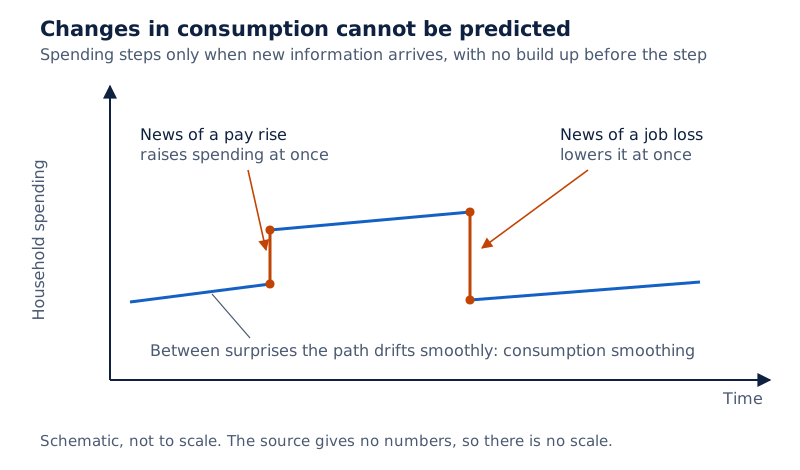
Draw a line showing a household's actual spending over several years as a fairly smooth, slowly rising path, with occasional sudden jumps only at the exact points where genuinely new information (such as a pay rise or a job loss) arrives, and no gradual build-up before each jump, to show that the change itself was not predictable in advance.
Drawn by One Young India.
How does Michael Woodford's New Keynesian model work?
Woodford's task was to combine Hall's insight about consumption with ideas about how firms set prices, to build a complete working model of the whole economy that governments and central banks could actually use.
He set this out fully in a 2003 book, bringing together many earlier research papers, his own and others'.
The resulting framework, often called the New Keynesian model, is built from just three core equations, yet it is powerful enough to guide real policy decisions.
- An equation describing household consumption, based directly on Hall's theory that spending depends on expectations of future income and on the interest rate.
- An equation describing how firms set prices, recognising that changing prices is costly, so prices adjust only slowly, a feature called price stickiness.
- An equation describing how the central bank sets its policy interest rate in response to inflation and economic activity.
- Combining these three equations to trace out, month by month, how the whole economy responds to a shock, such as a change in energy prices or a shift in household confidence.
A central idea is the neutral (or natural) rate of interest, a concept Woodford took from the nineteenth-century economist Knut Wicksell.
At this rate, interest neither pushes consumption up nor down; setting the policy rate below it stimulates spending, and setting it above it cools spending.
Because firms are forward-looking when they set prices, their expectations about future costs and about the central bank's future plans directly affect inflation today, which is why clear communication by central banks about their future intentions became a practically important tool.
The table below contrasts the older approach with the New Keynesian approach that Hall and Woodford helped to build.
| Feature | Traditional Keynesian models | New Keynesian models |
|---|---|---|
| Foundation | Statistical links between national totals | Decisions of individual households and firms |
| Consumption | Depends mainly on current income | Depends on expected future income (Hall's theory) |
| Prices | Often treated as fixed in the short run | Sticky, adjusted slowly by forward-looking firms |
| Policy tool emphasised | Control of the money supply | Setting the central bank's interest rate |
| Behaviour under policy change | Relationships can break down (Lucas critique) | Designed to stay valid when policy changes |
What are output gaps and supply shocks?
Woodford's model also gives a precise way to describe how far an economy is from its best possible performance, using a concept called the output gap, which is the difference between the economy's actual output and its natural output, meaning the output level that would occur if prices could adjust freely and demand matched supply exactly.
When demand is strong and the output gap is positive, prices are pushed upward and inflation runs higher than normal, a pattern typical of a boom.
When demand is weak and the gap is negative, prices are pushed down and inflation runs lower than normal, typical of a downturn.
The task of stabilisation policy, in this framework, is to steer the output gap back toward zero.
The model also distinguishes between different causes of a downturn, called shocks. A demand shock is a change in how much households or firms want to spend, for example a wave of pessimism about the future.
A supply shock is a sudden change in how much the economy is capable of producing, for example a sharp rise in energy prices or a disruption to international supply chains.
This distinction matters because the right policy response differs according to the type of shock.
If a negative supply shock reduces natural output faster than it reduces actual output, the output gap can turn positive even though the economy feels weaker, and the correct response is to raise interest rates to prevent inflation rather than to stimulate demand further, unlike the standard response under the older Keynesian approach.
This insight helped policymakers handle recent supply shocks, such as energy price spikes, more effectively than during the 1970s oil crises.
Diagram
Balance between supply and demand
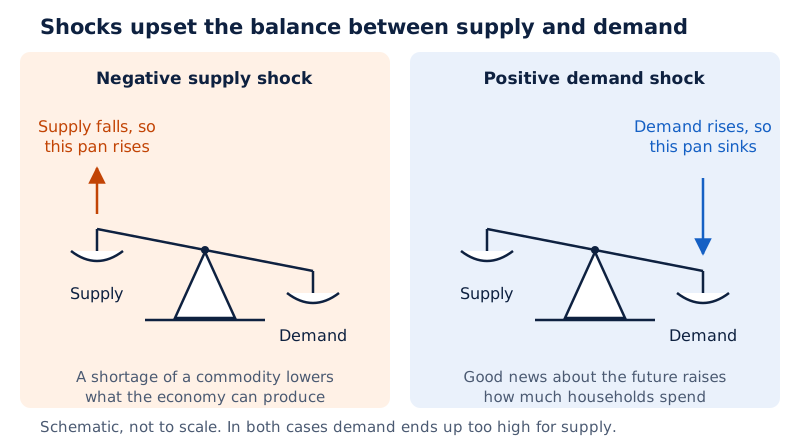
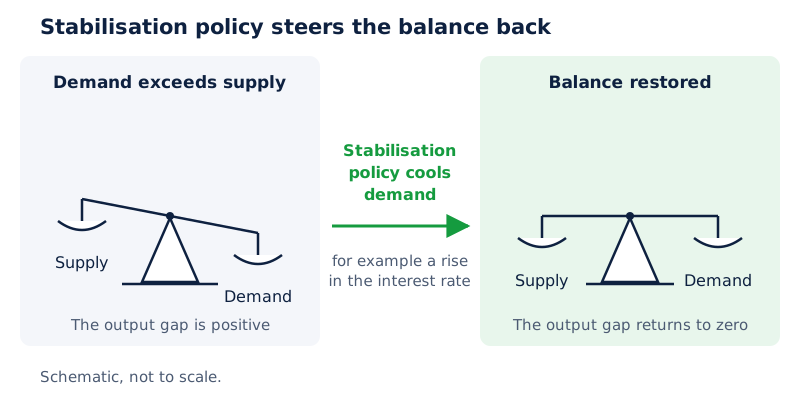
Draw a simple balance scale with "supply" on one side and "demand" on the other; show a negative supply shock as a shortage of a commodity tilting the scale, and a positive demand shock as good news about the future tilting the other side, then show stabilisation policy nudging the scale back level.
Drawn by One Young India.
How did the discovery unfold?
The ideas behind this prize did not arrive all at once. They grew over several decades, from the original Keynesian framework, through its breakdown in the 1970s, to the construction of the New Keynesian model and its use in real crises.
| Year | Event |
|---|---|
| 1936 | John Maynard Keynes publishes his theory that governments should manage total demand to fight recessions. |
| 1958 | The Phillips curve, describing an apparent trade-off between inflation and unemployment, is proposed. |
| 1967 | Robert E. Hall receives his PhD from the Massachusetts Institute of Technology. |
| 1978 | Hall publishes his paper showing that changes in household consumption should be unpredictable if households plan ahead rationally. |
| 1982 | Hall and Fredric Mishkin publish a study of individual household data, estimating that about 80 per cent of households spend according to the forward-looking theory. |
| 1983 | Michael Woodford receives his PhD from the Massachusetts Institute of Technology. |
| 2003 | Woodford publishes his book presenting the complete New Keynesian macroeconomic model built on microfoundations. |
| 2008 | The Great Recession hits; the New Keynesian framework, by then about a decade old, is used to help guide the policy response. |
| 2026 | The Sveriges Riksbank Prize in Economic Sciences is awarded jointly to Hall and Woodford. |
Why does this discovery matter?
The laureates' work gave governments and central banks a far more reliable toolkit for handling economic ups and downs.
New Keynesian models with microfoundations are now used by central banks and finance ministries around the world to decide how much to change interest rates, taxes or transfers in response to a given shock.
The committee chair, John Hassler, said the laureates' work provided a "stable theoretical foundation for the models" now used by policymakers globally, which helps them respond to disturbances such as energy crises or sudden swings in household spending.
This framework proved useful during the 2008 Great Recession and during the pandemic and recent energy crises, which have not had the same long-term damage to growth and inflation as the crises of the 1970s, and the world has not fallen into a depression as deep as that of the 1930s.
At the same time, economists see New Keynesianism as an evolving research programme rather than a finished answer.
Since Hall's and Woodford's original work, the models have continued to be refined and adapted to different countries' circumstances, and this process is expected to continue as economies keep changing.
The framework also highlights that different kinds of shocks need different policy responses even if they look similar on the surface, which keeps policy analysis focused on understanding the deeper cause of each downturn rather than reacting to its symptoms alone.
How does this connect to what you study?
School economics and business studies courses usually introduce ideas such as aggregate demand, inflation, unemployment and the role of the central bank's interest rate and the government's budget in managing the economy. The 2026 prize sits directly behind these classroom ideas.
When a textbook explains that a central bank raises interest rates to control inflation, or that government spending can fight unemployment during a slowdown, it is describing, in simplified form, exactly the kind of stabilisation policy that Hall's and Woodford's research placed on firmer theoretical ground.
The idea that households base their spending on expectations of the future, not just today's income, also connects to everyday observations: people often cut back on spending when they hear worrying economic news, even before their own pay has changed, which is consistent with Hall's forward-looking theory of consumption.
Understanding that different economic problems, such as an energy price shock versus a sudden loss of consumer confidence, call for different policy responses is a useful habit of mind well beyond economics classrooms, useful for reading news reports about interest rate decisions or budget announcements with a more critical eye.
Quick facts for exams
The Sveriges Riksbank Prize in Economic Sciences in Memory of Alfred Nobel 2026, commonly called the Nobel Prize in Economics 2026, was announced on 12 October 2026 by the Royal Swedish Academy of Sciences.
It was awarded jointly, one half each, to Robert E. Hall of Stanford University and Michael Woodford of Columbia University, both in the United States, for "microeconomic foundations of macroeconomic stabilisation".
Hall showed that household consumption changes are unpredictable if households plan ahead rationally, a 1978 result tested further with individual data in 1982.
Woodford combined this with price-setting theory to build the complete New Keynesian model in a 2003 book, now used worldwide by central banks and governments to design interest rate and fiscal policy. The prize carried 12 million Swedish kronor, shared equally.
| Fact | Detail |
|---|---|
| Prize | Sveriges Riksbank Prize in Economic Sciences in Memory of Alfred Nobel 2026 |
| Date announced | 12 October 2026 |
| Laureates | Robert E. Hall and Michael Woodford |
| Country of birth | Both born in the USA (Hall in Palo Alto, California; Woodford in Chicopee, Massachusetts) |
| Affiliation at award | Hall: Stanford University, USA; Woodford: Columbia University, USA |
| Share | One half each |
| Citation | "for microeconomic foundations of macroeconomic stabilisation" |
| Prize amount | 12 million Swedish kronor, shared equally |
Note: Source. The prize facts in this note are from the Nobel Prize's official site, nobelprize.org.
Glossary
- Stabilisation policy — the use of government spending, taxes or central bank interest rates to reduce swings in unemployment and inflation.
- Microfoundations — building a model of the whole economy from the decisions of individual households and firms, rather than from statistics about national totals alone.
- Consumption smoothing — the tendency of households to try to keep their spending steady over time rather than letting it swing with their income.
- Permanent income — a household's expected long-run average income, used to decide how much to spend today.
- Phillips curve — the idea that inflation tends to be low when unemployment is high, and high when unemployment is low.
- Stagflation — a situation with both high unemployment and high inflation at the same time, as seen in the 1970s.
- Lucas critique — the argument that statistical relationships between economic variables can change whenever government policy changes, making old-style models unreliable.
- New Keynesian model — a macroeconomic model with microfoundations, sticky prices and a central bank interest rate rule, developed chiefly by Michael Woodford.
- Price stickiness — the tendency of firms to change their prices only slowly because changing prices is itself costly.
- Neutral (natural) rate of interest — the interest rate at which policy neither stimulates nor slows down spending.
- Output gap — the difference between an economy's actual output and its natural output, the level it would reach if supply and demand matched perfectly.
- Supply shock — a sudden change in how much the economy is able to produce, for example a jump in energy prices.
- Demand shock — a sudden change in how much households or firms want to spend or invest.
- Hand-to-mouth households — households that spend all of their current income because they cannot save or borrow to smooth their spending.
Common errors and misconceptions
- Misconception: Hall and Woodford invented the idea of government intervention in the economy. Correct: That idea came from John Maynard Keynes decades earlier; Hall and Woodford rebuilt the models that explain when and how such intervention works.
- Misconception: The New Keynesian model says consumption depends only on current income. Correct: Hall's theory, at the heart of the model, says consumption depends on expectations of future income as well.
- Misconception: The Phillips curve trade-off between inflation and unemployment always holds. Correct: The 1970s oil crises showed that this relationship can break down, which was a central motivation for the new framework.
- Misconception: Woodford's model mainly controls the amount of money in circulation. Correct: It focuses on the central bank setting an interest rate directly, rather than targeting the money supply.
- Misconception: A positive output gap always means the economy is doing well. Correct: A positive output gap can also appear after a negative supply shock, which can bring inflation and reduced output together.
- Misconception: Hall's 1978 result proved that household spending never changes unexpectedly. Correct: It predicted that spending changes are unpredictable in advance, not that spending never changes; genuinely new information can still shift it.
- Misconception: The Nobel Prize in Economics is awarded by the Nobel Foundation in the same way as the science prizes. Correct: It is formally the Sveriges Riksbank Prize in Economic Sciences in Memory of Alfred Nobel, awarded by the Royal Swedish Academy of Sciences.
Exam-style questions with model answers
Q1. State the exact citation for the Nobel Prize in Economics 2026. [1 mark]
- "for microeconomic foundations of macroeconomic stabilisation", awarded jointly to Robert E. Hall and Michael Woodford.
Q2. Name the two 2026 laureates and their affiliations at the time of the award. [2 marks]
- Robert E. Hall was at Stanford University, USA, and Michael Woodford was at Columbia University, USA, each holding one half of the prize.
Q3. What is meant by "microfoundations" in macroeconomics? [3 marks]
- Microfoundations means building a model of the whole economy starting from the decisions of individual households and firms, such as how much to spend or what price to set, rather than from assumed statistical links between large national totals like total inflation or total output. Economists adopted this approach after discovering, during the 1970s, that purely statistical relationships between national variables could break down when government policy changed, an argument known as the Lucas critique. Hall's work on consumption and Woodford's work on pricing and interest rates together supplied the microfoundations for a model that policymakers use today.
Q4. Explain Robert E. Hall's main contribution and how he tested it. [4 marks]
- Hall proposed that if households plan their spending based on their expectations of future income rather than just current income, then changes in their spending from one period to the next should be impossible to predict using any information available today, because such changes should only follow genuinely new information. He tested this prediction against real national consumption data in a 1978 paper, and the prediction broadly held, giving economists a reliable benchmark. A later paper with Fredric Mishkin, using individual household data, estimated that around 80 per cent of households behaved this way while the rest spent hand to mouth.
Q5. Why did stabilisation policy appear to fail during the 1970s oil crises? [4 marks]
- Traditional Keynesian models relied on assumed stable statistical links between national variables, such as the Phillips curve's trade-off between inflation and unemployment and a fixed link between income and spending. During the oil crises of the 1970s, these links broke down: inflation rose even as unemployment also rose, a combination called stagflation, instead of falling as the old models predicted. This suggested that the models were not built on anything solid enough to survive changing economic conditions, prompting economists such as Robert E. Lucas, Jr. to argue that a new approach with microfoundations was needed.
Q6. Describe the three core equations of Woodford's New Keynesian model and what each represents. [5 marks]
- The first equation describes household consumption, built on Hall's theory that spending depends on expected future income and the interest rate. The second equation describes how firms set prices when changing prices is costly, which makes prices adjust only slowly, a feature called price stickiness; this is what allows monetary policy to have real effects on output rather than only on prices. The third equation describes how the central bank sets its policy interest rate in response to inflation and economic activity, replacing the older approach of controlling the money supply directly. Put together, these three equations trace out how the whole economy, including output, inflation and interest rates, moves over time in response to a shock, and the model can be expanded with extra variables for use by particular central banks and finance ministries.
Q7. Explain the difference between a demand shock and a supply shock, and why the distinction matters for policy. [5 marks]
- A demand shock is a sudden change in how much households or firms want to spend or invest, for example a wave of pessimism about the future that reduces consumption. A supply shock is a sudden change in how much the economy is capable of producing, for example a sharp rise in energy prices or a disruption to supply chains. The distinction matters because the correct policy response differs: a negative supply shock can push the output gap positive even while output falls, which calls for cooling measures such as higher interest rates to control inflation, whereas a pure demand shortfall generally calls for stimulus. Recognising this difference helped policymakers handle recent energy crises more effectively than the oil crises of the 1970s.
Q8. Discuss how the award citation describes the laureates' joint achievement, and why the Royal Swedish Academy of Sciences considered it significant enough for the 2026 prize. [6 marks]
- The citation reads "for microeconomic foundations of macroeconomic stabilisation", recognising that Hall and Woodford together rebuilt the theoretical basis of stabilisation policy after the traditional Keynesian approach was undermined by the instability of its statistical relationships during the 1970s. Hall supplied the crucial building block on consumption, showing that spending changes should be unpredictable if households plan rationally ahead, a result that survived rigorous testing against data. Woodford then combined this with insights on sticky prices and central bank interest-rate setting to construct the full New Keynesian model in his 2003 book, a model simple enough to be practically usable yet grounded in individual behaviour, so that it would not break down whenever policy changed, unlike the earlier approach. The committee chair, John Hassler, said the work gave a stable theoretical foundation for models now used by central banks and governments worldwide, and the framework helped limit the damage from the 2008 Great Recession and later crises compared with the prolonged stagflation of the 1970s. The Academy judged this rebuilding of macroeconomic theory, from the ground up, to be a major and lasting contribution to economic policymaking.
Key takeaways
- Robert E. Hall and Michael Woodford shared the 2026 Nobel Prize in Economics for giving macroeconomic stabilisation theory solid microeconomic foundations.
- Hall showed in 1978 that household spending changes should be unpredictable if households plan ahead rationally, a prediction confirmed by data.
- Hall and Mishkin's 1982 study found around 80 per cent of households behaved as forward-looking planners, the rest living hand to mouth.
- Woodford's 2003 book presented the full New Keynesian model, built on just three equations covering consumption, pricing and interest rates.
- The 1970s oil crises exposed the weakness of older Keynesian models, whose statistical links broke down under stagflation.
- The output gap and the distinction between demand and supply shocks let policymakers match their response to the real cause of a downturn.
- New Keynesian models with microfoundations are now used by central banks and finance ministries around the world.
- The framework helped limit long-term damage during the 2008 Great Recession and recent energy crises compared with the 1970s.
Test yourself
Where does Robert E. Hall work?
Robert E. Hall works at Stanford University in Stanford, California, USA, where he was a professor at the time of the award.
Where does Michael Woodford work?
Michael Woodford works at Columbia University in New York, USA, where he was a professor at the time of the award.
What is the official citation for the prize?
The citation reads "for microeconomic foundations of macroeconomic stabilisation", recognising both laureates equally.
What did Hall's 1978 paper predict about consumption?
It predicted that changes in household spending should be unpredictable in advance, because they should only follow genuinely new information.
What fraction of households did Hall and Mishkin find living hand to mouth?
Hall and Mishkin's 1982 study estimated that roughly 20 per cent of households spent hand to mouth, while about 80 per cent planned ahead.
How many core equations does Woodford's New Keynesian model have?
Woodford's basic New Keynesian model is built on just three core equations covering consumption, pricing and the interest rate.
What happened to stabilisation policy during the 1970s oil crises?
Inflation rose alongside unemployment, a pattern called stagflation, showing that the old Keynesian statistical relationships had broken down.
What is the output gap?
The output gap is the difference between an economy's actual output and its natural output, the level that would occur if supply matched demand perfectly.