
Nobel Prize in Chemistry 2011: Dan Shechtman and the Discovery of Quasicrystals
On this page

This note covers the Nobel Prize in Chemistry 2011: who won it, what a quasicrystal is, how Dan Shechtman's electron microscope image broke a rule that crystallographers had trusted for centuries, how mosaic patterns and the golden ratio explained what he saw, how the discovery unfolded against fierce resistance, why it matters today, and quick facts for exams.
What was the Nobel Prize in Chemistry 2011 awarded for?
The official citation reads: "for the discovery of quasicrystals". This single sentence hides a dramatic story about one scientist overturning a rule that chemists had treated as unbreakable for almost three centuries.
In plain language, a quasicrystal is a solid material whose atoms are arranged in a pattern that is ordered (it follows strict mathematical rules) but never repeats itself, unlike every ordinary crystal known before 1982.
Before this discovery, scientists believed that any solid with long-range atomic order had to be built from a pattern that repeated periodically, like tiles on a bathroom floor. Dan Shechtman's observation showed this assumption was wrong.
The prize is formally called the Nobel Prize in Chemistry 2011, and it was awarded by the Royal Swedish Academy of Sciences, announced on 5 October 2011.
Who are the laureates?
Dan Shechtman
Dan Shechtman was born on 24 January 1941 in Tel Aviv, in what was then the British Mandate of Palestine (now Israel).
At the time of the award he was affiliated with the Technion - Israel Institute of Technology in Haifa, Israel, and he received the whole prize, a share of 1/1.
Shechtman earned his doctorate in materials science from Technion in 1972 and remained connected to that institution for most of his career, though he also spent time abroad.
His Nobel-winning observation was made in the early 1980s while he was associated with researchers in the United States, including work connected to Johns Hopkins University in Baltimore and the National Institute of Standards and Technology (NIST).
He later also became connected with Iowa State University in Ames, United States, from 2004. He is married with four children.
His contribution was the discovery, through electron microscopy, that a rapidly cooled aluminium-manganese alloy produced a diffraction pattern with tenfold symmetry, a pattern that contemporary crystallography held to be impossible.
He then spent years defending this observation to a sceptical scientific community before it was accepted and the field of quasicrystal research was born.
What problem did this discovery address?
For almost three centuries, chemists had worked from a single assumption: that any solid showing long-range atomic order must be a periodic crystal, meaning its basic building block (the unit cell) repeats over and over in all directions, like a repeating wallpaper pattern.
This idea went back to the work of Abbé Haüy in 1784, who showed that the external shapes of crystals could be explained by the periodic repetition of identical blocks.
From this assumption, crystallographers proved mathematically that only certain rotational symmetries could exist in a crystal: 2-fold, 3-fold, 4-fold and 6-fold.
A 5-fold symmetry, or any symmetry of 7-fold or higher, was considered strictly forbidden, because such patterns cannot be made to repeat periodically and tile a flat plane or fill space without gaps or overlaps.
The 230 possible arrangements of atoms in crystals (called space groups) had been fully worked out independently by three scientists, Fedorov, Barlow and Schoenflies, in the late nineteenth century, and none of them allowed fivefold or tenfold rotational axes.
This was treated as settled science. So when a pattern appeared that showed tenfold symmetry, it directly contradicted what every textbook of crystallography said was possible, which is exactly why Shechtman's result was so hard for colleagues to accept.
What did Shechtman actually see on 8 April 1982?
Shechtman was examining a rapidly solidified alloy of aluminium with 10 to 14 percent manganese under an electron microscope. The sudden cooling of the molten metal should have left the atoms in disorder, since there was no time for them to settle into an ordinary repeating crystal.
Instead, the screen showed concentric circles made of ten bright dots, equally spaced from each other. Rotating the image by a tenth of a full circle, 36 degrees, produced exactly the same pattern again.
He wrote in his notebook: "10 Fold ???" with three question marks, because a tenfold diffraction pattern was not listed in the International Tables for Crystallography, the standard reference for what crystal symmetries were allowed to exist.
- Shechtman passed a beam of electrons through the thin alloy sample instead of ordinary light.
- The electrons scattered off the regularly spaced atoms inside the material, in the same way light waves bend when passing through a grating with narrow slits.
- The scattered waves overlapped and interfered, reinforcing each other at some points and cancelling at others.
- This interference produced a pattern of bright spots on the detector, called a diffraction pattern, which reveals how the atoms are spaced and arranged.
- Shechtman then rotated the sample systematically and found additional fivefold, threefold and twofold axes, showing the overall symmetry was not simply tenfold but icosahedral.
Diagram
Diffraction through a grating
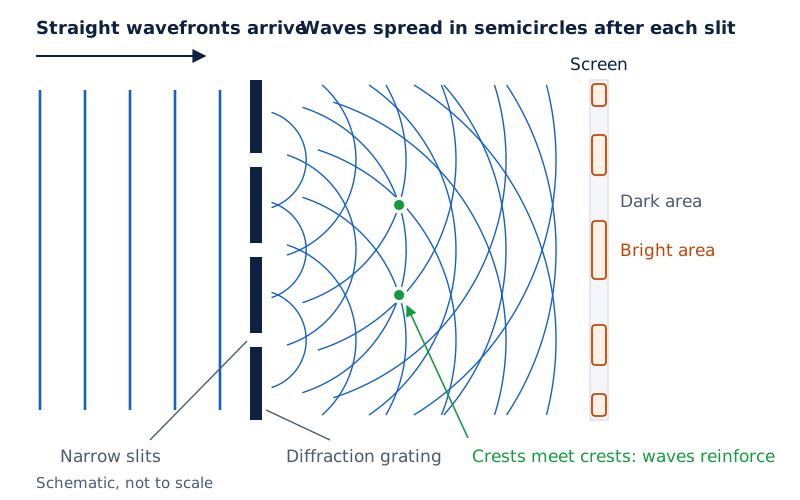
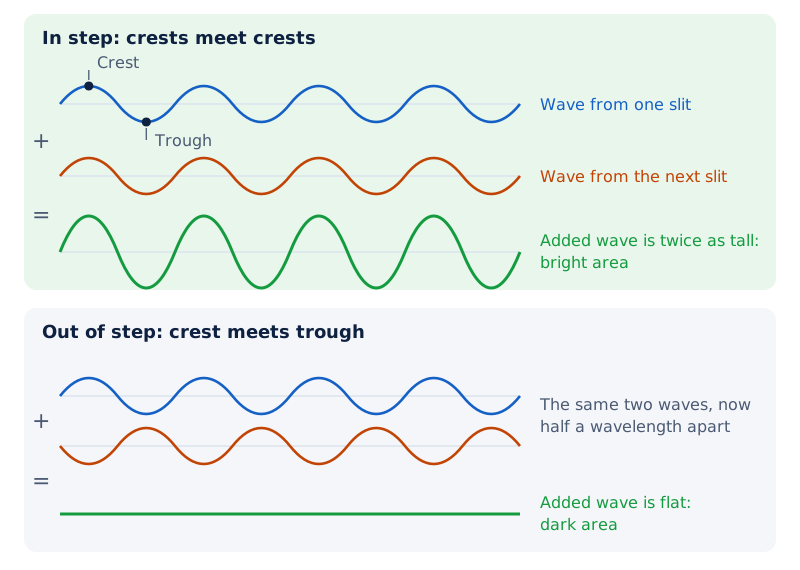
Draw a flat perforated plate with narrow slits, with straight wavefronts approaching it from one side.
Show the waves spreading out in semicircles after passing through each slit, overlapping on the far side, and label the places where crests meet crests as bright spots and where crests meet troughs as dark gaps, to show how a diffraction pattern of light and dark areas is built up.
Drawn by One Young India.
He checked carefully whether he was actually looking at a twin crystal, which is two ordinary crystals grown together at a shared boundary that can mimic unusual symmetry, a possibility colleagues repeatedly raised.
He found no evidence that this was the explanation, and he trusted his own careful experimental data over what the textbook required.
How did Penrose tilings and the golden ratio explain quasicrystals?
Years before Shechtman's discovery, mathematicians had already been playing with a seemingly unrelated puzzle: could a flat surface be covered completely with a small number of tile shapes so that the overall pattern never repeated itself? The first such aperiodic tiling, reported in 1966, needed more than 20,000 different tile shapes.
In the mid-1970s, the British mathematician Roger Penrose found a far more elegant solution using just two tile shapes, a fat rhombus and a thin rhombus.
The crystallographer Alan Mackay later placed dots at the intersections of a Penrose tiling, representing atoms, and used that pattern as a diffraction grating.
The result was a tenfold diffraction pattern, exactly the kind of result Shechtman had observed in his real alloy.
Physicists Paul Steinhardt and Dov Levine connected Mackay's theoretical model directly to Shechtman's experimental data, and in a paper published five weeks after Shechtman's own, on 24 December 1984, they coined the word "quasicrystal".
A key feature of both Penrose tilings and quasicrystals is the golden ratio, a mathematical constant already known to ancient Greek geometers, written as τ.
In a Penrose tiling the ratio of the number of fat rhombi to thin rhombi equals τ, and in quasicrystals the ratio between certain distances between atoms is also related to τ.
This constant is linked to the Fibonacci sequence (1, 1, 2, 3, 5, 8, 13, 21, 34, 55, 89, 144 and so on, where each number is the sum of the previous two); dividing a later Fibonacci number by the one before it gives a value close to the golden ratio.
| Idea | What it shows |
|---|---|
| Ordinary crystal (periodic) | Pattern repeats regularly; only 2-, 3-, 4- or 6-fold symmetry possible. |
| Penrose tiling | Two tile shapes cover a surface without the pattern ever repeating, yet following mathematical rules. |
| Islamic Girih mosaics (Alhambra, Darb-i Imam Shrine) | Medieval craftsmen built similar aperiodic patterns from five tile shapes centuries earlier. |
| Quasicrystal | Atoms arranged in a pattern that is ordered and governed by rules related to the golden ratio, but never repeats, giving forbidden symmetries such as tenfold. |
This meant that the old definition of regularity, which equated order with repetition, was too narrow. The Royal Swedish Academy of Sciences stated that the discovery "has fundamentally altered how chemists conceive of solid matter," because order could now exist without the pattern ever repeating itself.
How did the discovery unfold?
| Year | Event |
|---|---|
| 1982 | On 8 April, Shechtman observes a tenfold electron diffraction pattern in an aluminium-manganese alloy and writes "10 Fold ???" in his notebook. |
| 1983 | Ilan Blech, a colleague at Technion, joins Shechtman to try to interpret the diffraction pattern. |
| 1984 | In summer, their article is rejected immediately by the Journal of Applied Physics. |
| 1984 | In November, Shechtman, Blech, French crystallographer Denis Gratias and physicist John Cahn publish the discovery in Physical Review Letters. |
| 1984 | On 24 December, Dov Levine and Paul Steinhardt publish a paper naming these materials "quasicrystals". |
| 1987 | The first stable icosahedral quasicrystal is synthesised, in the aluminium-copper-iron system. |
| 1992 | The International Union of Crystallography changes its official definition of a crystal to include quasicrystals. |
| 2000 | A stable binary icosahedral quasicrystal is found using calcium-cadmium and ytterbium-cadmium systems. |
| 2009 | Scientists report the first naturally occurring quasicrystal mineral, later named icosahedrite, found in samples from the Khatyrka River in Russia. |
| 2011 | Dan Shechtman is awarded the Nobel Prize in Chemistry, announced on 5 October. |
During the years of resistance, Shechtman faced ridicule from colleagues and was asked to leave his research group because the situation had become, in his own later description, too embarrassing.
One of his most prominent critics was Linus Pauling, himself a two-time Nobel laureate, which shows how deeply the old assumption about crystals was held even by eminent scientists.
Why does it matter?
The discovery forced the International Union of Crystallography to abandon its old definition of a crystal, which had required "a regularly ordered, repeating three-dimensional pattern", and replace it in 1992 with a broader definition based only on the diffraction pattern a material produces.
This change left science more cautious about declaring any structural possibility permanently forbidden.
Quasicrystals have since been made in laboratories in hundreds of intermetallic systems, and natural quasicrystalline minerals have been found, including icosahedrite from the Khatyrka River in Russia.
A Swedish company found quasicrystals forming naturally inside a very hard steel, where they act like armour within a softer matrix; such steel has been used in products including razor blades and needles for eye surgery.
Because quasicrystals are poor conductors of heat and electricity and have low-friction, non-stick surfaces, scientists have experimented with using them in frying pan coatings, energy-saving LED components, and heat-insulating parts for engines such as diesel engines.
Their poor thermal conductivity also makes them candidates for thermoelectric materials, which convert waste heat into electricity.
Beyond its practical uses, the episode is widely cited as a lesson in scientific method: an established "truth", once treated as mathematically certain, turned out to be an assumption that held only for ordinary periodic crystals, and it took rigorous experimental evidence and years of persistence to overturn it.
How does this connect to what you study?
This discovery links directly to topics covered in school mathematics and chemistry. The golden ratio and the Fibonacci sequence, often introduced in mathematics lessons on number patterns and geometry, turn out to describe real physical structures at the atomic scale in quasicrystals.
In chemistry, the idea of symmetry in crystals, the rotational symmetries allowed in repeating patterns (2-fold, 3-fold, 4-fold, 6-fold), is a useful way to understand why a tenfold pattern seemed so shocking.
Students studying the states of matter and the structure of solids can use this story as a concrete example of how a single, well-documented experimental observation, electron diffraction producing unexpected bright dots, can challenge and eventually change an accepted scientific definition.
The story is also a useful case study in the nature of science itself: it shows that even a rule proved mathematically correct under certain assumptions (here, that long-range order requires periodicity) can fail once a new kind of material is discovered that does not fit those assumptions.
Quick facts for exams
The Nobel Prize in Chemistry 2011 was awarded solely to Dan Shechtman of the Technion - Israel Institute of Technology, Haifa, Israel, "for the discovery of quasicrystals".
The award was announced by the Royal Swedish Academy of Sciences on 5 October 2011.
Shechtman, born in Tel Aviv in 1941, made the discovery in 1982 when his electron microscope revealed a diffraction pattern with forbidden tenfold symmetry in an aluminium-manganese alloy, showing that atoms could be arranged in an order that never repeats, unlike the periodic repetition required of ordinary crystals.
His finding, published in 1984 after years of rejection, led to the naming of "quasicrystals" by Levine and Steinhardt and the 1992 redefinition of the word "crystal" by the International Union of Crystallography.
| Fact | Detail |
|---|---|
| Prize | Nobel Prize in Chemistry 2011 |
| Laureate | Dan Shechtman |
| Country of birth | British Mandate of Palestine (now Israel) |
| Country of affiliation at award | Israel (Technion - Israel Institute of Technology, Haifa) |
| Share | Whole prize (1/1) |
| Citation | "for the discovery of quasicrystals" |
| Date announced | 5 October 2011 |
| Prize amount | 10,000,000 Swedish kronor |
Note: Source. The prize facts in this note are from the Nobel Prize's official site, nobelprize.org.
Glossary
- Quasicrystal — a solid whose atoms form an ordered but never-repeating pattern, unlike ordinary periodic crystals.
- Periodic crystal — a solid built from a basic unit cell that repeats regularly in all directions, like repeating wallpaper.
- Diffraction pattern — the pattern of bright and dark spots produced when waves (light, X-rays or electrons) pass through a regularly spaced structure and interfere.
- Icosahedral symmetry — a type of symmetry related to the icosahedron, a solid with twenty three-cornered faces, found in Shechtman's quasicrystal.
- Golden ratio (τ) — a mathematical constant, approximately 1.618, that appears repeatedly in Penrose tilings and quasicrystal structures.
- Fibonacci sequence — a series of numbers where each term is the sum of the two before it (1, 1, 2, 3, 5, 8...), closely linked to the golden ratio.
- Penrose tiling — an aperiodic covering of a flat surface using two tile shapes, devised by Roger Penrose, that never repeats.
- Twin crystal — two ordinary crystals grown together sharing a boundary, which can produce unusual diffraction patterns that mimic forbidden symmetries.
- Space group — one of 230 possible mathematical descriptions of how atoms can be arranged periodically in a crystal.
- Unit cell — the smallest repeating block of atoms whose repetition builds up an ordinary periodic crystal.
- International Union of Crystallography (IUCr) — the international body that set, and in 1992 changed, the official definition of a crystal.
- Icosahedrite — the first naturally occurring quasicrystalline mineral, found in samples from the Khatyrka River, Russia.
Common errors and misconceptions
- Misconception: Quasicrystals are completely disordered, like glass. Correct: They show long-range order with a measurable, discrete diffraction pattern; they are simply not periodic.
- Misconception: Shechtman's discovery was accepted quickly once he published it. Correct: He faced years of ridicule and was asked to leave his research group before the finding was broadly accepted.
- Misconception: Fivefold and tenfold symmetry had never been seen in any pattern before 1982. Correct: Medieval Islamic mosaics such as those in the Alhambra Palace and the Darb-i Imam Shrine already showed similar aperiodic patterns, centuries earlier.
- Misconception: The word "quasicrystal" was coined by Shechtman himself. Correct: It was coined by Dov Levine and Paul Steinhardt in a paper published shortly after Shechtman's.
- Misconception: Quasicrystals are only laboratory curiosities with no natural occurrence. Correct: A naturally occurring quasicrystal mineral, icosahedrite, was later found in river samples from Russia.
- Misconception: The prize went to several scientists who worked on quasicrystals. Correct: The whole 2011 Chemistry Prize went to Dan Shechtman alone, for the original discovery.
- Misconception: The old crystal definition was simply discarded after 1982. Correct: The International Union of Crystallography kept the old definition in force until 1992, when it adopted a new one based on diffraction patterns.
Exam-style questions with model answers
Q1. For what discovery was the Nobel Prize in Chemistry 2011 awarded? [1 mark]
- It was awarded for the discovery of quasicrystals, solids whose atoms are arranged in an order that never repeats.
Q2. On what date did Shechtman first observe the tenfold diffraction pattern? [1 mark]
- He observed it on 8 April 1982, while examining a rapidly cooled aluminium-manganese alloy with an electron microscope.
Q3. Why did scientists originally believe tenfold symmetry in a crystal was impossible? [3 marks]
- Crystallographers held that long-range atomic order required a periodic, repeating pattern, built from a basic unit cell.
- Mathematical proofs showed that only 2-, 3-, 4- and 6-fold rotational symmetries can repeat periodically without leaving gaps.
- Fivefold, tenfold and all higher symmetries were proved to be incompatible with this periodic repetition, so they were excluded from the 230 recognised space groups listed in the standard crystallography reference.
Q4. Explain how Penrose tilings and the golden ratio helped explain Shechtman's observation. [4 marks]
- Mathematician Roger Penrose had shown, before 1982, that a flat surface could be covered without repetition using just two tile shapes, a fat and a thin rhombus.
- Crystallographer Alan Mackay placed dots at the intersections of such a tiling, representing atoms, and showed this pattern produced a tenfold diffraction pattern when used as a diffraction grating.
- Physicists Paul Steinhardt and Dov Levine linked Mackay's theoretical model directly to Shechtman's real experimental data and named these structures "quasicrystals".
- The golden ratio, linked to the Fibonacci sequence, describes the relationship between distances in both Penrose tilings and real quasicrystals, showing the pattern follows mathematical rules even though it never repeats.
Q5. Discuss how the discovery of quasicrystals changed the scientific definition of a crystal, and why this matters for how science treats established "truths". [6 marks]
- Before 1982, the International Union of Crystallography defined a crystal as a substance whose atoms are packed in a regularly ordered, repeating three-dimensional pattern, tying order inseparably to periodic repetition.
- Shechtman's electron diffraction images of an aluminium-manganese alloy showed tenfold symmetry with clear long-range order, yet the pattern never repeated, directly contradicting this definition.
- After years of resistance, including ridicule from colleagues and even criticism from double Nobel laureate Linus Pauling, the finding was confirmed through further experiments and was explained using Penrose tilings and the golden ratio.
- In 1992, the International Union of Crystallography replaced the old definition with a broader one based on the diffraction pattern a solid produces, rather than requiring periodicity outright.
- This episode illustrates how a mathematically proved rule, correct under its original assumptions, can still be overturned once a genuinely new kind of material is discovered.
- It also shows the importance of trusting careful experimental evidence even against strong consensus, rather than assuming unanimous expert opinion must be right.
Q6. Name two practical uses of quasicrystals mentioned in the sources. [2 marks]
- Quasicrystals have been used to reinforce a very hard Swedish steel, used in products such as razor blades and needles for eye surgery.
- Scientists have also experimented with using quasicrystals as frying pan coatings.
Q7. Who were Shechtman's main collaborators in publishing the original 1984 paper? [2 marks]
- His co-authors included Ilan Blech, a colleague at Technion, who first helped interpret the diffraction pattern.
- Physicist John Cahn and French crystallographer Denis Gratias also joined as co-authors before the 1984 publication.
Q8. What is the significance of the naturally occurring mineral icosahedrite? [3 marks]
- Icosahedrite, found in samples from the Khatyrka River in Russia, was identified as the first naturally occurring quasicrystal mineral.
- It is composed of aluminium, copper and iron and produces a diffraction pattern with tenfold symmetry.
- Its discovery showed that quasicrystals are not only artificial laboratory materials but can also form naturally.
Key takeaways
- The Nobel Prize in Chemistry 2011 went entirely to Dan Shechtman for discovering quasicrystals.
- Quasicrystals show long-range atomic order without ever repeating, unlike ordinary periodic crystals.
- Shechtman's tenfold diffraction pattern, seen on 8 April 1982, contradicted a rule treated as settled for centuries.
- Penrose tilings and the golden ratio provided the mathematical explanation for the pattern's structure.
- Shechtman faced years of ridicule, including from double Nobel laureate Linus Pauling, before acceptance.
- The International Union of Crystallography redefined "crystal" in 1992 to include quasicrystals.
- Natural quasicrystals, such as icosahedrite, have since been found in river mineral samples.
- Quasicrystals have practical uses in hard steel, non-stick coatings and potential thermoelectric materials.
Test yourself
Where and when was Dan Shechtman born?
Dan Shechtman was born on 24 January 1941 in Tel Aviv, then part of the British Mandate of Palestine, now Israel.
What did Shechtman write in his notebook on 8 April 1982?
He wrote "10 Fold ???" with three question marks, recording his surprise at the unexpected tenfold diffraction pattern he had observed.
Who named the new class of materials "quasicrystals"?
Physicists Dov Levine and Paul Steinhardt coined the term in a paper published on 24 December 1984.
Which mathematician invented the two-tile aperiodic pattern linked to quasicrystals?
British mathematician Roger Penrose devised an aperiodic tiling using just a fat and a thin rhombus in the mid-1970s.
What change did the International Union of Crystallography make in 1992?
It changed its definition of a crystal from requiring periodic repetition to any solid with an essentially discrete diffraction pattern.
Name one everyday product that has used quasicrystal-reinforced steel.
Quasicrystal-reinforced steel has been used in razor blades and in needles made for eye surgery.
Which prominent scientist was one of Shechtman's fiercest critics?
Linus Pauling, a two-time Nobel laureate, was one of the fiercest critics of Shechtman's quasicrystal discovery.