
Nobel Prize in Chemistry 2022: Click Chemistry and Bioorthogonal Chemistry
On this page
What was the Nobel Prize in Chemistry 2022 awarded for?
The Royal Swedish Academy of Sciences gave the 2022 prize to three chemists "for the development of click chemistry and bioorthogonal chemistry". This is the exact official citation, and it covers two connected ideas developed over about two decades.
In plain words, the laureates found simple, reliable ways to join two molecules together, almost as easily as snapping together two pieces of a buckle.
Click chemistry is a style of chemical reaction that is fast, selective and produces almost no unwanted waste.
Bioorthogonal chemistry takes this idea one step further: it is a version of click chemistry gentle enough to be carried out inside a living cell or a living animal without disturbing the cell's own biology.
The award is officially called the Nobel Prize in Chemistry, and in 2022 it was shared equally among the three laureates for building this whole new way of thinking about how molecules can be linked.
Who are the laureates?
Carolyn R. Bertozzi
Carolyn R. Bertozzi was born on 10 October 1966 in Boston, MA, USA. At the time of the award she worked at Stanford University, Stanford, CA, USA, and also at the Howard Hughes Medical Institute, USA. She received one third of the prize.
Bertozzi adapted click chemistry so it could work inside living cells and organisms without interfering with normal cell chemistry. She used this bioorthogonal chemistry to study glycans, the sugar-based molecules that sit on the surface of cells, and to help improve the targeting of cancer drugs.
Morten Meldal
Morten Meldal was born on 16 January 1954 in Copenhagen, Denmark. At the time of the award he was a professor at the University of Copenhagen, Denmark, and received one third of the prize.
In 2001, while trying to make molecular libraries for drug screening, Meldal noticed an unexpected reaction in his test vessel. This observation led him to the copper catalysed azide-alkyne cycloaddition, the central reaction of click chemistry.
K. Barry Sharpless
K. Barry Sharpless was born on 28 April 1941 in Philadelphia, PA, USA. At the time of the award he worked at Scripps Research, La Jolla, CA, USA, and received one third of the prize.
This was his second Nobel Prize in Chemistry, after the 2001 prize for his earlier work on chirally catalysed oxidation reactions.
Around the year 2000, Sharpless coined the concept of click chemistry, and in a 2001 article with coworkers he set out strict criteria that a reaction must meet to count as a "click" reaction. Shortly afterwards, independently of Meldal, he too published the copper-catalysed azide-alkyne reaction.
What problem were the laureates trying to solve?
Since the eighteenth century, chemists have often used nature as a model, trying to rebuild complicated natural molecules in the laboratory, especially for medicines. The press release notes this approach "has led to many admirable molecular constructions, but these are generally time consuming and very expensive to produce."
The deep reason is chemical. Most natural molecules are built on frameworks of linked carbon atoms. Carbon atoms from different molecules often have no natural "urge" to bond to each other, so chemists must artificially activate them.
This activation usually creates many unwanted by-products, which then have to be removed, often losing most of the starting material along the way.
Sharpless argued that chemists should stop forcing reluctant carbon atoms together and instead start with small building blocks that already had a complete carbon skeleton, then link these blocks using simpler bridges, such as nitrogen or oxygen atoms, which are far easier to control.
He suggested that molecules built this way might not be exact copies of nature's molecules, but could still do the same job, just produced far more cheaply and reliably.
A second, separate problem faced biologists in the 1990s. Molecular biology was mapping genes and proteins quickly, but glycans, the complex sugar chains found on the surface of cells, were being left behind because there were no good chemical tools to track them inside a living, functioning cell. Carolyn Bertozzi set out to close this gap.
What is click chemistry and how does it work?
Sharpless set out a demanding checklist of conditions a reaction must satisfy to be called a click reaction.
According to the scientific background document, such reactions should be modular, operate under simple conditions with very high yields, use no solvent or an environmentally friendly one such as water, produce only harmless by-products, and have a strong thermodynamic drive so they run quickly to completion without reversing.
- Choose two simple building blocks, each carrying a small reactive group that is otherwise unreactive to everything else around it.
- Attach an azide group to one building block and an alkyne group to the other.
- Bring the two blocks together in a mild solvent, ideally water, in the presence of a copper catalyst.
- The copper ion activates the azide and alkyne so that they join rapidly to form a stable ring-shaped product called a triazole.
- Remove the finished product easily, since the reaction leaves behind almost no unwanted by-products to filter out.
This central reaction is called the copper catalysed azide-alkyne cycloaddition, often shortened to CuAAC. Meldal found it by accident while screening for drug candidates, and noticed the azide and alkyne had snapped together almost perfectly, leaving the rest of his starting materials untouched.
Sharpless, working independently, published a very similar result the same year and showed the reaction was reliable in water.
Diagram
The click reaction that changed chemistry
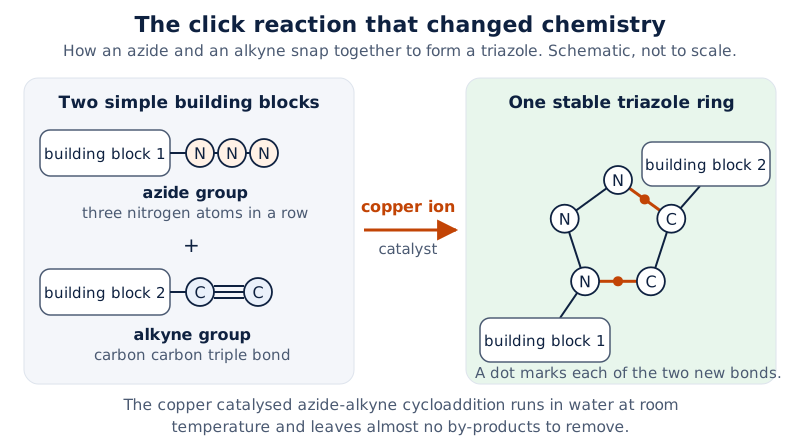
Draw two separate molecules, one ending in an azide group (three nitrogen atoms in a row) and one ending in an alkyne group (two carbon atoms joined by a triple bond).
Draw an arrow labelled "copper ion" pointing from these two molecules to a single new molecule containing a five-membered ring called a triazole, formed by joining the azide and alkyne ends together.
Drawn by One Young India.
The copper ion acts almost like a matchmaker. The Nobel Committee's presentation speech described it this way: "The copper ion then acted as a matchmaker and made the two a pair...
In a sense, it just said 'click' - and the two were united!" This single reaction turned out to have an enormous number of uses, from building new materials to developing drugs.
How did Bertozzi turn click chemistry into bioorthogonal chemistry?
Copper is useful in a test tube, but it is toxic to living cells, so Bertozzi could not simply use CuAAC inside an organism.
She needed a version of the click reaction that worked without any catalyst at all, while still being gentle enough not to disturb the cell's normal chemistry.
She called this requirement bioorthogonal, meaning the reaction has to be so selective that it only reacts with its intended partner, ignoring everything else happening in the crowded chemistry of a living cell.
| Term | What it means |
|---|---|
| Click chemistry | Simple, reliable, high-yield reactions that join two building blocks quickly with almost no by-products |
| Copper catalysed azide-alkyne cycloaddition (CuAAC) | The main click reaction, joining an azide and an alkyne using copper ions to form a triazole |
| Bioorthogonal chemistry | Click-type reactions gentle and selective enough to run inside a living cell or animal without disrupting it |
| Strain-promoted azide-alkyne cycloaddition (SPAAC) | Bertozzi's copper-free click reaction, using a ring-strained alkyne called a cyclooctyne instead of a copper catalyst |
| Glycan | A complex sugar chain found on the surface of proteins and cells, involved in processes such as infection and immunity |
Bertozzi's solution was to replace the copper catalyst with a built-in source of chemical energy. She used an alkyne forced into a ring shape, called a cyclooctyne.
The strain of squeezing the alkyne into this ring stores up energy, and that stored energy is released the moment the alkyne reacts with an azide, driving the reaction forward without needing copper at all.
In 2004 she published this copper-free click reaction, called the strain-promoted azide-alkyne cycloaddition.
To use this in cells, Bertozzi first fed cells a modified sugar that the cell's own machinery would mistake for its normal building block, so the cell unknowingly built azide groups into its own glycans.
She could then click a fluorescent tag onto those azides using her copper-free reaction, lighting up the glycans so researchers could see exactly where they were on the cell surface, all without harming the cell.
Diagram
Bioorthogonal chemistry illuminates the cell
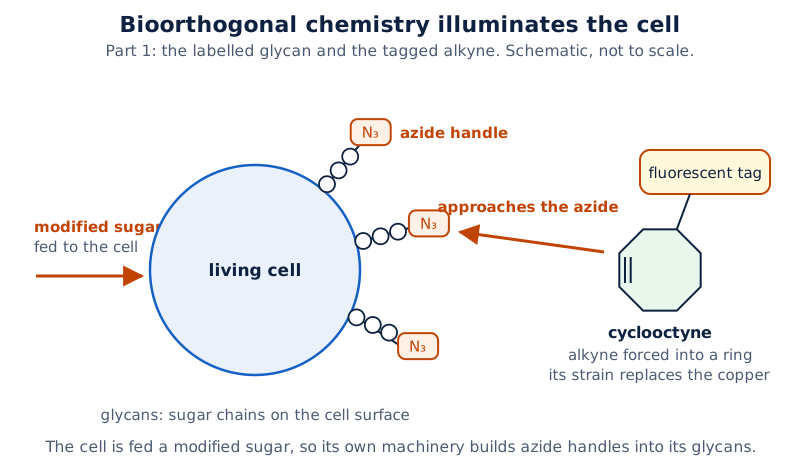
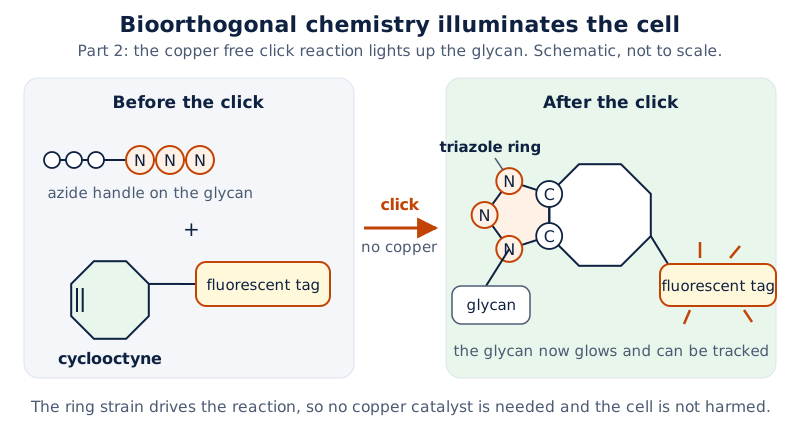
Draw a cell with a few of its surface sugar chains marked with a small azide label.
Draw a separate fluorescent tag molecule carrying a strained, ring-shaped alkyne approaching one of these labelled sugar chains, and then draw the resulting glowing dot where the two have clicked together, showing the glycan can now be seen and tracked.
Drawn by One Young India.
How did the discovery unfold?
| Year | Event |
|---|---|
| 1993 | Bertozzi received her PhD from UC Berkeley, having already begun studying how cells interact with sugars. |
| 1997 | Bertozzi showed that a chemical handle could be added to a cell's own sugars without disturbing the cell, proving her basic idea worked. |
| 2000 | Bertozzi found that an azide made the best chemical handle and used a modified Staudinger reaction to attach labels to cell-surface glycans; around this time Sharpless coined the term click chemistry. |
| 2001 | Sharpless published, with coworkers, the article setting out the criteria for click chemistry; Meldal first presented his accidental azide-alkyne discovery at a symposium in San Diego in June. |
| 2001 | Sharpless received his first Nobel Prize in Chemistry, for earlier work unrelated to click chemistry. |
| 2002 | Meldal published his findings on the copper catalysed azide-alkyne reaction; Sharpless, working independently, also published the same copper catalysed reaction and described it as an ideal click reaction. |
| 2004 | Bertozzi published the copper-free strain-promoted azide-alkyne cycloaddition, allowing the click reaction to be used safely inside living cells. |
| 2022 | Bertozzi, Meldal and Sharpless were jointly awarded the Nobel Prize in Chemistry, announced on 5 October. |
Why does click and bioorthogonal chemistry matter?
Click chemistry quickly became a standard tool across chemistry because it is cheap, reliable and works even in water. According to the press release, it is used in developing pharmaceuticals, mapping DNA, and creating new materials.
Manufacturers can add a clickable azide group to a plastic or fibre, then later click in extra properties, such as the ability to conduct electricity, resist bacteria or block ultraviolet light, or click in softeners so they do not leak out of the plastic over time.
Bioorthogonal chemistry has had a particularly strong impact in medicine. Bertozzi's reactions are now used worldwide to explore how cells work and to track biological processes.
Her research group found that some glycans on tumour cells seem to protect the tumour from the immune system by switching off immune cells nearby.
Using this insight, Bertozzi and colleagues built a new type of biological drug that attaches an enzyme to an antibody, so the enzyme strips away the protective glycans from the tumour's surface; this drug is now being tested in clinical trials on patients with advanced cancer.
Other researchers have also built clickable antibodies that attach to tumours, after which a second clickable molecule, such as a radioactive tracer, is injected separately and clicks onto the antibody already sitting on the tumour.
This can be used either to see the tumour on a scan or to deliver a dose of radiation directly to it.
The popular science text notes that these therapies' real-world success is not yet proven, and the scientific background says the achievements and discoveries of the three laureates have had "enormous influence on our society."
What did the Nobel Committee say about this work?
Johan Åqvist, Chair of the Nobel Committee for Chemistry, summarised the spirit of the award: "This year's Prize in Chemistry deals with not overcomplicating matters, instead working with what is easy and simple." The committee's broader message was that functional, simple chemistry can be just as valuable as painstakingly recreating nature's most complex structures.
The press release also stressed how far this simple idea has travelled, noting that click chemistry and bioorthogonal reactions "have taken chemistry into the era of functionalism," bringing benefits across pharmaceuticals, materials science and the study of living cells.
The popular science text underlines that Sharpless himself, in his earlier 2001 Nobel Lecture, valued the quality of being "useful" above words such as "elegant", "clever" or "novel", a value the committee said fitted this body of work particularly well.
Importantly, the award recognised a concept as much as a single discovery. The scientific background document explains that modern chemistry advances both through specific findings and through new ways of thinking that "catalyse and accelerate new development," and that click chemistry is a clear example of a concept that opened up a whole new research direction once it was named and defined.
How does this connect to what you study?
In school chemistry, you learn that reactions can be fast or slow, and that a catalyst speeds a reaction up without being used up itself. The copper ion in click chemistry is exactly this kind of catalyst: it lowers the energy needed for an azide and an alkyne to join, so a reaction that might otherwise be slow and messy instead runs cleanly within hours at room temperature.
You also study simple ideas about bonding, such as how atoms share electrons to form stable structures. The triazole ring formed in click chemistry is a good real example of a new, stable ring-shaped molecule being built directly from two much simpler starting pieces, with almost nothing wasted along the way.
In biology, you study how cells communicate with each other and how the immune system recognises friend from foe. Glycans, the sugar chains on cell surfaces that Bertozzi studied, are part of this communication system, and they are usually left out of basic biology lessons because they are so hard to track compared with genes or proteins.
Bertozzi's bioorthogonal chemistry gave scientists a practical way to watch glycans and other biomolecules behave inside a living, working cell, rather than only reading about theoretical interactions on a diagram. This link between a chemistry concept and a biological question is a useful example of how the subjects you study separately in school are, in real research, worked on together.
Quick facts for exams
The Nobel Prize in Chemistry 2022 was awarded jointly to Carolyn R. Bertozzi, Morten Meldal and K. Barry Sharpless "for the development of click chemistry and bioorthogonal chemistry".
It was announced on 5 October 2022 by the Royal Swedish Academy of Sciences and carried a prize amount of 10,000,000 Swedish kronor, shared equally among the three laureates. Bertozzi was born in the USA and worked at Stanford University;
Meldal was born in Denmark and worked at the University of Copenhagen; Sharpless was born in the USA and worked at Scripps Research, and this was his second Nobel Prize in Chemistry, after 2001.
Click chemistry provides simple, reliable reactions to join molecules, while bioorthogonal chemistry allows such reactions inside living cells, with wide use in medicine and materials.
| Fact | Detail |
|---|---|
| Prize | The Nobel Prize in Chemistry 2022 |
| Date announced | 5 October 2022 |
| Laureates | Carolyn R. Bertozzi, Morten Meldal, K. Barry Sharpless |
| Countries of birth | USA (Bertozzi, Sharpless), Denmark (Meldal) |
| Affiliations at award | Stanford University and Howard Hughes Medical Institute, USA (Bertozzi); University of Copenhagen, Denmark (Meldal); Scripps Research, USA (Sharpless) |
| Shares | One third each |
| Citation | "for the development of click chemistry and bioorthogonal chemistry" |
| Prize amount | 10,000,000 Swedish kronor |
Note: Source. The prize facts in this note are from the Nobel Prize's official site, nobelprize.org.
Glossary
- Click chemistry - a style of chemistry using simple, robust, high-yield reactions that join molecular building blocks quickly with little waste
- Bioorthogonal chemistry - click-type reactions selective and gentle enough to run inside living cells without disturbing normal cell processes
- Azide - a chemical group made of three nitrogen atoms, used as the reactive "handle" in most click reactions
- Alkyne - a chemical group containing a carbon-carbon triple bond, the partner group that reacts with an azide in click chemistry
- Triazole - the stable, ring-shaped product formed when an azide and an alkyne join together
- Cycloaddition - a reaction in which two molecules join to form a new ring-shaped structure
- Catalyst - a substance, such as copper ions here, that speeds up a reaction without being consumed by it
- Copper catalysed azide-alkyne cycloaddition (CuAAC) - the central click reaction, joining an azide and alkyne using copper ions
- Strain-promoted azide-alkyne cycloaddition (SPAAC) - Bertozzi's copper-free click reaction using a ring-strained alkyne as the energy source
- Glycan - a complex sugar chain found on the surface of many proteins and cells
- Staudinger reaction - an older reaction between an azide and a phosphine, which Bertozzi modified for use in labelling cells
- Combinatorial chemistry - making and testing very large collections of related compounds to find useful ones, the drug-screening work during which Meldal made his discovery
- Bioorthogonal - describing a reaction so selective that it only reacts with its intended partner inside the busy chemistry of a living system
Common errors and misconceptions
- Misconception: Click chemistry and bioorthogonal chemistry are the same thing. Correct: Click chemistry is the general style of simple, robust reactions; bioorthogonal chemistry is the special subset of click reactions gentle enough to use inside living cells.
- Misconception: The copper catalysed azide-alkyne reaction can be used directly inside the human body. Correct: Copper is toxic to cells, so Bertozzi had to invent a copper-free version, the strain-promoted azide-alkyne cycloaddition, for living systems.
- Misconception: Sharpless and Meldal worked together on the copper catalysed reaction. Correct: They discovered this reaction independently of each other, in the same period.
- Misconception: This was Sharpless's first Nobel Prize. Correct: Sharpless had already won the Nobel Prize in Chemistry in 2001 for separate earlier work.
- Misconception: Click chemistry is only useful for studying cells. Correct: It is also widely used in materials science, for example to add new properties to plastics and fibres, and in drug development generally.
- Misconception: Glycans are a type of protein. Correct: Glycans are complex sugar structures, often attached to the outside of proteins or cells, not proteins themselves.
- Misconception: The cancer drugs based on bioorthogonal chemistry are already approved treatments. Correct: The sources state these approaches are now being tested in clinical trials, not yet established treatments.
Exam-style questions with model answers
Q1. State the exact citation for the Nobel Prize in Chemistry 2022. [2 marks]
- The citation reads: "for the development of click chemistry and bioorthogonal chemistry", awarded jointly to Carolyn R. Bertozzi, Morten Meldal and K. Barry Sharpless.
Q2. Name the three laureates of the Nobel Prize in Chemistry 2022 and their affiliations at the time of the award. [2 marks]
- Carolyn R. Bertozzi was at Stanford University and the Howard Hughes Medical Institute, USA; Morten Meldal was at the University of Copenhagen, Denmark; K. Barry Sharpless was at Scripps Research, USA.
Q3. Explain what click chemistry is and why Sharpless proposed it. [4 marks]
- Click chemistry is a style of chemical reaction that joins molecular building blocks quickly, reliably and with very high yield, producing almost no harmful by-products.
- Sharpless proposed it because traditional chemistry, which often tried to copy nature's complex molecules by forcing reluctant carbon atoms to bond, was slow, costly and wasteful.
- He suggested instead starting with simple building blocks that already had a complete carbon frame, then linking them with easy-to-control bridges such as nitrogen or oxygen atoms.
- This approach made it possible to build a huge variety of useful molecules through simple, dependable steps rather than painstaking, custom-designed routes.
Q4. Describe the copper catalysed azide-alkyne cycloaddition and how it was discovered. [4 marks]
- This reaction joins an azide group and an alkyne group to form a stable, ring-shaped triazole, using copper ions as a catalyst.
- Morten Meldal discovered it by accident in 2001 while screening molecular libraries for drug candidates, noticing an unexpected and very clean reaction in his vessel.
- Independently, Barry Sharpless also published the same copper catalysed reaction around the same time, describing it as an ideal click reaction that worked reliably even in water.
- Both findings together established this reaction as the central example of click chemistry, now used widely in pharmaceuticals, materials and DNA mapping.
Q5. Explain how Carolyn Bertozzi adapted click chemistry for use inside living cells, and discuss why this mattered for medicine. [6 marks]
- Bertozzi needed a click-type reaction that would work safely inside living organisms, but copper, the usual catalyst, is toxic to cells.
- She solved this by using an alkyne forced into a strained ring shape, called a cyclooctyne, so that the stored strain energy drives the reaction instead of a copper catalyst, in a process called strain-promoted azide-alkyne cycloaddition, published in 2004.
- She first fed cells a modified sugar so that the cell's own machinery built azide groups into its glycans, the sugar chains on its surface, then clicked fluorescent tags onto these azides to light up and track the glycans.
- This bioorthogonal approach let researchers watch biological processes, such as how glycans interact with the immune system, happen in real cells without disturbing normal cell chemistry.
- It mattered for medicine because it revealed that some glycans on tumour cells switch off nearby immune cells, leading Bertozzi's group to design a drug that strips these protective glycans from tumours, now in clinical trials, and it also enabled clickable antibodies used for tumour imaging and radiation delivery.
Q6. What did the Nobel Committee for Chemistry say was the central idea behind the 2022 prize? [3 marks]
- Johan Åqvist, Chair of the Nobel Committee for Chemistry, said the prize was about "not overcomplicating matters, instead working with what is easy and simple."
- The committee valued that functional molecules could be built even by taking a straightforward route, rather than always copying nature's complex structures.
- The press release also described how this simple idea has brought chemistry "into the era of functionalism," with wide benefits across medicine and materials.
Q7. Why was K. Barry Sharpless's 2022 award notable in terms of his Nobel history? [2 marks]
- It was his second Nobel Prize in Chemistry, as he had already won the prize in 2001 for separate earlier research on selective oxidation reactions.
Key takeaways
- The 2022 Nobel Prize in Chemistry was shared by Bertozzi, Meldal and Sharpless for click chemistry and bioorthogonal chemistry.
- Click chemistry uses simple, robust reactions, especially the copper catalysed azide-alkyne cycloaddition, to join molecules efficiently.
- Meldal and Sharpless discovered the copper catalysed reaction independently around 2001 to 2002.
- Bertozzi developed a copper-free version, the strain-promoted azide-alkyne cycloaddition, so click reactions could be used safely inside living cells.
- Bioorthogonal reactions let scientists track glycans and other biomolecules inside living organisms without disrupting normal chemistry.
- Applications include new materials, pharmaceutical development, DNA mapping and improved targeting of cancer treatments.
- Sharpless had already won the Nobel Prize in Chemistry in 2001, making 2022 his second award.
- The Nobel Committee emphasised simplicity and usefulness, quoting Sharpless's own value of chemistry being "useful."
Test yourself
What is the official citation for the Nobel Prize in Chemistry 2022?
"for the development of click chemistry and bioorthogonal chemistry", shared by Bertozzi, Meldal and Sharpless.
Where did Morten Meldal work at the time of the award?
Morten Meldal worked at the University of Copenhagen in Denmark at the time of the award.
Why can copper not be used for click reactions inside living cells?
Copper ions are toxic to living cells, so Bertozzi had to design a copper-free click reaction for use in organisms.
What chemical group did Bertozzi use to replace the copper catalyst?
She used a ring-strained alkyne called a cyclooctyne, whose stored strain energy drives the reaction without any catalyst.
What is a glycan?
A glycan is a complex sugar chain often found on the surface of proteins and cells, involved in processes like infection and immunity.
How many Nobel Prizes in Chemistry has K. Barry Sharpless received?
K. Barry Sharpless has received two Nobel Prizes in Chemistry, in 2001 and in 2022.
Name one practical use of click chemistry outside medicine.
Click chemistry is used to add properties to materials, such as clicking antibacterial or electrically conductive substances onto plastics and fibres.