
Nobel Prize in Economics 2001: Markets with Asymmetric Information
On this page
This note covers the Nobel Prize in Economics 2001: who George A. Akerlof, A. Michael Spence and Joseph E.
Stiglitz are, what asymmetric information means, how adverse selection, signalling and screening work as three separate answers to the same problem, how each laureate's research developed, why the ideas still matter and quick facts for exams.
What was the Nobel Prize in Economics 2001 awarded for?
The prize was given "for their analyses of markets with asymmetric information". This is the exact citation used by the awarding body.
In plain words, the three laureates studied markets where one side knows far more than the other. A person selling a used car usually knows more about its real condition than the buyer does.
A job applicant knows more about their own ability than the employer does. A person buying insurance knows more about their own health or driving habits than the insurance company does.
Standard economic models of the time mostly assumed both sides knew the same things, which made it hard to explain some common and puzzling market behaviour.
Akerlof, Spence and Stiglitz each built a different piece of the theory that explains what happens when information is asymmetric, and together their work became the foundation of modern information economics.
The full official name of this award is the Sveriges Riksbank Prize in Economic Sciences in Memory of Alfred Nobel, and it is popularly called the Nobel Prize in Economics. It was announced on 10 October 2001 and awarded by the Royal Swedish Academy of Sciences.
Who are the laureates?
All three laureates received an equal one-third share of the 10,000,000 Swedish kronor prize, and all three worked on different sides of the same question: what happens in a market when one party knows more than the other.
George A. Akerlof
George A. Akerlof was born on 17 June 1940 in New Haven, Connecticut, USA. At the time of the award he was affiliated with the University of California, Berkeley, where he had been Goldman Professor of Economics since 1980.
He earned his PhD from MIT in 1966 and had earlier held professorships at the Indian Statistical Institute and the London School of Economics.
Akerlof showed how a seller's extra knowledge about product quality can push good products out of a market, leaving only low-quality goods behind, a problem called adverse selection.
A. Michael Spence
A. Michael Spence was born on 7 November 1943 in Montclair, New Jersey, USA. At the time of the award he was affiliated with Stanford University.
He earned his PhD from Harvard in 1972 and had taught at Harvard and at Stanford's Graduate School of Business, serving as dean at both institutions.
Spence identified signalling: how better-informed people can take costly, visible actions, such as gaining an education, to credibly prove their quality to less-informed people.
Joseph E. Stiglitz
Joseph E. Stiglitz was born on 9 February 1943 in Gary, Indiana, USA. At the time of the award he was affiliated with Columbia University, New York.
He earned his PhD from MIT in 1967, had held professorships at Yale, Princeton, Oxford and Stanford, and had served as Chief Economist of the World Bank.
Stiglitz explained the opposite kind of adjustment, called screening: how the less-informed side of a market can design choices that make the better-informed side reveal information about themselves.
What problem does asymmetric information create?
Many everyday markets are not as simple as the textbook picture of two equally informed sides agreeing on a price. In reality, one side of the market usually knows more than the other.
Borrowers know more than lenders about whether they will repay a loan. Company managers and boards know more than shareholders about how profitable the firm really is.
People applying for insurance know more than the insurance company about their own risk of an accident or illness. Tenant farmers know more than landowners about how hard they are working and about local harvest conditions.
Before the 1970s, economic theory had trouble explaining several real puzzles that stem from this gap in knowledge: why interest rates on local lending markets in poorer countries could be extremely high, why a used car bought from a private seller is often viewed with more suspicion than one bought from a dealer, why some companies pay dividends even though dividends are taxed more heavily than capital gains, and why landowners do not simply bear the whole risk of a bad harvest themselves.
During the 1970s, Akerlof, Spence and Stiglitz each worked out a part of the answer. Together their contributions, as the awarding committee put it, "form the core of modern information economics", a field that is now applied to markets ranging from traditional agriculture to modern financial markets.
How did George Akerlof explain adverse selection?
Akerlof's best-known contribution is his 1970 essay on the market for used cars, often remembered through the slang word "lemon" for a faulty old car. He imagined a market where sellers know whether their car is good or bad, but buyers cannot tell the difference just by looking.
Because buyers cannot distinguish good cars from bad ones, they are only willing to pay an average price that reflects the mixed quality of all cars on sale.
At that average price, owners of genuinely good cars feel underpaid and tend to leave the market, while owners of poor cars are happy to sell.
As more good cars exit, the average quality on sale falls further, pushing the price down again, and the cycle can continue until, in the extreme case, only low-quality cars remain for sale.
Akerlof called this downward spiral adverse selection: instead of a mix of qualities, the market selects against quality.
Akerlof pointed out that this same pattern explains other puzzles too. He used the example of local credit markets in India in the 1960s, where middlemen who borrowed money in town and lent it in the countryside, without knowing which borrowers were trustworthy, risked attracting borrowers with poor repayment prospects, becoming liable to heavy losses.
He also applied the idea to the difficulty older people face in buying individual health insurance and to discrimination against minorities in labour markets.
He further argued that many everyday market institutions, such as guarantees from car dealers, brand names, chain stores and franchising, exist precisely because they help to work around this information problem.
How did Michael Spence's signalling solve the problem?
Spence asked the question from the opposite direction: if one side of a market is better informed, what can that side do to prove it, rather than simply hope the other side guesses correctly? His answer, developed in a 1973 essay based on his PhD thesis, was signalling.
Spence's main example was education in the job market. Employers cannot directly observe how productive a job applicant will be, but they can observe the applicant's level of education.
Spence showed that education can work as a credible signal of ability only if gaining that education is less costly for genuinely able applicants than for less able ones.
If a less able person would find it too costly or difficult to get the same qualification, then only the more able apply for it, and the qualification becomes a trustworthy signal even if education itself does nothing to raise productivity.
Spence also noted that this kind of market can settle into different possible patterns of wages and education depending on what employers expect, which could help explain why groups such as men and women, or people of different races, with the same underlying ability sometimes end up receiving different wages for the same signal.
Beyond education, later research used his signalling idea to explain costly advertising, product guarantees, aggressive price cuts that signal a firm's strength, and companies paying heavily taxed dividends to signal to investors that their profits are genuinely high.
Diagram
Education as a costly signal
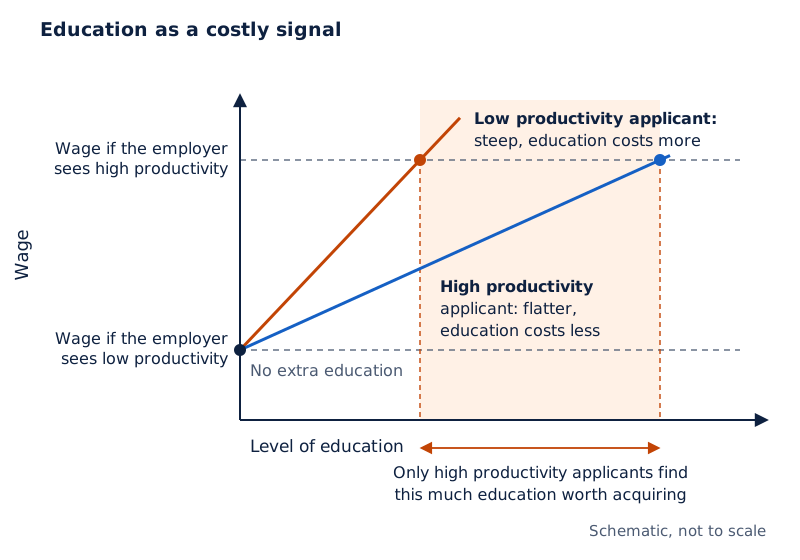
Sketch two sloped lines on a wage-versus-education graph, one steep line for low-productivity applicants and one flatter line for high-productivity applicants, each showing how much extra wage a worker would need to make a given amount of extra education worthwhile; mark the point where the gap between the two lines lets only high-productivity applicants find it worth acquiring the higher level of education.
Drawn by One Young India.
How did Joseph Stiglitz's screening solve the problem?
Stiglitz, working with Michael Rothschild, asked what the less-informed side of a market can do instead of waiting for the informed side to send a signal. Their answer was screening: designing a menu of choices so that people reveal information about themselves simply by which option they pick.
Their clearest example is insurance. An insurance company cannot see directly how risky an individual customer really is, but it can offer a menu of contracts, for instance a cheaper policy with a high deductible alongside a costlier policy with a low deductible.
Low-risk customers, who expect to make few claims, are happy to accept the high deductible in exchange for a lower premium, while high-risk customers prefer to pay more for the policy that covers them fully from the start.
By choosing between these contracts, customers sort themselves into risk classes without the company ever directly asking how risky they are.
Stiglitz extended this idea across many markets. With Andrew Weiss, he showed that banks facing uncertainty about who will repay a loan may find it better to simply ration credit, refusing some loans rather than raising interest rates for everyone, because very high rates tend to attract the riskiest borrowers.
With Sanford Grossman, he showed what is known as the Grossman-Stiglitz paradox: if market prices already reflected all available information perfectly, nobody would have any reason to spend effort gathering that information in the first place.
Stiglitz also studied sharecropping contracts between landowners and tenant farmers, showing that splitting the harvest in fixed shares, rather than making the richer landowner bear all the risk, gives the tenant a real incentive to work hard despite the landowner not being able to observe that effort directly.
| Mechanism | Who acts | Core idea |
|---|---|---|
| Adverse selection (Akerlof) | No deliberate action; a market outcome | Uncertainty about quality drives good products or honest sellers out of the market |
| Signalling (Spence) | The better-informed party | Costly, hard-to-fake actions such as education reveal true quality |
| Screening (Stiglitz) | The less-informed party | A menu of contracts makes people reveal their type by their own choice |
How did the discovery unfold?
The three laureates' ideas were developed separately through the 1960s and 1970s before becoming recognised as one connected body of theory.
| Year | Event |
|---|---|
| 1940 | George A. Akerlof is born in New Haven, Connecticut, USA |
| 1943 | A. Michael Spence is born in Montclair, New Jersey, and Joseph E. Stiglitz is born in Gary, Indiana |
| 1966 | Akerlof completes his PhD at MIT |
| 1967 | Stiglitz completes his PhD at MIT |
| 1970 | Akerlof publishes his essay on the market for used cars and adverse selection |
| 1972 | Spence completes his PhD in economics at Harvard |
| 1973 | Spence publishes his essay on education as a signal in the job market, based on his PhD thesis |
| 1980 | Akerlof becomes Goldman Professor of Economics at the University of California, Berkeley |
| 1997-2000 | Stiglitz serves as Chief Economist of the World Bank |
| 2001 | The prize is announced on 10 October and presented at the award ceremony in Stockholm on 10 December |
Why does it matter?
The committee noted that models built on asymmetric information became indispensable instruments for economists, moving quickly from academic papers into everyday use across many types of markets. Applications reach from traditional agricultural lending and sharecropping contracts in developing economies to modern financial and insurance markets.
The theory changed how economists think about regulation and public policy too. Once it is accepted that markets rarely have perfectly informed buyers and sellers, the theory implied that conclusions about appropriate public-sector regulation can differ from those of models that assume perfect information, because information gaps alone can cause otherwise workable deals to fail or markets to shrink, quite apart from any other kind of market failure.
Akerlof's work also helped explain real-world discrimination and the difficulty some groups face in markets such as health insurance.
Spence's signalling idea is still used to explain why firms advertise heavily, offer strong guarantees or pay dividends despite the tax cost.
Stiglitz's screening idea underlies the ordinary insurance menus people still choose from today, and his work with Weiss on credit rationing has shaped how economists understand why banks sometimes refuse loans instead of simply raising interest rates.
Beyond these three laureates' own papers, the award recognised an entire research programme that others built upon over the following decades, in fields including development economics, corporate finance, labour economics and the design of insurance and credit contracts.
How does this connect to what you study?
Students who study microeconomics encounter market failure as a key idea, usually alongside externalities and public goods. Asymmetric information is a third major reason why unregulated markets can fail to reach an efficient outcome, even when there is no pollution or shared resource involved at all.
The used-car example is a simple way to see how a market can shrink purely because of a knowledge gap, without any party acting dishonestly on purpose.
The insurance menu example, where customers choose between a high deductible and a low premium or the reverse, is also a practical illustration of how real insurance pricing works, and it connects directly to any study of insurance, risk and contract design in a commerce or economics course.
Quick facts for exams
The Sveriges Riksbank Prize in Economic Sciences in Memory of Alfred Nobel 2001, commonly called the Nobel Prize in Economics, was awarded jointly to George A. Akerlof, A. Michael Spence and Joseph E.
Stiglitz "for their analyses of markets with asymmetric information". The prize was announced on 10 October 2001 by the Royal Swedish Academy of Sciences and carried a total value of 10,000,000 Swedish kronor, split equally among the three laureates.
Akerlof explained adverse selection using the market for used cars, Spence explained signalling using education in job markets, and Stiglitz explained screening using insurance contract menus.
All three laureates were born in the United States: Akerlof in Connecticut, Spence in New Jersey and Stiglitz in Indiana.
| Fact | Detail |
|---|---|
| Prize | Sveriges Riksbank Prize in Economic Sciences in Memory of Alfred Nobel 2001 |
| Laureates | George A. Akerlof, A. Michael Spence, Joseph E. Stiglitz |
| Citation | "for their analyses of markets with asymmetric information" |
| Date announced | 10 October 2001 |
| Shares | One-third each |
| Prize amount | 10,000,000 Swedish kronor |
| Akerlof: birth and affiliation | Born New Haven, CT, USA; affiliated with University of California, Berkeley |
| Spence: birth and affiliation | Born Montclair, NJ, USA; affiliated with Stanford University |
| Stiglitz: birth and affiliation | Born Gary, IN, USA; affiliated with Columbia University |
Note: Source. The prize facts in this note are from the Nobel Prize's official site, nobelprize.org.
Glossary
- Asymmetric information — a situation where one side of a market knows significantly more relevant facts than the other side
- Adverse selection — a process in which uncertainty about quality drives the better-quality goods or honest sellers out of a market
- Signalling — a costly, observable action a better-informed party takes to credibly prove its true quality to others
- Screening — designing a menu of choices so that less-informed parties can learn about others from which choice they pick
- Information economics — the branch of economics studying how unequal access to information shapes market outcomes
- Lemon — a colloquial term for a defective used car, used by Akerlof as a symbol of hidden low quality
- Deductible — the amount a policyholder agrees to pay out of pocket before an insurance claim begins to pay out
- Credit rationing — a bank limiting the volume of loans it grants, rather than raising interest rates for all borrowers
- Grossman-Stiglitz paradox — the idea that fully efficient market prices would remove any incentive to gather the information behind them
- Sharecropping — a farming contract in which harvest output is divided in fixed shares between a landowner and a tenant
- Chief Economist of the World Bank — the senior economic adviser role Stiglitz held at the World Bank from 1997 to 2000
- Prize share — the fraction of the total prize money each joint laureate receives
Common errors and misconceptions
- Misconception: The three laureates all studied the same example. Correct: Akerlof used used cars, Spence used education signalling, and Stiglitz used insurance screening, each a different mechanism.
- Misconception: Adverse selection means someone is cheating. Correct: It can arise purely from an honest lack of information, with no dishonest intent by anyone.
- Misconception: Signalling requires the signal itself to be useful. Correct: Spence showed education could work as a signal even if it did not raise productivity, as long as it cost less for the genuinely able.
- Misconception: Screening means directly asking customers how risky they are. Correct: Screening works through a menu of contracts that customers choose from themselves, revealing information indirectly.
- Misconception: This prize is called the "Nobel Prize" in the same way as physics or chemistry. Correct: Its full official name is the Sveriges Riksbank Prize in Economic Sciences in Memory of Alfred Nobel.
- Misconception: The laureates worked together as a team from the start. Correct: Each developed his ideas separately in the 1960s and 1970s before the shared award recognised the connection.
- Misconception: Credit rationing means banks simply charge higher interest to risky borrowers. Correct: Stiglitz and Weiss showed banks may instead refuse loans altogether, since very high rates can attract the riskiest borrowers.
Exam-style questions with model answers
Q1. Name the three laureates of the Nobel Prize in Economics 2001. [1 mark]
- George A. Akerlof, A. Michael Spence and Joseph E. Stiglitz received the prize jointly in 2001.
Q2. State the official citation for the Nobel Prize in Economics 2001. [2 marks]
- The prize was awarded "for their analyses of markets with asymmetric information," recognising their joint work on how unequal access to information affects markets.
Q3. Explain Akerlof's concept of adverse selection using his used-car example. [4 marks]
- Akerlof imagined a market where sellers know their car's true quality but buyers cannot tell good cars from bad ones.
- Because buyers cannot distinguish quality, they will only pay an average price reflecting mixed quality across all cars on sale.
- Owners of genuinely good cars feel underpaid at this average price and tend to leave the market, lowering average quality further.
- This spiral can continue until mainly low-quality cars, or "lemons," remain for sale, a problem Akerlof called adverse selection.
Q4. Distinguish between signalling and screening as solutions to asymmetric information. [4 marks]
- Signalling, developed by Spence, is an action taken by the better-informed side of a market, such as a job applicant gaining an education.
- A signal only works if it costs less for the genuinely able party, so that less able people find it unworthwhile to copy.
- Screening, developed by Stiglitz with Rothschild, is designed by the less-informed side, such as an insurance company offering a menu of contracts.
- Under screening, customers reveal information about themselves simply by which contract they choose, rather than through any direct signal they send.
Q5. Discuss how the work of Akerlof, Spence and Stiglitz together changed economic theory and its applications. [6 marks]
- Before the 1970s, mainstream economic models largely assumed both sides of a market had equal information, which made several real puzzles hard to explain.
- Akerlof showed that when sellers know more than buyers about quality, adverse selection can shrink a market or even make good products disappear from it.
- Spence showed that better-informed parties can overcome this problem by taking costly, credible actions, such as education, that only genuinely able people find worthwhile.
- Stiglitz, with Rothschild, showed the opposite route: less-informed parties can design menus of contracts, as insurers do, that make people reveal information through their own choices.
- Together, these three mechanisms, adverse selection, signalling and screening, became what the awarding committee called the core of modern information economics.
- Their work has since been applied to credit markets, labour markets, insurance, development economics and corporate finance, well beyond their original examples.
Q6. Who held the position of Chief Economist of the World Bank among the 2001 laureates, and when? [2 marks]
- Joseph E. Stiglitz served as Chief Economist of the World Bank from 1997 to 2000, before his affiliation with Columbia University.
Q7. Explain the Grossman-Stiglitz paradox. [3 marks]
- Stiglitz, working with Sanford Grossman, studied what happens if market prices perfectly reflect all available information at every moment.
- If prices already contained all relevant information, no single trader would have any reward for spending effort to gather new information.
- Yet information only gets into prices because some traders gather it, so a fully informationally efficient market is, in this sense, paradoxical.
Q8. What is credit rationing, and which laureate studied it? [3 marks]
- Credit rationing is when a bank limits the total amount it lends rather than simply raising the interest rate for all borrowers.
- Stiglitz, together with Andrew Weiss, showed that raising interest rates very high can attract the riskiest borrowers, making rationing the safer choice for the bank.
- This insight helped explain why credit rationing is commonly observed in real lending markets.
Key takeaways
- The Nobel Prize in Economics 2001 went jointly to George A. Akerlof, A. Michael Spence and Joseph E. Stiglitz for analysing markets with asymmetric information.
- Asymmetric information means one side of a market, such as a seller or borrower, knows more relevant facts than the other side.
- Akerlof's used-car essay showed how uncertainty about quality can cause adverse selection, pushing good products out of a market.
- Spence's signalling theory explained how costly, credible actions like education let better-informed people prove their quality to others.
- Stiglitz's screening theory, developed with Rothschild, showed how a menu of contracts lets less-informed parties learn about customers indirectly.
- Insurance menus with different premiums and deductibles are a real-world example of screening still used today.
- Stiglitz and Weiss explained credit rationing, where banks limit loan volumes instead of simply raising interest rates for risky borrowers.
- The prize carried a value of 10,000,000 Swedish kronor, shared equally among the three laureates, and was announced on 10 October 2001.
Test yourself
Where was George A. Akerlof born, and with which university was he affiliated at the time of the award?
George A. Akerlof was born in New Haven, Connecticut, and was affiliated with the University of California, Berkeley, in 2001.
What example did Akerlof use to explain adverse selection?
Akerlof used the market for used cars, showing that uncertainty about quality can push good cars out and leave mainly poor-quality cars for sale.
What condition must a signal meet for Spence's signalling theory to work?
The signal, such as education, must cost less for genuinely able people than for less able people, so copying it is not worthwhile for the latter.
How does screening work in Stiglitz's insurance example?
Insurance companies offer a menu of contracts with different premiums and deductibles, letting customers sort themselves into risk classes by their own choice.
What was the Grossman-Stiglitz paradox about?
It argued that if market prices fully reflected all information, nobody would have any reason to spend effort gathering that information in the first place.
When was the Nobel Prize in Economics 2001 announced, and by whom?
It was announced on 10 October 2001 by the Royal Swedish Academy of Sciences.
What position did Joseph E. Stiglitz hold at the World Bank, and when?
Joseph E. Stiglitz was Chief Economist of the World Bank from 1997 to 2000, before joining Columbia University.
What example from India did Akerlof use to illustrate adverse selection in credit markets?
Akerlof described middlemen in 1960s India who borrowed in town and lent in the countryside without knowing borrowers' creditworthiness, risking heavy losses from bad loans.