
Nobel Prize in Economics 2008: Paul Krugman's Trade and Geography Theory
On this page
This note covers the Nobel Prize in Economics 2008: who won it, what Paul Krugman's theory of international trade and economic geography says, how economies of scale and consumer love of variety explain trade between similar countries, how his ideas on migration grew into the "core-periphery" model of cities, how the discovery unfolded, why it matters and quick facts for exams.
What was the Nobel Prize in Economics 2008 awarded for?
The official citation reads: "for his analysis of trade patterns and location of economic activity".
This single sentence covers two linked questions that had puzzled economists for decades: why do countries trade with each other, and why does economic activity cluster in particular cities or regions rather than spreading out evenly?
In plain words, the committee honoured one economist for building a new way to explain two things with the same basic idea.
First, he explained why rich countries that look alike (similar technology, similar wages) still trade huge amounts of similar goods with each other, something the older trade theories could not explain well.
Second, he used almost the same tools to explain why people and firms crowd into big cities, leaving the countryside relatively empty.
The prize's full official name is the Sveriges Riksbank Prize in Economic Sciences in Memory of Alfred Nobel, often called the Nobel Prize in Economics. It is not one of the Nobel Foundation's original five prizes established in Alfred Nobel's will, but it is awarded by the Royal Swedish Academy of Sciences (as are the Physics and Chemistry prizes) and presented alongside the others.
Who is the laureate?
Paul Krugman
Paul Krugman was born on 28 February 1953 in New York, NY, USA. At the time of the award he was affiliated with Princeton University, Princeton, NJ, USA, where the press release notes he had been Professor of Economics and International Affairs since 2000.
He received the whole prize (a full share), worth 10,000,000 Swedish kronor in 2008.
Krugman earned his Ph.D. in 1977 from the Massachusetts Institute of Technology (MIT), Cambridge, MA, USA, according to the press release.
His contribution, as the citation states, was building a rigorous theory connecting trade patterns with the location of economic activity, work that according to the press release "integrated the previously disparate research fields of international trade and economic geography."
The popular information page also notes that beyond his research, Krugman was known among students as a good teacher and textbook author, and more widely as "a lively blogger and spirited columnist in the New York Times".
What problem was Krugman's work trying to solve?
For a long time, economists explained international trade using the idea of comparative advantage. The English economist David Ricardo, in the early 1800s, argued that countries trade because they differ in technology: a country good at making one thing exports it and imports what it is less good at making.
In the 1920s and 1930s, Swedish economists Eli Heckscher and Bertil Ohlin extended this, arguing that countries trade because they differ in their supply of labour and capital, so a labour-rich country exports labour-intensive goods and a capital-rich country exports capital-intensive goods.
These theories worked reasonably well for a long time. But after the Second World War, economists noticed something odd: an increasing share of world trade did not fit this pattern at all.
Rich countries with very similar technology and similar factor supplies were trading huge volumes of similar goods with each other.
The classic example the sources give is Sweden, which both exports and imports cars: Volvo and Saab cars go out, Mercedes and Volkswagen cars come in.
Traditional theory struggled to explain this "intra-industry trade" (trade in similar products) unless one assumed oddly specific technology differences between, say, Volvo and BMW production, which seemed implausible.
This gap between theory and reality is the background against which Krugman worked. He needed a new explanation that did not rely on countries being different.
How does Krugman's trade theory work?
Krugman's 1979 paper, published in the Journal of International Economics and only about ten pages long, rested on two fairly ordinary observations combined in a new way.
The first building block is economies of scale: goods and services often cost less per unit when produced in long production runs rather than small batches.
The second building block, newer to economics at the time, is that consumers value variety: people prefer having many different brands or types of a good available rather than just one standard version, once their basic needs are met.
Putting these together produces a surprising result. Even if two countries are completely identical in technology and resources, it still pays for them to trade, because:
- Within a single country producing for only its own market, firms cannot fully exploit economies of scale because the market is limited.
- If trade opens up, firms can specialise: one country's firm makes one brand of car and sells to the whole combined market, while another country's firm makes a different brand.
- Each specialised firm can now produce on a much larger scale, lowering its cost per unit.
- Consumers in both countries end up with lower prices and a greater choice of brands than they would have had producing everything only at home.
This explains why similar countries trade similar goods: trade is not about difference, it is about letting producers specialise and reach scale while consumers keep their variety.
The scientific background document notes Krugman built this on a 1977 model of "monopolistic competition" developed by Avinash Dixit and Joseph Stiglitz, which let each producer behave a little like a monopolist for its own brand while still facing competition from other brands.
Diagram
Economies of scale and trade
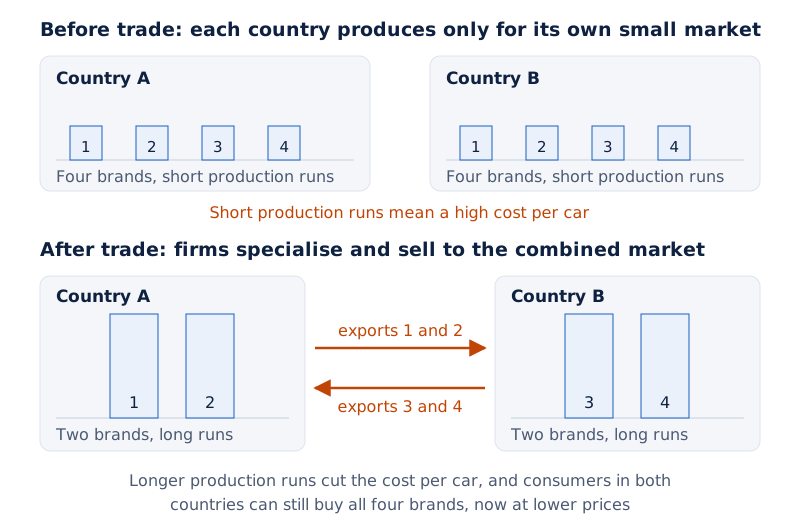
Draw two identical countries, each producing several car brands only for its own small market (many brands, small production runs, high cost per car).
Then draw them after trade opens: each country now makes fewer brands but in much larger volumes, with arrows showing both countries exporting their own brand and importing the other's.
Drawn by One Young India.
How did Krugman's ideas grow into a theory of cities and regions?
Krugman's 1979 paper ended with a short section asking what would happen if trade were blocked, for instance by very high transport costs, but workers were free to move.
He reasoned that if two regions are alike except one has a slightly bigger population, people in the bigger region enjoy a somewhat higher real wage and more product variety, because firms there can exploit economies of scale better.
This would attract migration, raising the population further, raising the real wage further, and so on, a self-reinforcing process.
Twelve years later, in 1991, Krugman developed this seed into a full theory now called the core-periphery model, generally seen as the starting point of what is known as the "new economic geography".
In this model, workers can move freely between two regions while trade in manufactured goods faces transport costs.
The key mechanism is a trade-off firms and workers both face:
- Firms want to locate where the market is largest, to exploit economies of scale and minimise transport costs: this is called the "home-market effect".
- Workers want to live where real wages and product variety are highest, which tends to be the region with more firms.
- More workers moving to a region makes it an even more attractive market for firms, and more firms moving there makes it an even more attractive place for workers.
- Depending on the balance between transport costs and economies of scale, this circular process can either concentrate almost all manufacturing and population into one urbanised "core," leaving a thin agricultural "periphery," or it can settle into a more balanced, decentralised outcome.
The press release states that Krugman's theories showed the outcome of these processes "can well be that regions become divided into a high-technology urbanized core and a less developed 'periphery'." The scientific background paper adds that falling transport costs over the twentieth century tend to push the system towards concentration and urbanisation, which the committee said could help explain real-world patterns of rapidly growing megacities surrounded by shrinking rural areas.
Diagram
Core-periphery pattern
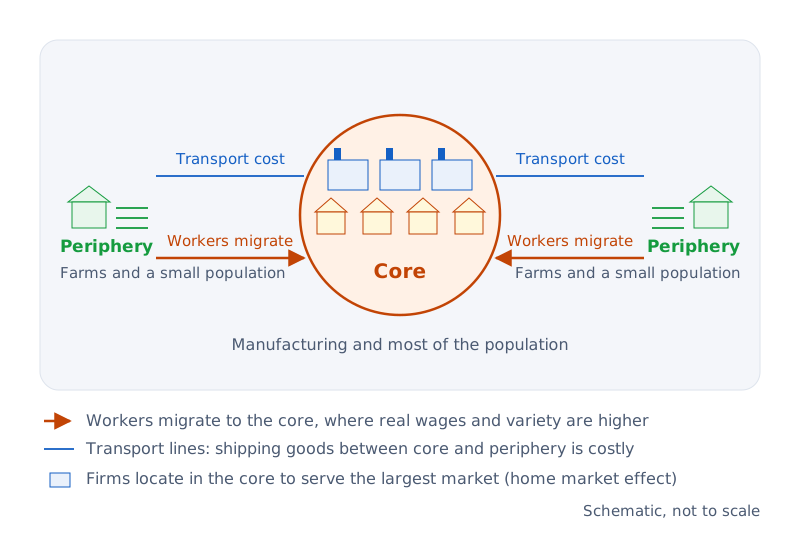
Draw a map with a dense cluster of factories and population labelled "core" in the centre, connected by transport lines to a sparse surrounding area labelled "periphery" with farms, showing arrows of migration flowing from periphery towards core.
Drawn by One Young India.
What forces decide whether cities form or activity stays spread out?
The core-periphery model is driven by a competition between two opposing forces, as the scientific background document explains.
On one side, economies of scale and the home-market effect push firms and workers to cluster together: a bigger local market lets firms produce more cheaply and lets workers enjoy more variety and higher real wages.
On the other side, transport costs and competition for the remaining market push against pure concentration: a lone firm that moves to a smaller, less crowded region can act almost like a local monopolist there, selling to nearby farmers and workers while being only lightly disciplined by costly imports from the core.
Whether the economy ends up concentrated in one core region or spread between regions depends on the balance between these forces, which in turn depends on transport costs, the strength of economies of scale and how strongly consumers value variety.
The model also shows that outcomes can change suddenly: as trade costs fall gradually, nothing visible may happen for a long time, but once costs cross a certain threshold, a small nudge can tip the system from a balanced, symmetric outcome into a lopsided concentration of activity in one region, even though nothing in the underlying conditions of the two regions was actually different to begin with.
| Idea | What it explains |
|---|---|
| Economies of scale + variety-loving consumers (1979 trade model) | Why similar countries trade similar goods (intra-industry trade), such as Sweden exporting and importing cars |
| Transport costs + home-market effect (1980 paper) | Why firms concentrate production near their largest market |
| Core-periphery model with worker migration (1991 paper) | Why population and industry concentrate into urbanised cores, leaving a less developed periphery |
How did the discovery unfold?
| Year | Event |
|---|---|
| 1953 | Paul Krugman is born in New York, NY, USA. |
| 1977 | Krugman receives his Ph.D. from MIT; in the same period Dixit and Stiglitz publish their model of consumer preference for product variety, which Krugman later uses. |
| 1979 | Krugman publishes "Increasing Returns, Monopolistic Competition, and International Trade" in the Journal of International Economics, launching the new trade theory and sketching, in its final section, the seed of a new economic geography. |
| 1980 | Krugman publishes "Scale Economies, Product Differentiation, and the Pattern of Trade," adding transport costs and the home-market effect to his model. |
| 1991 | Krugman publishes "Increasing Returns and Economic Geography," developing the core-periphery model and founding the new economic geography. |
| 2000 | Krugman becomes Professor of Economics and International Affairs at Princeton University. |
| 2008 | Krugman is awarded the Sveriges Riksbank Prize in Economic Sciences in Memory of Alfred Nobel, announced on 13 October 2008. |
Why does Krugman's work matter?
The committee's stated view was that Krugman's theory gave "an extensive reorientation of the research" on trade and geography, according to the popular information page, by showing how economies of scale shape both what is traded and where it is produced.
Practically, the new trade theory gives a framework used, as the scientific background notes, by bodies such as the World Bank when assessing the effects of trade liberalisation under World Trade Organization rounds.
The theory also reshaped how economists think about globalisation and urbanisation: it helps explain why free trade can raise welfare even between near-identical countries (through more variety and lower prices), and why an ever larger share of the world's population lives in cities.
The committee noted in the presentation speech that for the first time in history more than half the world's population lives in cities, a pattern the core-periphery model helps make sense of.
The sources also note open questions and mixed results. The scientific background document reports that empirical tests of the new trade theory have had varied success: some studies supported the theory strongly, while others, such as those by Hummels and Levinsohn, found the fit sometimes "too well" in ways that suggested other unexplained factors were also at work in real trade flows.
Evidence on the "home-market effect" for economic geography is similarly described as "mixed."
Quick facts for exams
The Sveriges Riksbank Prize in Economic Sciences in Memory of Alfred Nobel 2008 was awarded entirely to Paul Krugman of Princeton University, USA, "for his analysis of trade patterns and location of economic activity." Announced on 13 October 2008 by the Royal Swedish Academy of Sciences, the prize carried a value of 10,000,000 Swedish kronor.
Krugman, born in New York in 1953, built a 1979 trade theory based on economies of scale and consumers' preference for variety, explaining why similar countries trade similar goods.
He later extended this into the 1991 core-periphery model of economic geography, explaining urbanisation and regional concentration of industry. His work linked two previously separate fields: international trade theory and economic geography.
| Fact | Detail |
|---|---|
| Prize | Sveriges Riksbank Prize in Economic Sciences in Memory of Alfred Nobel 2008 |
| Laureate | Paul Krugman |
| Country of birth | USA (New York, NY) |
| Country of affiliation | USA (Princeton University, Princeton, NJ) |
| Share | Whole prize (1/1) |
| Citation | "for his analysis of trade patterns and location of economic activity" |
| Date announced | 13 October 2008 |
| Prize amount | 10,000,000 Swedish kronor |
Note: Source. The prize facts in this note are from the Nobel Prize's official site, nobelprize.org.
Glossary
- Economies of scale — a fall in the cost of producing each unit of a good as the total quantity produced increases.
- Comparative advantage — Ricardo's idea that a country should produce and export the goods it can make relatively more efficiently than other countries.
- Factor endowments — the quantities of labour, capital and other resources a country has available for production.
- Intra-industry trade — trade in which a country both exports and imports goods from the same industry, such as different brands of cars.
- Monopolistic competition — a market structure where many firms sell differentiated products and each has some pricing power over its own brand, despite competing with similar firms.
- Home-market effect — the tendency of firms to locate production disproportionately in the country with the largest demand for their product.
- Core-periphery model — Krugman's 1991 theory describing how economic activity may concentrate in an urbanised "core" region, leaving a less developed "periphery".
- Transport costs (iceberg costs) — costs of shipping goods between regions, modelled by Krugman as a fraction of the good lost in transit.
- Agglomeration — the clustering of firms, workers and economic activity in a particular place.
- Real wage — a worker's wage measured in terms of the goods and variety it can actually buy, not just its money value.
- New trade theory — the theory, pioneered by Krugman, explaining trade through economies of scale and product variety rather than country differences.
- New economic geography — the field, founded by Krugman's 1991 paper, analysing the location of economic activity using models of scale economies and imperfect competition.
Common errors and misconceptions
- Misconception: Krugman's theory says trade only happens between different countries. Correct: His key insight is that trade also happens, in large volumes, between similar countries trading similar goods, because of economies of scale and variety-seeking consumers.
- Misconception: The Nobel Prize in Economics is one of the original five Nobel Prizes. Correct: It is a separate prize, the Sveriges Riksbank Prize in Economic Sciences in Memory of Alfred Nobel, established later and awarded by the Royal Swedish Academy of Sciences.
- Misconception: Krugman's 1991 geography paper was his first idea on the topic. Correct: The seed of the idea already appeared in the final section of his 1979 trade paper; he developed it fully twelve years later.
- Misconception: The core-periphery model always predicts cities will form. Correct: The outcome depends on the balance of transport costs, economies of scale and consumer preferences; decentralisation can also be the equilibrium outcome.
- Misconception: Heckscher-Ohlin theory was proven wrong by Krugman. Correct: The sources describe Krugman's theory as a complement to, not a replacement for, the traditional Heckscher-Ohlin theory, with real-world trade showing features of both.
- Misconception: Krugman received only a share of the 2008 prize. Correct: He was awarded the whole prize, a full share of 1/1.
Exam-style questions with model answers
Q1. For which contribution was Paul Krugman awarded the Nobel Prize in Economics 2008? [2 marks]
- He was awarded the prize "for his analysis of trade patterns and location of economic activity," linking international trade theory with economic geography.
Q2. Name the two earlier trade theories that Krugman's work built upon or departed from. [2 marks]
- Ricardo's theory of comparative advantage (based on technology differences).
- The Heckscher-Ohlin theory (based on differences in factor endowments such as labour and capital).
Q3. Explain how economies of scale and consumer preference for variety together generate trade between identical countries. [4 marks]
- Krugman assumed goods can be produced more cheaply in long production runs (economies of scale) and that consumers value having many different brands available (preference for variety).
- If a country produced only for its own small market, no single firm could fully exploit economies of scale because demand for any one brand would be limited.
- Once trade opens, firms can specialise: one country's firm produces one brand for the whole combined market while another country's firm produces a different brand.
- This lets each firm achieve larger production runs and lower costs per unit, while consumers in both countries enjoy lower prices and greater variety than under no trade, even though the two countries are identical in technology and resources.
Q4. What is the core-periphery model and what does it explain? [4 marks]
- The core-periphery model, developed by Krugman in 1991, analyses how workers and firms locate themselves between two regions when trade in manufactured goods faces transport costs but labour can migrate freely.
- Firms want to locate near the largest market to exploit economies of scale and save transport costs, while workers want to live where real wages and product variety are highest.
- These incentives reinforce each other: as a region attracts more workers it becomes a more attractive market for firms, and as it attracts more firms it becomes more attractive to workers.
- Depending on the strength of transport costs versus economies of scale, this process can lead to most activity concentrating in an urbanised "core," leaving a less developed agricultural "periphery," or it can settle into a more balanced, decentralised pattern.
Q5. Discuss how Krugman's 1979 and 1991 contributions together unified the fields of international trade and economic geography, and assess their relevance to understanding globalisation and urbanisation today. [6 marks]
- In his 1979 paper, Krugman built a trade model around two assumptions: economies of scale in production and consumers' preference for product variety, using a framework of monopolistic competition drawn from Dixit and Stiglitz's 1977 work.
- This model showed that trade can occur even between identical countries, because specialisation lets each country's firms exploit scale economies while consumers enjoy a wider range of goods, explaining real-world intra-industry trade such as Sweden both exporting and importing cars.
- In the final section of the same 1979 paper, Krugman noted that if trade were blocked but workers could migrate, the region with a larger population would offer higher real wages and more variety, drawing further migration in a self-reinforcing way.
- He developed this seed twelve years later, in 1991, into the full core-periphery model, where transport costs and the home-market effect interact with worker migration to produce either concentrated urban cores or decentralised regions.
- The committee stated that through this work Krugman integrated "the previously disparate research fields of international trade and economic geography" using the same basic tools of scale economies and imperfect competition.
- The theory remains relevant for understanding globalisation (why similar countries trade so much with each other) and continuing urbanisation (why more than half the world's population now lives in cities), although the scientific background notes some empirical tests give mixed results, so the theory is best seen as a powerful but not fully settled explanation.
Q6. Who delivered the presentation speech for the 2008 Economics Prize, and in which city was it given? [2 marks]
- Professor Bertil Holmlund delivered the presentation speech, at the Stockholm Concert Hall on 10 December 2008.
Q7. What role did Avinash Dixit and Joseph Stiglitz's 1977 model play in Krugman's trade theory? [3 marks]
- Dixit and Stiglitz had published a model, two years before Krugman's paper, analysing consumer preferences for variety under monopolistic competition.
- In this model, each producer behaves somewhat like a monopolist for its own brand, even while facing strong competition from similar brands made by other firms.
- Krugman used this framework as the foundation for his own 1979 trade theory, applying it to explain patterns of international trade.
Key takeaways
- Paul Krugman won the entire 2008 Economics Prize for analysing trade patterns and the location of economic activity.
- His 1979 theory showed economies of scale and variety-loving consumers can generate trade even between identical countries.
- This explained real-world "intra-industry trade," such as a country exporting and importing similar goods like cars.
- Krugman's 1980 paper added transport costs, producing the "home-market effect."
- His 1991 core-periphery model showed how worker migration and firm location choices can concentrate activity into urban cores.
- The work unified two previously separate fields: international trade theory and economic geography.
- Empirical evidence for parts of the theory is mixed, according to the scientific background document.
- Krugman was based at Princeton University, New Jersey, USA, at the time of the award.
Test yourself
What was the exact wording of Krugman's Nobel citation?
The citation reads "for his analysis of trade patterns and location of economic activity."
Where and when was Paul Krugman born?
Paul Krugman was born on 28 February 1953 in New York, NY, USA.
Which university was Krugman affiliated with when he received the prize?
He was affiliated with Princeton University in Princeton, NJ, USA, at the time of the award.
What two assumptions underlie Krugman's 1979 trade model?
The model assumes economies of scale in production and that consumers value a diverse range of goods.
What is the "home-market effect"?
It is the tendency of firms to concentrate production in the country or region with the largest market for their product.
What does the core-periphery model describe?
It describes how migration of workers and location choices of firms can concentrate industry and population into an urbanised core, leaving a less developed periphery.
How much was the 2008 prize worth?
The prize amount was 10,000,000 Swedish kronor.
Give the Swedish car example used to illustrate intra-industry trade.
Sweden both exports and imports cars: Volvo and Saab cars go to Germany, while Mercedes and Volkswagen cars come in from there.