
Nobel Prize in Physiology or Medicine 2001: CDK, Cyclin and the Control of the Cell Cycle
On this page
What was the Nobel Prize in Physiology or Medicine 2001 awarded for?
The Nobel Prize in Physiology or Medicine 2001 was awarded jointly to Leland H. Hartwell, Tim Hunt and Sir Paul M. Nurse "for their discoveries of key regulators of the cell cycle".
This is the official name of the prize category; it is sometimes loosely called the Nobel Prize in Medicine, but its full and correct title is the Nobel Prize in Physiology or Medicine.
In plain words, the three scientists worked out how a living cell decides when to grow, when to copy its chromosomes and when to split into two daughter cells.
Every time a cell divides, it must pass through a fixed, ordered sequence of stages called the cell cycle.
The laureates found the actual molecules that drive the cell from one stage to the next and that stop the cycle if something has gone wrong, such as damaged DNA.
Who are the laureates?
Leland Hartwell
Leland H. Hartwell was born on 30 October 1939 in Los Angeles, California, USA. At the time of the award he was affiliated with the Fred Hutchinson Cancer Research Center in Seattle, Washington, USA.
He received one third of the prize. Working with baker's yeast, Saccharomyces cerevisiae, he identified more than a hundred genes that control the cell cycle, called CDC genes, and introduced the idea of a checkpoint, a built-in pause that lets the cell cycle halt when DNA is damaged.
Tim Hunt
Tim Hunt was born on 19 February 1943 in Neston, United Kingdom. At the time of the award he was affiliated with the Imperial Cancer Research Fund in London, United Kingdom. He received one third of the prize.
Using sea urchin eggs as his model, he discovered cyclin, a protein whose amount rises and falls in a regular rhythm during each cell cycle.
Sir Paul Nurse
Sir Paul M. Nurse was born on 25 January 1949 in Norwich, United Kingdom. At the time of the award he was also affiliated with the Imperial Cancer Research Fund in London, United Kingdom.
He received one third of the prize. Working with a different yeast species, he identified, cloned and characterised the gene cdc2, which encodes a protein now called CDK (cyclin dependent kinase), and showed that this gene's function has been conserved right across evolution, from yeast to humans.
Why does every living thing need a cell cycle?
All organisms on Earth grow from cells that multiply by dividing. An adult human body contains roughly 100,000 billion cells, all descended from a single fertilised egg cell, and about one billion cells exist per gram of tissue.
Even in a fully grown adult, huge numbers of cells keep dividing every second to replace cells that die.
Before a cell can divide, it must grow bigger, make an exact copy of its chromosomes, and then separate those chromosomes so each of the two new daughter cells gets a complete and identical set.
These linked processes are coordinated in a repeating sequence called the cell cycle. Eukaryotic cells, which keep their DNA inside a nucleus, appeared on Earth about two billion years ago, and the basic machinery that runs their cell cycle has stayed remarkably similar ever since, in yeasts, plants, animals and humans alike.
For more than a hundred years scientists knew that cells divide, but it is only in the last couple of decades before this prize that researchers worked out which molecules actually control the timing of division.
Each human cell nucleus carries the entire hereditary material, the DNA, arranged across 46 chromosomes in 23 pairs, and this complete set must be copied once, and only once, before a cell splits.
If this control fails, chromosomes can be lost, rearranged, or shared out unevenly between daughter cells, a pattern of damage often seen in cancer cells.
Understanding how the cell cycle is normally controlled was therefore seen as central to both basic biology and medicine, since the same mechanisms turned out to operate, with only small variations, across the whole of eukaryotic life.
What are the four phases of the cell cycle?
The cell cycle has distinct stages, each with a specific job. A student can remember the order as a simple sequence that always repeats.
- G1 phase: the cell grows larger and prepares the materials it will need.
- S phase: once the cell reaches a suitable size, it enters this stage, where DNA synthesis happens, meaning the hereditary material is copied so each chromosome now has a duplicate.
- G2 phase: the cell checks that the DNA copying finished correctly and prepares itself for division.
- M phase (mitosis): the duplicated chromosomes are separated and the cell physically splits into two daughter cells, each receiving an identical set of chromosomes.
After mitosis the daughter cells are back at G1, and the cycle is complete. In most mammalian cells, one full turn of this cycle takes between 10 and 30 hours.
Not every cell keeps cycling: cells in G1 can instead leave the cycle altogether and enter a resting stage called G0, where they stay without dividing.
Diagram
the cell cycle phases
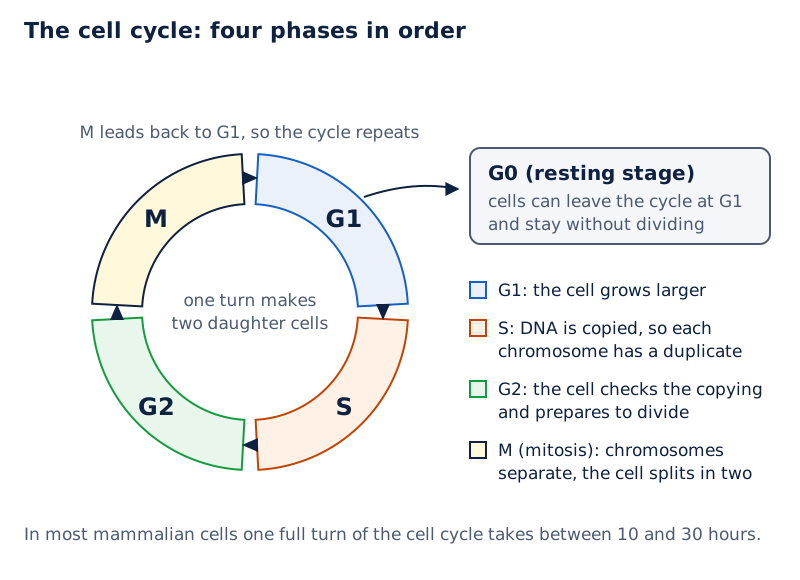
Draw a circle divided into four labelled arcs in order: G1 (growth), S (DNA copied), G2 (checks and preparation), and M (chromosomes separated, cell divides into two).
Add an arrow looping back from M to G1 to show the cycle repeats, and a side branch from G1 leading to a box labelled G0 (resting stage).
Drawn by One Young India.
How do CDK and cyclin actually control the cycle?
Paul Nurse found the gene cdc2 in the yeast Schizosaccharomyces pombe and showed it controlled the switch from G2 to mitosis.
He later discovered that this same gene was identical to the "start" gene Hartwell had already identified in a different, distantly related yeast species, where it controlled the switch from G1 to S.
This showed that one gene's product could regulate more than one transition in the cycle.
In 1987 Nurse isolated the matching human gene, later named CDK1, confirming that this control system had been conserved for over a billion years of evolution between yeast and humans.
The CDK protein works by phosphorylation, a chemical process where a phosphate group is attached to, or removed from, other proteins, switching their activity on or off. On its own, CDK is inactive.
It needs a partner protein called cyclin, discovered by Tim Hunt in sea urchin eggs, which rises and falls in amount at each turn of the cycle and is destroyed, or degraded, at specific points.
This periodic destruction of cyclin is itself an important control mechanism, and Hunt later showed that similar cyclins exist in many other species, meaning they too have been conserved through evolution.
The Nobel committee compared CDK to an engine and cyclin to a gear box: the amount of CDK stays roughly constant through the cycle, but its activity rises and falls because cyclin levels rise and fall, controlling whether the "engine" idles or drives the cell forward into the next phase.
| Component | Discovered by | Model organism used | Role in the cell cycle |
|---|---|---|---|
| CDC genes / "start" gene | Leland Hartwell | Baker's yeast (Saccharomyces cerevisiae) | Controls initiation of the cell cycle; checkpoint concept |
| cdc2 gene / CDK protein | Paul Nurse | Schizosaccharomyces pombe yeast | Drives transitions between phases via phosphorylation |
| Cyclin | Tim Hunt | Sea urchin (Arbacia) eggs | Binds and regulates CDK activity; degraded periodically |
What is a checkpoint, and why did Hartwell introduce it?
While studying how yeast cells responded to irradiation, Hartwell noticed that cells would pause the cell cycle if their DNA had been damaged.
He introduced the concept of a checkpoint: a point in the cycle where the cell "checks" that an earlier step has been completed correctly before allowing the next step to begin.
The Nobel committee's presentation speech compared this to the programme in a washing machine that confirms one step has finished properly before starting the next, which gives students a simple everyday picture of a safety check built into a repeating process.
This idea mattered because it explained how a cell avoids passing on damaged or incomplete DNA to its daughter cells.
If a checkpoint fails, a cell may divide anyway with faulty chromosomes, a pattern of error that is often seen in cancer cells, and checkpoint defects are considered one possible route by which a normal cell can start turning into a cancer cell.
Hartwell later extended the checkpoint concept beyond DNA damage, to include checks that keep the phases of the cycle happening in the correct order, not out of sequence.
Together, Hartwell's genetic screens in yeast, which isolated mutant cells that stalled at particular points in the cycle when grown at an elevated temperature, gave the field its first systematic way of identifying which genes actually mattered for cell division.
This screening approach, later copied by Nurse in a different, more distantly related yeast, also proved valuable, because it gave later researchers a general method for finding cell cycle regulators in any organism.
How did the discovery unfold?
| Year | Event |
|---|---|
| 1970-71 | Hartwell isolates yeast cells with mutated cell cycle genes and identifies more than a hundred CDC genes, including the "start" gene CDC28. |
| Mid-1970s | Nurse discovers the gene cdc2 in the yeast Schizosaccharomyces pombe and shows it controls the transition from G2 to mitosis. |
| Early 1980s | Hunt discovers cyclin in sea urchin eggs, a protein that builds up then disappears abruptly at each cell division. |
| 1987 | Nurse isolates the human version of cdc2, later named CDK1, confirming the gene's function is conserved from yeast to humans. |
| 2001 | Hartwell, Hunt and Nurse are awarded the Nobel Prize in Physiology or Medicine on 8 October. |
| 10 December 2001 | The award ceremony is held, with the presentation speech delivered by Professor Anders Zetterberg of the Nobel Committee at Karolinska Institutet. |
Why does this discovery matter?
The Nobel committee said these fundamental discoveries have "a great impact on all aspects of cell growth".
Because CDK and cyclin genes can act as oncogenes when faulty, and because they work alongside tumour suppressor proteins such as p53 and Rb, understanding the cell cycle helps explain how chromosome instability develops in cancer cells.
Raised levels of CDK molecules and cyclins have been found in human tumours, including breast cancer and brain tumours.
At the time of the award, the discoveries were about to be applied to tumour diagnostics, and clinical trials using inhibitors of CDK molecules were in progress, aimed at new principles for cancer therapy.
More broadly, because the cell cycle machinery is conserved across eukaryotic life, from yeast to humans, the findings have shaped research across cell biology, developmental biology and medicine, well beyond cancer alone.
The presentation speech also placed the discovery alongside the earlier finding of the DNA double helix, noting that where the double helix explained how a gene copies itself, the discovery of CDK and cyclin began to explain, at the molecular level, how an entire cell copies itself.
This framing helps explain why the prize committee saw the work as a major advance for cell biology as a whole, with broad applications across many fields of biology and medicine, rather than as a narrow finding limited to cancer research alone.
How does this connect to what you study?
Students who study cell biology learn about mitosis and the stages of cell division, which is exactly the process this prize explains at the molecular level: the phases named G1, S, G2 and M in a biology classroom are the same phases Hartwell, Hunt and Nurse worked out how to control.
The idea that a cell checks its own progress before moving to the next stage, the checkpoint, connects directly to classroom topics on DNA replication and cell division, since it shows how a cell avoids passing on damaged genetic material to its daughter cells.
The link between faulty cell cycle control and cancer also connects to lessons on how cancer cells divide uncontrollably compared with normal cells, because losing a working checkpoint is one way that uncontrolled division can begin.
The engine-and-gear-box picture of CDK and cyclin is also a useful model for any topic about enzymes and their regulators, since it shows a general pattern in biology: one molecule provides a constant underlying activity, while a second molecule switches that activity on and off at the right moments.
Finally, the fact that the same cdc2 gene works in yeast and in humans, despite more than a billion years of separate evolution, is a clear classroom example of how deeply conserved basic life processes can be across very different organisms.
How did each laureate's experimental method actually work?
Hartwell's method relied on growing baker's yeast at a temperature that revealed faults in mutated genes. Under the microscope, he could spot yeast cells that had stopped partway through the cell cycle because a particular gene no longer worked properly at that temperature.
By collecting many such stalled, mutated cells across 1970 and 1971, Hartwell was able to identify more than a hundred genes essential to cell division, which he named CDC genes, short for cell division cycle genes.
Nurse followed a similar genetic strategy but worked with fission yeast, Schizosaccharomyces pombe, a species only distantly related to baker's yeast that had separated from it more than a billion years earlier in evolution.
In the late 1970s and early 1980s, Nurse found that mutating the gene cdc2 in two different ways produced two opposite faults: either the cells failed to divide at all, or they divided too early, before they were ready. This showed him that cdc2 normally controls the timing of cell division.
He then moved human genes into yeast cells as a test, and in 1987 found that a human version of cdc2 worked perfectly inside yeast, proving the gene's function had stayed essentially unchanged for over a billion years of separate evolution.
Hunt took a very different approach, working with sea urchin eggs rather than yeast. Sea urchin eggs can be fertilised in large numbers and divide in a highly synchronised way, which let him track how individual proteins rose and fell in amount as the eggs moved through repeated rounds of division, which is how he spotted cyclin disappearing abruptly at each division.
- Grow cells, yeast or sea urchin eggs, under conditions that let many rounds of division be observed together.
- Look for cells that behave abnormally, either stalling at a fixed point or dividing at the wrong time.
- Trace the abnormal behaviour back to a single altered gene or a single rising-and-falling protein.
- Test whether the same gene or protein exists, and works the same way, in a very different species, to check whether the mechanism has been conserved through evolution.
Quick facts for exams
The Nobel Prize in Physiology or Medicine 2001 was awarded jointly to Leland H. Hartwell, Tim Hunt and Sir Paul M. Nurse for discovering the key molecular regulators of the cell cycle, announced on 8 October 2001.
Hartwell worked at the Fred Hutchinson Cancer Research Center in Seattle, USA, while Hunt and Nurse both worked at the Imperial Cancer Research Fund in London, United Kingdom. Each laureate received one third of the prize.
Hartwell identified CDC genes and the checkpoint concept in baker's yeast; Nurse identified the cdc2/CDK gene in fission yeast and showed it is conserved in humans; Hunt discovered cyclin in sea urchin eggs. The prize is awarded by the Nobel Assembly at Karolinska Institutet.
| Fact | Detail |
|---|---|
| Prize | Nobel Prize in Physiology or Medicine 2001 |
| Laureates | Leland H. Hartwell, Tim Hunt, Sir Paul M. Nurse |
| Countries of birth | Hartwell: USA; Hunt and Nurse: United Kingdom |
| Countries of affiliation | Hartwell: USA (Seattle); Hunt and Nurse: United Kingdom (London) |
| Shares | One third each |
| Citation | "for their discoveries of key regulators of the cell cycle" |
| Date announced | 8 October 2001 |
| Prize amount | 10,000,000 Swedish kronor |
Note: Source. The prize facts in this note are from the Nobel Prize's official site, nobelprize.org.
Glossary
- Cell cycle — the repeating sequence of stages a cell passes through from one division to the next.
- G1 phase — the stage where the cell grows before copying its DNA.
- S phase — the stage where DNA synthesis, or copying of chromosomes, takes place.
- G2 phase — the stage where the cell checks DNA copying is complete and prepares to divide.
- M phase (mitosis) — the stage where chromosomes separate and the cell splits into two daughter cells.
- G0 — a resting stage some cells enter instead of continuing the cell cycle.
- Checkpoint — a control point where the cell cycle pauses until an earlier step is confirmed complete.
- CDC gene — any of the genes Hartwell identified that control the cell division cycle in yeast.
- CDK (cyclin dependent kinase) — a protein that drives the cell cycle forward by phosphorylating other proteins.
- Cyclin — a protein that binds to CDK and regulates its activity; levels rise and fall through the cycle.
- Phosphorylation — the chemical attachment of a phosphate group to a protein, which can switch its activity on or off.
- Eukaryotic cell — a cell that keeps its DNA inside a nucleus, separated from the rest of the cell.
- Oncogene — a gene that, when altered, can contribute to cancer.
- Tumour suppressor gene — a gene, such as p53 or Rb, that normally helps prevent uncontrolled cell division.
Common errors and misconceptions
- Misconception: CDK alone controls the cell cycle. Correct: CDK must bind to cyclin to become active; the amount of CDK stays roughly constant while cyclin levels rise and fall to control its activity.
- Misconception: all three laureates studied the same organism. Correct: Hartwell used baker's yeast, Nurse used a different, distantly related fission yeast, and Hunt used sea urchin eggs.
- Misconception: the cell cycle has only one checkpoint. Correct: Hartwell's checkpoint concept covers multiple control points, including checks on DNA damage and on the correct order of phases.
- Misconception: this is called the Nobel Prize in Medicine. Correct: its official name is the Nobel Prize in Physiology or Medicine.
- Misconception: cyclin was discovered in humans first. Correct: Tim Hunt first discovered cyclin while studying sea urchin eggs, and later found it in other species.
- Misconception: every cell keeps dividing forever. Correct: cells in G1 can exit the cycle and enter the resting stage G0 instead of continuing to divide.
Exam-style questions with model answers
Q1. State the official citation for the Nobel Prize in Physiology or Medicine 2001. [2 marks]
- The Nobel Prize in Physiology or Medicine 2001 was awarded jointly to Hartwell, Hunt and Nurse "for their discoveries of key regulators of the cell cycle", recognising their work on how cell division is controlled.
Q2. Name the three laureates and their affiliations at the time of the award. [2 marks]
- Leland H. Hartwell (Fred Hutchinson Cancer Research Center, Seattle, USA), Tim Hunt and Sir Paul M. Nurse (both Imperial Cancer Research Fund, London, UK).
Q3. List the four phases of the cell cycle in order. [3 marks]
- G1, where the cell grows; S, where DNA is copied; G2, where the cell checks the copying and prepares; and M (mitosis), where chromosomes separate and the cell divides into two daughter cells, after which the cycle returns to G1.
Q4. Explain what Hartwell meant by a "checkpoint" in the cell cycle. [4 marks]
- A checkpoint is a control point where the cell cycle halts if an earlier step has not been completed correctly, such as when DNA is damaged.
- This pause gives the cell time to repair the damage before continuing to the next phase.
- Hartwell discovered this through experiments on yeast sensitivity to irradiation.
- He later extended the idea to checks that keep the cell cycle phases happening in the correct order.
Q5. Describe the roles of CDK and cyclin, and explain why both are needed. [5 marks]
- CDK, or cyclin dependent kinase, is a protein that drives the cell cycle forward by phosphorylating, meaning chemically modifying, other proteins in the cell.
- On its own, CDK is not active; it needs to bind to a partner protein called cyclin.
- Cyclin levels rise and fall periodically during each cell cycle and cyclin is degraded at specific points, which switches CDK activity on and off at the right times.
- Nurse discovered the CDK gene (cdc2) in fission yeast and later found the equivalent gene in humans, showing this system is conserved across evolution.
- Hunt discovered cyclin in sea urchin eggs and later found related cyclins in other species.
- The Nobel committee compared CDK to an engine and cyclin to a gear box, together driving the cell from one phase of the cycle to the next.
Q6. Discuss why the discoveries honoured by this prize matter for cancer research. [5 marks]
- Errors in cell cycle control can cause chromosomes to be lost, rearranged or shared out unevenly between daughter cells, a pattern commonly seen in cancer cells.
- Genes for CDK molecules and cyclins can act as oncogenes when they malfunction.
- CDK and cyclin work alongside tumour suppressor proteins such as p53 and Rb during the cell cycle, so faults in this network can disrupt normal cell growth control.
- Raised levels of CDK molecules and cyclins have been observed in human tumours, including breast cancer and brain tumours.
- At the time of the award, these findings were being applied to tumour diagnostics, and clinical trials of CDK inhibitors were already in progress, aiming at new approaches to cancer therapy.
Key takeaways
- The 2001 prize went jointly to Hartwell, Hunt and Nurse for discovering key regulators of the cell cycle.
- The cell cycle has four phases: G1 (growth), S (DNA copied), G2 (checks), and M (division).
- Hartwell found CDC genes in baker's yeast and introduced the checkpoint concept.
- Nurse discovered the cdc2/CDK gene in fission yeast and showed it is conserved in humans.
- Hunt discovered cyclin in sea urchin eggs, a protein that rises and falls with each division.
- CDK acts like an engine; cyclin acts like a gear box controlling when the engine drives the cell forward.
- Faulty cell cycle control is linked to the chromosome errors seen in cancer cells.
- At the time of the award, the findings were being applied to cancer diagnostics and to trials of CDK-inhibiting drugs.
Test yourself
What organism did Leland Hartwell use to study the cell cycle?
Leland Hartwell used baker's yeast, Saccharomyces cerevisiae, to identify genes controlling the cell cycle.
What did Tim Hunt discover, and in which model organism?
Tim Hunt discovered cyclin, a periodically produced and destroyed protein, while studying sea urchin eggs.
What gene did Paul Nurse identify, and what did it later become known as in humans?
Paul Nurse identified the gene cdc2 in fission yeast; its human equivalent was later named CDK1.
What is a checkpoint in the cell cycle?
A checkpoint is a control point where the cycle pauses until an earlier step, such as DNA repair, is properly completed.
In which phase of the cell cycle is DNA copied?
DNA is copied during the S phase, when the cell duplicates its chromosomes before dividing.
How is CDK activity controlled if its own amount stays constant?
CDK activity is controlled by cyclin, whose levels rise and fall through the cycle, switching CDK on and off.
Where was Sir Paul Nurse affiliated at the time of the award?
Sir Paul M. Nurse was affiliated with the Imperial Cancer Research Fund in London, United Kingdom.
Why does faulty cell cycle control matter for cancer?
Faulty control can cause chromosomes to be lost or unevenly shared between daughter cells, a pattern often seen in cancer cells.