
Open Economy Macroeconomics | CBSE Class 12 Economics Notes
On this page
Watch & explore
Start with a few high-quality watches, then dive into the notes below.
This note covers open-economy links, the balance of payments, current and capital accounts, foreign exchange demand and supply, exchange-rate systems, and the effect of trade on equilibrium income.
What makes an economy open?
An open economy interacts with other countries. Its residents can trade goods and services and, often, financial assets. The links run through the output market, financial market and labour market. The labour link lets firms choose where to produce and workers choose where to work, although immigration laws restrict movement between countries.
In the output market, buyers and producers can choose between domestic and foreign goods. In the financial market, investors can choose between domestic and foreign assets. These links matter for the demand for goods made at home, the flow of money across borders and the value of one currency against another.
When residents buy imports, that spending is a leakage from the circular flow of domestic income. It reduces demand for domestically produced goods. When foreign residents buy exports, their spending is an injection into that flow. It adds to demand for domestic output.
Cross-border purchases also require a way to pay. A buyer may need the seller's currency, so the buyer must know how much domestic currency to exchange for it. That price is the foreign exchange rate. Together, foreign trade and currency exchange connect a country's output market with the rest of the world.
Definition: An open economy trades goods and services with other nations and often also trades financial assets with them.
How does the balance of payments organise international transactions?
The balance of payments, or BoP, records transactions in goods, services and assets between a country's residents and the rest of the world over a specified period, typically a year. The two-account classification uses a current account and a capital account.
The current account records trade in goods and services together with transfers. The capital account records international transactions in assets under this presentation. A transaction bringing foreign exchange into the country is a credit; a transaction sending it out is a debit. Thus, exporting goods is a credit in the trade balance, while importing goods is a debit. Buying an asset abroad is a capital-account debit, while selling a domestic asset to a foreign resident is a capital-account credit.
| Question | Current account | Capital account |
|---|---|---|
| What does it record? | Goods, services and transfers | International asset transactions |
| What is an inflow? | Exports or incoming transfers | Foreign purchase of domestic assets or borrowing from abroad |
| What is an outflow? | Imports or outgoing transfers | Domestic purchase of foreign assets or repayment of foreign loans |
| When is it in balance? | Receipts equal payments on current account | Capital inflows equal capital outflows |
This two-account layout is useful for following how a current-account gap is financed. A more recent classification separates a financial account from the capital account and places most trading in financial assets there. The Reserve Bank of India also continues to publish the older layout used here.
Note: Check which account classification a question uses before placing a transaction in the capital or financial account.
What enters the current account?
The current account contains three broad groups: trade in goods, trade in services and transfer payments. Goods trade covers physical exports and imports. Services trade includes factor income and non-factor services. A transfer payment is received without providing a good or service in return; gifts, remittances and grants are examples.
Factor income includes international earnings from factors of production such as labour, land and capital. Non-factor income comes from service products such as shipping, banking, tourism and software services. The figure separates these two branches under trade in services and shows transfers as a separate branch.
What the figure shows
Components of current account
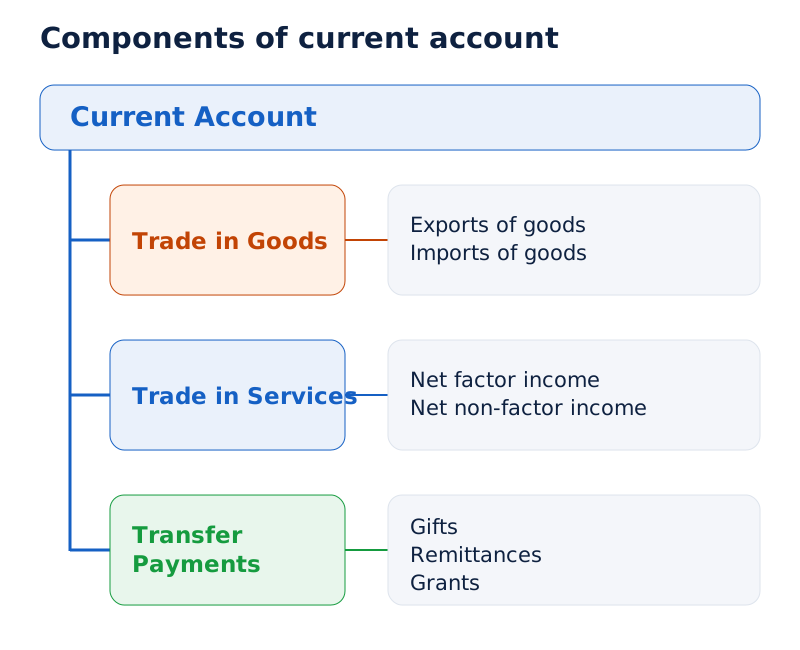
A top box labelled Current Account branches to Trade in Goods, Trade in Services and Transfer Payments. Goods branch to exports and imports; services branch to net factor and net non-factor income; transfers list gifts, remittances and grants.
Drawn by One Young India. See Fig. 6.1 in your NCERT textbook
Imports are payments to the rest of the world and meet part of domestic demand through foreign output. They are subtracted from total spending when calculating demand for domestically produced goods and services. Exports bring income from the rest of the world and add to demand for domestic output. Imports and exports therefore enter demand for domestic output with opposite signs.
A balanced current account has equal receipts and payments. A current-account surplus has receipts above payments; a deficit has receipts below payments. A surplus corresponds to lending to other countries and a deficit to borrowing from them. The balance can be analysed through the balance of trade and the balance on invisibles.
How do trade balance and invisibles determine the current-account balance?
The balance of trade, also called trade balance or BOT, compares exports and imports of goods over a period. It covers goods, rather than every current-account transaction. A trade surplus means goods exports exceed goods imports. A trade deficit means goods imports exceed goods exports. Equal values give a balanced trade account.
Net invisibles compare receipts and payments for services, transfers and income flows across countries. Because these flows are not goods trade, a country can have a goods-trade deficit while its current-account deficit is smaller. The current-account balance combines the two parts.
BOT = exports of goods − imports of goods.
Current-account balance = BOT + net invisibles.
Worked example 1. In a sample balance of payments, exports of goods are 150 million US dollars, imports of goods are 240 million US dollars and net invisibles are 52 million US dollars. Find BOT and the current-account balance.
Answer: BOT = 150 − 240 = −90 million US dollars, a trade deficit. Current-account balance = −90 + 52 = −38 million US dollars, a current-account deficit. Positive invisibles partly offset the goods deficit but do not remove it.
For a transaction, first ask whether it concerns goods, an invisible service or income flow, or a transfer. Then decide whether money comes in or goes out. This prevents the common mistake of calling every foreign receipt an export of goods. A remittance received without a good or service in return belongs with transfers, while a tourism service belongs with services.
What does the capital account record in the two-account classification?
An asset is a form in which wealth can be held, such as money, shares, bonds or government debt. In the two-account classification, the capital account records international transactions involving assets. When an Indian resident buys an asset abroad, foreign exchange flows out and the purchase is a debit. When a foreign resident buys a domestic asset, foreign exchange flows in and the sale is a credit.
Capital-account items include investments, external borrowings and external assistance. Investments are divided into direct investment and portfolio investment. The borrowing branch includes external commercial borrowing and short-term debt. These are different ways in which funds can cross the border.
What the figure shows
Components of capital account
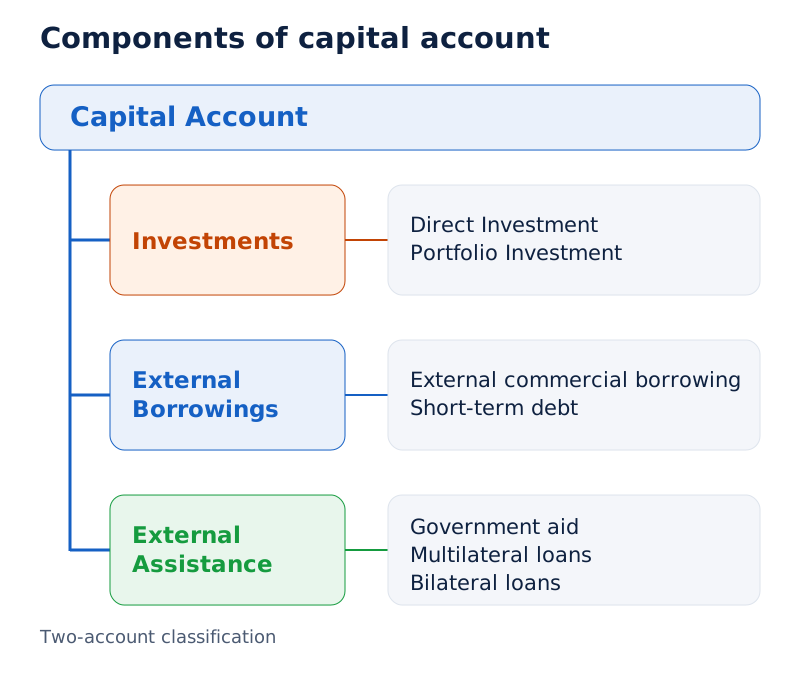
A Capital Account box branches to Investments, External Borrowings and External Assistance. Investments divide into Direct Investment and Portfolio Investment; the other branches show borrowing and assistance examples.
Drawn by One Young India. See Fig. 6.2 in your NCERT textbook
The capital-account balance compares inflows with outflows. It is balanced when they are equal. It has a surplus when inflows exceed outflows and a deficit when inflows are smaller. Borrowing abroad can therefore create an inflow even though the borrower must later repay the loan.
Do not classify by the nationality of the buyer alone. Identify the asset and the direction of the foreign exchange flow. An Indian purchase of an overseas company and a foreign purchase of shares in an Indian company affect opposite sides of the account. Also remember that a question using the newer three-account classification will put most transactions in financial assets under the financial account.
How are a balance-of-payments deficit and official reserves related?
A country with a current-account deficit spends more on current-account payments than it receives. It must finance the gap through a net capital inflow, such as borrowing or selling assets abroad, or through a use of foreign exchange reserves. In the simple case without reserve movements, a current-account deficit is matched by a capital-account surplus of equal size.
Current-account balance + capital-account balance = 0 in that no-reserve-movement case.
The official reserves are foreign exchange held by the monetary authority. When a deficit needs financing, the reserve bank may sell foreign exchange. A fall in reserves accompanies an overall BoP deficit; a rise accompanies a surplus. Such transactions are especially relevant when an exchange rate is fixed, because the monetary authority may need to buy or sell currency to maintain the announced rate.
What makes a transaction autonomous or accommodating?
Autonomous transactions occur for reasons independent of a BoP gap, such as earning profit. They are called above-the-line items. If autonomous receipts exceed autonomous payments, the BoP is in surplus; if they are smaller, it is in deficit. Accommodating transactions arise because a gap has to be bridged. Official reserve transactions are accommodating items.
Errors and omissions acknowledge that not every international transaction can be recorded accurately. This is another entry in the accounting presentation, alongside the current and capital balances. It should not be mistaken for a normal source of trade receipts or an economic policy that finances a deficit.
Note: A current-account deficit and an overall BoP deficit are different statements. Check autonomous flows and reserve movements before deciding whether the overall balance is in deficit.
Why are foreign currencies demanded and supplied?
The foreign exchange market is the market in which national currencies are traded for one another. Its participants include commercial banks, foreign exchange brokers, authorised dealers and monetary authorities. Trading centres remain in close contact, making the market worldwide rather than confined to one place.
The foreign exchange rate is the price of one currency in terms of another. If one US dollar costs Rs 50, the rupee-dollar rate is Rs 50 per dollar. This quotation tells an Indian buyer how many rupees are needed for a dollar payment.
What creates demand for foreign exchange?
Residents demand foreign currency to buy goods and services from other countries, send gifts abroad or purchase foreign financial assets. If foreign currency becomes more expensive in rupees, imported goods cost more in rupees. Other things remaining constant, import demand and the demand for foreign exchange fall.
What creates its supply?
Foreign currency enters when foreigners buy domestic goods and services, send gifts or transfers, or buy domestic assets. A higher rupee price of foreign currency makes Indian products cheaper in that foreign currency, other things remaining constant. Exports and foreign exchange supply may rise; the actual response depends on factors including the elasticity of export and import demand.
Keep the currency quotation clear throughout an answer. A rise in a rate written as rupees per dollar means a dollar costs more rupees. It is not a rise in the rupee's value.
How is a flexible exchange rate determined?
A flexible exchange rate, or floating rate, is determined by the market forces of foreign exchange demand and supply. Their intersection gives the equilibrium exchange rate and the quantity traded. Under a completely flexible system, the central bank does not intervene in this market to set the rate.
What the figure shows
Flexible exchange equilibrium
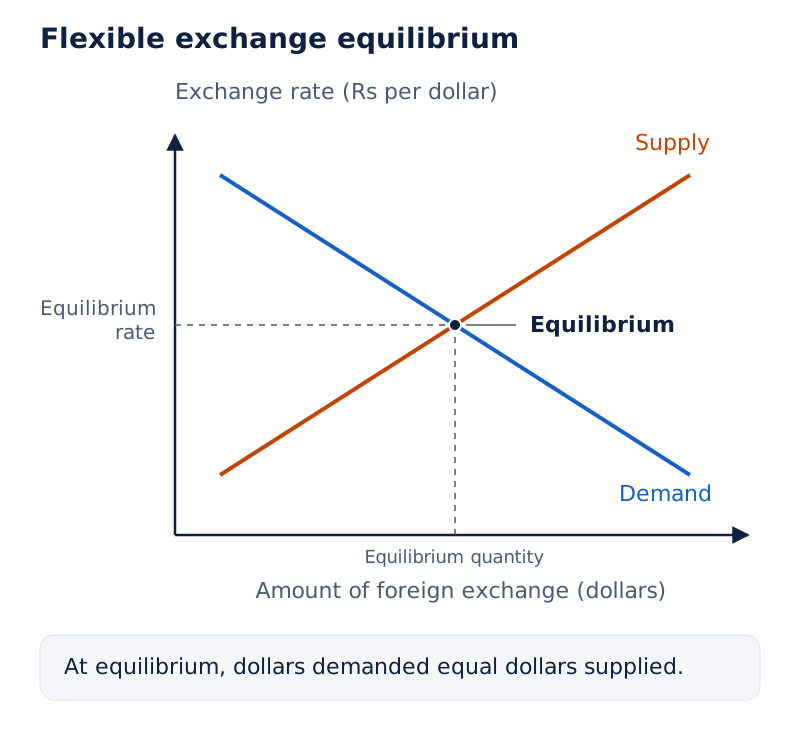
The vertical axis measures Rs per dollar and the horizontal axis measures the amount of foreign exchange. A downward demand curve and upward supply curve meet at the equilibrium rate.
Drawn by One Young India. See Fig. 6.1 in your NCERT textbook
If demand for foreign goods and services increases, residents demand more foreign currency. The demand curve shifts to the right. At the new intersection, more rupees are required for a dollar. The domestic currency has depreciated against the dollar. A movement in the opposite direction, in which fewer rupees buy a dollar, is an appreciation of the rupee.
What the figure shows
Higher demand for foreign exchange
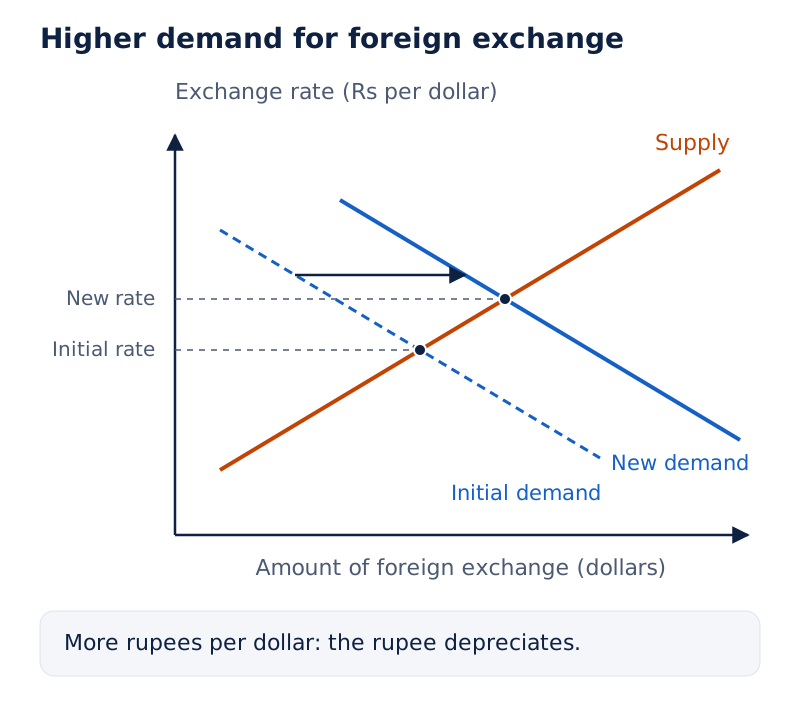
The upward supply curve remains in place while a second downward demand curve is drawn to the right of the first. Its new intersection with supply is at a higher Rs-per-dollar rate.
Drawn by One Young India. See Fig. 6.2 in your NCERT textbook
Worked example 2. In a flexible exchange-rate system, the rate rises from Rs 50 per dollar to Rs 70 per dollar after demand for foreign goods rises. What happened to the rupee?
Answer: A dollar initially cost Rs 50 and now costs Rs 70. The rupee therefore buys fewer dollars than before and has depreciated against the dollar. The dollar has appreciated in rupee terms. This is a market-driven change under a flexible rate, not a government-announced devaluation.
The direction of the rate depends on its quotation. With rupees per dollar on the vertical axis, a higher point means a dearer dollar and a cheaper rupee. Label both currencies in a diagram or calculation to avoid reversing the conclusion.
What else can move the exchange rate?
How can expectations affect it?
Currency is an asset, so expectations about its future value can change present demand. If people expect the pound to appreciate against the rupee, they may want to hold pounds now. This extra demand can itself raise the present rupee-pound exchange rate.
Worked example 3. The initial exchange rate is Rs 80 per pound. An investor expects Rs 85 per pound and purchases 1,000 pounds. Calculate the outlay and the expected rupee proceeds.
Answer: The outlay is Rs 80,000. At the expected rate, 1,000 pounds would bring Rs 85,000, giving an expected gain of Rs 5,000. Demand for pounds may rise now because of this expectation. The gain is an expectation in the example, rather than a guaranteed return.
What roles do interest rates and income play?
An interest-rate differential can draw funds towards the country with the higher return, provided comparable assets can be bought across borders. Suppose equally safe bonds pay 8 per cent in one country and 10 per cent in another. Investors seeking the higher return demand the second country's currency. A rise in domestic interest rates can therefore lead to domestic-currency appreciation.
Higher domestic income tends to raise spending, including on imports. That shifts foreign exchange demand to the right and tends to depreciate the domestic currency. Higher income abroad may raise domestic exports and foreign exchange supply. If both incomes rise, the final exchange-rate movement depends on how exports and imports change relative to each other.
What does purchasing power parity suggest?
Purchasing power parity, or PPP, is used for long-run predictions. With no trade barriers such as tariffs and quotas, exchange rates tend to adjust so that a product's price is comparable across countries, apart from transport differences. Over time, rates reflect differences in price levels.
Worked example 4. A shirt costs $8 in the United States and Rs 400 in India. Find the price-equivalent rupee-dollar rate. Then recalculate it when the shirt prices change to $12 in the United States and Rs 480 in India.
Answer: Initially, Rs 400 ÷ $8 = Rs 50 per dollar. With the changed prices, Rs 480 ÷ $12 = Rs 40 per dollar. The price-equivalent dollar value falls from Rs 50 to Rs 40, so the dollar depreciates in this comparison.
How is a fixed exchange rate maintained?
Under a fixed exchange rate, the government sets the rate at a particular level. If that level differs from the market equilibrium, demand and supply of foreign currency will not match. The central bank then needs to intervene to keep the announced rate in place.
When the government sets a higher rupee-per-dollar rate than the market rate, the rupee is cheaper to foreigners. At that rate, the supply of dollars exceeds demand. The Reserve Bank of India buys the excess dollars with rupees and accumulates foreign exchange. When the fixed rate is below the market rate, demand for dollars exceeds supply. The authority must sell dollars from its holdings to meet the excess demand.
What the figure shows
Foreign exchange under a fixed rate
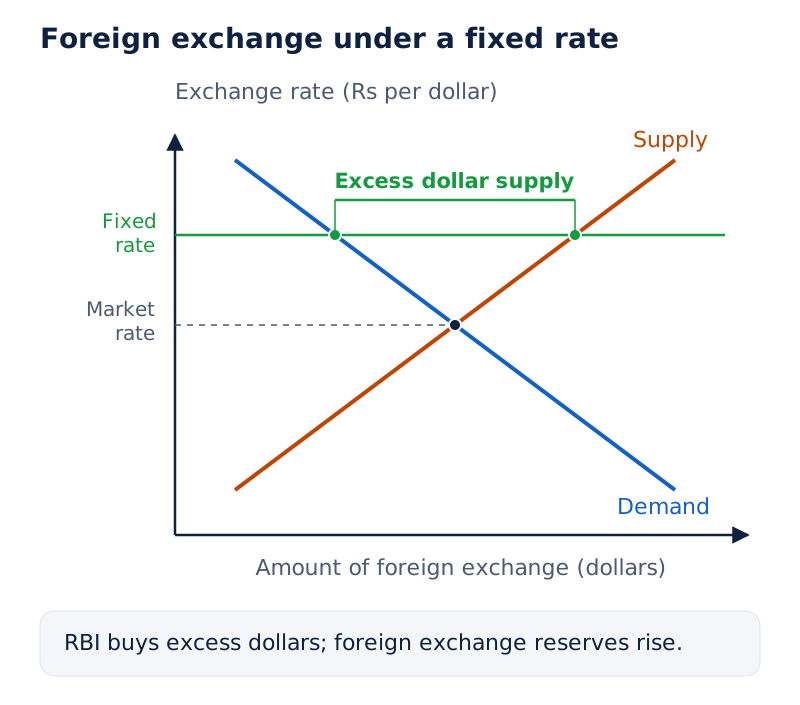
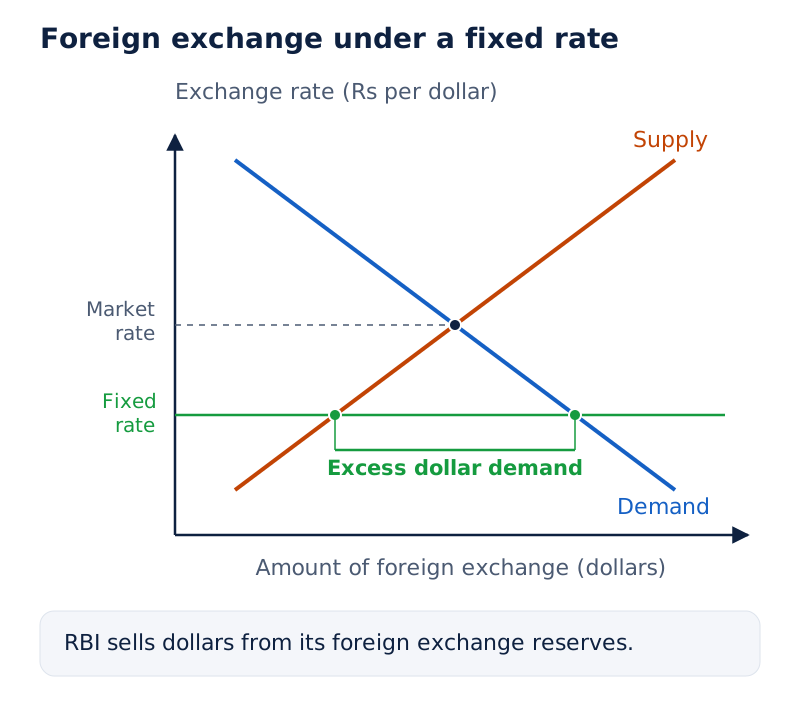
Demand slopes down and supply slopes up, meeting at the market rate. A line above that rate meets supply farther right than demand, showing excess dollar supply; a line below shows excess demand.
Drawn by One Young India. See Fig. 6.3 in your NCERT textbook
Suppose the government raises the official rate from Rs 50 to Rs 70 per dollar to make the rupee cheaper to foreigners. In a fixed system, a government action that raises the quoted rupees per dollar is devaluation. Government action that lowers that rate is revaluation. These terms describe policy changes to a fixed rate. Depreciation and appreciation describe changes in the currency's value under a flexible rate.
The ability to maintain a fixed rate depends on credibility. A persistent excess demand for dollars uses up official reserves. If people doubt that the authority can keep the rate, their buying of foreign currency may intensify and contribute to a speculative attack.
How do fixed, flexible and managed floating systems compare?
A fixed system offers an announced rate, but maintaining it can require reserve purchases or sales. The government must be credible in its ability to hold the rate. A BoP deficit may require use of official reserves, and doubts about their adequacy can encourage speculation against the currency.
A flexible system lets demand and supply change the exchange rate. Its main advantage is that exchange-rate movements automatically respond to BoP surpluses and deficits. Governments have more room to conduct monetary policy because they do not have to intervene to defend a fixed rate, and they need not maintain the same large stocks of foreign exchange reserves for that purpose.
| Feature | Fixed rate | Flexible rate | Managed float |
|---|---|---|---|
| How the rate is set | Government specifies a level | Market demand and supply meet | Market rate with possible intervention |
| Central-bank role | Buys or sells currency to maintain the level | No intervention in a completely flexible system | May buy or sell to moderate movements |
| Reserve transactions | Can be needed to defend the rate | Not needed to maintain a fixed level | Not necessarily zero |
| Rate-change terms | Devaluation or revaluation by government action | Depreciation or appreciation through the market | Market movements with central-bank management |
Managed floating mixes features of the two systems. Currencies float, while central banks buy or sell foreign exchange when they consider it appropriate to moderate movements. It is also called dirty floating. Because intervention can occur, official reserve transactions need not be zero.
How does trade change the determination of equilibrium income?
In a closed economy, the income identity includes consumption, investment and government spending. In an open economy, foreign buyers add demand through exports. Imports are part of domestic spending that falls on foreign output, so they must be subtracted when finding demand for domestic output.
Y = C + I + G + X − M, where Y is domestic income, C is consumption expenditure, I is domestic investment expenditure, G is government spending, X is exports and M is imports.
NX = X − M, so Y = C + I + G + NX.
Here net exports, NX, are positive when exports exceed imports and negative when imports exceed exports. Domestic demand for goods and demand for domestic goods are therefore different: some domestic spending buys imports, while some demand for domestic goods comes from foreign buyers.
What changes imports and exports?
Higher domestic income raises imports. A higher real exchange rate, defined here as the relative price of foreign goods in domestic goods, makes imports more expensive and tends to reduce them. Higher foreign income raises demand for exports. A higher real exchange rate makes domestic goods cheaper relative to foreign goods and tends to raise exports.
In a simple income model, price levels and the nominal exchange rate are held constant, exports are exogenous, and imports have an autonomous part plus a part that rises with domestic income.
M = M̄ + mY, where M is imports, M̄ is autonomous imports, Y is domestic income and m is the marginal propensity to import, with 0 < m < 1.
The coefficient marginal propensity to import, m, is the fraction of an extra rupee of income spent on imports. The import term removes part of each increase in spending from demand for domestic goods.
Why is the open-economy multiplier smaller?
With marginal propensity to consume c and marginal propensity to import m, the open-economy multiplier = 1 ÷ (1 − c + m). The comparable closed-economy multiplier is closed-economy multiplier = 1 ÷ (1 − c). Since m is positive, the open-economy denominator is larger and its multiplier is smaller.
Worked example 5. Suppose the marginal propensity to consume is c = 0.8 and the marginal propensity to import is m = 0.3. Compare the open and closed multipliers and the effects of an autonomous spending rise of 100.
Answer: Closed multiplier = 1 ÷ (1 − 0.8) = 5, so output rises by 500. Open multiplier = 1 ÷ (1 − 0.8 + 0.3) = 2, so output rises by 200. Imports are a leakage in each round of spending, making the domestic income response smaller.
In this model, a rise in autonomous exports adds to demand for domestic output, while a rise in autonomous imports reduces it. The conclusion follows from the distinction between spending by domestic residents and spending on domestically produced goods.
Glossary
- Open economy — An economy linked to other countries through trade in goods and services and often through financial assets.
- Balance of payments — A record of transactions in goods, services and assets between residents and the rest of the world over a period.
- Current account — The part of the BoP recording trade in goods and services together with transfer payments.
- Balance of trade — The difference between a country's goods exports and goods imports during a given period.
- Net invisibles — The difference between receipts and payments for services, transfers and international income flows.
- Capital account — In the two-account classification, the record of international asset transactions.
- Autonomous transaction — An international transaction undertaken independently of the need to close a BoP gap.
- Accommodating transaction — A transaction determined by a BoP gap and used to bridge its effects.
- Foreign exchange rate — The price of one national currency expressed in terms of another national currency.
- Depreciation — A fall in a currency's value against another currency under a flexible exchange-rate system.
- Devaluation — A government action that makes domestic currency cheaper under a fixed exchange-rate system.
- Managed floating — A system in which currencies float while central banks may intervene to moderate exchange-rate movements.
- Marginal propensity to import — The fraction of an additional rupee of income spent on imports.
Common errors and misconceptions
- Misconception: The trade balance includes every current-account receipt. Correct: It compares goods exports with goods imports; the current account also includes invisibles.
- Misconception: A current-account deficit is the same as an overall BoP deficit. Correct: Capital inflows can finance a current-account gap; the overall position also relates to reserve movements.
- Misconception: A rise from Rs 50 to Rs 70 per dollar means the rupee appreciated. Correct: A dollar now costs more rupees, so the rupee depreciated in a flexible market.
- Misconception: Depreciation and devaluation are interchangeable. Correct: Depreciation is a flexible-rate market movement; devaluation is government action under a fixed rate.
- Misconception: The central bank never intervenes when a currency floats. Correct: It may intervene under managed floating to moderate movements.
- Misconception: A remittance is an export of goods. Correct: A remittance received without a good or service in return is a transfer payment.
- Misconception: Imports add to demand for domestically produced output. Correct: Imports meet part of domestic demand through foreign output and are subtracted in the open-economy income identity.
Exam-style questions with model answers
Q1. Define the foreign exchange rate and interpret Rs 50 per dollar. [2 marks]
- The foreign exchange rate is the price of one currency in terms of another currency.
- Rs 50 per dollar means that one US dollar costs Rs 50. The quotation gives the rupee amount needed to obtain a dollar for a foreign-currency payment.
Q2. Distinguish the balance of trade from the current-account balance. [3 marks]
- The balance of trade compares the value of exports and imports of goods. It is in surplus when goods exports exceed goods imports and in deficit when imports exceed exports.
- The current account also contains services, transfers and income flows, grouped as invisibles. Its balance combines the trade balance with net invisibles.
- Consequently, a goods-trade deficit need not have the same size as a current-account deficit. Positive net invisibles can partly offset a negative goods balance.
Q3. Explain three reasons for demand and three sources of supply of foreign exchange. [4 marks]
- Foreign exchange is demanded when residents buy goods or services from abroad, send gifts abroad or buy foreign financial assets. These transactions require payment to foreigners.
- Foreign exchange is supplied when foreigners buy domestic goods and services, send gifts or transfers to residents, or purchase domestic assets.
- If foreign currency becomes dearer in rupees, imported goods cost more in rupees, so import-related demand tends to fall, other things remaining constant.
- The same rise makes domestic goods cheaper to foreign buyers in their currency, so exports and foreign exchange supply may increase. The actual response depends on factors including demand elasticity.
Q4. Explain how a fixed rupee-dollar rate above market equilibrium is maintained. [4 marks]
- At a fixed rupee-per-dollar rate above the market equilibrium, the rupee is cheaper to foreign buyers. At that rate, the supply of dollars exceeds demand for dollars.
- The Reserve Bank of India buys the excess dollars with rupees. Its purchase absorbs the excess supply and helps keep the announced rate in place.
- Foreign exchange reserves rise while the intervention continues. If the fixed rate were below market equilibrium instead, there would be excess dollar demand and the authority would need to sell dollars from its holdings.
Q5. Explain autonomous and accommodating BoP transactions, including the role of reserves. [5 marks]
- Autonomous transactions occur for reasons independent of the BoP gap, such as profit. They are above-the-line items. A surplus exists when autonomous receipts exceed autonomous payments; a deficit exists when they fall short.
- Accommodating transactions are determined by the gap left by autonomous transactions. They are below-the-line items because their purpose is to bridge that gap.
- Official reserve transactions are accommodating. The reserve bank can sell foreign exchange to finance a deficit or buy it when foreign exchange is in excess. Reserves therefore fall with an overall deficit and rise with a surplus.
- A current-account deficit may instead be financed by a capital-account surplus through borrowing or asset sales. The two deficits should not be treated as identical.
Q6. Compare fixed, flexible and managed floating exchange-rate systems. [6 marks]
- A fixed exchange rate is set by the government. The monetary authority may need to buy or sell foreign currency when the fixed rate differs from market equilibrium. Maintaining it requires credibility and can use official reserves.
- A flexible rate is determined by foreign exchange demand and supply. A completely flexible system has no central-bank intervention to maintain a particular rate. Exchange-rate movements respond to BoP surpluses and deficits, and policy makers have more monetary-policy independence.
- Managed floating combines market determination with central-bank intervention. The bank may buy or sell foreign currencies to moderate movements when it considers that appropriate, so official reserve transactions need not be zero.
- A government-led fall in domestic currency's value at a fixed rate is devaluation; a comparable market movement at a flexible rate is depreciation.
Q7. Use the shirt prices of Rs 400 and $8 to calculate the price-equivalent exchange rate, then recalculate it at Rs 480 and $12. [3 marks]
- Initially, divide the Indian price by the US price: Rs 400 ÷ $8 = Rs 50 per dollar. At that quotation the two shirt prices are equivalent.
- With the changed prices, Rs 480 ÷ $12 = Rs 40 per dollar. The price-equivalent dollar value falls from Rs 50 to Rs 40.
- In this purchasing-power-parity comparison the dollar has depreciated. The result uses the product prices and is a long-run comparison, with transport differences and trade barriers relevant to the theory.
Q8. Derive the open-economy income identity and explain why its multiplier is smaller. [6 marks]
- In a closed economy, domestic demand comes from consumption, investment and government spending. In an open economy, exports add demand from abroad, while imports are domestic spending on foreign goods.
- Thus Y = C + I + G + X − M. With NX = X − M, the same identity is Y = C + I + G + NX.
- Imports are modelled as M = M̄ + mY, where M̄ is autonomous imports. The positive coefficient m is the fraction of extra income spent on imports.
- With marginal propensity to consume c, the open-economy multiplier is 1 ÷ (1 − c + m), compared with 1 ÷ (1 − c) in the closed model. Positive m makes the denominator larger. Each spending round leaks partly into imported goods, reducing the increase in domestic output.
Key takeaways
- Imports are a leakage from demand for domestic output, while exports inject foreign demand into the domestic circular flow of income.
- The two-account BoP classification separates current-account transactions in goods, services and transfers from capital-account transactions in assets.
- Goods-trade balance equals goods exports minus goods imports; adding net invisibles gives the current-account balance.
- A current-account deficit needs financing through net capital inflow or use of foreign exchange reserves.
- A higher rupee-per-dollar rate means the dollar costs more rupees; under a flexible rate this is rupee depreciation.
- A fixed rate can require central-bank currency purchases or sales, while a completely flexible rate is set by market demand and supply.
- Managed floating allows central-bank intervention to moderate market movements, so official reserve transactions can occur.
- Imports reduce the open-economy multiplier because part of each extra round of spending falls on foreign rather than domestic output.
Test yourself
Which three markets can link an open economy with other countries?
The output market, financial market and labour market can create international links. The output and financial markets link countries through trade in goods and services and through transactions in financial assets.
What is the difference between a transfer and a sale of services?
A transfer is received without giving a good or service in return, such as a gift or remittance. A service sale provides a service in exchange for payment.
If goods exports are below goods imports, what is the trade-balance position?
It is a trade deficit because the value of goods imported exceeds the value of goods exported. Net invisibles are considered separately when finding the current-account balance.
What makes an official reserve transaction accommodating?
It responds to a balance-of-payments gap. The monetary authority buys or sells foreign exchange to bridge the gap left by autonomous transactions.
What happens to the rupee when the rate rises from Rs 50 to Rs 70 per dollar in a flexible market?
The rupee depreciates against the dollar. More rupees are required to purchase one dollar, so each rupee buys less dollar currency than before.
At a fixed rate with excess dollar demand, what must the monetary authority do?
It must sell dollars from its foreign exchange holdings to meet the excess demand if it wants to maintain the fixed rate.
Why can foreign income affect a country's exchange rate?
Higher income abroad can raise demand for the country's exports. That can increase the supply of foreign exchange in its market and affect the equilibrium rate.
What does m represent in M = M̄ + mY?
It is the marginal propensity to import, the fraction of an extra rupee of domestic income spent on imports.