
Human Capital Formation in India | CBSE Class 12 Economics Notes
On this page
Try an idea before you read. Test your understanding of human capital formation concepts. Explore →
This note covers human capital and its sources, physical capital, economic growth, human development, government intervention, education expenditure, educational attainment, gender equity, educated unemployment and India’s movement towards a knowledge economy.
What is human capital, and why does education matter?
Definition: Human capital is the acquired productive ability embodied in people through education, health, training and other investments that can increase their future income.
Human capital formation develops people’s knowledge, skills and productive capacity. Just as investment can turn physical resources such as land into factories, investment in people can develop the capabilities needed by doctors, engineers, nurses, farmers and teachers.
How do human resources become human capital?
People possess the capacity to acquire, store and transmit knowledge. Education and training develop this capacity into useful abilities. An educated and trained workforce can perform tasks more efficiently, generate income and contribute to the development of the economy.
Producing more human capital also requires existing human capital. Competent teachers, professors and other trained professionals educate and train others. Investment therefore develops both the people receiving education and the capacity to educate further generations.
The process involves more than increasing the number of people. Its central concern is improving their capabilities. The availability of human resources becomes economically valuable when people receive opportunities to acquire education, maintain health and develop relevant skills.
What benefits go beyond earnings?
Education can improve social standing, self-respect and the ability to make choices. It helps people understand social changes and scientific developments. These benefits matter alongside the prospect of higher earnings from more productive employment.
Education also encourages inventions and innovations. An educated workforce can understand and adapt to new technologies. Thus, its value includes both the creation of new knowledge and the ability to use knowledge that already exists.
Alfred Marshall’s argument for educational expenditure emphasised benefits beyond immediate returns. Expanding educational opportunities can help people develop abilities that would otherwise remain unused. Both public and private expenditure can contribute to this process.
Cartoon: Education and farm productivity (Figure 4.1). The caption reads, “Adequate education and training to farmers can raise productivity in farms”. Two farmers stand beside unequal piles of produce, with a tractor behind the farmer on the left. The farmer on the right wonders, “with equal size of land how is it that his yield is more than mine?” The cartoon links education and training with higher farm productivity.
How do education, health and training create human capital?
The five sources of human capital formation are education, health, on-the-job training, migration and information. Education and health are especially important. Their benefits can extend over time, making expenditure on them an investment in future productive capacity.
Why is educational expenditure an investment?
Individuals spend on education partly because they expect higher future incomes. This resembles a firm’s purchase of capital goods in anticipation of future profits. Expenditure occurs before the full stream of benefits is received.
The investment interpretation does not remove education’s social and personal benefits. It explains why spending on learning can be treated as an addition to productive capacity instead of being understood solely as immediate consumption.
How does health support productivity?
A sick worker without medical facilities may have to stay away from work. This reduces labour supply and productivity. Health expenditure supports a healthier workforce and helps workers supply labour more continuously.
| Form of health expenditure | Illustration or purpose |
|---|---|
| Preventive medicine | Vaccination to prevent illness |
| Curative medicine | Medical intervention during illness |
| Social medicine | Spreading health literacy |
| Clean drinking water | Provision of safe water as part of health improvement |
| Good sanitation | Improvement of sanitary conditions that support health |
Why do firms pay for training?
On-the-job training may take place within a firm under a skilled worker’s supervision. Alternatively, workers may be sent for off-campus training. Both arrangements involve expenditure by the firm.
The firm expects enhanced productivity to generate returns exceeding the training cost. It may therefore require trained workers to remain for a specified period so that it can recover the benefits of its expenditure.
- A firm identifies the need to improve workers’ skills.
- It incurs expenditure on supervised or off-campus training.
- Workers acquire abilities that increase their productivity.
- The firm benefits from the higher productivity while trained workers continue working for it.
Training illustrates why human capital formation continues beyond formal schooling. Abilities can be improved while people are employed, and further learning helps them respond to changes in production methods and technology.
Why are migration and information sources of human capital?
What are the costs and benefits of migration?
Migration can help people obtain jobs with higher earnings than those available at their original location. Unemployment encourages rural-to-urban migration in India. Technically qualified people, including engineers and doctors, may move abroad because of higher salaries.
Such movement involves expenditure and personal costs. Transport must be paid for, living expenses may rise, and migrants may experience difficulty adjusting to an unfamiliar social and cultural setting. These adjustment difficulties are called psychic costs.
Migration is treated as an investment when the increase in earnings at the destination outweighs these costs. The economic argument concerns the relationship between expenditure and expected benefits; it does not imply that changing location is costless.
| Cost involved | Meaning in migration |
|---|---|
| Transport cost | Expenditure on moving to the new location |
| Higher living cost | Additional expenditure required to live at the destination |
| Psychic cost | Difficulty of living in an unfamiliar socio-cultural environment |
Why spend on information?
People need information about labour, education and health markets. They may investigate salaries for different jobs, whether an institution teaches employable skills, and how much its courses cost. This helps them choose where to invest.
Information also assists the effective use of human capital already acquired. Knowing which jobs reward particular skills helps people decide how to use their training. Information expenditure therefore supports both formation and utilisation of human capital.
The distinction is useful: acquiring a skill and finding a suitable opportunity to use it are related but different decisions. Expenditure that improves either decision can contribute to the productive use of people’s capabilities.
Education, health, training, migration and information thus work together. Learning develops abilities, health supports their use, training improves performance, migration opens employment opportunities, and information helps people evaluate the available choices.
How does human capital differ from physical capital?
Physical capital includes tangible productive assets such as machines and buses. Human capital consists of abilities embodied in people. Both result from investment decisions, but their formation, ownership, mobility and benefits differ in important ways.
Who makes the investment decision?
An entrepreneur can compare expected returns from alternative physical investments before choosing one. Physical capital formation is mainly an economic and technical process. Human capital formation is also shaped by families, educators, peers and society.
Much investment in children’s education and health occurs before they can judge its effect on future earnings. Later education depends on capabilities developed during schooling. Human capital formation is therefore partly a social process and partly an individual decision.
| Basis | Physical capital | Human capital |
|---|---|---|
| Form | Tangible assets used in production | Intangible abilities embodied in a person |
| Separation from owner | Can be used without the owner being present | Cannot be separated from its possessor |
| Sale | The asset itself can be sold | The person supplies services of acquired abilities |
| International mobility | Can move between countries, subject to trade restrictions | Movement is restricted by nationality and culture |
| Depreciation | Use causes wear; technological change can make machinery obsolete | Ageing reduces capacity, but continued education and health investment can limit the decline |
| Benefits | Private benefits flow through goods and services purchased | Benefits accrue to the individual and also to society |
What does the bus example explain?
A bus owner need not be present whenever the bus is used. The driver, however, must be present to supply driving services. This illustrates separability: the bus can be separated from its owner, but driving ability cannot be separated from the driver.
External benefits reach people beyond the individual making the investment. An educated person can participate effectively in democratic processes. A healthy person maintaining hygiene and sanitation can help prevent the spread of contagious disease.
Continued learning also helps people adjust to new technology. Human capital can therefore be maintained and improved through further investment, even though ageing causes depreciation. The relationship between investment and depreciation differs from that of an existing machine.
How does human capital influence economic growth?
Definition: Economic growth is an increase in a country’s real national income. Human capital contributes by improving productive abilities, health, innovation and the capacity to use new technology.
What are the main channels?
- Labour productivity: education and training improve the skills used to produce goods and services.
- Healthier labour supply: better health supports a longer and more continuous working contribution.
- Innovation: education helps people understand scientific advances and develop new ideas.
- Technological adaptation: an educated workforce can absorb and use unfamiliar production methods.
The Seventh Five Year Plan recognised human resource development as a central element of development strategy. A large population, when educated and trained, can become an asset supporting economic growth and desired social change.
Why is causation difficult to establish?
Education measured by years of schooling, enrolment or teacher-pupil ratios may not reveal its quality. Similarly, money spent on health, mortality rates and life expectancy may not fully represent people’s actual health status.
These measurement problems make empirical proof difficult. Improvements in education and health can accompany rising income without establishing that one variable alone caused the other. Different indicators capture only parts of a complex relationship.
Human capital indicators in developing countries have moved closer to those of developed countries, but there is no sign of convergence in real per capita income. Faster growth in human capital in developing countries has not been accompanied by equally fast growth in real income per person.
Two-way causation is possible. Better human capital can raise income; higher income can also support greater investment in education and health. Growth in these areas can reinforce each other rather than following a single direction.
The following historical figures show simultaneous changes. Real per capita income means real income per person. The final column covers 2018 to 2022; it should not be read as a set of observations all belonging to one year.
| Indicator | 1951 | 1981 | 1991 | 2001 | 2018 to 2022 |
|---|---|---|---|---|---|
| Real per capita income, rupees | 7,651 | 12,174 | 15,748 | 23,095 | 94,054 |
| Crude death rate per 1,000 population | 25.1 | 12.5 | 9.8 | 8.1 | 6.0 |
| Infant mortality rate | 146 | 110 | 80 | 63 | 28 |
| Male life expectancy at birth, years | 37.2 | 54.1 | 59.7 | 63.9 | 68.6 |
| Female life expectancy at birth, years | 36.2 | 54.7 | 60.9 | 66.9 | 71.4 |
| Literacy rate, per cent | 16.67 | 43.57 | 52.21 | 65.20 | 78 |
Note: Improving education and health indicators alongside income supports discussion of their relationship. It does not by itself prove that human capital alone determines economic growth.
How is human development broader than human capital?
Human development places people’s well-being at the centre of development. Education and health matter because they enable individuals to lead valued lives and make meaningful choices. Their value is not conditional on raising production.
What is the difference in purpose?
The human capital approach considers education and health as means of increasing labour productivity. Its emphasis is the productive contribution of human beings. The human development approach treats people as ends in themselves.
Someone’s ability to read, write and live a long, healthy life is valuable even when it does not lead to higher output. This is why human development is broader than the economic return on investment in people.
| Question | Human capital approach | Human development approach |
|---|---|---|
| Why support education and health? | They increase productive capacity | They are integral to well-being |
| How are people viewed? | As a means of increasing productivity | As ends in themselves |
| Must investment raise output to matter? | Productivity is central to its investment logic | Basic education and health remain valuable without higher output |
| What is the wider principle? | Improved income-generating ability | Every person’s right to literacy and a healthy life |
Why does the distinction matter?
Policies judged only by output may overlook benefits that people value directly. Basic education and basic health care enlarge human choices, even where their immediate effect on labour productivity is uncertain.
The two approaches overlap because education and health can improve both productivity and well-being. Their difference concerns the reason for valuing those improvements. Human development does not require people to prove an economic return before their welfare matters.
Remember the distinction through the question being asked. Human capital asks how improved capabilities contribute to production. Human development asks whether people can lead healthier, more informed lives and exercise choices they value.
Why must government intervene in education and health?
Education and health generate private and social benefits. India consequently has both public and private providers. Government intervention is needed to support access, maintain standards and protect people who cannot judge service quality or afford essential services.
What problems require regulation?
Investment in schooling or medical care has long-term consequences that cannot easily be reversed. If a child receives poor services, damage may occur before the family discovers the problem and moves to another institution.
Consumers also lack complete information about quality and costs. This can give providers monopoly power and opportunities for exploitation. Government must ensure that private providers meet stipulated standards and charge appropriate prices.
- Families make decisions about services with substantial long-term effects.
- They may not possess complete information about quality and cost.
- Poor provision can cause damage before the decision is reversed.
- Government regulation therefore protects users through standards and oversight of charges.
Why is public provision necessary?
Many people cannot afford basic education or health care. Access to higher education and specialised treatment is even more difficult for substantial sections of the population. Affordability therefore affects the development of people’s capabilities.
When basic education and health are recognised as rights, the government must provide free services for deserving citizens and socially oppressed groups. Public spending helps extend opportunities beyond those able to pay private providers.
Which levels and organisations are involved?
The Union, state and local governments all incur expenditure on education and health. Local bodies include Municipal Corporations, Municipalities and Village Panchayats. Their involvement reflects the distribution of responsibilities in India’s federal system.
| Sector | Ministries and organisations facilitating institutions |
|---|---|
| Education | Union and state education ministries and departments; National Council of Educational Research and Training (NCERT); University Grants Commission (UGC); All India Council of Technical Education (AICTE) |
| Health | Union and state health ministries and departments; National Medical Commission; Indian Council for Medical Research (ICMR) |
Government’s role therefore includes both providing services and regulating their provision. These functions address different problems: inability to pay requires wider access, while incomplete information and poor quality require effective supervision.
How is education expenditure measured and distributed in India?
What do the two expenditure measures show?
Government education spending is expressed as a share of total government expenditure and as a share of Gross Domestic Product (GDP). The measures have different denominators and answer different questions.
The first indicates education’s priority within government spending. The second indicates how much of the economy’s income is committed through government expenditure to education. A percentage must therefore be read together with the total to which it relates.
| Measure | 1952 | 2020 | Interpretation |
|---|---|---|---|
| Education expenditure as a percentage of total government expenditure | 7.92 | 16.54 | Education’s place in government spending priorities |
| Education expenditure as a percentage of GDP | 0.64 | 4.47 | Income committed to education through public expenditure |
The rise during 1952 to 2020 was not uniform. There were irregular increases and decreases. Spending by individuals and philanthropic institutions would add to public expenditure, so total educational expenditure is larger than the government component alone.
Why distinguish total expenditure from spending per student?
Elementary education receives a major share of total education expenditure, while higher or tertiary education receives the smallest share. Yet average expenditure per student is higher in tertiary education than in elementary education.
These observations are compatible because total spending and spending per student measure different things. The smaller aggregate share of higher education does not establish that each higher education student receives less expenditure.
Nor does it justify simply transferring funds away from higher education. Expanding schooling requires more teachers, who are trained in higher educational institutions. Expenditure needs to increase at all educational levels.
How do states differ?
The symbol ₹ denotes Indian rupees. In 2020-21, per capita public expenditure on elementary education was ₹96,968 in Sikkim and ₹10,710 in Bihar. Such regional differences contribute to unequal educational opportunities and attainments across states.
These figures concern a particular spending measure and year. They should not be confused with the national GDP share or with expenditure per student in tertiary education. Keeping the unit, population basis and period clear prevents misleading comparisons.
Which policies and spending commitments support education?
Education for all requires adequate funding as well as access to institutions. Policy commitments identify desired provision, while actual expenditure indicates the resources made available. A target should not be mistaken for an achieved outcome.
What were the major commitments?
| Date or period | Commitment or measure | Purpose |
|---|---|---|
| 1950 constitutional framework | Directive Principles envisaged free and compulsory education up to age 14 within ten years of the Constitution’s commencement | Universal access to basic schooling |
| 1964 to 1966 | Education Commission recommended spending at least 6 per cent of GDP on education | A noticeable improvement in educational achievements |
| 1999 | Tapas Majumdar Committee estimated expenditure of around ₹1.37 lakh crore for the period 1998-99 to 2006-07 | Bringing all children aged 6 to 14 within school education |
| 2009 | Right of Children to Free and Compulsory Education Act | Free education as a fundamental right for children aged 6 to 14 |
| 2020 | National Education Policy | Preparing skills and multidisciplinary capabilities for a changing knowledge landscape |
The 6 per cent recommendation provides a benchmark for discussing inadequate expenditure. The 2020 government education expenditure figure of 4.47 per cent of GDP remained below that benchmark. Accepting the goal in principle does not mean the spending level has been reached.
How have additional resources been directed?
A 2 per cent education cess on Union taxes was introduced with revenue earmarked for elementary education. This is a historical funding measure. Government support has also included substantial outlays for higher education and loan schemes for students pursuing further study.
Basic education and higher education serve connected purposes. Making schooling widely available increases the need for trained teachers, while higher institutions develop advanced knowledge and professional skills. Financing one level should be considered alongside the needs of the others.
What the figure shows
Educational infrastructure
A drawing shows a multi-storey educational building with surrounding trees. It illustrates the physical infrastructure needed alongside investment in teaching and learning.
See Fig. 4.5 in your NCERT textbook
Funding commitments must translate into accessible, effective services. A school building, opportunities to learn and adequately trained teachers form connected parts of educational provision. Spending totals alone cannot reveal the quality of education received.
What do educational attainment and gender differences reveal?
Educational attainment is commonly assessed through adult literacy, primary education completion and youth literacy. These indicators refer to different populations and stages of learning, so they should be compared carefully.
Adult literacy concerns people aged 15 and above. Youth literacy concerns those aged 15 to 24. Primary completion is measured for the relevant age group. All entries in the following table are percentages.
| Indicator and group | 1990 | 2000 | 2011 | 2017-18 |
|---|---|---|---|---|
| Adult literacy: male | 61.9 | 68.4 | 79 | 82 |
| Adult literacy: female | 37.9 | 45.4 | 59 | 66 |
| Primary completion: male | 78 | 85 | 92 | 93 |
| Primary completion: female | 61 | 69 | 94 | 96 |
| Youth literacy: male | 76.6 | 79.7 | 90 | 93 |
| Youth literacy: female | 54.2 | 64.8 | 82 | 90 |
What has improved, and what remains incomplete?
Adult and youth literacy rose for both sexes, and the gap between male and female literacy narrowed. However, improvement is different from universal literacy. The presence of continuing illiteracy means that education for all remains unfinished.
Female primary completion exceeded male primary completion in 2011 and 2017-18 in these figures. This does not imply that women led in every educational indicator: adult and youth literacy remained lower among females in those columns.
Why promote women’s education?
Women’s education supports economic independence and social status. It also has favourable effects on fertility and on the health care of women and children. The case for it combines economic, social and health considerations.
Increasing literacy is therefore a positive development, but it does not justify complacency. Educational access and quality must continue improving, particularly for groups whose opportunities remain restricted.
Diagram
Adult literacy comparison
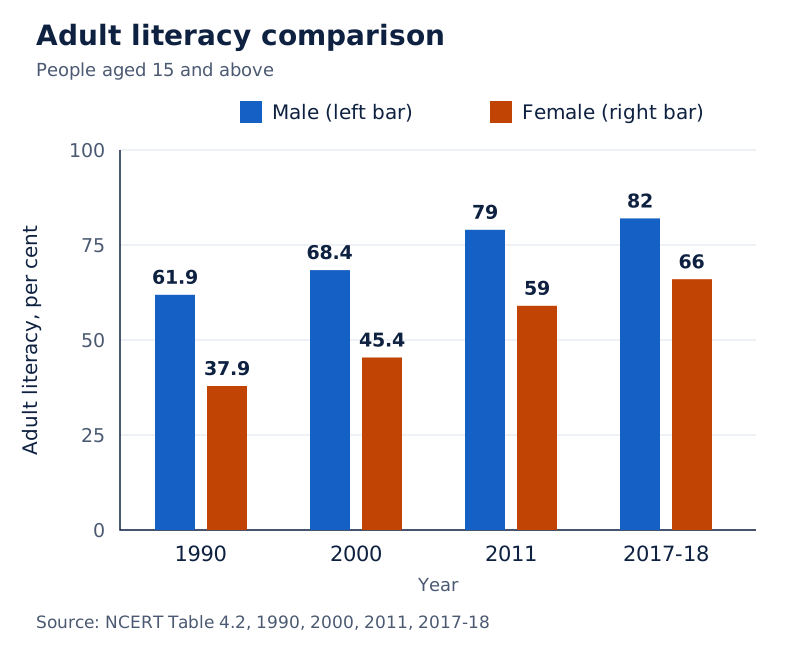
Draw paired bars for males and females in 1990, 2000, 2011 and 2017-18. Label the vertical axis “Adult literacy, per cent” and use the adult literacy rows above. Include a key distinguishing the two groups.
Drawn by One Young India.
Diagram
Primary completion comparison
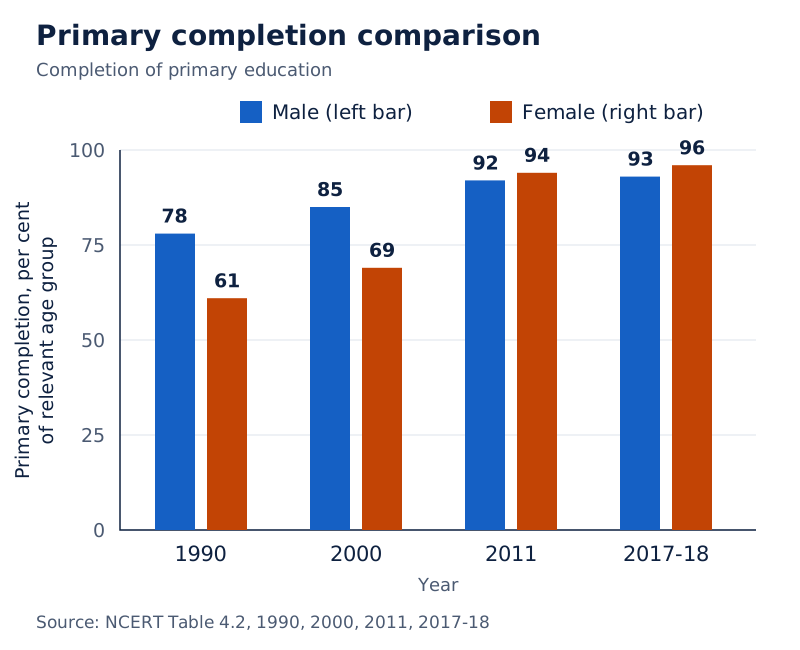
Draw paired bars using the male and female primary completion rows above. Label the vertical axis “Primary completion, per cent of relevant age group”. The bars show female completion overtaking male completion in the later two observations.
Drawn by One Young India.
What challenges shape India’s future human capital formation?
Why is educated unemployment a concern?
India’s education pyramid is steep: fewer people reach higher levels. Yet obtaining more education does not guarantee employment. Educated unemployment shows why the quality and employability of acquired skills matter alongside access to qualifications.
National Sample Survey Organisation (NSSO) figures for 2011-12 showed unemployment of 19 per cent among rural young men educated to graduation and above, compared with 16 per cent among their urban counterparts. Nearly 30 per cent of young rural female graduates were unemployed.
In contrast, only about 3 to 6 per cent of primary-educated youth in rural and urban areas were unemployed. These historical comparisons show the employment difficulty faced by educated youth; they do not mean that basic schooling provides the same capabilities as higher education.
The Periodic Labour Force Survey 2023-24 indicated moderate improvement. Nevertheless, higher education requires greater allocation and better institutional standards so that students acquire employable skills. India also needs conditions that enable its scientific and technical capabilities to be used within the country.
What does a knowledge economy require?
A knowledge economy draws on people’s knowledge and technical abilities. India’s software industry, villagers’ use of email and proposals for electronic governance illustrate the discussion of information technology’s role. Its value depends greatly on the existing level of economic development.
The National Education Policy 2020 anticipates changing skill requirements as big data, machine learning and artificial intelligence develop. Machines may take over many unskilled jobs, while demand grows for mathematics, computer science and data science combined with broader learning.
Climate change, pollution and resource depletion also create a need for skills spanning biology, chemistry, physics, agriculture, climate science and social science. Epidemics and pandemics strengthen the need for collaborative research, vaccine development and understanding associated social issues.
Multidisciplinary learning therefore connects technical capabilities with social sciences, humanities and the arts. The policy’s discussion is a vision of changing needs, not a guarantee that every learner will automatically find employment.
How are growth and equity connected?
Education and health services need to reach different sections of society. Unequal access can leave productive abilities undeveloped, while broad access supports both well-being and economic participation. Improving quality is as important as expanding provision.
The central challenge is to develop capabilities, make opportunities widely available and create conditions for effective use of skills. Human capital formation and human development can then support economic growth and equity together.
Glossary
- Human capital — Acquired productive abilities embodied in people through education, health, training and other investments.
- Human capital formation — The process of developing people’s productive capabilities through investment in learning, health and related activities.
- Physical capital — Tangible productive assets, such as machines and buses, that can be separated from their owners.
- Human development — Improvement in people’s well-being and valued choices, with education and health important in themselves.
- Economic growth — An increase in a country’s real national income over time.
- On-the-job training — Firm-supported skill development through supervised work within the firm or through off-campus training.
- Psychic costs — Personal difficulties experienced when adapting to an unfamiliar social and cultural environment after migration.
- External benefits — Benefits of an individual’s education or health that also extend to other members of society.
- Depreciation — Reduction in capital’s capacity over time, associated with machinery’s use or with human ageing.
- Adult literacy rate — Literacy expressed as a percentage of the population aged fifteen years and above.
- Youth literacy rate — Literacy expressed as a percentage of young people aged fifteen to twenty-four years.
- Education cess — A levy on taxes used to raise revenue earmarked for educational expenditure.
Common errors and misconceptions
- Misconception: Human capital formation means increasing population. Correct: It means developing people’s acquired productive abilities through education, health, training and related investments.
- Misconception: Education is the only source of human capital. Correct: Health, on-the-job training, migration and information are also sources.
- Misconception: Human capital can be sold separately from its owner. Correct: People supply its services; their embodied abilities are inseparable from them.
- Misconception: Human development values education only when earnings rise. Correct: It values literacy, health and meaningful choices as elements of well-being in themselves.
- Misconception: Education and income rising together proves one-way causation. Correct: Causation can operate both ways, and imperfect measurement complicates empirical proof.
- Misconception: Tertiary education’s smaller total spending share means lower expenditure per student. Correct: Its expenditure per student is higher than that of elementary education.
- Misconception: The 6 per cent education expenditure recommendation is an achieved spending figure. Correct: It is a benchmark; government spending was 4.47 per cent of GDP in 2020.
- Misconception: Higher literacy removes the need to promote women’s education. Correct: Remaining gaps, economic independence, social status and health benefits make continued promotion necessary.
Exam-style questions with model answers
Q1. Name the two major sources of human capital and explain how each improves productive capacity. [2 marks]
- Education develops knowledge and skills, increasing the ability to perform productive work.
- Health enables people to work more continuously and reduces productivity losses caused by illness and absence.
Q2. Explain three costs of migration and state why migration expenditure can be an investment in human capital. [3 marks]
- Transport expenditure is incurred when a person moves from the original location to the destination.
- Living costs may be higher at the destination, increasing the expenditure needed to maintain daily life.
- Psychic costs arise from adjustment to an unfamiliar social and cultural environment.
- Migration expenditure is an investment when enhanced earnings at the new location outweigh these costs. It helps people use their abilities where employment offers better returns.
Q3. Distinguish human capital from human development in three respects. [3 marks]
- The human capital approach values education and health as means of increasing labour productivity. Human development values them as integral parts of human well-being.
- Human capital treats people as a means to greater production. Human development treats people as ends in themselves.
- Human development supports basic education and health even without higher output, because literacy, healthy life and valued choices matter directly. It is therefore broader than the productive-capacity approach.
Q4. In 2020-21, per capita public expenditure on elementary education was ₹96,968 in Sikkim and ₹10,710 in Bihar. Using these figures, explain regional differences in educational opportunities. Do the figures alone establish the quality of education? [4 marks]
- Sikkim had substantially higher per capita public expenditure on elementary education than Bihar in the stated year.
- Such differences in educational expenditure contribute to unequal opportunities and educational attainments across states.
- Lower per capita spending can constrain the resources available for expanding elementary education, while higher spending can support wider provision of educational facilities.
- The figures alone do not establish teaching or learning quality. Expenditure and other broad indicators do not fully capture the capabilities that education develops.
Q5. Explain five reasons for government intervention in education and health. [5 marks]
- Education and health create social benefits as well as benefits for the individual. Government support helps extend these benefits across society.
- Decisions have substantial long-term consequences. Poor services may damage a child’s education or health before the family can change institutions.
- Consumers do not possess complete information about quality and costs. This can allow providers to acquire monopoly power and exploit users.
- Government regulation is needed to ensure that private institutions meet prescribed standards and charge appropriate prices for their services.
- Many people cannot afford basic services. Public provision, including free services for deserving and socially oppressed groups, supports access when education and health are recognised as rights.
Q6. Explain four ways human capital contributes to economic growth. Why should this relationship not be described as proven one-way causation? [6 marks]
- Education and training improve workers’ skills, raising their ability to produce goods and services and earn income.
- Better health enables more continuous labour supply and reduces losses of work caused by sickness.
- Education stimulates innovation by helping people understand social changes, scientific knowledge and new possibilities.
- An educated workforce can absorb and adapt to new technologies, improving the use of productive methods.
- Measurement is imperfect: schooling, enrolment, spending and health indicators do not fully represent educational quality or health status. Their association with income cannot alone prove causation.
- Causation may operate in both directions. Improved human capital can raise income, while higher income makes greater investment in education and health possible. These processes may reinforce each other.
Q7. Adult literacy rates were 61.9 per cent for males and 37.9 per cent for females in 1990; in 2017-18 they were 82 and 66 per cent respectively. Interpret the changes without calculating a growth rate, and explain why women’s education still needs promotion. [4 marks]
- Literacy increased for both groups: male literacy rose from 61.9 to 82 per cent and female literacy from 37.9 to 66 per cent.
- The male-female gap narrowed, indicating progress towards gender equity, but female literacy remained lower and neither group reached universal literacy.
- Women’s education needs continued promotion because it supports economic independence and social status.
- It also has favourable effects on fertility and on the health care of women and children. Progress therefore strengthens, rather than removes, the case for further investment.
Q8. A bus owner can be absent while the bus is used, but its driver must be present. What distinction between physical and human capital does this illustrate? [2 marks]
- The bus is physical capital and is separable from its owner.
- Driving ability is human capital embodied in the driver. It cannot be separated from that person, who must be present to provide the service.
Key takeaways
- Human capital formation develops acquired productive abilities through education, health, on-the-job training, migration and information.
- Education can raise earnings while also improving choices, social understanding, innovation and adaptation to technology.
- Human capital is inseparable from its possessor and can generate benefits for society beyond the individual.
- Human capital and income can reinforce each other; simultaneous improvements do not establish one-way causation.
- Human development values education and health directly as elements of well-being, even without increased output.
- Government intervention addresses unequal access, incomplete information, long-term consequences and the need for quality standards.
- Education expenditure must be interpreted using its denominator, period and level, distinguishing totals from spending per student.
- Improved literacy, gender equity, educational quality and employable skills remain connected priorities for India’s development.
Test yourself
What are the five sources of human capital formation?
They are investment in education, health, on-the-job training, migration and information.
How is preventive medicine different from curative medicine?
Preventive medicine includes vaccination to prevent illness; curative medicine involves medical intervention when illness occurs.
Why might firms require trained employees to remain for a specified period?
They want time to recover training expenditure through the benefits of the workers’ enhanced productivity.
Why is higher education necessary for expanding school education?
More schools require more trained teachers, whose preparation takes place in higher educational institutions.
What does education spending as a share of total government expenditure indicate?
It indicates the importance assigned to education within the government’s overall spending priorities.
Which age group is covered by the 2009 Right of Children to Free and Compulsory Education Act?
It covers children aged six to fourteen, making free education a fundamental right for this group.
Why can rising income itself contribute to human capital formation?
Higher income makes greater investment in education and health possible, helping build further productive capabilities.
What does human development value even without a productivity gain?
It values basic education, health and the ability to make meaningful choices as parts of human well-being.
Try it
Human Capital Formation In India
Test your understanding of human capital formation concepts.
1A company sells its physical capital (machines, equipment) to another firm. However, a doctor cannot sell their medical knowledge to another person. What does this illustrate about the difference between physical and human capital?
This is not what the text illustrates. The text specifically discusses that physical capital is tangible and can be sold like any commodity, while human capital is intangible and built into the body and mind of its owner—it cannot be sold, only its services can be sold.
Correct. The text explicitly states: 'Physical capital is separable from its owner, whereas human capital is inseparable from its owner.' This is why physical capital can be sold but human capital cannot.
This is not supported by the text. The text focuses on separability and market tradability as key differences, not on training requirements.
2Why are children themselves unable to make optimal decisions about their own human capital investment, according to the text?
The text does not make any claim about children's intelligence. The reason given is specifically about their developmental stage and ability to assess future earnings potential.
Correct. The text states: 'A substantial part of human capital formation... takes place in one's life when he or she is unable to decide whether it would maximise future earnings.' Parents and society make these decisions for children.
This is not the reason given in the text. The text specifically mentions that children cannot assess whether education would maximize future earnings—a forward-looking economic calculation that young children are not capable of making.