
Money and Banking | CBSE Class 12 Economics Notes
On this page
Watch & explore
Start with a few high-quality watches, then dive into the notes below.
This note covers money and barter, the functions and demand for money, currency and deposits, money supply measures, commercial banks, credit creation, the money multiplier, central banking, monetary policy tools, bonds, the liquidity trap, digital payments and demonetisation.
Why does money make exchange easier than barter?
Definition: Money is a commonly accepted medium of exchange, meaning something people accept in payment for goods and services.
Barter exchange means exchanging commodities, or goods, without money. It requires a double coincidence of wants: each party must want what the other offers. Finding this match can involve considerable searching, especially when an economy contains many people exchanging different goods.
How does the rice and clothing example work?
A person with surplus rice wants clothing. Direct exchange requires another person who has surplus clothing and wants rice. The rice owner may not find such a person. Search costs may become prohibitive as the number of individuals increases.
Money separates the sale from the purchase. The rice owner can sell rice for money, then use the money to buy clothing. Both parties accept the intermediate good, so the original seller need not find a clothing seller who specifically wants rice.
When does money have a role?
Money becomes important when economic agents, meaning people or institutions participating in economic activity, exchange through markets. An economy consisting of one individual has no exchange between individuals. Money has no role in that situation.
Even a family on an isolated island has no use for money if its members do not participate in market transactions.
How does money measure value and store wealth?
Besides facilitating exchange, money serves as a unit of account: a common unit in which goods and services are valued. A wristwatch priced at Rs 500 can be exchanged for 500 monetary units, with the rupee as the unit.
How are relative prices calculated?
A relative price expresses the value of one commodity in terms of another. Prices expressed in the same monetary unit make this comparison possible without directly exchanging the goods.
Worked example 1. A pencil costs Rs 2 and a pen costs Rs 10. Find the pen's value in pencils and the purchasing power of one rupee in each good.
Answer: A pen is worth 10 ÷ 2 = 5 pencils. One rupee purchases 1 ÷ 2 = 0.5 pencil or 1 ÷ 10 = 0.1 pen.
Purchasing power is what a unit of money can buy. If the prices of all commodities rise, each monetary unit buys less of any commodity. This is a deterioration in purchasing power, even though the number printed on a currency note remains unchanged.
Why is money a useful store of value?
A store of value carries wealth into the future. Rice can represent wealth, but it is perishable, takes storage space and may require another search for buyers. Selling the rice for money makes carrying wealth forward easier.
Money is not perishable and its storage costs are considerably lower. However, its value must be sufficiently stable for it to perform this function well. A rising price level, the general level of commodity prices, may erode purchasing power.
| Function | What money does | Problem addressed |
|---|---|---|
| Medium of exchange | Acts as an accepted means of payment | Difficulty of matching wants under barter |
| Unit of account | Expresses values in a common monetary unit | Difficulty of comparing the values of different commodities |
| Store of value | Holds wealth for future use | Perishability and storage difficulties of goods such as rice |
Gold, landed property and houses can also store value. However, they may not be easily convertible into other commodities and do not have universal acceptability. Money combines the storage function with ready acceptability in exchange.
What determines the demand for money?
Demand for money is the amount of money people desire to hold. It concerns the money balance people wish to hold at a particular point in time. Transactions require money, so a larger value of transactions increases the quantity people want to keep.
How do income and interest affect money holdings?
Transactions depend on income. A rise in income therefore leads to a rise in money demand. Interest is payment for using borrowed or deposited funds; the interest rate expresses it as a percentage over a period. Holding money instead of an interest-earning deposit means giving up this return.
This forgone return is the opportunity cost of holding money. At higher interest rates, people become less interested in keeping money because they forgo more interest. Money demanded therefore falls as the interest rate rises.
Liquidity means ease of conversion into other commodities. Money is the most liquid asset because it is universally acceptable. Demand for money balances is thus often called liquidity preference: the preference for holding wealth in this readily usable form.
Why is cash held between receipts and payments?
The transaction motive is the desire to hold money to make payments. Income receipts and expenditure do not normally occur together. People may receive income at particular times and spend continuously between those receipts.
Worked example 2. A person receives Rs 100 on the first day of each month and spends it evenly, reaching a zero balance at month-end. Calculate the average cash balance.
Answer: Average cash balance = (Rs 100 + Rs 0) ÷ 2 = Rs 50. The average transaction balance is half the Rs 100 monthly income under these spending assumptions.
The Rs 50 average depends on even spending between receipts; it is not a general rule for every person.
How are transaction demand, income and velocity related?
Let Mᵈₜ denote transaction demand for money, T the total monetary value of transactions during a unit period, and k a positive fraction linking the money balance to those transactions. The superscript d denotes demand; the subscript t identifies transactions.
Mᵈₜ = kT
What does the two-person economy show?
A firm pays its worker Rs 100 at the beginning of each month. The worker spends this income during the month on the firm's output, the only good available. The worker's balance falls while the firm's balance rises.
Each holds an average of Rs 50, so their combined transaction demand is Rs 100. Monthly transactions total Rs 200: the worker sells services worth Rs 100, and the firm sells output worth Rs 100.
Velocity of circulation, denoted by v, is the number of times a monetary unit changes hands during a unit period. Here each rupee changes hands twice per month. Thus v = 2 per month and k = 1/2 for the monthly calculation.
v = 1/k
vMᵈₜ = T
How does nominal income enter the relationship?
A stock is measured at a point in time; a flow is measured over a period. Money demand is a stock, while transaction value is a flow. Velocity supplies the time dimension connecting the money stock to transactions during the period.
Gross domestic product (GDP) measures final production within an economy. Real GDP, denoted by Y, measures it at constant prices. P denotes the general price level, or GDP deflator, linking real GDP to GDP valued at current prices.
The product PY is nominal GDP. Annual transactions also include intermediate goods and services used in further production, so their total value is much greater than nominal GDP. Normally, there is a stable, positive relationship between transaction value and nominal GDP.
Mᵈₜ = kPY
Diagram
Transaction demand and nominal GDP
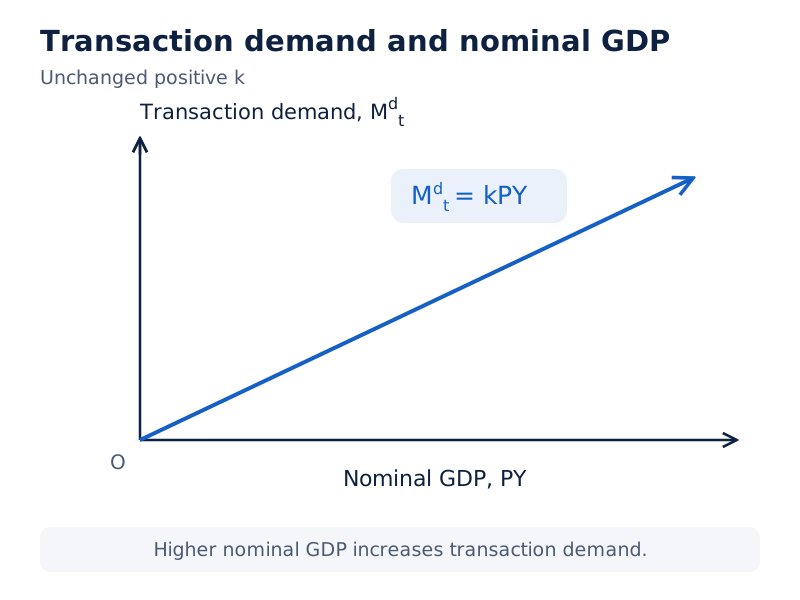
Put nominal GDP, PY, on the horizontal axis and transaction demand, Mᵈₜ, on the vertical axis. For an unchanged positive k, draw an upward-sloping straight line through the origin representing Mᵈₜ = kPY.
Drawn by One Young India.
In this income form, k is a different fraction from the k in Mᵈₜ = kT, because T is much greater than PY, and it links transaction money demand to nominal GDP. Transaction demand is positively related both to real income and to the general price level. Higher real production or higher prices increases the money needed for the associated transactions.
How do bonds and interest rates affect speculative money demand?
A bond is typically a tradable promise of future monetary returns issued by a government or firm borrowing from the public. For a simple comparison of wealth holdings, assets other than money can be grouped together as bonds.
What determines a bond's present value?
A bond's face value is its stated principal, or original sum borrowed. Its maturity period is the time until repayment, and its coupon rate specifies the interest payment relative to face value.
Present value, abbreviated as PV, is the current amount equivalent to future receipts when discounted at the market interest rate. Discounting calculates how much must be set aside now to produce a specified future amount with interest.
Worked example 3. A two-year bond has a face value of Rs 100 and a coupon rate of 10 per cent. It pays Rs 10 after one year and Rs 110, including principal, after two years. Find its present value at a market interest rate of 5 per cent.
Answer: PV = 10 ÷ (1 + 5/100) + 110 ÷ (1 + 5/100)² = Rs 109.30 approximately. The squared denominator discounts the second payment over two years.
Under competitive asset-market conditions, the equilibrium bond price equals its present value. A price below present value attracts buyers, raising the price. A price above present value makes the bond less attractive than the alternative bank deposit, creating downward pressure on its price.
Worked example 4. For the same two-year payment stream of Rs 10 after one year and Rs 110 after two years, calculate present value when the market interest rate rises to 6 per cent.
Answer: PV = 10 ÷ (1 + 6/100) + 110 ÷ (1 + 6/100)² = Rs 107.33 approximately. The rise from 5 to 6 per cent lowers the value from about Rs 109.30 to Rs 107.33.
Why might someone hold money instead?
A capital loss is a loss caused by a fall in the market price of an asset already held. A person expecting interest rates to rise expects bond prices to fall and may sell bonds to hold money instead.
This expectation-based holding is speculative demand for money. Different people have different expectations about future interest rates. At very high rates, expected falls encourage bond holding; as rates fall, more people anticipate future rises and prefer money.
Speculative money demand is therefore inversely related to the interest rate.
What happens to money demand in a liquidity trap?
Let Mᵈₛ denote speculative demand for money, with subscript s identifying speculation. Let r be the market interest rate. The symbols rₘₐₓ and rₘᵢₙ represent its upper and lower limits, both positive constants in the simplified relationship.
Mᵈₛ = (rₘₐₓ − r)/(r − rₘᵢₙ)
As the interest rate falls from its upper limit towards its lower limit, speculative demand rises from zero without bound. The symbol ∞ means infinity. The expression describes the approach to the lower limit; division by zero is not an ordinary finite calculation.
What the figure shows
The speculative demand for money
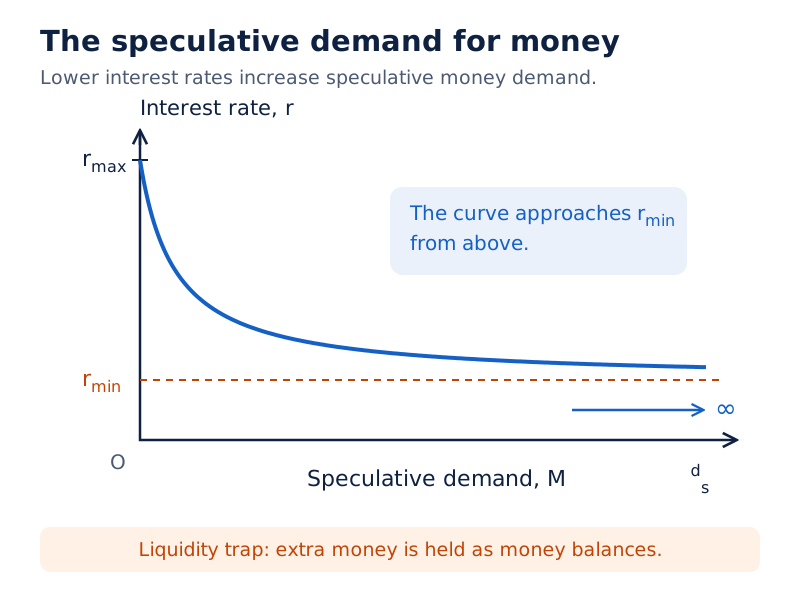
The vertical axis shows r and the horizontal axis shows Mᵈₛ. A downward-sloping curve begins at rₘₐₓ on the vertical axis and flattens towards the dashed horizontal level rₘᵢₙ. A rightward arrow indicates demand extending towards infinity.
Drawn by One Young India. See Fig. 3.1 in your NCERT textbook
Why can extra money fail to lower interest further?
If additional money is used to purchase bonds, bond demand and prices rise, reducing the interest rate. But when the rate is already low enough that everybody expects it to rise, people anticipate losses from holding bonds.
A liquidity trap is the situation in which additional money is held as money balances instead of increasing bond demand. The interest rate does not fall below its floor. Speculative money demand is infinitely elastic there, meaning additional balances are absorbed at that interest rate.
What is total money demand?
Let Mᵈ denote aggregate, or total, demand for money. It combines transaction demand and speculative demand. These components respond to different influences: income and prices affect transactions, while interest rates and expectations affect speculative balances.
Mᵈ = Mᵈₜ + Mᵈₛ
Combining the relationships gives Mᵈ = kPY + (rₘₐₓ − r)/(r − rₘᵢₙ).
What counts as money, fiat money and legal tender?
Modern money includes cash, meaning currency notes and coins, and bank deposits, balances held in bank accounts. In India, currency notes are issued by the Reserve Bank of India (RBI), while coins are issued by the Government of India. A deposit balance can also provide a means of settling transactions.
How do demand and time deposits differ?
Demand deposits are payable by the bank when the account-holder asks for them. Savings and current-account balances held by the public are included because cheques drawn on them can settle transactions. A cheque instructs a bank to make a payment from an account.
Time deposits, such as fixed deposits, have a fixed period to maturity. Including different kinds of deposits produces different measures of money supply. Therefore, identifying the particular measure matters before deciding which deposits belong in it.
| Form | Relevant characteristic | Implication |
|---|---|---|
| Currency notes and coins | Carry the issuing authority's guarantee | Are fiat money and legal tender |
| Demand deposits | Are repayable on demand | Can support cheque payments but are not legal tender |
| Time deposits | Have a fixed maturity period | Enter broader measures of money supply |
Why are notes accepted despite their material value?
Fiat money derives value from the issuing authority's guarantee rather than intrinsic value like a gold or silver coin. The paper in a hundred-rupee note is worth much less than Rs 100. The metal in a five-rupee coin is probably not worth Rs 5.
Legal tender means money that cannot be refused in settlement of transactions. Currency notes and coins have this status. Cheques can be refused as a payment method, so demand deposits are not legal tender even though they form part of money.
Note: Being included in money supply does not make every payment form legal tender. Keep the economic role of demand deposits separate from the legal status of currency.
How are narrow money and broad money measured?
Money supply is the total stock of money circulating among the public at a particular point in time. Like money demand, it is a stock variable. The RBI publishes four alternative measures, labelled M₁, M₂, M₃ and M₄.
What enters each measure?
Let CU mean currency notes and coins held by the public. Let DD mean net demand deposits of the public held by commercial banks, institutions that accept deposits and make loans. Here net excludes interbank deposits, which are deposits one commercial bank holds in another.
M₁ = CU + DD
M₂ = M₁ + Savings deposits with Post Office savings banks
M₃ = M₁ + Net time deposits of commercial banks
M₄ = M₃ + Total deposits with Post Office savings organisations, excluding National Savings Certificates
National Savings Certificates are a savings instrument excluded from the Post Office deposits added in M₄. Preserve that exclusion when stating the measure. Similarly, the currency component in M₁ concerns currency held by the public rather than currency held by banks.
How do the measures compare?
| Measure | Classification | Distinguishing feature |
|---|---|---|
| M₁ | Narrow money | Currency with the public plus net demand deposits |
| M₂ | Narrow money | Adds Post Office savings-bank savings deposits to M₁ |
| M₃ | Broad money | Adds net commercial-bank time deposits to M₁ |
| M₄ | Broad money | Adds specified Post Office deposits to M₃ |
Narrow money comprises M₁ and M₂; broad money comprises M₃ and M₄. The measures are arranged in decreasing liquidity. M₁ is the most liquid and easiest to use for transactions, while M₄ is the least liquid of the four.
M₃ is the most commonly used measure and is also called aggregate monetary resources.
How do commercial banks connect deposits, loans and reserves?
Commercial banks accept deposits and lend part of those funds to borrowers. They connect people or firms with excess funds to those needing funds. The spread is the difference between the higher interest rate charged to borrowers and the lower rate paid to depositors.
What does the goldsmith example illustrate?
The goldsmith Lala keeps people's gold safely and issues receipts. As those receipts become accepted for purchases, they begin functioning as money. With 100 kilograms of gold deposited, Lala has issued receipts representing 100 kilograms.
If he lends 25 kilograms to Ramu, who pays Ali, Ali can redeposit the gold with Lala. Receipts then represent 125 kilograms. The example depends on depositors not all withdrawing their gold at the same time.
Banks likewise retain part of their funds for withdrawals and lend the remainder. Keeping money in a bank may be safer than keeping excess funds at home. Demand deposits also make transactions convenient through cheques and debit cards, even when they earn no interest.
How is the simplified balance sheet organised?
A balance sheet records assets and liabilities. Assets are things owned or claims on others; liabilities are amounts owed. Bank loans are assets because borrowers owe the bank, while customers' deposits are liabilities because the bank owes depositors.
Reserves include commercial-bank deposits with the RBI and cash. For example, the State Bank of India (SBI) keeps deposits with the RBI. In the simplified balance sheet, the bank's assets are reserves and loans.
Assets = Reserves + Loans
Liabilities = Deposits
Net worth is the excess of assets over liabilities. It is recorded on the right-hand side to balance the account when assets exceed liabilities.
Net worth = Assets − Liabilities
Banks would like to lend because loans earn interest, but confidence in repayment on demand is crucial. Lending must therefore be balanced against having enough funds available for depositors. The possibility of creating deposits does not remove this responsibility.
How do banks create money, and what limits the multiplier?
When a bank lends and opens a deposit in the borrower's name, deposits increase. Money supply then includes both the earlier deposits and the new deposit, together with currency. Lending can thus create money within the banking system.
What assumptions govern the numerical example?
Consider an economy with one bank and no currency in public circulation. Ms Fernandes deposits Rs 100, which the bank initially holds as reserves with the RBI. Deposits are Rs 100, reserves are Rs 100 and net worth is zero.
The Cash Reserve Ratio (CRR) is the required fraction of deposits kept as cash reserves with the RBI. It limits lending. In the example, CRR is 20 per cent, or 0.2 as a fraction.
Worked example 5. A bank has deposits of Rs 100 and a required reserve ratio of 20 per cent. Find required reserves and the amount available for the first loan.
Answer: Required reserves = Rs 100 × 0.2 = Rs 20. The first loan can be Rs 100 − Rs 20 = Rs 80.
How does repeated lending expand deposits?
In the repeated-lending illustration, the bank starts from the same position: an initial Rs 100 deposit, made here by Leela. Loans return as deposits in the same bank. The original Rs 100 of reserves supports successively larger deposits until the reserve requirement prevents further expansion.
- The initial Rs 100 deposit requires Rs 20 in reserves, allowing an Rs 80 loan to Jaspal Kaur.
- The Rs 80 returns as a deposit, raising total deposits to Rs 180.
- Required reserves become Rs 36, leaving Rs 64 of the original Rs 100 available for a further loan to Junaid.
- The process repeats until deposits reach Rs 500 and required reserves absorb the full Rs 100.
| Final balance-sheet entry | Amount | Position |
|---|---|---|
| Reserves | Rs 100 | Asset |
| Total loans | Rs 400 | Asset |
| Deposits | Rs 500 | Liability |
What does the money multiplier measure?
The money multiplier in this simplified example shows deposits supported per unit of reserves. With no currency held by the public, deposits equal money supply. Use the reserve ratio as a fraction when calculating its reciprocal.
Money multiplier = 1/CRR
Worked example 6. In the one-bank economy, reserves are Rs 100, CRR is 20 per cent, all loans return as deposits and the public holds no currency. Find the multiplier, final deposits and total loans.
Answer: Multiplier = 1/0.2 = 5. Final deposits = Rs 100 × 5 = Rs 500. Total loans = Rs 500 − Rs 100 = Rs 400.
The Statutory Liquidity Ratio (SLR) is the ratio requiring banks to keep some reserves in liquid form in the short term, apart from CRR. Both reserve requirements and the need to meet withdrawals constrain lending.
Note: Rs 500 is the final deposit total, while Rs 400 is total loans. The initial Rs 100 deposit is included in Rs 500. Do not describe the final loan total as another fresh loan in the last round.
How does the RBI control money supply?
A central bank is the institution that issues currency and manages the monetary system. Almost every country has one. India's central bank, the RBI, dates from 1935. It also acts as banker to government, banker to banks and custodian of foreign exchange reserves.
Foreign exchange reserves are holdings of foreign currency and related assets. Currency issued by the central bank and held by the public or commercial banks forms the basis of credit creation. It is called high-powered money, reserve money or the monetary base.
What does lender of last resort mean?
Commercial banks needing funds may approach the market or the RBI. The RBI's readiness to lend to banks gives it the role of lender of last resort. This function concerns support to the banking system, distinct from ordinary bank lending to households and firms.
How do reserve ratios and the bank rate work?
Quantitative tools influence the extent of money supply, including reserve ratios, the bank rate and open market operations. Raising the reserve ratio reduces the lending that a given stock of reserves can support.
With Rs 100 reserves and a reserve ratio increased to 25 per cent, deposits can be Rs 400 and loans Rs 300 in the simplified example. The bank must call back some loans to meet the increased requirement, reducing money supply.
The bank rate is the rate at which the RBI lends to commercial banks. Raising it makes borrowing more expensive, reducing bank reserves and money supply. A fall in the bank rate can increase money supply.
How do open market operations, repo and reverse repo differ?
Open market operations are central-bank purchases and sales of government bonds in the open market. Buying bonds by cheque adds to reserves and increases money supply; selling bonds to private individuals or institutions reduces reserves and money supply.
| Operation | Agreement | Monetary effect |
|---|---|---|
| Outright purchase or sale | No promise to reverse the transaction later | Permanent injection or absorption of money |
| Repo | Purchase specifies the date and price of resale | Money is lent under a repurchase agreement |
| Reverse repo | Sale specifies the date and price of repurchase | Money is withdrawn under a reverse repurchase agreement |
The repo rate is the interest rate for money lent through repo. The reverse repo rate is the rate for money withdrawn through reverse repo. These agreements differ from outright transactions because they specify a future reversal.
What are qualitative tools?
Qualitative tools encourage or discourage particular lending behaviour. Moral suasion means central-bank persuasion of commercial banks. A margin requirement is the part of the value of an asset offered as loan security that the borrower must finance rather than borrow.
Increasing that margin reduces the loan available against the same security; reducing it permits a larger loan. This affects the conditions on which credit is extended, while a reserve-ratio change directly alters the funds banks must retain against deposits.
How do digital payments and demonetisation relate to money?
A cashless society uses transfers of digital information, usually an electronic representation of money, instead of physical notes and coins for financial transactions. Using less cash changes the form of payment; transactions still transfer purchasing power between parties.
How can payment access become wider?
Financial inclusion means wider access to formal financial services. Indian initiatives include Jan Dhan accounts, bank accounts intended to widen this access, and Aadhaar-enabled payment systems, which use Aadhaar identity information in making payments.
Other initiatives include e-wallets, electronic facilities for making payments, and the National Financial Switch (NFS), a payment-network initiative. Because of mobile and smartphone penetration across the country, wider financial inclusion is now seen as a realistic possibility.
What happened during demonetisation?
Demonetisation withdraws the legal-tender status of specified currency. In November 2016, old Rs 500 and Rs 1000 notes ceased to be legal tender, and new Rs 500 and Rs 2000 notes were introduced.
The initiative sought to tackle corruption, black money, terrorism and fake currency. Black money refers to income or funds concealed from the authorities. The change received both appreciation and criticism, with queues outside banks and automated teller machines, which dispense cash.
A shortage of currency adversely affected economic activity. Conditions improved with time and normalcy returned. Savings also moved into the formal financial system, giving banks more resources that could be used to provide loans at lower interest rates.
Tax compliance means meeting tax obligations, while tax evasion means avoiding them unlawfully. Bringing more people into the tax system improved compliance. Demonetisation could also help tax administration by shifting transactions from cash into the formal payment system.
Glossary
- Money — A commonly accepted medium of exchange used to settle transactions involving goods and services.
- Double coincidence of wants — A situation in which each party wants the commodity the other party offers in exchange.
- Unit of account — A common monetary unit used to express and compare the values of goods and services.
- Store of value — A means of holding wealth for future use, whose effectiveness depends on sufficiently stable value.
- Liquidity — The ease with which an asset can be exchanged for other commodities.
- Transaction demand — Money balances held to make payments when expenditure and income receipts occur at different times.
- Speculative demand — Money held because expectations about interest rates and bond prices make holding bonds less attractive.
- Liquidity trap — A situation where extra money is held without raising bond demand or lowering interest below its floor.
- Demand deposits — Deposits repayable by a bank when requested by the account-holder.
- Fiat money — Money whose value rests on the issuing authority's guarantee rather than its intrinsic material value.
- Money supply — The stock of money in circulation among the public at a particular point in time.
- Cash Reserve Ratio — The fraction of deposits that commercial banks must retain as cash reserves with the central bank.
- Money multiplier — The factor linking reserves to deposits in the simplified credit-creation example, equal to the reciprocal of CRR.
- Lender of last resort — The central bank's role of standing ready to provide funds to commercial banks needing them.
- Open market operations — Central-bank buying and selling of government bonds to influence reserves and the money supply.
Common errors and misconceptions
- Misconception: Money is useful merely because an economy has many people. Correct: Its role depends on market transactions; an isolated family may have no use for money.
- Misconception: Money preserves purchasing power regardless of prices. Correct: A rising price level may erode purchasing power, so value must be sufficiently stable.
- Misconception: Demand deposits must be legal tender because they are money. Correct: Cheques may be refused, unlike legal-tender currency notes and coins.
- Misconception: Every deposit held by a bank is counted in M₁. Correct: DD means the public's net demand deposits only: interbank deposits are excluded, and time deposits enter M₃ instead of M₁.
- Misconception: The reserve ratio of 20 per cent gives a multiplier of 1/20. Correct: Use the fraction 0.2, giving 1/0.2 = 5.
- Misconception: Final deposits of Rs 500 in the Rs 100 reserve example mean Rs 500 of loans. Correct: Total loans are Rs 400; reserves account for the remaining assets.
- Misconception: A rise in the market interest rate raises a bond's present value. Correct: For an unchanged payment stream, a higher discount rate lowers present value and bond price.
- Misconception: Extra money necessarily lowers interest rates. Correct: In a liquidity trap it is held as money balances without further lowering the interest rate.
Exam-style questions with model answers
Q1. A pencil costs Rs 2 and a pen costs Rs 10. Calculate the pen's relative price in pencils and the purchasing power of one rupee in pens. [2 marks]
- The pen's relative price is Rs 10 ÷ Rs 2 = 5 pencils per pen.
- One rupee buys 1 ÷ 10 = 0.1 pen at the given price.
Q2. Explain three functions of money and show how each assists exchange or the holding of wealth. [3 marks]
- As a medium of exchange, money separates selling from buying. A seller can accept money without finding a buyer who offers exactly the commodity the seller wants.
- As a unit of account, money expresses values in a common unit, so relative prices, such as a pen being worth 5 pencils, can be compared easily and exchanges are simpler to arrange.
- As a store of value, money carries wealth forward with lower storage costs than rice. Its purchasing power must remain sufficiently stable for this function to work well.
Q3. A firm pays its worker Rs 100 at the beginning of each month. Immediately after this payment, the worker holds Rs 100 and the firm holds Rs 0; these are the only money balances in the economy. The worker spends the Rs 100 evenly during the month on the firm's only output. There are no other transactions. Calculate each party's average holding, total transaction demand, monthly transaction value and velocity. [4 marks]
- The worker's balance falls from Rs 100 to zero and the firm's rises from zero to Rs 100, giving each an average holding of Rs 50.
- Total transaction demand is the sum of their average balances: Rs 50 + Rs 50 = Rs 100.
- Monthly transactions are Rs 100 for labour services plus Rs 100 for output, totalling Rs 200.
- Velocity is transaction value divided by the money balance: Rs 200 ÷ Rs 100 = 2 times per month.
Q4. Explain the four money supply measures M₁ to M₄, identifying what is added in each and excluding interbank deposits where relevant. [4 marks]
- M₁ equals currency notes and coins held by the public plus net demand deposits. Net demand deposits exclude interbank deposits.
- M₂ adds savings deposits with Post Office savings banks to M₁. M₁ and M₂ are classified as narrow money.
- M₃ adds net time deposits of commercial banks to M₁. It is broad money and is also called aggregate monetary resources.
- M₄ adds total Post Office savings-organisation deposits to M₃, excluding National Savings Certificates. It is broad money and the least liquid of the four measures.
Q5. A single-bank economy starts with an Rs 100 deposit held entirely as reserves. The public holds no currency, every loan returns as a deposit, banks lend all permissible funds, and CRR is 20 per cent. Explain six steps or results showing the first lending rounds, multiplier and final balance sheet. [6 marks]
- The initial deposit requires Rs 100 × 0.2 = Rs 20 in reserves. Therefore Rs 80 is available for the first loan.
- The first Rs 80 loan returns as a deposit, raising the total deposit balance from Rs 100 to Rs 180.
- Required reserves are now Rs 180 × 0.2 = Rs 36. Against the original Rs 100 reserves, a further Rs 64 can be lent.
- With repeated redepositing under the stated assumptions, the multiplier is 1/0.2 = 5. Final deposits are Rs 100 × 5 = Rs 500.
- The final asset side consists of Rs 100 reserves and Rs 400 total loans. These assets match the Rs 500 deposit liability.
- Money supply is Rs 500 because public currency is zero. Required reserves now equal the available Rs 100, preventing further credit expansion under the given ratio.
Q6. A two-year bond pays Rs 10 at the end of year one and Rs 110, including principal, at the end of year two. Calculate its present value at market interest rates of 5 per cent and 6 per cent, then explain the relationship. [3 marks]
- At 5 per cent, present value is 10/(1.05) + 110/(1.05)² = Rs 109.30 approximately. Each receipt is discounted for the time until it is paid.
- At 6 per cent, present value is 10/(1.06) + 110/(1.06)² = Rs 107.33 approximately, using the same promised receipts.
- The higher interest rate reduces present value. Under competitive asset-market conditions, equilibrium bond price equals present value, so bond price and market interest rate are inversely related.
Q7. Explain five ways the central bank can influence money supply: reserve-ratio changes, bank-rate changes, outright bond purchases or sales, repo, and reverse repo. [5 marks]
- A higher reserve ratio requires banks to keep more reserves against deposits. Given reserves, less lending and deposit creation can be supported, reducing money supply.
- A higher bank rate makes central-bank borrowing more expensive for commercial banks, reducing reserves and money supply. A lower bank rate can increase money supply.
- An outright government-bond purchase adds reserves and money, while an outright sale withdraws them. Neither transaction promises a later reversal, making the injection or absorption permanent.
- Under repo, the central bank purchases securities with an agreed resale date and price. Money is lent through the arrangement at the repo rate, so reserves and money supply rise until the securities are resold.
- Under reverse repo, the central bank sells securities with an agreed repurchase date and price. Money is withdrawn through the arrangement at the reverse repo rate, so reserves and money supply fall until the securities are repurchased.
Q8. Explain why additional money may fail to reduce interest rates when an economy is in a liquidity trap. [3 marks]
- At a sufficiently low interest rate, everyone expects a future rise in rates and therefore a fall in bond prices, creating the prospect of capital losses.
- People prefer holding money to acquiring bonds. Additional money is absorbed into money balances rather than used to increase demand for bonds.
- Without that additional bond demand, bond prices do not rise through this channel and interest does not fall below its floor. Speculative money demand is infinitely elastic there.
Key takeaways
- Money overcomes the double coincidence of wants by allowing people to sell for money and buy separately.
- Money measures value and stores wealth, but rising prices may reduce its purchasing power over time.
- Transaction demand increases with income and prices, while speculative demand is inversely related to interest rates.
- Demand deposits help settle transactions but are not legal tender, because cheques can be refused.
- Money supply measures differ by included deposits; M₁ and M₂ are narrow, while M₃ and M₄ are broad.
- Commercial banks create deposits through lending, while required reserves constrain how far that process can continue.
- The reciprocal reserve-ratio multiplier applies to the simplified example with no public currency and loans returning as deposits.
- The RBI influences money supply through reserves, interest rates and securities transactions, alongside qualitative credit controls.
Test yourself
What must coincide for rice and clothing to be exchanged directly?
The rice owner must want clothing, and the clothing owner must want rice. Each must offer what the other wants.
Why is money demand a stock rather than a flow?
It measures the money balance people wish to hold at a particular point in time, rather than transactions over a period.
What does the word net exclude from demand deposits in M₁?
It excludes interbank deposits, which one commercial bank holds in another. The measure includes the public's demand deposits.
What distinguishes M₃ from M₁?
M₃ adds net time deposits of commercial banks to M₁ and is classified as broad money.
For a reserve ratio of 20 per cent, how is the simplified multiplier calculated?
Write the ratio as 0.2 and take its reciprocal: 1/0.2 = 5, under the simplified banking assumptions.
Why is a customer's deposit a bank liability?
The bank owes the deposited funds to the customer, while the customer's claim on the bank is an asset.
How does an outright operation differ from repo?
An outright transaction has no promise of later reversal. Repo specifies the date and price at which the purchased security will be resold.
What happens to a fixed payment stream's present value when the market interest rate rises?
Its present value falls because future receipts are discounted at a higher rate, lowering the corresponding equilibrium bond price.
Take this further
How does India make policy?
The Model NITI Aayog self-paced course: 41 chapters, about 19 hours of study, on how India makes policy, from the policy cycle and writing a white paper to the economy, the Union Budget and governance. It comes with Learnacy Essential.
Learnacy Essential also adds feedback from an AI writing coach, submission to The OYI Review, World 101’s member tools and the 3D labs. Publication is not guaranteed. See what a year includes
Or create a free account to draft in the Writing Studio, explore World 101’s map and open the 2D version of every lab. Create a free account