
Indian Economy on the Eve of Independence | CBSE Class 12 Economics Notes
On this page
Try an idea before you read. Test your understanding of how British rule shaped India's economy. Explore →
This note covers colonial economic policy, pre-colonial production, income estimates, agricultural stagnation, industrial decline, foreign trade, the drain of wealth, demographic conditions, occupational structure, infrastructure and the economic challenges facing India at independence.
How did colonial rule change the Indian economy?
Production before British rule
Before British rule, India had an independent economy. Agriculture supported most people, but manufacturing was also important. Cotton and silk textiles, metal work and precious stone work were well known. Their materials and craftsmanship gave Indian handicrafts a worldwide market.
India’s later industrial weakness should therefore not be understood as the absence of an earlier manufacturing tradition. The decline involved industries that already produced goods valued internationally. Agriculture and handicrafts together formed an important part of the economy before colonial restructuring.
The Bengal textile example
Muslin was a cotton textile originating in Bengal, particularly around Dhaka, then spelled Dacca and now the capital of Bangladesh. Daccai Muslin became internationally famous. Its finest variety was malmal; travellers used malmal shahi or malmal khas to suggest a fabric suitable for royalty.
The purpose of colonial policy
The imperial outlook expressed in 1894 treated the loss of India as a threat to the survival of the British Empire. India’s importance to Britain was closely connected with the colonial economy’s role in serving British interests.
British rule lasted almost two centuries before independence on 15 August 1947. Colonial economic policy prioritised Britain’s interests. India was transformed into a supplier of raw materials for British industry and a consumer of finished industrial products from Britain.
These two roles were connected. British industry required materials for production and markets for its output. Policies affecting Indian production and trade supported those requirements rather than the development of a balanced Indian economy.
Definition: In this context, a colonial economy is an economy whose production and trade are shaped to serve the interests of the ruling country.
The consequences extended across agriculture, industry and trade. Understanding these connections explains why the economy inherited at independence combined agricultural dependence, a weak modern industrial base and widespread poverty. Its condition was the result of historical policies, not simply a lack of productive skills or resources.
What do income estimates reveal about colonial economic development?
Who estimated income?
The colonial government made no sincere attempt to estimate India’s national income and per capita income. Individual researchers attempted the task, but their results were inconsistent and conflicting. National income concerns the country as a whole; per capita income expresses income per person.
The notable estimators were Dadabhai Naoroji, William Digby, Findlay Shirras, V.K.R.V. Rao and R.C. Desai. Rao’s estimates were considered particularly significant. The existence of these estimates does not mean that a complete and consistent official income series was available.
How slow was growth?
| Measure | Position in the first half of the twentieth century | Meaning |
|---|---|---|
| Aggregate real output growth | Less than two per cent | The growth of total output was very low. |
| Per capita output growth | About half a per cent per year | Output per person increased very slowly. |
Aggregate real output refers to total output measured without treating price changes as output growth. Per capita output is output per person. The small increase in the latter indicates how limited the expansion of production was in relation to the population.
The estimates support the description of colonial economic development as stagnant. They do not imply that every activity stopped growing. Some agricultural output increased and some modern factories appeared, but these developments did not create strong growth across the economy.
Note: “Less than two per cent” is an upper-bound description, not an exact growth rate. “Half a per cent” means 0.5 per cent, not five per cent.
The distinction between total and per-person measures matters. A statement about aggregate output cannot be substituted for a statement about output per person. Similarly, evidence of a new factory alone cannot establish that national economic development was rapid.
Why did agriculture stagnate despite supporting most people?
Dependence and low productivity
Under colonial rule, about 85 per cent of the population lived mostly in villages and obtained a livelihood directly or indirectly from agriculture. Yet agriculture experienced stagnation and, not infrequently, unusual deterioration. Its importance as a source of livelihood did not ensure investment or high productivity.
Agricultural output grew to some extent because the total cultivated area expanded. Productivity, meaning output in relation to the resources used, remained low. Thus, an increase in the area cultivated must be distinguished from an improvement in agricultural efficiency.
Land settlement and rent collection
The systems of land settlement were a major cause of stagnation. Under the zamindari system, implemented in the then Bengal Presidency, agricultural profits went to zamindars rather than cultivators. That Presidency included parts of present-day eastern India.
A considerable number of zamindars did nothing to improve the condition of agriculture. Their concern was collecting rent regardless of cultivators’ economic condition. This imposed hardship on cultivators and created social tension, while improvements to agricultural production received little attention.
- The revenue settlement fixed dates for depositing specified amounts of revenue.
- Zamindars risked losing their rights if they failed to meet these requirements.
- Rent collection consequently became their central concern, regardless of cultivators’ condition.
- Agricultural improvement was neglected, contributing to stagnation and rural distress.
The contrast with earlier Bengal
The French traveller Bernier described seventeenth-century Bengal as agriculturally prosperous. He referred to exports of cottons, silks, rice, sugar and butter, plentiful food for local consumption, livestock and fish, and canals used for navigation and irrigation.
This example helps distinguish the earlier productive capacity of the region from its later stagnation. Agricultural weakness under colonial rule cannot be explained merely by saying that India had always been unable to produce sufficient agricultural goods.
Photograph: India’s agricultural stagnation under the British colonial rule (NCERT Class 11 Figure 1.1). The photograph shows people and cattle working in a cultivated field, with raised land and trees behind them.
How did technology and commercialisation affect cultivators?
Shortages of productive investment
Land arrangements were accompanied by serious technical weaknesses. Low levels of technology, inadequate irrigation and negligible fertiliser use contributed to low agricultural productivity. Cultivators faced several constraints together, rather than a single isolated cause of poor performance.
There was some progress in irrigation, but investment remained inadequate in terracing, flood control, drainage and the removal of salts from soil, or desalinisation. The existence of some irrigation development did not mean that agriculture received the wider investment it needed.
Cash crops and food crops
Commercialisation of agriculture involved production for the market. In some areas it was associated with relatively higher cash-crop yields. However, this did little to improve farmers’ economic position because cash crops replacing food crops ultimately supplied British industries.
A small section of farmers changed from food crops to commercial crops. A large section of tenants, small farmers and sharecroppers lacked resources, technology and incentives to invest. A change in the crop sold therefore did not necessarily bring a general improvement in rural living conditions.
| Constraint | Condition under colonial rule | Effect on agriculture |
|---|---|---|
| Technology | Low levels of agricultural technology | Contributed to poor productivity |
| Irrigation and fertilisers | Insufficient irrigation and negligible fertiliser use | Restricted improvements in cultivation |
| Land improvement | Inadequate terracing, flood control, drainage and desalinisation | Left important investment needs unmet |
| Cultivators’ resources | Many tenants, small farmers and sharecroppers lacked resources and incentives | Limited their ability to invest |
Note: Higher cash-crop yields in certain areas did not establish widespread agricultural prosperity. Crop choice, cultivators’ income and the condition of agriculture are related but distinct issues.
The overall result was an agricultural economy supporting a very large population without a corresponding improvement in productivity. Commercialisation operated within an unequal system of land relations and inadequate investment, so it did not remove the underlying causes of stagnation.
How did de-industrialisation affect handicrafts and modern industry?
The two-fold colonial motive
De-industrialisation involved the decline of India’s traditional handicraft industries without an adequate modern industrial replacement. Colonial policy sought both to obtain raw materials for Britain’s expanding industries and to secure a large Indian market for their finished products.
The destruction of handicraft production had two linked consequences: workers lost employment, and Indian consumers lost a source of locally manufactured goods. Imports of cheap British manufactures supplied the resulting demand and supported Britain’s industrial expansion.
- India’s established handicraft industries declined under colonial economic policies.
- The decline created massive unemployment among people dependent on those industries.
- Consumers faced a loss of locally produced manufactured goods.
- Increasing imports of cheap British goods met this demand, reinforcing India’s role as a market.
The limited growth of factories
Modern industry began taking root in the second half of the nineteenth century, but developed slowly. Initial growth centred on cotton and jute textile mills. Their ownership and location differed, showing that industrial development was concentrated rather than evenly spread.
| Industry | Location or timing | Important feature |
|---|---|---|
| Cotton textiles | Western India, especially Maharashtra and Gujarat | Predominantly controlled by Indians |
| Jute textiles | Mainly Bengal | Predominantly controlled by foreigners |
| Iron and steel | Beginning of the twentieth century | Tata Iron and Steel Company was incorporated in 1907 |
| Sugar, cement and paper | Some industries emerged after the Second World War | Added to the limited modern industrial base |
Tata Iron and Steel Company (TISCO) was an important example of modern industrial development. However, the appearance of a few manufacturing units did not compensate for the widespread displacement of traditional handicrafts. Both developments must be considered when assessing the industrial position at independence.
Why was the modern industrial base still weak at independence?
The missing capital goods industry
India had hardly any capital goods industry to support further industrialisation. Such industries produce machine tools that are then used to manufacture articles for current consumption. Their weakness restricted the development of a sound and diversified industrial base.
Definition: Capital goods industries produce machine tools used in making goods for current consumption. Their role differs from industries producing finished consumer articles.
A cotton textile mill and an industry making production machinery therefore perform different functions. The growth of a few factories producing consumer goods could not by itself remove the weakness caused by the near absence of industries producing machine tools.
Small contribution and limited public activity
The new industrial sector’s growth and contribution to Gross Domestic Product (GDP) or Gross Value Added remained very small. GDP concerns domestic production, while value added refers to the value contributed in production. Modern industrial expansion was insufficient to replace the lost handicraft base.
The public sector, involving government economic undertakings, also had a narrow area of operation. It was confined to railways, power generation, communications, ports and some other departmental undertakings. It did not provide broad support for industrial transformation.
| Weakness | Why it mattered |
|---|---|
| Slow modern industrial growth | New production remained inadequate after the decline of handicrafts. |
| Hardly any capital goods industry | Machine-tool production did not provide a strong basis for further industrialisation. |
| Small contribution to domestic production | Industry remained a limited component of the economy. |
| Narrow public-sector activity | Government undertakings were concentrated in a few services and infrastructure activities. |
At independence, industry consequently required modernisation, diversification, capacity building and increased public investment. The issue was broader than whether any factory existed: it concerned the scale, composition and capacity of the industrial system as a whole.
How did foreign trade serve Britain and drain Indian wealth?
Composition and direction of trade
Colonial restrictions on commodity production, trade and tariffs damaged the structure, composition and volume of Indian foreign trade. India exported primary products and imported British manufactured goods, reinforcing its position as a raw-material supplier and a market for finished products.
| Trade category | Examples |
|---|---|
| Primary-product exports | Raw silk, cotton, wool, sugar, indigo and jute |
| Finished consumer-goods imports | Cotton, silk and woollen clothes |
| Capital-goods imports | Light machinery made in British factories |
Britain exercised monopoly control over India’s foreign trade for practical purposes. More than half of that trade was with Britain. The remainder involved a few countries, including China, Ceylon, now Sri Lanka, and Persia, now Iran.
Why an export surplus did not mean prosperity
A large export surplus was a major feature of colonial trade. Exports exceeded imports, but essential goods such as food grains, clothes and kerosene were scarce in India. The surplus did not bring a corresponding inflow of gold or silver.
- India generated an export surplus through its foreign trade.
- Essential commodities remained scarce in the domestic market.
- The surplus financed the colonial government’s office in Britain, British war expenses and imports of invisible items.
- These payments contributed to the drain of Indian wealth rather than domestic economic improvement.
Invisible items refer to transactions such as services, rather than physical merchandise. Their import payments were among the uses of the surplus. The drain of wealth describes the use of Indian resources to meet these external colonial expenses.
The key distinction is between the existence of a trade surplus and who benefited from it. A favourable merchandise balance did not ensure that its proceeds were available to improve production, consumption or living conditions within India.
Why was the Suez Canal important to colonial trade?
A shorter sea route
The Suez Canal is an artificial waterway running north to south across the Isthmus of Suez in north-eastern Egypt. It links Port Said on the Mediterranean Sea with the Gulf of Suez, an arm of the Red Sea.
The canal provides a direct route between European or American ports and ports in South Asia, East Africa and Oceania. Ships using this connection avoid the need to sail around Africa. Its geographical position therefore made it strategically and economically important.
The opening in 1869
The canal opened in 1869. It reduced transportation costs and made the Indian market more accessible. In the colonial setting, this improved access intensified British control over India’s foreign trade and strengthened the existing economic connection between Britain and India.
What the figure shows
The Suez Canal trade route
The map labels the United Kingdom, India, Africa, Port Said, Suez Canal, Mediterranean Sea, Red Sea and Arabian Sea. Route arrows connect Britain and India through the Mediterranean Sea, Suez Canal, Red Sea and Arabian Sea. It is marked “Not to scale”.
See Fig. 1.2 in your NCERT textbook
The canal’s importance must be connected with the composition of trade. Britain was already obtaining primary products from India and selling manufactured goods there. Cheaper and easier transport strengthened this relationship; it did not by itself change the purpose of colonial trade.
The Suez example also shows why an infrastructure improvement needs an economic explanation. A shorter route is a physical advantage, but its effects depend on the production and trade arrangements it serves. Here, increased access operated within British control of India’s external commerce.
What do demographic indicators show about living conditions?
Census and population transition
Population details for British India were first collected through a census in 1881. Despite limitations, it revealed uneven population growth. Census operations subsequently took place every ten years. They provided a basis for examining the population’s condition and changes over time.
India was in the first stage of demographic transition before 1921; the second stage began after 1921. Demographic transition concerns changes in population patterns over time. Neither the total population nor the population growth rate at this stage was very high.
Literacy, health and survival
| Indicator | Colonial-period condition |
|---|---|
| Overall literacy | Less than 16 per cent |
| Female literacy | About seven per cent |
| Infant mortality | About 218 per thousand |
| Life expectancy | 32 years |
| Public health facilities | Unavailable to large sections or highly inadequate |
Diagram
Literacy levels under colonial rule
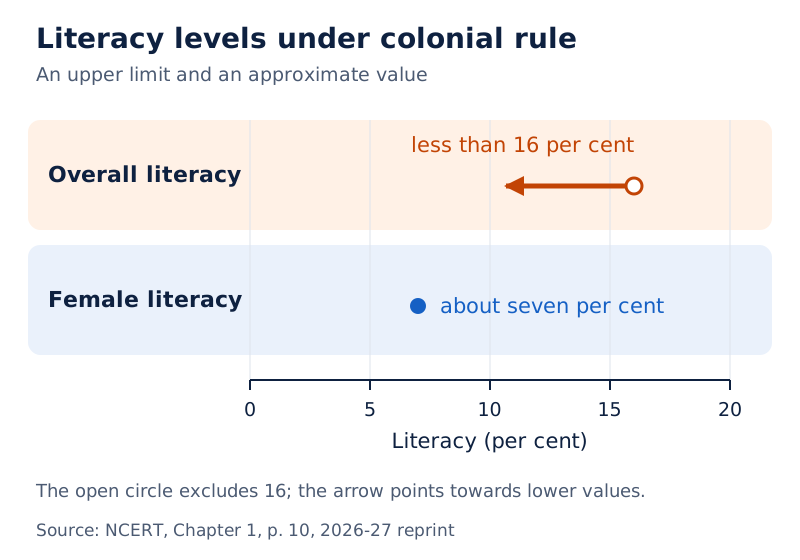
Draw a horizontal percentage scale starting at zero, with separate rows for overall literacy and female literacy. In the overall row, mark an open endpoint at 16 per cent with an arrow towards lower values, labelled “less than 16 per cent”.
In the female row, plot a point at seven per cent labelled “about seven per cent”. The first mark represents an upper limit, while the second represents an approximate value. Do not draw an exact overall literacy bar ending at 16 per cent.
Drawn by One Young India.
Infant mortality concerns deaths of infants; life expectancy concerns the expected length of life. High infant mortality and low life expectancy reflected severe weaknesses in health and living conditions, while low literacy indicated limited educational development.
Water-borne and air-borne diseases were widespread and caused many deaths. The overall mortality rate was high. Poverty was extensive, but the lack of reliable data prevents a precise statement of its extent. A specific colonial poverty percentage should therefore not be assumed.
Photograph: A large section of India’s population did not have basic needs such as housing (NCERT Class 11 Figure 1.3). The photograph shows a densely packed settlement of makeshift shelters, with people standing in a narrow passage.
These indicators should be read together. The population’s condition involved education, health, survival and access to basic needs. A description based only on population size would miss the widespread deprivation that shaped the economic challenges at independence.
What was the occupational structure of colonial India?
Definition: Occupational structure means the distribution of working people across different industries and sectors of the economy.
Agriculture’s dominant workforce share
The occupational structure showed little change during colonial rule. Agriculture employed the largest share of the workforce, while manufacturing and services absorbed much smaller shares. The economy therefore remained heavily dependent on agriculture as a source of employment.
| Sector | Usual share of the workforce |
|---|---|
| Agriculture | 70 to 75 per cent |
| Manufacturing | 10 per cent |
| Services | 15 to 20 per cent |
These are the given broad shares, including ranges, rather than one exact set of observations. They should not be converted into a single precise distribution without choosing values that the evidence does not specify.
Diagram
Occupational structure under colonial rule
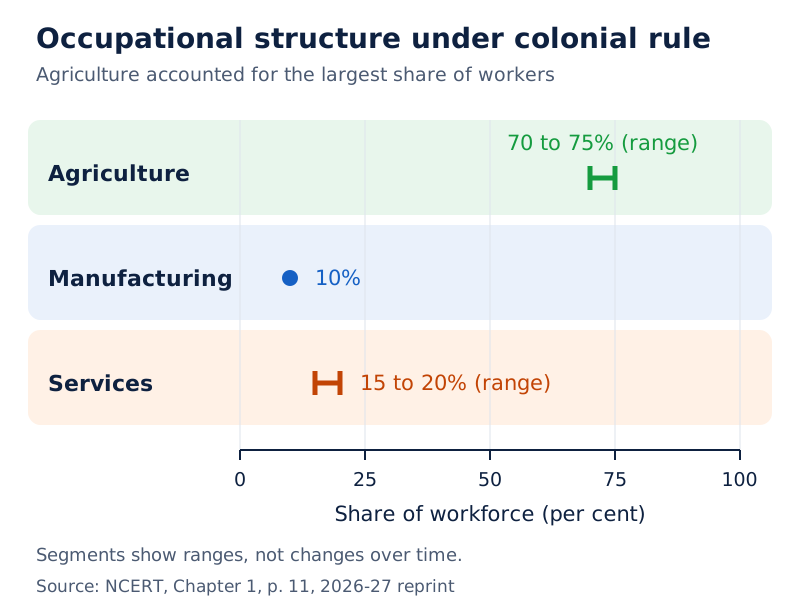
Draw a horizontal axis labelled “Share of workforce (per cent)” from zero to 100, with separate rows for agriculture, manufacturing and services. Show agriculture as a segment from 70 to 75, manufacturing as a point at 10, and services as a segment from 15 to 20.
Label both segments as ranges. Their positions show agriculture’s dominance in employment. Do not replace the ranges with midpoints or treat their endpoints as a change over time.
Drawn by One Young India.
Regional differences
Parts of the then Madras Presidency, Bombay and Bengal saw agricultural dependence decline while manufacturing and services increased their shares. Madras Presidency included areas now in Tamil Nadu, Andhra Pradesh, Kerala and Karnataka.
In contrast, the agricultural workforce share increased in Orissa, Rajasthan and Punjab. The broad national picture of agricultural dominance thus coexisted with regional differences. A shift away from agriculture in some regions did not mean that such a shift occurred throughout India.
Note: The figure of about 85 per cent refers to people living mostly in villages and depending directly or indirectly on agriculture. The 70 to 75 per cent range concerns agriculture’s share of working people.
The distinction is between the population and the workforce. The two figures describe different groups and should not be treated as contradictory measurements of the same group. Together, they show both broad rural dependence and the limited movement of workers into manufacturing and services.
How did infrastructure develop, and what challenges remained in 1947?
Roads and railways
Railways, ports, water transport, posts and telegraphs developed under colonial rule. Their principal purpose was to serve colonial interests. Roads helped move the army and carry raw materials from the countryside to railway stations and ports for shipment abroad.
All-weather roads remained scarce in rural areas. During the rainy season, poor access intensified suffering from natural calamities and famines. The construction of some roads did not provide adequate transport connections for the population as a whole.
The British introduced railways in 1850. They enabled long-distance travel and helped break geographical and cultural barriers. They also encouraged agricultural commercialisation, weakening village self-sufficiency. Exports expanded, but the gains rarely reached the Indian people; economic losses outweighed the social benefits.
Illustration: Railway bridge; Photograph: Early aviation (NCERT Class 11 Figures 1.4 and 1.5). The illustration shows a train crossing a long arched bridge, captioned “First Railway Bridge linking Bombay with Thane, 1854”. The photograph shows an aircraft, captioned “Tata Airlines, a division of Tata and Sons, was established in 1932 inaugurating the aviation sector in India”.
Waterways and communications
The Coast Canal on the Orissa coast illustrates unsuccessful infrastructure investment. Built at great public expense, it could not compete with the railway running parallel to it and was eventually abandoned. Inland waterways and sea-lane development remained unsatisfactory.
The expensive electric telegraph served the maintenance of law and order. Postal services served a useful public purpose but remained inadequate. These examples show that useful facilities existed alongside serious limitations in their availability, operation and public orientation.
The inherited development task
Agriculture faced surplus labour and extremely low productivity. Industry needed modernisation, diversification, capacity building and public investment. Foreign trade served Britain’s Industrial Revolution, while infrastructure required expansion, improvement and a stronger orientation towards public needs.
Poverty and unemployment also demanded a welfare orientation in economic policy. Independent India had an infrastructure base on which to build, but the scale and direction of development needed to change to address the population’s needs.
Glossary
- Colonial economy — An economy whose production and trade are shaped to serve the interests of a ruling foreign country.
- Per capita income — Income expressed per person, rather than as a total for the whole economy.
- Agricultural stagnation — A condition of weak agricultural progress associated here with low productivity and inadequate improvement.
- Zamindari system — A land settlement arrangement under which zamindars received agricultural profits while cultivators faced rent demands.
- Commercialisation of agriculture — Production for the market, associated here with a shift from food crops towards commercial crops.
- De-industrialisation — Decline of traditional handicraft production without a corresponding modern industrial base adequately replacing it.
- Capital goods industry — Industries producing machine tools that are used to make articles for current consumption.
- Public sector — Government economic undertakings, restricted under colonial rule to a narrow range of activities.
- Export surplus — A situation in which exports exceed imports, without necessarily guaranteeing improvement in domestic welfare.
- Drain of wealth — Use of Indian resources to finance external colonial expenses rather than improve the domestic economy.
- Census — An organised collection of population information. In British India, census operations were undertaken every ten years after the census of 1881.
- Occupational structure — Distribution of working people across the different industries and sectors of an economy.
Common errors and misconceptions
- Misconception: India had no significant manufacturing before British rule. Correct: Indian cotton and silk textiles, metal work and precious stone work enjoyed worldwide markets.
- Misconception: Increased cultivated area proves higher productivity. Correct: Total agricultural output grew somewhat through area expansion while productivity remained low.
- Misconception: Commercialisation made most cultivators prosperous. Correct: Some cash-crop yields improved, but many cultivators lacked resources, technology and incentives to invest.
- Misconception: No modern industries existed under colonial rule. Correct: Textile mills and iron and steel industries existed, but growth was slow and the overall base remained weak.
- Misconception: The export surplus increased India’s gold and silver holdings. Correct: It financed external colonial expenses and contributed to the drain of wealth.
- Misconception: Agriculture employed 85 per cent of the workforce. Correct: Its workforce share was usually 70 to 75 per cent; the 85 per cent figure concerns broader population dependence.
- Misconception: Britain was India’s sole trading partner. Correct: More than half the trade was with Britain, while some involved China, Ceylon and Persia.
- Misconception: Railway development brought no social benefits. Correct: Travel helped overcome geographical and cultural barriers, although colonial economic losses outweighed those benefits.
Exam-style questions with model answers
Q1. Colonial policy sought raw materials for British industry and an Indian market for British manufactures. Identify its two linked economic objectives. [2 marks]
- It aimed to make India a supplier of raw materials for Britain’s expanding industries.
- It also aimed to make India a market for finished British industrial products, supporting their continued expansion.
Q2. Zamindars faced fixed revenue deadlines and loss of rights for non-payment. Many prioritised rent collection over agricultural improvement. Technology, irrigation and fertiliser use were inadequate. Explain three causes of agricultural stagnation from this evidence. [3 marks]
- Revenue requirements encouraged zamindars to focus on rent collection regardless of cultivators’ circumstances, creating hardship instead of supporting improvement.
- Many zamindars neglected agricultural development. The receipt of agricultural profits by landlords did not translate into better conditions for cultivators or investment in production.
- Low technology, insufficient irrigation and negligible fertiliser use restricted productivity. Institutional weaknesses and technical shortages therefore operated together to keep agriculture stagnant.
Q3. Handicrafts declined without adequate replacement; cotton and jute mills grew slowly; capital goods industries were nearly absent; public undertakings were confined to railways, power, communications, ports and some departmental activities. Evaluate four weaknesses of colonial industrial development. [4 marks]
- The loss of handicrafts was not compensated by a sufficiently strong modern industrial base, so new factories did not offset the earlier industrial decline.
- Slow growth in cotton and jute mills indicated limited industrial expansion rather than broad development across industries.
- The near absence of capital goods industries meant that machine-tool production did not support further industrialisation adequately.
- Public undertakings operated within a narrow field. Their concentration in a few infrastructure and service activities left industrial development without broad public-sector support.
Q4. India exported more than it imported, yet food grains, clothes and kerosene were scarce. The surplus financed the colonial office in Britain, British war expenses and invisible imports, rather than bringing gold or silver into India. Explain the drain of wealth. [4 marks]
- An export surplus means exports exceeded imports, but it does not establish that the population received the resulting economic benefits.
- Scarcity of essential goods shows that the surplus coexisted with unmet domestic consumption needs.
- The proceeds financed the colonial office in Britain, British war expenses and payments for invisible imports instead of producing an inflow of gold or silver.
- The drain of wealth therefore concerned the external use of Indian resources for colonial purposes, limiting their availability for improvement within India.
Q5. Overall literacy was below 16 per cent, female literacy about seven per cent, infant mortality about 218 per thousand and life expectancy 32 years. Health facilities were absent or inadequate, diseases were widespread and poverty data unreliable. Assess colonial living conditions using this evidence. [5 marks]
- The low overall literacy level indicates limited educational development across the population. The still lower female literacy level shows the particularly poor educational position of women.
- Infant mortality of about 218 per thousand indicates severe threats to survival early in life and forms part of the wider picture of poor health.
- Life expectancy of 32 years provides further evidence of low survival and difficult living conditions.
- Absent or inadequate health facilities, together with widespread diseases, help explain why the health indicators were so unfavourable.
- The evidence supports a picture of widespread deprivation. However, unreliable poverty data mean that a precise poverty percentage cannot be supplied. The assessment should preserve the stated approximations and limits rather than turn them into exact values.
Q6. Agriculture usually employed 70 to 75 per cent of workers, manufacturing 10 per cent and services 15 to 20 per cent. Agricultural dependence fell in parts of Madras Presidency, Bombay and Bengal, but rose in Orissa, Rajasthan and Punjab. Explain the national pattern and regional differences. [3 marks]
- Agriculture dominated employment, accounting for far more workers than either manufacturing or services. The national structure remained strongly agricultural.
- Parts of Madras Presidency, Bombay and Bengal moved towards a greater workforce share in manufacturing and services as agricultural dependence declined.
- Orissa, Rajasthan and Punjab moved in the opposite direction, with an increased agricultural share. Regional differences therefore existed within the broader national pattern; a uniform shift away from agriculture cannot be assumed.
Q7. Roads moved troops and raw materials, while rural all-weather roads were scarce. Railways enabled travel but encouraged commercialisation and weakened village self-sufficiency. Exports expanded with few gains for Indians. Telegraphs served law and order; useful postal services remained inadequate. Assess colonial infrastructure development. [6 marks]
- Infrastructure expanded, but its objectives largely reflected colonial priorities. Roads served military movement and the transport of raw materials rather than providing adequate access for all rural communities.
- The shortage of all-weather roads shows the gap between building transport facilities and meeting the population’s everyday needs.
- Railways provided a real social benefit by enabling long-distance travel and reducing geographical and cultural barriers. This contribution should be recognised.
- However, railway-linked commercialisation weakened village self-sufficiency. Export expansion brought few benefits to Indians, so increased movement of goods did not establish widespread economic improvement.
- The expensive electric telegraph system served the colonial administration’s purpose of maintaining law and order.
- Postal services served a useful public purpose but remained inadequate. Overall, colonial infrastructure provided a base for development but needed expansion and a stronger public orientation.
Q8. Agriculture inherited surplus labour and low productivity; industry needed modernisation and investment; trade served British industry; infrastructure needed improvement; poverty and unemployment were widespread. Identify the principal development priorities at independence. [5 marks]
- Agriculture required attention to its extremely low productivity and the burden of surplus labour. Its importance for livelihoods made these weaknesses central to the development task.
- Industry required modernisation, diversification and capacity building, supported by greater public investment. Merely retaining the existing narrow industrial base was insufficient.
- Foreign trade needed a different orientation because the inherited pattern had served the requirements of British industry rather than India’s development.
- Infrastructure needed expansion and improvement, together with a greater emphasis on public needs. Existing facilities provided a base but were inadequate for the new task.
- Widespread poverty and unemployment required welfare-oriented public economic policy. Development therefore involved changes across production, trade, infrastructure and living conditions rather than improvement in a single sector.
Key takeaways
- Colonial policy reshaped India into a supplier of raw materials and a market for British industrial products.
- Agricultural stagnation reflected land settlement arrangements, neglected investment, weak technology and limited incentives for many cultivators.
- The decline of handicrafts was not adequately offset by the slow growth of modern factories.
- A large export surplus coexisted with domestic scarcity and financed external expenses contributing to the drain of wealth.
- Low literacy, high infant mortality, low life expectancy and inadequate health facilities revealed severe deprivation.
- Agriculture dominated employment, although some regions experienced a shift towards manufacturing and services while others became more agricultural.
- Infrastructure served colonial priorities while providing some useful facilities that independent India needed to expand and improve.
- Independence brought connected challenges in agricultural productivity, industrial development, trade orientation, infrastructure, poverty and unemployment.
Test yourself
What was malmal?
Malmal was the finest variety of muslin; malmal shahi and malmal khas suggested cloth suitable for royalty.
Which income estimator’s colonial-period estimates were particularly significant?
V.K.R.V. Rao’s estimates were considered particularly significant among the individual attempts to measure income.
Why could agricultural output increase without higher productivity?
Total output could rise through expansion of cultivated area even while productivity remained low.
When was TISCO incorporated?
Tata Iron and Steel Company was incorporated in 1907, during the development of modern iron and steel industry.
What changed when the Suez Canal opened in 1869?
Transportation costs fell and access to the Indian market became easier, intensifying British control over India’s foreign trade.
In which year was India’s first official census undertaken, and after which year did the second stage of demographic transition begin?
Population details were first collected through a census in 1881; the second stage of demographic transition began after 1921.
Why was the Coast Canal abandoned?
The costly Coast Canal on the Orissa coast failed to compete with the railway running parallel to it.
Which dates distinguish railway introduction, the Bombay-Thane bridge image and Tata Airlines?
The dates are 1850 for railway introduction, 1854 for the bridge image and 1932 for the establishment of Tata Airlines.
Try it
Indian Economy on the eve of Independence | Class 12 Indian Economic Development Notes
Test your understanding of how British rule shaped India's economy.
1Why did the British colonial government deliberately deindustrialise India?
This contradicts the text. The British deliberately destroyed India's handicraft sector, causing widespread unemployment, not developing it.
The text explicitly states the colonial government deindustrialised India 'for two reasons: to make India an exporter of raw material for British factories, and to turn India into a market for finished British goods.'
The text shows British policies kept agricultural productivity low through unfair land systems like the Zamindari system, not to modernise it.
You've completed this scenario! The key takeaway: British rule transformed India from a producer of high-quality finished goods into a supplier of raw materials, leaving the country with a weak economic base at Independence.