
Government Budget and the Economy | CBSE Class 12 Economics Notes
On this page
Watch & explore
Start with a few high-quality watches, then dive into the notes below.
This note covers the government budget, allocation, redistribution and stabilisation, revenue and capital accounts, budget deficits, fiscal policy, expenditure and tax multipliers, automatic stabilisers, transfer payments, government debt and deficit reduction.
What is a government budget and how is it organised?
Definition: A government budget presents estimated government receipts and expenditure for a financial year. In India, the financial year runs from 1 April to 31 March.
Under Article 112, the government must present the Annual Financial Statement before Parliament. This statement forms the main budget document. Receipts are the amounts the government receives; expenditure records the amounts it spends.
A mixed economy contains both a private sector and a government sector. The budget is one way through which the government influences economic life. Its effects can continue beyond the financial year to which its estimates relate.
Why are there two budget accounts?
The revenue budget covers the revenue account, relating to the current financial year. The capital budget covers transactions concerning government assets and liabilities. An asset represents something owned or a financial claim held; a liability represents an obligation owed.
| Budget account | Receipts side | Expenditure side |
|---|---|---|
| Revenue budget | Revenue receipts, divided into tax and non-tax revenue | Revenue expenditure, associated with current services and other spending that does not create central government assets |
| Capital budget | Capital receipts, which create liabilities or reduce financial assets | Capital expenditure, which creates assets or reduces financial liabilities |
The budget also expresses policy priorities. It brings together decisions about public services, taxation and borrowing. Understanding it therefore requires both classification of transactions and examination of their effects on income, employment and welfare.
How do accompanying policy statements explain the budget?
The Fiscal Responsibility and Budget Management Act, 2003, abbreviated as FRBMA, provided an institutional framework for prudent fiscal policy. Its accompanying statements connect annual decisions with medium-term financial sustainability and broader economic prospects.
- The Medium-term Fiscal Policy Statement sets three-year rolling targets for specific fiscal indicators and examines revenue financing and productive use of capital receipts.
- The Fiscal Policy Strategy Statement explains government fiscal priorities, examines current policies and justifies important deviations.
- The Macroeconomic Framework Statement assesses economic prospects, including domestic output growth, the central government's fiscal balance and the external balance.
There have been fears that welfare expenditure may be reduced to meet fiscal targets. Fiscal discipline therefore raises questions about both financial sustainability and the expenditure choices used to achieve it.
Why does the government provide public goods?
The allocation function concerns the government's provision of goods and services that the market mechanism cannot provide. The market mechanism means exchange between individual consumers and producers. National defence, roads and government administration are examples of public goods.
How do public and private goods differ?
Public goods are collectively consumed. Their benefits are available to all rather than restricted to a particular consumer. Two features explain why charging individual users is difficult: non-rivalry and non-excludability.
| Feature | Public goods | Private goods |
|---|---|---|
| Rivalry in consumption | One person's enjoyment does not reduce what is available for others | A chocolate eaten or a shirt worn by one person is unavailable to others in that use |
| Exclusion from benefits | There is no feasible way to exclude someone from the benefits | A person without a cinema ticket can be excluded from the screening |
| Examples of shared benefits | A public park or measures reducing air pollution benefit many people | Clothes, cars and food items are consumed as private goods |
Non-rivalrous consumption means several people can enjoy a good without reducing its availability to others. Non-excludability means there is no feasible way to prevent a person from enjoying its benefits. These characteristics break the normal link between payment and consumption.
Free-riders enjoy benefits without paying. Collecting fees for public goods is difficult and sometimes impossible. Consumers will not voluntarily pay for what they can obtain free without an exclusive property title. Private enterprise will in general not provide these goods, so government provision becomes necessary.
Is public provision the same as public production?
Public provision means financing goods through the budget so that people can use them without direct payment. Public production means the government produces the goods itself. Publicly provided goods may be produced by either the government or the private sector.
Note: The financing arrangement and the identity of the producer are different questions. Public provision does not require every publicly provided good to be produced directly by the government.
How does the budget redistribute income and stabilise the economy?
What is the redistribution function?
Private income is the national income accruing to firms and households, while public income accrues to government. Personal income is the part of private income reaching households. Personal disposable income is the amount available for households to spend.
Government changes disposable income through taxes and transfers, payments made to households that affect their spending resources. By collecting taxes and making transfers, it can alter the distribution of income towards one society considers fair. This is the redistribution function.
Progressive income taxation means that a higher income attracts a higher tax rate. It supports the redistribution objective by making the rate depend on the level of income rather than applying the same proportion at every income level.
What is the stabilisation function?
Aggregate demand means total planned spending on goods and services in the economy. Employment and prices depend on its level. Private spending decisions depend on factors including income and credit availability, so demand may be insufficient for full utilisation of labour and other resources.
Since wages and prices do not fall below a level, employment cannot automatically return to its earlier level. Government intervention to raise aggregate demand may then be needed. This is one aspect of the stabilisation function.
Alternatively, demand may exceed available output when employment is high. This may give rise to inflation, a rise in prices. Restrictive measures may then be needed to reduce demand. Stabilisation therefore includes intervention to expand demand or to restrain it, depending on economic conditions.
The three functions operate through government receipts and spending. Allocation concerns public goods; redistribution concerns the distribution of income; stabilisation concerns fluctuations in income, employment and prices. They explain why a budget matters beyond the accounting totals.
How are government receipts classified?
What are revenue receipts?
Definition: Revenue receipts do not create a claim on the government. They are non-redeemable, meaning that the government does not have to repay them as borrowed funds.
Revenue receipts comprise tax revenue and non-tax revenue. Tax revenue comes from taxation. Personal income tax and corporation tax, imposed on firms, are direct-tax examples. Indirect-tax examples include excise duties on domestically produced goods and customs duties on imports and exports.
Non-tax revenue mainly includes interest on government loans, dividends and profits from government investments, and fees and other receipts for government services. Cash grants-in-aid from foreign countries and international organisations also belong to this category.
The Finance Bill, presented with the Annual Financial Statement, gives details of proposed tax changes. These include the imposition, abolition, remission, alteration or regulation of taxes. Revenue estimates take account of the effects of these proposals.
What makes a receipt capital in nature?
Capital receipts create a liability or reduce government financial assets. A fresh loan creates a repayment obligation and future interest payments. Selling a government asset reduces its holdings and removes future earnings from that asset.
Public Sector Undertakings, abbreviated as PSUs, are public-sector enterprises. PSU disinvestment means selling government shares in these enterprises. It is a capital receipt because it reduces government financial assets, even though it does not create debt.
| Receipt | Classification | Reason |
|---|---|---|
| Personal income tax | Tax revenue receipt | It does not create a repayment claim on government |
| Interest received on a government loan | Non-tax revenue receipt | It is income received on lending |
| A fresh government borrowing | Debt-creating capital receipt | It creates a liability to repay |
| Recovery of a loan | Non-debt-creating capital receipt | It recovers a financial asset without fresh borrowing |
| Sale of government shares in PSUs | Non-debt-creating capital receipt | It reduces government financial assets |
Non-debt-creating capital receipts are capital receipts other than borrowings. Loan recovery and PSU sale proceeds are examples. Keep these separate from total non-debt receipts, which also include revenue receipts.
How does the Goods and Services Tax work?
Goods and Services Tax, or GST, is a comprehensive indirect tax on the supply of goods and services, operational from 1 July 2017. It is a destination-based consumption tax, associated with the destination of consumption, and provides credit for tax paid earlier in the supply chain.
Input Tax Credit means credit for tax paid at a previous stage, available for adjustment against tax due at the next stage. GST is thus effectively a tax on value addition, the value added at each stage of supply.
Cascading of tax occurs when tax is charged on a total value that includes taxes already paid on intermediate goods or services. Credit across successive stages addresses this problem. GST brought together a large number of Central and State taxes and cesses, simplifying multiple taxes on goods and services.
How do revenue expenditure and capital expenditure differ?
Revenue expenditure is spending for purposes other than creating physical or financial assets of the central government. It includes the normal functioning of government departments and services, interest on government debt, meaning the amounts government owes, and grants to state governments and other parties.
Some grants may be intended to create assets. They nevertheless remain revenue expenditure of the central government. The relevant distinction is whether the transaction creates an asset of the central government, rather than whether any recipient may use the funds to build something.
What counts as capital expenditure?
Capital expenditure creates physical or financial assets or reduces financial liabilities. Acquiring land, buildings, machinery and equipment creates physical assets. Investment in shares creates financial assets. Loans and advances to states, Union Territories, PSUs and other parties also belong here.
| Basis | Revenue expenditure | Capital expenditure |
|---|---|---|
| Asset effect | For purposes other than creating central government assets | Creates physical or financial assets, or reduces financial liabilities |
| Government operations | Normal departmental functioning and services | Acquisition of land, buildings, machinery and equipment |
| Payments connected with lending | Interest paid on government debt | Loans and advances made by the central government |
| Payments to states | Grants, including some intended for asset creation | Loans and advances to state governments |
Why does the composition of spending matter?
Subsidies are a policy instrument intended to increase welfare. They may be implicit, through under-pricing public services such as education and health, or explicit, on items such as food, fertilisers and interest on loans.
Committed expenditure is spending with limited scope for reduction. Defence expenditure has this character because of national security concerns. Interest payments also reflect obligations on debt already incurred, rather than just decisions about new government programmes.
Classification should not become a judgement that ordinary service spending is inherently wasteful. Salaries are an important part of education and health expenditure. Neglecting maintenance of existing capacity and service levels can distort resource allocation even while new schemes receive attention.
What do balanced, surplus and deficit budgets show?
A balanced budget occurs when government expenditure equals the revenue it collects. If government increases spending while maintaining balance, it must raise the corresponding revenue. A surplus budget occurs when collections exceed required expenditure.
A deficit budget occurs when expenditure exceeds revenue. Different deficit measures answer different questions. Revenue deficit concerns the revenue account, fiscal deficit identifies overall borrowing needs, and primary deficit separates the interest component from the fiscal imbalance.
What is revenue deficit?
Revenue deficit = Revenue expenditure − Revenue receipts.
A revenue deficit shows government dissaving: government uses the savings of other sectors to finance part of its consumption expenditure. It needs borrowing for consumption requirements as well as investment. This builds up debt and interest liabilities.
Since a major part of revenue expenditure is committed, adjustment is difficult. Often the government reduces productive capital expenditure or welfare expenditure. Such reductions would mean lower growth and adverse welfare consequences.
What is fiscal deficit?
Gross fiscal deficit = Total expenditure − (Revenue receipts + Non-debt-creating capital receipts).
Total expenditure includes both revenue and capital expenditure. Borrowing is excluded from the receipts deducted because fiscal deficit measures the gap that borrowing must finance. It therefore indicates the government's total borrowing requirement from all sources.
Fiscal deficit = Revenue deficit + Capital expenditure − Non-debt-creating capital receipts.
A large revenue-deficit share in fiscal deficit indicates that a large part of borrowing finances consumption needs rather than investment. The composition of the deficit therefore helps assess the quality of government expenditure.
What is primary deficit?
Primary deficit removes the interest component from fiscal deficit to focus on present fiscal imbalances. The simple calculation subtracts interest payments. The gross formulation uses net interest liabilities, defined as interest payments minus government interest receipts on net domestic lending.
Gross primary deficit = Gross fiscal deficit − Net interest liabilities.
Note: State which interest measure a calculation uses. Interest payments and net interest liabilities are distinct: the latter deduct the relevant interest receipts. Do not silently substitute one for the other.
How does fiscal policy enter the income determination model?
Fiscal policy uses government expenditure and taxes to influence output and income and stabilise economic fluctuations. Government purchases directly add to aggregate demand. Taxes and transfers affect the income households have available for consumption and saving.
What do the model's symbols mean?
Let Y denote income or output, Yᴰ disposable income, C consumption, C̄ autonomous consumption independent of current income, and c the marginal propensity to consume: the fraction of additional disposable income spent on consumption.
Let T denote lump-sum taxes, which do not depend on income; TR̄ constant government transfers; I investment; G government purchases of goods and services; and AD aggregate demand. Investment is held unchanged in the policy comparisons. Autonomous spending components are those independent of current income.
Yᴰ = Y − T + TR̄.
C = C̄ + cYᴰ = C̄ + c(Y − T + TR̄).
Taxes reduce disposable income and consumption. A person earning Rs 1 lakh and paying Rs 10,000 in taxes has the same disposable income as someone earning Rs 90,000 with no taxes. Transfers work in the opposite direction.
How is equilibrium found?
AD = C̄ + c(Y − T + TR̄) + I + G.
Equilibrium income is the income level at which planned aggregate demand equals output. Write this condition as Y = AD. The star in Y* denotes the equilibrium value of income.
- Set output equal to planned spending: Y = C̄ + c(Y − T + TR̄) + I + G.
- Expand consumption to separate the income-dependent term cY from other spending.
- Move cY to the left: (1 − c)Y = C̄ − cT + cTR̄ + I + G.
- Divide by 1 − c to obtain the equilibrium income expression.
Y* = (C̄ − cT + cTR̄ + I + G)/(1 − c).
The expression shows why purchases, taxes and transfers have different initial effects. Purchases enter spending directly, whereas taxes and transfers enter multiplied by the marginal propensity to consume.
Why do government purchases and taxes have different multipliers?
A multiplier measures the change in equilibrium income caused by a change in an expenditure or policy variable. The symbol Δ means a change, so ΔY is the change in income and ΔG the change in government purchases.
How does higher government spending raise income?
With taxes constant, an increase in G raises planned aggregate spending. Demand initially exceeds output, so firms expand production. The income generated produces further consumption spending, setting the multiplier mechanism in motion.
Government expenditure multiplier = ΔY/ΔG = 1/(1 − c).
Here G′ is the higher purchase level; E and E′ are the initial and new equilibrium points; Y′ is the new equilibrium income. A prime mark distinguishes a changed value from its initial value.
What the figure shows
Effect of higher government expenditure
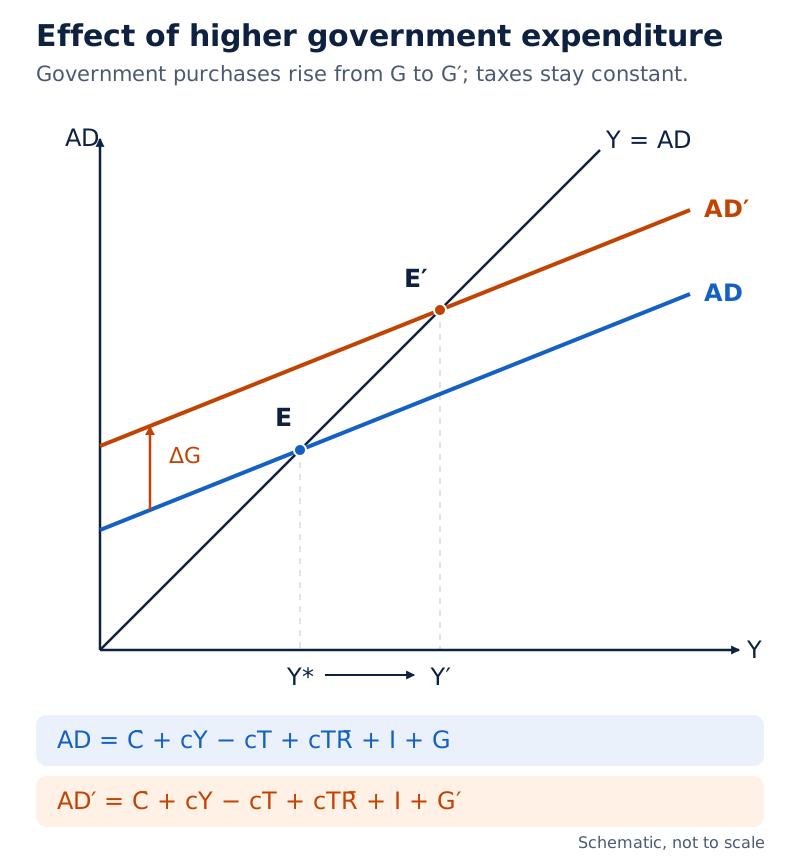
The vertical axis is AD and the horizontal axis is Y. A rising line labelled Y = AD crosses two parallel spending schedules. The higher schedule replaces G with G′. Equilibrium moves from E to E′ and income from Y* to Y′.
Drawn by One Young India. See Fig. 5.1 in your NCERT textbook
Worked example 1. The marginal propensity to consume is 0.8. Government purchases increase by 100, with lump-sum taxes and other autonomous components unchanged. Find the expenditure multiplier and the income increase.
Answer: The multiplier is 1/(1 − 0.8) = 5. Hence ΔY = 5 × 100 = 500. Government purchases directly initiate spending of 100; the completed multiplier process raises equilibrium income by 500.
Why is the tax multiplier negative?
Let ΔT be the change in lump-sum taxes. A tax increase reduces disposable income and consumption, lowering equilibrium output. A tax cut has the opposite effect. This explains the negative sign of the tax multiplier.
Tax multiplier = ΔY/ΔT = −c/(1 − c).
T′ denotes the lower tax level.
What the figure shows
Effect of a reduction in taxes
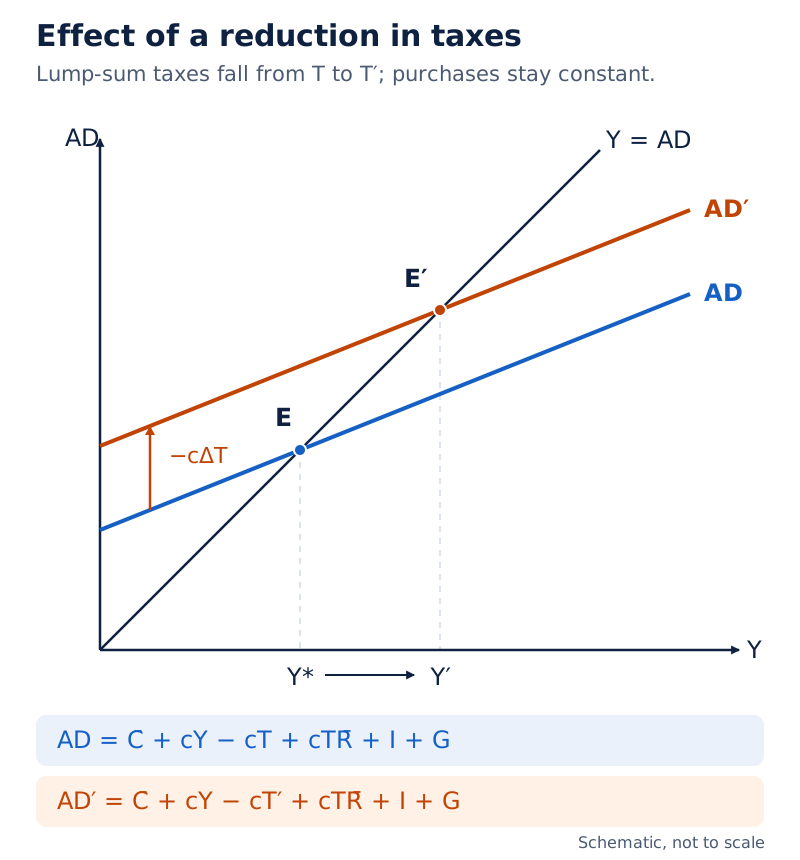
AD is measured vertically and Y horizontally. The line Y = AD intersects two parallel upward-sloping spending schedules. The upper schedule contains −cT′ instead of −cT. The new intersection E′ corresponds to higher income Y′, compared with Y* at E.
Drawn by One Young India. See Fig. 5.2 in your NCERT textbook
A tax cut shifts spending upwards by c times the tax reduction. Its initial effect is smaller than an equal increase in purchases because part of the extra disposable income is saved.
Worked example 2. With marginal propensity to consume 0.8 and lump-sum taxes, government cuts taxes by 100 while purchases and other autonomous components remain unchanged. Calculate the income effect.
Answer: The tax multiplier is −0.8/(1 − 0.8) = −4. A cut gives ΔT = −100, so ΔY = (−4) × (−100) = 400. The income increase is smaller than the 500 generated by an equal purchase increase.
Why is the balanced budget multiplier equal to one?
The balanced budget multiplier measures the income effect when an increase in government purchases is matched by an equal increase in lump-sum taxes. Within this model, the tax multiplier is one less in absolute value than the expenditure multiplier.
Balanced budget multiplier = 1/(1 − c) − c/(1 − c) = 1.
The increase in purchases adds its full amount to initial spending. The tax increase initially reduces consumption by only c times that amount. The two effects therefore do not cancel completely. Their net effect raises income by the increase in purchases.
How do the two effects combine?
- Raise government purchases and lump-sum taxes by equal amounts, so ΔG = ΔT.
- Keep investment and transfers unchanged while allowing consumption to respond to disposable income.
- Write the income change as ΔY = ΔG + c(ΔY − ΔT).
- Substitute ΔT = ΔG and rearrange to obtain (1 − c)ΔY = (1 − c)ΔG, giving ΔY = ΔG.
Worked example 3. The marginal propensity to consume is 0.8. Government purchases and lump-sum taxes each increase by 100, while investment and transfers remain unchanged. Find the combined income effect.
Answer: Higher purchases raise income by 5 × 100 = 500. Higher taxes reduce it by 4 × 100 = 400. The net increase is 500 − 400 = 100, equal to the increase in government purchases.
The equilibrium change refers to the final income reached after all rounds of the multiplier have worked through. The result belongs to the stated lump-sum-tax framework. It should not be detached from its assumptions about unchanged investment, transfers and matched tax and spending changes.
How do proportional taxes act as automatic stabilisers?
A proportional income tax collects a constant fraction of income. Let t denote this tax rate, so T = tY. As income changes, tax revenue changes with it even without a new policy decision.
C = C̄ + c(1 − t)Y + cTR̄.
The consumption response to income becomes c(1 − t). Some additional income is paid as tax before the household makes its consumption decision. The aggregate demand schedule therefore becomes flatter than in the lump-sum-tax model.
What happens to the multiplier?
Let Ā denote autonomous expenditure, the spending component independent of current income. In this proportional-tax model, Ā = C̄ + cTR̄ + I + G. Equilibrium gives Y* = Ā/[1 − c(1 − t)].
Proportional-tax expenditure multiplier = 1/[1 − c(1 − t)].
Worked example 4. The marginal propensity to consume is 0.8 and the proportional tax rate is 0.25. Government purchases increase by 100, with the tax rate, transfers and investment unchanged. Find the income increase.
Answer: The consumption response is 0.8 × (1 − 0.25) = 0.6. The multiplier is 1/(1 − 0.6) = 2.5. Therefore, income rises by 2.5 × 100 = 250, compared with 500 under unchanged lump-sum taxes.
Why is the stabilising effect automatic?
An automatic stabiliser reduces fluctuations without requiring a fresh decision. When income rises, proportional taxes limit the rise in disposable income and consumption. During a recession, a downturn in economic activity, taxes fall as income falls, cushioning the decline in disposable income.
Gross domestic product, or GDP, measures domestic output. Disposable income fluctuates less sharply than GDP under proportional taxation. Welfare transfers also sustain consumption during a slump, while tax receipts during boom years exert a stabilising influence.
Discretionary fiscal policy is deliberate government action to stabilise the economy. Government purchases can be increased to offset a fall in investment. Automatic stabilisers reduce only part of economic fluctuations; deliberate policy must address the remainder.
How do transfer payments affect equilibrium income?
Transfers raise household disposable income, but they do not enter aggregate demand in the same way as government purchases. A household spends part of the additional transfer and saves part. The initial spending increase is therefore c times the transfer increase.
Let ΔTR denote a change in government transfers. With lump-sum taxes, the transfer multiplier gives the change in equilibrium income for a change in transfers, holding the other autonomous components unchanged.
Transfer multiplier = ΔY/ΔTR = c/(1 − c).
Why is the purchase effect larger?
Government purchases increase spending directly by their full amount. Transfers increase spending through consumption, so some of the initial addition to disposable income is saved. Consequently, an equal transfer increase raises output by less than an increase in purchases.
Worked example 5. The marginal propensity to consume is 0.75 and taxes are lump-sum. Compare two separate policies: a purchase increase of 20 and a transfer increase of 20. Hold other autonomous components unchanged in each case.
Answer: The purchase multiplier is 1/(1 − 0.75) = 4, so income rises by 4 × 20 = 80. The transfer multiplier is 0.75/(1 − 0.75) = 3, so income rises by 3 × 20 = 60.
These calculations compare alternative changes, not a combined policy. Keeping them separate makes clear that the difference comes from the route through which spending enters the economy. Purchases enter demand directly; transfers first pass through household consumption decisions.
When is government debt burdensome and how can deficits be reduced?
Government debt is what government owes. A deficit is a flow, measured over a period; debt is a stock, accumulated at a point in time. Continued borrowing adds to debt, and associated interest payments can themselves contribute to further borrowing.
Why are there different views of the burden?
Borrowing can shift reduced consumption to future generations if future taxes repay current borrowing. It can also reduce savings available for private investment. To the extent that this reduces capital formation and growth, debt burdens future generations.
Ricardian equivalence is the counterargument that forward-looking households anticipate future taxes and increase saving now. Their extra saving fully offsets government dissaving in this view. Taxation and borrowing are then equivalent ways of financing expenditure.
The argument assumes concern for future family members as well as present consumption. It is a perspective on behaviour, not a claim that every household necessarily responds this way. Debt owed abroad involves a burden because goods must be sent abroad corresponding to interest payments.
Are deficits necessarily inflationary or harmful to investment?
Higher purchases or lower taxes raise demand. Firms may be unable to increase output at existing prices, producing inflation. However, with unutilised resources and insufficient demand, a high fiscal deficit can raise demand and output and need not be inflationary.
Crowding out occurs when government borrowing competes for savings and leaves fewer funds for private borrowers. However, savings are not fixed if income can rise. If deficits raise production, higher income can generate more saving, allowing government and industry to borrow more.
Infrastructure investment may leave future generations better off, provided its return exceeds the interest rate. Output growth could repay the debt. Debt growth therefore needs assessment alongside growth of the economy as a whole.
What choices are involved in deficit reduction?
Deficits can be reduced by increasing taxes or reducing expenditure. In India, attempts have included greater reliance on direct taxes and receipts from selling PSU shares. Better programme planning and administration can improve the efficiency of government spending.
Cutting programmes in agriculture, education, health and poverty alleviation would adversely affect the economy. Reducing spending therefore requires attention to its purpose and effects, rather than treating all expenditure cuts as equally desirable.
Note: Larger deficits do not always signify more expansionary fiscal policy. During recession, falling income reduces tax receipts and increases the deficit even without a policy change. A boom can produce the opposite movement.
Glossary
- Government budget — A statement of estimated government receipts and expenditure for a financial year.
- Public goods — Collectively consumed goods whose benefits are non-rivalrous and non-excludable among users.
- Free-rider — A person who enjoys the benefits of a public good without paying for them.
- Revenue receipts — Government receipts that do not create a repayment claim on the government.
- Capital receipts — Government receipts that create liabilities or reduce the government's financial assets.
- Revenue expenditure — Spending for purposes other than creating physical or financial assets of the central government.
- Capital expenditure — Government expenditure that creates physical or financial assets or reduces financial liabilities.
- Revenue deficit — The excess of government revenue expenditure over its revenue receipts.
- Fiscal deficit — Total government expenditure minus revenue receipts and non-debt-creating capital receipts, indicating borrowing requirements.
- Gross primary deficit — Gross fiscal deficit after deducting the government's net interest liabilities.
- Fiscal policy — Government use of expenditure and taxes to influence output, income and economic fluctuations.
- Marginal propensity to consume — The fraction of additional disposable income that households spend on consumption.
- Automatic stabiliser — A feature that cushions economic fluctuations without requiring a fresh policy decision.
- Ricardian equivalence — The view that anticipated future taxation induces saving that fully offsets increased government dissaving.
- Crowding out — Displacement of private borrowing when government borrowing claims available savings in financial markets.
Common errors and misconceptions
- Misconception: Public provision means government production. Correct: Budget financing is public provision; either government or private producers may produce publicly provided goods.
- Misconception: Every capital receipt is a borrowing. Correct: Loan recovery and PSU disinvestment are non-debt-creating capital receipts.
- Misconception: Interest received and loan recovery have the same classification. Correct: Interest is non-tax revenue; loan recovery is a capital receipt.
- Misconception: Grants for asset creation must be central government capital expenditure. Correct: Grants to states and other parties remain revenue expenditure of the central government, even when some finance assets.
- Misconception: Borrowing should be deducted when calculating fiscal deficit. Correct: Fiscal deficit deducts receipts excluding borrowing because it measures the borrowing requirement.
- Misconception: A tax cut of 100 and a purchase increase of 100 have equal multiplier effects. Correct: Under lump-sum taxation, the tax effect is smaller in absolute value because consumption transmits it.
- Misconception: Every fiscal deficit causes inflation. Correct: With unutilised resources and deficient demand, a deficit can increase output and need not be inflationary.
- Misconception: A larger deficit proves a more expansionary policy. Correct: Falling tax revenue during recession can enlarge the deficit without any policy change.
Exam-style questions with model answers
Q1. Distinguish public provision from public production. [2 marks]
- Public provision means financing goods through the government budget so that users do not make direct payments for their use.
- Public production means direct production by government. Publicly provided goods may instead be produced by private producers.
Q2. Explain the allocation, redistribution and stabilisation functions of the government budget. [3 marks]
- Allocation involves providing public goods, such as national defence, whose non-rivalrous and non-excludable benefits make market provision difficult.
- Redistribution changes household disposable income through taxes and transfers, helping move income distribution towards one considered fair by society.
- Stabilisation addresses fluctuations in income and employment by expanding demand when it is insufficient or restraining demand when it exceeds available output.
Q3. Explain revenue deficit, fiscal deficit and gross primary deficit, including their formulas. [3 marks]
- Revenue deficit equals revenue expenditure minus revenue receipts. It indicates government dissaving and the financing of some consumption expenditure from other sectors' savings.
- Fiscal deficit equals total expenditure minus revenue receipts and non-debt-creating capital receipts. It indicates total borrowing requirements.
- Gross primary deficit equals gross fiscal deficit minus net interest liabilities. Net interest liabilities mean interest payments less government interest receipts on net domestic lending.
Q4. In a lump-sum-tax model, marginal propensity to consume is 0.8. Compare a purchase increase of 100 with a separate tax cut of 100. Keep investment, transfers and other autonomous components unchanged in each case. [4 marks]
- The government expenditure multiplier is 1/(1 − 0.8) = 5. Purchases initiate spending directly.
- A purchase increase of 100 therefore raises equilibrium income by 5 × 100 = 500.
- The tax multiplier is −0.8/(1 − 0.8) = −4. A tax cut is a tax change of −100, giving an income increase of 400.
- The purchase effect exceeds the tax-cut effect because the tax cut initially raises consumption by only the marginal propensity to consume times the increase in disposable income.
Q5. Marginal propensity to consume is 0.8 and the proportional income tax rate is 0.25. Government purchases rise by 100, with investment, transfers and the tax rate unchanged. Calculate the income response and explain the stabilising role of proportional taxation. [4 marks]
- The consumption response to additional income is 0.8 × (1 − 0.25) = 0.6, since part of income is paid as tax.
- The expenditure multiplier is 1/(1 − 0.6) = 2.5.
- The increase in equilibrium income is 2.5 × 100 = 250, reflecting the smaller induced consumption response.
- Proportional taxation automatically cushions fluctuations: rising income raises taxes, while falling income lowers taxes. Disposable income and consumption therefore fluctuate less sharply without requiring a fresh policy decision.
Q6. With lump-sum taxes and marginal propensity to consume 0.75, compare a government purchase increase of 20 with a separate transfer increase of 20. Keep other autonomous components unchanged. [3 marks]
- The government purchase multiplier is 1/(1 − 0.75) = 4. A purchase increase of 20 raises equilibrium income by 4 × 20 = 80.
- The transfer multiplier is 0.75/(1 − 0.75) = 3. A transfer increase of 20 raises equilibrium income by 3 × 20 = 60.
- Transfers have the smaller effect because households save part of the additional transfer, while purchases directly add their full amount to spending.
Q7. Explain six considerations in assessing whether government debt imposes a burden. [6 marks]
- Future taxes used to repay current borrowing can lower future generations' disposable income and consumption, shifting a burden across generations.
- Government borrowing can reduce savings available for private investment. To the extent that this lowers capital formation and growth, debt is burdensome.
- Ricardian equivalence offers a counterargument: forward-looking households anticipating future taxes increase saving, fully offsetting government dissaving in this view.
- Debt owed to foreigners involves a burden because interest payments require the transfer of goods abroad, rather than retaining purchasing power within the nation.
- If deficit spending raises production and income, saving can also rise. Government and industry may then both obtain more funds.
- Infrastructure investment may benefit future generations if its return exceeds the interest rate. Debt should therefore be assessed alongside growth of the economy.
Q8. Explain five considerations involved in reducing government deficits. [5 marks]
- Raising tax revenue can reduce a deficit. Indian efforts have included greater reliance on direct taxes as a means of increasing receipts.
- Sale of government shares in Public Sector Undertakings provides receipts. This approach reduces government financial assets rather than creating fresh debt.
- Better planning and administration can make government activities more efficient, providing a route to expenditure reduction through improved programme management.
- Cutting programmes in agriculture, education, health and poverty alleviation would adversely affect the economy, so the composition of spending reductions matters.
- Deficits also depend on economic conditions. Recession lowers tax receipts and can increase the deficit without a policy change, so deficit size alone does not establish policy stance.
Key takeaways
- The budget combines estimated receipts and expenditure with policy choices about public goods, income distribution and economic stabilisation.
- Public goods are non-rivalrous and non-excludable; public provision concerns budget financing, while public production concerns who produces them.
- Revenue receipts create no repayment claim; capital receipts create liabilities or reduce financial assets held by government.
- Revenue deficit indicates dissaving, fiscal deficit measures borrowing requirements, and primary deficit removes the relevant interest component.
- In the lump-sum-tax model, government purchases have a larger multiplier effect than an equal tax cut or transfer increase.
- Proportional income taxation reduces the multiplier and automatically cushions changes in disposable income when economic activity fluctuates.
- Deficits need not be inflationary when unutilised resources allow increased demand to generate more output.
- Assess debt alongside growth and spending quality; deficit reduction through cuts in vital programmes can harm the economy.
Test yourself
What is the financial year covered by the Indian government budget?
It runs from 1 April to 31 March, with estimated government receipts and expenditure presented in the Annual Financial Statement.
Why can free-riding obstruct private provision of public goods?
Non-paying users cannot feasibly be excluded, so collecting fees is difficult and sometimes impossible. Private enterprise will in general not provide such goods.
How does interest on government lending differ from recovery of the loan?
Interest is non-tax revenue, while recovery of the loan is a non-debt-creating capital receipt.
Why is borrowing excluded from receipts when calculating fiscal deficit?
Fiscal deficit measures the gap that borrowing must finance, so including borrowing would obscure the borrowing requirement.
What is deducted from gross fiscal deficit to obtain gross primary deficit?
Net interest liabilities, meaning interest payments minus government interest receipts on net domestic lending, are deducted.
Why does an equal transfer increase have a smaller effect than a purchase increase under lump-sum taxes?
Part of the transfer is saved, whereas government purchases directly add their full amount to aggregate spending.
What distinguishes automatic stabilisation from discretionary fiscal policy?
Automatic stabilisation cushions fluctuations without a new decision; discretionary policy involves deliberate changes in government fiscal instruments.
Can a deficit rise even when fiscal policy has not changed?
Yes. During recession, lower income reduces tax receipts, increasing the deficit even without a change in fiscal policy.
Take this further
How does India make policy?
The Model NITI Aayog self-paced course: 41 chapters, about 19 hours of study, on how India makes policy, from the policy cycle and writing a white paper to the economy, the Union Budget and governance. It comes with Learnacy Essential.
Learnacy Essential is ₹1,499 for the year. It also adds feedback from an AI writing coach, submission to The OYI Review, World 101’s member tools and the 3D labs. Publication is not guaranteed. See what a year includes
Or create a free account to draft in the Writing Studio, explore World 101’s map and open the 2D version of every lab. Create a free account