
Introduction (Introductory Macroeconomics) | CBSE Class 12 Economics Notes
On this page

This note covers macroeconomics and microeconomics, economic decision-makers, the Great Depression, the emergence of macroeconomics, capitalist production, the distribution of income, investment, households, firms, government and the external sector.
What does macroeconomics study?
Definition: Macroeconomics studies aggregate economic variables and the interlinkages that may exist between different sectors of an economy. An aggregate is an overall economic measure rather than a measure for an individual unit.
Output means the goods and services produced. Macroeconomics asks about total production, the general level of prices and employment across the economy. These questions concern the condition of the country as a whole, although conditions within particular sectors also matter.
A variable is an economic attribute whose level can change. Prices, employment and production are variables. The rate of interest concerns payment for capital, a productive resource used to run an enterprise. The wage rate is the price at which labour services, meaning human work in production, are bought and sold.
Which broad questions does it address?
- Will prices as a whole rise or come down?
- Are employment conditions in the country, or in some sectors, improving or worsening?
- Which indicators can show whether the economy is doing better or worse?
- What steps, if any, can the State take, or people ask for, to improve economic conditions?
The State, called government here, is the institution that frames laws, enforces them and delivers justice. Its economic actions form part of the wider investigation into production, employment and public welfare. Macroeconomics therefore connects economic conditions with questions about possible public action.
Output levels of different goods and services have a tendency to move together. Growth in food grain output is generally accompanied by a rise in industrial output. Within industry, the output of different goods also tends to rise or fall simultaneously.
Prices of different goods and services generally have a tendency to rise or fall simultaneously. Employment in different production units also goes up or down together. These relationships help explain why studying the economy as a whole can be useful.
Inflation refers here to a rise in prices. Falling employment and production levels can indicate movement towards a depression, a period of declining economic activity. When changes become rapid, individual commodities usually show the same general direction of movement as economy-wide aggregates.
Why does macroeconomics use a representative good?
A representative good is a single imaginary commodity used to represent the goods and services produced in the economy. Its production level corresponds to their average production level; its price and employment level reflect the general price and employment level.
This simplification is useful if output, prices and employment across production units bear close relationships to one another. Instead of separately examining every commodity, macroeconomic analysis can focus on the representative good and the relationships between total production, employment and other variables.
Why is this simplification useful?
Macroeconomics usually simplifies analysis in this way because changes in prices and earnings for one commodity more or less also occur for others. The simplification makes it possible to study broad relationships without examining every real commodity bought and sold.
However, a tendency towards common movement does not mean that every commodity has identical production conditions. A single category may overlook vital differences. Agricultural and industrial goods, for example, have production conditions of a different nature.
The same problem arises with labour, meaning human work used in production. Treating all labour as one category may fail to distinguish a firm's manager from its accountant. Both supply labour, but grouping them together may conceal characteristics relevant to the analysis.
When are separate categories needed?
In many cases, a handful of categories is used instead of one representative category. Agricultural goods, industrial goods and services may represent the different commodities produced. These categories may have different production technologies, meaning ways of producing output, and different prices.
| Approach | What it helps examine | Qualification |
|---|---|---|
| One representative good | General production, price and employment levels | May overlook distinctive characteristics of particular goods |
| Several broad categories | Agricultural goods, industrial goods and services | Allows for different technologies and prices |
| Separate sectors | Relationships among households, businesses and government | May explain some developments better than a single aggregate |
A sector is a distinct part of the economy considered for analysis. Interdependence, or even rivalry, between agriculture and industry may matter. Macroeconomics therefore also examines the output, prices and employment of different categories and the relationships between sectors.
How does microeconomics differ from macroeconomics?
Microeconomics studies individual markets, demand and supply, and the decisions of individual buyers and sellers. Demand concerns the quantity of a good buyers are willing and able to purchase at a given price during a specified period, while supply concerns the quantity sellers are willing and able to offer at a given price during that period. Economic agents are individuals or institutions that take economic decisions.
Consumers choose their preferred combinations of goods within their tastes and incomes. Their objective is personal satisfaction or welfare. Producers try to maximise profit, their earnings left after payments for productive resources, by keeping costs low and obtaining favourable selling prices.
An entrepreneur controls major decisions of an enterprise and bears a large part of its risk. Capital is a productive resource used to run an enterprise, including resources embodied in machinery and factories. Land includes the natural resources needed for production.
Does a large company become a macroeconomic agent?
Even a large company is microeconomic in this sense. It acts in the interest of its shareholders, the people who own shares in it. Their interest is not necessarily the interest of the country as a whole. Size alone does not determine the distinction.
In microeconomic analysis, economy-wide phenomena such as inflation or unemployment are either not mentioned or taken as given. Unemployment concerns people who are not working and are looking for jobs. Individual buyers or sellers cannot change these economy-wide conditions by themselves.
| Basis | Microeconomics | Macroeconomics |
|---|---|---|
| Focus | Individual markets and agents | The economy as a whole and sectoral interlinkages |
| Typical decisions | Consumer purchases and producers' output choices | Policies concerning employment, output and public welfare |
| Other parts of the economy | Mostly assumes the rest remains the same | Examines interdependence between sectors |
| Economy-wide conditions | Inflation and unemployment are omitted or taken as given | These conditions are matters to be explained |
General equilibrium means equilibrium of supply and demand in each market in the economy. It brings microeconomic analysis closest to macroeconomics. Nevertheless, macroeconomics also examines public choices that may require changes to the aggregate effects of individual market decisions.
Why are public goals important in macroeconomics?
Adam Smith, regarded as the founding father of modern economics, suggested that buyers and sellers following their own self-interest could make separate consideration of national wealth and welfare unnecessary. Economists gradually found reasons to look beyond this view.
Smith was a Scotsman, a philosopher by training and a professor at the University of Glasgow. His major work on the wealth of nations appeared in 1776. The Physiocrats of France were prominent thinkers of political economy before him.
Why may individual market decisions be insufficient?
- In some cases, markets did not or could not exist.
- In some other cases, markets existed but failed to produce equilibrium of demand and supply.
- In a large number of situations, society chose important social goals that required modification of the aggregate effects of individual decisions.
Such goals include employment, administration, defence, education and health. In India, public choices have to be made to remove or reduce unemployment, improve access to education and primary health care for all, and provide good administration and sufficient defence.
Macroeconomic policies are actions directed towards these wider economic conditions and public goals. They include taxation and other budgetary policies, meaning government decisions about receipts and spending, and policies affecting money supply, interest rates, wages, employment and output.
Who makes these decisions?
The State and statutory bodies, institutions established under law, pursue macroeconomic policies. Examples include the Reserve Bank of India (RBI) and the Securities and Exchange Board of India (SEBI). Typically, their public goals are defined by law or the Constitution of India.
These objectives differ from maximising an individual agent's private profit or personal welfare. Macroeconomic decision-makers often have to go beyond economic objectives and direct resources towards public needs. Their activities pursue the welfare of the country and its people as a whole.
Note: Macroeconomics has deep roots in microeconomics because it studies the aggregate effects of demand and supply. It also examines policies that modify these forces, if necessary, to pursue choices society makes outside markets.
How did the Great Depression lead to macroeconomics?
The classical tradition, dominant before Keynes, held that labourers ready to work would find employment and factories would operate at full capacity. Full capacity here means using the factory's available productive capacity fully. The experience of the Great Depression challenged this view.
The Great Depression began in 1929 and continued into subsequent years. Output and employment fell by huge amounts in Europe and North America. Other countries were affected as well. Demand for goods was low, many factories lay idle and workers lost their jobs.
What does the evidence from the United States show?
The unemployment rate may be defined as the number of people not working and looking for jobs divided by the total number working or looking for jobs. Its denominator therefore includes employed people and unemployed job-seekers, rather than the entire population.
| Measure in the United States of America (USA) | Period or year | Recorded change or level |
|---|---|---|
| Unemployment rate | 1929 | 3 per cent |
| Unemployment rate | 1933 | 25 per cent |
| Aggregate output | 1929 to 1933 | Fell by about 33 per cent |
Worked example 1. In the USA, unemployment rose from 3 per cent in 1929 to 25 per cent in 1933, while aggregate output fell by about 33 per cent. What problem did these developments pose for the classical tradition?
Answer: The rise from 3 per cent to 25 per cent showed a severe employment problem alongside falling output. The possibility of long lasting unemployment required explanation, challenging the expectation that workers ready to work would find employment and factories would operate at full capacity.
What changed with Keynes?
Macroeconomics emerged as a separate branch after the British economist John Maynard Keynes published The General Theory of Employment, Interest and Money in 1936. The economy's capacity to experience long lasting unemployment needed to be theorised about and explained.
Keynes examined the economy in its entirety and the interdependence of its sectors. His approach responded to the problem revealed by the Depression: understanding one individual market was insufficient to explain the broad decline in production and employment.
Born in 1883, Keynes studied at King's College, Cambridge, and later became its Dean. He participated in international diplomacy after the First World War. His The Economic Consequences of the Peace appeared in 1919.
What are the main features of a capitalist economy?
Definition: A capitalist economy is one in which most economic activities involve private ownership of the means of production, production for market sale, and the sale and purchase of labour services at a wage rate.
The means of production are the resources used to produce goods and services. Private ownership places ownership of these resources with private individuals or enterprises. Production activities in a capitalist country are mainly carried out by capitalist enterprises.
Wage labour means labour sold and purchased against wages. It connects those hiring labour with people supplying their work. Production for the market means that goods and services are produced for sale, rather than solely for consumption by their producers.
How is a capitalist enterprise organised?
A typical enterprise has one or several entrepreneurs. They control its major decisions and bear a large part of its risk. They may supply the required capital themselves or borrow it. Production also requires natural resources and human labour.
Some natural resources, such as raw materials, are consumed during production. Others, such as plots of land, are fixed. The entrepreneur combines capital, land and labour to produce output and then sells that output in the market.
| Feature | Meaning for production |
|---|---|
| Private ownership | Means of production are privately owned |
| Market sale | Output is produced to be sold in the market |
| Wage labour | Labour services are bought and sold at a wage rate |
Most is an essential qualification in this definition. It does not state that every activity has these features. The presence of capitalist production also does not remove the role of government or the importance of households in the economy.
The historical setting matters. Capitalist countries came into being only during the last three to four hundred years. Strictly speaking, a handful of countries in North America, Europe and Asia qualify as capitalist countries under these criteria.
How do firms generate income and investment?
A firm is a production unit. In a capitalist firm, the entrepreneur hires wage labour and employs capital and land. These resources are inputs, the resources used in production. Goods and services produced using them are the firm's output.
The money earned from selling output is revenue. It is distributed through payments associated with production. Rent is paid for the service of land, interest is paid to capital, and wages are paid to labour. The remaining revenue is the entrepreneur's profit.
How are production and income connected?
- The entrepreneur obtains labour services and uses capital and land.
- These inputs are brought together to produce goods and services.
- The output is sold in the market, earning revenue for the firm.
- Revenue pays rent, interest and wages, with the remainder becoming profit.
The factors of production are resources and services contributing to production. Capital, land and labour enter the production process, while entrepreneurship organises decisions and bears risk. In a capitalist country, factors earn income through production and sale of the resulting output.
| Recipient or resource | Income | Basis |
|---|---|---|
| Land | Rent | Service provided by land |
| Capital | Interest | Use of capital |
| Labour | Wages | Human work in production |
| Entrepreneur | Profit | Revenue remaining after the other payments |
Why may profits finance expansion?
Investment expenditure includes spending that raises productive capacity, such as buying new machinery or building new factories. Productive capacity means the ability to produce output. Producers often use profits in the next period for these purposes so that production can expand.
The word often matters: using profits for expansion is a described pattern, not a claim about every producer's entire profit. Investment refers here to increasing productive capacity through the machinery and factory examples.
Profit is also uncertain. An entrepreneur may not obtain a high enough selling price for the goods produced, and this may reduce profit. The aim of earning profit therefore exists alongside the risk and uncertainty involved in production and market sale.
Why does the capitalist framework have limits?
The capitalist framework does not describe every form of production. In many underdeveloped countries, peasant families carry out production, especially in agriculture. Peasant family production here refers to farming organised by the family, with most labour performed by its own members.
Wage labour is seldom used in this setting. Production is not solely for the market because the family consumes a great part of its output. Many peasant farms also do not experience a significant increase in their capital stock over time.
Capital stock means the stock of productive capital available. The absence of a significant increase in it distinguishes these farms from the pattern of expansion through new machinery or factories. This is a qualification about many peasant farms, not a statement about every farm.
How can ownership also differ?
In many tribal societies, ownership of land does not exist in the form assumed by the capitalist framework; the land may belong to the whole tribe. Such arrangements differ from private ownership of the means of production. The capitalist analysis is not applicable to these societies.
However, many developing countries have a significant presence of production units organised on capitalist principles. Thus, capitalist firms can be important within a developing country even when the country's production arrangements cannot be described entirely through that framework.
The distinction is between recognising capitalist production where it exists and assuming that all production shares its characteristics. Family labour, consumption of one's own produce, and tribal ownership show why the scope of an economic framework needs careful attention.
Note: An analysis dealing mostly with the working of a capitalist economy may not be entirely able to capture the functioning of a developing country. Keep this qualification when applying the framework to economies with different production arrangements.
How do households and government participate in the economy?
A household is either one individual making decisions about personal consumption or a group whose consumption decisions are jointly determined. Consumption concerns using goods and services to meet wants. A household is therefore identified by its consumption decisions, not simply by the number of members.
Households consume, save and pay taxes. Saving concerns income kept rather than spent on consumption, while taxes are payments imposed by government. Households obtain income because their members participate in production, own firms or provide land and capital.
Where does household income come from?
- Members working in firms receive wages.
- Members employed in government departments receive salaries.
- Owners of firms earn profits.
- Households may receive rent from leasing land and interest from lending capital.
Households also provide demand for firms' products. The market in which firms sell output could not function without this household demand. Their role therefore connects the receipt of income with purchases of the goods and services that firms produce.
What economic functions does government perform?
Government exists alongside the private capitalist sector in both developed and developing countries. It frames laws, enforces them and delivers justice. In many instances, it undertakes production. It also imposes taxes and spends on services and facilities for the public.
Examples include building public infrastructure, meaning facilities provided for public use, running schools and colleges, and providing health services. These economic functions must be included when describing a country's economy. Government cannot be left outside the account of economic activity.
Diagram
Household and firm relationships
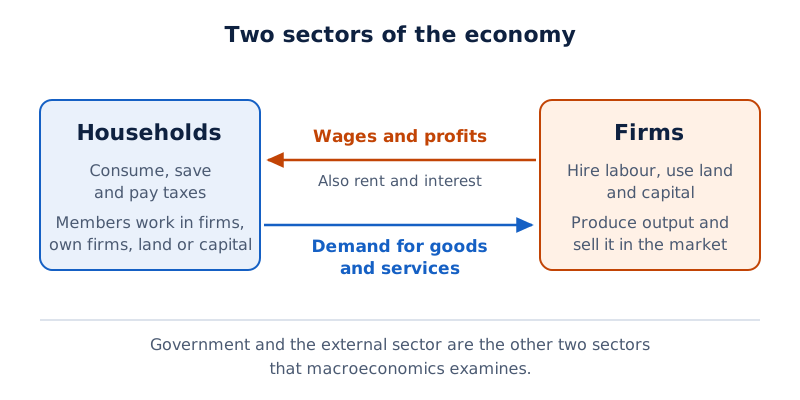
Draw boxes labelled “Households” and “Firms”. Add an arrow from firms to households labelled “Wages and profits”. Add an arrow from households to firms labelled “Demand for goods and services”. This shows relationships between these two sectors.
Drawn by One Young India.
The household and government sectors also connect through government employment and taxes. Taken together with firms, they show why macroeconomic analysis examines relationships between sectors: production, income, consumption and public activity involve connected decisions.
How does the external sector connect with the domestic economy?
The domestic economy is the economy within the country being studied. The external sector consists of its economic connections with the rest of the world. It is the fourth important sector alongside households, firms and government.
Exports are goods sold by the domestic country to the rest of the world. Imports are goods bought by the domestic economy from the rest of the world. The distinction depends on the direction of the transaction from the domestic country's viewpoint.
Are these connections confined to trade?
External connections also involve capital. Capital from foreign countries may flow into the domestic country, or the domestic country may export capital to foreign countries. Thus, the external sector affects the economy through more than purchases and sales of goods.
These movements are called capital flows, meaning movements of capital between countries. Both inward and outward movements are possible. Keeping them distinct from exports and imports helps identify the different ways the rest of the world can affect the domestic economy.
| Sector | Activities or relationships |
|---|---|
| Households | Consumption, saving, taxes and receipt of income |
| Firms | Hiring inputs, producing output and selling it for profit |
| Government | Law, taxation, public spending and, in many instances, production |
| External sector | Exports, imports and international capital movements |
Why consider all four sectors together?
The four sectors provide a way of examining the economy and its interlinkages. Firms employ people from households; households demand firms' products; government collects taxes and provides services; and the country exchanges goods and capital with the rest of the world.
Macroeconomics takes account of the various interlinkages that may exist between sectors. Microeconomics mostly examines particular parts while assuming that the rest remains the same. The four-sector view brings these connections into the analysis of aggregate economic variables.
Glossary
- Macroeconomics — Study of aggregate economic variables and the interlinkages that may exist between different sectors of an economy.
- Microeconomics — Study of individual markets and economic agents, mostly assuming that the rest of the economy remains the same.
- Economic agents — Individuals or institutions that take economic decisions, including consumers, producers, government and banks.
- Representative good — An imaginary commodity used to represent production, prices and employment across goods and services in the economy.
- Unemployment rate — Number not working and looking for jobs divided by the total number working or looking for jobs.
- Capitalist economy — Economy where most activities involve private means of production, market sale of output and purchase of wage labour.
- Entrepreneur — Person controlling major decisions of an enterprise and bearing a large part of its associated risk.
- Revenue — Money earned by an enterprise from selling its output in the market.
- Profit — Entrepreneur's earnings remaining from revenue after payments to land, capital and labour.
- Investment expenditure — Expenditure raising productive capacity, such as buying new machinery or building new factories.
- Wage labour — Labour services sold and purchased in exchange for payment of wages.
- Household — An individual deciding personal consumption or a group whose consumption decisions are jointly determined.
- External sector — The economy's connections with the rest of the world through trade and movements of capital.
- Exports — Goods that the domestic country sells to the rest of the world.
- Imports — Goods that the domestic economy buys from the rest of the world.
Common errors and misconceptions
- Misconception: Every large company is a macroeconomic agent. Correct: Even a large company is microeconomic when acting for its shareholders, whose interests are not necessarily those of the country.
- Misconception: All goods have identical production conditions. Correct: Agricultural and industrial goods have different production conditions; a representative good may overlook important differences.
- Misconception: Macroeconomics has no connection with microeconomics. Correct: It studies aggregate effects of market demand and supply as well as policies that may modify those effects.
- Misconception: The unemployment rate uses the entire population as its denominator. Correct: Its denominator is the total number working or looking for jobs.
- Misconception: All revenue is profit. Correct: Rent, interest and wages are paid from revenue; the remaining earnings are profit.
- Misconception: Every activity in a capitalist economy must follow capitalist principles. Correct: The definition refers to most economic activities, and government also has economic functions.
- Misconception: Households only consume. Correct: They also save, pay taxes and receive income through employment, ownership of firms, land and capital.
- Misconception: The external sector concerns only exports and imports. Correct: Capital may also flow into the domestic country or from it to foreign countries.
Exam-style questions with model answers
Q1. Distinguish exports from imports from the domestic country's viewpoint. [2 marks]
- Exports are goods that the domestic country sells to the rest of the world.
- Imports are goods that the domestic economy buys from the rest of the world.
Q2. Explain three main characteristics of a capitalist economy. [3 marks]
- There is private ownership of the means of production: productive resources belong to private individuals or enterprises.
- Production takes place for selling output in the market. Goods and services are produced with market sale as their purpose.
- Labour services are bought and sold at a wage rate. This is wage labour. These characteristics apply to most economic activities in a capitalist economy.
Q3. Describe the four major sectors considered in macroeconomic analysis. [4 marks]
- Households make consumption decisions, save and pay taxes. Their members earn income through work and ownership of firms, land or capital.
- Firms hire labour, use land and capital, produce goods and services, and sell their output with the motive of earning profits.
- Government frames and enforces laws, delivers justice, taxes and spends, and in many instances also undertakes production.
- The external sector connects the domestic economy with the rest of the world through exports, imports and movements of capital.
Q4. In the USA, unemployment rose from 3 per cent in 1929 to 25 per cent in 1933, while aggregate output fell by about 33 per cent. Using these data, explain the economic problem and how it challenged the classical tradition. [5 marks]
- The unemployment rate rose from 3 per cent to 25 per cent over the stated period. This indicated a severe deterioration in employment conditions in the USA.
- Aggregate output fell by about 33 per cent. The employment problem therefore occurred alongside a major decline in total production.
- The classical tradition held that all labourers ready to work would find employment, an expectation challenged by the substantial unemployment shown in these data.
- It also held that factories would operate at full capacity. The sharp contraction in output called attention to the problem of unused productive capacity.
- The possibility of long lasting unemployment required explanation. Economists needed to reconsider how the economy as a whole functioned instead of presuming employment would be available.
Q5. Explain six differences or connections between microeconomics and macroeconomics. [6 marks]
- Microeconomics studies individual markets and the decisions of buyers and sellers. Macroeconomics examines aggregate variables and situations facing the economy as a whole.
- Microeconomic consumers seek personal satisfaction, while producers seek profit. Macroeconomic policy-makers pursue public goals concerning the welfare of the country and its people.
- Even a large company is microeconomic when acting for its shareholders. Macroeconomic policies are pursued by the State and statutory institutions with public responsibilities.
- Microeconomics omits or takes as given economy-wide conditions such as inflation and unemployment. Macroeconomics investigates these broader conditions.
- Microeconomics mostly examines particular sectors while holding the rest unchanged. Macroeconomics considers the interlinkages that may exist between sectors.
- Macroeconomics remains rooted in microeconomics because it studies aggregate effects of demand and supply. It additionally examines policies that may modify those market effects.
Q6. A firm earns revenue by selling output produced using land, capital and labour. Explain its distribution into four forms of income. [4 marks]
- Part of the revenue is paid as rent for the service rendered by land used in production.
- Part is paid as interest to capital, which is another resource employed in the production process.
- Part goes to labour as wages for the human work involved in producing the firm's output.
- The remainder is profit, the earnings of the entrepreneur. Revenue must therefore be distinguished from the profit left after these other payments.
Q7. Why may a capitalist framework fail to capture the entire functioning of a developing economy? Give three reasons. [3 marks]
- In many underdeveloped countries, peasant families perform most agricultural labour themselves. Wage labour is seldom used in this form of production.
- Production is not solely for market sale, because families consume a great part of the output. Many peasant farms also lack a significant rise in capital stock.
- In many tribal societies, land may belong to the whole tribe. This differs from private ownership of the means of production assumed in the capitalist framework.
Q8. State two reasons for using several categories of goods or labour instead of one representative category. [2 marks]
- Agricultural and industrial goods have different production conditions that a single representative good may conceal.
- A single category of labour may fail to distinguish the work of a firm's manager from that of its accountant.
Key takeaways
- Macroeconomics studies aggregate output, prices and employment while considering the interlinkages that may exist between sectors.
- A representative good simplifies analysis, but several categories may be needed to preserve important differences.
- Even large companies remain microeconomic agents when they pursue shareholder interests rather than the country's welfare.
- The Great Depression challenged classical expectations and helped stimulate Keynes's examination of the economy in its entirety.
- Most activities in a capitalist economy involve private ownership, market sale of output and wage labour.
- Revenue pays rent, interest and wages; the remainder is profit, which producers often use to finance expansion.
- Households, firms, government and the external sector together provide a framework for examining economic activity and relationships.
- A framework focused on capitalist production may not entirely capture economies with substantial family or tribal production arrangements.
Test yourself
What is an economic agent?
An individual or institution that takes economic decisions, such as a consumer, producer, bank or government.
Why can a large company still be microeconomic?
It acts in its shareholders' interests, which are not necessarily the interests of the country as a whole.
What does a representative good help simplify?
It helps analyse relationships between total production, employment and variables such as prices, wages, interest and profits.
What belongs in the denominator of the unemployment rate?
The total number of people who are working or looking for jobs, rather than the entire population.
Which publication marked the emergence of macroeconomics as a separate branch?
Keynes's The General Theory of Employment, Interest and Money, published in 1936, marked this development.
What makes spending on new machinery investment expenditure?
It raises productive capacity, allowing production to expand, as does expenditure on building new factories.
How can households earn rent and interest?
Households can earn rent by leasing land and interest by lending capital.
Which external connection exists besides exports and imports?
Capital may flow from foreign countries into the domestic country, or the domestic country may export capital.
Write about it
Turn a question from this chapter into a paper.
The Writing Studio has a structure guide, a rubric and citation tools for 15 formats, from essays to research papers. Drafting is free with an account. Learnacy Essential adds feedback from an AI writing coach and submission to The OYI Review.
Publication depends on review and is not guaranteed.