
Indian Economy 1950-1990 | CBSE Class 12 Economics Notes
On this page
Try an idea before you read. For decades India protected its industries. Work out the logic — and the cost. Explore →
This note covers India's mixed economy, economic planning, growth, modernisation, self-reliance, equity, land reforms, the Green Revolution, agricultural subsidies, industrial policy, small-scale industry, import substitution and the achievements and limitations of development policies during 1950 to 1990.
Why did India choose a mixed economy after independence?
What economic choices faced the new nation?
After independence on 15 August 1947, India's leaders had to choose an economic system that would improve the welfare of the population. The central concern was development that benefited the many rather than prosperity confined to a few.
Every economy must decide what to produce, how to produce and how to distribute its output. These questions concern the choice of goods and services, the use of labour or machinery, and the people who receive the resulting products.
| Economic system | Production decisions | Distribution |
|---|---|---|
| Capitalist economy | Market demand, profitability and relative costs guide production. | Purchasing power determines access to goods and services. |
| Socialist economy | The government decides what and how to produce. | In principle, distribution is based on people's needs. |
| Mixed economy | The market and government both make economic decisions. | The government also supplies essential services that the market fails to provide. |
Purchasing power means the ability to buy goods and services. Low-cost housing may be urgently needed by poor households, but their need does not become market demand unless they can pay. This explains why relying on market forces alone could leave many people behind.
Under capitalism, demand for cars or bicycles guides their production. Relative costs also influence methods: cheaper labour encourages labour-intensive production, while cheaper capital encourages greater use of machines. Need and profitable demand are therefore different ideas.
What alternative did Nehru favour?
Jawaharlal Nehru favoured the socialist outlook but did not support adopting the former Soviet Union's complete state ownership of factories and farms. India's democratic setting and private property called for a different approach.
The chosen mixed economy combined a strong public sector with private property and democracy. Government planning would guide development, while private enterprise would participate in the plan effort. The Industrial Policy Resolution of 1948 and the Constitution's Directive Principles reflected this outlook.
What is planning, and how were India's plans organised?
Definition: An economic plan sets out how national resources should be used to achieve general goals and specific objectives within a stated period.
The Planning Commission was established in 1950, with the Prime Minister as its Chairperson. Planning aimed to raise living standards and widen people's opportunities through the organised use of the country's resources.
How did five-year and perspective plans differ?
India adopted five-year plans, borrowing the idea from the former Soviet Union. A five-year plan specified objectives for five years. A perspective plan stated longer-term objectives over twenty years, with successive five-year plans providing its basis.
Plan documents up to 2017 contained both these time horizons. Planning did not require officials to specify the quantity of every good and service. Instead, it could concentrate on sectors such as power generation and irrigation while leaving other decisions to the market.
Goals were necessary to give direction to resource use. Since resources were limited, every goal could not receive equal priority in every plan. Planners had to balance objectives and avoid policies that contradicted the overall goals as far as possible.
How did Mahalanobis contribute?
Prasanta Chandra Mahalanobis, a statistician, supplied the ideas on which the Second Five Year Plan was based. Its approach established basic ideas about Indian planning, earning him recognition as an architect of the planning process.
Born in 1893 in Calcutta, he studied at Presidency College and Cambridge University. He became a Fellow of Britain's Royal Society in 1945, established the Indian Statistical Institute in Calcutta and started the journal Sankhya.
During the Second Plan, Mahalanobis invited distinguished economists from India and abroad to advise on development. He also listened to critics of the Plan's socialist principles. His contribution to planning can be recognised even when economists disagree with his approach.
What were the four common goals of five-year plans?
What do growth and modernisation mean?
Growth means an increase in the economy's capacity to produce goods and services. It can result from more productive capital, expanded supporting services such as transport and banking, or greater efficiency in using capital and services.
Gross Domestic Product (GDP) is the market value of all final goods and services produced within the country during a year. A steady increase in GDP is an indicator of economic growth. A larger output makes a richer and more varied life possible.
Modernisation includes adopting new technology, such as improved seed varieties on farms or new machines in factories. It also includes changes in social attitudes, particularly recognising women's equal rights and using their talents in workplaces such as banks, schools and factories.
Why were self-reliance and equity needed?
Self-reliance meant avoiding imports of goods that could be produced in India. The first seven plans emphasised reducing dependence on foreign countries, especially for food. Dependence on foreign food, technology and capital was feared to expose Indian policies to foreign interference.
Equity required the benefits of development to reach poor people. Growth, modern technology and domestic production could coexist with widespread poverty. Equity therefore involved meeting basic needs and reducing inequality in the distribution of wealth.
| Goal | Central concern |
|---|---|
| Growth | Expand the capacity to produce goods and services. |
| Modernisation | Improve technology and change restrictive social attitudes. |
| Self-reliance | Reduce dependence on imports that domestic production can replace. |
| Equity | Meet basic needs and reduce inequalities in wealth. |
Basic needs include food, decent housing, education and health care. A larger national output does not itself ensure that these needs are met for everyone. Growth with equity therefore joins greater production with wider access to its benefits.
Note: Planning goals can conflict. A modern technology that reduces labour requirements may work against employment generation. Planners must balance such effects rather than assume every policy advances every goal equally.
How did land reforms seek to improve growth and equity?
Why was ownership important?
At independence, intermediaries such as zamindars and jagirdars collected rent from cultivators without contributing to improvements on farms. Low agricultural productivity forced India to import food from the United States. Both production and fairness required attention.
Land reforms primarily concerned changes in the ownership of landholdings. Steps to abolish intermediaries began a year after independence. The aim was to make actual cultivators owners, giving them an incentive to improve the land when sufficient capital was available.
- A cultivator receives ownership of the land being cultivated.
- The cultivator can benefit from profits created by higher output.
- This strengthens the incentive to invest in improvements, provided capital is available.
- Improved incentives can contribute to agricultural growth alongside the equity objective.
The abolition of intermediaries brought some 200 lakh tenants into direct contact with the government. Ownership incentives contributed to increased output, but removing intermediaries did not fully achieve equity.
The importance of incentives is illustrated by fruit packing in the former Soviet Union. Farmers sometimes packed rotten and fresh fruit together. Since they neither received the profits nor bore the losses, they lacked the ownership incentive to prevent waste.
What were land ceilings and their limitations?
Land ceiling meant fixing the maximum area an individual could own. It sought to reduce the concentration of land in a few hands. Its purpose differed from abolishing intermediaries, although both policies addressed unequal agricultural ownership.
Some former landlords retained large holdings through legal loopholes. In some cases, tenants were evicted and landlords claimed to be self-cultivators. Even where tenants gained ownership, the poorest agricultural workers, including sharecroppers and landless labourers, did not benefit.
Large landowners challenged ceiling laws in court and used delays to register land in relatives' names. Loopholes further weakened implementation. Land reforms succeeded in Kerala and West Bengal, where governments were committed to land for the tiller; commitment was weaker elsewhere.
How did the Green Revolution change Indian agriculture?
At independence, about 75 per cent of the population depended on agriculture. Old technology, inadequate infrastructure and limited irrigation kept productivity low. Farmers without irrigation were particularly vulnerable when the monsoon was insufficient.
Definition: The Green Revolution was the large increase in foodgrain production resulting from high yielding variety seeds, especially for wheat and rice, together with the inputs required for their successful cultivation.
Why were seeds alone insufficient?
High Yielding Variety (HYV) seeds offered higher output, but required fertilisers and pesticides in the correct quantities and a regular water supply. Farmers needed reliable irrigation and enough finance to purchase the complementary inputs.
- Farmers adopted HYV seeds suited to the new cultivation technology.
- They supplied fertilisers and pesticides in the required proportions.
- Reliable irrigation provided the regular water supply needed by the crops.
- The combined use of these inputs increased foodgrain production.
| Phase | Approximate period | Extent of spread |
|---|---|---|
| First phase | Mid-1960s to mid-1970s | HYV use was restricted to more affluent states such as Punjab, Andhra Pradesh and Tamil Nadu; wheat-growing regions primarily benefited. |
| Second phase | Mid-1970s to mid-1980s | The technology reached more states and benefited a wider variety of crops. |
The initial concentration reflected differences in access to irrigation and finance. It should not be confused with an equal or simultaneous spread across all regions. The later phase widened the reach of the technology.
What was the main national achievement?
The spread of Green Revolution technology enabled self-sufficiency in foodgrains. By the late 1960s, increased agricultural productivity had made this possible. Reduced dependence on foreign food supplies strengthened the planning objective of self-reliance.
The achievement was more than an increase in seeds distributed or machinery used. The important result was a rise in foodgrain output. Its wider benefits also depended on how much produce entered markets and whether smaller farmers could participate.
How did marketed surplus and government support spread the benefits?
Why does selling the additional output matter?
Marketed surplus is the portion of agricultural produce that farmers actually sell in the market. A rise in output has a limited economy-wide effect if farmers consume most of the additional produce themselves.
A good proportion of the additional rice and wheat produced during the Green Revolution was sold. Foodgrain prices consequently declined relative to other consumption items. Low-income households benefited because food absorbed a large share of their income.
The government could also procure sufficient foodgrains to build stocks for periods of shortage. Thus, greater production supported consumption beyond farming households and increased the country's ability to cope with food scarcity.
- HYV technology and complementary inputs increased rice and wheat production.
- Farmers sold a good proportion of the produce as marketed surplus.
- Greater availability lowered foodgrain prices relative to other consumption items.
- Low-income consumers benefited, while government procurement helped build food stocks.
How were risks to small farmers reduced?
The technology created a risk of widening inequalities because big farmers could more readily afford the inputs. HYV crops were also more prone to pest attacks, which could cause devastating losses for small farmers.
Government intervention helped prevent these fears from materialising. Low-interest loans and subsidised fertilisers gave small farmers access to inputs. In time, output on small farms equalled output on large farms, and the Green Revolution benefited small as well as rich farmers.
Government research institutes considerably reduced the risk of small farmers being ruined by pests. This did not mean that pests disappeared. It showed why technology and public support had to work together if the benefits were to reach poorer cultivators.
Note: A fall in the relative price of foodgrains is a comparison with other consumption goods. It should not be rewritten as a claim that every food price fell in absolute terms.
Why are agricultural subsidies debated?
A subsidy is government financial assistance for production activities. Agricultural subsidies helped farmers obtain inputs and encouraged them to try new technology that they initially regarded as risky.
What is the argument for continuing subsidies?
Supporters stress that farming remains risky and most farmers are poor. Without assistance, many cannot afford the necessary inputs. Removing subsidies can widen inequalities between rich and poor farmers, conflicting with the goal of equity.
From this viewpoint, poor targeting is a reason to improve delivery. If fertiliser producers and richer farmers capture much of the benefit, the response should be to ensure that assistance reaches poor farmers rather than abolish it.
What is the argument for reducing subsidies?
Critics accept the initial case for encouraging HYV adoption. They argue that subsidies should be phased out once the technology is profitable and widely used. A substantial share of fertiliser subsidy benefits the fertiliser industry, while farmer benefits largely favour prosperous regions.
Subsidies also place a large burden on government finances. Their justification therefore depends on both the benefits delivered and the cost of maintaining them. Economists differ over whether continued assistance is the best way to support cultivators.
| Concern | Reasoning |
|---|---|
| Adoption of technology | Assistance encourages farmers to try inputs that initially appear risky. |
| Equity | Poor farmers may be unable to purchase inputs without support. |
| Targeting | Benefits may reach fertiliser producers and prosperous farmers instead of the intended recipients. |
| Resource use | Artificially cheap inputs can weaken incentives to conserve scarce resources. |
How do prices act as signals?
A higher price can signal greater scarcity and encourage careful use. Costlier water may encourage households to stop watering gardens. A petrol price increase can encourage lower consumption or a search for alternative fuels.
Some economists argue that free or subsidised water and electricity obscure these signals. Farmers may grow water-intensive crops in water-scarce regions. Fertiliser and pesticide subsidies can also encourage excessive use, damaging the environment. The debate links equity, incentives and conservation.
Why did changes in employment lag behind changes in output?
What is structural composition?
The structural composition of an economy refers to the contributions of agriculture, industry and services to its output. Development usually reduces agriculture's share, with industry becoming dominant before services lead at higher levels of development.
India's pattern was distinctive. By 1990, services contributed more to GDP than either agriculture or industry. The shift in output did not produce a comparable movement of people out of agriculture.
Sectoral shares of GDP, in per cent
| Sector | 1950-51 | 1990-91 |
|---|---|---|
| Agriculture | 59.0 | 34.9 |
| Industry | 13.0 | 24.6 |
| Services | 28.0 | 40.5 |
Diagram
Sectoral GDP shares
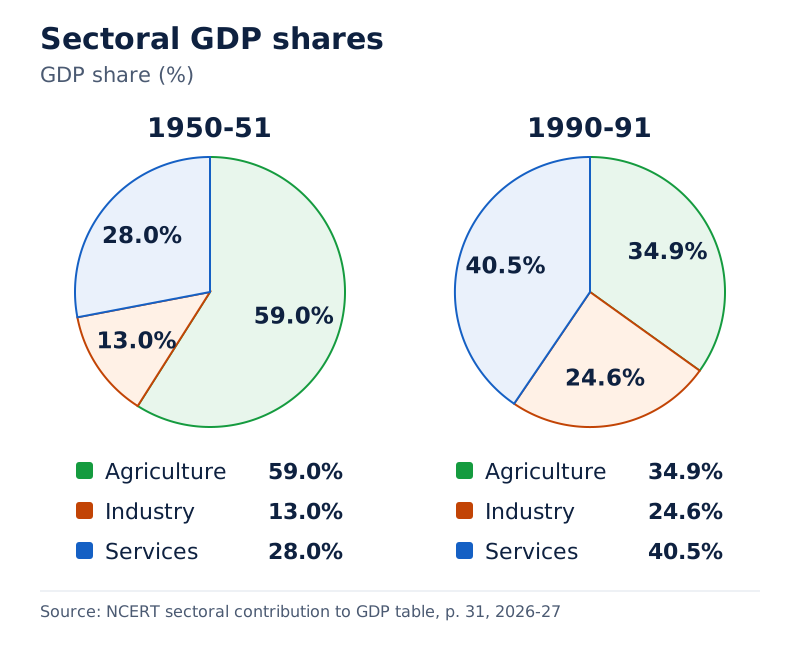
Draw a pie chart for each year using the GDP percentages above. Label agriculture, industry and services. The pair should show agriculture's smaller share and the larger shares of industry and services in 1990-91.
Drawn by One Young India.
What does the occupational structure show?
Occupational shares, in per cent
| Sector | 1950-51 | 1990-91 |
|---|---|---|
| Agriculture | 72.1 | 66.8 |
| Industry | 10.7 | 12.7 |
| Services | 17.2 | 20.5 |
Diagram
Occupational structure
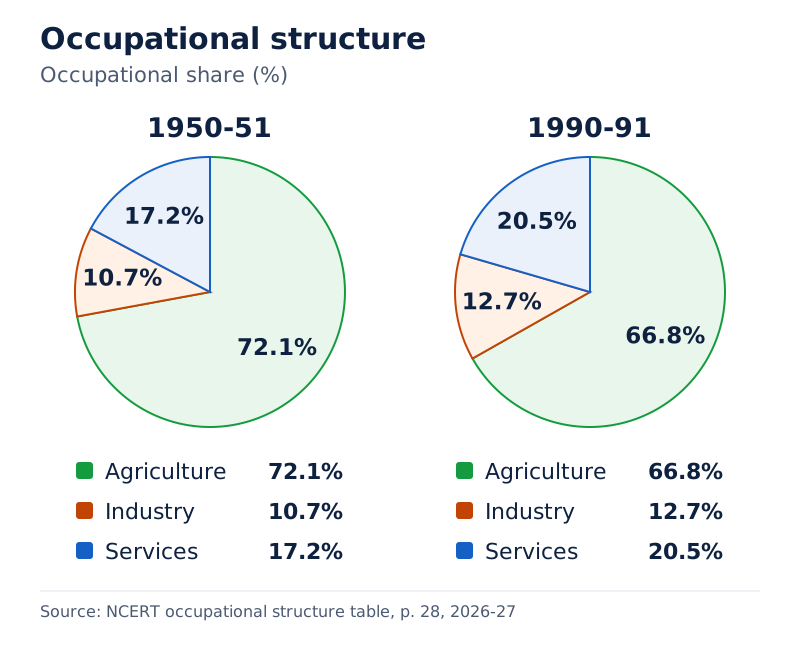
Draw two pie charts using the occupational percentages above, one for each year. Label all sectors and years. Agriculture should remain the largest segment in both charts, with only a limited decline in its occupational share.
Drawn by One Young India.
The industrial and service sectors did not absorb enough people from agriculture. Agricultural output could have increased with fewer people working in the sector, but alternative employment did not expand sufficiently to bring about the expected shift.
This was an important limitation of the policies followed during 1950 to 1990. A falling agricultural GDP share therefore did not mean that the agricultural workforce had fallen to a similarly small proportion.
Note: The two tables measure different things. A sector's share of GDP describes its contribution to output; its occupational share describes the distribution of workers. Use the figures from the relevant table.
Why did the public sector lead industrial development?
What industrial weaknesses did India inherit?
At independence, the industrial base was narrow and largely concentrated in cotton textiles and jute. There were two well-managed iron and steel firms, one in Jamshedpur and the other in Kolkata, but a much wider industrial base was needed.
Industrial development could provide employment more stable than agricultural work, encourage modernisation and promote prosperity. These considerations explain the strong emphasis on industry in the five-year plans.
Private industrialists lacked the capital required for major development projects. The market was also not large enough to encourage such investment, even where funds might have been available. The government therefore took an extensive role in building industry.
The socialist orientation reinforced this decision. The public sector was expected to control the commanding heights, meaning industries vital to the economy. Private-sector policies were expected to complement public-sector leadership.
How did IPR 1956 classify industries?
The Industrial Policy Resolution of 1956 (IPR 1956) formed the basis of the Second Five Year Plan's approach to building a socialist pattern of society. It divided industries into three categories.
| Category | Ownership and role |
|---|---|
| First | Industries exclusively owned by the government. |
| Second | Private enterprise could supplement public-sector efforts, while the government alone had responsibility for starting new units. |
| Third | The remaining industries were assigned to the private sector. |
The distinction between the second and third categories matters. The second allowed private participation without giving private firms the government's responsibility for establishing new units. The third assigned remaining industries to private enterprise, subject to state regulation.
Public leadership therefore did not mean complete abolition of private industry. It was part of a mixed economy in which the government led key investments and regulated the space in which private firms operated.
How did licensing and small-scale industry policies work?
Why were industrial licences required?
Even industries assigned to private enterprise remained under government control through industrial licensing. A new industrial unit required a licence. Existing industries also needed permission to expand output or diversify into a new variety of goods.
Licensing sought to guide investment and ensure that production did not exceed what the economy required. Expansion was permitted when the government was convinced that a larger quantity of the goods was needed.
It was also used to promote regional equality. Establishing a unit in an economically backward area made a licence easier to obtain. Such units could receive tax concessions and electricity at a lower tariff, encouraging investment outside more developed regions.
Why were small-scale industries supported?
In 1955, the Village and Small-Scale Industries Committee, also called the Karve Committee, highlighted the potential of small-scale industry for rural development. Small-scale status was defined by the maximum permitted investment in a unit's assets.
In 1950, this investment limit was ₹5 lakh. The limit changed over time, so this historical figure should not be treated as a permanent definition of small-scale production.
Small-scale industries were believed to be more labour-intensive than large firms and therefore capable of generating more employment. However, they needed protection because they could not compete effectively with large industrial firms.
- Product reservation: production of several goods was reserved for small-scale units, based on their ability to manufacture them.
- Tax concessions: lower excise duties reduced the burden on these enterprises.
- Credit support: bank loans at lower interest rates supported their operations.
These policies gave people without enough capital for large enterprises opportunities to enter business. The intended advantages were employment, rural development and wider participation in industry, alongside the broader objective of expanding production.
How did import substitution protect domestic industry?
Definition: Import substitution means replacing imported goods with goods produced within the country. It formed the basis of the inward-looking trade strategy followed during the first seven plans.
How did tariffs and quotas differ?
For example, instead of importing vehicles manufactured abroad, policy encouraged industries to manufacture them in India. Domestic producers were protected against foreign competition through tariffs and quotas.
| Instrument | Meaning | How it protects producers |
|---|---|---|
| Tariff | A tax on imported goods. | Raises the price of imports and discourages their use. |
| Quota | A limit specifying the quantity of goods that may be imported. | Restricts the amount of foreign goods entering the domestic market. |
The distinction concerns the method of restriction. A tariff works through the price of imported goods, while a quota works through their permitted quantity. Both can reduce foreign competition faced by domestic producers.
What was the case for protection?
Planners believed industries in developing countries were not ready to compete with established producers in more developed economies. Protection was expected to provide time for domestic firms to develop and learn to compete.
There was also concern that unrestricted imports would use scarce foreign exchange on luxury goods. The strategy thus connected industrial growth with self-reliance and the careful use of resources available for purchases abroad.
Protection supported indigenous development in electronics and automobiles. These industries could grow behind restrictions on competing imports. However, the approach gave little serious attention to export promotion until the mid-1980s.
What was its central limitation?
If protection continued after firms had developed, it could weaken the pressure to improve quality and efficiency. Consumers had to buy what domestic producers offered, and firms could sell low-quality goods at high prices in a captive market.
The policy therefore needs to be assessed through both its contribution to establishing industry and its effects on producers' incentives over time. Initial protection and indefinite protection do not have identical consequences.
What were the achievements and limitations of the first seven plans?
What changed in industry and agriculture?
Industry's contribution to GDP increased from 13 per cent in 1950-51 to 24.6 per cent in 1990-91. Industrial output grew at an annual rate of 6 per cent during the period.
The industrial base became much more diverse, largely because of public-sector investment. Small-scale industry encouraged participation by people with limited capital. Protection helped establish indigenous electronics and automobile industries.
Agriculture also made major progress. Land reforms abolished the zamindari system, although their equity effects were incomplete. The Green Revolution brought foodgrain self-sufficiency and helped the government build stocks against shortages.
What problems called for policy change?
Many public enterprises incurred large losses and continued operating, placing pressure on limited resources. Critics argued that government firms remained in activities private producers could undertake. This concern did not imply that private firms were always profitable.
Some public enterprises had originally been loss-making private firms that were nationalised to protect employment. Their performance therefore cannot be explained simply by assuming that every private firm succeeds and every government firm fails.
Telecommunications remained reserved for the public sector even after private firms could provide the service. Lack of competition contributed to long waits for telephone connections even into the late 1990s. Modern Bread, a government bread-manufacturing firm, was sold to the private sector in 2001.
The permit licence raj also encouraged misuse. Large industrialists sometimes obtained licences to stop competitors entering rather than to establish production. Time spent securing permission and lobbying ministries diverted attention from product improvement.
Import restrictions weakened competitive pressure, while the inward-looking approach failed to build a strong export sector. Employment opportunities outside agriculture remained inadequate. These problems limited the gains from growth and industrial diversification.
Why is a balanced assessment necessary?
Some economists argued that public enterprises should be judged by their contribution to welfare rather than profits alone. Others defended continued protection while rich nations also protected their producers. These disagreements show that the evaluation involved competing objectives.
Dissatisfaction with existing policies, together with other economic problems and a changing global setting, led to the new economic policy in 1991. The earlier period had built important capabilities but also revealed the need for greater efficiency and policy reform.
Glossary
- Mixed economy — An economy in which government and markets share decisions about production and the distribution of goods and services.
- Economic plan — A statement of how national resources should be used to achieve objectives within a specified period.
- Perspective plan — A long-term plan describing objectives over twenty years, supported by successive five-year plans.
- GDP — Gross Domestic Product, the market value of final goods and services produced within a country during one year.
- Modernisation — Adoption of new technology together with progressive changes in social outlook, including recognition of women's equal rights.
- Self-reliance — Reducing dependence on foreign countries by avoiding imports of goods that can be produced domestically.
- Equity — Ensuring that development benefits poorer people, meets basic needs and reduces inequalities in wealth.
- Land ceiling — A legal maximum on the land an individual can own, intended to reduce concentrated land ownership.
- HYV seeds — High Yielding Variety seeds that raise crop output when supported by appropriate inputs and reliable water.
- Marketed surplus — The portion of agricultural produce that farmers actually sell in the market rather than consume themselves.
- Subsidy — Financial assistance provided by the government to support production activities and encourage the use of inputs.
- Import substitution — A strategy of replacing imported goods with domestic production, supported by protection from foreign competition.
- Tariff — A tax on imported goods that increases their price and discourages their use in the domestic market.
- Quota — A restriction specifying the quantity of goods permitted to enter a country through imports.
- Labour-intensive production — Production that uses more labour, as illustrated by the comparison of small-scale with large-scale industry.
Common errors and misconceptions
- Misconception: A mixed economy removes private enterprise. Correct: India's approach combined public-sector leadership with private property, democracy and private participation in development.
- Misconception: Modernisation means buying new machines alone. Correct: It also includes changes in social attitudes, such as recognising women's equal rights and using their talents at work.
- Misconception: Self-reliance required ending all imports. Correct: The goal concerned avoiding imports of goods that India could produce itself and reducing dependence.
- Misconception: HYV seeds guarantee high output without other inputs. Correct: They require reliable water and the correct quantities of fertilisers and pesticides.
- Misconception: All agricultural output is marketed surplus. Correct: Marketed surplus is the portion actually sold; produce consumed by farmers is not included.
- Misconception: Agriculture's GDP share and occupational share are interchangeable. Correct: One measures its output contribution; the other concerns the distribution of workers.
- Misconception: A quota is a tax on imports. Correct: A tariff is an import tax; a quota restricts the quantity imported.
- Misconception: Public-sector losses prove that private firms are always profitable. Correct: Some public firms were previously loss-making private enterprises nationalised to protect employment.
Exam-style questions with model answers
Q1. Define marketed surplus and explain why it matters when agricultural output rises. [2 marks]
- Marketed surplus is the portion of agricultural produce that farmers actually sell in the market.
- Higher output benefits the wider economy more when a substantial part is sold, increasing food availability beyond the producing households.
Q2. Explain why growth and equity were separate but complementary planning goals. [3 marks]
- Growth increases the economy's capacity to produce goods and services through more capital, better supporting services or greater efficiency. A steady rise in GDP is an indicator of growth.
- Growth alone can coexist with widespread poverty because its benefits may be concentrated among richer people.
- Equity seeks to extend prosperity to poorer sections, meet basic needs such as food and health care, and reduce inequalities in wealth. Together, the goals concern both output and access to its benefits.
Q3. Explain two land reform measures and two obstacles to their implementation. [4 marks]
- Abolition of intermediaries sought to make cultivators owners, remove rent-collecting intermediaries and strengthen incentives to improve production when capital was available.
- Land ceilings set a maximum holding size to reduce the concentration of ownership in a few hands.
- Landlords used legal loopholes and sometimes evicted tenants while claiming to be self-cultivators, weakening the transfer of ownership.
- Large landowners challenged ceiling legislation in court and used the delay to transfer land into relatives' names. Uneven government commitment also limited implementation.
Q4. Explain the Green Revolution's contribution to self-reliance and equity, including the role of government support. [6 marks]
- The Green Revolution increased foodgrain production through HYV seeds, particularly for wheat and rice, supported by correct input use and reliable irrigation.
- Greater production enabled foodgrain self-sufficiency and reduced dependence on foreign supplies, strengthening self-reliance.
- Farmers sold a good proportion of their produce. Lower foodgrain prices relative to other consumption goods benefited low-income households, while government procurement built stocks for shortages.
- The technology initially risked favouring richer farmers, who could afford the necessary inputs. HYV crops also exposed cultivators to greater pest risks.
- Low-interest loans and subsidised fertilisers helped small farmers obtain inputs, allowing them to share in the gains.
- Government research institutes considerably reduced the danger of small farmers being ruined by pest attacks. State support was therefore central to making technological progress more equitable.
Q5. Discuss the arguments for continuing agricultural subsidies and for phasing them out. [6 marks]
- Subsidies initially encouraged adoption of HYV technology because farmers regarded unfamiliar methods as risky. Support helped them test the new technology and obtain complementary inputs.
- Supporters of continuation argue that agriculture remains risky and most farmers are poor. Many could not afford the required inputs without assistance.
- Removing support could widen inequality. If richer farmers or fertiliser producers capture benefits, supporters favour directing assistance towards poor farmers.
- Critics argue that subsidies should end after the technology becomes profitable and widely adopted, since the original purpose has been served.
- They also point to the burden on government finances and the substantial benefits reaching the fertiliser industry and prosperous regions.
- Cheap water, electricity and other inputs can weaken scarcity signals and encourage wasteful or environmentally harmful use. Evaluation therefore requires attention to equity, targeting, public cost and resource conservation.
Q6. Describe the three industrial categories under IPR 1956 and explain how licensing promoted regional equality. [4 marks]
- The first category contained industries exclusively owned by the government.
- In the second category, private enterprise could supplement public-sector efforts, but the government alone was responsible for starting new units.
- The third category contained the remaining industries assigned to private enterprise, although they remained subject to state regulation.
- Licences were easier to obtain for units established in economically backward regions. Tax concessions and electricity at a lower tariff also encouraged investment there, supporting regional equality.
Q7. Distinguish tariffs from quotas as instruments of import substitution. [2 marks]
- A tariff is a tax on imported goods, raising their price and discouraging their use.
- A quota limits the quantity that can be imported. Both instruments protect domestic producers by restricting foreign competition.
Q8. GDP shares in 1950-51 and 1990-91 were: agriculture 59.0% and 34.9%, industry 13.0% and 24.6%, services 28.0% and 40.5%. Occupational shares were: agriculture 72.1% and 66.8%, industry 10.7% and 12.7%, services 17.2% and 20.5%. Using these figures, explain how output and employment structures changed differently. [4 marks]
- Agriculture's GDP share fell from 59.0 per cent to 34.9 per cent, while industry's rose from 13.0 per cent to 24.6 per cent.
- Services increased from 28.0 per cent to 40.5 per cent and became the largest contributor to GDP among the three sectors.
- Agriculture's occupational share fell only from 72.1 per cent to 66.8 per cent. It still accounted for most employment.
- Industry and services gained occupational shares, but their expansion did not move people out of agriculture to an extent comparable with the change in output composition.
Key takeaways
- India chose a mixed economy combining public-sector leadership, private property, democracy and private participation in planned development.
- The common planning goals were growth, modernisation, self-reliance and equity, although their priorities differed across individual plans.
- Land reforms targeted ownership incentives and unequal holdings, but loopholes and uneven implementation limited their equity gains.
- The Green Revolution raised foodgrain production through HYV seeds, complementary inputs and reliable irrigation, strengthening national self-reliance.
- Government credit, fertiliser support and research helped small farmers share in technological gains and reduced serious risks.
- Agricultural subsidies involve a debate over access, equity, targeting, fiscal costs and incentives to conserve scarce resources.
- IPR 1956 assigned roles to public and private industry, while licensing and small-scale support directed industrial development.
- Import substitution helped build domestic industry, but prolonged protection and excessive regulation weakened competitive incentives and encouraged inefficiency.
- Industry and services increased their GDP shares, while movement of workers out of agriculture remained much more limited.
Test yourself
What three questions must every economy answer?
It must decide what goods and services to produce, how to produce them and how to distribute the resulting output among people.
Who chaired the Planning Commission established in 1950?
The Prime Minister was its Chairperson, linking national planning with the leadership of the government.
Why could modernisation conflict with employment generation?
A new technology may increase production while reducing the labour required, creating a conflict with the objective of generating employment.
What distinguished the second phase of the Green Revolution?
From approximately the mid-1970s to the mid-1980s, HYV technology spread to more states and benefited a wider variety of crops.
Why does land ownership provide an incentive to improve cultivation?
An owner can benefit from the profits created by higher output, encouraging investment in improvements when sufficient capital is available.
What did the Karve Committee highlight in 1955?
It highlighted the potential of village and small-scale industries to contribute to rural development.
Why did planners support import substitution?
They wanted domestic industries to develop before facing stronger foreign competition and sought to avoid spending foreign exchange on luxury imports.
Why should public enterprises not be assessed by profits alone?
Some economists argue that their purpose includes promoting national welfare, so their contribution to people's well-being also matters when evaluating performance.
Try it
Why did India shut out imports?
For decades India protected its industries. Work out the logic — and the cost.
11950s India wanted to build its own industries. How did policy protect them from foreign competition?
Correct. The aim was self-reliance: shield home industry behind tariffs/quotas so India made what it used to import.
The opposite — 1950-90 policy raised barriers to protect infant industries, not lower them.
2What was the downside of this protection over time?
Yes — without competitive pressure, protected industries could grow inefficient, a key reason for the 1991 reforms.
Protection can nurture industry but, prolonged, it dulls the pressure to improve — the recognised weakness of the era.
Planning-era India chose self-reliance through import substitution and a large public sector — building capacity, but with protected inefficiency that the 1991 reforms later targeted.