
Organs of Government | ISC Class 12 Political Science Notes
On this page
Watch & explore
Start with a few high-quality watches, then dive into the notes below.
Try an idea before you read. Step into the shoes of a policymaker and a citizen to see how the branches of government interact in practice. Explore →

This note covers the legislature, executive and judiciary; their composition, powers and relationships in India and the USA; parliamentary accountability, presidential government, judicial independence, court jurisdiction, judicial review, and constitutional checks and balances.
What are the three organs of government, and how do they share power?
The legislature makes laws, the executive administers government and implements laws, and the judiciary interprets laws and settles disputes. These functions are distinct, but governing requires cooperation between the institutions that perform them.
Definition: An organ of government is an institution entrusted with a principal governmental function, such as legislation, administration or adjudication.
Division of functions
The legislature represents people and debates public concerns. Its functions extend beyond passing legislation to authorising public expenditure and scrutinising government. The executive frames policies and organises their implementation through ministers and the administrative machinery.
The judiciary applies the law to disputes, protects rights and examines constitutional limits. An independent court can decide against the government when its action violates the Constitution. This protects citizens challenging public authorities.
Checks and balances
Separation of powers assigns different responsibilities to different organs. Checks and balances give each organ ways of limiting the misuse of power by another. Neither principle means that the organs work in complete isolation.
India combines a parliamentary executive with an independent judiciary. Ministers depend on legislative confidence, while courts examine constitutional validity. In the USA, the President and Congress have separate electoral foundations, but the President still needs congressional legislation and financial authorisation.
How are the Lok Sabha and Rajya Sabha constituted?
The Indian Parliament consists of the President, the Lok Sabha and the Rajya Sabha. Its two Houses reflect different principles of representation. The Lok Sabha represents the people through territorial constituencies, while the Rajya Sabha provides representation to the States and certain Union Territories.
Composition and tenure
| Feature | Lok Sabha | Rajya Sabha |
|---|---|---|
| Other name | House of the People | Council of States |
| Strength | 543 elected seats; constitutional maximum of 550 elected members | Constitutional maximum of 250: up to 238 representatives of States and Union Territories, and 12 nominated members |
| Election | Direct election from territorial constituencies through universal adult suffrage | State representatives elected by elected MLAs through proportional representation using the single transferable vote |
| Tenure | Normal term of five years, subject to earlier dissolution | Members normally serve six years; approximately one-third retire every two years |
| Continuity | The House can be dissolved | A continuing House which is not dissolved |
The President nominates twelve Rajya Sabha members with special knowledge or practical experience in literature, science, art and social service. Nominated membership brings such experience into parliamentary deliberations without direct popular election.
States do not have equal numbers of Rajya Sabha seats. More populous States generally receive more seats. This contrasts with the equal representation of States in the American Senate, where each State has two Senators.
Why have two Houses?
Bicameralism permits a second examination of proposed laws and provides an additional channel of representation. A second House can draw attention to defects, demand clarification and make hasty decisions harder.
What functions and special powers does the Indian Parliament exercise?
Parliament performs legislative, constituent, executive-control, judicial, electoral and financial functions. These categories explain why it is more than a law-making body. It also provides a public forum in which policies, expenditure and the conduct of ministers can be examined.
| Function | Meaning in India |
|---|---|
| Legislative | Discusses, amends and passes bills within its constitutional competence |
| Constituent | Amends the Constitution according to the applicable constitutional procedure |
| Executive control | Questions ministers, debates policy and scrutinises administrative action |
| Judicial | Participates in constitutionally prescribed removal proceedings involving the President and higher judges |
| Electoral | Elected MPs participate in electing the President; members of both Houses elect the Vice-President |
| Financial | Authorises taxation and expenditure and scrutinises the use of public money |
Where does the Lok Sabha have an advantage?
The Council of Ministers is collectively responsible to the Lok Sabha. If it loses that House's confidence, it cannot continue governing on the same basis. The Rajya Sabha can criticise ministers and demand explanations but cannot remove the ministry through a no-confidence motion.
Money Bills can originate only in the Lok Sabha. The Rajya Sabha can recommend changes, but the Lok Sabha may accept or reject them. This makes the two Houses unequal in the special Money Bill procedure.
What special role belongs to the Rajya Sabha?
Under Article 249, a resolution supported by at least two-thirds of Rajya Sabha members present and voting can enable Parliament to legislate on a State List matter in the national interest. It does not transfer that subject permanently to another legislative list.
Under Article 312, a similarly supported resolution can enable Parliament to create an All India Service. The Rajya Sabha also has the exclusive power to initiate the resolution for removing the Vice-President; the Lok Sabha must agree to it.
For constitutional amendment bills, both Houses must separately approve the required majority. Neither House can simply substitute its approval for the other's. The Rajya Sabha's weaker position on Money Bills therefore does not make it powerless in all fields.
How does Parliament make laws and hold ministers accountable?
A bill is a legislative proposal that must undergo parliamentary procedure and receive presidential assent. Ordinary bills and Money Bills follow different routes.
The ordinary legislative process
- A bill is introduced in either House. Government proposals are normally prepared through the relevant ministry after policy decisions by the executive.
- The House examines the proposal. It may refer the bill to a committee for detailed scrutiny and recommendations.
- The House considers provisions and amendments and votes on the bill.
- The other House considers the bill. Both Houses must agree on the text; a qualifying deadlock may lead to a joint sitting.
- The bill goes to the President. Assent completes its enactment; an ordinary bill may be returned for reconsideration.
What the figure shows
Passage of a bill
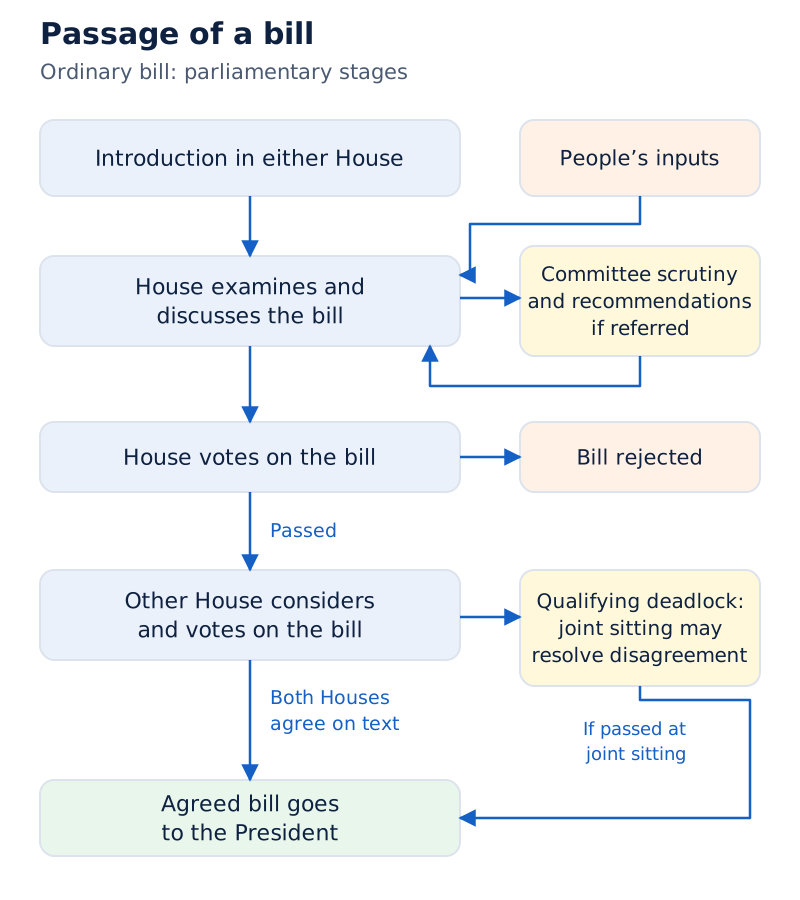
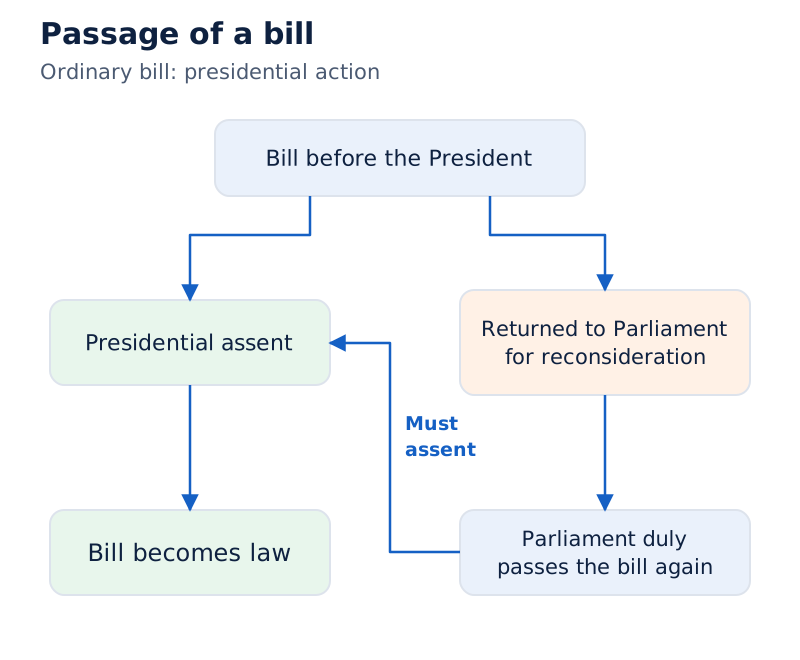
The flowchart links introduction, discussion or committee examination, voting, consideration by the other House and presidential action. It includes people's inputs, committee recommendations and a joint session if required.
Drawn by One Young India.
Article 109 provides the special procedure for Money Bills. The Rajya Sabha has fourteen days to return one with recommendations. The Lok Sabha decides whether to accept those recommendations; the second House cannot insist on them.
Instruments of accountability
Question Hour requires ministers to answer members' questions. Discussions and motions allow representatives to examine policies and administrative failures. Committees study bills, demands for grants and expenditure in greater detail than the full House can usually manage.
Financial control links policy to resources. Government must seek legislative approval for taxation and spending. Scrutiny of expenditure also asks whether authorised money was properly used.
The no-confidence motion gives the Lok Sabha a decisive sanction. These controls work best when members have time, information and freedom to debate. Repeated disruption can reduce the opportunity to obtain answers and examine government conduct.
How is the US Congress organised, and why is the Senate powerful?
The US legislature, Congress, comprises the House of Representatives and Senate. Their composition, tenure and special powers differ.
| Feature | House of Representatives | Senate |
|---|---|---|
| Strength | 435 voting members | 100 Senators, two from each State |
| Basis of representation | Seats apportioned among States broadly according to population | Equal representation of States regardless of population |
| Election | Direct popular election | Direct popular election |
| Term | Two years | Six years, with roughly one-third elected every two years |
| Special impeachment role | Brings the charges through impeachment | Tries impeachments and decides conviction |
| Special financial role | Bills for raising revenue originate here | May propose or concur in amendments to revenue bills |
The Senate's additional checks
The Senate gives advice and consent to presidential nominations requiring its approval, including Supreme Court appointments. Treaties made through the constitutional treaty process require the consent of two-thirds of Senators present. These powers give it substantial influence over administration and foreign relations.
Its longer term and continuing membership support institutional experience. Equal State representation gives it a distinct federal foundation. Its legislative and financial powers are substantial, unlike a second chamber limited mainly to delay or recommendations.
The Senate is consequently often described as the world's most powerful second chamber. The description refers to this combination of equal legislative participation and special executive checks. It does not mean that the Senate can enact every law without the House.
Congressional functions beyond ordinary laws
Congress controls federal taxation and appropriations, investigates executive conduct and participates in constitutional amendment. Amendments may be proposed by two-thirds of each House, followed by ratification by three-fourths of the States through the prescribed method.
Congress also has contingent electoral functions. If no presidential candidate wins an Electoral College majority, the House chooses the President under the constitutional procedure. If no vice-presidential candidate wins the required majority, the Senate chooses the Vice-President.
How do the Indian and American legislative chambers compare?
Comparison distinguishes representation from power. The Rajya Sabha and Senate both represent constituent States, but their electoral bases and constitutional authority differ. Similarly, direct election does not give the Lok Sabha and the House of Representatives identical relations with the executive.
Rajya Sabha compared with the Senate
| Basis | Rajya Sabha | US Senate |
|---|---|---|
| State seats | Unequal, with population influencing allocation | Equal: two Senators per State |
| Election of State representatives | Indirect, through elected MLAs | Direct, through voters |
| Money or revenue legislation | Can recommend changes to Money Bills | Has substantial amending power over revenue bills |
| Executive appointments and treaties | No corresponding general power of confirmation | Exercises constitutionally assigned advice-and-consent powers |
| Continuity | Continuing House with six-year membership terms | Continuing chamber with six-year membership terms |
Lok Sabha compared with the House of Representatives
Both lower Houses are directly elected and use territorial representation. The Lok Sabha normally lasts five years and may be dissolved earlier. The House of Representatives has a two-year term; the President cannot dissolve it.
The most important difference concerns executive responsibility. The Indian ministry depends on Lok Sabha confidence. The American President does not lose office merely because the House rejects a policy or opposes the President politically.
In India, loss of confidence can remove the ministry. In the USA, the House's impeachment role begins a separate constitutional process, with trial in the Senate. Impeachment is therefore not the American name for a parliamentary no-confidence motion.
Financial comparison also needs precision. The Lok Sabha's superiority concerns the special Money Bill procedure. The American House's right to originate revenue bills does not reduce the Senate to offering non-binding recommendations.
How does the political executive differ from the permanent executive?
The executive is the organ principally responsible for implementing laws and administering government. It includes political leaders and the civil service. Distinguishing these parts explains how a government can change politically while administration continues.
| Basis | Political executive in India | Permanent executive in India |
|---|---|---|
| Members | Political office-holders, including the Prime Minister and ministers | Civil servants and administrative officials |
| Main task | Sets policy and assumes political responsibility | Advises on and implements policy through administration |
| Continuity | Changes with political circumstances and government formation | Normally continues when the governing party changes |
| Political position | Usually associated with a party or coalition programme | Expected to serve with political neutrality |
| Expertise | Provides political leadership and public accountability | Contributes professional knowledge and administrative experience |
Neutrality and responsibility
Political neutrality means that officials should serve the lawful government impartially rather than use their position to promote a party. When a new government adopts new lawful policies, the administration is expected to assist their formulation and implement them faithfully.
The Union Public Service Commission conducts recruitment processes for the Union civil services. Merit-based selection supports a professional administration. Continuity, however, must be accompanied by responsiveness: administrative experience does not justify indifference to citizens' needs.
What powers does the President of India exercise?
The President is India's constitutional head of State. Executive authority is formally vested in this office, but the parliamentary system places effective governmental leadership with the Prime Minister and Council of Ministers.
The President is indirectly elected for five years. The electoral college includes elected members of both Houses of Parliament and elected members of State Legislative Assemblies, including those of Delhi and Puducherry. Voting uses proportional representation by the single transferable vote.
Executive and legislative powers
The President appoints the Prime Minister and appoints other ministers on the Prime Minister's advice. Other constitutional appointments are formally made through the presidency. Executive action is taken in the President's name, ordinarily on ministerial advice.
Legislative functions include summoning and proroguing Parliament, dissolving the Lok Sabha and giving assent to bills. The President can promulgate an ordinance when the constitutional conditions are met, including the need for immediate action when at least one House is not in session.
An ordinance has the force of law but requires subsequent parliamentary consideration. It normally ceases to operate six weeks after Parliament reassembles unless replaced by legislation. It is not a permanent substitute for Parliament's legislative role.
Emergency powers
| Provision | Constitutional situation |
|---|---|
| Article 352 | National Emergency arising from war, external aggression or armed rebellion |
| Article 356 | Failure of constitutional machinery in a State |
| Article 360 | Threat to the financial stability or credit of India or part of its territory |
These powers operate within constitutional conditions and parliamentary controls. They are not a personal licence for the President to govern independently of the parliamentary executive.
Discretion within constitutional limits
Under Article 74(1), the President may ask ministers to reconsider advice, but must accept the advice tendered after reconsideration. An ordinary bill may also be returned; if duly passed again, assent cannot be withheld on that basis.
Where no party or coalition clearly commands a Lok Sabha majority, selecting a Prime Minister involves judgement about who can secure confidence. Such discretion serves the formation of a responsible government, rather than replacing majority support with presidential preference.
Why is the Prime Minister central to India's parliamentary executive?
The Prime Minister heads the Council of Ministers and leads the actual work of government. The President formally appoints the person able to command majority support in the Lok Sabha. Political authority therefore rests on legislative support as well as constitutional office.
Formation and coordination of the ministry
The Prime Minister selects colleagues for appointment as ministers and allocates portfolios. As Chairman of the Cabinet, the Prime Minister guides deliberations and coordinates departments whose work affects one another. Important policy decisions require this central coordination.
The 91st Amendment limits the Union Council of Ministers, including the Prime Minister, to fifteen per cent of the Lok Sabha's total membership. Ministerial office cannot therefore be expanded indefinitely to accommodate political supporters.
Ministers must be members of Parliament or become members within six months of appointment. The ministry is collectively responsible to the Lok Sabha, even though individual ministers may belong to either House.
Link with President, Parliament and nation
The Prime Minister communicates Cabinet decisions and proposals for legislation to the President and supplies requested information. This makes the office the principal link between the constitutional head and the working executive.
As parliamentary leader, the Prime Minister explains government policy and seeks legislative support. As national leader, the Prime Minister articulates priorities and represents the government in major public and international dealings.
Collective responsibility requires ministers to support Cabinet decisions publicly or resign. If the ministry loses Lok Sabha confidence, the whole Council must resign. The principle treats the government's programme as a shared responsibility.
Prime ministerial influence varies with political circumstances. A secure majority strengthens leadership; a coalition may require negotiation over appointments and policies. Constitutional importance does not eliminate the need to retain the confidence of colleagues and parliamentary supporters.
How does the US President differ from India's parliamentary executive?
The US President combines the roles of head of State and head of government. The President exercises executive power personally through an administration and is elected through the Electoral College for a four-year term. The office does not depend on continuing congressional confidence.
Executive and legislative powers
The President directs federal administration, appoints major officials through the applicable constitutional procedures, conducts foreign relations and serves as Commander-in-Chief. Important appointments require Senate consent. Treaties under the constitutional treaty procedure also require Senate approval.
The President can recommend legislation and communicate policy proposals to Congress. Congressional supporters introduce the necessary bills. A bill passed by Congress may receive presidential assent or be returned with a veto.
A returned veto can be overridden by a two-thirds vote in each House. This illustrates a check in both directions: the President can require reconsideration, while Congress can overcome the objection with the necessary support.
Comparison of the two executives
| Basis | India | USA |
|---|---|---|
| Type | Dual executive: constitutional President and governing Prime Minister with ministers | Single executive: President combines the two leading roles |
| Presidential election | Indirect election by the constitutional electoral college of elected legislators | Indirect election through the Electoral College |
| Legislative relationship | Ministry depends on Lok Sabha confidence | President serves a fixed term subject to constitutional removal |
| Cabinet relationship | Cabinet works through collective responsibility under the Prime Minister | Cabinet officers advise and serve under the President |
| Financial role | Government presents financial proposals and seeks parliamentary approval | President submits budget proposals; Congress controls authorisation and appropriations |
The President and Cabinet officers do not sit in Congress as ministers sit in India's Parliament. The President cannot dissolve Congress. Equally, congressional disagreement with a policy does not itself terminate the presidency.
Impeachment supplies a different form of accountability. The House brings charges; the Senate conducts the trial. Conviction requires two-thirds of Senators present. This is a constitutional removal mechanism, distinct from ordinary political loss of confidence.
Why must the judiciary be independent?
The judiciary settles legal disputes, interprets law and protects rights. It must be able to decide cases impartially even when the government is a party. Otherwise, constitutional promises could depend on the wishes of the authority being challenged.
Judicial independence means freedom from improper legislative or executive interference in deciding cases. It does not mean that judges are free to ignore the Constitution or act without legal reasons.
Conditions supporting independence
- Professional qualifications: Legal knowledge and experience should guide selection, rather than political loyalty.
- Security of tenure: Judges should not face dismissal merely because a government dislikes a judgement.
- Financial safeguards: Protected salaries and service conditions reduce opportunities for pressure.
- Difficult removal: A demanding constitutional procedure discourages arbitrary removal while retaining accountability for serious misconduct.
- Freedom in adjudication: Other authorities must not dictate the outcome of cases.
In India, a Supreme Court judge can be removed for proved misbehaviour or incapacity through the prescribed parliamentary process followed by presidential action. Each House must support removal by a majority of its total membership and at least two-thirds of members present and voting.
Independence and accountability together
A reasoned judgement explains how a decision follows from law. Constitutional limits and removal provisions constrain judicial power.
The principle of rule of law requires the government and citizens to be subject to law. Judicial independence supports that principle by allowing a dispute to be decided on its legal merits rather than the political influence of the parties.
What powers and jurisdictions belong to the Supreme Court of India?
The Supreme Court stands at the apex of India's integrated judicial system. High Courts and subordinate courts form part of this hierarchy. Its decisions bind lower courts, allowing constitutional interpretation to operate across the country.
Its composition includes the Chief Justice of India and other judges whose permitted number is determined by law. The 2019 increase established a sanctioned strength of thirty-four, comprising the Chief Justice and thirty-three other judges. Supreme Court judges retire at sixty-five.
What the figure shows
Structure of the judiciary
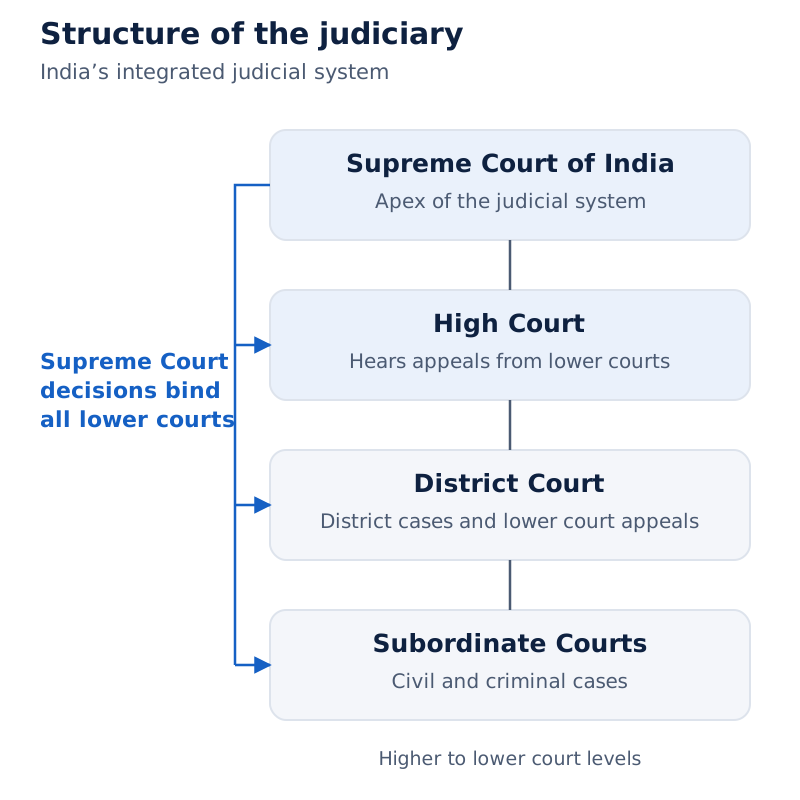
Four labelled boxes run down the page: Supreme Court of India, High Court, District Court and Subordinate Courts. Connecting arrows show relationships between the higher and lower levels.
Drawn by One Young India.
Different kinds of jurisdiction
| Jurisdiction | Meaning and application |
|---|---|
| Original | Cases begin in the Supreme Court, including specified legal disputes between the Union and States or between States |
| Appellate | The Court hears eligible appeals involving constitutional, civil or criminal questions from lower courts |
| Advisory | The President refers appropriate questions of law or public importance for the Court's opinion |
| Writ | The Court issues constitutional remedies for enforcement of Fundamental Rights |
Article 32 enables direct access to the Supreme Court for enforcement of Fundamental Rights. Article 226 gives High Courts writ powers. The availability of a Supreme Court remedy does not eliminate the High Courts' role.
Under Article 137, the Supreme Court can review its own judgements. This is different from reviewing the constitutional validity of legislation. Article 144 requires civil and judicial authorities to act in aid of the Supreme Court.
An advisory opinion differs from a binding judgement in contested litigation. Its value lies in clarifying legal questions before action is taken. The President is not bound to accept such advice, and the Court may decline an ordinary reference seeking its opinion.
How does the US Supreme Court compare with India's Supreme Court?
The US Supreme Court is the highest court in the American federal judicial system. It comprises one Chief Justice and eight Associate Justices. The President nominates Justices and the Senate decides whether to confirm them.
Tenure and jurisdiction
American Justices hold office during good behaviour, without a compulsory retirement age. This permits life tenure, although resignation, retirement or constitutional removal may end service. India's Supreme Court judges instead serve until the specified retirement age.
The US Supreme Court has original jurisdiction over constitutionally specified categories, including cases affecting ambassadors and certain cases involving States. Original jurisdiction means that the case starts there, rather than reaching the Court through an appeal.
Its much larger appellate role concerns review of lower-court decisions raising federal legal or constitutional questions within its jurisdiction. State-court cases can reach it on federal questions; it is not a general final appeal court on every issue of State law.
Principal comparisons
| Feature | Supreme Court of India | Supreme Court of the USA |
|---|---|---|
| Judicial organisation | Apex of an integrated court hierarchy | Apex federal court within a system containing federal and State court structures |
| Tenure | Retirement at sixty-five | Good-behaviour tenure without compulsory retirement age |
| Original jurisdiction | Includes specified federal disputes | Includes constitutionally specified categories involving States and diplomatic representatives |
| Appellate jurisdiction | Constitutional, civil and criminal appeals under applicable rules | Appeals and review concerning federal legal and constitutional questions |
| Advisory role | Can provide opinions on presidential references | Does not give advisory opinions outside a case or controversy |
| Constitutional review | Reviews laws and governmental action for constitutional validity | Reviews laws and governmental action for constitutional validity |
How does judicial review preserve constitutional limits?
Judicial review is the power to examine whether legislation or governmental action complies with the Constitution. A court can invalidate what exceeds constitutional authority. Disagreement with a policy is not, by itself, proof that the policy is unconstitutional.
In India, Article 13 provides a basis for invalidating laws inconsistent with Fundamental Rights. Review also protects the constitutional distribution of legislative power between the Union and States. A legislature must respect both rights and the boundaries of its competence.
Principles or maxims of review
- A constitutional issue comes before the court through a case; review is not automatic political supervision of every proposal.
- The court identifies the relevant constitutional provisions and gives legal reasons for finding a violation.
- The decision addresses the unconstitutional law or provision; separable valid provisions need not fall with it.
- A constitutional ruling in litigation has binding legal effect and differs from an advisory opinion.
- Where a multi-judge bench decides a constitutional question, the majority determines the result; judicial reasoning must stay within the issue properly before it.
- Judgements normally become operative from the day they are delivered, subject to any directions about their effect.
- Courts generally refrain from deciding purely political questions, while retaining the power to decide legal or constitutional issues arising from political disputes.
Procedure established by law and due process
Procedure established by law directs attention to an authorised law and the procedure it prescribes. Due process of law, associated with the USA, also tests constitutional fairness in the law and its operation.
This traditional comparison must not imply that Indian courts accept any procedure merely because legislation prescribes it. Constitutional protection of liberty also requires fairness. Neither expression removes the court's duty to apply constitutional rights and limits.
Amendments and institutional limits
In Kesavananda Bharati v. State of Kerala, decided in 1973, the Supreme Court held that constitutional amendments cannot destroy the Constitution's basic structure. Parliament's constituent power is extensive but remains constitutionally limited.
The 52nd Amendment introduced anti-defection provisions, later modified by the 91st Amendment. These constitutional rules regulate legislative conduct and executive formation.
Note: Judicial review of a law, review of a court's own judgement, and judicial activism are different ideas. Constitutional validity, reconsideration of a decision, and the intensity of judicial intervention answer different questions.
Glossary
- Legislature — The representative organ that makes laws and performs financial, deliberative and executive scrutiny functions.
- Executive — The organ responsible principally for implementing laws, directing administration and carrying out government policies.
- Judiciary — The system of courts that interprets laws, settles disputes and protects constitutional rights.
- Bicameralism — A legislative arrangement with two chambers participating in law-making under their respective constitutional powers.
- Collective responsibility — The principle requiring the ministry to act together and retain the confidence of the Lok Sabha.
- Permanent executive — The professional administrative machinery that normally continues in service when political governments change.
- Money Bill — A bill confined to constitutionally specified financial matters and governed by a special parliamentary procedure.
- Impeachment — A constitutional process involving formal charges against an office-holder, with subsequent proceedings governed by the relevant Constitution.
- Original jurisdiction — The authority to hear a category of cases at first instance rather than on appeal.
- Appellate jurisdiction — The authority to reconsider eligible cases brought from lower courts through an appeal.
- Advisory jurisdiction — The authority to provide a legal opinion on a constitutionally permitted reference from the President.
- Judicial review — The power of courts to examine legislation or governmental action for compliance with the Constitution.
- Rule of law — The principle that public authorities and individuals are subject to law rather than arbitrary personal power.
- Checks and balances — Constitutional arrangements allowing different organs to restrain misuse of power by one another.
Common errors and misconceptions
- Misconception: Having a President makes India presidential. Correct: India's ministry depends on Lok Sabha confidence, making the working executive parliamentary.
- Misconception: Both Indian Houses can remove the ministry by a no-confidence motion. Correct: Collective responsibility is to the Lok Sabha; the Rajya Sabha can scrutinise and criticise the ministry.
- Misconception: The Rajya Sabha's members remain permanently. Correct: The House continues, but individual members normally serve six-year terms and retire in rotation.
- Misconception: The Senate merely recommends amendments to revenue bills. Correct: It has substantial financial legislative power; it does not occupy the Rajya Sabha's position on Indian Money Bills.
- Misconception: Impeachment and a no-confidence motion are interchangeable. Correct: They have different constitutional purposes, grounds and procedures.
- Misconception: Judicial independence removes accountability. Correct: Judges remain bound by constitutional limits, legal reasoning and applicable removal procedures.
- Misconception: Judicial review means reviewing the Court's own decision. Correct: Constitutional review examines laws or governmental action; reconsidering a judgement is a separate review power.
- Misconception: A Rajya Sabha resolution under Article 249 transfers a State List subject permanently. Correct: It enables parliamentary legislation under the specified constitutional conditions without that permanent transfer.
Exam-style questions with model answers
Q1. A legislature makes laws, an executive implements them, and a judiciary interprets them in disputes. Identify the organ performing implementation and distinguish it from the law-making organ. [2 marks]
- The executive is the organ responsible for implementation and administration.
- The legislature makes laws, whereas the executive implements them within the legislative framework.
Q2. The Lok Sabha is directly elected, normally lasts five years and can be dissolved. Rajya Sabha members normally serve six years, with approximately one-third retiring every two years; the House is not dissolved. Explain three differences concerning mandate, tenure and continuity, using the fact that State representatives in the Rajya Sabha are elected by elected MLAs. [3 marks]
- The Lok Sabha has a direct popular mandate, whereas State representatives in the Rajya Sabha are indirectly elected by elected MLAs.
- The Lok Sabha normally has a five-year term, subject to dissolution. Rajya Sabha members normally serve six-year terms.
- The Lok Sabha may be dissolved as a House. The Rajya Sabha continues through rotating retirement, with approximately one-third of its members retiring every two years.
Q3. The Council of Ministers is collectively responsible to the Lok Sabha. The Rajya Sabha may question ministers but cannot remove the ministry through no-confidence. A Money Bill originates only in the Lok Sabha; the Rajya Sabha has fourteen days to recommend changes, which the Lok Sabha may reject. Explain the Lok Sabha's superiority in these two fields. [4 marks]
- In executive accountability, collective responsibility makes Lok Sabha confidence necessary for the ministry's continuation. Its control therefore includes a sanction affecting the government's survival.
- The Rajya Sabha can seek explanations and criticise ministers, but cannot use no-confidence to remove the ministry.
- In the Money Bill procedure, introduction belongs exclusively to the Lok Sabha. The Rajya Sabha's role is limited to recommendations within fourteen days.
- Because the Lok Sabha may reject those recommendations, the two Houses do not have equal power over Money Bills.
Q4. The US President combines the offices of head of State and government, serves a four-year term, and does not depend on congressional confidence. In India, the President is the constitutional head, while the Prime Minister and ministers govern and depend on Lok Sabha confidence. Compare the type of executive and its relationship with the legislature. [4 marks]
- The USA has a single executive: its President is both head of State and head of government. India has a dual executive: the President is the constitutional head, while the Prime Minister and Council of Ministers govern.
- The US President serves a four-year term independent of congressional confidence, subject to constitutional removal. India's ministry remains in office only while it retains Lok Sabha confidence.
- India links ministerial office to parliamentary membership. The US President and Cabinet officers do not sit in Congress.
- Indian ministers can introduce government bills in Parliament. The US President recommends legislation and relies on congressional supporters to introduce bills.
Q5. The US Senate has two directly elected members from each State, six-year terms with rotating renewal, substantial legislative and financial powers, consent powers over specified presidential appointments and treaties, and authority to try impeachments. The House of Representatives has two-year terms, originates revenue bills and brings impeachment charges. Explain five reasons for the Senate's strength without claiming it can govern alone. [5 marks]
- Equal representation gives every State two members, providing the Senate with a distinct federal foundation regardless of differences in population.
- Six-year terms and rotating renewal support continuity and experience. Members have longer terms than those in the House of Representatives.
- Substantial legislative and financial powers make the Senate an active participant in decisions. It is not merely a body that offers suggestions.
- Consent powers over specified appointments and treaties enable it to check important presidential decisions concerning personnel and foreign relations.
- Its impeachment trial power is another constitutional check. Nevertheless, the House brings charges and originates revenue bills, so the Senate's strength does not eliminate the other chamber's necessary functions.
Q6. Judges require legal expertise, secure tenure, protected financial conditions and freedom from interference. Indian Supreme Court judges may be removed for proved misbehaviour or incapacity through the prescribed parliamentary and presidential process. Judges must apply the Constitution and give legal reasons. Explain how these provisions combine independence with accountability. [6 marks]
- Legal expertise supports decisions based on law rather than political loyalty or the personal influence of litigants.
- Secure tenure reduces the fear that an unwelcome judgement will immediately cost a judge the office. This matters when the government itself is a party.
- Protected financial conditions reduce the possibility of pressure through a judge's pay or conditions of service.
- Freedom from interference allows the court to decide the dispute on its merits rather than obey another organ's preferred result.
- Independence does not remove accountability: judges must follow the Constitution and explain the legal grounds of their decisions.
- The removal procedure for proved misbehaviour or incapacity supplies an exceptional constitutional safeguard. Together, these arrangements protect impartial judgement while limiting arbitrary judicial conduct.
Q7. Original jurisdiction allows specified disputes to begin in the Supreme Court; appellate jurisdiction concerns eligible appeals from lower courts; advisory jurisdiction allows a presidential reference for an opinion. Judicial review tests constitutional validity, while Article 137 allows the Indian Supreme Court to review its own judgements. Explain these five distinct powers. [5 marks]
- Original jurisdiction concerns the starting point of a case. A specified dispute comes directly before the Supreme Court without first being decided by a lower court.
- Appellate jurisdiction concerns reconsideration of an eligible case that has already been decided below. It describes the route through which the case reaches the higher court.
- Advisory jurisdiction concerns an opinion sought by the President through a permitted reference. It differs from deciding contested litigation.
- Judicial review concerns the constitutional validity of legislation or governmental action, rather than simply the route by which a case arrived.
- Article 137 concerns reconsideration of the Supreme Court's own judgement. It must therefore be distinguished from examining a law for constitutional defects.
Q8. An ordinary bill may be introduced in either Indian House, examined in the House or by a committee, passed by both Houses and sent for presidential assent. A qualifying deadlock may lead to a joint sitting. The President may return an ordinary bill, but must assent if it is duly passed again. Explain the sequence and the checks it contains. [4 marks]
- Introduction begins parliamentary consideration. Examination in the House or a committee allows the proposal's provisions to be scrutinised.
- Passage through both Houses supplies a second institutional check. A qualifying deadlock may be addressed through a joint sitting.
- The agreed bill is then sent for presidential assent, completing enactment when assent is given.
- The President's return power permits reconsideration, but is limited: if Parliament duly passes the bill again, the President must assent. It is not an unlimited power to prevent enactment.
Key takeaways
- The legislature, executive and judiciary perform different functions while checking misuse of power and cooperating within constitutional limits.
- The Lok Sabha's control of ministerial confidence and Money Bills distinguishes its powers from those of the Rajya Sabha.
- The Senate combines equal State representation, long terms, substantial legislative powers and special checks on presidential appointments and treaties.
- India's parliamentary ministry depends on Lok Sabha confidence; the American President has a separate constitutional tenure.
- The political executive provides policy leadership, while the permanent executive supplies professional advice, continuity and administrative implementation.
- Judicial independence protects impartial decisions, but judges remain accountable to constitutional limits and legally reasoned adjudication.
- Original, appellate and advisory jurisdiction describe different judicial functions and must be distinguished from constitutional judicial review.
- Judicial review protects rights and constitutional competence; the basic structure doctrine also limits Parliament's constitutional amendment power.
Test yourself
Why does India's President not make its executive presidential?
Effective government is led by the Prime Minister and ministers, who depend on Lok Sabha confidence.
What makes the Rajya Sabha a continuing House?
It is not dissolved; members retire in rotation rather than the entire membership ending together.
How does State representation differ in the Rajya Sabha and Senate?
Rajya Sabha representation varies among States, while every American State has two Senators.
What is the difference between bringing and trying an American impeachment?
The House of Representatives brings the charges, while the Senate conducts the trial and decides conviction.
What does political neutrality require of civil servants?
They should serve the lawful government impartially and implement its policies without promoting party interests.
How does an advisory opinion differ from a judgement in litigation?
An advisory opinion answers a permitted reference; it differs from a binding decision resolving contested litigation.
Does judicial independence allow courts to ignore the Constitution?
No. Independence protects adjudication from improper pressure while leaving courts bound by constitutional limits.
How does reviewing a law differ from reviewing a judgement?
The former tests constitutional validity; the latter reconsiders a court's own earlier decision.
Try it
Navigating the Organs of Government
Step into the shoes of a policymaker and a citizen to see how the branches of government interact in practice.
1You are a newly elected minister in a parliamentary system. You want to implement a complex new policy, but you lack technical expertise and worry about what happens to the policy's administration if your party loses the next election. Who do you rely on to ensure the policy is technically sound and continues to be administered even if leadership changes?
Correct! The text states that the permanent executive (bureaucracy) consists of career civil servants who provide technical expertise and administrative continuity, ensuring government functions smoothly even when political leadership changes.
Incorrect. The text notes that the political executive consists of elected ministers who hold office temporarily and make broad policy decisions, rather than providing technical expertise and long-term continuity.
Incorrect. While the upper house acts as a revising chamber to prevent hasty legislation, it is part of the legislature. The text specifies that the permanent executive handles day-to-day administration and continuity.
2The legislature passes a new law that severely restricts citizens' fundamental rights. As a citizen worried about this state overreach, which constitutional mechanism and organ of government can you rely on to invalidate this law?
Incorrect. The text describes the executive as the 'engine' that drives laws into reality, but does not grant it the power to invalidate laws passed by the legislature.
Incorrect. According to the text, a no-confidence motion is used by the legislature to hold the executive accountable in a parliamentary system, not to strike down its own laws.
Correct! The text explains that Judicial Review gives the judiciary the authority to examine legislative actions and declare them null and void if they violate the Constitution or infringe on fundamental rights.
Great job! You've successfully applied the concepts of executive continuity and judicial review, demonstrating how the separation of powers and checks and balances protect democracy.