
The Indian Constitution | ISC Class 12 Political Science Notes
On this page
Try an idea before you read. Step into the shoes of an Indian lawmaker and a citizen to test your understanding of how the Constitution functions in practice. Explore →
The Indian Constitution: its written and comprehensive character, the Preamble and its key words, constitutional sources, federalism, amendment, parliamentary government, citizenship, adult franchise, rights and duties, Directive Principles, the judiciary, emergency powers, and safeguards for Scheduled Castes and Scheduled Tribes.
Why is the Indian Constitution written and comprehensive?
A constitution establishes the basic framework of government. It identifies institutions, distributes their powers, places limits on authority and expresses the goals of the political community. It therefore concerns both the organisation of government and the relationship between government and people.
The Indian Constitution is written because its fundamental provisions are set out in a constitutional document. Its comprehensive character means that it deals with a wide range of matters rather than merely naming the main institutions.
What does the constitutional framework cover?
Its provisions cover the Union and State governments, the legislature, executive and judiciary, elections, rights, social objectives and constitutional change. These subjects connect the machinery of government with the aspirations of the people who live under it.
The Constitution both restrains and enables public power. Fundamental Rights protect people against violations of their freedoms. Other provisions allow government to pursue welfare and address deprivation. A constitution can therefore limit the State while also giving it responsibilities for social change.
How was this framework established?
The Constituent Assembly debated the distribution of powers, rights and institutional relationships. The Constitution was adopted on 26 November 1949 and came into force on 26 January 1950. Adoption and commencement refer to different stages.
The Assembly was not elected through universal adult franchise. Nevertheless, its deliberations brought together different views, and members defended proposals through reasoned argument about the country's needs. The authority of the Constitution also rests on the values and public purposes embodied in it.
Definition: A comprehensive constitution sets out a broad framework of institutions, powers, rights and public objectives. Its scope extends beyond the rules for selecting a government.
What is the Preamble and why is it important?
The Preamble is the introductory statement of the Constitution's underlying philosophy. It identifies the source of constitutional authority, describes the kind of political order India seeks to establish, and states the objectives to be secured for its citizens.
The opening words, “We, the people of India”, express popular authority. The Constitution is presented as a document that the people give to themselves through their representatives. Political power is therefore connected to the people rather than to hereditary entitlement or an outside ruler.
How does it connect authority with objectives?
| Element | Constitutional meaning |
|---|---|
| Source of authority | The people of India establish the constitutional order. |
| Character of the State | India is a sovereign, socialist, secular, democratic republic. |
| Objectives | Justice, liberty, equality and fraternity guide the political community. |
| Common life | The dignity of the individual is linked with the unity and integrity of the nation. |
These statements help explain the purpose of the detailed provisions. Elections give institutional form to democratic participation; rights protect liberty; and social welfare measures help pursue justice. The Preamble provides a standard for assessing how public institutions serve constitutional values.
The 42nd Amendment of 1976 changed the Preamble, including the addition of “Socialist” and “Secular” and the reference to the nation's integrity. Secular commitments were present in the constitutional framework before the word was added.
What the figure shows
Reading the Preamble
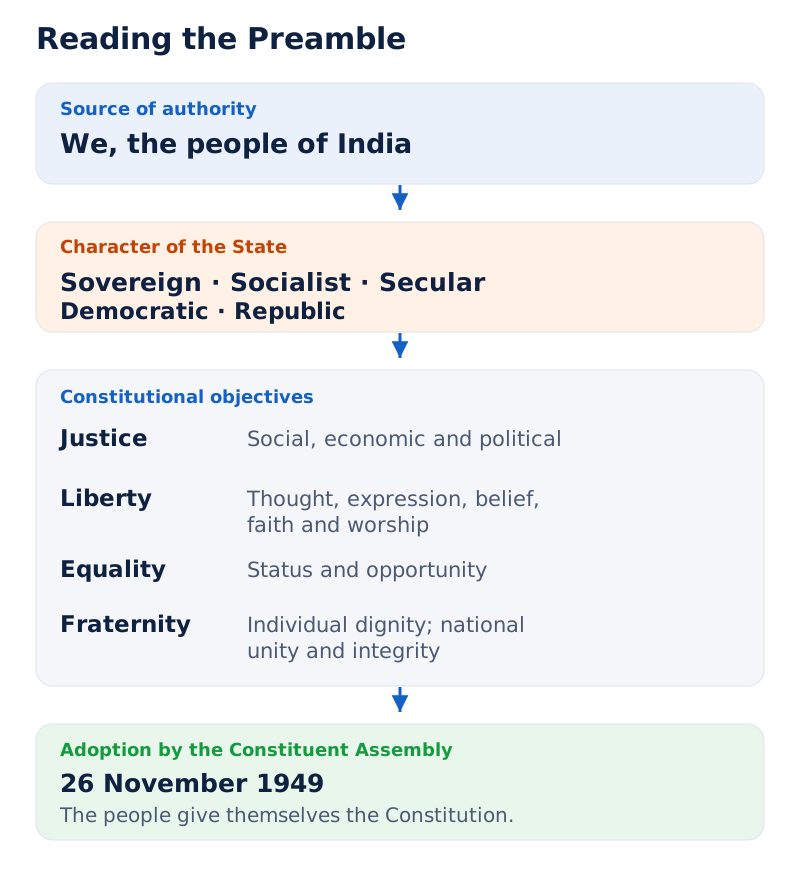
The panel begins with the people as the source of authority, then names the character of the State. Justice, liberty, equality and fraternity appear in sequence, followed by the adoption statement.
Drawn by One Young India.
What do sovereign, socialist, secular, democratic and republic mean?
The five descriptions in the Preamble identify different features of India's constitutional order. They answer questions about independence, social and economic objectives, religion, political participation and the head of the State. Each term therefore needs its own explanation.
How do sovereignty and the republic define political authority?
Sovereign means that India has authority to decide its internal and external affairs without being subject to an outside power. The term concerns the independence of the political community and its capacity to govern itself.
Republic means that the head of the State holds an elected rather than hereditary position. India's President is elected indirectly. This feature concerns the basis on which the head of the State holds office.
How do socialism and secularism guide public life?
Socialist expresses a commitment to reducing social and economic inequalities. It directs attention to the distribution of resources and the welfare of disadvantaged people. The pursuit of social justice is connected with public action against deprivation.
Secular means that the State has no official religion and respects religious freedom. India's constitutional approach protects individuals and religious communities. Freedom of conscience and the protection of minority institutions help give practical meaning to that commitment.
Indian secularism does not require the State to remain passive towards every religious practice. It permits intervention to protect freedom, equality and dignity, including action against untouchability. The guiding consideration is the protection of constitutional values.
How does democracy connect government with citizens?
Democratic government rests on equal political participation, elected representatives and public accountability. Universal adult franchise makes citizens participants in choosing their representatives. Constitutional rules also limit how the resulting government can exercise its authority.
Democracy and a republic are related but distinct ideas. Democracy concerns participation and accountability; a republic concerns the non-hereditary headship of the State. Explaining each separately avoids reducing the entire Preamble to the single idea of elections.
How do justice, liberty, equality and fraternity support one another?
The Preamble sets out justice in social, economic and political life. Social justice challenges entrenched inequalities and discrimination. Economic justice concerns deprivation and unequal access to resources. Political justice is linked to equal participation in public affairs.
Liberty includes thought, expression, belief, faith and worship. It protects space for people to form opinions, express them and follow their convictions. Constitutional freedom also recognises that one person's conduct must not destroy the freedom of others.
What does equality require?
Equality of status rejects inferior standing based on inherited social position. Equality of opportunity requires meaningful opportunities to participate and advance. Equal treatment must be considered alongside the unequal conditions in which people actually live.
Special measures for historically disadvantaged groups can help make equality effective. The constitutional commitment to equality therefore does not mean that government must ignore every difference in social circumstances. Measures addressing exclusion may support equal opportunity.
Why is fraternity essential?
Fraternity is a sense of common belonging and mutual respect. It connects the dignity of each individual with national unity and integrity. People must be able to live together without treating fellow citizens as inferior because of community or social background.
Liberty, equality and fraternity reinforce one another. Freedom without equality can leave power concentrated among the privileged. Equality without freedom can suppress individual initiative. Fraternity helps make both values part of shared social life.
These objectives also connect institutions to outcomes. An election expresses political equality, protection against arbitrary action supports liberty, and measures against exclusion advance justice. The constitutional order seeks a democratic society as well as democratic government.
Note: Political equality does not by itself remove social or economic inequality. The Constitution combines equal citizenship with rights, welfare objectives and special protections to address this wider challenge.
How did the Constitution adapt ideas from several sources?
The Constitution's framers examined the experience of other countries while responding to India's own circumstances. They selected institutions and principles that could help establish representative government, protect rights and organise relations between the Union and the States.
Adaptation is central to this process. A provision needed justification in terms of Indian problems and aspirations. Learning from an existing institution did not remove the need to decide how it would fit within the rest of the constitutional framework.
Which constitutional ideas came from different traditions?
| Constitutional tradition | Ideas adapted |
|---|---|
| Britain | Parliamentary government, First Past the Post elections, the rule of law, the Speaker's institution and law-making procedure. |
| United States | Fundamental Rights, judicial review and judicial independence. |
| Ireland | Directive Principles of State Policy. |
| France | Liberty, equality and fraternity. |
| Canada | A federal arrangement with a strong Centre and the idea of residuary powers. |
These features perform different functions within the same system. Parliamentary government helps secure executive accountability. Judicial review supports constitutional limits. Directive Principles connect government with social and economic objectives. Their combination is part of the Constitution's distinctive design.
The Indian Constitution also reflects experiences of colonial rule, the national movement and debate within the Constituent Assembly. Its concern for individual freedom is linked to opposition to arbitrary authority; its social commitments address inequalities within Indian society.
What the figure shows
Constitutional sources
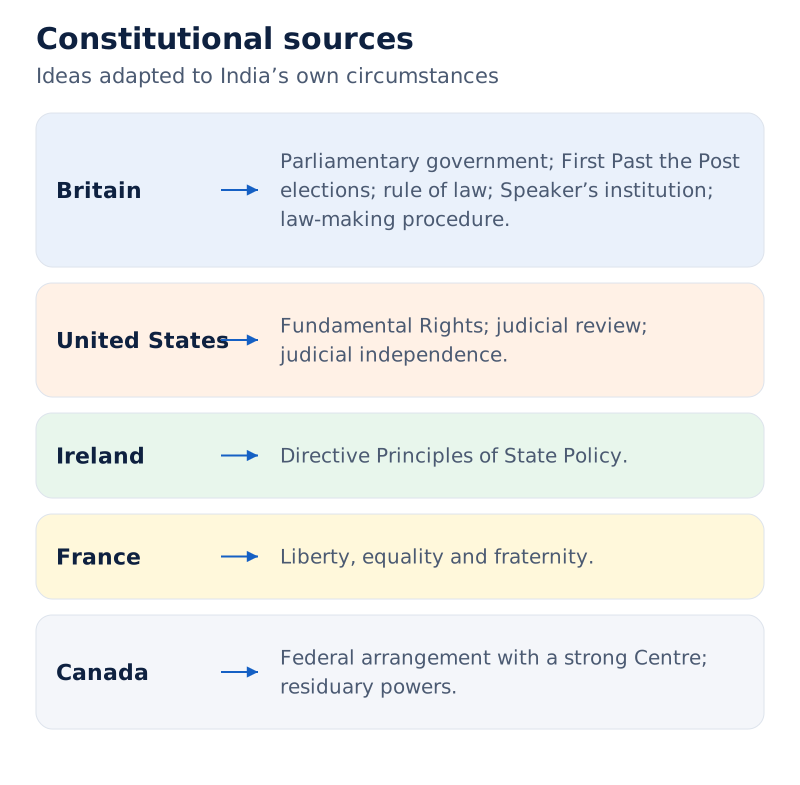
Overlapping circles are labelled British, United States, Irish, French and Canadian Constitution. Each circle contains the institutions or principles associated with that constitutional tradition.
Drawn by One Young India.
How is India federal with a unitary spirit and single citizenship?
Federalism distributes authority between a national government and regional governments. In India, the Union and State governments have constitutional status and defined areas of responsibility. Regional diversity is recognised within a common constitutional order.
Article 1 describes India as a Union of States. The Constitution provides the framework for both levels of government. Courts can resolve disputes concerning the distribution of powers by interpreting that framework.
How are legislative subjects distributed?
| Category | Examples | Legislative authority |
|---|---|---|
| Union List | Defence, foreign affairs and currency. | The Union legislature. |
| State List | Police, agriculture and public health. | Normally the State legislature. |
| Concurrent List | Education, forests and trade unions. | Both Union and State legislatures. |
| Residuary matters | Matters outside the listed subjects, including cyber laws. | The Union legislature. |
Why does the Centre have a strong position?
The unitary spirit is visible in provisions that strengthen the Union. Residuary legislative powers belong to it. Parliament can alter State boundaries through the constitutional process, and emergency provisions can concentrate power at the Centre.
The existence of a strong Centre does not erase the constitutional position of the States. Federal division and centralising provisions operate within the same document. Understanding the Constitution requires explaining both features together.
Single citizenship means that India does not establish separate State citizenships alongside Indian citizenship. People can retain regional, linguistic and cultural identities while belonging to the same national political community. Two levels of government do not require two citizenships.
The integrated judicial system also supports a common constitutional framework. Thus, division of governmental powers is combined with institutions and principles that maintain national unity. Cooperation between the Union and the States is an important part of this arrangement.
What the figure shows
Division of powers
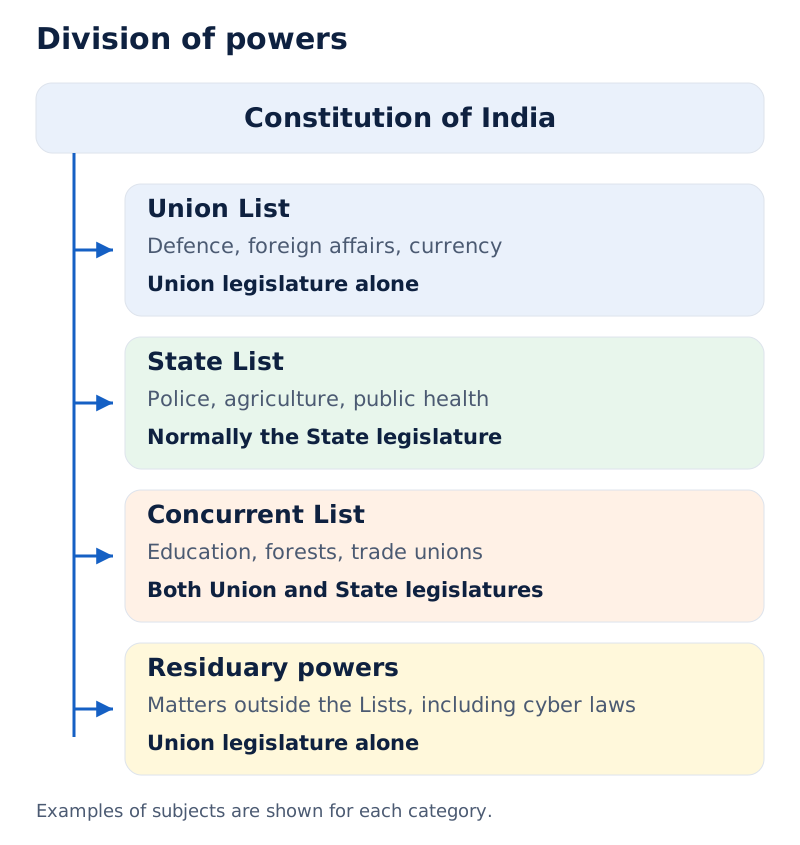
A top box labelled Constitution of India leads to Union, State and Concurrent List columns. A lower box identifies residuary powers and states that the Union legislature legislates on these matters.
Drawn by One Young India.
Why is the Constitution partly rigid and partly flexible?
A flexible constitution can be changed relatively easily, while a rigid constitution requires a more demanding procedure. India's constitutional arrangements combine these characteristics. Different changes require different degrees of legislative agreement.
This balance allows correction and adaptation without leaving important institutions open to easy alteration. Provisions concerning the federal relationship require a wider agreement because they affect the position of the States as well as the Union.
How do the methods of change differ?
| Method | Requirement | Significance |
|---|---|---|
| Ordinary legislative process | Specified changes can be made by a simple majority in Parliament. | Allows flexibility in matters such as changes concerning States under Article 2 and Article 3. |
| Article 368 procedure | Each House passes the amendment separately with the required special majority. | Requires support beyond an ordinary legislative majority. |
| Article 368 with State ratification | Special majorities in Parliament plus ratification by at least half the State legislatures. | Gives the States a role in specified changes affecting the federal framework. |
For Article 368, the parliamentary special majority requires a majority of the total membership of each House and at least two-thirds of its members present and voting. A joint sitting cannot replace separate approval by both Houses.
What is the amendment procedure?
- Initiate a constitutional amendment in Parliament and identify whether the proposal requires State ratification.
- Obtain the required special majority separately in each House of Parliament.
- For provisions requiring State consent, obtain ratification by at least half the State legislatures.
- Present the duly passed amendment bill to the President for assent; the President cannot return it for reconsideration.
The basic structure doctrine further limits amendment. The Supreme Court's Kesavananda Bharati decision in 1973 established that Parliament cannot use its amending power to violate the Constitution's basic structure. Constitutional change is possible, but that power has limits.
How do parliamentary government and a bicameral legislature work together?
India follows a parliamentary system in which the executive is answerable to the legislature. At the Union level, the President is the formal head of the State, while the Prime Minister and Council of Ministers conduct the government.
Article 74(1) provides for a Council of Ministers headed by the Prime Minister to aid and advise the President. The President may ask for reconsideration of advice but must act on the advice given after reconsideration.
Why does the Lok Sabha's confidence matter?
The Council of Ministers is responsible to the Lok Sabha. The government must retain majority support there. A ministry that loses that support cannot continue on the same parliamentary basis. This is a central mechanism of executive accountability.
Questions, discussions, financial control and a no-confidence motion allow representatives to scrutinise the executive. Parliamentary government therefore involves a continuing relationship of responsibility, rather than accountability confined to the moment of an election.
Why does Parliament have two Houses?
Bicameralism means a legislature with two Houses. India's parliamentary Houses are the Lok Sabha, or House of the People, and the Rajya Sabha, or Council of States. They provide different bases of representation.
The Lok Sabha is directly elected. The elected representatives of States in the Rajya Sabha are chosen by elected members of State Legislative Assemblies. The Rajya Sabha also includes nominated members.
A second House allows reconsideration and further discussion of legislation. Its role also provides representation to the States. However, the two Houses do not possess identical powers: the Rajya Sabha cannot remove the Council of Ministers through a no-confidence vote.
Parliamentary government and bicameralism thus answer different questions. The first concerns executive responsibility; the second concerns the structure of the legislature. India combines both within its representative institutions.
Why is universal adult franchise a major constitutional feature?
Universal adult franchise gives adult citizens the right to participate in elections without making wealth, education, caste, religion or sex the basis of political entitlement. It expresses the principle that citizens possess equal political standing.
The minimum voting age is 18 years. The 61st Amendment reduced the voting age from 21 to 18. This widened participation by bringing younger adult citizens within the electorate.
How does franchise support representative democracy?
Citizens elect representatives who make decisions on public matters. The Lok Sabha and State Legislative Assemblies are directly elected. Electoral participation connects public authority with the people and provides a basis for holding representatives accountable.
The principle was significant in a society marked by inherited inequalities. A person's poverty or lack of formal education does not make that person's political voice less valuable. Equal voting rights challenge the assumption that public power belongs naturally to privileged groups.
What are the limits of voting alone?
Equal political rights do not automatically remove inequalities in social and economic life. A constitution must also address the circumstances that prevent people from enjoying dignity, freedom and opportunity. Rights, welfare objectives and safeguards for disadvantaged groups complement franchise.
The Constitution's democratic character therefore includes both participation and limits on power. Citizens choose representatives, but elected institutions must work within the constitutional framework. An electoral majority does not replace the obligations created by rights and constitutional rules.
How do Fundamental Rights, Directive Principles and Fundamental Duties differ?
Fundamental Rights protect freedoms and provide safeguards against arbitrary power. They include equality, freedom, protection against exploitation, religious freedom, cultural and educational rights, and constitutional remedies. Courts can enforce these protections when they are violated.
Rights are not unlimited permissions to act in any manner. Reasonable restrictions may apply, and the Constitution defines the protections and their conditions. Article 21, for example, protects life and personal liberty through the requirement of procedure established by law.
How do rights and Directive Principles compare?
| Feature | Fundamental Rights | Directive Principles |
|---|---|---|
| Central purpose | Protect rights and freedoms. | Guide social and economic welfare policies. |
| Enforceability | Enforceable through courts. | Non-justiciable policy directions. |
| Constitutional role | Restrain violations of protected rights. | Direct public action towards a more just society. |
| Illustration | Protection of life and personal liberty. | Equitable distribution of resources and adequate livelihood. |
Non-justiciable means that a Directive Principle cannot by itself be enforced through a court order requiring government to carry out that policy. This does not make the principles unimportant. They establish objectives for which governments can be held politically accountable.
Rights and Directive Principles can support one another. Freedom and equality protect individuals, while welfare measures help create the conditions in which these protections become meaningful. Constitutional government must consider both individual protection and the well-being of society.
What responsibilities do Fundamental Duties express?
The 42nd Amendment inserted Fundamental Duties. Article 51A includes responsibilities such as respecting the Constitution, defending the country, promoting harmony, protecting the environment, preserving cultural heritage and developing scientific temper.
The 86th Amendment added the duty of a parent or guardian to provide educational opportunities to a child or ward aged six to fourteen. Duties express responsibilities connected with citizenship and common life.
Enjoyment of Fundamental Rights is not made conditional on first proving fulfilment of Fundamental Duties. The two should therefore be understood as different constitutional elements. A duty to promote harmony does not turn a person's rights into a reward that government may grant or withdraw at will.
The 44th Amendment removed property from the list of Fundamental Rights. It remains protected as a legal right under Article 300A. This distinction shows why identifying the legal status of a right matters.
How do an integrated judiciary and judicial review protect the Constitution?
India has a single integrated judicial system. The Supreme Court stands at the top, followed by High Courts, district courts and subordinate courts. Courts within States form part of this common hierarchy rather than a separate State judicial system.
Judicial independence means that judges can decide cases without improper pressure from the executive or legislature. Security of tenure, a demanding removal process and protections concerning judicial salaries help support this independence.
How are rights enforced?
Under Article 32, the Supreme Court can issue writs to enforce Fundamental Rights. High Courts possess writ powers under Article 226. These powers make constitutional protection more than a statement of desirable values.
Article 13 supports the invalidation of laws that violate Fundamental Rights. Judicial review allows courts to examine the constitutional validity of laws and governmental action. It helps keep public authorities within the limits imposed by the Constitution.
How does review relate to constitutional supremacy?
Constitutional supremacy means that public institutions derive their authority from the constitutional framework. The legislature makes laws, but its decisions can be examined for consistency with that framework. Courts also settle disputes about the allocation of powers between governments.
The basic structure doctrine applies this concern to constitutional amendments. In the Kesavananda Bharati ruling, the Court limited Parliament's amending power and retained the authority to decide whether an amendment violates the basic structure.
Independence does not place the judiciary above the Constitution. Courts remain accountable to constitutional principles and operate within their jurisdiction. Judicial independence is intended to protect impartial justice, rather than to create unrestricted judicial power.
What the figure shows
The judicial hierarchy
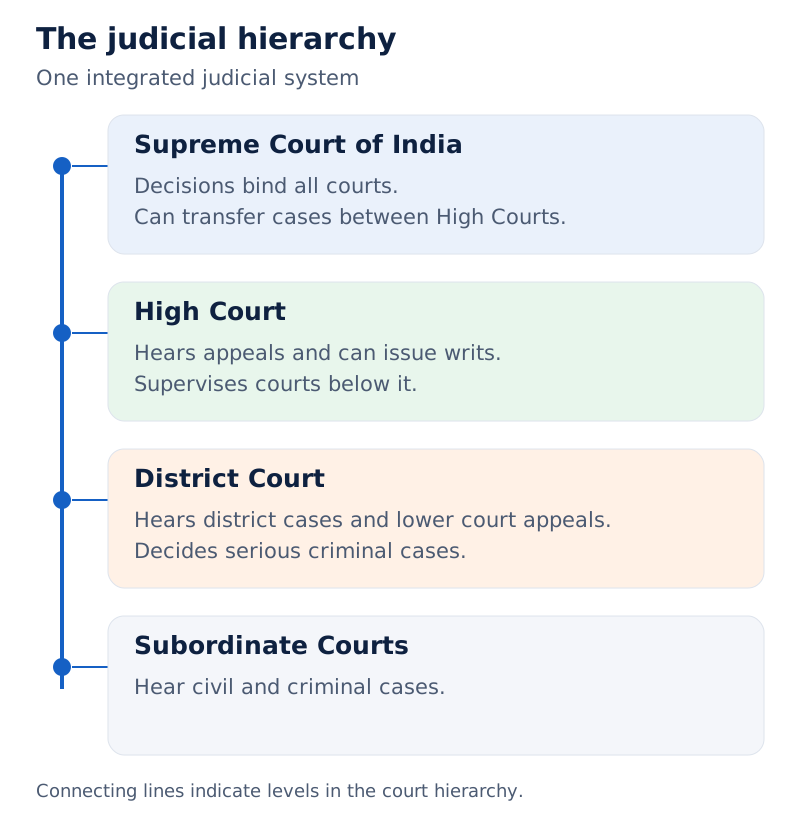
Four connected boxes descend from Supreme Court of India to High Court, District Court and Subordinate Courts. Each box lists functions, and connecting lines show relationships within the integrated court system.
Drawn by One Young India.
What are emergency powers and how can they affect federal government?
Emergency powers allow exceptional action when specified constitutional conditions arise. They are a significant centralising feature of the Constitution. During an emergency, the normal distribution and exercise of governmental powers can change.
Which situations do the provisions address?
| Provision | Situation addressed |
|---|---|
| Article 352 | A national emergency arising from war, external aggression or armed rebellion. |
| Article 356 | Failure of constitutional government in a State, leading to President's Rule. |
| Article 360 | A threat to the financial stability or credit of India or any part of its territory. |
Under Article 356, the relevant condition is that State government cannot be carried on in accordance with the Constitution. The Union takes over the government of the State under President's Rule, and the proclamation requires parliamentary approval.
Emergency arrangements illustrate how a federal system can become more centralised under exceptional conditions. They do not mean that the ordinary constitutional distribution of authority is irrelevant during normal government.
Why are safeguards necessary?
The experience of the 1975 Emergency revealed the dangers that concentrated power can pose to civil liberties. Later changes replaced internal disturbance with armed rebellion as the internal ground for a national emergency.
The Union Cabinet must give its advice to the President to proclaim a national emergency in writing. This requirement helps distinguish a constitutional decision of the Cabinet from an informal recommendation.
Courts can examine the constitutional validity of imposing President's Rule. Emergency powers therefore need to be understood alongside parliamentary scrutiny and judicial review. Their purpose concerns exceptional constitutional situations, not unrestricted authority for the government in office.
Why are special provisions for Scheduled Castes and Scheduled Tribes necessary?
The Constitution recognises that a formal declaration of equality may be insufficient to overcome entrenched exclusion. Scheduled Castes and Scheduled Tribes receive special protections intended to make social justice and equal participation effective.
These provisions connect the right to equality with the realities of historical disadvantage. Treating everyone identically while ignoring severe inequalities can leave existing barriers in place. Special measures seek to improve access to institutions and public opportunities.
How do reserved constituencies work?
Seats are reserved for Scheduled Castes and Scheduled Tribes in the Lok Sabha and State Legislative Assemblies. In a reserved constituency, all eligible voters in that constituency can vote, while candidates must belong to the community for which the seat is reserved.
This arrangement differs from a separate electorate, in which voting itself is confined to members of a community. Reserved constituencies combine representation for disadvantaged groups with participation by the constituency's entire eligible electorate.
How is special protection consistent with equality?
Article 16(4) permits reservation of appointments or posts for a backward class of citizens that, in the State's opinion, is inadequately represented in its services. The Constitution also makes public employment reservations possible for Scheduled Castes and Scheduled Tribes.
The underlying purpose is substantive opportunity. Social justice requires attention to the obstacles that keep people out of public life. Constitutional protection, representation and access to employment are connected aspects of this effort.
These safeguards should be understood alongside the abolition of untouchability, equal access to public places and the Preamble's commitment to dignity. Together, they show how political equality and action against social exclusion form parts of the same constitutional project.
Glossary
- Constitution — The basic framework defining public institutions, their powers, limits on authority and the political community's objectives.
- Preamble — The introductory statement expressing the Constitution's authority, guiding values and objectives for the political community.
- Sovereign — Having authority over internal and external affairs without being subject to an outside power.
- Republic — A political order whose head of State occupies an elected rather than hereditary position.
- Secularism — Equal respect for religious freedom and communities, with State action guided by constitutional freedom and equality.
- Fraternity — Common belonging and mutual respect linking individual dignity with the unity and integrity of the nation.
- Federalism — A constitutional arrangement distributing authority between national and regional governments with distinct powers and responsibilities.
- Residuary powers — Legislative powers concerning matters outside the listed subjects, assigned to the Union in India.
- Bicameralism — A legislative arrangement with two Houses that provide representation and opportunities to reconsider proposed legislation.
- Adult franchise — The right of adult citizens to vote without wealth, education or inherited social status determining political entitlement.
- Directive Principles — Non-justiciable constitutional directions guiding government towards social welfare, economic justice and other public objectives.
- Judicial review — The power of courts to examine whether laws and governmental action conform to constitutional requirements.
- Basic structure — Essential constitutional features that Parliament cannot violate through amendment, as determined through judicial interpretation.
- Reserved constituency — A constituency in which all eligible voters vote but candidates belong to the community for which the seat is reserved.
Common errors and misconceptions
- Misconception: The Constitution was adopted and came into force on the same day. Correct: Adoption occurred on 26 November 1949; commencement followed on 26 January 1950.
- Misconception: Republic and democracy have exactly the same meaning. Correct: Republic concerns the elected head of State; democracy concerns political participation, representation and accountability.
- Misconception: A federal Constitution must create separate State citizenships. Correct: India combines federal division of powers with single citizenship.
- Misconception: Every constitutional change requires approval from the States. Correct: State ratification is required for specified changes affecting the federal framework, rather than every amendment.
- Misconception: The Rajya Sabha can remove the Council of Ministers by passing a no-confidence motion. Correct: The Council of Ministers is responsible to the Lok Sabha.
- Misconception: Directive Principles are enforceable in the same manner as Fundamental Rights. Correct: Directive Principles are non-justiciable, although they guide government policy.
- Misconception: Citizens receive Fundamental Rights only after fulfilling Fundamental Duties. Correct: Enjoyment of rights is not constitutionally conditional on prior fulfilment of duties.
- Misconception: Only Scheduled Caste voters may vote in a constituency reserved for Scheduled Castes. Correct: All eligible voters there may vote; the restriction concerns candidates.
Exam-style questions with model answers
Q1. The Constitution was adopted on 26 November 1949 and came into force on 26 January 1950. Distinguish adoption from commencement using these dates. [2 marks]
- Adoption refers to the acceptance of the constitutional document on 26 November 1949.
- Commencement refers to its coming into force on 26 January 1950. The dates therefore mark different stages.
Q2. Consider these descriptions: India decides its internal and external affairs independently; its head of State holds an elected rather than hereditary position. Identify and distinguish the two Preamble terms illustrated. [2 marks]
- Sovereign describes independence in internal and external decision-making without subjection to an outside power.
- Republic describes the elected, non-hereditary character of the head of State. It concerns the basis of that office.
Q3. The framers adapted parliamentary government from Britain, Fundamental Rights and judicial review from the United States, and Directive Principles from Ireland. They selected provisions for India's needs. Explain why this was adaptation rather than mechanical copying, referring to accountability, protection of rights and welfare. [4 marks]
- The framers assessed borrowed ideas for their suitability to Indian problems and aspirations, adapting them to local needs rather than reproducing another country's system unchanged.
- Parliamentary government from Britain made the executive answerable to elected representatives, serving the need for accountable government.
- Fundamental Rights and judicial review from the United States protected individuals and limited public power, serving the need to safeguard rights.
- Directive Principles from Ireland guided welfare policies, serving India's social and economic objectives within the same constitutional framework.
Q4. The Constitution gives Union and State governments defined powers: defence belongs to the Union List, police normally to the State List, and residuary powers to the Union. Emergency provisions can centralise authority. Use these facts to explain “federal structure with a unitary spirit”. [4 marks]
- The structure is federal because Union and State governments both have constitutional status and defined areas of authority.
- The division of legislative subjects gives practical effect to federalism: defence belongs to the Union List, while police normally belongs to the State List.
- The allocation of residuary powers to the Union strengthens the Centre, giving the federal arrangement a unitary spirit.
- Emergency provisions can centralise authority in exceptional circumstances, adding a further unitary feature without removing the ordinary federal division of powers.
Q5. Specified constitutional changes use an ordinary parliamentary majority. Article 368 requires separate special majorities in both Houses, with no joint sitting; specified federal changes also require ratification by at least half the State legislatures. The bill then goes for presidential assent and cannot be returned for reconsideration. No amendment may violate the basic structure. Explain how these arrangements combine flexibility with safeguards, setting out the Article 368 sequence. [6 marks]
- Specified changes can be made by an ordinary parliamentary majority. This provides flexibility by allowing change without the more demanding Article 368 procedure.
- For an Article 368 amendment, the process begins with introduction of an amendment bill in Parliament.
- Each House must then approve the bill separately by the required special majority. The absence of a joint sitting ensures that one House's approval cannot replace the other's.
- For specified federal changes, at least half the State legislatures must next ratify the amendment. This safeguards State participation in changes affecting the federal framework.
- The duly passed and, where required, ratified bill then goes to the President for assent; it cannot be returned for reconsideration.
- Throughout this process, the basic structure limits the substance of any amendment: Parliament can make changes but cannot violate the Constitution's essential features.
Q6. Fundamental Rights can be enforced through courts; Directive Principles guide welfare policy but are non-justiciable; Fundamental Duties include promoting harmony and protecting the environment. Enjoyment of rights is not conditional on fulfilment of duties. Compare the constitutional roles of these three elements. [4 marks]
- Fundamental Rights protect individuals through enforceable guarantees, allowing judicial remedies when protected rights are violated.
- Directive Principles guide government towards social and economic welfare; unlike Fundamental Rights, they cannot themselves be enforced through courts.
- Fundamental Duties concern citizens' responsibilities, such as promoting harmony and protecting the environment, rather than the welfare directions addressed to government by Directive Principles.
- Rights and duties have distinct constitutional roles: enjoyment of Fundamental Rights is not conditional on prior fulfilment of Fundamental Duties.
Q7. Reserved seats for Scheduled Castes and Scheduled Tribes aim to address historical exclusion and secure representation. In a reserved constituency all eligible voters vote, while candidates must belong to the community for which the seat is reserved. A separate electorate restricts voters themselves to a community. Explain the justification for reservation and distinguish the two electoral arrangements. [5 marks]
- Historical exclusion can prevent disadvantaged groups from securing effective representation even where formal political rights are equal.
- Reserved seats address this disadvantage by ensuring representation for Scheduled Castes and Scheduled Tribes, giving practical effect to political equality.
- In a reserved constituency, candidates must belong to the community for which the seat is reserved.
- All eligible voters in that reserved constituency can vote, so the safeguard for candidates retains a common electorate.
- In a separate electorate, only voters belonging to the community concerned elect its representative. This restricts the electorate itself, unlike a reserved constituency.
Q8. Article 74 provides for ministerial advice to the President. The Council of Ministers must retain Lok Sabha support; the Rajya Sabha represents States and allows legislative reconsideration. Independent courts can enforce Fundamental Rights and review constitutional validity. Using these facts, explain how the constitutional system distributes power and secures accountability. [6 marks]
- Ministerial advice connects the President's formal position with the Council of Ministers, which conducts government under the parliamentary system.
- The Council must retain Lok Sabha support, making the executive accountable to elected representatives for remaining in office.
- The Rajya Sabha represents the States, giving them a voice in the Union legislature.
- The Rajya Sabha also allows reconsideration of legislation, providing an additional stage of scrutiny in law-making.
- Independent courts enforce Fundamental Rights, giving people judicial protection against violations of those rights.
- Courts also review constitutional validity, checking that laws and governmental action remain within constitutional limits.
Key takeaways
- The Preamble identifies the people as the source of authority and expresses the character and objectives of India's constitutional order.
- Justice, liberty, equality and fraternity connect the organisation of government with individual dignity and shared national life.
- The Constitution adapts ideas from different constitutional traditions while addressing India's needs, inequalities and regional diversity.
- Federal division of powers coexists with a strong Centre, single citizenship and an integrated judicial system.
- Different methods of constitutional change combine flexibility with special majorities, specified State participation and the basic structure limitation.
- Parliamentary government makes the Council of Ministers responsible to the Lok Sabha, while bicameralism adds representation and reconsideration.
- Fundamental Rights, Directive Principles and Fundamental Duties have distinct roles in protection, welfare and civic responsibility.
- Universal adult franchise and safeguards for disadvantaged groups help make political participation consistent with equality and social justice.
Test yourself
What is the difference between the Constitution's adoption and its commencement?
Adoption was the Constituent Assembly's formal acceptance of the Constitution on 26 November 1949; commencement was when it came into force on 26 January 1950.
Why does single citizenship not contradict federalism?
Federalism divides governmental powers between levels; single citizenship concerns membership of the national political community.
What are residuary powers, and who exercises them in India?
They concern matters outside the listed legislative subjects. In India, the Union legislature exercises these powers.
Which House determines whether the Council of Ministers retains parliamentary confidence?
The Lok Sabha determines this; the Council of Ministers must retain majority support in that House.
Why are Directive Principles described as non-justiciable?
They guide government policy but cannot themselves be enforced by courts in the manner of Fundamental Rights.
What does the basic structure doctrine limit?
It limits Parliament's amending power: constitutional amendments cannot violate essential features identified through judicial interpretation.
Who votes in a constituency reserved for Scheduled Tribes?
All eligible voters in the constituency vote. The community requirement applies to the candidates contesting that reserved seat.
How do Articles 32 and 226 contribute to protection of rights?
They provide writ powers to the Supreme Court and High Courts respectively, enabling judicial enforcement of Fundamental Rights.
Try it
Constitutional Scenarios: Lawmakers and Citizens
Step into the shoes of an Indian lawmaker and a citizen to test your understanding of how the Constitution functions in practice.
1You are a Member of Parliament proposing an amendment to alter how the President of India is elected. You have successfully secured a Special Majority in both Houses of Parliament. Is the amendment ready to become law?
Incorrect. While a Special Majority is required for most amendments, the text specifies that altering the federal structure requires an additional step.
Correct! The text states that for amendments affecting the federal structure, such as the election of the President, a Special Majority must be coupled with ratification by at least half of the State Legislatures so the Centre cannot unilaterally alter state powers.
Incorrect. The text notes that a Simple Majority is only used for basic provisions like changing state boundaries, not for federal structure changes.
2A citizen decides to approach the courts to sue the government for failing to ensure 'equal pay for equal work' in their industry. Based on the text, how will the court evaluate this claim?
Incorrect. The text specifically categorizes 'equal pay for equal work' as a Directive Principle of State Policy (DPSP), not a Fundamental Right.
Correct! The text explains that DPSPs, such as ensuring equal pay for equal work, are non-justiciable guidelines for creating a welfare state, meaning you cannot approach the courts to enforce them.
Incorrect. The text states that the Minerva Mills case established that Fundamental Rights and DPSPs are complementary and neither is inherently superior.
Great job! You've successfully applied the mechanics of the amendment process and the balance between Fundamental Rights and Directive Principles.