
Forms of Government | ISC Class 12 Political Science Notes
On this page
Watch & explore
Start with a few high-quality watches, then dive into the notes below.
Try an idea before you read. Test your understanding of unitary, federal, and quasi-federal constitutional systems through a two-step scenario. Explore →

This note covers totalitarian, authoritarian and liberal democratic states; unitary government in Britain; federal government in the United States of America; parliamentary government in India; presidential government in the United States; and comparisons of their institutions, distribution of power, accountability and protection of rights.
How are forms of government classified?
A government is the machinery through which a state makes and implements public decisions. A state is the political organisation exercising sovereign authority over a population within a territory. Sovereign authority means the state's supreme authority to govern, rather than the authority of a particular office holder.
Different classifications ask different questions. The distinction between totalitarian, authoritarian and liberal democratic states concerns the character and limits of political power. The distinction between unitary and federal government concerns its territorial distribution. Parliamentary and presidential systems concern the relationship between the executive and the legislature.
What institutions must be distinguished?
The legislature makes laws. The executive implements laws and policies and administers government. The judiciary interprets law and settles legal disputes. The executive is often involved in framing policy as well as implementing it. These organs have different functions even when their personnel and activities are closely connected.
| Basis of classification | Question to ask | Forms distinguished |
|---|---|---|
| Character of rule | How extensive is state control, and how are rulers limited? | Totalitarian, authoritarian and liberal democratic |
| Territorial distribution | Where do national and regional authorities obtain their powers? | Unitary and federal |
| Executive-legislature relationship | Does the political executive depend on legislative confidence? | Parliamentary and presidential |
The classifications can be combined. The United States of America, abbreviated as USA, is federal in territorial organisation and presidential in its executive system. India combines federal arrangements with a parliamentary executive. Britain combines a unitary constitutional structure with parliamentary government. A label from one classification cannot answer a question from another.
Diagram
Classifying government
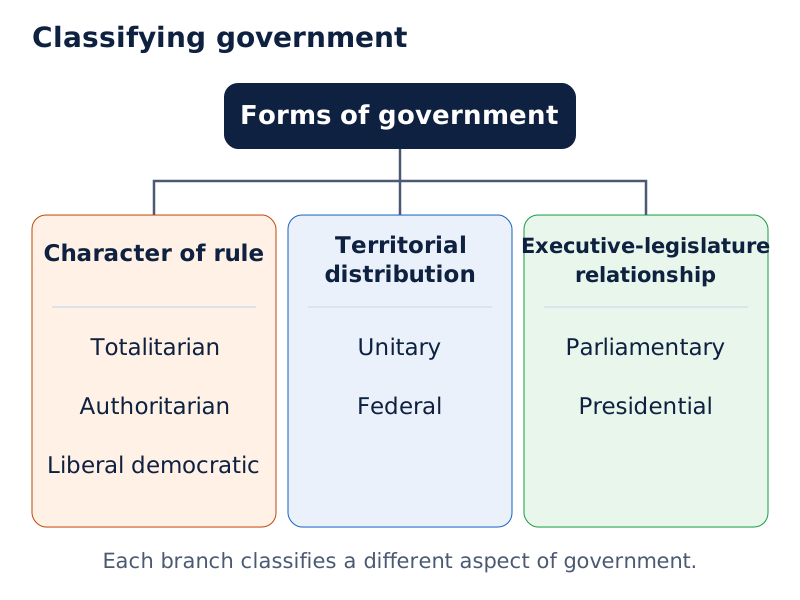
Draw three branches from “Forms of government”. Label them “Character of rule”, “Territorial distribution” and “Executive-legislature relationship”. Under each, place the corresponding forms from the table. Keep the three branches separate because they classify different aspects of government.
Drawn by One Young India.
What are the meaning and features of a totalitarian state?
A totalitarian state seeks comprehensive control over political and social life. Its ambition extends beyond keeping a ruler in office. It attempts to shape how people think, organise, communicate and participate in society according to an official ideology, meaning a connected set of political beliefs and goals.
How does comprehensive control operate?
Concentration of power leaves little room for institutions that can independently challenge the ruling leadership. An exclusive ruling party commonly links the leadership to public organisations. Effective political opposition is suppressed, and citizens cannot freely replace the rulers through competitive elections.
Official ideology supplies the regime's explanation of society and its desired future. Education, public communication and organised activity are used to spread that outlook. The aim is not simply obedience to particular laws but conformity to an approved political understanding.
Propaganda is organised communication intended to shape beliefs in favour of a cause or authority. Censorship restricts the circulation of information or opinions. In a totalitarian system, these methods work alongside surveillance, intimidation and coercion, meaning the use or threat of force to secure compliance.
Political mobilisation means drawing people into organised political activity. Totalitarian regimes seek active displays of loyalty through organisations and campaigns controlled by the regime. Participation organised from above differs from voluntary association in which people can independently choose their purposes and criticise public policy.
Does totalitarianism mean literally perfect control?
The defining feature is the ambition and institutional effort to exercise comprehensive control. It does not follow that every private belief can actually be controlled or that resistance disappears. The state seeks to subordinate independent organisations and personal life to political authority, but aspiration and achievement must be distinguished.
Thus, totalitarianism concerns the breadth of domination as well as the concentration of power. Calling a government harsh or repressive is insufficient by itself: the additional issue is whether it seeks to reorganise society and absorb independent social activity into its political project.
What is an authoritarian state, and how does it differ from totalitarianism?
An authoritarian state concentrates political power in a ruler or restricted group and limits meaningful public control over that power. Political opposition, criticism and competition are restricted. Rulers are not subject to the effective democratic accountability associated with free political choice and enforceable limits on government.
Authoritarian rule need not seek the comprehensive transformation of society characteristic of totalitarianism. It may leave some social, religious or economic organisations room to function, provided they do not threaten political control. This limited space is conditional and should not be confused with a secure democratic right.
Which features distinguish the two?
| Basis | Totalitarian state | Authoritarian state |
|---|---|---|
| Reach of control | Seeks comprehensive political and social control | Concentrates on preserving political authority without necessarily controlling every sphere |
| Ideology | An elaborate official ideology is central to the regime's project | Justifications for rule need not form a comprehensive ideology |
| Mobilisation | Seeks organised mass participation under official direction | May prefer obedience and limited independent political participation |
| Independent organisations | Seeks to absorb or suppress autonomous organisations | May tolerate limited autonomy where it does not challenge rulers |
| Shared restriction | Suppresses effective political opposition | Restricts effective political opposition |
The difference is one of characteristic aims and methods, not a claim that authoritarian governments are necessarily mild. Both can use repression. An authoritarian ruler may censor critics or imprison opponents without constructing a totalitarian system of comprehensive ideology and organised mass mobilisation.
Limited pluralism means the restricted existence of distinct organisations or interests. In authoritarian conditions, tolerated groups lack the political freedom and secure independence associated with liberal democracy. Their continued existence may depend on avoiding a challenge to the ruling authority.
Note: Do not distinguish these forms merely by saying that one has a powerful ruler. Both may concentrate authority. Compare the intended reach of control, the role of ideology, mobilisation and the independence allowed to social organisations.
What makes a state liberal democratic?
A liberal democratic state combines popular political choice with protected individual liberties and limits on government. Democracy concerns public participation and the selection and accountability of rulers. The liberal element concerns rights, lawful restrictions on power and protection against arbitrary treatment, including treatment by an elected government.
What are its principal features?
Representative government allows citizens to choose people who govern on their behalf. Free and fair elections must provide meaningful political competition. Opposition parties and public criticism allow alternatives to be expressed. Elections lose their democratic significance if political choice is controlled or opposition cannot function effectively.
Political equality requires citizens to be treated as equals in political participation. Rule of law means that public power operates under law rather than the unrestricted wishes of rulers. Constitutional government places powers, procedures and limits within an authoritative framework of basic rules.
Civil liberties protect freedoms such as expression, association and belief. An independent judiciary provides protection when public authorities violate rights. A democracy must ensure that individuals have rights which government recognises; in most democratic countries, it is often a practice to list rights in the constitution.
Why are rights more than promises?
A bill of rights is a list of rights mentioned and protected in a constitution. It limits government and provides remedies for violations. Rights may be threatened by private persons and organisations as well as by public authorities, so government has a duty to protect them.
In India, Fundamental Rights receive special constitutional protection. Executive or legislative actions that violate them or restrict them unreasonably can be declared illegal by the judiciary. These rights are not absolute or unlimited: reasonable restrictions may be imposed on their exercise.
Article 16(4) permits reservation of appointments or posts for a backward class of citizens which the state considers inadequately represented in its services. Such measures support equality of opportunity rather than violating the right to equality.
Article 21 protects life and personal liberty: no person may be deprived of either except according to procedure established by law. This guarantee illustrates how constitutional rights limit the exercise of government power.
During construction for the 1982 Asian Games, contractors paid workers less than the prescribed minimum wage. Social scientists petitioned the Supreme Court, arguing that this amounted to forced labour. The Court accepted the plea and directed the government to ensure payment of the prescribed wages.
This example connects a protected right with an enforceable remedy. Forced labour means work extracted through compulsion; the case shows that economic conditions can also make labour coercive. Protection of rights requires institutions capable of correcting violations, including violations arising in work undertaken for government.
Majority rule therefore does not authorise unlimited power over minorities or individuals. The relevant test combines political competition with practical protection of rights. A constitution's written guarantees matter, but their enforcement also matters: people must be able to obtain a remedy when a guarantee is violated.
What are the meaning and features of Britain as a unitary state?
A unitary state has a central constitutional authority from which subordinate territorial institutions derive their powers. This does not mean that all decisions are made by one person, or that local government is absent. The defining question is whether territorial powers are constitutionally divided between coordinate levels as in a federation.
Where does ultimate authority lie?
Britain's unitary structure rests on the sovereignty of Parliament, meaning the supreme law-making authority of the United Kingdom Parliament. Regional and local institutions do not possess the same constitutionally entrenched position as the constituent states of the USA. Their powers exist within a system whose central legislature remains legally sovereign.
Devolution means the transfer of powers from central institutions to territorial institutions. The United Kingdom has devolved institutions in Scotland, Wales and Northern Ireland. Their existence makes territorial government more varied and permits decisions to be made closer to the populations concerned.
Devolution should not be treated as proof that Britain has become a federation. The constitutional basis of authority remains different from a federal division of powers protected against ordinary unilateral alteration by the national legislature. Legal authority and the political difficulty of changing arrangements are separate issues.
Can unitary government accommodate local differences?
Yes. A unitary state can decentralise administration, allow local decision-making and make different arrangements for different territories. Decentralisation means dispersing decision-making or administrative responsibilities away from the centre. It describes how powers are exercised and does not by itself settle their constitutional source.
A unitary structure can facilitate centrally coordinated policy, but it does not guarantee identical laws or administration everywhere. Nor does it necessarily mean authoritarian government. Britain illustrates why territorial centralisation and democratic accountability must be examined separately.
Definition: The central test of a unitary system is the constitutional location of ultimate authority, not the complete absence of regional institutions, local councils or delegated responsibilities.
What are the meaning and features of the USA as a federal state?
A federal state accommodates national and regional governments, each autonomous within its own sphere. Autonomy means the authority to govern within an assigned field. The two levels have distinct powers and responsibilities; regional governments are not simply administrative offices carrying out the central government's instructions.
How does the constitutional division work?
The details of federal arrangements are generally set out in a written constitution, the basic framework that establishes public institutions and their powers. This constitution is supreme and supplies authority to both levels. Matters concerning the nation as a whole, such as defence and currency, belong to national government.
In the USA, the federal government and the states operate under a constitutional division of authority. The federal government's enumerated powers are powers specifically assigned by the Constitution. Powers not delegated to the United States, nor prohibited to the states, are reserved to the states or the people.
Constitutional supremacy means that government institutions are subject to the Constitution. Federal law made within constitutional authority takes priority over conflicting state law. This does not give the national government an unlimited right to replace the constitutional distribution with whatever arrangement it prefers.
What institutions protect the federal arrangement?
The USA has a written Constitution with an amendment procedure requiring participation beyond an ordinary act of the national legislature. The states participate in the amendment process. The Senate, one of the two chambers of Congress, gives each state equal representation. Congress is the federal legislature.
An independent judiciary settles legal disputes over the distribution of powers. Judicial review means examining laws or government actions for conformity with the Constitution. Courts help maintain constitutional boundaries when national and state authorities disagree about their respective competence.
Federalism is not a single uniform model. American, German and Indian federalism developed differently. Its working depends on politics, history and cooperation as well as legal rules. Trust, mutual respect and restraint help a federation function smoothly; merely adopting a federal constitution cannot guarantee unity.
How do other constitutions illustrate variations in federalism?
| Constitutional provision | Federal arrangement |
|---|---|
| India: Article 1 | Describes India, that is Bharat, as a Union of States, with the states and their territories specified in the First Schedule. |
| India: Article 257(1) | State executive power must not impede or prejudice Union executive power. The Union may give states directions necessary for this purpose. |
| India: Article 356 | Provides for President's rule when a state government cannot be carried on in accordance with the Constitution. The Union takes over the state government, and Parliament must ratify the proclamation. |
| Belgium: Article 1 | Defines Belgium as a federal state made up of communities and regions. |
| Belgium: Article 2 | Identifies three communities: the French Community, the Flemish Community and the German Community. |
How do Britain’s unitary structure and the USA’s federal structure compare?
The most useful comparison concerns the source and protection of territorial power. Both countries have national and territorial institutions, so counting the levels of administration does not establish whether a state is unitary or federal. Ask how those institutions obtain authority and how that authority can be changed.
Which constitutional differences matter?
| Basis | Britain: unitary structure | USA: federal structure |
|---|---|---|
| Ultimate constitutional authority | Parliament is the supreme law-making authority | The Constitution is supreme over government institutions |
| Territorial powers | Devolved powers operate within parliamentary sovereignty | Federal and state powers rest on constitutional distribution |
| Changing the distribution | Legal authority remains with the sovereign Parliament | Constitutional changes must follow the amendment procedure |
| Constituent units | Territorial institutions are not coordinate sovereign law-making authorities | States possess constitutionally protected spheres of authority |
| Role of courts | Courts operate within a constitution based on parliamentary sovereignty | Courts can decide whether laws exceed constitutional powers |
| Upper chamber | The House of Lords does not provide equal representation of constituent states | The Senate provides equal state representation |
Coordination and regional autonomy are concerns in both arrangements. A unitary framework permits the centre to organise territorial powers under one ultimate legislative authority. A federation protects a constitutional distribution while making provision for decisions affecting the country as a whole.
Neither label means the disappearance of political disagreement. A unitary state can experience disputes about regional powers; a federation can experience disputes about the interpretation of its constitutional division. Legal structure provides a framework for resolving such disagreements, but political practice shapes how that framework operates.
Diagram
Sources of territorial authority
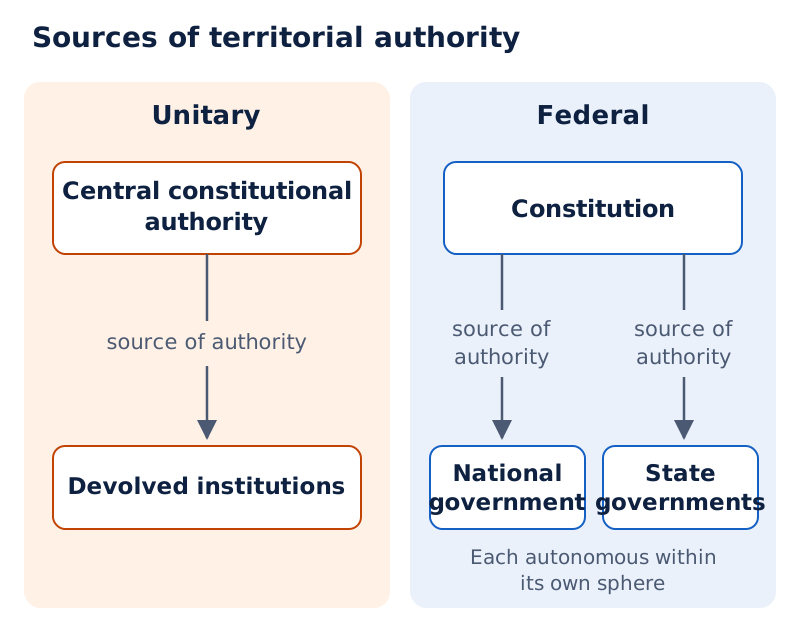
Draw two panels. In the unitary panel, place central constitutional authority above devolved institutions. In the federal panel, place the Constitution above national and state governments, with separate arrows to each. Label the arrows “source of authority”, not “daily instructions”.
Drawn by One Young India.
What are the meaning and features of parliamentary government in India?
A parliamentary government is one in which the political executive depends on the confidence of the legislature. Confidence means the support needed to remain in office. In India, the Council of Ministers is collectively responsible to the Lok Sabha, the directly elected House of the People.
How are the formal and real executives related?
The President is India's formal head of state, representing the state as a whole. The Prime Minister is the head of government, leading the Council of Ministers that runs the government. Executive power is formally vested in the President but is exercised through the ministerial system.
An Article is a numbered provision of the Constitution. Article 74(1) provides for a Council of Ministers with the Prime Minister at its head to aid and advise the President. The President may require reconsideration of advice but must act according to the advice given after reconsideration.
The President is elected indirectly for five years. This fixed term does not give the Prime Minister an independent guaranteed term. The Prime Minister must retain majority support in the Lok Sabha. If a party lacks a majority, a coalition, an alliance of parties, may provide it.
How is a parliamentary ministry formed?
- A leader obtains the support of a majority in the Lok Sabha, through a party or an alliance.
- The President formally appoints the leader who has that support as Prime Minister.
- The Prime Minister selects the members of the Council of Ministers and allocates their portfolios, meaning their areas of ministerial responsibility.
- The ministry governs while remaining answerable to Parliament and retaining the confidence of the Lok Sabha.
Ministers must be members of Parliament; a person appointed without membership must become a member within six months. The 91st Amendment Act (2003) limited the Council of Ministers to 15 per cent of the total membership of the House of the People.
Collective responsibility means that the ministry stands together before the Lok Sabha. A ministry losing its confidence must resign. Cabinet solidarity requires a minister who disagrees with a cabinet decision either to accept it or resign. A cabinet is the senior ministerial group directing major government policy.
Why did India choose parliamentary government, and how does accountability work?
India had experience of parliamentary institutions under the Acts of 1919 and 1935. The Constitution's makers wanted an executive responsive to public expectations and accountable to elected representatives. They sought a strong executive accompanied by safeguards against excessive concentration of authority around a single personality.
Why is the legislature-executive relationship important?
The executive is routinely subject to legislative control and supervision. Its dependence on majority support gives Parliament a continuing relationship with government. A no-confidence motion tests whether the elected House continues to support the ministry. Loss of confidence requires the Council of Ministers to resign.
Parliamentary government does not make concentrated personal leadership impossible. A Prime Minister with strong majority support can be very powerful. The effectiveness of accountability therefore depends on the conduct of representatives and citizens as well as the formal rules relating the ministry to Parliament.
How can the President act when a majority is unclear?
The President is for the most part a formal power holder and ceremonial head, but it would be incorrect to say that discretion is absent in every circumstance. When no leader clearly commands a majority, the President must judge who may be able to form and run a government.
After the March 1998 election, the Bharatiya Janata Party, abbreviated as BJP, and its allies held 251 seats, 21 short of a majority. President Narayanan asked alliance leader Atal Behari Vajpayee to provide documents supporting his claim and to secure a confidence vote within ten days of being sworn in.
This example shows that appointment and parliamentary support are connected. The President's role in selecting a Prime Minister does not replace the requirement to demonstrate confidence in the House. Discretion here means judgement within constitutional arrangements, not unrestricted personal choice of a government.
A historical example concerns the Indian Post Office (Amendment) Bill of 1986. A bill is a proposal for a law. President Gyani Zail Singh withheld a decision on it after criticism that it would curtail press freedom.
His successor, Venkataraman, returned it for reconsideration. The different coalition government elected in 1989 did not bring it back. Keeping assent pending in this way illustrates what is sometimes called a pocket veto; it does not mean that the President became the head of government.
The President can also ask ministers to reconsider advice. Once reconsidered advice is tendered, it is binding. Thus, an opportunity to question or warn the government is different from a general power to reject its decisions and govern independently.
What are the meaning and features of presidential government in the USA?
A presidential government places the offices of head of state and head of government in the President. In the USA, the President is the effective chief executive. The executive does not depend on the continuing confidence of Congress in the way an Indian ministry depends on the Lok Sabha.
How does separation of powers operate?
Separation of powers assigns executive, legislative and judicial authority to distinct institutions. The President and Congress have separate constitutional positions. The President is chosen through an electoral college, meaning a body of electors participating in the presidential election, and has a four-year term.
The President's principal departmental advisers, commonly called the cabinet, are not a parliamentary ministry collectively responsible to Congress. They serve under presidential leadership. Members of Congress cannot simultaneously hold executive office. The President does not possess the parliamentary power to dissolve the legislature.
A fixed term provides continuity, but it does not mean immunity from constitutional removal. Impeachment is the constitutional process for bringing formal charges against an office holder. In the USA, the House of Representatives impeaches and the Senate tries the charges; conviction can result in removal.
Why does a presidential executive still face limits?
Checks and balances allow institutions to restrain one another. Congress makes laws and controls public expenditure. The President can veto legislation, meaning refuse approval, while Congress can override a veto through the required special majority. Courts can review the constitutionality of government action.
These checks distinguish a powerful constitutional executive from an unrestricted ruler. Presidential government does not mean that the President makes every law, controls every institution or can ignore constitutional boundaries. Independence from a confidence vote is a particular institutional feature, not independence from accountability altogether.
Separate electoral and constitutional authority can also produce disagreement between executive and legislature. Their cooperation may be necessary for policy to proceed. The presidential system therefore combines an independently constituted executive with limits arising from the powers of other institutions.
How do parliamentary government in India and presidential government in the USA compare?
The core distinction concerns executive dependence on legislative confidence. India has a parliamentary executive even though it has a President. The USA has a presidential executive because its President is the effective head of government with a constitutional tenure independent of ordinary legislative confidence.
What are the principal points of comparison?
| Basis | India | USA |
|---|---|---|
| Executive leadership | President is formal head of state; Prime Minister heads government | President is both head of state and head of government |
| Relationship with legislature | Ministry depends on confidence of the Lok Sabha | Executive does not depend on congressional confidence |
| Ministerial membership | Ministers must be members of Parliament, subject to the six-month provision | Congressional membership and executive office cannot be held simultaneously |
| Responsibility | Council of Ministers is collectively responsible to the Lok Sabha | Departmental advisers are responsible to the President rather than collectively to Congress |
| Tenure | Prime Minister remains while commanding majority support | President has a fixed four-year term, subject to constitutional removal |
| Removal through loss of support | A successful no-confidence motion requires the ministry to resign | Ordinary loss of congressional support does not remove the President |
Fusion in a parliamentary system means close institutional connection between executive and legislature, especially through ministerial membership and responsibility. It does not mean that the two perform identical functions. Separation in a presidential system does not mean that institutions have no dealings with one another.
In both comparisons, distinguish the office from its holder. The powers associated with “President” differ between India and the USA. Similarly, a politically strong Prime Minister still operates in a system whose government depends on legislative support.
Finally, connect this comparison to the other classifications without mixing them. Federalism explains the relationship between national and state governments; presidentialism explains the executive's relationship with the legislature. Liberal democracy concerns political choice, liberties and restraints on authority. Each answers a distinct question about the same political system.
Glossary
- Totalitarian state — A state seeking comprehensive control of political and social life through an official ideological project.
- Authoritarian state — A state concentrating political power while restricting effective opposition and democratic public accountability.
- Liberal democracy — Government combining meaningful popular political choice with protected liberties and enforceable limits on public power.
- Unitary state — A state in which subordinate territorial institutions derive their powers from central constitutional authority.
- Federal state — A state with constitutionally distributed powers between national and regional governments autonomous in their respective spheres.
- Devolution — The transfer of powers from central institutions to institutions governing particular territories within a state.
- Constitutional supremacy — The principle that government institutions exercise authority subject to the higher rules of the Constitution.
- Parliamentary executive — A political executive whose continuance in office depends on retaining the required legislative confidence.
- Presidential executive — An executive headed by a President who combines state and government leadership independently of ordinary legislative confidence.
- Collective responsibility — The obligation of the ministry to stand together and resign when it loses the elected House's confidence.
- Separation of powers — An institutional arrangement distributing executive, legislative and judicial authority among distinct branches of government.
- Checks and balances — Powers enabling different institutions to restrain one another within the constitutional distribution of authority.
- Judicial review — Examination of laws or government actions by courts to determine whether they conform to the Constitution.
- Coalition — An alliance of political parties cooperating to provide support for forming or maintaining a government.
Common errors and misconceptions
- Misconception: Every state with a President has presidential government. Correct: India's President is formal head of state; the ministry depends on Lok Sabha confidence.
- Misconception: A unitary state cannot have regional institutions. Correct: Britain has devolved institutions; the key issue is the constitutional source of their authority.
- Misconception: Federal state governments receive all powers as central instructions. Correct: A federation constitutionally distributes powers between levels autonomous in their respective spheres.
- Misconception: Authoritarian and totalitarian are interchangeable. Correct: Totalitarianism seeks comprehensive ideological and social control; authoritarianism need not pursue that extent of transformation.
- Misconception: Majority rule permits the destruction of individual rights. Correct: Liberal democracy combines majority government with liberties and limits on public power.
- Misconception: India's President can permanently reject reconsidered ministerial advice. Correct: Article 74(1) requires the President to act on the advice tendered after reconsideration.
- Misconception: A fixed presidential term makes removal impossible. Correct: Constitutional removal procedures remain available even though ordinary loss of legislative confidence does not end the term.
Exam-style questions with model answers
Q1. Define totalitarian and authoritarian states, giving one separate definition for each. [2 marks]
- A totalitarian state seeks comprehensive political and social control, organised around an official ideological project.
- An authoritarian state concentrates political power and restricts opposition without necessarily seeking comprehensive control over society.
Q2. Distinguish totalitarian and authoritarian states on ideology, mobilisation and independent organisations. [3 marks]
- Ideology: Totalitarian rule centres on a comprehensive official ideology; authoritarian rule need not justify itself through such an elaborate system of beliefs.
- Mobilisation: Totalitarian regimes seek organised mass participation under official direction; authoritarian regimes may prefer obedience and limited political involvement.
- Organisations: Totalitarian rule seeks to absorb or suppress autonomous organisations; authoritarian rule may tolerate limited independence where it does not threaten political control.
Q3. Explain four features that make a state liberal democratic. [4 marks]
- Political choice: Free and fair elections permit meaningful competition and enable citizens to choose representatives who govern on their behalf.
- Liberties: Freedoms of expression, association and belief protect individuals and allow public criticism of government decisions.
- Legal limits: Constitutional rules and the rule of law restrain arbitrary authority, including authority exercised by an elected majority.
- Remedies: An independent judiciary helps enforce rights so that constitutional promises can provide practical protection when public authorities violate them.
Q4. Compare Britain as a unitary state and the USA as a federal state on constitutional authority, territorial powers, alteration of powers, courts and upper-chamber representation. [5 marks]
- Authority: Britain's Parliament possesses supreme law-making authority; in the USA, the Constitution is supreme and binds both federal and state institutions.
- Territorial powers: British devolved institutions operate within parliamentary sovereignty; American state powers rest on constitutional distribution rather than ordinary central delegation.
- Alteration: Britain's sovereign Parliament retains legal authority over devolution; changes to America's constitutional distribution must follow the constitutional amendment procedure involving states.
- Courts: British courts operate within parliamentary sovereignty; American courts can determine whether legislation exceeds powers permitted by the supreme Constitution.
- Representation: Britain's House of Lords does not give constituent states equal representation; the American Senate gives each state equal representation.
Q5. Explain Article 74(1) and distinguish the Indian President's power to request reconsideration from the power to reject reconsidered advice. Give two points. [2 marks]
- Article 74(1) establishes a Council of Ministers headed by the Prime Minister to aid and advise the President, who may request reconsideration.
- After reconsideration, the President must act on the advice tendered; requesting reconsideration is not a permanent power to reject it.
Q6. After the March 1998 election, the BJP and its allies held 251 seats, 21 short of a majority. President Narayanan asked Atal Behari Vajpayee for documents supporting his claim and a confidence vote within ten days of being sworn in. Explain what these facts show about majority support, presidential judgement and legislative confidence. [3 marks]
- Majority support: The alliance's stated seats fell short of a majority, so its claim required evidence of support beyond its existing seat total.
- Presidential judgement: Asking for supporting documents helped the President assess whether the claimant could command the support necessary to form a government.
- Legislative confidence: Requiring a confidence vote connected appointment to demonstrated support in the House; the President's appointment did not replace parliamentary accountability.
Q7. Compare parliamentary government in India and presidential government in the USA on executive leadership, confidence, ministerial membership, collective responsibility, tenure and selection of the head of government. [6 marks]
- Leadership: India's President is formal head of state while the Prime Minister leads government; the American President combines both leadership roles.
- Confidence: India's ministry must retain the Lok Sabha's confidence; the American executive does not depend on continuing confidence in Congress.
- Membership: Indian ministers must be parliamentarians, subject to the six-month provision; American congressional membership cannot be combined with executive office.
- Responsibility: India's ministers must accept cabinet decisions or resign under cabinet solidarity; American departmental advisers serve under presidential leadership rather than as a ministry collectively responsible to Congress.
- Tenure: An Indian Prime Minister's continuance depends on majority support; the American President has a four-year term subject to constitutional removal.
- Selection: India's President appoints as Prime Minister a leader commanding majority support in the Lok Sabha; the American President is chosen through an electoral college.
Key takeaways
- Classify governments separately by the character of rule, territorial distribution of authority and executive-legislature relationship.
- Totalitarian rule seeks comprehensive ideological and social control; authoritarian rule need not pursue the same extent of transformation.
- Liberal democracy combines meaningful political competition with liberties, constitutional limits and practical remedies against violations of rights.
- Britain's devolved institutions operate within a unitary structure whose ultimate law-making authority remains with Parliament.
- The USA constitutionally distributes authority between federal and state governments, with courts helping resolve disputes about powers.
- India's Council of Ministers depends on Lok Sabha confidence and must stand together under collective responsibility.
- The American President combines state and government leadership, while Congress and courts exercise separate constitutional powers.
- A powerful executive remains subject to constitutional limits; neither presidentialism nor parliamentary government guarantees accountability without effective institutions.
Test yourself
Which classification asks where territorial authorities obtain their powers?
The unitary-federal classification concerns the constitutional distribution and source of territorial governmental authority.
Why is a powerful ruler alone insufficient to identify totalitarianism?
Totalitarianism additionally seeks comprehensive ideological and social control, rather than merely concentrating political authority in a ruler.
Does devolution automatically create a federation?
No. Devolution can transfer powers within a unitary structure while central parliamentary sovereignty remains the constitutional basis.
What is the purpose of an independent judiciary in a federation?
It resolves legal disputes between national and regional governments over the constitutional distribution of powers.
What happens if India's ministry loses Lok Sabha confidence?
The Council of Ministers must resign because it is collectively responsible to the Lok Sabha.
Can India's President ignore advice after requiring its reconsideration?
No. The President must act according to the ministerial advice tendered after reconsideration under Article 74(1).
What makes India's system parliamentary despite its President?
The Prime Minister heads government, and the ministry's continuance depends on the confidence of the Lok Sabha.
Does separation of powers eliminate interaction between institutions?
No. Distinct institutions interact through constitutional checks, including legislative control of expenditure and judicial review.
Try it
Forms of Government: Comparative Structures and Mechanics
Test your understanding of unitary, federal, and quasi-federal constitutional systems through a two-step scenario.
1A multi-ethnic nation is drafting a new constitution to reconcile national unity with regional diversity and prevent central tyranny. The framers require that neither the central nor the regional tier can unilaterally alter the distribution of authority. Which constitutional framework achieves this goal?
Correct. In a federal government, sovereignty is institutionally divided by a written, rigid constitution that cannot be amended unilaterally by either level, supported by an autonomous judiciary that settles disputes and preserves constitutional boundaries.
Incorrect. In a unitary system, the central parliament is the sole legislative source of sovereign authority, and subordinate bodies derive power purely through delegation that the centre can modify, curtail, or dissolve at will.
Incorrect. While administrative uniformity and single legal codes provide prompt decision-making in a unitary state, they carry the risk of central despotism and systematically neglect regional aspirations.
2The drafting commission studies the Indian constitutional model as a potential blueprint. How does the Indian system handle regional territorial boundaries when restructuring internal borders?
Correct. Under Article 3, the Indian Union is an 'indestructible Union of destructible states,' allowing Parliament to unilaterally alter state boundaries, change names, or carve new states without mandatory state consent.
Incorrect. Article 1 designates India as a 'Union of States' precisely to underscore that it is not the result of an agreement among sovereign units, and states hold no right to secede or block reorganization.
Incorrect. The Supreme Court acts as an independent arbiter for constitutional disputes, but internal territorial alteration is a unilateral legislative power vested in Parliament under Article 3.
You have analyzed the foundational mechanics of federalism and the unitary biases of India's quasi-federal model.