
Democracy in India: Challenges | ISC Class 12 Political Science Notes
On this page
This note covers democracy, government based on popular participation and choice; caste, a social grouping traditionally associated with birth and inherited occupation; regionalism, political assertion of a region’s identity and interests; and political violence, the use or threat of physical force for political purposes.
What makes caste a challenge to Indian democracy?
How did the caste system organise society?
The traditional caste system made inherited occupational divisions part of a social order supported by religious rituals. Members of a caste were supposed to follow the same or similar occupations, marry within their group and avoid eating with members of other caste groups.
Caste hierarchy means the ranking of caste groups from those regarded as highest to those regarded as lowest. This hierarchy involved exclusion and discrimination against groups treated as outside the caste order. Untouchability is the practice of treating particular caste groups as polluting and excluding them from ordinary social interaction.
Political leaders and social reformers, including Jotiba Phule, Gandhiji, B.R. Ambedkar and Periyar Ramaswami Naicker, worked against caste inequality. Their efforts, together with economic and social changes, contributed to substantial changes in the caste system.
What has changed, and what persists?
Urbanisation, the movement of population from rural to urban areas, has weakened old caste restrictions. Education, economic development and the declining position of village landlords have also contributed. Occupational mobility means changing occupations, usually when a generation takes up work different from its ancestors’ work.
The Constitution, the basic framework of government and rights, prohibits caste-based discrimination. Nevertheless, untouchability has not ended completely. Even now, most people marry within their own caste or tribe. Legal prohibition and the disappearance of a social practice are therefore different things.
Article 29(2) bars denial of admission to citizens in educational institutions maintained by the State or receiving State funds solely on grounds of religion, race, caste or language. This provides a specific safeguard against caste exclusion in education.
The effects of accumulated advantage and disadvantage also persist. Groups with earlier access to education have benefited in acquiring modern education. Groups formerly excluded from education have lagged behind. Caste continues to be closely linked to economic status, although rich and poor people can be found in every caste.
Note: Changing caste practices do not mean that caste has disappeared. Equally, continuing inequality does not mean that the traditional system remains unchanged.
How does caste influence parties, candidates and elections?
How is caste support mobilised?
Casteism is the belief that caste is the sole basis of social community and that members of the same caste share interests that they do not share with other castes. This belief overlooks the different interests and experiences found within a caste.
When choosing candidates, political parties consider the caste composition of the electorate, the people entitled to vote. They nominate candidates from different castes to gather sufficient support. This connects the social composition of an area with parties’ attempts to win elections.
Parties and candidates also appeal to caste sentiments. Some parties become known for favouring particular castes and are seen as their representatives. When governments are formed, parties usually take care that representatives of different castes and tribes find a place in them.
Universal adult franchise means the voting right of adult citizens without exclusion on grounds such as caste. Together with the principle of one-person-one-vote, it compelled leaders to mobilise political support and brought new consciousness among castes previously treated as inferior.
| Political activity | Role of caste |
|---|---|
| Selection of candidates | Parties consider the caste composition of the electorate while choosing candidates. |
| Election campaigns | Candidates and parties make appeals to caste sentiments to gather support. |
| Formation of governments | Parties usually seek representation for different castes and tribes. |
| Political participation | Equal voting rights bring previously subordinated castes into the struggle for political influence. |
What does a vote bank mean?
A vote bank usually means that a large proportion of the voters of a caste or community support a particular party. It does not mean that every member votes identically. No party wins the votes of all the voters of a caste or community.
Caste is therefore relevant to candidate selection, campaigning, representation and participation. These connections explain its importance without turning caste identity into a complete explanation of political behaviour. The distinction between influence and complete determination is essential to understanding elections.
Why does caste alone fail to explain electoral behaviour?
What limits a purely caste-based explanation?
Political parties need support across social groups. No parliamentary constituency has a clear majority of one single caste. A constituency is an electoral area whose voters choose a representative. Candidates and parties therefore need to win the confidence of more than one caste and community.
Several parties may nominate candidates of the same caste where that caste is believed to dominate the electorate. Some voters then have more than one candidate from their caste, while many voters have no candidate from their caste. The candidate’s caste cannot by itself explain the choice each voter makes.
Ruling parties and sitting representatives frequently lose elections. Voters’ political preferences are not permanently fixed by caste membership. Attachment to a political party is often stronger than attachment to caste or community.
People within the same caste have different economic interests. Rich and poor people, or men and women from the same caste, often vote very differently. Assessments of government performance and the popularity of leaders matter and are often decisive in elections.
How does politics change caste?
The relationship works in both directions. Caste groups try to enlarge themselves by incorporating neighbouring castes or sub-castes previously excluded. They also form a coalition, an alliance of groups, with other castes and communities, requiring dialogue and negotiation.
Politics has produced broader groupings such as backward and forward castes. In some situations, political expression of caste differences gives disadvantaged communities space to demand a share of power.
Dalits are communities historically subjected to caste exclusion. Other Backward Classes is the category of socially and educationally backward classes distinct from Scheduled Castes and Scheduled Tribes, the officially listed caste and tribal communities respectively.
Caste politics has helped Dalits and Other Backward Classes gain better access to decision-making. Political and non-political organisations have demanded an end to caste discrimination, greater dignity, and improved access to land, resources and opportunities.
Exclusive attention to caste can also divert attention from poverty, development and corruption. In some cases, caste divisions lead to tensions, conflict and even violence. Political organisation against discrimination must therefore be distinguished from politics based on caste identity alone.
What is regionalism, and why does it develop?
What connects identity with regional demands?
Regionalism draws strength from the diversity of languages, cultures, tribes and religions, especially where these identities are geographically concentrated. A sense of regional deprivation, the feeling that a region has been neglected or denied a fair share of development, also encourages regional demands.
Autonomy means a measure of self-government within a wider political arrangement. Federalism divides governmental powers between levels, including the Centre and the States. Indian federalism has provided a means of accommodating regional sentiments.
Regional aspirations are demands concerning a region’s identity, development and political position. Language issues concern recognition or imposition of languages. Sons-of-the-soil policies seek preference for local inhabitants in jobs and resources. River water disputes concern disagreements over sharing or using river water.
Statehood means recognition as a State within India. Secession means separation from the existing country; a secessionist demand seeks that separation. These objectives differ from greater autonomy within the existing political arrangement.
The Indian approach to diversity allows different regions and linguistic groups to retain their cultures within a united national life. Political parties and groups can address regional identities, aspirations and problems. Democracy permits these expressions and does not treat regional aspirations as inherently anti-national.
Where can tensions arise?
Sometimes concern for national unity may overshadow regional needs. At other times, concern for a region alone may obscure the larger needs of the nation. Political conflicts can therefore arise over the powers, rights and separate existence of regions.
Uneven economic development contributes to feelings of regional discrimination. Regions that remain economically backward feel that their needs should receive priority. When some States develop rapidly while others remain poor, regional imbalances and migration between regions follow.
Diagram
Kinds of regional aspirations
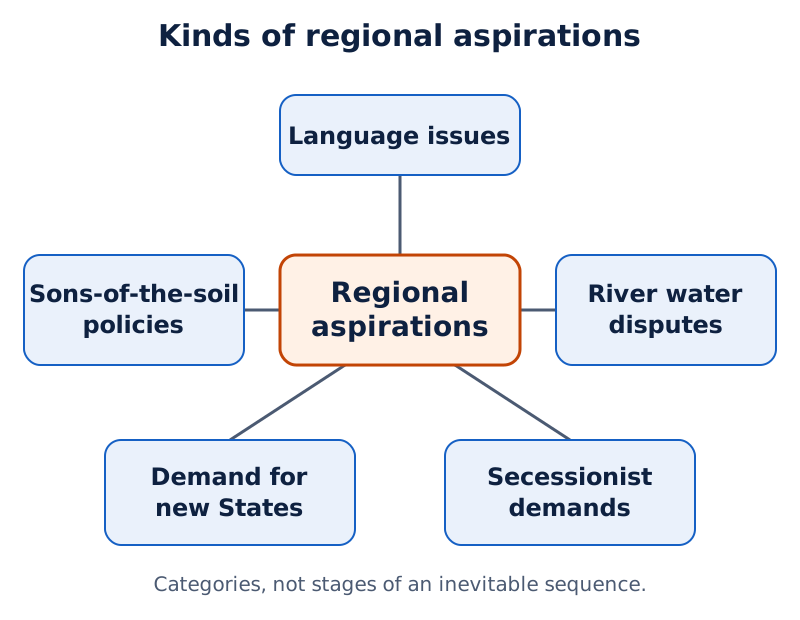
Draw a central box labelled “Regional aspirations”. Connect it to five boxes: language issues, sons-of-the-soil policies, river water disputes, demand for new States, and secessionist demands. These are categories, not stages of an inevitable sequence.
Drawn by One Young India.
How do language issues become regional political demands?
What are linguistic demands?
Linguistic means relating to language. Language issues arise when people seek recognition of their language, resist the imposition of another language or demand political boundaries that reflect linguistic identity. Such claims connect cultural recognition with participation in public life.
An agitation is an organised campaign pressing a demand. After Independence, mass agitations sought the formation of linguistic States, States organised substantially around language. Andhra Pradesh, Karnataka, Maharashtra and Gujarat were among the regions affected by these movements. Redrawing internal boundaries became one way of responding to the country’s diversity.
From the late 1950s, Punjabi-speaking people agitated for a separate State. Punjab and Haryana were created in 1966. The demand concerned the internal organisation of India, rather than the creation of an independent country outside India.
Schedule 8 of the Constitution recognises twenty-two languages. Constitutional recognition and educational rights provide ways of protecting linguistic diversity within India.
| Constitutional provision | Protection for cultural and educational life |
|---|---|
| Article 29(1) | Citizens with a distinct language, script or culture have the right to conserve it. |
| Article 30(1) | Religious and linguistic minorities may establish and administer educational institutions of their choice. |
| Article 30(2) | In granting aid, the State cannot discriminate against an educational institution because a religious or linguistic minority manages it. |
What does the Dravidian movement illustrate?
In southern India, particularly Tamil Nadu, there were protests against making Hindi the country’s official language. There were also strong pro-Hindi agitations in the north demanding its immediate adoption as the official language. The issue involved competing political demands concerning language.
The Dravidian movement, a regional movement associated with southern identity and later concentrated in Tamil Nadu, illustrates the compatibility of regionalism and nationalism, identification with and commitment to the nation. Although some sections had ambitions for a separate Dravida nation, the movement did not take to arms.
Instead, it used public debates and elections. Regional demands thus entered democratic competition. Its political success shows why cultural assertion should not automatically be equated with armed rebellion or hostility to the nation.
Linguistic reorganisation did not resolve all regional problems for all time. Nevertheless, recognition of linguistic identity helped accommodate diversity within India. Language can generate disputes, but providing political recognition to language communities can also strengthen their place within the Union.
What do sons-of-the-soil policies seek to achieve?
Who is treated as an insider or outsider?
Sons-of-the-soil policies seek preference for people regarded as local inhabitants of a region, especially in access to jobs and resources. The underlying claim is that those considered to belong to the region should receive priority over people regarded as outsiders.
A migrant is someone who moves from one place to another. In regional politics, people described as outsiders may have arrived from another Indian State or from another country. These categories must be distinguished: interstate migration and immigration across a national border are different movements.
In the North-East, large-scale migration created tensions between local communities and people perceived as outsiders. Migrants were seen as competitors for scarce land, employment opportunities and political power. This issue took political and sometimes violent forms.
What does the Assam movement show?
The Assam movement lasted from 1979 to 1985. The All Assam Students’ Union, a students’ organisation not affiliated to a political party, led an anti-foreigner movement. Its concerns included illegal migration, perceived outsider domination and a faulty voters’ register.
Assamese participants feared that foreign settlers would reduce the indigenous population to a minority. Indigenous here refers to the population regarded as belonging originally to the region. Economic grievances included poverty and unemployment despite Assam’s oil, tea and coal resources.
Participants felt that resources were being taken out without corresponding benefits to local people. These were the movement’s perceptions and grievances; the fact that a fear motivated a movement does not by itself establish every allegation made within it.
The movement used varied methods of mobilisation and also involved tragic violence and loss of life and property. Negotiations produced the Assam Accord in 1985. This illustrates how concerns about identity, economic opportunity and political representation can come together in a regional movement.
Why can river water sharing become a regional dispute?
What is being disputed?
A river water dispute is a disagreement over the sharing or use of river water, including disagreements between States. Unlike a demand for a separate country, it concerns claims over a resource. It can nevertheless become closely connected with regional political mobilisation.
The Punjab movement provides an example. After the Akali government was dismissed in 1980, the Akali Dal, a political party associated with Punjab, launched a movement concerning the distribution of water between Punjab and neighbouring States.
This issue existed alongside other demands concerning regional autonomy and identity. The Anandpur Sahib Resolution of 1973 had sought greater regional autonomy and a redefinition of Centre-State relations. It was a plea to strengthen federalism and had a limited appeal among the Sikh masses.
What did the Punjab Accord propose?
An accord is a negotiated agreement. In July 1985, Prime Minister Rajiv Gandhi and Akali Dal president Harchand Singh Longowal reached the Punjab Accord, also known as the Rajiv Gandhi-Longowal Accord.
The agreement provided for a tribunal, a body established to adjudicate a dispute, to decide the sharing of Ravi-Beas river water among Punjab, Haryana and Rajasthan. This was a proposed institutional response to a resource-sharing disagreement.
The Accord also proposed a separate commission to resolve the Punjab-Haryana border dispute and the transfer of Chandigarh to Punjab. These were terms of an agreement, not proof that every proposed measure had already been implemented.
Peace did not come easily or immediately. Violence continued nearly for a decade. The example shows why the signing of an accord must be distinguished from its implementation and from the eventual restoration of peaceful political life.
How does a demand for a new State differ from secession?
What political outcome does each demand seek?
A demand for statehood seeks recognition as a State within the Indian Union. Secession means separation from an existing country to form a separate sovereign political entity. Sovereignty means supreme political authority; a separate country claims authority outside the existing Union.
These demands differ from a claim for autonomy within an existing State. Regional movements must therefore be understood by identifying the political arrangement they seek. Language, tribal identity and a sense of economic neglect can support demands without fixing the outcome in advance.
| Demand | Political objective | Relationship with India |
|---|---|---|
| Greater autonomy | More self-government for a region or community. | Can be accommodated within the existing Union. |
| New State | A separate State government and State boundaries. | The proposed State remains part of India. |
| Secession | Separation from India as a sovereign political entity. | The demand goes outside the Indian Union. |
How have different regional demands been accommodated?
Chhattisgarh, Uttarakhand and Jharkhand illustrate the creation of new States within India. Their formation shows why a new internal boundary need not mean the breakup of the country. Regional recognition and national membership can coexist.
In the North-East, demands for autonomy arose among communities that felt the Assam government was imposing the Assamese language. Some demands led to separate States. Others involved arrangements for self-government within Assam rather than further division into smaller States.
District Councils, institutions providing regional self-government in designated areas, offered autonomy to communities including the Karbis and Dimasas. These arrangements illustrate a distinction between greater control over local affairs and complete separation from India.
Schedule 6 of the Constitution provides for tribal autonomy in preserving customary laws and practices. Such constitutional accommodation has helped resolve complex political problems in the North-East.
Before its abrogation in August 2019, Article 370 provided special constitutional arrangements for Jammu and Kashmir. Some people outside the State opposed its special status because they believed it obstructed full integration with India.
Another view, held mostly among Kashmiris, was that autonomy under Article 370 was insufficient and had been eroded in practice. This grievance contributed to demands for the restoration of greater State autonomy.
Secessionist movements posed a more difficult problem because their objective was a separate country. Yet even an armed separatist movement could enter negotiations and accept a settlement within India, as the experience of Mizoram demonstrates.
What are the six forms of political violence?
How does violence differ from political disagreement?
Political violence uses force or threats of force to pursue political purposes. It differs from peaceful disagreement, public debate and electoral competition. An agitation is an organised campaign pressing a demand; agitation is not necessarily violent.
The six forms are linguistic, secessionist, terrorist, caste and electoral violence, and the politics of violent agitation. The labels describe different bases, objectives or settings of violence. They do not imply that every language movement, caste organisation or regional demand becomes violent.
| Form | Meaning |
|---|---|
| Linguistic violence | Violence associated with language disputes, imposition or hostility between language groups. |
| Secessionist violence | Armed or violent action directed towards separating a territory from the country. |
| Terrorist violence | Political violence deliberately targeting civilians, or threats of such violence, intended to terrorise the public and pressure governments or other parties to a conflict. |
| Caste violence | Violence arising from caste domination, discrimination or conflict. |
| Electoral violence | Force or intimidation connected with influencing an election or obstructing free political choice. |
| Politics of violent agitation | Use of violent methods in a political campaign to press demands or compel a response. |
Why should the categories be distinguished carefully?
Linguistic and caste violence are identified by the social issue around which conflict develops. Secessionist violence is identified by the goal of territorial separation. Electoral violence is identified by its connection with an election. Terrorist violence targets civilians to terrorise a wider public and pressure governments or other parties to a conflict.
These distinctions allow overlap. A violent campaign can have a secessionist objective and use terrorist methods. Conversely, merely demanding recognition for a language, or campaigning against caste discrimination, does not establish that violence has occurred.
In some cases, caste divisions lead to conflict and violence. In parts of the North-East, perceptions of language imposition produced protests and riots. The Mizo movement’s armed campaign provides a historical example of secessionist violence. Each example must be linked to the conduct actually described.
Note: Identify both the demand and the method. Regional autonomy is an objective; peaceful negotiation and armed action are different methods. A shared objective does not make those methods equivalent.
What do regional conflicts show about violence and democratic politics?
How did the Mizoram conflict move towards settlement?
In the Mizo Hills, the Assam government’s inadequate response to the famine of 1959 helped build support for secession. Laldenga led the Mizo National Front, the organisation that launched an armed campaign for independence in 1966. Insurgency means organised armed rebellion against established authority.
- The famine and the inadequate response strengthened anger and support for a movement seeking separation.
- The Mizo National Front began its armed campaign in 1966, followed by a prolonged conflict with Indian forces.
- Laldenga later entered negotiations with the Indian government, and Rajiv Gandhi helped bring them to a conclusion.
- The 1986 peace agreement provided for full statehood with special powers, while the organisation agreed to abandon its secessionist struggle.
Mizoram became a State in 1987. The shift from armed struggle to a negotiated arrangement demonstrates the difference between demanding independence and accepting statehood within India. It also shows that the political position of a movement can change through negotiation.
How does violence affect political life?
In the Mizo conflict, repressive security measures caused further anger and alienation, a sense of estrangement from political authority. Common people suffered during the conflict. An account of violence must therefore consider the experience of the population as well as the actions of armed organisations.
Punjab also shows the damage to ordinary political processes. Militancy, the use of violent methods for political goals, and counter-insurgency, action against armed rebellion, involved police excesses and violations of human rights, the basic rights of every person. The normal electoral and political process was suspended, and restoring it in an atmosphere of suspicion and violence was difficult.
The Justice Nanavati Commission of Inquiry report, 2005, described evidence of organised attacks on Sikhs in 1984. Instructions to kill and loot, together with attackers’ apparent lack of fear of the police, showed the systematic character of the violence.
When Punjab held elections in 1992, only 24 per cent of electors voted. Peace returned by the middle of the 1990s. This historical sequence shows that formal elections and the restoration of normal democratic participation need not occur at the same moment.
Regional aspirations remain part of democratic politics. The distinction between recognising a regional grievance and endorsing violence is central: cultural identity, resource claims and demands for self-government can be addressed through political participation and negotiation.
Public accountability also depends on citizens being able to scrutinise government. The Right to Information Act 2005 gives access to government records, including rights to inspect documents and obtain copies.
The Official Secrets Act 1923 had restricted information disclosure. The right to information framework requires public authorities to publish certain information proactively, reducing citizens’ need to make formal requests.
Glossary
- Caste — A social grouping traditionally linked to birth, inherited occupation, marriage restrictions and a ranked social order.
- Casteism — The belief that caste alone defines a social community and its members’ shared interests.
- Caste hierarchy — A ranked ordering of caste groups from those regarded as highest to those regarded as lowest.
- Vote bank — A description usually meaning that a large proportion of a caste or community’s voters supports one party.
- Regionalism — Political assertion of the identity, interests and demands associated with a particular region.
- Regional deprivation — A sense that a region has been neglected or denied its fair share of development.
- Autonomy — A measure of self-government exercised within a wider political arrangement rather than complete independence.
- Federalism — A system dividing governmental powers between levels, including the central government and State governments.
- Sons-of-the-soil policies — Policies seeking preference for people regarded as local inhabitants in employment or access to regional resources.
- Statehood — Recognition of a territory as a State within the Indian Union, rather than a separate country.
- Secession — Separation from an existing country to form a separate sovereign political entity.
- Political violence — The use or threat of physical force to pursue political objectives or influence political decisions.
- Insurgency — Organised armed rebellion directed against established political authority within a territory.
- Accord — A negotiated agreement between parties seeking to address a political dispute or conflict.
Common errors and misconceptions
- Misconception: Constitutional prohibition has eliminated caste discrimination. Correct: Untouchability has not ended completely, and the effects of accumulated social advantages and disadvantages persist despite legal prohibition.
- Misconception: A vote bank means unanimous voting by a caste. Correct: It usually means a large proportion of that caste’s voters support a party; no party wins all its votes.
- Misconception: Caste alone determines election results. Correct: Party loyalties, economic interests, government performance and leaders’ popularity also matter. Rich and poor voters of the same caste often vote differently.
- Misconception: Regional identity is necessarily anti-national. Correct: Regional culture and political aspirations can coexist with national membership, as linguistic States and democratic regional movements illustrate.
- Misconception: A new State and a new country mean the same thing. Correct: Statehood remains within the Indian Union; secession seeks separation from it.
- Misconception: Every agitation is political violence. Correct: Agitation can use public debate and elections. The Dravidian movement did not take to arms, despite some sections’ separatist ambitions.
- Misconception: Signing an accord proves immediate peace and implementation. Correct: The Punjab Accord contained proposed measures, but violence continued nearly for a decade.
Exam-style questions with model answers
Q1. Define statehood and secession. [2 marks]
- Statehood: Recognition as a State within the Indian Union.
- Secession: Separation from an existing country to form a separate sovereign political entity.
Q2. Parties consider caste composition when selecting candidates, appeal to caste sentiments during campaigns, and usually include representatives of different castes and tribes in governments. Explain these three roles of caste in politics. [3 marks]
- Candidate selection: Parties consider the electorate’s caste composition when choosing candidates, linking nomination decisions with the search for electoral support.
- Campaign mobilisation: Appeals to caste sentiments are used to gather votes, making caste identity a basis of political support.
- Government formation: Parties usually provide places to representatives of different castes and tribes, connecting social representation with the composition of government.
Q3. No party wins all the votes of a caste; party attachment is often stronger than caste attachment; rich and poor members of a caste often vote differently; and government performance and leaders’ popularity are often decisive. Use these facts to explain four limits of a caste-only account of elections. [4 marks]
- A caste does not vote unanimously, so shared caste identity cannot establish that all its members support the same party.
- Political loyalties are often stronger than caste loyalties, allowing party attachment to influence choices across caste boundaries.
- Economic differences create different interests within a caste, helping explain why rich and poor members often vote differently.
- Judgements about government performance and leaders’ popularity are often decisive, showing that electoral choice includes assessments beyond caste identity.
Q4. Regional aspirations include recognition for a language, preference for local inhabitants in jobs and resources, disputes over river water, new States within India, and separation into a sovereign country. Identify and explain these five kinds of aspiration. [5 marks]
- Language issues: A community seeks recognition for its language or resists linguistic disadvantage. The demand concerns the public position of language and regional cultural identity.
- Sons-of-the-soil policies: People regarded as local inhabitants claim preference in jobs and resources. The defining issue is priority for insiders over those regarded as outsiders.
- River water disputes: Regions or States disagree over water sharing or use. The immediate issue concerns access to a shared resource.
- Demand for new States: A region seeks statehood within India. Its political objective changes internal boundaries while retaining membership of the Union.
- Secessionist demands: A region seeks separation into a sovereign country. Unlike statehood, the proposed outcome lies outside the Indian Union.
Q5. Classify six forms of political violence from these descriptions: violence over language; armed action for territorial separation; violence deliberately targeting civilians to spread public fear for political ends; caste-based attacks; intimidation affecting elections; and violent methods used in a campaign pressing political demands. Give one explained classification for each. [6 marks]
- Linguistic violence: Violence over language belongs to this category because the dispute is organised around linguistic identity, recognition or relations between language groups.
- Secessionist violence: Armed action seeking territorial separation is defined by its objective of taking a region outside the existing country.
- Terrorist violence: Deliberately targeting civilians with violence to spread public fear uses terror as a means of pressuring governments or other parties to a conflict.
- Caste violence: Caste-based attacks belong here because violence is connected to caste identity, domination, discrimination or conflict between caste groups.
- Electoral violence: Intimidation affecting elections belongs to this form because force interferes with electoral participation or free political choice.
- Politics of violent agitation: A campaign pressing demands through violent methods falls here because violence becomes a means of securing a political response.
Q6. Some sections of the Dravidian movement wanted a separate Dravida nation, but the movement did not take to arms and used public debate and elections. Explain three conclusions about the relationship between regional demands and political methods. [3 marks]
- A regional movement may contain different political aspirations among its supporters; separatist ambitions held by some sections should not automatically be attributed to the whole movement.
- Public debate and elections provide political methods through which regional claims can be expressed, making cultural assertion compatible with democratic participation.
- The objective and the method must be distinguished: a demand for separation does not by itself demonstrate that the movement used political violence.
Q7. Inadequate response to the 1959 Mizo famine strengthened separatist support. The Mizo National Front began an armed campaign in 1966. Laldenga later negotiated with the Indian government. The 1986 agreement provided statehood with special powers in return for abandoning secession, and Mizoram became a State in 1987. Explain this movement from conflict to settlement in five points. [5 marks]
- The inadequate response to the famine strengthened anger and support for separation. The grievance helped give the movement a wider basis of support.
- The armed campaign launched in 1966 expressed the separatist objective through force. At this stage, the demand went beyond self-government within India.
- Laldenga’s later negotiations introduced a political route towards settlement. Negotiation created a way to discuss the future relationship between the region and India.
- The 1986 agreement linked statehood with special powers to abandonment of the secessionist struggle. It changed the proposed outcome from independence to accommodation within India.
- Mizoram’s statehood in 1987 gave institutional form to this settlement. A new State within the Union differed fundamentally from the earlier objective of separation.
Q8. The Punjab Accord of July 1985 proposed a tribunal for Ravi-Beas water sharing among Punjab, Haryana and Rajasthan, a Punjab-Haryana border commission, and transfer of Chandigarh to Punjab. Violence continued nearly for a decade. Explain the three proposed measures and one limit of treating the Accord as an immediate solution. [4 marks]
- The proposed tribunal would decide river water sharing among Punjab, Haryana and Rajasthan, providing an institution to address the resource dispute.
- The proposed commission would address the Punjab-Haryana border disagreement, dealing with a territorial issue distinct from water sharing.
- The proposed transfer of Chandigarh to Punjab was another term of the agreement; stating the proposal does not establish its implementation.
- Violence continued nearly for a decade, so signing the Accord did not mean that peace followed easily or immediately.
Key takeaways
- Caste practices have changed substantially, but untouchability has not ended completely and accumulated social inequalities continue to affect opportunities.
- Caste influences candidate selection, campaigns and representation, while party attachment, economic interests and performance also shape electoral choices.
- Politics changes caste identities through broader groupings and alliances, sometimes giving disadvantaged communities greater access to decision-making.
- Regional aspirations can express demands for cultural recognition, resources, autonomy, statehood or separation; these objectives must be distinguished.
- Language issues, sons-of-the-soil policies, river water disputes, new State demands and secession are different kinds of regional aspiration.
- Political violence includes linguistic, secessionist, terrorist, caste and electoral forms, together with the politics of violent agitation.
- Regional identity does not automatically imply violence: the Dravidian movement used public debate and elections without taking to arms.
- Mizoram illustrates a transition from armed secessionism to negotiated statehood, while Punjab shows that an accord need not bring immediate peace.
Test yourself
What is the difference between caste and casteism?
Caste is a social grouping traditionally associated with birth and inherited occupation. Casteism treats caste as the sole basis of community and shared interests.
Does a vote bank mean unanimous voting?
No. It usually means that a large proportion of a caste or community’s voters support a party, rather than every member doing so.
How can politics reshape caste identities?
Caste groups can incorporate previously excluded groups, negotiate alliances with other communities and participate in broader political categories such as backward and forward castes.
Which five kinds of regional aspirations should be distinguished?
Language issues, sons-of-the-soil policies, river water disputes, demands for new States, and secessionist demands express different kinds of regional claims.
Why is a demand for a new State different from secession?
A new State remains within India. Secession seeks separation from India and political authority outside the existing Union.
Does regional agitation necessarily involve violence?
No. Agitation can use peaceful political methods. The Dravidian movement used public debates and elections and did not take to arms.
What river-sharing arrangement did the Punjab Accord propose?
It proposed a tribunal to decide the sharing of Ravi-Beas river water among Punjab, Haryana and Rajasthan.
What changed through the Mizoram peace agreement?
The Mizo National Front agreed to abandon its secessionist struggle, while the agreement provided for statehood with special powers within India.
Take this further
How does India make policy?
The Model NITI Aayog self-paced course: 41 chapters, about 19 hours of study, on how India makes policy, from the policy cycle and writing a white paper to the economy, the Union Budget and governance. It comes with Learnacy Essential.
Learnacy Essential is ₹1,499 for the year. It also adds feedback from an AI writing coach, submission to The OYI Review, World 101’s member tools and the 3D labs. Publication is not guaranteed. See what a year includes
Or create a free account to draft in the Writing Studio, explore World 101’s map and open the 2D version of every lab. Create a free account