
Franchise and Representation | ISC Class 12 Political Science Notes
On this page

This note covers universal adult franchise, reasons for its widespread acceptance, representation, First Past the Post, proportional representation, political parties, and the meanings and merits of single-party, bi-party and multi-party systems.
What does universal adult franchise mean?
Franchise, also called suffrage, means the right to vote. Universal adult franchise means that all adult citizens are eligible to vote in elections. An election is the method through which people choose their representatives to take part in governing the country.
Democracy means government based on the rule of the people. In a representative democracy, citizens choose people who make public decisions on their behalf. Franchise therefore concerns who has a voice in selecting those representatives.
What do universal and adult mean?
Universal extends the voting principle to adult citizens generally. It rejects the idea that political choice belongs to a privileged section. Adult refers to the minimum voting age: in India, citizens become eligible to vote at 18.
Universal adult franchise does not mean that children vote. Nor does it mean that educational qualifications determine a citizen's political worth. The principle recognises adult citizens as equals when they judge what is good for society, their country and their own locality.
Definition: Universal adult franchise gives adult citizens the right to participate in choosing representatives, giving citizens equal standing and an opportunity to participate without discrimination.
How does voting differ from standing for election?
Eligibility means meeting the conditions required to exercise a right or perform a role. Eligibility to vote and eligibility to contest an election are separate questions. To contest means to stand as a candidate seeking election.
The voting age in India is 18. A candidate for the Lok Sabha, the elected House of the People in Parliament, India's national law-making body, or a State Legislative Assembly must be at least 25. A State Legislative Assembly is the elected law-making chamber of a state.
This distinction prevents a common confusion. An adult citizen's right to choose a representative does not automatically mean that the citizen has reached the minimum age to become that representative. Universal voting rights and qualifications for candidature perform different roles.
Why has universal adult franchise gained widespread acceptance?
The central argument for universal adult franchise is political equality: adult citizens should have an equal standing in choosing those who govern them. Its acceptance rests on a view of citizenship in which political participation is not reserved for a specially qualified minority.
How does it express equality and inclusion?
- Equal political standing: every adult citizen is recognised as capable of participating in the choice of representatives. Political judgement is not treated as the exclusive possession of a privileged group.
- Non-discrimination: this means refusing unequal treatment on irrelevant grounds. Extending the franchise to adult citizens is consistent with equality rather than restricting participation according to educational attainment.
- Inclusive participation: the opportunity to select representatives belongs to the adult citizen body. Inclusion here concerns the right to take part, rather than a promise that every voter will support the successful candidate.
In many countries, citizens fought long struggles to obtain voting rights. In many countries, women obtained this right very late and only after struggle. Universal adult franchise recognises their place in political decision-making rather than treating them as subjects without an electoral voice.
Why is confidence in ordinary citizens important?
The principle rests on confidence in citizens' judgement. The framers of India's Constitution believed in the ability and worth of all adult citizens as equals in deciding public questions. A Constitution is the basic framework of rules governing a country's political institutions.
Many people have questioned, and many still question, giving citizens voting rights irrespective of educational qualifications. The democratic reply is that formal education is not the test of a person's equal worth in choosing representatives. Citizens are entitled to consider their own needs and the interests of society.
How does the franchise connect people and government?
Broad participation gives people a part in authorising representative government. It also supports accountability, meaning answerability for decisions and conduct. Where competitive elections allow voters to reject parties, political organisations have a reason to respond to people's needs.
These are reasons for accepting the principle, not guarantees of perfect government. Voting rights establish an opportunity for participation. The fairness of the electoral process and the possibility of a meaningful choice remain important to democratic representation.
What is representation, and why do electoral methods matter?
Representation means acting on behalf of others in public decision-making. In a large democracy, all citizens cannot directly take every decision. They elect representatives who take part in governing and administering the country.
How does representative democracy work?
In direct democracy, citizens themselves participate in day-to-day public decisions and government. In representative, or indirect, democracy, elected representatives take major decisions. Rule by the people usually means rule through these representatives when very large populations are involved.
Citizens therefore participate indirectly in major policy decisions through the people they elect. This makes the method of selecting representatives important: the electoral rules determine how citizens' choices become membership of a public decision-making body.
A legislature is a law-making body. A seat is a place held by a representative in that body. Votes and seats are different things: votes record electoral choices, while seats indicate who has been elected to represent people.
Which questions must be kept separate?
| Concept | Question it answers | Central concern |
|---|---|---|
| Franchise | Who is entitled to vote? | Participation by adult citizens |
| Representation | Who acts on behalf of the people? | Selection of representatives |
| Electoral method | How do votes determine the elected result? | Rules translating choices into seats |
An electoral method is the set of rules used to determine election results from votes. Different electoral methods connect votes with representation in different ways. The same entitlement to vote can therefore operate alongside different rules for determining the elected result.
Holding an election does not by itself establish democracy. Non-democratic rulers also hold elections, sometimes arranged so that their rule is not threatened. A meaningful democratic choice requires more than the existence of voting machinery.
Diagram
From voters to representation
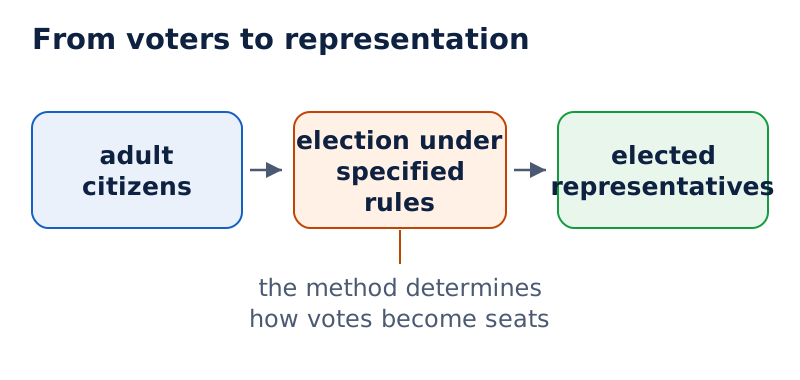
Draw three boxes labelled adult citizens, election under specified rules, and elected representatives. Connect them in that order. Below the middle box write: the method determines how votes become seats.
Drawn by One Young India.
The diagram links participation and representation without treating them as identical. The franchise identifies the voters; the electoral method determines the result; the representatives then act in public institutions on behalf of the people.
What is the First Past the Post system?
First Past the Post (FPTP) is an electoral method in which the candidate with the highest number of votes in a constituency wins. A constituency is a geographical electoral area from which a representative is chosen.
Under the form used for Lok Sabha elections, each constituency elects one representative. Voters choose between candidates. The successful candidate is the one who receives more votes than any other individual candidate in that constituency.
How is the result identified?
- Identify the constituency whose representative is being chosen. The contest is decided within that electoral area.
- Count the votes received by each candidate in that constituency.
- Compare each candidate's total with the totals secured by the other candidates.
- Declare the candidate with the highest total elected to the constituency's seat.
How does plurality differ from a majority?
Plurality means having more votes than any other candidate. A majority of votes means more than half the votes. FPTP is also called the plurality system because the winner need not secure a majority.
If there are several candidates, the winning candidate often receives much less than 50 per cent of the votes. The crucial comparison is with each rival's total, rather than with the combined total received by all the losing candidates.
Note: The expression First Past the Post describes finishing ahead of the other candidates. It does not impose a requirement that the winner receive more than half the votes.
What does this mean for votes and seats?
Vote share is the proportion, or share of the total, of votes obtained; seat share is the proportion of seats won. Under FPTP, a political party, an organised group seeking governmental power through elections, can win a larger seat share than its vote share.
The reason is that seats are awarded constituency by constituency. Votes for losing candidates do not elect those candidates to that constituency's seat. Adding votes across the country therefore does not directly determine a party's number of seats.
The essential meaning remains local electoral victory by the highest vote total. A candidate's plurality, a majority of votes, and a party's majority of seats, meaning more than half the seats, are distinct ideas and should be identified separately when interpreting an election result.
What does proportional representation mean?
Proportional representation (PR) is a method that connects the share of seats allocated to a party with its share of votes. The central principle is representation in proportion to electoral support.
What is proportional about the method?
The word proportion refers to a share of a total. In the basic party-based explanation of PR, parties receive legislative seats in proportion to their votes. Representation is therefore related to the distribution of support among parties.
In a party-list form, a party announces a list of candidates before the election. Voters express a preference for a party. The party fills its allotted seats from its declared list, rather than each seat being awarded to a constituency's highest-polling candidate.
Some forms treat the whole country as one constituency. Other forms divide it into multi-member constituencies, electoral areas returning more than one representative. In these list forms, representatives from the same constituency can belong to different parties.
How do the meanings of FPTP and PR differ?
| Basis | FPTP | Party-list PR |
|---|---|---|
| Choice expressed | Vote for a candidate | Vote for a party |
| Basic allocation rule | Highest-polling candidate wins the constituency seat | Party seats correspond to its share of votes |
| Constituency representation | One elected representative per constituency | Several representatives may come from one constituency |
| Relationship between votes and seats | Party vote share and seat share can differ | Proportional allocation is the organising principle |
The table specifies party-list PR because proportional representation has different forms. It would be inaccurate to turn the statement about voting for parties into a claim that every form of PR uses an identical ballot or counting process.
FPTP and PR therefore answer the same broad question in different ways: how should electoral support produce representation? FPTP identifies the leading candidate in a constituency; PR relates representation to the distribution of votes.
Diagram
Two meanings of representation
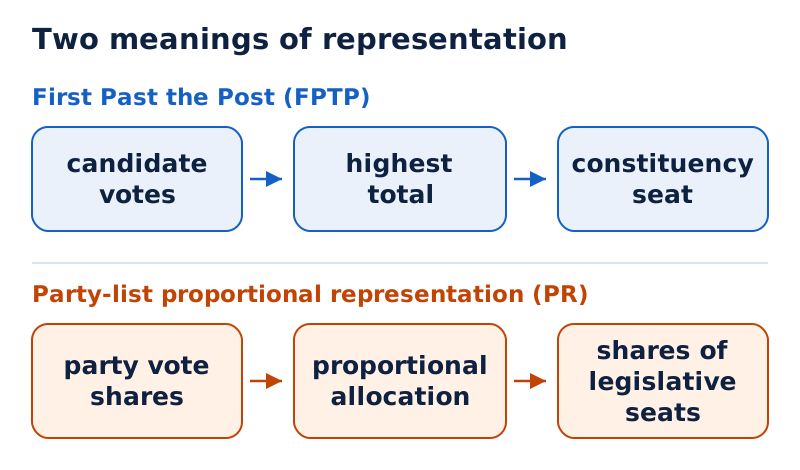
Draw parallel rows. Label the first candidate votes, highest total, constituency seat. Label the second party vote shares, proportional allocation, shares of legislative seats. Keep the two allocation rules separate.
Drawn by One Young India.
Universal adult franchise can be discussed separately from either method. The right to vote identifies eligible citizens; proportional representation and FPTP concern the treatment of votes after citizens have expressed their choices.
What is a political party, and what is a party system?
A political party brings people together to contest elections and exercise governmental power. Its members agree on policies and programmes intended to benefit society as a whole. Policies are proposed courses of public action; programmes set out what the party seeks to do.
What gives a party its identity?
People disagree about what benefits society. Parties try to persuade voters that their proposals are preferable to those of competitors. They seek electoral support so that they can put those proposals into effect.
A party is identified by the interests it upholds, the policies it supports and the section of society it represents. A partisan is someone strongly committed to a party, group or faction. Partisanship involves a tendency to side with that group and an inability to assess an issue in a balanced way.
A political party has three components: leaders, active members and followers. These together make up the political organisation; the party is not simply the individual candidate whom a voter encounters during an election.
How does the party connect citizens with government?
In most democracies, elections are fought mainly by candidates put forward by parties. Parties gather similar opinions into policy positions that voters can compare. They connect many separate public preferences with proposals for governing.
A ruling party is a party running the government. The opposition consists of parties outside government that put forward alternative views and criticise its failures or policies. These roles help explain why parties matter beyond polling day.
Large societies need organisations that gather public views, bring representatives together and support or restrain governments. The development of parties is directly linked to representative democracy because individual local choices must also become collective political decisions.
What distinguishes a party from a party system?
A party system is the pattern in which parties compete for and exercise power. Single-party, bi-party and multi-party systems describe different patterns of effective political competition, rather than the internal organisation of one particular party.
The number of parties formally existing is not enough to identify the system. Usually only a handful are effectively competing to win elections and form government. The important question is which parties have a real opportunity to exercise power.
What is a single-party system, and what merits are claimed for it?
In a single-party system, also called a one-party system, only one party is allowed to control and run the government. The defining feature is the absence of free competition between alternative parties for governmental power.
Why is permission to compete the key distinction?
Single-party rule differs from one-party dominance, in which one party remains electorally stronger while other parties exist and compete. A party's repeated success is a different matter from a political arrangement that prevents rivals from freely competing for power.
In a democratic system, competing parties must have a fair chance of coming to power. A single-party system does not provide that alternative. Its meaning cannot be established merely by observing that one party currently forms the government.
What are its claimed administrative merits?
- Continuity of policy: supporters argue that continued rule by the same organisation can help maintain a programme over time. This is an argument about continuity, not proof that the programme serves everyone equally.
- Speed of decision-making: supporters argue that the absence of bargaining between rival governing parties can make decisions easier to take. Faster decision-making does not establish that the decisions themselves are sound.
- Unity of direction: supporters argue that a single governing organisation can coordinate policies under one leadership. The claim concerns administrative direction rather than free agreement among competing political alternatives.
These are claimed merits, conditional on how the organisation actually works. They should not be stated as guarantees of stability, efficiency or public welfare. The institutional meaning of single-party rule does not demonstrate such outcomes.
Note: Administrative continuity and democratic choice are different standards. A claim that single-party rule simplifies administration does not show that citizens can replace the governing party through free competition.
The central distinction is therefore between a proposed advantage of unified administration and the democratic requirement of a fair contest for power. Keeping these separate makes it possible to explain the claimed merits without misdescribing the political system.
What is a bi-party system, and what are its merits?
A bi-party system, also called a two-party system, has two main parties with a serious chance of obtaining a majority of seats and forming government. Power usually changes between these two main competitors.
Does this mean that only two parties exist?
Several other parties may exist, contest elections and win some seats. The system is called bi-party because the two main parties are the serious competitors for governmental power. It is not defined by a prohibition on smaller parties.
A majority of seats means more than half the seats in the relevant elected body. This differs from a majority of votes. The phrase describes legislative strength, which is important when identifying parties able to form a government.
What advantages can this pattern offer?
- A clear choice of government: two main competitors give voters identifiable alternatives for exercising power. Their programmes and records can be compared as competing approaches to government.
- Potential for stable government: where one main party secures a majority, it can govern without depending on an agreement among several governing parties. This is a possible advantage, not an automatic result of the label bi-party.
- Clearer responsibility: where a single party governs, voters can connect governmental decisions with that party. Responsibility is easier to identify than when several governing partners share control.
- An organised alternative: the other main party can scrutinise government and present itself as a prospective replacement. Scrutiny means examining and questioning decisions rather than simply accepting them.
The meaning and the merits should be connected carefully. Two serious competitors create the possibility of a clear alternative. Whether a particular government is stable or responsive depends on actual political conditions as well as the party pattern.
How does it differ from single-party rule?
The distinction concerns competition for power. Single-party rule restricts control of government to one party. Bi-party competition gives two main parties a serious opportunity to govern, even though smaller parties may also participate.
The word usually matters when describing changes of power. It does not mean that the parties must alternate after every election. A description of a general pattern should not become a fixed prediction of each electoral result.
What is a multi-party system, and what are its merits?
A multi-party system exists where several parties compete and more than two have a reasonable chance of coming to power, either independently or together with others. India has a multi-party system.
How do parties work together?
An alliance, also called a front, is an arrangement in which parties join together to contest elections and seek power. A coalition government is a government formed by more than one party acting together.
The possibility of cooperation is part of the definition: a party may reach office through its own strength or with partners. Therefore, the system cannot be understood by asking only whether each party could win a majority entirely on its own.
Why is this system valued for representation?
- Variety of interests: several political organisations allow different interests and opinions to obtain political representation. This is the central representative merit of a multi-party arrangement.
- Expression of social diversity: a wide range of social and regional differences need not be contained within two large parties. India's social and geographical diversity helps explain the development of its multi-party system.
- Scope for smaller parties: cooperation can allow smaller parties to participate in the competition for governmental power. In India, the rise of coalitions has made entry possible for new and smaller parties despite FPTP.
These merits concern the range of political voices that can obtain representation or take part in competition. They should not be confused with a promise that every party will enter government or that every social interest will secure equal influence.
How do the three systems compare?
| System | Effective competition for power | Merit to explain carefully |
|---|---|---|
| Single-party | One party is allowed to control government | Claimed continuity and unified administrative direction |
| Bi-party | Two main parties have a serious chance to govern | Clear governmental alternatives and identifiable responsibility |
| Multi-party | More than two parties can gain power alone or with partners | Representation of varied interests and opinions |
Party systems develop over time. Social and regional divisions, political history and electoral arrangements shape them. They are not simply selected from a list without reference to a country's circumstances.
No system is ideal for every country and situation. Comparing their meanings and merits requires attention to effective competition, the possibility of forming government, and the representation of different public preferences.
Glossary
- Franchise — The right to vote in elections through which political representatives are chosen.
- Universal adult franchise — The principle that all adult citizens are eligible to participate as voters in elections.
- Political equality — Equal standing of citizens in political participation, including the choice of their representatives.
- Representation — Acting on behalf of other people in the process of public decision-making.
- Constituency — A geographical electoral area from which voters choose a representative or representatives.
- First Past the Post — An electoral method awarding the constituency seat to the candidate receiving the highest vote total.
- Plurality — A vote total greater than that of every other candidate, without necessarily exceeding half the votes.
- Proportional representation — An electoral method relating the share of legislative seats to the share of votes received.
- Political party — An organised group seeking governmental power through elections on the basis of shared policies and programmes.
- Party system — The pattern through which political parties compete for and exercise governmental power.
- Single-party system — An arrangement in which only one party is allowed to control and run government.
- Bi-party system — A pattern in which two main parties have a serious chance of obtaining a governing majority.
- Multi-party system — A pattern where more than two parties can reasonably gain power independently or through cooperation.
- Coalition government — A government formed through cooperation between more than one political party.
- Alliance — An arrangement between parties that join together to contest elections and seek political power.
Common errors and misconceptions
- Misconception: Universal franchise means that children also vote. Correct: Universal adult franchise applies to adult citizens; the voting age in India is 18.
- Misconception: Eligibility to vote means eligibility to contest any election. Correct: Candidature has separate conditions, including a minimum age of 25 for Lok Sabha and State Assembly elections.
- Misconception: An FPTP winner must obtain more than half the votes. Correct: The winner needs more votes than any other individual candidate in the constituency.
- Misconception: FPTP awards a party seats directly in proportion to its national votes. Correct: Seats are won constituency by constituency; proportional allocation is the defining principle of PR.
- Misconception: A bi-party system legally permits only two parties. Correct: Other parties may compete and win seats; two main parties have a serious chance of forming government.
- Misconception: One party forming government proves that the country has a single-party system. Correct: The test is whether alternative parties can freely compete for power.
- Misconception: Claimed merits of a party system are guaranteed results. Correct: Administrative continuity, governmental stability and broad representation depend on how political institutions actually work.
Exam-style questions with model answers
Q1. Universal adult franchise makes all adult citizens eligible to vote; India's voting age is 18. Using these facts, explain both the universal and adult elements of the principle. [2 marks]
- The universal element includes all adult citizens in eligibility to vote, rather than limiting voting rights to a privileged section.
- The adult element applies a minimum age; in India, citizens become eligible at 18, so children are not included.
Q2. India's voting age is 18, while the minimum age for contesting Lok Sabha or State Assembly elections is 25. Distinguish voting from candidature using both figures. [2 marks]
- Voting means choosing representatives, and the minimum age for exercising this right in India is 18.
- Candidature means standing to become a representative; contesting a Lok Sabha or State Assembly election requires a minimum age of 25.
Q3. Universal adult franchise recognises adult citizens as political equals, includes them in selecting representatives and trusts their judgement regardless of educational qualifications. Explain these three reasons for accepting it. [3 marks]
- Political equality recognises adult citizens as having equal worth in public choice. The opportunity to choose representatives should not belong to a privileged minority.
- Inclusion opens participation in selecting representatives to the adult citizen body. It gives citizens a voice in deciding who will act on their behalf.
- Confidence in citizens' judgement rejects formal education as the test of political worth. Adults can consider the needs of society and their locality when voting.
Q4. Under FPTP, each constituency elects one representative and its highest-polling candidate wins, without needing more than half the votes. Suppose a party receives 25 per cent of votes in every constituency and every rival candidate receives less in each constituency. Explain the possible result in four points. [4 marks]
- The party's candidate finishes ahead of every rival in each constituency because the question specifies that every other candidate receives a smaller vote share.
- FPTP awards the constituency's single seat to its highest-polling candidate, so the party's candidate wins in every constituency described.
- The party could consequently win all the seats, even though its share of votes is only 25 per cent.
- This demonstrates the difference between plurality and majority: the winner needs the largest individual vote total, rather than more than half the votes.
Q5. Compare FPTP with party-list PR in five respects: the size of constituencies, the number of representatives elected per constituency, the choice on the ballot, the relationship between vote share and seat share, and the selection of successful candidates. [5 marks]
- FPTP divides the country into small geographical constituencies. Party-list PR uses larger constituencies, which may include the whole country.
- Each FPTP constituency elects one representative. A party-list PR constituency elects several representatives.
- In FPTP, voters choose a candidate. In the party-list PR form described here, voters choose a party.
- Under FPTP, a party's seat share can differ substantially from its vote share because seats are won constituency by constituency. Party-list PR allocates seats to parties in proportion to their vote shares.
- FPTP directly elects the highest-polling candidate in each constituency. In party-list PR, parties fill their allocated seats from candidate lists declared before the election.
Q6. A political party seeks power through elections, agrees on policies and programmes, and contains leaders, active members and followers. It seeks support to implement its proposals. Using these facts, explain its purpose, policy basis and organisation. [3 marks]
- Its purpose is to contest elections and exercise governmental power. Electoral support provides the means through which it seeks to put its proposals into effect.
- Its policy basis is agreement on programmes and courses of action. These shared proposals give voters an organised political position to consider.
- Its organisation includes leaders, active members and followers. A party is therefore more than one candidate: it brings together people supporting a common political approach.
Q7. A single-party system permits one party to control government. Its supporters claim policy continuity, faster decisions without bargaining between governing parties, and unified direction. Democratic competition requires a fair chance for rival parties to gain power. Explain these three claimed merits and why they do not establish democratic competition. [4 marks]
- Policy continuity means that the same governing organisation can maintain a programme over time, rather than changing direction through a transfer between rival parties.
- Faster decisions are claimed because the governing organisation need not negotiate agreement among several rival parties sharing governmental office.
- Unified direction is claimed because one leadership can coordinate the governing programme and its implementation.
- These are administrative arguments. They do not provide alternative parties with a fair opportunity to gain power through free competition, which is required for democratic choice.
Q8. In a bi-party system, two main parties seriously compete to govern and smaller parties may also exist. Its claimed merits include clear alternatives and identifiable responsibility. In a multi-party system, more than two parties can gain power alone or with partners, allowing varied interests and smaller parties to participate. Explain three features of each. [6 marks]
- A bi-party system has two main contenders with a serious opportunity to govern. The existence of smaller parties does not contradict that definition.
- Its clear-alternative merit gives voters two identifiable main approaches to government, allowing them to compare the competitors seeking power.
- Its responsibility merit concerns identifying the governing party with governmental decisions, particularly where that party governs on its own.
- A multi-party system includes more than two parties with a reasonable prospect of gaining power, either independently or by cooperating with others.
- Its representative merit is that a variety of interests and opinions can find political expression through different competing organisations.
- Its scope for smaller parties includes participation through cooperation with partners, rather than requiring every party to form government entirely on its own.
Key takeaways
- Universal adult franchise recognises adult citizens as eligible voters and expresses the democratic principles of equality and non-discrimination.
- Voting rights and qualifications for candidature answer different questions; India's voting age and minimum Lok Sabha candidature age differ.
- Representation allows citizens in large societies to choose people who take part in public decision-making on their behalf.
- FPTP elects the highest-polling candidate in a constituency; the winner need not obtain more than half the votes.
- Proportional representation connects seat shares with vote shares; party-list PR and FPTP translate electoral choices into seats differently.
- Political parties organise shared programmes, seek electoral support and connect public preferences with the exercise of governmental power.
- Single-party, bi-party and multi-party systems differ in effective competition for power, not simply in the number of names on a party list.
- Explain party-system merits as reasoned advantages or claims, while preserving the distinction between administrative convenience and democratic political choice.
Test yourself
What does the term franchise mean?
Franchise means the right to vote in elections choosing political representatives.
Why does universal adult franchise not include children?
The principle applies to adult citizens and therefore includes a minimum voting age.
Can an FPTP candidate win without a majority of votes?
Yes. The candidate needs more votes than each rival, rather than more than half the votes.
What is proportional in proportional representation?
The allocation of seats relates to the shares of electoral support recorded in votes.
Which three components make up a political party?
The three components are its leaders, its active members and its followers.
Does a bi-party system exclude the existence of smaller parties?
No. Smaller parties may exist and win seats, while two main parties seriously compete to govern.
What is the central representative merit of a multi-party system?
It allows a variety of interests and opinions to enjoy political representation.
Why does single-party dominance differ from a single-party system?
Dominance describes one party's electoral strength; a single-party system restricts control of government to one party without free competition for power.
Take this further
How does India make policy?
The Model NITI Aayog self-paced course: 41 chapters, about 19 hours of study, on how India makes policy, from the policy cycle and writing a white paper to the economy, the Union Budget and governance. It comes with Learnacy Essential.
Learnacy Essential also adds feedback from an AI writing coach, submission to The OYI Review, World 101’s member tools and the 3D labs. Publication is not guaranteed. See what a year includes
Or create a free account to draft in the Writing Studio, explore World 101’s map and open the 2D version of every lab. Create a free account