
Constitution: Meaning and Classification | ISC Class 12 Political Science Notes
On this page

This note covers the meaning and functions of a constitution, written and unwritten constitutions, rigid and flexible constitutions, their merits and demerits, amendment procedures in the United Kingdom, the United States of America and India, and the balance between constitutional continuity and change.
What is a constitution, and why does a society need one?
Definition: A constitution is the body of fundamental principles that establishes a state and governs the organisation and exercise of its public power.
A state is a politically organised community with a population, territory, government and sovereign authority, meaning supreme authority over its internal affairs and independence externally. Its government consists of the institutions through which public decisions are made and implemented.
A constitution answers an initial question: who has the authority to decide? Before examining a particular law, we must know which institution can make it. The constitution establishes that authority and determines how government is organised.
What functions do constitutional rules perform?
- Coordination: Basic rules make cooperation possible among people with different interests and beliefs. Publicly known and enforceable rules give people an assurance that others must also obey them.
- Allocation of power: The constitution identifies who makes decisions and how the decision-making institutions are constituted. In democratic constitutions, broadly speaking, the people decide, including through their elected representatives.
- Limits on government: Constitutional rules restrict what public authorities can impose on citizens. Fundamental rights are basic rights protected by the constitution and provide a common means of limiting governmental power.
- Social aspirations: A constitution can empower government to pursue a more just society. In India, this includes overcoming inequality and enabling positive welfare measures.
- Collective identity: Agreement on principles of government gives people a shared political identity. It also establishes values within which individual aims and freedoms are pursued.
The legislature is the law-making institution; the executive conducts government and implements laws; the judiciary interprets laws and settles legal disputes. Distributing power across institutions can prevent one institution from monopolising authority.
Constitutional rules therefore do more than list prohibitions. They both authorise public action and restrict its use. The Indian Constitution, for example, enables action against caste discrimination while providing protections against arbitrary power, meaning power exercised without proper legal justification.
Note: Possessing a constitution does not by itself guarantee fair government. Its effectiveness also depends on public acceptance, the content of its provisions and the organisation of political institutions.
How do written and unwritten constitutions differ?
The distinction between written and unwritten constitutions concerns the form in which fundamental rules are collected. A written constitution brings the principal constitutional rules together in an authoritative constitutional text. India and the United States of America, abbreviated as USA, are examples.
An unwritten constitution does not collect all its principal rules in one comprehensive constitutional document. The United Kingdom, abbreviated as UK, has documents and decisions which together form its constitution. The term uncodified, meaning not collected into one constitutional code, describes this more accurately.
Why does unwritten not mean entirely unwritten?
Written laws can be important parts of an unwritten constitution. A statute is a law enacted by a legislature. Judicial decisions are rulings of courts. Conventions are accepted rules of constitutional practice that guide political conduct without themselves being legally enforceable rules.
These different sources help explain the British constitution. Conversely, a written constitution can be supplemented by conventions and judicial interpretation. Writing down fundamental principles does not remove every question about how they apply in practice.
Table: Comparison of written and unwritten constitutions
| Basis | Written constitution | Unwritten constitution |
|---|---|---|
| Principal form | Fundamental rules collected in an authoritative constitutional text. | Fundamental rules distributed across several constitutional sources. |
| Written material | A central constitutional text is the main reference. | Written statutes and decisions still form important sources. |
| Conventions | Can supplement the constitutional text. | Have an important place alongside legal rules. |
| Interpretation | The meaning of written provisions still needs interpretation. | Different sources and practices must be understood together. |
| Examples | India and the USA. | The UK. |
The distinction is therefore about the predominant form of the constitution. It does not divide countries into those with recorded rules and those without any records. Nor does the word written tell us how difficult changing those rules will be.
What are the merits and demerits of a written constitution?
A written constitution provides a common text through which citizens and institutions can identify the main rules of government. Its merits concern clarity, reference and the expression of constitutional commitments. These are advantages of a written framework, rather than guarantees that every provision will work well.
What advantages does a written framework offer?
- Clear reference: Bringing fundamental rules together makes it easier to identify the constitutional basis of governmental authority than searching across scattered sources.
- Defined powers: A text can state the responsibilities of different institutions and the distribution of powers between different levels of government.
- Rights recorded: Express provisions give citizens and public authorities a reference for understanding protected rights and the limits on power.
- Shared commitments: A written statement can give enduring expression to a society's values, aspirations and political identity.
In a federal system, powers are constitutionally distributed between central and regional governments. A written statement of this division supplies a reference when the governments disagree about the extent of their respective authority.
What limitations should be recognised?
- Interpretive disputes: Written wording does not interpret itself. Institutions can disagree about the meaning of the same constitutional provision.
- Unforeseen circumstances: No text can anticipate every future situation. Interpretation and provision for amendment remain necessary.
- Formal protection without practice: Rights recorded in a document need institutions and public commitment to make them effective.
An amendment is an authorised alteration of constitutional provisions. If a written constitution also has a demanding amendment procedure, necessary changes can be difficult. That difficulty follows from rigidity, meaning a specially demanding amendment procedure, rather than from writing alone.
The existence of a text and the effectiveness of its rules must be assessed separately. Public confidence, fair provisions and balanced institutions help turn written commitments into a working constitution.
What are the merits and demerits of an unwritten constitution?
An unwritten constitution draws on several sources and on constitutional practice. Its merits are associated with continuity and the ability of practices to develop. Its demerits concern accessibility, uncertainty and reliance on political restraint. These considerations should be kept separate from the question of amendment procedure.
What advantages can an uncodified framework have?
- Continuity of experience: Existing practices can develop over time without requiring all constitutional arrangements to be restated in a single new text.
- Practical adjustment: Conventions can respond to changes in political circumstances and help institutions work together.
- Room for development: A system drawing on several sources can accommodate new practices without treating the wording of one document as an exhaustive account of government.
These advantages depend on how institutions actually behave. Political acceptance of conventions can support orderly government. Their value comes from the willingness of political actors to recognise and observe the practices concerned.
What difficulties can arise?
- Scattered sources: Understanding the constitution requires consulting different documents, decisions and practices instead of one main constitutional text.
- Uncertainty: Disagreement can arise over the content or application of conventions, especially when political circumstances change.
- Dependence on restraint: Since conventions are not themselves legally enforceable, their observance depends on political responsibility and accepted standards of conduct.
Where an unwritten constitution is also flexible, meaning changeable through ordinary legislation, an ordinary legislative majority can make significant constitutional changes. That majority means more than half of the members present and voting. This can assist reform but also creates concern about hasty change. The concern belongs to flexibility; it is not proof that every unwritten constitution has identical safeguards.
Note: The UK has a constitution even though it lacks one single comprehensive constitutional document. Calling it unwritten does not mean that its constitutional rules are imaginary or that its government operates without law.
What distinguishes a rigid constitution from a flexible constitution?
The distinction between rigidity and flexibility concerns the procedure for constitutional change. A constitution that can be very easily changed is often called flexible. A constitution that is very difficult to amend is described as rigid.
More precisely, a flexible constitution can be changed through the ordinary legislative procedure. A rigid constitution requires a special procedure more demanding than that for ordinary legislation. Legislation means the making of laws by the legislature.
How do the procedures compare?
Table: Comparison of rigid and flexible constitutions
| Basis | Rigid constitution | Flexible constitution |
|---|---|---|
| Amendment method | A special constitutional procedure is required. | The ordinary legislative procedure can make constitutional changes. |
| Level of agreement | Additional approval or a higher voting threshold is required. | The normal legislative majority can be sufficient. |
| Main advantage | Protection against unnecessary or frequent alteration. | Ease of adaptation to changed circumstances. |
| Main danger | Necessary reform can be obstructed by a demanding procedure. | Fundamental arrangements can be exposed to hasty alteration. |
| Standard illustration | The USA. | The UK. |
A majority means support exceeding half of the relevant group unless a specified special fraction is required. The group being counted matters: a rule about all members is different from a rule about only those present and voting.
Can the two classifications overlap?
Written/unwritten and rigid/flexible answer different questions. The first asks how the rules are recorded; the second asks how they are altered. Treating the pairs as interchangeable hides the distinction between form and procedure.
India illustrates the importance of separating them. It has a written Constitution, but different provisions require different amendment procedures. Some changes follow a simple legislative route, while others demand wider agreement. Its Constitution therefore combines rigid and flexible features.
Definition: A rigid constitution is amendable through a specially demanding procedure. Rigid does not mean permanently unchangeable, and flexible does not mean that there are no rules for making changes.
What are the merits and demerits of rigidity and flexibility?
Constitutional design must balance two needs: keeping fundamental arrangements dependable and allowing society to respond to change. Stability means continuity and predictability in those arrangements. Adaptability means the capacity to adjust them when experience reveals new needs.
What are the merits and demerits of rigidity?
A demanding amendment procedure helps protect fundamental commitments from easy interference. It makes a temporary political majority seek broader support before changing the rules of government. This promotes deliberation, meaning careful consideration before a decision.
In a federal constitution, requiring the participation of regional governments can protect their constitutionally assigned position. Their powers are then not simply at the disposal of the central legislature. India's requirement of State consent for specified amendments illustrates this safeguard.
Rigidity nevertheless has limitations. A reform considered necessary by many people can face procedural obstacles. If constitutional rules cannot respond adequately to changed circumstances, tension can grow between the existing framework and social needs. Too rigid a constitution is likely to break under the weight of change.
What are the merits and demerits of flexibility?
Flexibility permits changes when circumstances change or errors become apparent. It allows later generations to respond to problems that the constitution's makers could not fully foresee. It also reduces the difficulty of correcting provisions of a temporary or technical character.
Excessive flexibility has the opposite danger. If fundamental rules are too easily altered, people lose security and predictability. A governing majority can change constitutional arrangements without the wider agreement that a special amendment procedure would require.
Table: Weighing constitutional change
| Concern | Value of restraint | Value of change |
|---|---|---|
| Basic commitments | Protect rights and the structure of government against easy interference. | Apply enduring commitments to new circumstances. |
| Defects | Consider proposed changes carefully. | Correct faults revealed by constitutional experience. |
| Federal relations | Give States a part in changes affecting their position. | Allow agreed changes without making amendment impracticable. |
No simple label establishes that a constitution will succeed. A workable balance preserves core values while allowing the framework to develop. The Indian approach reflects this balance through different amendment routes and limits on the use of the amending power.
How is the constitution of the United Kingdom changed?
The UK is the standard example of an unwritten and flexible constitution. Its constitution includes written material, but there is no single constitutional code containing all the main rules. Constitutional development can occur through legislation and changes in accepted practices.
What is the legislative route?
Parliamentary sovereignty, in the British context, means Parliament's supreme legal authority to make or unmake law. There is no separate general amendment procedure requiring a special constitutional majority merely because legislation concerns a constitutional matter.
Parliament is the national legislature. Its two Houses are the House of Commons and the House of Lords. Royal Assent is the monarch's formal approval of a bill, meaning a proposed law, after the required parliamentary stages.
- A proposed constitutional change is put forward as legislation where alteration of the law is required.
- The bill is considered through the ordinary parliamentary law-making process, including debate and the required stages in the Houses.
- Approval follows ordinary legislative voting requirements rather than a distinct, generally applicable constitutional supermajority.
- After the parliamentary requirements and Royal Assent, the enacted law forms part of the legal constitutional framework.
A supermajority is a voting threshold higher than a simple majority, meaning more than half of those present and voting. The absence of a general constitutional supermajority requirement is what makes the British legislative route flexible. Political difficulty in securing agreement can still exist.
Do all constitutional developments take the form of legislation?
No. Conventions can evolve through political practice, and judicial decisions can affect the understanding of legal rules. The source of a rule therefore matters when explaining how it changes.
British flexibility supports adjustment without a general special amendment machinery. Its limitation is that the legal amendment process does not itself require the wider constitutional agreement demanded in a rigid system. Political scrutiny and accepted practices consequently remain important.
How is the constitution of the United States of America amended?
The USA provides an example of a written and rigid constitution. Its amendment procedure separates the proposal of an amendment from its ratification. Ratification means the formal approval required to confirm a proposed constitutional change.
Article V, where V is the Roman numeral for five, sets out the amending procedure. An Article is a numbered division of a constitution. Both the national level and the States participate, reflecting the federal character of the American system.
What are the proposal and ratification routes?
- Congressional proposal: Congress, the national legislature consisting of the House of Representatives and the Senate, can propose an amendment with a two-thirds majority in each House.
- Alternative proposal: Congress must call a convention for proposing amendments when the legislatures of two-thirds of the States apply for one. Here a convention means an assembly called for this constitutional purpose.
- Choice of ratification method: Congress specifies whether the proposed amendment is to be considered by State legislatures or by conventions in the States.
- Ratification: Approval by the legislatures of three-fourths of the States, or by conventions in three-fourths of the States, as specified, is required for the amendment to become part of the Constitution.
The two proposal methods are alternatives. The two ratification methods are also alternatives. An amendment does not have to pass through all four methods successively. It needs a valid proposal followed by ratification through the selected route.
What makes this procedure rigid?
The national legislature cannot change the Constitution by an ordinary law alone. High approval thresholds and State participation require agreement extending beyond an ordinary national legislative majority. Proposal and ratification perform separate functions.
The President of the USA has no formal role of assent or veto in this amendment process. A veto is the power to reject a proposed measure. Article V also protects each State against losing equal representation in the Senate without that State's consent.
Rigidity here protects the federal settlement and makes casual alteration difficult. At the same time, the demanding requirements can make necessary reform difficult to secure. The Constitution remains amendable even though amendment is deliberately demanding.
What are the different ways of amending India's Constitution?
India's Constitution combines flexibility and rigidity. Some constitutional changes follow an ordinary legislative route; others require the special procedures in Article 368. The appropriate route depends on the provision concerned, rather than on the government's preference.
What changes use a simple majority?
A simple majority means more than half of the members present and voting. Certain changes can be made by ordinary parliamentary law outside the special amendment procedure. Article 2 concerns the admission or establishment of new States; Article 3 concerns alterations to States, including changes in their area.
These examples show the flexible element of the Constitution. They do not mean that Parliament can use ordinary legislation to change any constitutional provision. The specific constitutional provision determines the power and the applicable requirements.
What does the special majority require?
For an amendment under Article 368, each House must approve the bill separately. India's two parliamentary Houses are the Lok Sabha, or House of the People, and the Rajya Sabha, or Council of States.
The special majority for this purpose requires both a majority of the total membership of that House and at least two-thirds of its members present and voting. Meeting only one of these conditions is insufficient.
Total membership refers to the full membership of the House. Present and voting counts members who attend and actually cast a vote. An abstention, meaning a decision not to cast a vote, is not an affirmative vote.
Both conditions must be checked in each House. A large proportion of votes cast does not by itself establish support from a majority of the total membership. Equally, support from that majority does not remove the two-thirds requirement.
When is State ratification also needed?
Specified amendments affecting the federal arrangement require, in addition, ratification by the legislatures of at least half of the States. The State legislatures decide by simple majority. This gives the States a role in changes affecting their constitutional position.
Article 368 thus contains two special routes: parliamentary special majority alone, and parliamentary special majority together with the required State ratification. The ordinary-law route for certain changes is distinct from these two routes.
Table: India's routes for constitutional change
| Route | Parliamentary requirement | State participation |
|---|---|---|
| Ordinary-law route for specified changes | Simple majority, outside the special Article 368 procedure. | No Article 368 ratification requirement; any other applicable constitutional conditions remain relevant. |
| Special parliamentary route | The required special majority in each House separately. | Ratification is not required for this category. |
| Special federal route | The required special majority in each House separately. | Ratification by legislatures of at least half of the States. |
What the figure shows
How to amend the Constitution
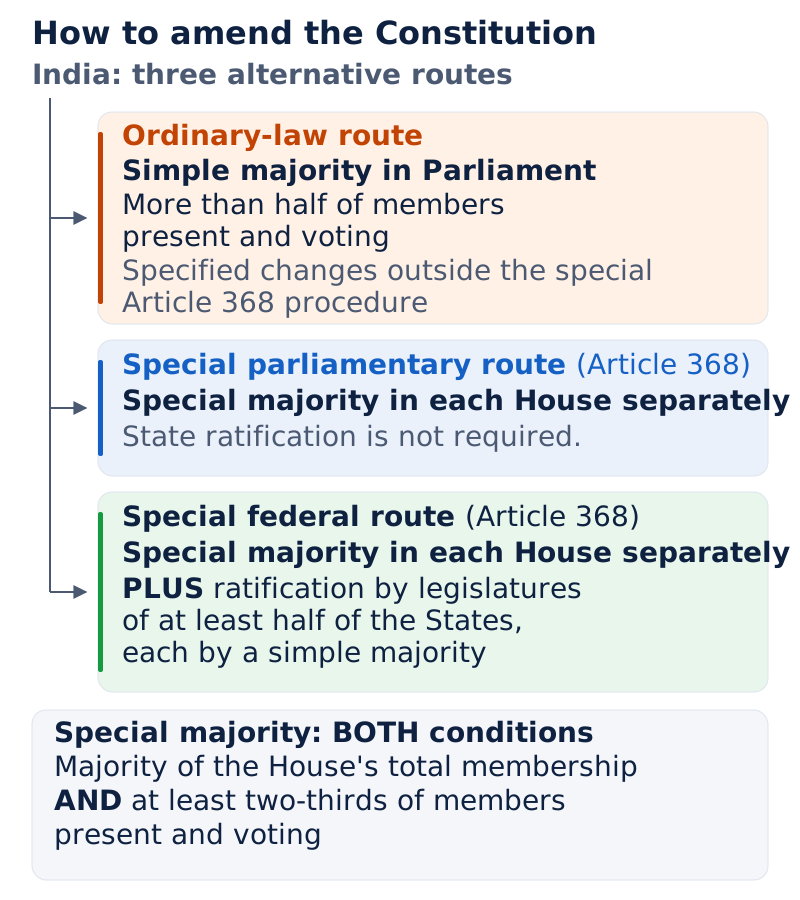
A blue heading box connects to three grey boxes. They show the ordinary-law simple-majority route, the special-majority route in both Houses separately, and special majority with the legislatures of half the States. The latter two boxes refer to Article 368.
Drawn by One Young India.
The diagram separates the three routes rather than presenting them as successive stages for every change. Which route applies must be established before deciding what approvals are required.
How do India's amendment safeguards preserve a living constitution?
The procedure under Article 368 combines the authority of elected representatives with safeguards against easy alteration. Constituent power means the power to make constitutional changes, distinct from the ordinary power to make laws within the constitutional framework.
What sequence does an amendment follow?
- The amendment bill is initiated in Parliament. State legislatures cannot formally introduce a constitutional amendment bill in Parliament on their own.
- Each House passes it separately by the required special majority. There is no joint sitting, meaning a combined meeting of both Houses to vote together, to resolve disagreement over an amendment bill.
- Where the provision requires State ratification, the legislatures of at least half of the States approve it by simple majority.
- The bill goes to the President of India for assent, meaning formal approval. The President must give assent to a duly passed constitutional amendment bill and cannot return it for reconsideration.
No referendum, meaning a direct vote of the electorate on a particular proposal, is required to ratify an Indian constitutional amendment. The electorate consists of those entitled to vote. Constitutional amendment is decided through the prescribed representative institutions.
What limits Parliament's amending power?
The basic structure consists of the essential features defining the Constitution's fundamental character. The basic structure doctrine prevents Parliament from damaging or destroying those features through amendment. The Supreme Court, India's highest court, established this limit in the Kesavananda Bharati ruling of 1973.
Parliament can amend all parts of the Constitution within this limit. The judiciary decides what constitutes the basic structure and whether an amendment violates it. The doctrine emerged through judicial interpretation; it is not a separately written list in the constitutional text.
How does constitutional change respond to experience?
A living constitution develops through authorised amendment, interpretation and political practice while retaining its fundamental framework. India's constitutional experience includes technical adjustments as well as changes reflecting wider social and political agreement.
- The 15th Amendment raised the retirement age of judges of High Courts, the highest courts at State level, from 60 to 62 years, illustrating an administrative change.
- The 54th Amendment increased the salaries of High Court and Supreme Court judges, providing another example of a technical adjustment.
- The 61st Amendment reduced the minimum voting age from 21 to 18 years, illustrating a change associated with political consensus, meaning broad agreement.
Written rules also interact with practice. The amendment to Article 74(1) made explicit that the President acts in accordance with the advice of the Council of Ministers, the body of ministers headed by the Prime Minister. It clarified the practice of parliamentary government.
Amendment therefore need not imply rejection of the entire Constitution. The key issue is whether changes respond to experience while respecting constitutional limits. Stability and adaptation work together when the framework permits reform without allowing its basic character to be destroyed.
Glossary
- Constitution — A body of fundamental principles establishing government, allocating public power and setting the framework within which it operates.
- Written constitution — A constitution whose principal fundamental rules are collected in an authoritative constitutional text.
- Unwritten constitution — A constitution drawn from several sources rather than one comprehensive constitutional document, including written laws and decisions.
- Convention — An accepted rule of constitutional practice that guides political conduct without itself being a legally enforceable rule.
- Rigid constitution — A constitution requiring a special amendment procedure more demanding than the procedure for making ordinary laws.
- Flexible constitution — A constitution whose rules can be changed through the ordinary legislative procedure.
- Amendment — An authorised alteration of constitutional provisions through the procedure applicable to the proposed change.
- Simple majority — Support from more than half of the members present and actually voting on a proposal.
- Special majority — For an Indian Article 368 amendment, a majority of total House membership and at least two-thirds present and voting.
- Ratification — Formal approval of a proposed constitutional change by the bodies whose consent the amendment procedure requires.
- Federal system — A system in which constitutional rules distribute governmental powers between central and regional levels of government.
- Referendum — A direct vote by the electorate on a specific proposal or public question.
- Basic structure doctrine — The principle that Parliament's constitutional amendments must not damage or destroy the Constitution's basic structure.
- Living constitution — A constitutional framework that responds to changing circumstances through amendment, interpretation and practice while retaining its fundamental character.
Common errors and misconceptions
- Misconception: An unwritten constitution contains no written rules. Correct: The UK has written constitutional sources, including laws and decisions, although it lacks one comprehensive constitutional document.
- Misconception: Written and rigid mean the same thing. Correct: Written describes the form of the rules; rigid describes their amendment procedure. India's written Constitution combines rigidity and flexibility.
- Misconception: A rigid constitution cannot change. Correct: It can be amended through its special procedure. Rigidity makes amendment more demanding, rather than impossible.
- Misconception: Every Indian constitutional change follows Article 368. Correct: Certain specified changes follow the ordinary-law route; Article 368 provides the two special amendment routes.
- Misconception: A two-thirds vote alone satisfies India's parliamentary amendment requirement. Correct: Each House must also supply support from a majority of its total membership.
- Misconception: Every Indian amendment requires every State's approval. Correct: Specified federal amendments require ratification by legislatures of at least half of the States, not all States.
- Misconception: The American proposal and ratification fractions are interchangeable. Correct: Two-thirds applies at the proposal stage in the specified ways; ratification requires three-fourths of the States through the selected method.
- Misconception: Parliament can destroy the basic structure if it follows the voting procedure. Correct: The basic structure doctrine imposes a substantive limit as well as the procedural requirements for amendment.
Exam-style questions with model answers
Q1. The UK has constitutional laws and decisions but no single comprehensive constitutional document. Using these facts, identify its classification by form and correct the claim that this classification means it has no written rules. [2 marks]
- It is classified as an unwritten, or uncodified, constitution because its principal rules are not collected in one comprehensive constitutional document.
- The label does not mean an absence of written rules: the constitutional laws and decisions mentioned are written constitutional sources.
Q2. Constitutional rules establish decision-making institutions, make cooperation possible through enforceable common rules, limit public power through protected rights, and empower action against inequality. Explain four functions of a constitution using this information. [4 marks]
- Organisation: A constitution establishes which institutions possess public authority, enabling people to identify who is entitled to make decisions.
- Coordination: Enforceable common rules help people cooperate because they provide assurance that other members of society must follow them.
- Limitation: Protected rights restrict the use of public power and provide constitutional safeguards against governmental interference with those rights.
- Social purpose: The power to act against inequality enables government to pursue collective aspirations and improve conditions within society.
Q3. Written constitutions collect principal rules in an authoritative text; unwritten constitutions draw on several sources. Rigid constitutions require special amendment procedures; flexible constitutions use ordinary legislation. India has a written Constitution with different procedures for different provisions. Explain the two classifications and India's position in four points. [4 marks]
- The written/unwritten distinction concerns the form in which principal constitutional rules are recorded, whether collected in a constitutional text or distributed across sources.
- The rigid/flexible distinction concerns amendment procedure, distinguishing a specially demanding process from the procedure for ordinary legislation.
- India belongs to the written category because it has a constitutional text collecting its principal fundamental rules.
- India combines rigidity and flexibility because its different provisions require different amendment procedures; being written does not settle how easily every provision changes.
Q4. Under the American procedure, two-thirds of each House of Congress can propose an amendment. Alternatively, applications from two-thirds of State legislatures require Congress to call a proposing convention. Congress chooses ratification by State legislatures or State conventions; three-fourths of the States must approve. The President has no assent or veto role. Explain this procedure in six points. [6 marks]
- Congressional proposal: An amendment may originate through Congress when the proposal obtains the required two-thirds support in each House separately.
- Alternative proposal: Applications from the legislatures of two-thirds of the States require Congress to call a convention for proposing amendments.
- Choice: Congress determines whether ratification will occur through State legislatures or conventions in the States; these are alternative methods.
- Ratification threshold: The selected bodies in three-fourths of the States must approve the proposal for it to become a constitutional amendment.
- Presidential position: The President does not approve or veto the amendment, so presidential assent is not an additional constitutional stage.
- Sequence: A valid proposal must be followed by the required ratification; approval at the proposal stage alone does not complete amendment.
Q5. An Indian Article 368 bill starts in Parliament. Each House must approve it separately by a majority of its total membership and at least two-thirds present and voting. There is no joint sitting. Specified federal amendments additionally need simple-majority approval by legislatures of at least half the States. The President must assent to a duly passed bill. Explain six procedural requirements. [6 marks]
- Initiation: The amendment bill begins in Parliament, which is the institution authorised to initiate this formal process of constitutional change.
- Total membership: Affirmative votes must come from a majority of the total membership of each House, independently of attendance at the vote.
- Voting membership: In each House, those affirmative votes must also reach at least two-thirds of members present and actually voting.
- Separate approval: Both Houses must approve the bill independently; a joint sitting cannot substitute for the required approval of either House.
- Federal ratification: Where the specified federal provisions are affected, legislatures of at least half the States must additionally approve by simple majority.
- Assent: After the applicable parliamentary and State requirements are met, the President must give assent to the duly passed amendment bill.
Q6. A demanding amendment process can protect fundamental rules from frequent changes and require broad agreement, but it can obstruct necessary reform. An ordinary legislative route makes adaptation easier but exposes constitutional rules to hasty change. Assess rigidity and flexibility through two merits and two demerits drawn from these facts. [4 marks]
- Merit of rigidity: A demanding process protects fundamental arrangements from frequent changes and encourages agreement extending beyond an ordinary legislative majority.
- Demerit of rigidity: The same procedural obstacles can prevent or delay reform even when changed circumstances make constitutional adjustment necessary.
- Merit of flexibility: Using an ordinary legislative route enables a constitution to respond more easily when circumstances or practical needs change.
- Demerit of flexibility: Easier alteration exposes fundamental rules to hasty decisions, reducing the security that a more demanding procedure could provide.
Q7. The UK uses ordinary legislation for legal constitutional changes and has no separate general constitutional supermajority requirement. American amendments require proposal and State ratification through demanding thresholds. India uses an ordinary-law route for specified changes, a special parliamentary route, and a special route with ratification by at least half the States. Compare the three amendment systems in six points. [6 marks]
- British route: Legal constitutional changes use ordinary legislation, so there is no separate general constitutional supermajority procedure merely because the subject is constitutional.
- British classification: This ordinary legislative route illustrates flexibility because the amendment requirements do not generally exceed the requirements for ordinary law.
- American stages: Proposal and ratification are separate requirements, meaning that a proposal alone does not complete the constitutional change.
- American classification: Demanding thresholds and required State ratification illustrate rigidity by placing constitutional alteration beyond ordinary national legislative approval.
- Indian flexibility: Specified changes can use the ordinary-law route, giving parts of the Indian Constitution a relatively flexible character.
- Indian rigidity: Other provisions require a parliamentary special majority, with specified federal changes also requiring ratification by at least half the States.
Q8. The basic structure doctrine allows Parliament to amend all parts of India's Constitution but prohibits damage to its basic structure. The judiciary determines the content of that structure and whether an amendment violates it. The doctrine developed through interpretation rather than an express constitutional list. Explain its significance in four points. [4 marks]
- Reform remains possible: Parliament retains authority to amend all parts of the Constitution, so the doctrine does not freeze the entire document.
- Substantive protection: The prohibition on damaging basic structure restricts what amendments may do, beyond the requirement to follow the voting procedure.
- Judicial responsibility: The judiciary decides both what belongs to the basic structure and whether a particular amendment violates that structure.
- Interpretive development: The doctrine demonstrates how constitutional understanding can develop through interpretation even without a separately written list in the constitutional text.
Key takeaways
- A constitution establishes public authority, allocates decision-making power, limits government and can enable action towards a more just society.
- Written and unwritten constitutions differ in their predominant form; unwritten constitutions still include written laws and judicial decisions.
- Rigid and flexible constitutions differ in amendment procedure; rigidity means a specially demanding process, rather than an inability to change.
- The merits of rigidity concern stability and safeguards; the merits of flexibility concern adaptation and correction of defects.
- The UK illustrates flexibility through ordinary legislation, while American amendment requires a valid proposal followed by the prescribed State ratification.
- India combines an ordinary-law route for specified changes with two special amendment routes, one additionally requiring State ratification.
- Indian parliamentary special majority requires both a majority of total House membership and at least two-thirds of members present and voting.
- The basic structure doctrine permits amendment while preventing destruction of the Constitution's fundamental character, with the judiciary deciding whether the limit is breached.
Test yourself
What question does a constitution answer before particular laws can be examined?
It identifies who has authority to make decisions and laws, and how the institutions exercising that authority are constituted.
Why is uncodified a useful description of the British constitution?
Its rules are drawn from several sources rather than one comprehensive constitutional document. The description avoids suggesting that none of its rules are written.
Why can a written constitution still need interpretation?
Written provisions must be applied to circumstances, and institutions can disagree about their meaning. Writing does not anticipate every future question.
What is the main distinction between the two pairs of constitutional classifications?
Written/unwritten concerns how rules are recorded. Rigid/flexible concerns the procedure through which constitutional rules are changed.
What separates American proposal from ratification?
Proposal puts forward the amendment through an authorised route. Ratification requires approval by three-fourths of the States through the method Congress specifies.
Which two conditions form India's parliamentary special majority for an amendment?
Each House must supply support from a majority of its total membership and at least two-thirds of members present and voting.
Do all Indian constitutional changes require State ratification?
No. Specified amendments affecting the federal arrangement require ratification by legislatures of at least half of the States; other routes do not carry that requirement.
Does the basic structure doctrine remove Parliament's amending power?
No. Parliament can amend all parts of the Constitution within the limitation that an amendment must not damage or destroy its basic structure.
Take this further
How does India make policy?
The Model NITI Aayog self-paced course: 41 chapters, about 19 hours of study, on how India makes policy, from the policy cycle and writing a white paper to the economy, the Union Budget and governance. It comes with Learnacy Essential.
Learnacy Essential is ₹1,499 for the year. It also adds feedback from an AI writing coach, submission to The OYI Review, World 101’s member tools and the 3D labs. Publication is not guaranteed. See what a year includes
Or create a free account to draft in the Writing Studio, explore World 101’s map and open the 2D version of every lab. Create a free account