
Local Self Government | ISC Class 12 Political Science Notes
On this page
Try an idea before you read. Step into the shoes of a state policy advisor. Apply the rules of the 73rd and 74th Amendments to solve these local governance challenges. Explore →
Local self-government covers democratic participation, the development of local institutions, the 73rd and 74th Constitutional Amendments, rural and urban bodies, elections, reservations, finances, the Eleventh and Twelfth Schedules, and the composition and functions of Zila Parishads and Municipal Corporations.
What is local self-government and why does it matter?
Definition: Local self-government brings the management of local affairs closer to people through institutions representing their village, town or city. It enables citizens to participate in decisions affecting their daily lives.
Decentralisation means transferring power from higher levels of government to lower levels. Local self-government gives this principle an institutional form. Instead of approaching the State or national government for every problem, people can approach representatives who work near them.
Why is local knowledge valuable?
People know their area's needs, problems and priorities. This knowledge helps them discuss development proposals, identify difficulties and judge whether a public service works. Local involvement can make administration more responsive and convenient, with problems addressed quickly and at minimum cost.
Participation means taking part in public decisions. Accountability means being answerable for decisions and performance. Local democracy joins these ideas: citizens help identify priorities and can question what their representatives have done about them.
Tasks that can be performed locally should be left with local people and their representatives. This does not remove the need for State and national governments. It gives local communities a meaningful role within a wider system of government.
How does the Jamonia Talab example illustrate this?
Geeta Rathore became Sarpanch, the head of a Gram Panchayat or village council, at Jamonia Talab in Sehore district, Madhya Pradesh. She won a reserved seat in 1995 and was elected again from a non-reserved seat in 2000.
Her Panchayat renovated water tanks, built a school building and village roads, opposed domestic violence and atrocities against women, and encouraged environmental awareness, afforestation and water management. Afforestation means establishing tree cover through planting.
The example connects leadership with collective action. An elected position provided an opportunity to address shared concerns; the Panchayat's work then gave villagers a basis for judging that leadership. Local self-government can therefore strengthen both public services and democratic responsibility.
How did local government develop before the constitutional reforms?
It is believed that self-governing village communities existed in India from the earliest times as sabhas, or village assemblies. These bodies later took the form of Panchayats, historically assemblies of five persons. Their roles changed over time; modern elected Panchayats should not be equated with those earlier bodies.
Which developments shaped the system?
| Period or date | Development |
|---|---|
| After 1882 | Lord Ripon encouraged elected local bodies known as local boards. |
| 1919 | Following the Government of India Act 1919, village Panchayats were established in a number of provinces. |
| 1935 | The trend continued after the Government of India Act 1935. |
| 1952 | The Community Development Programme sought public participation in local development activities. |
| Around 1960 | States such as Gujarat and Maharashtra adopted elected local bodies. |
| 1989 | The P. K. Thungon Committee recommended constitutional recognition, periodic elections, appropriate functions and funds. |
Mahatma Gandhi supported decentralisation of economic and political power. He regarded strong village Panchayats and local involvement as essential to development. His vision of independence began with villages capable of managing their affairs.
Why was the original constitutional provision limited?
Local government became a State subject, an area on which States make laws. Village Panchayats also appeared in the Directive Principles of State Policy, constitutional guidelines for government. These principles are non-justiciable: they are not directly enforceable through courts.
The Partition encouraged a preference for a strong Union. Jawaharlal Nehru viewed extreme localism as a threat to national unity. B. R. Ambedkar believed that caste divisions and factions in villages would defeat the democratic purpose of local government.
Their concerns differed, although both questioned an uncritical reliance on village institutions. Before the later reforms, many local bodies lacked powers and money. Elections were sometimes postponed, bodies were dissolved, and government officers took over their administration. These weaknesses helped create the demand for stronger constitutional safeguards.
What changed through the 73rd and 74th Constitutional Amendments?
A constitutional amendment is a formal change to the Constitution. Parliament passed the 73rd and 74th Constitutional Amendments in 1992; both came into force in 1993. They gave local institutions constitutional protection and introduced greater uniformity in their structure and functioning.
The 73rd Amendment concerns rural local government, also called Panchayati Raj Institutions. The 74th Amendment concerns urban local government, or Nagarpalikas. Local government remained a State subject, but State laws had to conform to the amended Constitution. States received one year to make the necessary changes.
How do the two amendments compare?
| Feature | 73rd Amendment | 74th Amendment |
|---|---|---|
| Area | Rural areas | Urban areas |
| Institutions | Panchayati Raj institutions | Municipal institutions |
| Subject list | Eleventh Schedule | Twelfth Schedule |
| Representation | Elected representatives and reserved positions | Elected representatives and reserved positions |
| Electoral safeguard | State Election Commission | State Election Commission |
| Financial review | State Finance Commission | State Finance Commission |
A Schedule is a list or set of details attached to the Constitution. The two Schedules identify areas of local responsibility. Listing subjects and actually transferring powers are related but distinct steps: State legislation remains important in deciding what institutions can do.
What does constitutional status accomplish?
Constitutional safeguards support regular elections, representation of disadvantaged groups and continuity of elected institutions. They make local democracy a recognised part of the governing system rather than merely an arrangement that depends on a State government's willingness to hold elections.
However, constitutional status does not itself supply every institution with sufficient money, staff or freedom to choose programmes. The reforms establish a framework; the quality of implementation determines how much practical self-government communities enjoy.
How are rural institutions and the Gram Sabha organised?
Panchayati Raj is the rural system of local self-government. Its general structure has three tiers, meaning three levels: village, intermediate and district. The intermediate body need not be constituted in smaller States, so the general three-tier pattern has an exception.
| Level | Institution | Area or relationship |
|---|---|---|
| Village | Gram Panchayat | A village or group of villages |
| Intermediate | Panchayat Samiti, Block Panchayat or Mandal Panchayat | The link between village and district institutions |
| District | Zila Parishad or Zilla Panchayat | The district's rural area |
What the figure shows
Three tiers of Panchayati Raj
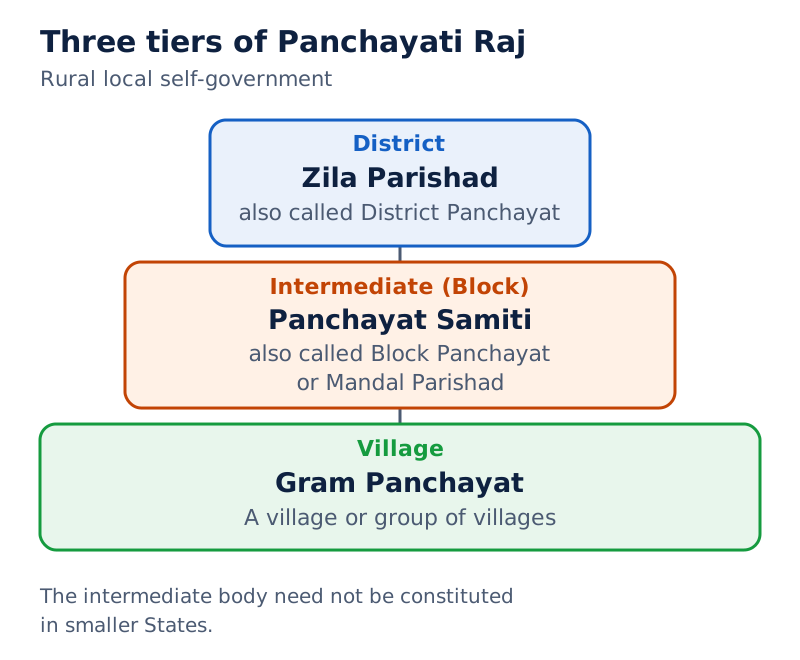
A three-level pyramid has a broad green village base, an orange block middle and a blue district top. Labels identify Gram Panchayat, Panchayat Samiti or Mandal Parishad, and District Panchayat or Zila Parishad.
Drawn by One Young India.
How does the Gram Sabha differ from the Gram Panchayat?
The Gram Sabha comprises all adults registered as voters in the Panchayat area. The Gram Panchayat is the elected village body. The Sabha is therefore the wider body of voters, while the Panchayat consists of their elected representatives.
The 73rd Amendment made provision for the mandatory creation of Gram Sabhas. Their powers and functions are decided by State legislation. Discussion of local concerns, review of Panchayat performance and consideration of the annual budget connect representative government with public participation.
A budget is a plan of receipts and expenditure. When voters discuss a budget, they can examine whether spending reflects local needs. Merely electing members does not replace this continuing opportunity to question priorities and performance.
How can meaningful participation work?
- Residents identify needs and bring them before the Gram Sabha.
- The Sabha discusses priorities and the Panchayat's proposed work.
- Elected representatives take decisions and undertake work within their powers and resources.
- Residents review performance and raise unresolved concerns through further participation.
This is an explanatory sequence for democratic participation, not a uniform statutory timetable. The precise arrangements depend on State law. Attendance and open discussion matter because a meeting that merely announces decisions already made elsewhere provides little scope for self-government.
How do elections and reservations make local government representative?
The 73rd Amendment provides for direct election of representatives at the three Panchayat levels. Direct election means voters themselves choose representatives. Panchayat bodies have a five-year term. The constitutional scheme requires fresh elections within six months when a Panchayat is dissolved before its term ends.
The Constitution has a narrow exception: fresh elections need not be held solely for the remaining period when that period is less than six months. The general rule prevents prolonged replacement of elected institutions by administration through officials.
What reservations are provided?
Reservation means setting aside seats or offices for specified groups. Seats for Scheduled Castes and Scheduled Tribes, constitutionally recognised communities receiving special safeguards, are reserved in proportion to their population in the relevant area.
At least one-third of seats are reserved for women. Reservation for women also operates within reserved categories. Thus, a seat can be reserved both for a woman and for a member of a Scheduled Caste or Scheduled Tribe.
Reservation also extends to chairperson positions, the leadership offices of local bodies. States may provide reservations for Other Backward Classes, socially and educationally backward groups. This State option should be distinguished from the constitutional requirements for women, Scheduled Castes and Scheduled Tribes.
Does representation automatically create influence?
Reserved positions have enabled many women to gain experience, confidence and control over resources. In many cases, women representatives have brought a new perspective and greater sensitivity to discussions. Representation has also changed the social composition of local leadership.
In many cases, however, women were unable to assert their presence or acted as proxies for male family members. A proxy acts in someone else's place or under their effective control. Such instances are becoming fewer, but the distinction between holding office and exercising power remains important.
Dominant groups that previously controlled villages do not wish to give up their power. The resulting tension does not necessarily mean democracy has failed: attempts to make democracy more meaningful and empower previously excluded people are bound to create some conflict and tension in society.
What does the Eleventh Schedule allow Panchayats to do?
The Eleventh Schedule lists 29 subjects associated largely with local development and welfare. These include agriculture, drinking water, rural housing, education, roads and health. They identify a broad field of possible Panchayat responsibility rather than a single identical workload for every local body.
Article 243G, a numbered provision of the Constitution, permits State legislatures to endow Panchayats with powers and authority concerning these matters. The crucial qualification is that actual transfer depends on State legislation. Each State decides which functions are entrusted to local institutions.
Which subjects show the range of rural responsibilities?
| Area | Examples in the Eleventh Schedule |
|---|---|
| Production and livelihoods | Agriculture; small-scale industries, including food processing; markets and fairs |
| Water and infrastructure | Minor irrigation, water management, watershed development, drinking water, roads and rural electrification |
| Education and culture | Primary and secondary schools, technical training, adult education, libraries and cultural activities |
| Health and family needs | Health and sanitation, hospitals, primary health centres, dispensaries and family welfare |
| Social support | Poverty alleviation, women and child development, social welfare and welfare of weaker sections |
| Basic supplies and housing | Public distribution system and rural housing |
Watershed development concerns managing land and water in an area draining towards a common outlet. Poverty alleviation means reducing poverty. The public distribution system supplies essential commodities through a public distribution network.
Why is the distinction between assignment and transfer important?
An institution needs usable authority and resources to perform an assigned function. Naming education or drinking water as a possible local responsibility does not establish that every Panchayat controls all decisions or expenditure in that field.
Note: A constitutional list of subjects is not proof of complete devolution. Devolution means the actual transfer of responsibilities, powers and resources to a lower level of government.
For effective self-government, local representatives must be able to connect identified needs with decisions, funds and implementation. Otherwise, they may remain chiefly responsible for carrying out programmes selected by higher governments.
What are the composition and functions of a Zila Parishad?
The Zila Parishad is the district-level institution in the rural Panchayati Raj system. It is also called the Zilla Panchayat or District Panchayat. Its area covers the rural part of the district; urban local bodies have their own institutional arrangements.
Who belongs to it?
Most members are elected. Members of the Lok Sabha, the directly elected House of Parliament, and members of the State Legislative Assembly associated with the district also participate as provided by State law. Some officials of other district-level bodies are also members.
The Zila Parishad chairperson is its political head. Elected territorial representatives should be distinguished from other categories of members. The presence of legislators or officials does not mean that the whole Parishad is an appointed body.
The precise composition and allocation of functions vary across States. Rural institutions operate under a common constitutional framework, while State laws shape the detailed arrangements. A single membership total should therefore not be presented as universal.
How does it contribute to district development?
- Coordination: It connects rural development work across the district, drawing together matters that extend beyond one village or block.
- Planning: It considers development needs emerging through village and intermediate institutions within the responsibilities entrusted to it.
- Development and welfare: It supports work in fields such as rural roads, education, health, agriculture and social welfare, subject to State allocation of functions.
- Support and review: It helps coordinate resources and review rural programmes within the powers granted by State law.
The Panchayat Samiti is the intermediate link between Gram Panchayats and the Zila Parishad. Bringing village proposals together helps connect local priorities with development planning and the allocation of funds at higher levels.
The Parishad should not be confused with the entire district administration. Its elected political leadership forms part of rural self-government; this does not mean that its chairperson replaces every administrative officer or controls every government function within the district.
How does the 74th Amendment organise urban self-government?
Urban local bodies are institutions of local government in towns and cities. The 74th Amendment extends the broad principles of elected local representation, reservations, financial review and independent election administration to urban areas.
Which bodies serve different urban areas?
| Institution | Broad area served |
|---|---|
| Nagar Panchayat | An area in transition from rural to urban |
| Municipal Council | A smaller urban area |
| Municipal Corporation | A larger urban area |
Article 243Q provides this constitutional classification. The three types should not be drawn as a village-block-district ladder: they serve different kinds of urban areas. A Municipal Corporation is not an upper rural tier above the Zila Parishad.
Towns and cities are divided into wards, smaller territorial units for local representation and administration. Ward-level participation helps residents draw attention to problems such as damaged roads, blocked drains and water leakage.
What protections support urban democracy?
Municipalities have a five-year term. If dissolved early, fresh elections must be held within six months, subject to the exception where the remaining period is less than six months. Reservations for Scheduled Castes, Scheduled Tribes and women apply to urban bodies as well.
Their elected membership, reservations and election arrangements bring local representatives into regular contact with the electorate. The State Election Commission conducts local elections, while the State Finance Commission examines the finances of local institutions.
The Twelfth Schedule identifies urban functions. As with rural bodies, meaningful decentralisation depends on the powers actually transferred and the resources available. An elected urban body needs the capacity to act on residents' priorities.
Urban governance can be complex because cities combine diverse communities, activities and infrastructure needs. Ward committees help connect residents with authorities and can support activities such as health camps or campaigns against single-use plastics. Their precise functioning differs from State to State.
Citizens also have responsibilities. Segregating waste, meaning separating different kinds of rubbish, assists collection. Promptly reporting a water leak can prevent further wastage. Local self-government works through both public institutions and continuing civic participation.
How is a Municipal Corporation composed and how does it work?
A Municipal Corporation is the urban local government for a larger city. Its elected body consists of representatives known as municipal councillors. The city is divided into wards, from which residents elect councillors to represent local concerns.
How do political leadership and administration differ?
The Mayor is the Corporation's political head. The Municipal Commissioner is its principal executive officer, generally appointed by the State government. The distinction separates elected leadership from the administrative machinery responsible for implementing decisions.
The Corporation discusses civic matters, determines priorities and considers its budget within the governing law. Committees assist with particular fields of work. The Commissioner and municipal staff carry out administration and implementation. Detailed arrangements, including mayoral election and tenure, vary under State laws.
| Component | Main role |
|---|---|
| Elected councillors | Represent residents and take part in civic decisions |
| Mayor | Provides political leadership as head of the Corporation |
| Municipal Commissioner | Heads executive administration and implementation |
| Committees | Assist the institution in particular areas of municipal work |
What does municipal work include?
Municipal work includes maintaining infrastructure, collecting and disposing of garbage, maintaining burial grounds, collecting local taxes and fines, and checking the implementation of government schemes. Urban bodies also have a role in economic and social development planning.
Indore Municipal Corporation illustrates the variety of services. These include property tax administration, water charges, solid waste management, licences, fire services and responses to grievances. Property tax is a tax on property; a grievance is a complaint requiring attention.
Photograph: Services under the Indore Municipal Corporation. A grid combines photographs and labels for property tax, water charges, waste management, licences, fire services and grievances. Its bottom strip shows services on request, including tankers, an auditorium, funeral van, mobile toilet and ambulance. CRM means Citizen Relationship Management.
The display shows that municipal government combines service delivery, revenue collection and responses to residents. Effective performance requires coordination between elected representatives, administrative staff and people using those services.
What functions are listed in the Twelfth Schedule?
The Twelfth Schedule, introduced through the 74th Amendment, contains 18 matters concerning urban development and welfare. Article 243W enables State legislatures to give municipalities powers and responsibilities for self-government, development planning and matters in this Schedule.
The Schedule combines planning, essential services, public amenities and social needs. Land-use regulation concerns controlling the purposes for which land is used. Public amenities are facilities provided for common use, such as street lighting and public conveniences.
Which 18 matters does it cover?
- Urban planning, including town planning.
- Regulation of land use and construction of buildings.
- Planning for economic and social development.
- Roads and bridges.
- Water supply for domestic, industrial and commercial purposes.
- Public health, sanitation, conservancy and solid waste management. Conservancy concerns maintaining sanitary conditions.
- Fire services.
- Urban forestry, environmental protection and promotion of ecological aspects.
- Safeguarding weaker sections, including people with physical or intellectual disabilities.
- Slum improvement and upgrading.
- Urban poverty alleviation.
- Urban amenities such as parks, gardens and playgrounds.
- Promotion of cultural, educational and aesthetic aspects, including the appearance and cultural life of the urban environment.
- Burials, burial grounds, cremations, cremation grounds and electric crematoriums.
- Cattle pounds, enclosures for impounded cattle, and prevention of cruelty to animals.
- Vital statistics, including registration of births and deaths.
- Public amenities including street lighting, parking lots, bus stops and public conveniences.
- Regulation of slaughterhouses and tanneries, establishments where animal skins are processed into leather.
How does this differ from the Eleventh Schedule?
The Eleventh Schedule identifies 29 matters for Panchayats; the Twelfth identifies 18 for municipalities. Some concerns overlap, including water, roads, health and welfare. Their organisation reflects the different needs of rural and urban communities.
Neither list means that every local body independently controls every listed matter. State legislation determines the powers actually conferred. The Schedule provides a constitutional field of responsibility; effective local action additionally requires institutional capacity and funds.
How do election safeguards, finance and tribal protections support local autonomy?
Autonomy means the capacity to act within one's own sphere of authority. Local autonomy needs more than elected office: institutions require reliable elections, money and recognition of the communities whose affairs they manage.
Which constitutional provisions should be distinguished?
| Provision | Main concern |
|---|---|
| Article 243B | Constitution of Panchayats at the prescribed levels, with the intermediate-tier exception |
| Article 243D | Reservation of seats and chairperson offices in Panchayats |
| Article 243E | Duration of Panchayats and the timing of elections |
| Article 243I | State Finance Commission review of Panchayat finances |
| Article 243K | State Election Commission authority over Panchayat elections |
The State Election Commissioner conducts local elections through an autonomous office. This officer is independent of the Election Commission of India and is not under its control. Separating local election administration from routine State administration protects the electoral process.
The State Finance Commission is constituted every five years. It examines local finances and reviews revenue distribution between State and local governments and between rural and urban bodies. Revenue means government receipts; grants are financial transfers supporting another body's work.
Why were special provisions needed for tribal areas?
The 73rd Amendment's provisions were not initially applied to areas inhabited by Adivasi populations in many States. Adivasi refers to India's tribal communities. A separate law in 1996 extended the Panchayat system to specified areas while recognising traditional self-government.
The law is the Provisions of the Panchayats (Extension to the Scheduled Areas) Act, 1996, commonly called PESA. Scheduled Areas are constitutionally designated areas with special protections for tribal communities.
Many such communities manage forests, water reservoirs and other shared resources through traditional practices. The law protects community rights and gives Gram Sabhas greater authority. Elected village Panchayats must obtain Gram Sabha consent in many respects. The principle combines democratic institutions with respect for local traditions and diversity.
What do actual cases reveal about the achievements and limits of local democracy?
How did Vengaivasal defend its powers?
In 1997, the Tamil Nadu government allotted two hectares of land near Vengaivasal village to 71 government employees. A hectare is a unit of land area. The District Collector of Kancheepuram directed the Gram Panchayat President to obtain a resolution endorsing the allotment.
The President and Panchayat refused. After the Collector ordered acquisition of the land, the Panchayat approached the Madras High Court through a writ petition, an application seeking the court's intervention to protect legal rights.
A single-judge bench upheld the Collector's order and held that Panchayat consent was unnecessary. On appeal, a Division Bench, a bench of more than one judge, reversed that ruling. It found an infringement of Panchayat powers and a serious violation of its constitutional status.
The case illustrates local representatives using constitutional protection to defend community decision-making. It does not mean that a Panchayat can disregard every State decision. The relevant lesson concerns the protection of its lawful powers.
Why can elected institutions still have limited power?
Many States have not transferred most of the subjects to local bodies. Local governments therefore have limited freedom to choose welfare programmes or allocate resources. Financial dependence further restricts their ability to act on local priorities.
The problem is not solved simply by increasing the number of elected representatives. A body implementing schemes selected by higher governments may perform useful work while still lacking substantial self-government. Elections, participation, authority and resources must work together.
What wider examples illuminate decentralisation?
Brazil's Constitution assigns independent powers to municipal councils and protects them against State interference. This illustrates constitutional protection for a local sphere of government.
Bolivia's Popular Participation Law of 1994 decentralised power through municipalities, popularly elected mayors and fiscal transfers, meaning transfers of public money. In that arrangement, 20 per cent of nationwide tax collections were distributed among municipalities on a per-person basis.
These examples show two connected requirements: legal authority and financial support. The practical test of local democracy is whether people can influence policies and programmes, and whether their institutions have the means to carry those decisions into effect.
Glossary
- Local self-government — Management of local public affairs through institutions enabling residents and their representatives to participate in decisions.
- Decentralisation — Transfer of power from higher levels of government to lower levels closer to people.
- Accountability — The responsibility of public representatives and institutions to explain decisions and answer for performance.
- Gram Sabha — The body comprising all adults registered as voters within the relevant Panchayat area.
- Gram Panchayat — An elected village-level institution serving a village or a group of villages.
- Panchayat Samiti — An intermediate rural institution linking village Panchayats with the district-level Zila Parishad.
- Zila Parishad — The district-level rural local institution, with elected representation and responsibilities determined under State law.
- Municipal Corporation — An urban local government institution for a larger city, led politically by a Mayor.
- Ward — A smaller territorial division of a town or city used for local representation and administration.
- Reservation — Setting aside seats or leadership offices to ensure representation of specified groups in public institutions.
- Devolution — Actual transfer of responsibilities, powers and resources to institutions at a lower level of government.
- State Election Commission — The independent State-level institution responsible for conducting elections to rural and urban local bodies.
- State Finance Commission — A commission constituted every five years to examine local finances and recommend arrangements for financial distribution.
- Autonomy — The capacity of an institution to take decisions within its legally assigned sphere of authority.
- Non-justiciable — Describes a constitutional guideline that cannot itself be directly enforced through proceedings in a court.
Common errors and misconceptions
- Misconception: The two amendments were passed in 1993. Correct: They were passed in 1992 and came into force in 1993.
- Misconception: The Gram Sabha and Gram Panchayat have identical membership. Correct: The Sabha includes all registered adult voters; the Panchayat is the elected village body.
- Misconception: Every Panchayat automatically controls all 29 subjects. Correct: Actual transfer of functions depends on State legislation.
- Misconception: Municipal Councils and Corporations are successive rural tiers. Correct: They serve different kinds of urban areas; rural tiers belong to Panchayati Raj.
- Misconception: Reservation applies only to ordinary seats. Correct: It also extends to chairperson positions, and women's reservation operates within reserved categories.
- Misconception: The State Election Commissioner works under the Election Commission of India. Correct: The State officer is independent of that institution.
- Misconception: The Mayor and Municipal Commissioner are the same office. Correct: The Mayor is the political head; the Commissioner heads executive administration.
- Misconception: Elections alone guarantee effective self-government. Correct: Meaningful participation also needs real powers, resources and accountability.
Exam-style questions with model answers
Q1. Distinguish the areas covered by the 73rd and 74th Constitutional Amendments. Give one point for each. [2 marks]
- The 73rd Amendment concerns rural local government through Panchayati Raj institutions.
- The 74th Amendment concerns urban local government through municipal institutions or Nagarpalikas.
Q2. Explain three differences between the Gram Sabha and Gram Panchayat, covering membership, character and accountability. [3 marks]
- The Gram Sabha includes all adults registered as voters in the Panchayat area; the Gram Panchayat consists of elected village representatives.
- The Sabha provides a forum for direct public discussion, while the Panchayat functions as an elected body taking decisions about village affairs.
- The Sabha reviews Panchayat performance and discusses the budget; the Panchayat must account for its work before the people it represents.
Q3. Explain four features of reservation in Panchayati Raj institutions, including the distinction between constitutional requirements and the State option. [4 marks]
- Scheduled Castes and Scheduled Tribes receive reserved seats in proportion to their population in the relevant area, supporting the representation of disadvantaged communities.
- At least one-third of seats are reserved for women, and women's reservation also operates within the reserved categories.
- Reservation extends to chairperson offices, so access to leadership is addressed as well as membership of local bodies.
- States may also provide reservations for Other Backward Classes; this is a State option rather than an identical mandatory arrangement everywhere.
Q4. Explain five points about the composition, leadership and functions of a Zila Parishad. Preserve the qualification concerning State law. [5 marks]
- The Zila Parishad is the district-level rural institution, covering the rural area of the district and linking development concerns beyond individual villages.
- Most members are elected; district-associated members of Parliament and the State Legislative Assembly, together with certain other members, participate as provided by State law.
- Its chairperson is the political head, giving the institution elected leadership within the rural local government system.
- It coordinates rural development concerns and plans brought through village and intermediate institutions, helping connect local priorities with district-level work.
- It undertakes or supports development and welfare responsibilities entrusted under State law; its exact composition and powers should not be assumed identical across States.
Q5. Explain six distinct functions included in the Twelfth Schedule, choosing urban planning, land use, water supply, sanitation, social protection and public amenities. [6 marks]
- Urban planning, including town planning, concerns the organised development of urban areas and the planning framework within which a town or city grows.
- Regulation of land use and building construction concerns how land is used and the regulation of structures built within urban areas.
- Water supply covers domestic, industrial and commercial needs, recognising that households and different urban activities require this essential service.
- Public health, sanitation, conservancy and solid waste management concern sanitary conditions and the handling of waste in urban settlements.
- Safeguarding weaker sections includes attention to people with physical or intellectual disabilities, making social protection part of urban responsibilities.
- Public amenities include street lighting, parking lots, bus stops and public conveniences, facilities that support the everyday use of urban space.
Q6. A village Panchayat seeks funds for a school building. Officials refuse because available money is tied to other schemes. Explain four implications for local self-government using only this situation. [4 marks]
- The Panchayat has identified a local education priority, showing that local representatives are attempting to respond to a community need.
- Its inability to redirect the available money demonstrates limited financial discretion over the resources required for its proposed work.
- Control over spending remains with officials administering other schemes, so local priority-setting does not itself determine the use of funds.
- The situation weakens practical self-government because identifying a need is insufficient when the elected institution lacks usable resources to act on it.
Q7. In 1997, Tamil Nadu allotted two hectares near Vengaivasal to 71 government employees. The Collector sought a Panchayat resolution endorsing it. The Panchayat refused; after an acquisition order, it petitioned the Madras High Court. A single judge upheld the Collector, but a Division Bench reversed that ruling, finding infringement of Panchayat powers and constitutional status. Explain six stages or implications of this case. [6 marks]
- The proposed land allotment was a decision made by higher authorities that affected an area associated with the village Panchayat.
- Seeking an endorsing resolution placed the Panchayat in the position of being asked to approve a decision already made elsewhere.
- The Panchayat's refusal asserted a local institution's claim to participate meaningfully in decisions concerning local interests and resources.
- Its petition challenged the acquisition order through the courts, using a legal route to defend the powers it claimed.
- The initial ruling favoured the Collector, but the Division Bench reversed it on grounds concerning Panchayat powers and constitutional status.
- The outcome illustrates how constitutional recognition can support local accountability and protect lawful institutional powers against infringement by higher authorities.
Q8. Explain four features of the State Election Commission and State Finance Commission, covering their work, electoral independence, periodic financial review and revenue distribution. [4 marks]
- The State Election Commission conducts elections to local bodies; the State Finance Commission examines their financial position and arrangements for revenue distribution.
- The State Election Commissioner is independent of the Election Commission of India and is not an officer working under its control.
- A State Finance Commission is constituted every five years, providing periodic examination of local government finances rather than conducting electoral contests.
- Financial review concerns distribution between State and local governments and between rural and urban local bodies, helping address the resources needed for local work.
Key takeaways
- Local self-government strengthens participation and accountability by bringing decisions about daily needs closer to residents and their representatives.
- The 73rd and 74th Amendments were passed in 1992 and came into force in 1993, covering rural and urban institutions respectively.
- The Gram Sabha includes registered adult voters, while the Gram Panchayat is the elected village institution accountable to the community.
- Reservations widen access to seats and leadership offices, but meaningful influence also depends on the ability to exercise authority.
- The Eleventh Schedule lists 29 rural matters and the Twelfth Schedule 18 urban matters; actual powers depend on State legislation.
- The Zila Parishad coordinates district-level rural concerns, while Municipal Corporations address the government and civic services of larger urban areas.
- The State Election Commission safeguards local elections, while periodic State Finance Commissions examine local finances and revenue distribution.
- Effective self-government requires genuine transfer of powers and resources, continuing public participation and implementation of constitutional safeguards.
Test yourself
When were the two local government amendments passed and implemented?
Both were passed in 1992 and came into force in 1993.
Who belongs to a Gram Sabha?
All adults registered as voters in the relevant Panchayat area belong to it.
What is the general three-tier rural structure?
Gram Panchayat at village level, Panchayat Samiti at intermediate level, and Zila Parishad at district level.
Why is the Eleventh Schedule not proof of full devolution?
Actual transfer of its listed subjects depends on State legislation and the powers and resources given to local institutions.
Who is the political head of a Municipal Corporation?
The Mayor is its political head, distinct from the Municipal Commissioner responsible for executive administration.
How frequently is a State Finance Commission constituted?
It is constituted every five years to examine local finances and financial distribution arrangements.
What was protected in the Vengaivasal appeal?
The Division Bench protected the Panchayat's powers and constitutional status against infringement through the challenged government action.
What is the central lesson of the 1996 law concerning tribal areas?
Introducing elected Panchayats should protect traditional community self-government and resource management, including the stronger role of Gram Sabhas.
Try it
Local Governance in Action
Step into the shoes of a state policy advisor. Apply the rules of the 73rd and 74th Amendments to solve these local governance challenges.
1A small state with a population of 1.5 million (15 lakhs) is setting up its rural Panchayati Raj system. The Chief Minister wants to establish a full three-tier system (Gram Panchayat, Panchayat Samiti, Zila Parishad) to ensure maximum administrative coverage. Based on the text, what should you advise?
Correct! The text states that as a numerical exception for efficiency, states with a population under 20 lakhs (2 million) are not required to constitute the intermediate tier (Panchayat Samiti) to prevent over-bureaucratization.
Incorrect. While the 73rd Amendment established a uniform three-tier structure, the text explicitly notes an exception: states with a population under 20 lakhs (2 million) do not need the intermediate tier.
Incorrect. According to the text, Nagar Panchayats are for transitional areas changing from rural to urban under the 74th Amendment, not a replacement for rural tiers based on state population size.
2A Municipal Council was elected for a five-year term but gets dissolved after just two years. The state government plans to hold fresh elections in eight months, and the newly elected body will serve a full five-year term. What is constitutionally wrong with this plan according to the text?
Incorrect. The text states that the State Election Commission is exclusively responsible for conducting local body elections, completely separate from the Election Commission of India.
Correct! The text mandates two rules for premature dissolution: fresh elections must be held within six months, and the newly elected body only serves the remainder of the dissolved body's term.
Incorrect. The text mandates a minimum of one-third (33.33%) reservation for women, and there is no mention of this percentage increasing due to premature dissolution.
Great job! You successfully applied the constitutional rules and exceptions of the 73rd and 74th Amendments to practical governance scenarios.