
The Judiciary: Supreme Court, High Courts and Subordinate Courts | ICSE Class 10 History & Civics Notes
On this page
This note covers the organisation of the Indian judiciary, the composition and appointment of Supreme Court and High Court judges, judicial independence, courts' powers, protection of Fundamental Rights, writs, subordinate courts and Lok Adalats.
What is the judiciary, and how are India's courts organised?
The judiciary is the branch of government that interprets laws, settles legal disputes and administers justice. The Constitution is the framework of fundamental rules governing the country. Courts protect this framework by deciding whether laws and government actions conform to it.
The rule of law means that all individuals are subject to the same law, regardless of wealth, gender or caste. A dispute should therefore be decided through law, rather than through the political influence or social position of either side.
What makes the system integrated?
India has a single integrated judicial system: courts at different levels form one connected structure. The Supreme Court stands at the top, followed by High Courts, district courts and other subordinate courts. Higher courts supervise courts below them.
Jurisdiction means a court's legally defined scope of authority. Territorial jurisdiction is the geographical area within which that authority operates. Each level has particular responsibilities. Integration does not mean that every court can hear every case; it means that the courts are linked within a common judicial structure.
| Level | Place and broad responsibility |
|---|---|
| Supreme Court | Highest court; its decisions bind courts throughout India. |
| High Courts | Exercise authority within their territorial jurisdiction and supervise courts below them. |
| District courts | Deal with district-level cases and appeals from lower courts. |
| Other subordinate courts | Hear civil and criminal cases within their assigned powers. |
A civil case concerns rights and obligations, such as a property dispute. A criminal case concerns an alleged offence punishable by law. An appeal asks a higher court to reconsider a lower court's decision.
What the figure shows
Structure of the judiciary
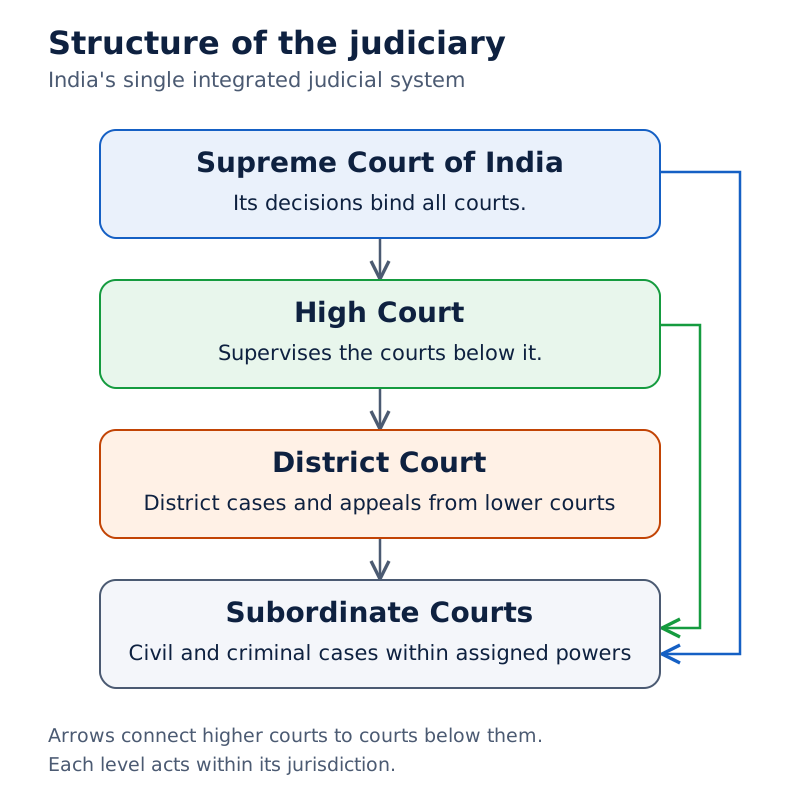
Four boxes descend from Supreme Court of India to High Court, District Court and Subordinate Courts. Arrows connect the boxes, including longer arrows from the higher levels towards lower courts.
Drawn by One Young India.
The connected structure helps higher courts correct decisions and maintain consistency in legal interpretation. It also explains why a court's position and its particular jurisdiction must be considered together.
Why must the judiciary be independent?
Judicial independence means that judges must be able to decide cases without fear or favour. The executive, which implements laws, and the legislature, which makes laws, must not interfere with judicial decisions or prevent courts from administering justice.
Disputes can arise between individuals, between groups, or between people and the government. A court cannot protect rights effectively if one party can dictate its decision. Independence supports the rule of law by allowing judges to apply legal standards even against powerful interests.
Which safeguards protect independent decisions?
Tenure means the period during which a person holds an office. For judicial removal, a special majority means a majority of each House's total membership together with at least two-thirds of its members present and voting, meaning those who vote, excluding members who abstain by not voting.
- Qualifications: judicial appointments require legal knowledge and experience rather than political loyalty.
- Security of tenure: judges hold office until retirement unless removed through the prescribed exceptional procedure.
- Difficult removal: removal requires proved misbehaviour, meaning established improper conduct, or incapacity, meaning inability to perform judicial duties, and a special parliamentary majority.
- Financial protection: judges' salaries and allowances are protected from ordinary legislative voting.
- Protection of judicial functioning: courts can punish contempt, meaning conduct that obstructs justice or undermines the court's lawful authority.
Security of tenure reduces the danger that a judge will lose office merely because a decision displeases the government.
Parliament cannot discuss a judge's conduct except in connection with removal proceedings. This protects judicial decision-making from political pressure. It does not mean that judges stand outside the constitutional system.
Does independence remove accountability?
Accountability means being answerable for the exercise of authority. The judiciary remains accountable to the Constitution, democratic traditions and the people. Independence does not justify arbitrary decisions, which are decisions based on personal will rather than governing rules.
Note: Independence protects the freedom to administer justice. It does not give judges unlimited power or remove the constitutional limits within which courts must function.
How is the Supreme Court composed, and who can become a judge?
The Supreme Court is India's highest court. Its composition consists of the Chief Justice of India and other judges. Parliament determines the permitted number of other judges by law. The Chief Justice of India heads the Court.
An Article is a numbered provision of the Constitution. Article 124 provides the constitutional framework for the Supreme Court's establishment and the appointment and qualifications of its judges.
What qualifications are required?
A person must be a citizen of India and satisfy at least one of the following qualifications. An advocate is a legal practitioner who represents parties in court; a jurist is a person with distinguished knowledge of law.
- Have been a judge of a High Court, or of two or more High Courts in succession, for at least five years.
- Have been an advocate of a High Court, or of two or more High Courts in succession, for at least ten years.
- Be, in the President's opinion, a distinguished jurist.
These are alternative qualifying routes. A person does not have to complete both periods of professional service and also qualify as a distinguished jurist. Citizenship is a separate requirement that accompanies whichever qualifying route applies.
Who appoints the judges?
The President of India, the constitutional head of the Indian State, formally appoints Supreme Court judges. Judicial consultation forms an important part of the appointment process. By convention, the senior-most Supreme Court judge is appointed Chief Justice of India.
The collegium is a group of senior judges involved in recommending judicial appointments. For Supreme Court appointments, the Chief Justice of India consults the four senior-most Supreme Court judges. This collective consultation helps distinguish recommendation from the President's formal act of appointment.
Supreme Court judges retire at 65 years. Their tenure is protected through the difficult removal procedure. The combination of legal qualifications, judicial consultation and secure tenure supports their ability to decide cases independently.
How can a Supreme Court or High Court judge be removed?
A judge of the Supreme Court or a High Court can be removed on the ground of proved misbehaviour or incapacity. Misbehaviour concerns improper conduct; incapacity means inability to perform the duties of judicial office.
Disagreement with a judgement is not itself one of these grounds. A judgement is a court's formal decision, with its reasons. The difficult removal process protects judges from losing office merely because their interpretation of law is unpopular.
What is the constitutional sequence?
An address here means Parliament's formal request to the President. A session is a period during which Parliament meets to conduct its business.
- Charges alleging misbehaviour or incapacity are raised through the prescribed parliamentary procedure.
- The allegations are investigated, and the ground for removal must be proved.
- Each House of Parliament must support the removal address by the required special majority.
- The address is presented to the President in the same parliamentary session, and the President issues the removal order.
Removal is therefore a constitutional process involving Parliament and the President.
What does special majority mean here?
The special majority required in each House combines two conditions: a majority of the House's total membership and at least two-thirds of the members present and voting. Both conditions must be satisfied in each House.
Present and voting excludes members who abstain from voting. Therefore, support from two-thirds of those who vote does not by itself establish that the motion also has the support of a majority of the entire membership.
This procedure balances independence with accountability. It makes removal possible for the specified serious grounds, while preventing a simple political disagreement from becoming an easy means of controlling judges.
How do the Supreme Court's original and appellate jurisdictions differ?
Original jurisdiction allows a court to hear a case at its beginning, without that case first passing through a lower court. The Supreme Court's original jurisdiction includes specified legal disputes between the Union, meaning the national government, and States or between States.
The Union means the government at the national level. India's federal system distributes powers between the Union and State governments. Disputes about this constitutional division require an authoritative legal decision.
Why are federal disputes important?
The Supreme Court acts as an impartial authority in disputes involving the legal rights of governments. It can interpret the constitutional powers of the Union and the States while deciding the dispute. Its role therefore extends beyond settling disagreements between private individuals.
Appellate jurisdiction means the authority to reconsider decisions brought on appeal from lower courts. The Supreme Court is the highest court of appeal, and its appellate work includes constitutional, civil and criminal matters.
| Point of difference | Original jurisdiction | Appellate jurisdiction |
|---|---|---|
| Starting point | The case begins in the court exercising this jurisdiction. | A lower court has already given a decision. |
| Supreme Court's role | Decides specified disputes directly, including federal legal disputes. | Reconsiders a challenged lower-court decision. |
| Central question | Does the dispute fall within its direct authority? | Can the previous decision be brought before it on appeal? |
Is every appeal automatically admitted?
Appeals must satisfy the relevant legal conditions. A High Court may certify that a case is fit for appeal because of an important question of law or constitutional interpretation. The Supreme Court can also grant special leave, meaning exceptional permission to appeal.
When reconsidering a case, the Supreme Court examines the legal issues and the interpretation adopted below. If it finds that the law or Constitution has a different meaning, it can change the ruling and explain the correct interpretation.
What are advisory jurisdiction, revisory power and a court of record?
Advisory jurisdiction allows the Supreme Court to give legal advice when the President refers a question of public importance or constitutional interpretation to it. Such a reference differs from an appeal against a judgement.
For these public-importance references, the Court is not bound to give advice, and the President is not bound to accept it. Advice can help the government consider the legal implications of a proposed action before proceeding.
Why is legal advice useful?
Obtaining the Court's opinion may prevent unnecessary litigation, meaning legal proceedings before a court. The government can also use the advice to make suitable changes to a proposed law or course of action.
Revisory power, in the Supreme Court's case, includes reconsideration of its own judgements or orders. Article 137 recognises this power of review. A review of the Court's own decision differs from an appeal against a lower court.
What is a court of record?
A court of record preserves authoritative records of its proceedings and decisions and has the power to punish contempt of itself. Article 129 gives the Supreme Court this status.
A precedent is an earlier judicial decision that guides the resolution of later legal questions. The Supreme Court's authoritative interpretation helps courts apply the law consistently. Record-keeping and the authority of legal decisions are therefore connected but distinct ideas.
Article 144 requires civil and judicial authorities throughout India to act in aid of the Supreme Court. Its orders can be enforced throughout the country, and other courts are bound by its decisions.
Note: Advisory jurisdiction concerns a presidential request for legal advice. Appellate jurisdiction concerns a challenged lower-court decision. Revisory power concerns reconsideration of the Supreme Court's own judgement or order.
How do courts protect Fundamental Rights through writs?
Fundamental Rights are constitutionally guaranteed rights that courts can enforce. The right to constitutional remedies enables a person to approach the courts when these rights are violated. A right becomes effective when a remedy can secure its protection.
A writ is a special judicial order used to enforce legal rights and duties. Article 32 allows the Supreme Court to issue writs for enforcing Fundamental Rights. Article 226 empowers High Courts to issue writs.
What do the five writs do?
A tribunal is a body authorised to decide particular categories of legal disputes. To quash an order means to set it aside through judicial authority. Detention means keeping a person in custody.
| Writ | Meaning and purpose |
|---|---|
| Habeas corpus | Requires an arrested or detained person to be brought before the court so it can examine the legality of detention and order release if detention is unlawful. |
| Mandamus | Commands a public authority to perform a legal duty it has failed to perform. |
| Prohibition | Stops a lower court or tribunal from proceeding beyond its jurisdiction. |
| Certiorari | Enables a higher court to call for the record of a lower court or tribunal and quash an unlawful order. |
| Quo warranto | Questions a person's legal authority to occupy a public office and prevents unlawful occupation of that office. |
How can the writs be distinguished?
Habeas corpus concerns unlawful detention; mandamus concerns an unperformed legal duty; quo warranto concerns entitlement to public office. Prohibition and certiorari concern the lawful exercise of authority by lower courts or tribunals.
Prohibition stops proceedings beyond jurisdiction. Certiorari can set aside an order already made. Remembering the object of each writ is more useful than treating their names as interchangeable terms for court orders.
For a Fundamental Rights violation, a person may approach the Supreme Court directly or seek relief from a High Court. High Courts' writ powers also extend to other legal rights, making their purposes wider than the Supreme Court's Article 32 jurisdiction.
What is judicial review, and why does it matter?
Judicial review is the power of the Supreme Court and High Courts to examine whether laws and government actions conform to the Constitution. A law found inconsistent with constitutional provisions can be declared unconstitutional and inapplicable.
Unconstitutional means contrary to the Constitution. Courts do not apply this label simply because a policy is unpopular. They examine a legal measure against the constitutional rules that limit public authority.
How does review protect rights and federal powers?
Article 13 provides a basis for invalidating laws that conflict with Fundamental Rights. Judicial review therefore connects the protection of individual rights with the judiciary's wider responsibility to interpret the Constitution.
Review also protects the distribution of powers between the Union and States. Courts can examine whether a legislature has acted outside the powers allocated to it. Both Union laws and State laws can be examined on constitutional grounds.
Constitutional interpretation means explaining the meaning and application of constitutional provisions. Judicial review depends on this process: the court identifies the relevant rule, interprets it and considers whether the challenged measure complies with it.
How is this different from reviewing a judgement?
Reviewing a judgement under Article 137 means that the Supreme Court reconsiders its own earlier decision. Judicial review tests the constitutional validity of a law or government action. The word “review” occurs in both expressions, but their objects differ.
Perhaps the most important power of the Supreme Court is judicial review. Its importance comes from enabling courts to uphold the Constitution when another public authority acts inconsistently with it.
Judicial review does not make the judiciary an unlimited law-making body. The legislature makes laws, the executive implements them, and the judiciary settles disputes and examines constitutional validity. Each institution must respect the authority and constitutional limits of the others.
How are High Courts composed, and how are their judges appointed?
A High Court is the highest court within its territorial jurisdiction below the Supreme Court. Territorial jurisdiction means the geographical area within which a court exercises authority. A common High Court may serve more than one State.
Each High Court consists of a Chief Justice and other judges whom the President considers necessary to appoint. Article 217 deals with the appointment and conditions of office of High Court judges.
Which qualifications must a judge possess?
Judicial office means an office involving the exercise of judicial functions.
A High Court judge must be a citizen of India and meet one of two professional qualifications. The person must have held judicial office in India for at least ten years or have been an advocate of a High Court, or successive High Courts, for at least ten years.
The judicial-service route and the advocate route are alternatives. They should not be combined into a requirement that every candidate must complete both.
Who takes part in appointment?
The President appoints High Court judges after consultation with the Chief Justice of India and the Governor of the State. When appointing a judge other than the High Court's Chief Justice, the Chief Justice of that High Court is also consulted.
The Governor is the constitutional head of a State. Consultation gives the appointment process both a constitutional and a judicial dimension. Judicial recommendations are considered through the collegium system, while the President makes the formal appointment.
High Court judges retire at 62 years, compared with 65 years for Supreme Court judges. They are protected by the same difficult removal framework: proved misbehaviour or incapacity, parliamentary approval by the required special majority and a presidential removal order.
The High Court's lower position in the judicial hierarchy does not remove its independence. Its judges must decide cases within their jurisdiction without direction from the executive or legislature.
What powers and functions do High Courts exercise?
High Courts perform several connected functions: they decide cases directly where permitted, hear appeals, supervise subordinate courts, enforce rights and examine constitutional validity. Their powers must be understood within the territorial and legal limits of their jurisdiction.
How do original, appellate and revisory powers work?
A High Court's original jurisdiction includes matters it is empowered to hear in the first instance, including writ petitions. A petition is a formal request asking a court to exercise its authority and grant relief.
High Courts also hear civil and criminal appeals from subordinate courts. The appeal allows reconsideration of a decision according to the applicable law. Appellate jurisdiction links the High Court to the district and other courts below it.
Revisory jurisdiction enables a High Court to examine proceedings of subordinate courts for jurisdictional or legal irregularities. It helps ensure that lower courts act within their authority and follow the required legal procedure.
Superintendence means supervisory authority over subordinate courts. This is wider than merely hearing individual appeals: it supports the proper functioning of the judicial system below the High Court.
How are rights and the Constitution protected?
Under Article 226, High Courts can issue the five writs for Fundamental Rights and other legal rights. Their writ jurisdiction is therefore broader in purpose than the Supreme Court's power under Article 32.
High Courts also exercise judicial review. They can examine whether laws and government actions within the matters before them conform to the Constitution. Their constitutional role extends beyond deciding private disputes.
Article 215 makes every High Court a court of record with the power to punish contempt of itself. Its records have authoritative status, and its decisions contribute to the consistent interpretation of law.
Note: High Courts have original, appellate, revisory and writ powers, judicial review and court-of-record status. The presidential advisory jurisdiction discussed here belongs to the Supreme Court.
How does the District Judge's Court differ from the Sessions Court?
Subordinate courts are courts below the High Court in the judicial hierarchy. They handle the civil and criminal work arising within their assigned areas and powers. Their decisions can be subject to appeal or revision according to law.
At district level, the distinction between the District Judge's Court and the Sessions Court concerns the nature of the work. The same judicial officer can function as District Judge in civil matters and Sessions Judge in criminal matters.
Which court deals with which kind of case?
A sentence is the punishment imposed after conviction in a criminal case. Conviction means a court's finding that an accused person is guilty.
| Point | District Judge's Court | Sessions Court |
|---|---|---|
| Nature of work | Civil disputes involving rights and obligations. | Criminal cases involving offences against the law. |
| District-level role | Principal civil court at district level. | Principal criminal court at district level for serious offences. |
| Judicial functions | Exercises civil original and appellate powers according to law. | Tries serious criminal cases and hears criminal appeals according to law. |
| Higher judicial control | Functions under the High Court's supervision. | Functions under the High Court's supervision; a death sentence requires its confirmation. |
The Sessions Court can impose a death sentence, but it cannot be carried out without High Court confirmation.
Why does the distinction matter?
The word “district” identifies a level of judicial organisation, while “civil” and “criminal” identify different kinds of legal work. Calling both institutions district-level courts does not make their functions identical.
Subordinate courts form the lower levels of the integrated judicial structure. High Court supervision, appeal and revision connect their work to higher judicial authority. The Supreme Court remains at the apex, meaning the highest point, of the overall system.
What are Lok Adalats, and what advantages do they offer?
Lok Adalat means “People's Court”. It is a forum that helps parties settle disputes through agreement. A party is a person or organisation involved in a legal dispute. Conciliation means assistance given to disputing parties to reach a mutually acceptable settlement.
Lok Adalats bring the parties together and seek a compromise, meaning a settlement acceptable to both sides. This differs from deciding an ordinary contested case solely through a court judgement.
How does settlement work?
Ordinary Lok Adalats deal with eligible disputes already pending before courts and disputes that have not yet reached a court. The emphasis is on resolving disagreement by consent. A settlement cannot be forced upon parties who do not agree.
An award records a Lok Adalat settlement. A decree is a court's formal determination of rights in a civil case. A settlement award is binding on the parties and is treated as a civil court decree.
What are the main advantages?
- Lower cost: no court fee is charged in a Lok Adalat.
- Speed: settlement can resolve disputes more quickly than prolonged contested litigation.
- Simpler procedure: the process is less formal and helps parties participate in reaching agreement.
- Reduced burden: settling eligible disputes helps reduce the number of cases awaiting court decisions.
- Cooperation: an agreed outcome can reduce continuing hostility between the parties.
These advantages depend on the possibility of a lawful agreement. Quick settlement should not be confused with compulsory acceptance of a proposal. The defining feature of an ordinary Lok Adalat is its effort to secure a mutually acceptable solution.
Lok Adalats complement the regular courts by offering a route to settlement. They help connect the wider aim of access to justice with practical concerns about expense, delay and the difficulty of pursuing a dispute.
Glossary
- Judiciary — The branch of government that interprets laws, settles legal disputes and administers justice.
- Rule of law — The principle that all individuals are subject to the same law regardless of social position.
- Jurisdiction — The legally defined scope within which a court may exercise its authority.
- Judicial independence — Freedom of judges to administer justice without improper interference, fear or favour.
- Original jurisdiction — Authority to hear a case directly before it has been decided by a lower court.
- Appellate jurisdiction — Authority to reconsider a lower court's decision through an appeal permitted by law.
- Advisory jurisdiction — The Supreme Court's authority to provide legal advice on questions referred by the President.
- Judicial review — Examination of laws and government actions to determine whether they conform to the Constitution.
- Writ — A special judicial order through which a court enforces legal rights and duties.
- Court of record — A court whose records are authoritative and which can punish contempt of itself.
- Collegium — A group of senior judges involved in making recommendations for judicial appointments.
- Special majority — For judicial removal, a majority of total membership plus two-thirds of those present and voting.
- Subordinate courts — Courts below the High Court that exercise assigned civil and criminal judicial powers.
- Lok Adalat — A People's Court that helps parties reach an agreed settlement of eligible disputes.
- Conciliation — Assistance offered to disputing parties to help them reach a mutually acceptable settlement.
Common errors and misconceptions
- Misconception: Judicial independence means that judges are accountable to nobody. Correct: The judiciary remains accountable to the Constitution, democratic traditions and the people.
- Misconception: Original jurisdiction means reviewing another court's judgement. Correct: It means hearing a case directly; appellate jurisdiction concerns challenges to lower-court decisions.
- Misconception: The President must follow the Supreme Court's advisory opinion. Correct: Advice on the public-importance references discussed here is not binding on the President.
- Misconception: Judicial review and reviewing the Supreme Court's own judgement are identical. Correct: The former examines constitutional validity; the latter reconsiders an earlier judicial decision.
- Misconception: High Courts cannot protect rights other than Fundamental Rights. Correct: Their writ powers also extend to other legal rights.
- Misconception: A District Judge and a Sessions Judge necessarily represent different judicial officers. Correct: The same officer can perform civil functions as District Judge and criminal functions as Sessions Judge.
- Misconception: A two-thirds vote alone is enough to remove a judge. Correct: Each House must also supply a majority of its total membership.
- Misconception: An ordinary Lok Adalat can force parties to accept a compromise. Correct: Settlement depends on their agreement.
Exam-style questions with model answers
Q1. The rule of law subjects everyone to the same law. Judicial independence allows judges to decide without fear or favour, including in disputes involving government. Explain two reasons why independence supports the rule of law. [2 marks]
- It allows judges to apply the same legal standards to all parties, regardless of their influence or social position.
- It enables courts to decide disputes involving the government without fear of pressure from the government itself.
Q2. Original jurisdiction allows a case to begin directly in the Supreme Court, including specified Union-State legal disputes. Appellate jurisdiction reconsiders lower-court decisions. Advisory jurisdiction supplies legal advice on presidential references concerning public importance. Distinguish these three jurisdictions by their starting point and function. [3 marks]
- Original jurisdiction begins with a case brought directly to the Supreme Court. The Court decides the dispute at its starting point, as in specified Union-State legal disputes.
- Appellate jurisdiction begins after a lower court has decided a case. The Supreme Court reconsiders that decision when the case is brought on appeal.
- Advisory jurisdiction begins with a presidential reference on a matter of public importance. The Supreme Court's function here is to provide legal advice.
Q3. A judge's removal requires proved misbehaviour or incapacity. Each House must approve an address by a majority of its total membership and at least two-thirds of members present and voting. The address must reach the President in the same session, and the President issues the order. Explain four safeguards or requirements in this process. [4 marks]
- Removal requires proved misbehaviour or incapacity. The grounds are therefore specified, and a charge must be established rather than merely asserted.
- Each House must support removal by a majority of its total membership, so the support of those voting alone is insufficient.
- Each House must also provide at least two-thirds support among members present and voting; both majority conditions must be satisfied.
- The address must be presented to the President in the same session, followed by a presidential order, completing the constitutional process.
Q4. Use these descriptions: habeas corpus tests the legality of detention; mandamus requires performance of a neglected public duty; prohibition stops lower courts proceeding beyond jurisdiction; certiorari can quash unlawful lower-court orders; quo warranto tests entitlement to public office. Explain the distinct purpose of each of the five writs. [5 marks]
- Habeas corpus addresses detention. Its purpose is to have the court examine whether keeping a person in custody is lawful, thereby protecting personal liberty.
- Mandamus addresses failure to perform a public duty. It requires the responsible public authority to carry out the legal duty that has been neglected.
- Prohibition addresses proceedings beyond a lower court's jurisdiction. It stops that court from continuing proceedings that exceed its legally permitted scope of authority.
- Certiorari addresses an unlawful lower-court order. It allows the higher court to quash the order, meaning to set it aside through judicial authority.
- Quo warranto addresses entitlement to public office. It questions the legal authority under which a person occupies that office, rather than examining detention or neglected duties.
Q5. The Supreme Court comprises the Chief Justice and other judges whose permitted number Parliament determines. A candidate must be an Indian citizen and have at least five years as a High Court judge, at least ten years as a High Court advocate, or be a distinguished jurist in the President's opinion. The President appoints judges; they retire at 65. State five features, combining citizenship and the alternative qualifications into one point. [5 marks]
- The Court consists of the Chief Justice of India and other judges, so its composition includes a head of the Court alongside its other members.
- Parliament determines the permitted number of other judges. The number of these positions is therefore determined through law rather than by individual candidates for appointment.
- A candidate must be an Indian citizen and meet one alternative: at least five years as a High Court judge, at least ten years as a High Court advocate, or distinguished-jurist status in the President's opinion.
- The President formally appoints the judges of the Supreme Court. The appointing authority is distinct from the professional qualifications that make a person eligible.
- A Supreme Court judge retires at 65 years. This age marks the ordinary end of judicial tenure in the Supreme Court.
Q6. A High Court hears some cases directly, considers appeals from subordinate courts, supervises those courts and checks their proceedings for jurisdictional irregularities. Its writs protect Fundamental Rights and other legal rights. Using only this information, explain any three different functions of a High Court. [3 marks]
- It exercises original jurisdiction by hearing cases directly where it has that authority. Such cases begin before the High Court itself rather than arriving as appeals.
- It exercises appellate jurisdiction by considering challenges to subordinate-court decisions. This function connects lower courts with a higher level of judicial examination.
- It issues writs to enforce rights. The purposes of these writs extend to both Fundamental Rights and other legal rights.
Q7. The same officer may act as District Judge for civil cases and Sessions Judge for criminal cases. The District Judge's Court is the principal district civil court; the Sessions Court tries serious offences. Both are supervised by the High Court, and a Sessions Court death sentence requires High Court confirmation. Make four comparisons covering work, officer, supervision and sentencing. [4 marks]
- The District Judge's Court handles civil work, while the Sessions Court handles criminal work, including trials for serious offences within its jurisdiction.
- The same officer may act in both capacities, with the title changing according to whether the work is civil or criminal.
- Both courts operate under High Court supervision, so their different functions do not place either outside the integrated judicial structure.
- A death sentence is a criminal punishment that the Sessions Court can impose, but it requires High Court confirmation; this is distinct from civil work.
Q8. An ordinary Lok Adalat seeks agreed settlements. It charges no court fee, follows a simpler and less formal process, can resolve disputes more quickly, reduces pending court cases and can lessen continuing hostility through agreement. Explain five advantages using these features. [5 marks]
- The absence of a court fee reduces a direct financial cost of pursuing settlement, making the process less expensive for the parties involved in the dispute.
- A simpler and less formal procedure makes participation easier. Parties can concentrate on reaching an agreement without the same degree of procedural complexity.
- Settlement can provide a quicker resolution than prolonged contested proceedings. This advantage reduces the delay experienced by parties when agreement can be achieved.
- Resolving eligible disputes reduces the number of cases remaining before regular courts. Lok Adalats therefore help relieve the burden of pending judicial work.
- An agreed solution can reduce continuing hostility between the parties. Acceptance by both sides supports cooperation because the outcome results from settlement rather than compulsion.
Key takeaways
- India has an integrated judicial hierarchy headed by the Supreme Court, with High Courts and subordinate courts below it.
- Judicial independence protects decisions from improper pressure while preserving accountability to the Constitution, democratic traditions and the people.
- Supreme Court and High Court judges have protected tenure and can be removed only through the prescribed constitutional process.
- Original, appellate and advisory jurisdictions differ according to how a matter reaches the Court and what the Court is asked to do.
- The five writs protect rights by addressing unlawful detention, neglected duties, jurisdictional excess, unlawful orders and improper occupation of office.
- Judicial review tests constitutional validity; review of the Supreme Court's own judgement reconsiders a judicial decision.
- The District Judge handles civil work, while the Sessions Judge handles criminal work within the district judicial structure.
- Lok Adalats seek agreed settlements and can reduce expense, delay, procedural complexity and the burden on regular courts.
Test yourself
What does a single integrated judicial system mean?
Courts at different levels form one connected hierarchy, with the Supreme Court at its apex.
What two majority conditions apply to removing a judge?
Each House must supply a majority of its total membership and at least two-thirds of members present and voting.
What is the difference between an appeal and Supreme Court review?
An appeal challenges a lower court's decision; Supreme Court review reconsiders the Supreme Court's own judgement or order.
Which writ addresses an unperformed public duty?
Mandamus commands the responsible public authority to perform a legal duty that it has failed to perform.
Why are High Court writ powers wider in purpose?
They protect Fundamental Rights and other legal rights, whereas Article 32 concerns enforcement of Fundamental Rights.
What are the retirement ages of Supreme Court and High Court judges?
Supreme Court judges retire at 65 years, while High Court judges retire at 62 years.
What distinguishes District Judge and Sessions Judge functions?
The District Judge performs civil functions, while the Sessions Judge performs criminal functions; the same officer may act in both capacities.
Can an ordinary Lok Adalat impose a compromise without agreement?
No. Its settlement depends on the parties reaching a mutually acceptable agreement through conciliation.
Take this further
How does India make policy?
The Model NITI Aayog self-paced course: 41 chapters, about 19 hours of study, on how India makes policy, from the policy cycle and writing a white paper to the economy, the Union Budget and governance. It comes with Learnacy Essential.
Learnacy Essential is ₹1,499 for the year. It also adds feedback from an AI writing coach, submission to The OYI Review, World 101’s member tools and the 3D labs. Publication is not guaranteed. See what a year includes
Or create a free account to draft in the Writing Studio, explore World 101’s map and open the 2D version of every lab. Create a free account