
Forward Bloc and the INA | ICSE Class 10 History & Civics Notes
On this page
This note covers the Forward Bloc, the Indian National Army (INA), their objectives, Subhas Chandra Bose’s leadership, the people who participated, the military campaign, the INA trials and their political significance.
What was the political background to the Forward Bloc and the INA?
Subhas Chandra Bose was an Indian nationalist leader who sought freedom from British rule. Nationalism here means the belief that India’s people should govern their own country. Colonial rule means control of a country by a foreign power.
Bose was elected President of the Indian National Congress, a major organisation of the Indian freedom movement, in 1938 and again in 1939. He resigned from the presidency after differences with Mahatma Gandhi and other Congress leaders.
How did Bose’s approach differ from Gandhi’s?
Bose did not share Gandhi’s ideal of ahimsa, meaning non-violence, although he respected him as the “Father of the Nation”. Bose supported an armed struggle, meaning the use of organised military force, to secure independence.
He also had socialist leanings: an inclination towards ideas that sought to reduce economic inequality and bring major economic resources under social or public control. This concerned the kind of society that should follow independence, as well as the struggle to obtain it.
In May 1939, Bose formed the Forward Bloc, initially a group within the Congress intended to unite its left-wing forces. “Left-wing” here refers to supporters of substantial social and economic change in favour of greater equality.
How did the struggle acquire an overseas dimension?
The Second World War, fought from 1939 to 1945, provided the international setting for Bose’s later strategy. In January 1941, he secretly left his Calcutta home. His subsequent journey took him through Germany and eventually to Singapore.
Bose sought assistance abroad for India’s liberation, meaning freedom from foreign control. The INA became the military organisation associated with this strategy. The Forward Bloc and the INA therefore belong to connected stages of his political work, but they were distinct organisations with different functions.
Why was the Forward Bloc formed, and what were its objectives?
The Forward Bloc was formed to bring together forces that favoured a more determined struggle for complete independence and substantial social and economic change. A bloc is a grouping of people or organisations acting together for shared political purposes.
What political objectives did it pursue?
- Complete independence: The central objective was the liberation of India from British rule. Complete independence meant that India should control its own affairs, rather than remain subject to British authority.
- Unity among left-wing forces: Bose sought to organise progressive and radical elements within the Congress. “Progressive” refers here to supporters of social reform; “radical” refers to those seeking fundamental change rather than limited adjustments.
- A more active struggle: The organisation aimed to strengthen the movement for immediate freedom. Uniting supporters was a means of making political action more effective, rather than an end separate from independence.
- A socialist reconstruction of society: The Forward Bloc sought a socialist state through reorganising agriculture and industry, abolishing zamindari, introducing a new monetary and credit system, and making the right to work a fundamental right.
- Religious and cultural freedoms: It supported freedom of religious worship and linguistic and cultural autonomy.
How were political freedom and social change connected?
The Forward Bloc’s programme included the interests of workers and peasants. Workers earn their livelihood through labour; peasants cultivate the land. Their economic concerns helped give the organisation’s demand for freedom a social purpose.
Political independence answers the question of who governs. Social and economic reconstruction answers questions about how people live and how economic power is organised. The Forward Bloc linked these concerns, but the two should still be explained separately.
An objective is an intended result, not proof that the result was achieved. The formation of the Forward Bloc in 1939 established an organisation for pursuing these aims. It did not itself end colonial rule or create the socialist society that its supporters envisaged.
Definition: The Forward Bloc was the political grouping founded by Subhas Chandra Bose in 1939 to unite left-wing forces and work for complete independence and social change.
How did the INA originate, and who was its founder?
The Indian National Army, also called the Azad Hind Fauj, was an armed force organised to fight for India’s freedom from British rule. “Azad Hind Fauj” means the army of free India.
Captain Mohan Singh organised the first INA in 1942. Its early recruitment, meaning the enrolment of members, drew on Indian soldiers captured by the Japanese in South-East Asia. A prisoner of war is a member of an armed force held captive by the opposing side during war.
What was Rash Behari Bose’s role?
Rash Behari Bose was an Indian revolutionary, a supporter of fundamental political change, working in Asia. He helped organise the political support behind the INA through the Indian Independence League, an organisation of Indians abroad working for India’s independence.
His role should be distinguished from Mohan Singh’s organisation of the first army. Political leadership, support networks and military command were related functions, but they were not identical. An army needed supporters and resources as well as soldiers.
How did Subhas Chandra Bose’s leadership follow?
In 1943, Subhas Chandra Bose took over leadership of the movement in South-East Asia and reorganised the INA. His contribution gave the armed struggle a renewed political direction and a prominent national leader.
| Person | Role to remember |
|---|---|
| Captain Mohan Singh | Organised the first INA in 1942. |
| Rash Behari Bose | Helped organise the Indian Independence League and political support for the INA. |
| Subhas Chandra Bose | Reorganised and led the INA from 1943. |
These contributions form a sequence rather than three competing answers to the same question. The first formation of the INA preceded Subhas Chandra Bose’s leadership. His later importance does not erase the work of those who organised the movement before him.
Note: Captain Mohan Singh was the founder of the first INA. Subhas Chandra Bose was its later reorganiser and leader. Rash Behari Bose and Subhas Chandra Bose were different people.
What did the INA aim to achieve?
The INA’s central objective was India’s independence through armed struggle. Its purpose was to end British control, using an organised Indian military force. It represented a method of pursuing freedom different from Gandhi’s commitment to non-violent action.
How were its objectives connected?
- End British rule: The ultimate purpose was national liberation. Military activity was intended to serve this political objective, rather than constitute a separate goal of its own.
- Organise Indians for an armed struggle: Recruitment and training were needed to turn support for independence into a force capable of military action. An army required coordinated effort and discipline.
- Advance towards India: The movement sought to carry the struggle from its overseas base towards Indian territory. Its purpose remained the liberation of India, even though much of its organisation took place abroad.
- Unite Indians in a common national cause: The INA brought together people from different religious and regional backgrounds. Their shared political commitment was more important to its national purpose than these differences.
How should aims be distinguished from methods?
Foreign assistance, including Japanese support, served the ultimate goal of independence. The INA’s organisational objectives included preparing an armed rebellion with modern weapons, assigning the struggle to Indians abroad, establishing a provisional government of free India, and mobilising Indian manpower and money for total war. These practical objectives supported the goal of ending British rule.
The difference also matters when considering outcomes. An army can have a clear objective without achieving it on the battlefield. The failure of a military campaign does not change what the organisation originally intended to accomplish.
The INA’s objectives therefore connect three levels: national freedom as the goal, armed struggle as the method, and unity and organisation as conditions needed to pursue that method. Explaining these relationships is more useful than treating each expression as an unrelated slogan.
How did Subhas Chandra Bose contribute to the INA?
Subhas Chandra Bose’s contribution involved military reorganisation, political leadership and public mobilisation. Mobilisation means bringing people and resources together for a shared purpose. His role extended beyond occupying a position at the head of an army.
How did he strengthen organisation and leadership?
After reaching South-East Asia in 1943, Bose reorganised the INA and appealed to Indians there for support. The movement needed recruits, funds and material assistance. His leadership connected these needs to the wider demand for India’s freedom.
Bose’s popular title was Netaji, meaning respected leader. His appeals stressed commitment and sacrifice. Sacrifice in this setting meant accepting personal hardship and danger for the cause of national independence.
The call “Delhi Chalo”, meaning “March to Delhi”, expressed the movement’s intended advance towards India. It was a rallying call and a statement of purpose. It does not mean that the INA actually reached Delhi.
What was the Provisional Government of Azad Hind?
On 21 October 1943, Bose proclaimed the Provisional Government of Azad Hind in Singapore. “Provisional” means temporary, pending a more permanent political arrangement; “Azad Hind” means free India.
This government provided a political expression of the claim that Indians should govern themselves. It was distinct from the INA: the government asserted political authority, while the army supplied the armed force associated with that claim.
How did he encourage wider participation?
Bose supported the formation of the Rani of Jhansi Regiment, a women’s military unit of the INA led by Captain Lakshmi Swaminathan. A regiment is an organised military unit. Its existence gave women a direct place in the armed movement.
His contribution can therefore be understood through connected activities: rebuilding the army, gathering overseas Indian support, articulating the goal of freedom, establishing a provisional government and encouraging women’s participation. These were different parts of one effort to make the armed struggle effective.
Diagram
Bose’s contribution
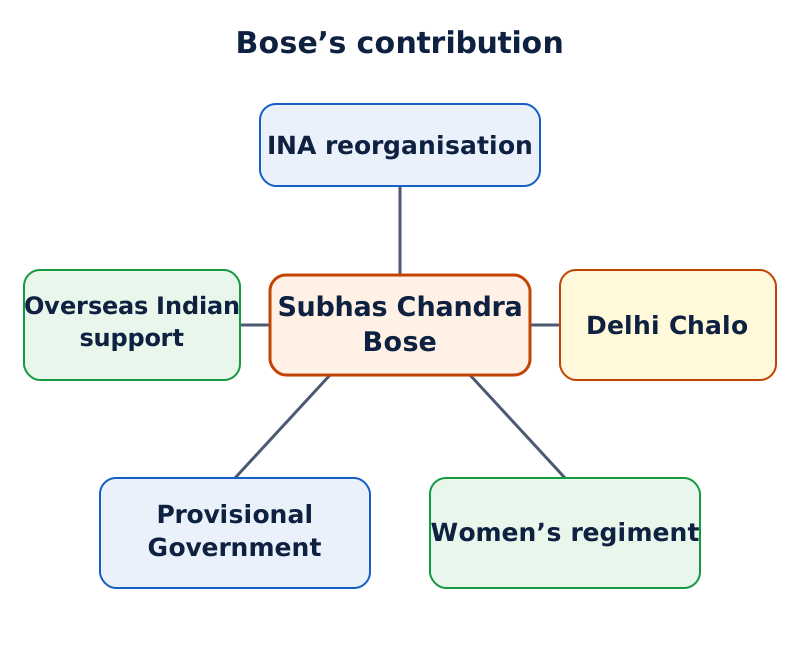
Place “Subhas Chandra Bose” in a central box. Link it to five boxes labelled “INA reorganisation”, “Overseas Indian support”, “Delhi Chalo”, “Provisional Government” and “Women’s regiment”.
Drawn by One Young India.
Which different groups participated in or supported the movement?
The INA depended on more than its best-known leader. Its history includes soldiers, civilian supporters and women who entered military organisation. Separating these forms of participation explains how an overseas movement could gather strength around an Indian national objective.
What did Indian soldiers contribute?
Indian prisoners of war supplied an important recruiting base for the early INA. Their military experience mattered because the organisation sought to fight an armed campaign. The first INA’s formation in 1942 should be understood in this wartime setting.
Captivity and enlistment are different conditions. Being an Indian soldier captured by Japan did not automatically make a person an INA member. Recruitment involved joining the new organisation, not simply sharing the circumstances in which it recruited.
How did Indians living abroad contribute?
Overseas Indians, meaning Indians living outside India, supported the movement through recruitment, donations and other assistance. South-East Asia was therefore a place of political organisation and civilian support as well as military activity.
Such support helped connect the army with a wider community. Soldiers required resources, and leaders needed people willing to sustain the movement. Civilian participation shows why the INA’s history cannot be reduced to accounts of battles alone.
How did women participate?
The Rani of Jhansi Regiment represented women’s participation within the INA’s military organisation. Captain Lakshmi Swaminathan’s leadership is a specific example of a woman holding responsibility in this armed struggle.
Participation should be described precisely. Membership of a military unit, donating resources and supporting a political cause are distinct contributions. Each can matter without being described as the same activity. Equally, the existence of a women’s regiment does not establish that every woman associated with the movement fought in battle.
The movement’s national purpose drew these contributions together. Soldiers, women recruits and civilian supporters could work towards a shared goal while performing different tasks and accepting different responsibilities.
How did the military campaign develop, and what was its outcome?
Under Bose’s leadership, the INA fought with Japanese assistance. Military cooperation means forces working together in a campaign. In this case, the INA’s political purpose was Indian independence, while its operations depended on cooperation with Japan.
What happened in the campaign of 1944?
In 1944, the INA tried to enter India through Imphal and Kohima. These places identify the attempted advance towards India. The campaign failed to achieve its military objective.
This outcome must be kept separate from the army’s ambition. A call to march towards India does not prove a successful advance, and a planned destination does not establish control over that destination. The INA did not liberate India through this campaign.
Why did dependence on Japan matter?
Japan’s defeat in 1945 brought the INA’s wartime campaign to an end. Dependence on an outside military partner made the movement vulnerable to the course of the wider war. Its fortunes could not be separated from that international setting.
Foreign aid therefore had both a purpose and a limitation. It helped make an armed challenge possible, but it also linked the INA’s campaign to a power whose own military position could deteriorate. Commitment to a cause could not remove that dependence.
INA members were subsequently imprisoned and tried. A trial is a legal proceeding in which charges against accused persons are examined. The trials moved attention from military operations to the treatment of those who had participated.
Note: Keep three things separate: the INA’s aim of liberation, the failure of its military campaign and the later political response to its members’ trials. They describe an intention, an outcome and an aftermath.
The campaign’s failure is essential to an accurate account. Recognising it does not require dismissing the movement’s political importance; it establishes the factual starting point for understanding that importance.
What were the consequences and political significance of the INA struggle?
The INA’s military outcome and political impact were different. Its campaign failed, but its members’ imprisonment and trials became a cause around which people in India mobilised. Political impact means the effect on public attitudes, action and relations of power.
Why did the trials attract support?
People across the country, from all walks of life, participated in the movement against the INA trials. This brought the fate of the soldiers into a much wider public struggle. The response extended beyond those who had served in the army.
The trials at the Red Fort in Delhi became especially prominent. In 1945, Shah Nawaz Khan, Prem Kumar Sahgal and Gurbaksh Singh Dhillon were tried together. Their case became an important focus of public support for the INA prisoners.
How did the struggle express national solidarity?
Solidarity means people supporting one another in a shared cause. Support for the prisoners showed that an unsuccessful armed campaign could still generate a powerful public response. Sympathy for the participants was not the same thing as a claim that they had won militarily.
The INA also demonstrated cooperation among Indians of different religious backgrounds. The shared struggle and the public response to the trials contributed to its place in the history of national unity.
What limits should be placed on claims about its impact?
The INA was one contribution to a wider freedom struggle. Its importance should not be turned into the claim that it single-handedly secured independence, or that its campaign drove the British out through battlefield victory.
A careful explanation connects the evidence to a proportionate conclusion: the campaign failed; the trials attracted a broad movement of support; and the INA became an important symbol of sacrifice and resistance to British rule.
The sequence also explains why public memory can extend beyond military results. People can remember courage, commitment and unity even where the immediate campaign does not succeed. Political significance requires attention to those later responses as well as to the fighting itself.
How did the Forward Bloc and the INA differ?
The Forward Bloc and the INA were linked by Bose’s leadership and the objective of independence. Their different forms of organisation explain why they should not be treated as alternative names for the same body.
| Basis of comparison | Forward Bloc | Indian National Army |
|---|---|---|
| Type of organisation | A political grouping, initially within the Congress. | An armed force organised for a military struggle. |
| Origin | Founded by Subhas Chandra Bose in 1939. | First organised by Captain Mohan Singh in 1942. |
| Bose’s role | Founder and political leader. | Later reorganiser and leader from 1943. |
| Immediate organisational purpose | Unite left-wing forces for a stronger independence movement. | Organise soldiers for an armed campaign against British rule. |
| Social programme | Associated independence with socialist reconstruction and the interests of workers and peasants. | Centred on the immediate military objective of national liberation. |
| Common objective | Freedom for India from British rule. | Freedom for India from British rule. |
What does this comparison reveal?
A political organisation brings supporters together around a programme. A military organisation arranges personnel and resources for armed operations. Both can pursue a political goal, but their immediate tasks and internal functions differ.
The common objective explains the connection between these two organisations; their different origins and methods explain the distinction. Bose founded one and later reorganised the other. This is why the same person can be central to both histories without being the original founder of both bodies.
The Provisional Government of Azad Hind adds a third category. It was a claim to governmental authority, not another name for either the Forward Bloc or the INA. Keeping the party, army and provisional government distinct makes Bose’s contribution clearer.
What timeline connects the main events?
Which earlier events shaped the national movement?
The Congress, mass campaigns and revolutionary organisations formed the wider political background to Bose’s later leadership. This earlier chronology traces debates over methods, demands for complete independence and proposals for social change.
| Date | Development in the national movement |
|---|---|
| December 1885 | The Indian National Congress was established when 72 delegates met at Bombay. |
| 1905 | Curzon partitioned Bengal. Opposition to the partition developed into the Swadeshi movement. |
| 1907 | The Congress split as the Moderates opposed the use of boycott, which they regarded as involving force. |
| December 1915 | The Moderates and Tilak’s followers reunited in the Congress. |
| 1918 | Gandhi led a successful millworkers’ strike in Ahmedabad. |
| 1919 | Gandhi called for satyagraha against the Rowlatt Act, which restricted fundamental rights and strengthened police powers. |
| 1920 | A harsh British treaty on the Turkish Sultan intensified the Khilafat issue. Gandhi supported the Khilafat leaders’ call for non-cooperation. |
| February 1922 | Gandhi called off the Non-Cooperation Movement after peasants set fire to a police station at Chauri Chaura, killing 22 policemen. |
| 1928 | Bhagat Singh, Chandra Shekhar Azad, Sukhdev and others founded the Hindustan Socialist Republican Association to pursue a revolution of workers and peasants. |
| 1929 | Under Jawaharlal Nehru’s presidency, the Congress resolved to fight for Purna Swaraj, meaning complete independence. |
| 26 January 1930 | Independence Day was observed across the country following the Congress resolution for complete independence. |
| 1935 | The Government of India Act prescribed provincial autonomy. |
| 1937 | Elections to provincial legislatures were announced, and the Congress formed governments in seven of eleven provinces. |
How did Bose’s leadership and the INA campaign unfold?
A timeline arranges events in chronological order, meaning the order in which they occurred. Here it connects Bose’s Congress leadership, the creation of the Forward Bloc, the INA’s early formation, its reorganisation and the aftermath of its campaign.
| Date | Event | Place in the sequence |
|---|---|---|
| 1938 | Bose became Congress President. | Leadership within the national political movement. |
| 1939 | Bose was re-elected Congress President. | His second presidency preceded his resignation. |
| 1939 | Bose resigned from the Congress presidency. | Differences within the leadership led to a new direction. |
| May 1939 | Bose formed the Forward Bloc. | A political grouping sought to unite left-wing forces. |
| January 1941 | Bose secretly left his Calcutta home. | His subsequent activity acquired an overseas base. |
| 1942 | Captain Mohan Singh organised the first INA. | The original army preceded Bose’s leadership. |
| 1943 | Bose reorganised and led the INA. | A new phase of military and political mobilisation. |
| 21 October 1943 | Bose proclaimed the Provisional Government of Azad Hind. | A political authority was associated with the armed struggle. |
| 1944 | The INA attempted an advance through Imphal and Kohima. | The military campaign failed. |
| 1945 | Japan was defeated. | The INA’s wartime campaign came to an end. |
| 1945 | The prominent joint Red Fort trial began. | The prisoners’ treatment became a focus of public mobilisation. |
The repeated years matter: different events can occur within the same year. Founding an organisation, reorganising an army and proclaiming a government are separate actions. Their sequence helps explain the changing form of Bose’s work without collapsing these actions into one event.
How can historical sources distinguish aims, events and outcomes?
Historical sources are materials used as evidence about the past. An organisation’s programme can reveal its declared aims; a speech can reveal an appeal to supporters; military and legal records address different kinds of events.
What questions should be asked of the evidence?
The Forward Bloc’s formation in 1939, the proclamation of a provisional government in 1943 and the failed campaign of 1944 each require different questions. What was intended? What was established? What actually happened?
For example, “Delhi Chalo” expresses a goal and an appeal. It is not evidence that the INA reached Delhi. Likewise, proclaiming a provisional government does not by itself establish that it exercised authority throughout India.
The trials and public response in 1945 concern the aftermath. They help explain political significance, but they cannot change the military result of the earlier campaign. Evidence about later sympathy must be used for conclusions about that sympathy.
Diagram
Aim, action and result
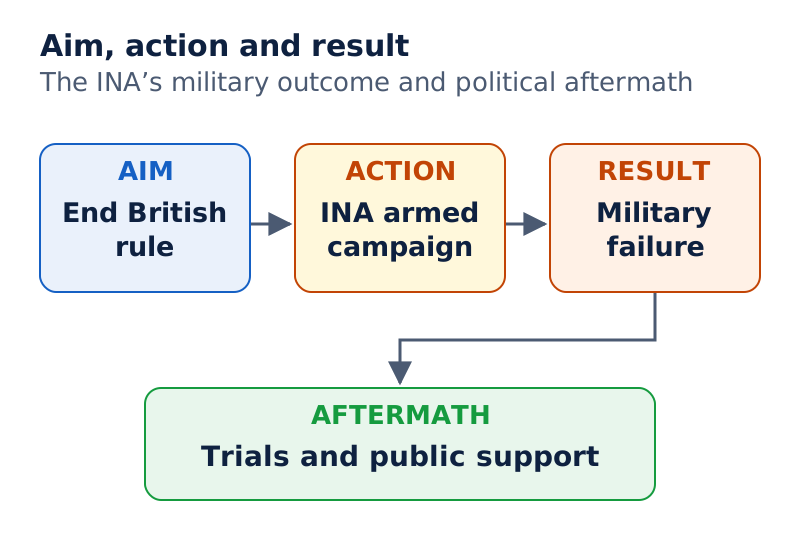
Draw three boxes labelled “End British rule”, “INA armed campaign” and “Military failure”. Beneath them add “Trials and public support” as the aftermath. Connect the boxes in chronological order.
Drawn by One Young India.
These distinctions prevent two opposite errors: treating an ambitious aim as an achieved result, and treating military failure as proof of political insignificance. A convincing historical account explains both what happened and why it mattered, while keeping each conclusion within the evidence that supports it.
Glossary
- Forward Bloc — Political grouping founded by Subhas Chandra Bose to unite left-wing forces and pursue independence and social change.
- Indian National Army — Armed force organised to fight for India’s liberation from British colonial rule.
- Azad Hind Fauj — Name meaning army of free India, used for the Indian National Army.
- Nationalism — Belief that a nation’s people should control their own political affairs and collective future.
- Colonial rule — Control exercised by a foreign power over another country and its people.
- Ahimsa — Non-violence, which Gandhi upheld as an ideal in the struggle against British rule.
- Socialism — Ideas seeking reduced economic inequality and social or public control of major economic resources.
- Prisoner of war — Member of an armed force held captive by an opposing side during a war.
- Indian Independence League — Organisation of Indians abroad supporting the effort to secure India’s freedom from British rule.
- Provisional government — Temporary government established pending a more permanent political arrangement or settlement.
- Mobilisation — Bringing people and resources together to act in support of a shared purpose.
- Regiment — An organised military unit, such as the INA’s Rani of Jhansi Regiment.
- Solidarity — Mutual support among people who identify with a shared cause or struggle.
- Chronological order — Arrangement of events according to the sequence in which they occurred in time.
Common errors and misconceptions
- Misconception: Subhas Chandra Bose originally founded the INA. Correct: Captain Mohan Singh organised the first INA in 1942; Bose reorganised and led it from 1943.
- Misconception: Rash Behari Bose and Subhas Chandra Bose were the same person. Correct: They were different leaders with different contributions to the movement.
- Misconception: The Forward Bloc was another name for the INA. Correct: The Forward Bloc was a political organisation; the INA was an armed force.
- Misconception: “Delhi Chalo” proves that the INA reached Delhi. Correct: It expressed an intended advance; it did not describe an achieved destination.
- Misconception: Bose agreed with Gandhi’s ideal of non-violence. Correct: Bose did not share that ideal, although he respected Gandhi as the “Father of the Nation”.
- Misconception: Military defeat made the INA politically unimportant. Correct: The trials generated a broad movement of support, giving the struggle significance beyond its military outcome.
- Misconception: The INA single-handedly won independence through military victory. Correct: Its campaign failed; its contribution formed part of a wider freedom struggle.
Exam-style questions with model answers
Q1. Captain Mohan Singh organised the first Indian National Army (INA) in 1942; Subhas Chandra Bose reorganised and led it from 1943. Identify the founder and the later reorganiser, giving the year of each role. [2 marks]
- Captain Mohan Singh founded the first INA in 1942.
- Subhas Chandra Bose reorganised the INA and led its later phase from 1943.
Q2. The Forward Bloc sought complete independence, unity among left-wing forces and socialist reconstruction, meaning social and economic reorganisation to reduce inequality. Explain these three objectives using the information given. [3 marks]
- Complete independence meant ending British rule so that Indians could control their own political affairs.
- Unity among left-wing forces meant bringing supporters of substantial social and economic change together for a common political effort.
- Socialist reconstruction meant reorganising society and the economy to reduce inequality, extending the organisation’s purpose beyond the transfer of political power.
Q3. Consider these facts: the Forward Bloc was a political grouping founded by Bose in 1939; the INA was an armed force first organised by Mohan Singh in 1942; Bose led its reorganisation in 1943; both sought Indian independence. State four comparisons covering organisation, origin, Bose’s role and shared objective. [4 marks]
- The Forward Bloc was a political grouping, whereas the INA was an armed force intended for military struggle.
- Their origins differed: Bose founded the Forward Bloc in 1939, while Mohan Singh first organised the INA in 1942.
- Bose was the founder of the Forward Bloc but the later reorganiser of the INA, taking that role in 1943.
- Their shared political objective was India’s independence, despite their different organisational forms and the different circumstances of their origins.
Q4. Bose reorganised the INA in 1943, appealed to overseas Indians for recruits and resources, used “Delhi Chalo” meaning “March to Delhi”, proclaimed a provisional government in Singapore on 21 October 1943, and supported the women’s Rani of Jhansi Regiment led by Captain Lakshmi Swaminathan. Explain five contributions from these facts. [5 marks]
- Bose reorganised the INA in 1943, providing leadership for a renewed armed effort directed towards the goal of India’s independence.
- He appealed to overseas Indians for recruits and resources, connecting the army’s practical requirements with support from a wider community.
- His call “Delhi Chalo” expressed the intended advance towards India and gave supporters a clear statement of the movement’s direction.
- He proclaimed the provisional government in Singapore on 21 October 1943, adding a political claim to authority alongside the military organisation.
- He supported women’s military participation through the Rani of Jhansi Regiment, whose leadership was entrusted to Captain Lakshmi Swaminathan.
Q5. In 1944 the INA tried to enter India through Imphal and Kohima, but its campaign failed. Its members were imprisoned and tried, and people across the country from all walks of life joined the movement against the trials. Explain the military outcome and political aftermath in three points. [3 marks]
- The attempted advance through Imphal and Kohima in 1944 failed, so it did not achieve the campaign’s military objective.
- The imprisonment and trials of INA members created a new issue concerning the treatment of participants in the armed struggle.
- People from all walks of life joined the movement against the trials, demonstrating broad public support despite the earlier military failure.
Q6. Bose did not share Gandhi’s ideal of ahimsa, meaning non-violence, but respected him as the “Father of the Nation”. What distinction between political method and personal regard follows from these facts? [2 marks]
- Bose disagreed with Gandhi’s ideal of non-violence as a method of struggle.
- That disagreement coexisted with respect for Gandhi, whom he called the “Father of the Nation”.
Q7. Both the Forward Bloc and INA sought Indian independence. Use this evidence: the Forward Bloc was founded in 1939; Bose proclaimed a provisional government in 1943; “Delhi Chalo” called for a march to Delhi; the INA’s 1944 campaign failed; the later trials attracted broad public support. Explain in five points why aims, institutions, military results and political impact must be distinguished. [5 marks]
- The Forward Bloc’s founding in 1939 records the creation of a political organisation. Establishing an organisation is distinct from achieving the freedom it seeks.
- The proclamation of a provisional government in 1943 records a political claim to authority, rather than proving that the whole country was already liberated.
- “Delhi Chalo” expresses an intended destination and an appeal to supporters. The slogan does not establish that the army actually reached Delhi.
- The failure of the 1944 campaign establishes the military outcome. An ambitious aim must not be substituted for that unsuccessful result.
- Broad support during the trials establishes a political response after the fighting. It shows significance beyond military success without turning defeat into victory.
Key takeaways
- Bose founded the Forward Bloc in 1939 to unite left-wing forces and pursue complete independence and social change.
- Captain Mohan Singh organised the first INA in 1942; Subhas Chandra Bose reorganised and led it from 1943.
- Rash Behari Bose helped organise political support through the Indian Independence League and was distinct from Subhas Chandra Bose.
- The INA sought national liberation through armed struggle, drawing on soldiers and support from Indians living overseas.
- Bose’s contribution included military reorganisation, public mobilisation, a provisional government and support for women’s military participation.
- The 1944 campaign through Imphal and Kohima failed, and Japan’s defeat in 1945 ended the wartime campaign.
- The INA trials attracted people from all walks of life, giving the struggle political significance beyond its military result.
- Distinguish a political organisation, an army and a provisional government when explaining Bose’s different contributions to the freedom struggle.
Test yourself
Who founded the Forward Bloc, and when?
Subhas Chandra Bose founded the Forward Bloc in May 1939.
How did the Forward Bloc connect freedom with social change?
It sought complete independence together with socialist reconstruction, linking political freedom to reduced economic inequality and the interests of workers and peasants.
Who organised the first INA, and who later reorganised it?
Captain Mohan Singh organised the first INA in 1942. Subhas Chandra Bose reorganised and led it from 1943.
What did “Delhi Chalo” mean?
It meant “March to Delhi” and expressed the movement’s intended advance towards India.
What was proclaimed on 21 October 1943?
Bose proclaimed the Provisional Government of Azad Hind in Singapore.
Which women’s military unit belonged to the INA?
The Rani of Jhansi Regiment was the women’s unit, led by Captain Lakshmi Swaminathan.
What happened to the INA’s campaign in 1944?
Its attempt to enter India through Imphal and Kohima failed.
Why did military failure not end the INA’s political significance?
The imprisonment and trials of its members attracted a broad movement of public support across India.
Write about it
Turn a question from this chapter into a paper.
The Writing Studio has a structure guide, a rubric and citation tools for 15 formats, from essays to research papers. Drafting is free with an account. Learnacy Essential adds feedback from an AI writing coach and submission to The OYI Review.
Learnacy Essential is ₹1,499 for the year. Publication depends on review and is not guaranteed.