
Independence and Partition of India | ICSE Class 10 History & Civics Notes
On this page
Watch & explore
Start with a few high-quality watches, then dive into the notes below.
This note covers the background to Independence and Partition, the Cabinet Mission Plan, the Mountbatten Plan and its acceptance, the Indian Independence Act, the transfer of power, and the consequences of dividing British India.
What was the background to Independence and Partition?
What did freedom and partition mean?
Independence meant the ending of British rule and the transfer of governing authority. Partition meant the division of British India into India and Pakistan. These changes occurred together in 1947, but they were different processes: one concerned political power, the other concerned territory.
British Indian provinces were territories directly governed under British authority. Princely states were territories ruled by princes who accepted British supremacy while retaining some control over internal affairs. Their relationship with Britain differed from that of the provinces, which mattered when British rule ended.
Why was a constitutional settlement difficult?
In 1945, a Labour government came to power in Britain and committed itself to granting independence to India. Elections to the provincial legislatures, the provinces' law-making bodies, followed in early 1946. The Indian National Congress swept the general seats; the Muslim League won an overwhelming majority of the seats reserved for Muslims.
The Indian National Congress was a major organisation of the national movement. The Muslim League pressed the demand for Pakistan. Its two-nation theory treated Hindus and Muslims as two separate peoples and supported a separate country for Muslims. Congress opposed this theory and the demand for Pakistan.
The central difficulty was therefore not simply choosing a date for British withdrawal. Political leaders also had to settle whether India would remain united, how much authority the central government would possess, and how provinces and communities would be represented in the future constitutional system.
Definition: A constitution is the framework of basic rules and institutions through which a country is governed. A constitutional plan proposes how those institutions and their powers should be organised.
The negotiations of 1946 sought agreement on a united arrangement. By 1947, agreement on that basis had failed. The eventual settlement combined independence with partition, producing both public celebrations of freedom and profound insecurity for people affected by the new borders.
What clauses did the Cabinet Mission Plan propose for a united India?
What was the proposed Union?
The Cabinet Mission was a delegation of British Cabinet ministers, members of Britain's senior executive body, sent to discuss India's constitutional future. Its constitutional scheme was announced on 16 May 1946. It proposed a Union of India embracing British Indian provinces and princely states, rather than the creation of a separate independent Pakistan.
A Union here meant an all-India political organisation with specified common responsibilities. The plan proposed a limited centre: the Union would deal with foreign affairs, defence and communications. It would also possess the powers necessary to raise the finances required for these responsibilities.
Foreign affairs means relations with other countries; defence concerns protection against external attack; and communications concerns systems connecting different parts of the country. Naming these subjects explains what the common government would actually do, rather than merely describing it as weak or strong.
The Union would have an executive, the body conducting government, and a legislature, the body making laws. Both British India and the princely states would be represented. A major communal issue, meaning one concerning religious communities, would require approval by a majority of the representatives present and voting of each major community, as well as an overall majority present and voting.
How would powers be distributed?
Provincial autonomy means a province's authority to manage its own affairs. Under the plan, subjects outside the Union's specified responsibilities, including residuary powers, or powers not otherwise allocated, would belong to the provinces. Princely states would retain powers they did not surrender to the Union.
Provinces could form groups with their own executives and legislatures. Such groups could decide which provincial subjects they would administer together. The proposed arrangement therefore distinguished the all-India Union, provincial groups and individual provinces. The groups were not independent countries.
Diagram
Proposed levels of government under the Cabinet Mission Plan
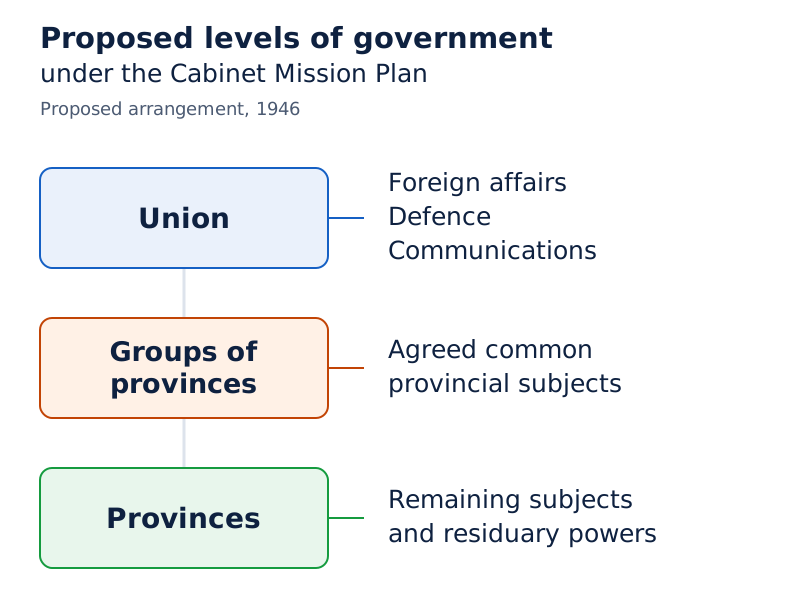
Draw three labelled boxes: Union, groups of provinces, and provinces. Beside Union write foreign affairs, defence and communications. Beside groups write agreed common provincial subjects. Beside provinces write remaining subjects and residuary powers.
Drawn by One Young India.
The plan tried to reconcile a common Indian framework with extensive powers below the centre. Its limited Union of 1946 must be distinguished from the territorial partition accepted in 1947. Both addressed the transfer of power, but they proposed different answers to the question of political unity.
How did the Cabinet Mission Plan organise groups and constitution-making?
Which provinces were placed together?
The plan arranged the provinces into three sections for the constitution-making process, commonly described as Groups A, B and C. These letters identify groups of provinces, not ranks or stages. The grouping arrangements were part of the attempt to combine an Indian Union with substantial regional authority.
| Group | Provinces included |
|---|---|
| Group A | Madras, Bombay, United Provinces, Bihar, Central Provinces and Orissa |
| Group B | Punjab, North-West Frontier Province and Sind |
| Group C | Bengal and Assam |
These are the provincial names used at the time. The North-West Frontier Province was a British Indian province on the north-western frontier. Group C included both Bengal and Assam; it should not be reduced simply to Bengal. Similarly, Group B contained three provinces.
How would the constitution be prepared?
A Constituent Assembly is a representative body entrusted with framing a constitution. The plan provided for an Assembly of 389 members: 292 from the British Indian provinces, four from the Chief Commissioners' provinces, which were smaller centrally administered territories, and 93 representing princely states.
Provincial seats were divided among General, Muslim and Sikh categories in proportion to population. Representatives were to be elected indirectly by the corresponding members of provincial legislative assemblies. Indirect election means that already elected representatives choose members of another body rather than voters choosing them directly.
Members would first meet together for preliminary business, then work in provincial sections on provincial constitutions and possible group constitutions, and then return to frame the Union constitution. This sequence connected local arrangements with the wider constitutional settlement; it did not give the central government unlimited powers.
After the first general election under the new constitution, a province could choose to leave its group. The constitutional arrangements would also allow reconsideration after ten years and at ten-year intervals thereafter. These provisions must not be confused with an immediate right to create a separate independent country.
An Interim Government, meaning a temporary government during the transition, was also proposed. Its role was different from that of the Constituent Assembly: governing during the transition and writing a constitution were separate tasks. The Assembly first met on 9 December 1946, before independence in 1947.
The distinction between a proposal and its implementation is essential. The Cabinet Mission outlined a constitutional system, but failure to secure lasting agreement between Congress and the League prevented that scheme from preserving a united India.
What were the main clauses of the Mountbatten Plan?
How did the plan change the basis of transfer?
Lord Mountbatten was the last British Viceroy of India; the Viceroy represented the British Crown, meaning the monarchy, in governing India. The Mountbatten Plan, announced on 3 June 1947, provided a basis for partition and transfer of power. It replaced the attempt to maintain the united constitutional arrangement proposed in 1946.
The plan accepted that British India could be divided into India and Pakistan. A separate Constituent Assembly would frame Pakistan's constitution. The constitution prepared by the existing Constituent Assembly would not be imposed on areas unwilling to accept it. The settlement therefore allowed separate constitutional futures.
What choices concerned Punjab and Bengal?
The legislative assemblies of Punjab and Bengal were to meet in separate sections representing Muslim-majority and non-Muslim-majority areas. Each section would vote on partition. If either section voted for partition, the province would be divided. This was a procedure for deciding provincial division, not a direct vote by every resident.
Boundary commissions, bodies appointed to determine territorial boundaries, would demarcate the division of the provinces. Religious majorities mattered because Punjab and Bengal contained substantial areas with different population majorities. Describing either province as uniformly Muslim or uniformly non-Muslim would conceal the problem the plan addressed.
How were other territorial decisions to be made?
| Area | Procedure proposed |
|---|---|
| Sind | The legislative assembly would decide whether to join the existing Constituent Assembly or the new Constituent Assembly of Pakistan. |
| North-West Frontier Province | A referendum would decide whether it would join India or Pakistan. |
| Sylhet district of Assam | A referendum would decide whether it remained in Assam or joined East Bengal if Bengal was partitioned. |
| British Baluchistan | The question of its constitutional future would be put to its representative institutions. |
A referendum is a direct vote by eligible voters on a specified question. Sylhet was a district within Assam, so the referendum there should not be described as a referendum for the whole province of Assam. The procedures differed from territory to territory.
British paramountcy, meaning the Crown's supremacy over princely states, would end. The states' future relationship with India or Pakistan therefore required separate arrangements. This was distinct from dividing provinces that had been under direct British administration.
The transfer of power was to take place during 1947. The resulting settlement established two Dominions, independent countries retaining the Crown as constitutional head at that stage. Dominion status did not mean that Britain would continue to make their laws as before.
The plan supplied the political arrangements for division. The Indian Independence Act subsequently gave the transfer its statutory basis, meaning authority established by an enacted law. Remembering this distinction prevents a proposal announced in June from being confused with legislation enacted in July.
Why did different groups accept or oppose the Mountbatten settlement?
Why did Congress accept partition?
Congress had opposed the two-nation theory and sought a united India. Its acceptance of the Mountbatten Plan in 1947 was a reluctant political decision after the failure of the united arrangement proposed in 1946. Acceptance of partition did not mean acceptance of the belief that religious communities could never share a country.
Communal violence, violence directed against people identified by religious community, made the situation increasingly urgent. Congress leaders hoped that a definite settlement and early transfer of power would prevent still greater bloodshed. This was a reason for acceptance, not proof that the decision actually ended violence.
The breakdown of cooperation with the League also made a shared government increasingly difficult. Congress leaders preferred an independent India with an effective central government to a prolonged constitutional deadlock. Deadlock means a situation in which opposing positions prevent an agreed decision or effective action.
Another concern was further political fragmentation, the breaking of India into still more separate units. Accepting partition was regarded as a way to secure a workable settlement and transfer power promptly. These considerations explain a difficult compromise; they do not turn it into an enthusiastic endorsement of division.
Why did the Muslim League accept?
The Muslim League accepted the settlement because it secured the creation of Pakistan. The resulting Pakistan did not include all of Punjab and Bengal: those provinces were divided. The League nevertheless obtained a separate country, which distinguished the settlement from the Cabinet Mission's proposed united Union.
The Congress and League thus accepted the same settlement for different reasons. Congress sought an early and workable transfer amid violence and deadlock; the League secured its central demand for a separate state. Shared acceptance did not erase their disagreement about India's political identity.
Did all Muslims support partition?
No. Khan Abdul Gaffar Khan, the leader associated with the North-West Frontier Province and known as Frontier Gandhi, strongly opposed the two-nation theory. His opposition shows why the position of a political organisation cannot automatically be treated as the view of every member of a religious community.
The eventual inclusion of the North-West Frontier Province in Pakistan did not mean that such opposition had never existed. Keep three questions separate: what a party demanded, why leaders accepted a settlement, and how different people experienced its outcome.
What were the principal clauses of the Indian Independence Act?
What changed legally?
The Indian Independence Act, 1947 received Royal Assent, the monarch's formal approval of legislation, on 18 July 1947. It provided for two independent Dominions, India and Pakistan, from 15 August 1947. The date of enactment and the date appointed for independence were therefore different.
The Act supplied the legal framework for ending British rule. Its provisions concerned the creation of the Dominions, their law-making powers, temporary constitutional arrangements and the ending of British authority over princely states. It did not itself supply a complete permanent constitution for independent India.
- Two independent Dominions: India and Pakistan were to be established from 15 August 1947. The territories assigned to Pakistan included the parts of Punjab and Bengal allocated to it through partition.
- Separate Governors-General: Each Dominion would have a Governor-General appointed by the Crown. A Governor-General was the Crown's representative in the Dominion.
- Constitution-making authority: Each Dominion's Constituent Assembly could frame its constitution. Until another arrangement was made, it also exercised the powers of the Dominion legislature.
- Legislative independence: The Dominion legislatures received full power to make laws, including laws inconsistent with existing British legislation. Later Acts of the British Parliament would not automatically extend to either Dominion.
- Temporary governing framework: Until new constitutions were made, government would proceed under the Government of India Act, 1935, with necessary adaptations. Continuity of machinery did not preserve British political control.
- End of paramountcy: British supremacy over the princely states lapsed. Treaties and agreements between the Crown and the states also lapsed, ending their previous constitutional relationship with Britain.
- End of British governmental responsibility: The British government ceased to be responsible for governing British India. The office of Secretary of State for India, the British minister responsible for Indian affairs, was abolished.
What did the transitional arrangements mean?
Legislative sovereignty means final authority to make laws within the relevant constitutional order. The Act placed law-making authority in the new Dominions rather than leaving them subject to continuing legislative control from Britain. It also enabled them to change the inherited constitutional framework.
The Government of India Act, 1935 was an existing law that supplied administrative and constitutional machinery. Its adapted use after independence was a temporary arrangement. A government needs institutions through which to operate while a new constitution is being prepared; independence did not require every existing rule to disappear immediately.
Note: The Mountbatten Plan was announced on 3 June 1947; the Indian Independence Act received Royal Assent on 18 July 1947; the Act appointed 15 August 1947 for the creation of the two independent Dominions. These dates describe different stages.
Pakistan celebrates independence on 14 August, and India on 15 August. This distinction in celebrations should not be used to alter the appointed date stated in the Act. Legal provisions and the public ceremonies accompanying a transfer must be identified accurately.
How did the three constitutional arrangements differ?
What problem did each arrangement address?
The Cabinet Mission Plan, Mountbatten Plan and Indian Independence Act belong to the same transition, but they should not be treated as interchangeable names. Compare their purpose, treatment of unity, allocation of powers and legal character to understand how the settlement changed.
| Point of comparison | Cabinet Mission Plan, 1946 | Mountbatten Plan, 1947 | Indian Independence Act, 1947 |
|---|---|---|---|
| Basic approach | Preserve an Indian Union with limited central subjects. | Accept partition as the basis of transfer. | Create two independent Dominions through legislation. |
| Constitution-making | Propose a common Union constitution with provincial and group arrangements. | Allow separate constitutional arrangements for areas choosing Pakistan. | Give each Dominion authority to frame its constitution. |
| Territorial organisation | Arrange provinces into three sections for constitution-making. | Provide procedures for territorial decisions and provincial partition. | Give legal effect to the establishment of India and Pakistan. |
| Central authority | Limit Union responsibilities to specified common subjects. | Make separate political centres possible through partition. | Recognise the legislative authority of the independent Dominions. |
| Character | A constitutional proposal intended to secure agreement. | A political plan for transfer and division. | An enacted law providing the transfer's legal framework. |
A useful comparison explains a relationship rather than listing isolated facts. For example, the Cabinet Mission's provincial groups were components of a proposed common Union. The Mountbatten settlement instead allowed a separate Pakistan. A provincial group under the first proposal was therefore not equivalent to a Dominion under the later settlement.
Likewise, the existence of a Constituent Assembly did not by itself settle every territorial question. The 1946 scheme sought a shared constitutional process, while the 1947 settlement recognised separate constitution-making bodies. The Act then provided the authority through which the new Dominions could govern and legislate.
Read the sequence as a change in constitutional policy: a negotiated Union was proposed, partition was accepted, and independence received legal effect. The sequence explains why the three arrangements share a historical setting while containing different provisions.
What timeline traces the course towards independence?
Which earlier movements and negotiations preceded the transfer of power?
| Date | Background event |
|---|---|
| January 1915 | Mahatma Gandhi returned to India from South Africa. |
| 1917 | Gandhi worked in Champaran for security of tenure and freedom of crop choice for peasants. |
| 1918 | Gandhi supported textile workers in Ahmedabad and peasants seeking tax remission after harvest failure in Kheda. |
| 1919 | Gandhi organised a countrywide campaign against the Rowlatt Act; the Jallianwala Bagh massacre occurred in April. |
| 1921 | The Non-cooperation and Khilafat movements mobilised popular protest against British rule. |
| February 1922 | Gandhi called off the Non-cooperation Movement after the violence at Chauri Chaura. |
| 1928 | A peasant movement took place in Bardoli. |
| December 1929 | The Lahore Congress accepted Purna Swaraj, or complete independence, as its goal. |
| March to April 1930 | The Dandi March marked the beginning of the Civil Disobedience Movement. |
| 1931 | The Gandhi-Irwin Pact was followed by Gandhi representing Congress at the Second Round Table Conference in London. |
| October 1939 | Congress ministries resigned after the British refused the offer of support for the war in return for a promise of independence afterwards. |
| 1940 and 1941 | Congress organised individual satyagrahas to press for freedom after the war. In March 1940, the League demanded autonomy for Muslim-majority areas. |
| 1942 | The Cripps Mission failed to secure agreement; Gandhi launched the Quit India Movement in August. |
| 1943 | Young leaders in Satara established a parallel government that organised people's courts and constructive work. |
| 1944 | Gandhi was released from prison in June and later held meetings with Jinnah to bridge the Congress and League divide. |
How did the final negotiations lead to independence?
A timeline places events in chronological order, meaning the order in which they happened. The short period between the Cabinet Mission's announcement and the transfer of power contained several different kinds of event: proposals, decisions, governmental changes and legal enactments.
| Date | Event | Connection with the transfer |
|---|---|---|
| 16 May 1946 | Cabinet Mission announced its constitutional scheme. | A united constitutional arrangement was proposed. |
| 16 June 1946 | Muslim League accepted the Cabinet Mission's constitutional scheme. | Initial acceptance did not produce a lasting settlement. |
| 16 August 1946 | The League called Direct Action Day to press its Pakistan demand; bloody riots broke out in Calcutta. | Communal conflict intensified during the negotiations. |
| 2 September 1946 | Congress formed the Interim Government with Jawaharlal Nehru as Vice-President. | A temporary government began work before independence. |
| 13 October 1946 | Muslim League decided to join the Interim Government. | Participation in government did not settle the constitutional dispute. |
| 9 December 1946 | Constituent Assembly began its sessions. | Constitution-making started while British rule continued. |
| 29 January 1947 | Muslim League demanded dissolution of the Constituent Assembly. | Disagreement over the constitutional process persisted. |
| 3 June 1947 | Mountbatten Plan was announced. | Partition became the basis of the agreed transfer. |
| 18 July 1947 | Indian Independence Act received Royal Assent. | The transfer obtained its statutory framework. |
| 15 August 1947 | The Act's appointed date for the two independent Dominions arrived. | British rule ended and India celebrated independence. |
Direct Action Day was the League's call for action to press its Pakistan demand after negotiations broke down. Its place in the timeline helps connect political deadlock with the violence that followed. It should not be described as a clause of either constitutional plan.
Notice especially the order of the final three entries. Announcement of a plan, enactment of a law and the law's appointed date are different events. Keeping them separate also makes clear that independence was preceded by negotiations and institutional preparation.
What were the consequences of independence with partition?
What changed for the new countries?
In August 1947, India and Pakistan emerged as independent countries. Pakistan consisted of western and eastern territories separated by a long expanse of Indian territory. The territorial arrangement reflected the existence of geographically separated concentrations of Muslim-majority population, rather than one continuous belt.
Punjab and Bengal were divided because they contained large areas with different religious majorities. Deciding on partition in principle did not instantly settle the exact boundary on the ground. A large number of people did not know at independence which country would contain their homes.
What did people experience?
Displacement means being forced to leave one's home. Partition involved large-scale displacement, violence and separation of communities that had lived together as neighbours. Refugees are people forced to seek safety away from their homes because of threats such as violence or persecution.
Millions moved across the new borders. Many died before reaching safety. These experiences explain why freedom could produce joy and hope while partition caused fear and loss. The human consequences cannot be reduced to the drawing of a line on a map or the transfer of offices.
Government property, financial assets and administrative personnel also had to be divided. Rehabilitation means helping displaced people rebuild their lives. Thus the new governments faced practical tasks affecting shelter, livelihoods and administration alongside the political task of governing independent countries.
Partition did not mean that every Muslim left India or that every religious community had supported division. Most leaders of the national movement believed that India must treat people of all religions equally. The ideal of a secular nation meant that religious affiliation should not determine superior or inferior citizenship.
The lapse of British paramountcy also left the future relationship of princely states with the new countries to be settled. Ending British authority and building an integrated political order were connected tasks, but they were not completed by precisely the same decision.
How can historical sources distinguish proposals, laws and experiences?
What can a constitutional document establish?
Historical sources are materials used to investigate and understand the past. Different sources answer different questions. A plan can establish what was proposed; an Act can establish what was legally enacted; speeches, debates and personal accounts can reveal aims, disagreements and experiences.
The Cabinet Mission proposals of 1946 explain the intended Union and distribution of powers. The Mountbatten Plan of 1947 explains the procedures accepted for transfer and partition. The Indian Independence Act of 1947 explains legal authority. The Government of India Act, 1935 helps explain the framework temporarily adapted for administration.
These documents should be read for their particular purpose. A proposed safeguard does not prove that political agreement endured. A legal date does not describe every ceremony. A law creating new Dominions does not, by itself, explain how an individual family experienced the new border.
Why compare different kinds of evidence?
Constituent Assembly debates record discussions about the country's future. The Assembly began meeting in 1946 amid political conflict, and its work continued after independence. Its discussions help reveal how questions of unity, rights and government were debated rather than simply assumed to have one agreed answer.
Personal recollections can reveal displacement, fear, assistance and loss. Such an account describes a particular experience; it should not automatically be generalised to every community or region. Equally, legal documents need to be connected with evidence of what happened when their provisions were implemented.
Careful historical explanation therefore separates an intended arrangement, a legal change and an experienced consequence. Together these perspectives help explain why the transfer of power was both a constitutional transformation and a deeply disruptive human event.
Glossary
- Partition — The division of British India into the two countries of India and Pakistan.
- Constitution — A framework of basic rules and institutions through which a country is governed.
- Union — An all-India political organisation proposed to exercise specified common powers under the Cabinet Mission scheme.
- Provincial autonomy — Authority of a province to manage its own affairs within a wider constitutional arrangement.
- Residuary powers — Powers over subjects not specifically allocated elsewhere by the constitutional distribution of authority.
- Constituent Assembly — A representative body entrusted with preparing the constitution of a country.
- Interim Government — A temporary government operating during the transition towards a new political arrangement.
- Referendum — A direct vote by eligible voters to decide a specified public question.
- Boundary commission — An appointed body responsible for determining a territorial boundary between areas being separated.
- Paramountcy — British Crown supremacy over princely states that retained some control over their internal affairs.
- Dominion — An independent country retaining the Crown as its constitutional head at that stage.
- Royal Assent — The monarch's formal approval through which legislation receives the required final constitutional sanction.
- Legislative sovereignty — Final authority to make laws within the relevant constitutional order.
- Rehabilitation — Assistance enabling displaced people to rebuild their lives after losing homes and livelihoods.
Common errors and misconceptions
- Misconception: The Cabinet Mission proposed partition. Correct: It proposed a common Indian Union with limited central subjects and extensive provincial powers.
- Misconception: Groups A, B and C were independent countries. Correct: They were provincial sections within the proposed constitution-making arrangement.
- Misconception: The Mountbatten Plan and Independence Act were the same document. Correct: The June plan supplied political arrangements; the July Act supplied the statutory framework.
- Misconception: Congress accepted the two-nation theory when it accepted partition. Correct: Congress accepted a political settlement while remaining opposed to that theory.
- Misconception: Assam as a whole held the referendum described in the Mountbatten Plan. Correct: That referendum concerned Sylhet district and its possible transfer to East Bengal.
- Misconception: The Act made India independent on 18 July 1947. Correct: It received Royal Assent that day and appointed 15 August for the new Dominions.
- Misconception: Using the adapted Government of India Act, 1935 preserved British rule. Correct: It provided temporary machinery while the independent Dominions possessed their own law-making authority.
- Misconception: Partition showed that all Muslims wanted Pakistan and left India. Correct: Opposition existed, including that of Khan Abdul Gaffar Khan, and Muslims continued to live in India.
Exam-style questions with model answers
Q1. Read this information: the Cabinet Mission proposed an Indian Union responsible for foreign affairs, defence and communications; the provinces would hold other subjects and residuary powers. Identify the Union's subjects and state where residuary powers belonged. [2 marks]
- The Union would administer foreign affairs, defence and communications as its specified common responsibilities.
- Residuary powers would belong to the provinces, together with subjects outside the Union's responsibilities.
Q2. A constitutional scheme provided a Union handling foreign affairs, defence and communications; groups could administer agreed provincial subjects; provinces retained other subjects and residuary powers. Explain its three levels of authority using this information. [3 marks]
- The Union formed the common all-India level, dealing with foreign affairs, defence and communications rather than taking responsibility for every governmental subject.
- Groups formed an intermediate level through which provinces could administer together those provincial subjects that they agreed to share.
- Individual provinces retained the remaining subjects and residuary powers, giving them substantial authority within the wider constitutional arrangement.
Q3. The Mountbatten Plan provided separate section votes in Punjab and Bengal, partition if either section favoured it, boundary commissions for demarcation, and referendums in the North-West Frontier Province and Sylhet. The North-West Frontier Province would choose between India and Pakistan. Sylhet would choose between remaining in Assam and joining East Bengal if Bengal was partitioned. Explain four territorial provisions from this information. [4 marks]
- Punjab and Bengal would have separate section votes for Muslim-majority and non-Muslim-majority areas, with either section's vote for partition sufficient to require division.
- Boundary commissions would determine the territorial boundaries needed to implement the division of the provinces.
- The North-West Frontier Province would use a referendum, allowing eligible voters to decide whether it joined India or Pakistan.
- Sylhet district would hold a referendum on remaining in Assam or joining East Bengal if Bengal was partitioned, rather than deciding the future of all Assam.
Q4. Use these provisions of the Indian Independence Act: two independent Dominions from 15 August 1947; a Governor-General representing the Crown in each; constitution-making powers for their Constituent Assemblies; full law-making powers without automatic application of future British Acts; and temporary use of the adapted Government of India Act, 1935. Explain five features of the new constitutional arrangement. [5 marks]
- India and Pakistan were to become two independent Dominions from 15 August 1947, replacing the previous arrangement of British rule with separate independent governments.
- Each Dominion would have a Governor-General serving as the Crown's representative, providing an office within the new Dominion structure.
- Each Constituent Assembly could prepare its Dominion's constitution, placing responsibility for the future constitutional framework within the newly independent political order.
- The Dominion legislatures possessed full law-making powers, and later British Acts would not apply automatically, establishing independence from continuing British legislative control.
- The adapted Government of India Act, 1935 supplied temporary governing machinery until new constitutional arrangements were made, allowing administration to continue during the transition.
Q5. Consider these facts: Congress opposed the two-nation theory; violence and constitutional deadlock increased; Congress leaders wanted early independence, an effective centre and protection against further fragmentation; the League accepted a settlement creating Pakistan even though Punjab and Bengal were divided. Explain five points about acceptance of the Mountbatten Plan. [5 marks]
- Congress accepted partition as a reluctant political compromise, while its opposition to the two-nation theory continued; accepting the settlement did not mean accepting that theory.
- Increasing violence encouraged acceptance because Congress leaders hoped an early and definite political settlement would prevent still greater bloodshed and insecurity.
- Constitutional deadlock made a shared arrangement difficult, encouraging Congress leaders to favour a workable independent government with an effective centre over continuing disagreement.
- The wish to avoid further fragmentation supported a settlement that could secure early independence, even though Congress had previously sought a united country.
- The League accepted because the settlement created Pakistan, obtaining its central political demand despite the division of Punjab and Bengal into separate territories.
Q6. Arrange and interpret these four events: the Act appointed 15 August 1947 for the two independent Dominions; the Cabinet Mission scheme for a united India was announced on 16 May 1946; Royal Assent was given on 18 July 1947; the Mountbatten Plan for partition was announced on 3 June 1947. Give one point for each event in chronological order. [4 marks]
- 16 May 1946 came first, when the Cabinet Mission scheme was announced as the constitutional proposal preceding the later partition settlement.
- 3 June 1947 followed, when the Mountbatten Plan was announced, marking the next listed stage in arranging the transfer.
- 18 July 1947 was the date of Royal Assent, distinguishing the enactment of the Independence Act from the earlier plan.
- 15 August 1947 was the appointed date for the two independent Dominions, separating the law's enactment from the date specified for independence.
Key takeaways
- The Cabinet Mission Plan sought a united Indian framework with limited Union responsibilities and extensive provincial powers.
- The proposed provincial groups were parts of a constitutional scheme, not separate independent countries.
- The Mountbatten Plan accepted partition and provided different procedures for deciding the future of different territories.
- Congress accepted partition reluctantly amid violence and deadlock; the League accepted because the settlement secured Pakistan.
- The Indian Independence Act gave legal effect to the creation of India and Pakistan as independent Dominions.
- The Act's Royal Assent on 18 July and appointed date of 15 August 1947 must be distinguished.
- British paramountcy over princely states lapsed, while the new Dominions received authority to govern and frame constitutions.
- Independence brought freedom, while partition also brought displacement, violence and the urgent work of rebuilding lives.
Test yourself
Which subjects were assigned to the Cabinet Mission's proposed Union?
The Union would deal with foreign affairs, defence and communications, with financial powers needed for those responsibilities.
What did Group C contain?
Group C contained Bengal and Assam within the proposed provincial grouping arrangement.
How does an Interim Government differ from a Constituent Assembly?
An Interim Government governs during a transition; a Constituent Assembly prepares a constitution.
What was the scope of the Sylhet referendum?
It concerned whether Sylhet district would remain in Assam or join East Bengal if Bengal was partitioned.
Why does acceptance of partition not prove Congress accepted the two-nation theory?
Congress accepted a political compromise amid violence and deadlock while continuing to oppose the two-nation theory.
What is the distinction between 18 July and 15 August 1947?
The Act received Royal Assent on 18 July; 15 August was its appointed date for the two independent Dominions.
What happened to British paramountcy over princely states?
It lapsed, ending the Crown's former supremacy and treaty relationship with the princely states.
Why is partition more than a change of boundaries?
It also involved violence, displacement, separated communities and the division of administrative resources.
Write about it
Turn a question from this chapter into a paper.
The Writing Studio has a structure guide, a rubric and citation tools for 15 formats, from essays to research papers. Drafting is free with an account. Learnacy Essential adds feedback from an AI writing coach and submission to The OYI Review.
Publication depends on review and is not guaranteed.