
The Prime Minister and Council of Ministers | ICSE Class 10 History & Civics Notes
On this page

This note covers the parliamentary executive, appointment of the Prime Minister, formation and tenure of the Council of Ministers, the Cabinet, ministerial responsibility, relations with the President, and policy-making, administrative, legislative, financial and emergency functions.
What is the Prime Minister's place in the parliamentary executive?
The executive is the branch of government concerned primarily with administration and the implementation of laws and policies. Administration means managing government work and putting decisions into practice. The executive is often involved in framing policy, meaning the broad course of action that government adopts.
The Constitution is the framework of fundamental rules governing the country. It establishes a parliamentary executive in India. In this system, the government depends on the support of the people's representatives and remains answerable to them.
Who holds formal authority and who runs the government?
The President is India's formal Head of State, representing the country as a whole. The Prime Minister is the head of government. The Council of Ministers is the body of ministers headed by the Prime Minister that runs the Union, or national, government. Ministers are political office holders responsible for government policy and assigned areas of administration.
Parliament is the national legislature, the institution that makes laws and scrutinises government. Its two Houses are the Lok Sabha, or House of the People, and the Rajya Sabha, or Council of States. The Council of Ministers depends on majority support in the Lok Sabha.
The Constitution formally places Union executive power in the President. In reality, the President exercises these powers through the Council of Ministers headed by the Prime Minister. The distinction concerns formal constitutional authority and the actual direction of government.
Definition: A parliamentary executive is a government whose continuation in office depends on the support of the majority in the legislature. At the Union level in India, the decisive House for this support is the Lok Sabha.
Why does this arrangement matter?
The arrangement combines leadership with accountability, meaning the obligation to explain decisions and answer for them. Ministers direct government, but elected representatives can question their work and withdraw support. The power to govern therefore carries a continuing responsibility to Parliament.
The political executive consists of the head of government and ministers responsible for policy. The permanent executive consists of officials responsible for day-to-day administration. Ministers provide political direction; officials assist with policy formulation and implementation.
How is the Prime Minister appointed?
The President formally appoints the Prime Minister. Under Article 75(1), the constitutional provision dealing with ministerial appointments, the President appoints the Prime Minister and appoints other ministers on the Prime Minister's advice. An Article is a numbered provision of the Constitution.
What happens when majority support is clear?
Normally, a leader who has the support of the majority in the Lok Sabha is appointed Prime Minister. Majority support means support sufficient to command the confidence, or continuing support, of the House. Appointment by the President does not replace the requirement of parliamentary support.
A coalition is an alliance of political parties that join together to form or support a government. When parties form a coalition with a majority in the House, a leader acceptable to most partners of the coalition becomes Prime Minister.
The Prime Minister's position therefore rests on two related elements: formal appointment by the President and political support in the Lok Sabha. Being the leader of a party is not, by itself, enough to establish that the person commands a parliamentary majority.
What happens when no leader clearly commands a majority?
If no leader has a clear majority and competing leaders claim support, the President must judge who really may have the support of the majority or who can form and run the government. This is an exercise of discretion, meaning constitutional judgement where circumstances leave a choice.
- The outcome of the election establishes the strength of parties in the Lok Sabha.
- Parties may form an alliance to bring together enough support for a government.
- The President considers who commands, or is likely to command, majority support and appoints the Prime Minister.
- The Prime Minister selects the ministerial team and assigns responsibilities, subject to the need to maintain political support.
This sequence links appointment to representative government. Presidential discretion becomes significant when support is uncertain; it does not make the President the ordinary director of government policy. The continuing test for the ministry is whether it retains the confidence of the Lok Sabha.
How is the Council of Ministers formed and organised?
After appointment, the Prime Minister chooses the ministers. The President makes their formal appointments on the Prime Minister's advice. The Prime Minister also allocates ranks, meaning levels within the ministry, and portfolios, meaning the subjects or departments assigned to ministers.
What are the ministerial ranks?
Depending on seniority and political importance, ministers receive the rank of Cabinet Minister, Minister of State or Deputy Minister. The Cabinet is the smaller group of senior ministers within the Council of Ministers that takes the principal decisions of government.
| Category | Position and work |
|---|---|
| Cabinet Ministers | Usually senior leaders responsible for major ministries who participate in the Cabinet's main policy decisions. |
| Ministers of State with independent charge | Usually responsible for smaller ministries; they attend Cabinet meetings when specially invited. |
| Ministers of State attached to Cabinet Ministers | Assist Cabinet Ministers in carrying out ministerial responsibilities. |
| Deputy Ministers | A junior ministerial rank whose members assist senior ministers in their work. |
Independent charge means responsibility for a ministry without being placed under a Cabinet Minister for that ministry. It does not automatically confer membership of the Cabinet. Distinguish a minister's responsibility for a subject from the minister's rank in the government.
Must ministers belong to Parliament?
The Prime Minister and ministers must be members of Parliament. A person appointed without already being a member must become a member of either House within six months, whether by election or, where applicable, nomination to the Rajya Sabha. Membership of either House can satisfy the parliamentary membership requirement.
Article 75(5) provides that a minister who remains outside both Houses for six consecutive months ceases to be a minister at the end of that period. The temporary opportunity to obtain membership does not remove the requirement.
Is the size of the Council unlimited?
The 91st Amendment Act, 2003 placed a limit on the size of ministries. A constitutional amendment is a formal change to the Constitution. Before this change, ministerial appointments could be used to attract parliamentary support by enlarging the Council.
Under Article 75(1A), the total number of Union ministers, including the Prime Minister, cannot exceed 15 per cent of the total membership of the Lok Sabha. Fifteen per cent means fifteen out of every hundred. This is a ceiling, not a required size.
How does the Cabinet differ from the Council of Ministers?
The Council of Ministers includes the whole ministerial team. The Cabinet is its smaller, senior decision-making group. Every Cabinet Minister belongs to the Council of Ministers, but membership of the Council does not automatically make a person a Cabinet Minister.
Why is there a smaller decision-making group?
It is not practical for all ministers to meet regularly to discuss every important matter. Usually, Cabinet Ministers meet and take decisions in the name of the Council of Ministers. This gives the government a smaller forum for coordinating its principal decisions.
The distinction does not mean that junior ministers are free from responsibility for government policy. Cabinet decisions carry responsibility for the ministerial team. Ministers may hold different views during discussion, but remaining in the ministry requires acceptance of its common policy.
| Basis of comparison | Council of Ministers | Cabinet |
|---|---|---|
| Membership | The complete body of ministers headed by the Prime Minister. | The senior group within the Council, headed by the Prime Minister. |
| Ranks included | Includes ministers of different ranks. | Membership consists of ministers of Cabinet rank; ministers of other ranks may attend by invitation. |
| Decision-making role | The wider body responsible for the government's conduct and policies. | The principal forum for major policy decisions and coordination. |
| Relationship | Contains the Cabinet as part of the whole ministerial organisation. | Acts as the inner group of the Council of Ministers. |
| Common responsibility | Collectively responsible to the Lok Sabha. | Its common decisions must be accepted by ministers who remain in the government. |
Diagram
The Cabinet within the Council of Ministers
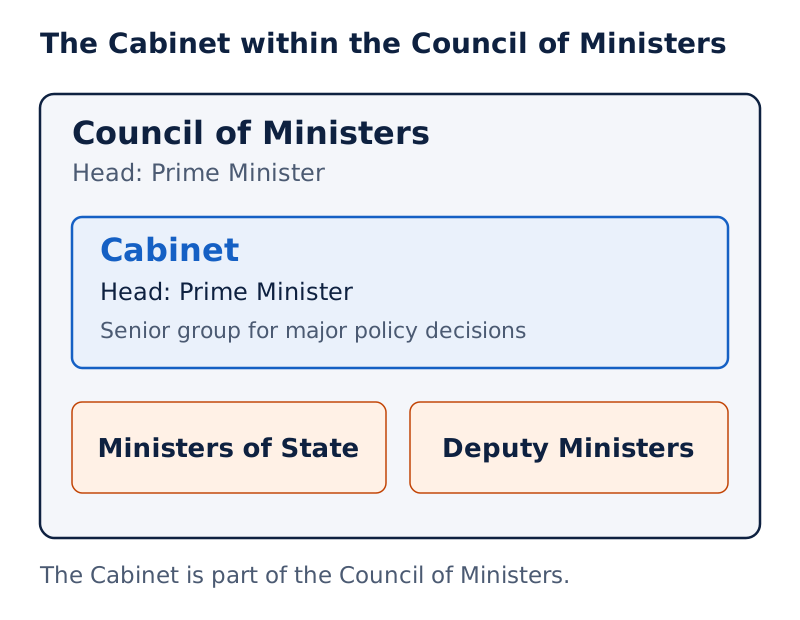
Draw a large rectangle labelled Council of Ministers. Inside it, draw a smaller rectangle labelled Cabinet. Place Ministers of State and Deputy Ministers inside the larger rectangle but outside the smaller one. Label the Prime Minister as head of both bodies.
Drawn by One Young India.
This arrangement explains why the two names are related but not interchangeable. Use Council of Ministers when discussing the entire ministry and collective responsibility. Use Cabinet when discussing the senior group that normally considers and coordinates the government's major decisions.
What powers make the Prime Minister the leader of the government?
The Prime Minister occupies a pre-eminent position, meaning a leading position above other ministers in directing government. The Council comes into existence after the Prime Minister takes the oath of office, the formal promise to discharge official duties.
How does leadership operate within the ministry?
Selection of ministers and allocation of ranks and portfolios give the Prime Minister substantial influence over the team's organisation. The Prime Minister chairs Cabinet meetings, coordinates work between departments and helps settle disagreements between ministers. Coordination means bringing different departments' work into a common direction.
The Prime Minister is involved in crucial government decisions and determines its policies. The office also links the Council of Ministers with the President and Parliament. Its importance therefore comes from several relationships, rather than from a single isolated power.
- Ministerial leadership: choosing the team and distributing responsibilities shapes how the government works.
- Parliamentary leadership: majority support in the Lok Sabha provides the political basis for governing.
- Administrative direction: control over the bureaucracy, or permanent administrative machinery, helps implement policy.
- Public leadership: access to the media and projection as a national leader can strengthen political influence.
What the figure shows
Cartoon of ministerial leadership
Cartoon: Shankar, 22 August 1954. The Prime Minister walks towards a doorway beside a sign reading "LOK SABHA", followed by ministers carrying bags; a figure stands in the doorway. There are no speech bubbles. Caption: "There is no Council of Ministers without the Prime Minister. This cartoon shows how, literally, the Prime Minister ‘leads’ the Council of Ministers!" The visual illustrates leadership; it does not establish unlimited personal power.
What limits the Prime Minister's practical authority?
The authority actually exercised depends on prevailing political conditions. A coalition requires consultation with partner parties and restricts the Prime Minister's choices of ministers, ranks and portfolios. Policies and programmes are framed through negotiations and compromises among the allies. The Prime Minister has to retain the support on which the government depends.
In this process, the Prime Minister has to act more as a negotiator than as leader of the government. This does not remove the constitutional office or its leadership role. It explains why the same office can exercise different degrees of practical influence under different political circumstances.
How do the Prime Minister and Council of Ministers work with the President?
Article 74(1) provides for a Council of Ministers headed by the Prime Minister to aid and advise the President. Here, aid and advice means the ministerial guidance through which the parliamentary government directs the exercise of presidential functions.
Is the advice binding?
The President acts in accordance with ministerial advice. The 42nd Amendment, 1976 made the binding nature of that advice explicit. Binding means that the advice must be followed; it is not merely an optional suggestion.
The 44th Amendment, 1978 allowed the President to require reconsideration of advice. Reconsideration means examining a decision again. After the Council has reconsidered and tendered its advice, the President must act in accordance with it.
- The Council of Ministers considers a matter and gives advice to the President.
- The President may require the Council to reconsider that advice.
- The Council re-examines the matter and tenders advice after reconsideration.
- The President follows the reconsidered advice, even if the Council maintains its earlier position.
The President's request can carry considerable weight, but it does not create a permanent power to reject reconsidered advice. In most cases, the President follows the Council's advice. The possibility of reconsideration helps explain why the President's role is not simply mechanical.
What information must the Prime Minister provide?
Under Article 78, the Prime Minister communicates the Council's decisions about Union administration and proposals for legislation to the President. Legislation means the making of laws. The Prime Minister must also furnish information about these matters when the President calls for it.
The President can require the Prime Minister to place before the Council a matter decided by an individual minister but not considered by the Council. This reinforces the relationship between the President, the Prime Minister and the ministry acting together.
The Prime Minister is therefore the principal link between the President and the ministerial team. Keeping the President informed is a constitutional duty. It is compatible with the Council's responsibility for the actual direction of government.
How do tenure, collective responsibility and individual responsibility work?
Tenure means the period for which a person holds office. The ministry's continuation depends on confidence, meaning the Lok Sabha's support for the government. The Prime Minister cannot claim an assured full term after losing that support.
What is collective responsibility?
Collective responsibility means that the Council answers as a team for government policy. Article 75(3) makes the Council collectively responsible to the Lok Sabha. A ministry that loses the confidence of that House is obliged to resign.
A no-confidence motion is a parliamentary proposal expressing that the House no longer supports the government. Its passage in the Lok Sabha requires the whole Council to resign. Government survival depends on the confidence of this House, rather than the Rajya Sabha.
The principle also requires Cabinet solidarity, meaning that ministers uphold the Cabinet's common decisions. A minister who disagrees with a Cabinet policy must accept it or resign. Remaining in office while rejecting the shared policy is inconsistent with collective responsibility.
What is individual responsibility?
Individual responsibility concerns a particular minister's conduct and administration of the assigned department. Under Article 75(2), ministers hold office during the pleasure of the President. In the parliamentary arrangement, the President removes an individual minister on the Prime Minister's advice.
The Prime Minister may ask a minister to resign or advise the President to remove that minister. The phrase pleasure of the President must therefore be understood alongside ministerial advice and parliamentary responsibility, rather than as ordinary personal control of policy by the President.
| Event | Effect on the ministerial team |
|---|---|
| An individual minister dies, resigns or is dismissed | A ministerial vacancy arises; this event alone does not dissolve the whole Council. |
| The Prime Minister dies or resigns | The Council of Ministers is dissolved because it cannot exist independently of its head. |
| The government loses the Lok Sabha's confidence | The Council is obliged to resign collectively. |
Note: Replacing one minister and losing the confidence of the Lok Sabha are different events. The first concerns an individual vacancy; the second concerns the right of the entire government to remain in office.
Collective and individual responsibility operate together. Ministers answer for their own departments, yet belong to a team committed to common decisions. This combination connects departmental administration with responsibility for the government as a whole.
What are the policy-making and administrative functions of ministers?
Policy-making involves deciding what the government intends to do and the direction it will follow. The Cabinet initiates policies, sets the government's agenda and carries those policies forward. The Prime Minister participates in crucial decisions and guides the government's overall direction.
How are policies turned into administrative action?
A policy requires implementation through government departments. Ministers exercise political control over the administration, while trained civil servants assist in formulating policies and putting them into practice. Civil servants are professional government officials belonging to the permanent administrative machinery.
The distinction is between responsibility for political direction and responsibility for administrative work. Officials supply knowledge and assistance, but ministers remain responsible for retaining control over the administration. Administrative officers cannot act in violation of policies adopted by the legislature.
- The government identifies its policy direction through ministerial and Cabinet decisions.
- The minister concerned directs the department responsible for carrying out that policy.
- Civil servants assist with formulation, planning and implementation under political supervision.
- Ministers explain and defend the department's work before the people's representatives.
Why is coordination necessary?
Government operates through different departments, but its policies require a common direction. Cabinet discussion and prime ministerial coordination connect departmental responsibilities with the government's wider programme. A minister's portfolio assigns work within the team; it does not create a separate government.
Political neutrality is the expectation that the bureaucracy will not take a political position on policy matters. If a change of government produces different policies, the administrative machinery must faithfully and efficiently help to draft and implement the new government's policies.
Neutrality and accountability serve different purposes. Neutrality enables professional officials to work under different elected governments. Accountability requires the ministers directing them to answer for government action. The permanent executive's continuity does not remove political supervision.
Administrative power is therefore linked to parliamentary control. Questions and debates allow representatives to seek information about implementation. The same government that decides a policy must explain how its machinery has carried that policy into practice.
What are the legislative and financial functions of the Cabinet?
Legislative functions concern making laws, while financial functions concern raising and using public money. Ministers take the initiative in both fields, but Parliament's approval remains essential. Government leadership of a proposal must be distinguished from legislative authority to approve it.
How does the Cabinet guide legislation?
A bill is a draft proposal for a law. A bill introduced by a minister is a Government Bill. A proposal introduced by a member who is not a minister is a Private Member's Bill.
The Cabinet decides the substance and timing of major government legislation. After it approves the policy behind a proposal, the ministry concerned prepares the draft. Officials draft it under the minister's supervision. Major bills are not introduced without Cabinet approval.
Within Parliament, the minister concerned often introduces the bill and explains the government's proposal. Parliamentary discussion and approval are still required. A policy approved inside the Cabinet does not become an Act, or enacted law, merely because the Cabinet has agreed to it.
After the required parliamentary passage, a bill goes to the President for assent, meaning formal approval. Presidential assent completes its enactment as law. Cabinet approval and presidential assent belong to different stages of the process.
How does the government obtain and use money?
The budget sets out the government's proposed receipts and expenditure for the financial year. Receipts are money coming in; expenditure is money spent. Preparing and presenting the budget for legislative approval is a constitutional obligation of the government.
The Cabinet settles the government's financial policy. The Finance Minister, responsible for government finance, presents the Union Budget. Taxation means raising revenue through taxes. The government needs the Lok Sabha's approval for new taxation and parliamentary approval for the resources used to implement its programmes.
A Money Bill is confined to constitutionally specified financial matters, such as taxation and government funds, and matters incidental to them. Under Article 109, a Money Bill cannot be introduced in the Rajya Sabha. It is introduced in the Lok Sabha.
| Function | Ministerial role | Parliamentary control |
|---|---|---|
| Legislation | Approve policy, prepare government proposals and guide their introduction. | Discuss and approve legislation through the prescribed process. |
| Finance | Prepare financial proposals and present the budget. | Approve resources, examine expenditure and scrutinise government policy. |
The government must explain the resources it wishes to raise and the money it has spent. Through this scrutiny, Parliament can examine both financial management and the policies reflected in the budget. Ministerial initiative and parliamentary control work together.
What role does the Cabinet play in emergencies?
An emergency is an exceptional constitutional situation in which special powers may be used to meet a serious crisis. Emergency functions belong within the constitutional relationship between the President and the Council of Ministers. The President formally exercises emergency powers; ministerial advice directs their use.
What safeguard applies to a national emergency?
A national emergency concerns a threat to India's security, or the security of part of its territory, through war, external aggression or armed rebellion. External aggression means an attack from outside the country; armed rebellion means an armed uprising against the state.
Under Article 352(3), the President cannot issue a national emergency proclamation unless the Union Cabinet's decision has been communicated in writing. A proclamation is a formal declaration. This written decision requirement applies to the Cabinet, not merely to the Prime Minister acting alone.
The written Cabinet decision safeguard was introduced by the 44th Amendment. It ensures that this exceptional action rests on a decision of the senior ministerial body. The constitutional procedure must be followed even though the Prime Minister leads that body.
How should emergency functions be understood?
The ministry assesses the situation, takes the relevant decisions and advises the President. Ministers then direct the administration in carrying those decisions into effect. Emergency action does not turn the Prime Minister's personal opinion into a substitute for a required constitutional decision.
President's Rule concerns a failure of constitutional government in a State, while a financial emergency concerns a threat to India's financial stability or credit, or that of part of its territory. These differ from a national emergency and must not be treated as interchangeable expressions.
Note: The requirement of a written Union Cabinet decision described here concerns a national emergency. Do not transfer this particular requirement indiscriminately to every kind of emergency.
The key distinction is between the President's formal declaration and the ministry's role in decision-making and administration. Constitutional safeguards identify how exceptional powers are exercised. They are part of the structure within which the political executive must govern.
Glossary
- Executive — The branch of government primarily responsible for administration and implementing laws and policies.
- Prime Minister — The head of government who leads the Council of Ministers and directs its work.
- Council of Ministers — The complete body of ministers headed by the Prime Minister and collectively responsible to the Lok Sabha.
- Cabinet — The senior group within the Council of Ministers that takes the government's principal decisions.
- Coalition — An alliance of political parties that join together to form or support a government.
- Portfolio — The subjects or departments assigned to a minister as part of government work.
- Tenure — The period during which a person continues to hold a particular office.
- Collective responsibility — The obligation of the Council of Ministers to answer together for government policy before the Lok Sabha.
- Individual responsibility — A minister's responsibility for personal conduct and administration of the department assigned to that minister.
- Cabinet solidarity — The requirement that ministers remaining in office accept and uphold the Cabinet's common decisions.
- No-confidence motion — A proposal in the Lok Sabha expressing withdrawal of support from the government.
- Discretion — Constitutional judgement exercised where circumstances leave an office holder a choice of action.
- Budget — The statement of proposed government receipts and expenditure for a financial year.
- Bill — A draft proposal for a law presented for consideration through the legislative process.
- Political neutrality — The expectation that civil servants avoid political positions and faithfully implement the elected government's policies.
Common errors and misconceptions
- Misconception: The President normally chooses any preferred person as Prime Minister. Correct: Appointment depends on who commands, or is likely to command, majority support in the Lok Sabha.
- Misconception: The Cabinet and Council of Ministers have identical membership. Correct: The Cabinet is the senior group within the larger Council, which includes ministers of different ranks.
- Misconception: Appointment guarantees the Prime Minister an uninterrupted full term. Correct: Continuation in office depends on retaining the confidence of the Lok Sabha.
- Misconception: The President can repeatedly reject advice after reconsideration. Correct: The President must act on advice tendered after the Council has reconsidered it.
- Misconception: A minister can remain outside Parliament indefinitely. Correct: A minister remaining outside both Houses for six consecutive months ceases to hold ministerial office.
- Misconception: Every ministerial resignation dissolves the entire Council. Correct: An ordinary minister's resignation creates a vacancy; the Prime Minister's resignation brings about the Council's dissolution.
- Misconception: Cabinet approval alone turns a bill into law. Correct: Cabinet approval guides government legislation, but parliamentary passage and presidential assent remain necessary.
- Misconception: The Prime Minister alone can authorise the President to declare a national emergency. Correct: The Union Cabinet's decision must be communicated in writing under Article 352(3).
Exam-style questions with model answers
Q1. The President is the formal Head of State, while the Prime Minister heads the Council of Ministers that runs the national government. Using these facts, distinguish their roles in two points. [2 marks]
- The President occupies the formal position of Head of State.
- The Prime Minister heads the ministerial team responsible for running the national government.
Q2. The President appoints the Prime Minister on the basis of Lok Sabha majority support. Where support is uncertain, the President judges who may command it. Coalition partners seek a leader acceptable to most of them. Explain three principles of appointment from this information. [3 marks]
- Formal appointment is made by the President, but the political basis for it is support from the majority in the Lok Sabha.
- Where support is uncertain, presidential judgement concerns who may command that support, rather than an unrestricted personal preference.
- In a coalition, the leader must be acceptable to most partner parties because their combined support sustains the government.
Q3. The Council of Ministers includes all ministers of different ranks. The Cabinet is its senior group, and Cabinet Ministers usually meet to take major decisions in the Council's name. Explain three distinctions or relationships between the two bodies. [3 marks]
- The Council of Ministers is the wider body containing all ministers, while the Cabinet forms a smaller group within it.
- The Council includes different ministerial ranks, whereas the Cabinet consists of the senior ministerial group.
- Cabinet Ministers usually take major decisions in the Council's name, so Cabinet decision-making operates within the wider ministerial organisation.
Q4. Article 74(1) requires the President to act on ministerial advice but permits reconsideration. After reconsideration the advice is binding. The Prime Minister communicates Council decisions and supplies information requested by the President. Explain four features of this relationship. [4 marks]
- The Council of Ministers supplies the advice on which the President acts, connecting formal presidential functions with ministerial government.
- The President can require reconsideration, allowing the Council to examine its advice again before final action.
- After reconsideration, the President must follow the advice tendered by the Council, even if its earlier view remains unchanged.
- The Prime Minister maintains communication by reporting Council decisions and supplying information that the President requests.
Q5. Ministers share responsibility to the Lok Sabha. Loss of its confidence requires the whole Council to resign. A dissenting minister must accept Cabinet policy or resign. An individual minister's departure creates a vacancy, while the Prime Minister's resignation dissolves the Council because it cannot exist without its head. Explain four consequences. [4 marks]
- If the ministry loses the Lok Sabha's confidence, the whole Council must resign because responsibility is collective.
- A minister disagreeing with Cabinet policy must accept the common decision or leave ministerial office through resignation.
- The departure of an individual minister creates a vacancy and does not, by itself, dissolve the whole Council.
- The Prime Minister's resignation dissolves the Council because the ministerial team cannot exist independently of its head.
Q6. The Prime Minister selects ministers, allocates ranks and portfolios, coordinates departments, communicates Council decisions to the President and depends on Lok Sabha majority support. In coalitions, choices involve consultation with partners. Explain five aspects of prime ministerial leadership using these facts. [5 marks]
- The Prime Minister shapes the composition of the government by selecting the people who will serve as members of the ministerial team.
- Allocation of ranks and portfolios determines each minister's position and assigned subjects, giving the Prime Minister influence over the organisation of work.
- Coordination connects different departments, helping their separate responsibilities contribute to the common direction of the government.
- Communication of Council decisions makes the Prime Minister the link through which the President receives information about ministerial decisions.
- Leadership depends on majority support; in coalitions, consultation with partner parties affects choices because their support helps sustain the government.
Q7. The Cabinet approves the policy behind major government bills. Ministries prepare drafts under ministerial supervision. Ministers guide government proposals in Parliament. The government presents a budget for approval, and Parliament scrutinises money raised and spent. Explain five legislative and financial functions or controls. [5 marks]
- The Cabinet establishes the policy direction behind major government bills before the proposals enter the legislative process for parliamentary consideration.
- The ministry concerned prepares the draft under ministerial supervision, turning an approved policy into a proposal that Parliament can examine.
- Ministers guide government proposals in Parliament, connecting the Cabinet's legislative initiative with discussion by the representatives who consider the proposed law.
- The government prepares and presents the budget for approval, setting out its proposals for raising resources and carrying out public expenditure.
- Parliament scrutinises money raised and spent, requiring the government to explain its financial proposals and account for the use of resources.
Q8. Under Article 352(3), a national emergency proclamation requires a Union Cabinet decision communicated to the President in writing. The President formally issues the proclamation. The Cabinet is the senior ministerial body headed by the Prime Minister, and ministers direct implementation. Explain six features of the procedure and division of responsibility. [6 marks]
- The Prime Minister heads the Union Cabinet and therefore leads the senior ministerial body that considers the emergency decision.
- The decision must be taken by the Union Cabinet, the senior ministerial body responsible for the government's principal decisions.
- The Cabinet's decision must be communicated to the President, linking the ministerial decision with the formal authority that issues the proclamation.
- The communication must be in writing; the requirement therefore calls for a written Cabinet decision before the proclamation is issued.
- The President formally issues the proclamation, while the Prime Minister's leadership of the Cabinet does not substitute for the required Cabinet decision.
- Ministers direct implementation after the decision, connecting the government's emergency responsibilities with the administration that carries them into effect.
Key takeaways
- The President is the formal Head of State, while the Prime Minister and Council of Ministers direct the national government.
- Appointment and continued tenure depend on the Prime Minister's ability to command the support of the majority in the Lok Sabha.
- The Prime Minister selects ministers, allocates their responsibilities and leads the Cabinet, subject to prevailing political conditions.
- The Cabinet is the senior decision-making group within the larger Council of Ministers, which includes different ministerial ranks.
- Collective responsibility requires the Council to resign if it loses the Lok Sabha's confidence and requires ministers to accept common Cabinet policy.
- The President may seek reconsideration of ministerial advice, but must follow the advice tendered after reconsideration.
- Ministers initiate policies, legislation and financial proposals, while Parliament scrutinises their work and controls approval of laws and resources.
- A national emergency requires the Union Cabinet's decision to be communicated to the President in writing before the proclamation is issued.
Test yourself
Which House's confidence determines whether the Council of Ministers can continue in office?
The Council of Ministers must retain the confidence of the Lok Sabha.
What is the difference between a rank and a portfolio?
A rank is a minister's level within the ministry; a portfolio is the subject or department assigned to that minister.
What must a minister do if unwilling to accept a Cabinet decision?
The minister must resign rather than remain in office while rejecting the Cabinet's common policy.
What happens if a minister remains outside Parliament for six consecutive months?
The person ceases to be a minister at the end of that period.
Can the President reject advice after the Council has reconsidered it?
The President must act in accordance with the advice tendered after reconsideration.
Why can coalition politics limit the Prime Minister's practical choices?
The Prime Minister must consult partner parties and negotiate choices about ministers, portfolios and policies to sustain their support.
Does Cabinet approval make a government bill a law?
No. Parliamentary passage and presidential assent are required for the bill to become law.
Whose written decision is required before a national emergency proclamation?
The Union Cabinet's decision must be communicated in writing to the President.
Take this further
How does India make policy?
The Model NITI Aayog self-paced course: 41 chapters, about 19 hours of study, on how India makes policy, from the policy cycle and writing a white paper to the economy, the Union Budget and governance. It comes with Learnacy Essential.
Learnacy Essential is ₹1,499 for the year. It also adds feedback from an AI writing coach, submission to The OYI Review, World 101’s member tools and the 3D labs. Publication is not guaranteed. See what a year includes
Or create a free account to draft in the Writing Studio, explore World 101’s map and open the 2D version of every lab. Create a free account