
Upthrust in Fluids, Archimedes' Principle, and Floatation | ICSE Class 9 Physics Notes
On this page
Watch & explore
Start with a few high-quality watches, then dive into the notes below.
Try an idea before you read. Let's apply the principles of upthrust and floatation to some real-world scenarios. Explore →

This note covers upthrust in fluids, Archimedes' principle, apparent weight, sinking and floatation, density and relative density, experimental methods, the fraction of a floating body immersed, and applications to ships, submarines, icebergs and balloons.
How does fluid pressure produce an upward force?
A fluid is a substance that can flow. Liquids and gases are fluids. A body surrounded by a fluid experiences forces exerted by that fluid on its surface. In a fluid at rest, each of these forces acts perpendicular to the surface on which it acts.
How are pressure and force connected?
Pressure is normal force per unit area. For a uniform pressure p acting over a flat area A, the normal force F is found by multiplying pressure by area. Pressure and force are different quantities, even though they are related.
p = F/A
F = pA
The SI unit of pressure is the pascal, Pa. 1 Pa = 1 N/m². The SI unit of force is the newton, N. Area is expressed in m² when calculating force from pressure in pascals.
Why is the resultant force upward?
In a stationary liquid of uniform density, pressure increases with depth. Consider an immersed block with horizontal upper and lower faces. The lower face lies deeper, so the liquid pushes upward on it more strongly than it pushes downward on the upper face.
For this block, forces on opposite vertical faces balance horizontally. The difference between the vertical forces gives a resultant upward force called upthrust. The pressure acts on several faces, but upthrust describes their combined vertical effect.
What the figure shows
Forces exerted by a liquid
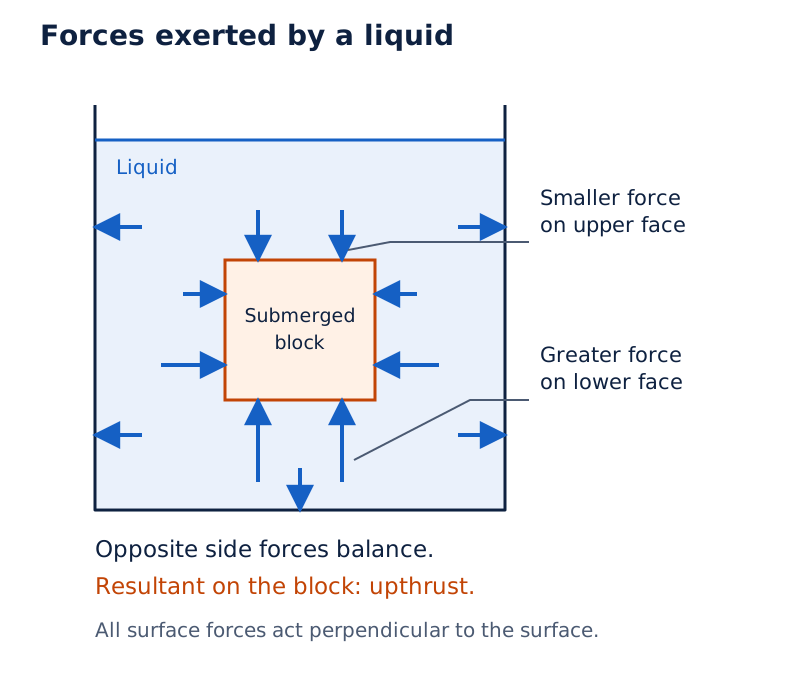
The drawing shows a submerged object inside a beaker. Arrows at its surfaces show forces directed perpendicular to those surfaces. The liquid also exerts forces perpendicular to the walls of the beaker.
Drawn by One Young India.
Greater pressure at greater depth is the starting point for understanding buoyancy. It does not mean that the upthrust on a completely immersed, rigid body keeps increasing as the body is lowered through a liquid of constant density.
How do density and relative density describe materials?
Density compares the mass of a substance with the volume it occupies. A large mass alone does not establish that a body has a high density: the corresponding volume must also be known. The symbol ρ represents density, m represents mass and V represents volume.
ρ = m/V
m = ρV
The SI unit of density is kg/m³. The SI unit of mass is the kilogram, kg. The SI unit of volume is m³. Thus, dividing a mass in kilograms by a volume in cubic metres gives density directly in SI units.
How does relative density differ from density?
Relative density, abbreviated RD, compares the density of a substance with the density of water at 4°C. Both densities must be expressed in the same units before taking their ratio. The density of water at this temperature is 1000 kg/m³.
RD = ρ/ρw
Here ρw denotes the reference density of water. Relative density has no unit, because the units in the numerator and denominator cancel. It is a ratio, whereas density is mass per unit volume.
| Quantity | Meaning | Unit |
|---|---|---|
| Mass | Amount of mass in the body | kg |
| Volume | Space occupied by the body | m³ |
| Density | Mass divided by volume | kg/m³ |
| Relative density | Density divided by the reference density of water | No unit |
Worked example 1. Aluminium has relative density 2.7. Find its density using the reference density of water, 1000 kg/m³.
Formula: ρ = RD × ρw. Substitute: ρ = 2.7 × 1000. Answer: 2700 kg/m³.
For a hollow body, distinguish the density of its material from its average density. The average uses the total mass divided by the whole external volume, including enclosed spaces. This distinction becomes essential when explaining why a ship can float.
What determines the magnitude of upthrust?
Definition: Upthrust, or buoyant force, is the resultant upward force exerted by a fluid on a body immersed wholly or partly in it.
The line of action of upthrust passes through the centre of gravity of the displaced fluid. This point is called the centre of buoyancy. It need not coincide with the centre of gravity of the body itself.
The fluid displaced by a body occupies the same volume as the immersed portion of the body. If the body is only partly immersed, its entire volume must not be used as the displaced volume. For complete immersion, the two volumes are equal.
Which factors must be compared?
At the same place, upthrust depends on the density of the fluid and the volume of fluid displaced. More displaced fluid of a given density has greater weight. A denser fluid also has greater weight for the same displaced volume.
| Change made | Condition kept fixed | Effect on upthrust |
|---|---|---|
| Increase immersed volume | Fluid density and acceleration due to gravity (g) | Upthrust increases |
| Use a denser liquid | Displaced volume and g | Upthrust increases |
| Lower a rigid, fully immersed body further | Liquid density, volume and g | Upthrust stays unchanged |
| Change the body's material | Immersed volume, liquid density and g | Upthrust stays unchanged |
A sinking body still experiences upthrust. Its downward tendency means that its weight exceeds the upward force, not that the upward force has disappeared. The weight depends on the body; upthrust depends on the displaced fluid.
What happens during gradual immersion?
As a suspended solid enters water, the immersed volume increases. Its buoyant force therefore increases. Once the solid is completely immersed, further lowering does not change the volume displaced, provided the body remains rigid and the liquid density remains constant.
Immersing the same solid fully in strongly salty water produces a greater buoyant force than immersing it fully in tap water. The volume displaced is the same, but the denser liquid has greater mass and weight within that volume.
Note: Compare equal displaced volumes when discussing the effect of liquid density. A freely floating body can change its immersed volume when transferred to another liquid.
What does Archimedes' principle state and how is it calculated?
Archimedes' principle relates buoyant force to displaced fluid: a body partly or completely immersed in a fluid at rest experiences an upward force equal to the weight of the fluid it displaces. The principle applies to liquids and gases.
The displaced fluid's weight is required, not merely its mass or volume. Volume must first be multiplied by fluid density to obtain mass; that mass is multiplied by acceleration due to gravity to obtain weight.
Derivation: Upthrust from displaced volume
- Let V denote the immersed volume of the body. The displaced fluid has this same volume.
- If the fluid density is ρf, the mass displaced is m = ρfV.
- The weight of this displaced fluid is mg, where g is acceleration due to gravity.
- Archimedes' principle identifies this displaced weight with the buoyant force F_B.
F_B = ρfVg
Use ρf in kg/m³, V in m³ and g in m/s². The answer is a force in newtons. In particular, the density in this formula belongs to the fluid, even when the problem also supplies the solid's density.
Worked example 2. A cube of side 5 cm is fully immersed in water. Calculate its upthrust using water density 1000 kg/m³ and g = 10 m/s².
Let a denote the cube's side length. Formula: V = a³; F_B = ρfVg. Substitute: a = 0.05 m, V = (0.05)³ = 0.000125 m³; F_B = 1000 × 0.000125 × 10. Answer: 1.25 N upward.
The calculation does not require the cube's mass because its displaced volume is already known. Its mass would be needed to calculate its weight or determine whether it would rise or sink if released. This separates calculation of buoyancy from prediction of motion.
Archimedes' principle remains applicable when a body sinks. For a freely floating body at rest, an additional condition is available: buoyant force balances the body's weight. That condition leads to the law of floatation.
Why does an immersed body have a smaller apparent weight?
The weight W of a body is the gravitational force on it. If its mass is m and the local acceleration due to gravity is g, its weight is given by the following expression. The SI unit of weight is the newton, N.
W = mg
A spring balance supporting a stationary body measures the force needed to support it. When the body is immersed in a liquid, the upward buoyant force provides part of the support. The balance then reads less than it did in air.
How are the three forces related?
Let T be the upward tension provided by the balance. The downward force W is balanced by T and F_B together. For a body suspended at rest, neglecting the small buoyancy of air, the reading in the liquid is its apparent weight Wapp.
W = T + F_B
Wapp = W − F_B
The difference between weight in air and apparent weight in liquid is the apparent loss of weight. It equals the upthrust. Immersion does not remove matter from the body or switch off gravity; it changes the support force required.
Worked example 3. A body gives a spring-balance reading of 10 N in air and 8 N when fully immersed in water. Neglect air buoyancy. Find its apparent loss of weight and the weight of displaced water.
Formula: F_B = W − Wapp. Substitute: F_B = 10 − 8. Answer: the apparent loss is 2 N, so the displaced water also weighs 2 N.
What does zero apparent weight mean?
A freely floating body at rest needs no additional upward support because buoyancy balances its weight. Its apparent weight is therefore zero in this sense, although its actual weight is not zero.
If a fully immersed body tends to rise, a downward holding force is required to keep it submerged. The algebraic value W − F_B is then negative. A spring balance hanging above the body cannot supply this downward force; the negative sign identifies the required direction of restraint.
How do force and density comparisons predict sinking or rising?
Consider a fully immersed body initially at rest and free to move vertically. Compare its downward weight with its upward buoyant force. Other support forces must be absent when using these two forces alone to predict the initial tendency to move.
What are the three cases?
| Force comparison | Density comparison for complete immersion | Initial behaviour |
|---|---|---|
| F_B < W | Body denser than fluid | Body tends to sink |
| F_B = W | Body and fluid have equal densities | Body can remain suspended |
| F_B > W | Body less dense than fluid | Body tends to rise |
For a fully immersed body of volume V and average density ρb, its weight is ρbVg. The upthrust is ρfVg. Since V and g occur in both expressions, the comparison depends on body density versus fluid density.
A denser body has positive apparent weight when supported in the liquid. Equal densities give zero apparent weight for complete immersion. A less dense body has an upward resultant while held completely below the surface, so a downward restraint is needed to keep it there.
Does rising mean the body will keep accelerating upward?
These comparisons describe the initial tendency under the stated conditions. Once the body moves, fluid resistance can also act. When a rising body reaches the surface and emerges partly, the volume of liquid displaced decreases.
The reduction in displaced volume reduces the buoyant force. In a final floating state at rest, the upward and downward forces balance. Thus, F_B > W while submerged and F_B = W while floating at rest describe different stages, not conflicting rules.
For hollow objects, use average density based on total mass and external volume. Comparing the density of the construction material alone with the liquid cannot explain the behaviour of the complete object.
How does the law of floatation determine the immersed fraction?
Definition: A freely floating body at rest displaces a weight of fluid equal to its own weight. This equilibrium condition is called the law of floatation.
The law follows by combining Archimedes' principle with balanced vertical forces. It does not replace Archimedes' principle. It adds the condition that the body is freely floating at rest, so no separate supporting force is required.
Derivation: Fraction of a floating body immersed
- Let Vb be the total volume of the body and ρb its average density. Its weight is ρbVbg.
- Let Vi be the volume below the liquid surface and ρf the liquid density. The upthrust is ρfVig.
- For floating equilibrium, set ρbVbg equal to ρfVig.
- Cancel g and divide by ρfVb to obtain the fraction of the total volume immersed.
Vi/Vb = ρb/ρf
The immersed fraction is the density of the body divided by the density of the liquid. The fraction above the surface is obtained by subtracting the immersed fraction from unity. Fractions of volume have no unit.
Diagram
Floating equilibrium
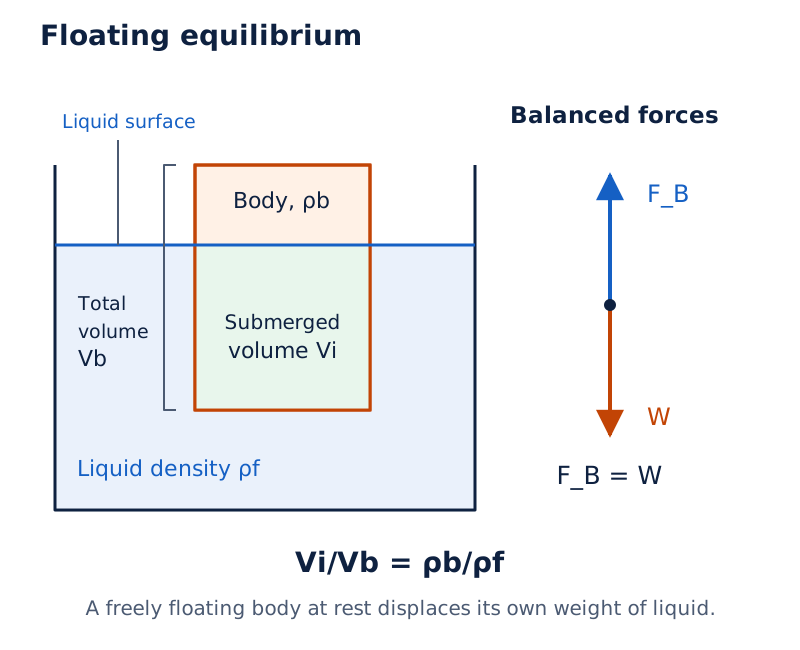
Draw a body crossing a horizontal liquid surface. Label its total volume Vb and submerged volume Vi. Add an upward arrow F_B and an equal downward arrow W, and label the liquid density ρf and body density ρb.
Drawn by One Young India.
What changes in a denser liquid?
A body of unchanged mass still needs the same upthrust to float at rest. In a denser liquid it obtains that force by displacing a smaller volume. It therefore floats with a smaller fraction immersed, provided its mass and external volume remain unchanged.
For example, if the fraction above the liquid surface is 1/9, the fraction immersed is 8/9. The body's density is then 8/9 of the liquid's density. Confusing the exposed fraction with the immersed fraction reverses the interpretation of such problems.
If a proposed immersed fraction exceeds unity, the body would need to displace more liquid than its whole volume permits. Under these conditions it cannot float freely at the surface.
How can Archimedes' principle be verified experimentally?
The experiment compares apparent loss of weight with the weight of displaced water. It requires a spring balance, stand, silk thread, suitable solid, overflow-can and measuring cylinder. Choose a non-porous solid denser than water so that it can hang immersed from the balance.
What procedure connects the measurements?
- Determine the range and least count of the spring balance and measuring cylinder. Check the balance for zero error and correct the readings if necessary.
- Fill the overflow-can until water flows from the spout. Wait for excess water to stop dripping, then position an empty measuring cylinder beneath the spout.
- Suspend the solid from the spring balance and record its weight in air, W. Keep the balance vertical.
- Lower the solid partly into the water. Wait for dripping to stop, then record the collected volume and the new balance reading.
- Repeat with a greater immersed volume and then with complete immersion. Record the corresponding displaced volumes and apparent weights.
- For each immersion, calculate W − Wapp and compare it with ρwVg, using the displaced volume V and the stated density of water.
The two calculated forces should agree approximately within experimental error. Increasing the immersed volume increases both the apparent loss of weight and the weight of water collected. Their agreement verifies the connection expressed by Archimedes' principle.
What the figure shows
Comparing weight and displacement
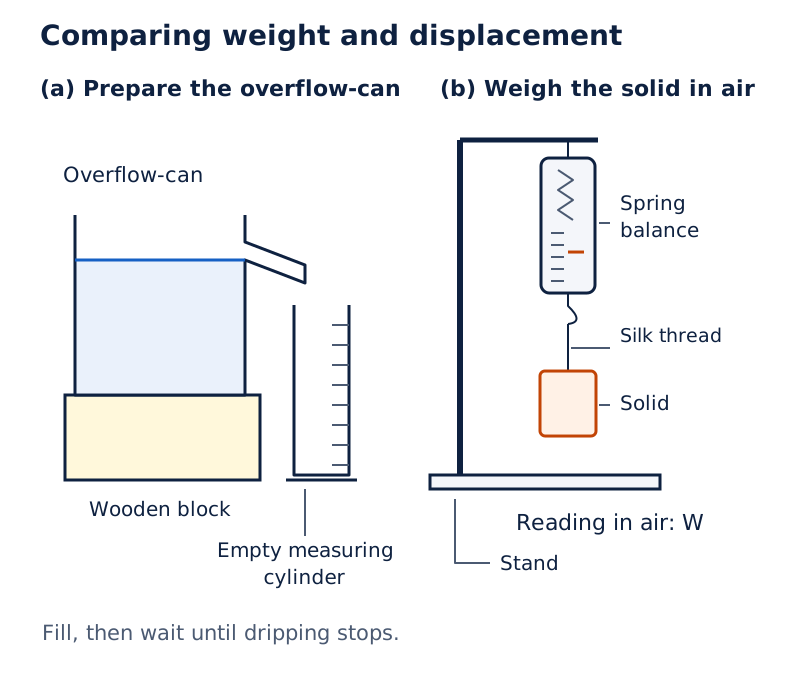
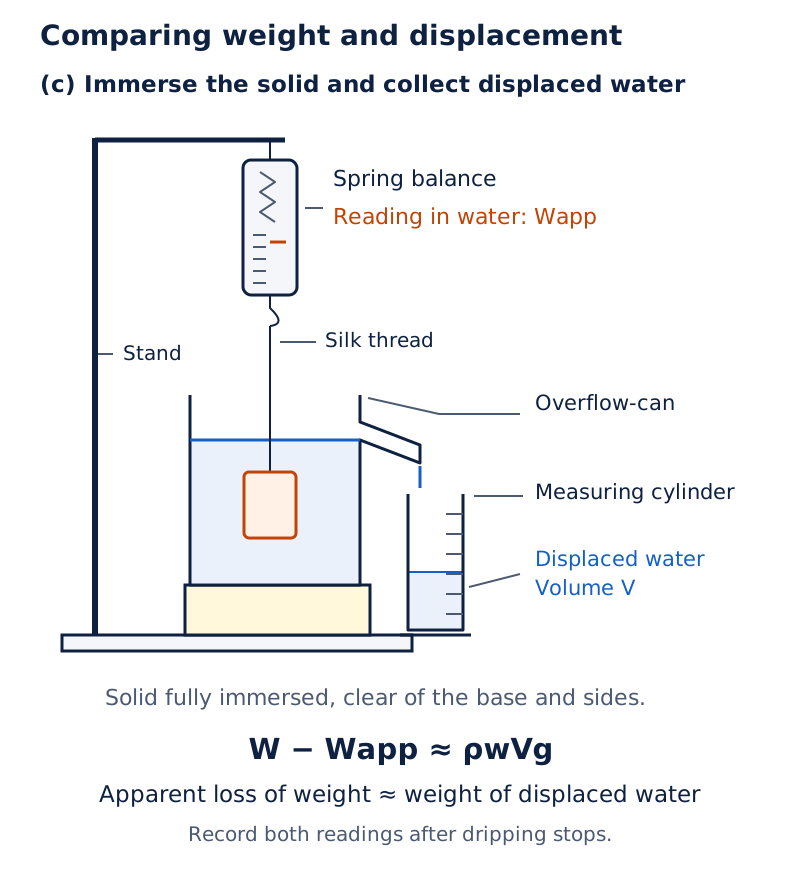
Part (a) shows an overflow-can on a block with a measuring cylinder beneath its spout. Part (b) shows a solid hanging from a spring balance on a stand. Part (c) places the suspended solid in water, with the cylinder collecting overflow.
Drawn by One Young India.
Which precautions protect the result?
Read the balance after its pointer comes to rest. Keep the measuring cylinder on a horizontal surface and read the lower water meniscus at eye level. Avoid trapped air bubbles and use a non-porous solid so that absorption does not alter the measurements.
The solid should hang freely without support from the can's base or sides. Such contact would introduce an additional force and make the apparent loss of balance reading an unreliable measure of buoyancy.
How is the relative density of a solid measured by weighing?
A solid denser than water can be suspended from a spring balance, first in air and then fully immersed in water. Let its corrected readings be W in air and Ww in water. Neglect air buoyancy and use a solid that does not absorb or dissolve in water.
Why does the weighing formula work?
The difference W − Ww is the upthrust, equal to the weight of water with the same volume as the solid. Dividing the solid's weight by that water weight compares the densities of equal volumes.
RD = W/(W − Ww)
This gives relative density directly when the reference water density is used. For a laboratory measurement at another temperature, the measured water density should be used to calculate the solid's density before comparing it with the reference value at 4°C.
- Record the corrected weight W of the dry solid in air.
- Immerse the solid completely in water while it hangs freely from the balance.
- Record Ww after the pointer settles, avoiding trapped bubbles and contact with the container.
- Calculate the apparent loss W − Ww, then divide W by this difference.
Using readings of 10 N in air and 8 N in water, the apparent loss is 2 N. If the water has the reference density, the relative density is 10/2 = 5. The result has no unit because it divides one force by another force.
The denominator must be the loss of weight, not the immersed reading alone. The immersed reading represents the support still provided by the balance; the loss represents the support provided by displaced water. Only the latter corresponds to the weight of an equal volume of water.
How can the relative density of a liquid be found?
The same immersed solid can be used to compare an unknown liquid with water. It must sink in both liquids and remain unchanged during the experiment. Use complete immersion in each case so that the same volume of each liquid is displaced.
Which readings are required?
Let W be the solid's weight in air, Ww its apparent weight in water, and Wl its apparent weight in the other liquid. The respective upthrusts are W − Ww and W − Wl. Each is proportional to the density of the corresponding liquid.
ρl/ρw = (W − Wl)/(W − Ww)
Here ρl is the unknown liquid density and ρw is the density of the water used. If water at the reference density is used, the ratio on the left is the liquid's relative density. Otherwise calculate ρl first, then divide by the reference water density.
- Measure the solid's corrected weight in air and its apparent weight when fully immersed in water.
- Obtain the apparent weight of the same solid when fully immersed in the other liquid.
- Calculate the loss of weight in each liquid by subtracting its immersed reading from W.
- Divide the loss in the other liquid by the loss in water to obtain the density ratio.
A larger apparent loss means greater upthrust and therefore a denser liquid when immersed volume and g remain constant. For the same suspended solid, that greater loss corresponds to a smaller spring-balance reading.
The comparison fails if only part of the solid is immersed in one liquid while it is completely immersed in the other. Both density and displaced volume would then affect the force, so the loss-of-weight ratio could not be interpreted as a density ratio alone.
How do ships, submarines, icebergs and balloons use buoyancy?
These applications use the same comparison between weight and displaced-fluid weight. The body's size, internal spaces and surroundings matter because they determine its average density and the amount of fluid it can displace.
Why can a ship float although its construction material is dense?
A ship encloses a large volume containing air. Its total mass is spread over a large external volume, making its average density different from the density of its solid construction material. It settles until the weight of water displaced equals its total weight.
Adding a load increases the total weight. A floating ship must then displace more water and sit deeper, within the limits of safe floatation. In denser water, the same loaded ship requires less displaced volume to obtain the required upthrust.
How does a submarine control its tendency to move vertically?
A submarine can admit water into ballast tanks or expel it. This changes its total mass and average density. Taking in water increases weight; removing water decreases it. For an approximately unchanged external volume while fully submerged, the displaced-water weight remains approximately unchanged.
Consequently, changing ballast can produce a downward or upward tendency, or a condition in which weight and buoyancy balance. This explanation concerns buoyancy control; the relevant comparison remains the two vertical forces.
Why are icebergs partly immersed, and why can balloons rise?
An iceberg floats because its average density is lower than that of the surrounding water. Its immersed fraction equals the density ratio. A numerical fraction cannot be calculated without the relevant densities.
A balloon displaces air, so it experiences buoyancy in a gas. To rise initially, the displaced air must weigh more than the complete balloon, including its gas, envelope and load. Comparing gas densities alone is insufficient when the envelope and load contribute to total weight.
How should numerical problems be solved and checked?
Begin by identifying the required quantity: density, upthrust, apparent weight or immersed fraction. Write down whether the body is fully immersed, partly immersed or freely floating. That condition determines which volume and which force balance may be used.
How are volume and buoyancy found from mass and density?
Worked example 4. A ball of mass 4 kg and density 4000 kg/m³ is fully immersed in water of density 1000 kg/m³. Take g = 10 m/s². Find its volume and buoyant force.
Formula: V = m/ρb; F_B = ρfVg. Substitute: V = 4/4000 = 0.001 m³; F_B = 1000 × 0.001 × 10. Answer: volume = 0.001 m³ and buoyant force = 10 N upward.
The ball's density determines the ball's volume. The water's density then determines the mass of water displaced. Substituting the ball's density into the upthrust formula would instead produce the ball's own weight.
How is apparent weight obtained from the same physical data?
Worked example 5. A ball of mass 4 kg and density 4000 kg/m³ is held fully immersed in water of density 1000 kg/m³. With g = 10 m/s², find the supporting balance reading. Neglect air buoyancy.
Formula: W = mg; V = m/ρb; F_B = ρfVg; Wapp = W − F_B. Substitute: W = 4 × 10 = 40 N; V = 0.001 m³; F_B = 10 N. Answer: Wapp = 40 − 10 = 30 N.
The result is positive and smaller than the weight in air. This matches the fact that the ball is denser than water: buoyancy supports part of its weight, while the balance supplies the remaining upward force.
How does changing a cube's side affect upthrust?
Worked example 6. Reduce the side of a cube from 5 cm to 4 cm. Both cubes are fully immersed in water separately. Use water density 1000 kg/m³ and g = 10 m/s² to find the smaller cube's upthrust and compare it with the larger cube's 1.25 N upthrust.
Formula: V = a³; F_B = ρfVg. Substitute: V = (0.04)³ = 0.000064 m³; F_B = 1000 × 0.000064 × 10. Answer: 0.64 N, which is 64/125 of the original upthrust.
Check the power of the unit conversion. A length in centimetres must be converted before cubing, or the cubic-centimetre volume must be converted to cubic metres. Do not treat a volume conversion as a length conversion.
Glossary
- Fluid — A substance capable of flowing, including both liquids and gases.
- Pressure — Normal force per unit area, expressed in pascals in SI units.
- Upthrust — The resultant upward force exerted by a fluid on an immersed body.
- Density — Mass per unit volume of a substance, expressed in kg/m³ in SI units.
- Average density — Total mass of a body divided by its whole external volume, including enclosed spaces.
- Relative density — Ratio of a substance's density to the density of water at 4°C, with no unit.
- Displaced volume — Volume of fluid moved aside, equal to the immersed volume of the body.
- Archimedes' principle — The buoyant force on an immersed body equals the weight of fluid displaced by it.
- Apparent weight — Supporting force required for a body in a fluid, reduced by the buoyant force.
- Apparent loss of weight — Difference between weight in air and apparent weight in liquid, neglecting air buoyancy.
- Law of floatation — A freely floating body at rest displaces fluid whose weight equals its own weight.
- Immersed fraction — Volume of a body below the liquid surface divided by its total volume.
Common errors and misconceptions
- Misconception: A sinking body experiences no buoyancy. Correct: It experiences an upward force, but its weight is greater than that force. The comparison explains its initial downward tendency.
- Misconception: A floating body has greater upthrust than weight. Correct: These forces are equal during free floating equilibrium. Greater upthrust describes the initial upward tendency of a less dense, fully immersed body.
- Misconception: The body's density belongs in the upthrust formula. Correct: Use fluid density with displaced volume. The body's density may first be needed to calculate its volume from its mass.
- Misconception: A spring balance showing less in water proves that the body has lost mass. Correct: Buoyancy provides some support, reducing the balance reading without requiring any loss of matter.
- Misconception: Relative density has units of kg/m³. Correct: Density has those SI units. Relative density divides densities expressed in the same units, so the units cancel.
- Misconception: Use the whole body volume in every buoyancy calculation. Correct: Use only the immersed volume for partial immersion. The whole volume is appropriate when the body is completely submerged.
- Misconception: Lowering a fully immersed rigid solid deeper must increase upthrust. Correct: With constant liquid density and g, displaced volume stays fixed, so upthrust remains constant despite increased surrounding pressure.
- Misconception: Relative density of a solid is its air reading divided by its immersed reading. Correct: Divide the air reading by the loss of reading in reference water, because that loss measures equal-volume water weight.
Exam-style questions with model answers
Q1. State Archimedes' principle and identify the direction of the force it describes. [2 marks]
- A body wholly or partly immersed in a fluid at rest experiences a buoyant force equal to the weight of displaced fluid.
- The buoyant force acts vertically upward.
Q2. A body reads 10 N on a spring balance in air and 8 N when fully immersed in water. Neglect air buoyancy. Find the upthrust and explain whether the body has lost actual weight. [3 marks]
- The apparent loss of weight is the air reading minus the immersed reading: 10 − 8 = 2 N.
- This loss equals the upthrust, so the water exerts a buoyant force of 2 N upward on the body.
- The body has not lost actual gravitational weight. Water supplies part of the supporting force, so the spring balance needs to supply only the remaining 8 N.
Q3. A ball has mass 4 kg and density 4000 kg/m³. It is supported at rest, fully immersed in water of density 1000 kg/m³. Take g = 10 m/s² and neglect air buoyancy. Find its volume, upthrust and apparent weight, and predict its initial tendency if released. [5 marks]
- Complete immersion means the volume of water displaced equals the ball's full volume. Its volume is V = m/ρb = 4/4000 = 0.001 m³.
- Its actual weight is W = mg = 4 × 10 = 40 N, acting downward.
- By Archimedes' principle, the upthrust is F_B = ρfVg = 1000 × 0.001 × 10 = 10 N, acting upward.
- While the ball is supported at rest, its apparent weight is W − F_B = 40 − 10 = 30 N. This is the force supplied by the balance.
- On release, weight exceeds buoyancy. The initial resultant is downward, so the ball tends to sink.
Q4. Derive the immersed-volume fraction for a freely floating body at rest. Define all symbols and explain how the fraction changes in a denser liquid if the body's mass and volume remain unchanged. [5 marks]
- Let the body's total volume be Vb and its average density be ρb. Its weight is ρbVbg, where g is acceleration due to gravity.
- Let Vi be the immersed volume and ρf the liquid density. The displaced volume is Vi, so upthrust is ρfVig.
- For free floating equilibrium, weight equals upthrust: ρbVbg = ρfVig. No extra supporting force is required.
- Cancelling g and rearranging gives Vi/Vb = ρb/ρf. The left side is the immersed-volume fraction and has no unit.
- A denser liquid increases the denominator on the right while body density stays unchanged. Therefore a smaller fraction is immersed; the same required upthrust comes from less displaced liquid.
Q5. Describe an overflow-can experiment to verify Archimedes' principle. Include the measurements, the comparison made and two precautions. [5 marks]
- Use a suitable non-porous solid denser than water. Check the spring balance for zero error, suspend the solid and record its corrected weight in air, W.
- Fill the overflow-can until water leaves the spout. Wait for excess dripping to finish before placing an empty measuring cylinder beneath it.
- Lower the suspended solid into water. After dripping stops, record the displaced volume V and the apparent weight Wapp. Repeat for greater immersion.
- Using water density ρw and local g, compare W − Wapp with ρwVg. Approximate agreement verifies that apparent loss equals displaced-water weight.
- Read the balance after the pointer settles. Keep the cylinder on a horizontal surface and read the lower water meniscus at eye level.
Q6. A non-porous solid reads 10 N in air and 8 N when fully immersed in reference water at 4°C. The water density is 1000 kg/m³. Neglect air buoyancy. Calculate the solid's relative density and density, explaining the denominator used. [4 marks]
- The apparent loss is 10 − 8 = 2 N. This equals the weight of displaced water, whose volume equals the solid's volume.
- Relative density compares the weights of equal volumes: RD = W/(W − Ww) = 10/2 = 5. It has no unit.
- The density is RD × ρw = 5 × 1000 = 5000 kg/m³.
- The denominator is the 2 N loss, not the 8 N immersed reading, because only the loss represents the equal-volume water weight.
Q7. A cube is fully immersed first in water and then in denser saturated salt solution. Explain the change in upthrust. If its side is reduced from 5 cm to 4 cm and it is fully immersed in the same water, find the ratio of new to original upthrust. Take g as unchanged. [4 marks]
- The fully immersed cube displaces the same volume in both liquids. Since saturated salt solution is denser, the displaced liquid weighs more and produces greater upthrust.
- For the two cube sizes in the same water, liquid density and g remain unchanged. Upthrust is therefore proportional to immersed volume.
- A cube's volume is the cube of its side. Hence new upthrust/original upthrust = 4³/5³ = 64/125. The smaller cube experiences less upthrust.
Q8. An object floats with 1/9 of its total volume above a liquid. Find the immersed fraction and the ratio of body density to liquid density. Explain why its apparent weight is zero although gravity still acts. [3 marks]
- The fraction immersed is unity minus the exposed fraction: 1 − 1/9 = 8/9.
- For floating equilibrium, body density/liquid density equals immersed volume/total volume. The required density ratio is therefore 8/9.
- The body's gravitational weight acts downward but is balanced by an equal upward buoyant force. No extra supporting force is needed, so its apparent weight is zero. This does not mean that its actual weight has vanished.
Key takeaways
- Upthrust is the resultant upward force exerted by a fluid, arising from the pressure forces acting on an immersed body.
- Archimedes' principle equates buoyant force with displaced-fluid weight; use fluid density and immersed volume in the calculation.
- Apparent loss of weight equals upthrust when a body hangs at rest in liquid and air buoyancy is neglected.
- Compare body weight with upthrust to predict the initial tendency to sink, remain suspended or rise.
- A freely floating body at rest displaces its own weight of fluid, so its apparent weight is zero.
- The immersed fraction of a floating body equals body density divided by liquid density, using average body density when needed.
- Relative density is a dimensionless comparison with water at 4°C; density itself has units of mass per volume.
- Equal immersed volumes allow loss-of-weight measurements to compare liquid densities; changing immersion would invalidate that simple comparison.
Test yourself
Why is pressure on the lower face of an immersed block greater?
The lower face lies deeper in the stationary liquid, where pressure is greater than at the upper face.
Which volume enters the buoyancy formula for a partly immersed body?
Use the immersed volume, because it equals the volume of fluid displaced by the body.
Why can a sinking body still have upthrust?
Sinking means weight exceeds the upward buoyant force; it does not mean that buoyancy is absent.
What happens to upthrust when a rigid, completely immersed solid is lowered further through liquid of constant density, at constant g?
Upthrust remains unchanged because fluid density, displaced volume and acceleration due to gravity remain unchanged.
What does a smaller spring-balance reading in a denser liquid indicate?
For the same fully immersed solid, greater buoyancy supports more weight, leaving less force for the balance to supply.
Why does relative density have no unit?
It divides two densities expressed in the same units, so those units cancel in the ratio.
Why is a floating body's average density useful?
It accounts for total mass and the whole external volume, including enclosed spaces in a hollow body.
What force comparison allows a balloon to rise initially?
The upward buoyant force must exceed the total weight of the gas, envelope and carried load.
Try it
Upthrust and Archimedes' Principle Scenarios
Let's apply the principles of upthrust and floatation to some real-world scenarios.
1You have two solid spheres of the exact same size (volume). One is made of heavy lead, and the other is made of hollow aluminium. You completely submerge both in a tank of water. Which one experiences a greater upthrust?
The text notes this is a common misconception. Upthrust depends on the volume of the submerged part, not the mass or material composition of the submerged body itself.
Correct! Upthrust depends on the volume of the submerged part, fluid density, and gravity. Since both spheres displace identical volumes of liquid, they experience the exact same upthrust regardless of their weight.
Upthrust depends on the density of the fluid, not the density of the submerged object. Since both displace the same volume of water, the upthrust is identical.
2A solid block weighs 500 gf in the air and has a volume of 200 cm³. It is completely submerged in water (density = 1 g/cm³). What will a spring balance read when holding this submerged block?
The block experiences an upward buoyant force (upthrust) that opposes gravity, so its apparent weight will decrease from its true weight in air.
Correct! The block displaces 200 cm³ of water, creating an upthrust of 200 gf. The apparent weight is the true weight (500 gf) minus the upthrust (200 gf), which equals 300 gf.
200 gf is the upthrust (the weight of the displaced liquid), not the apparent weight. Apparent weight is true weight (500 gf) minus upthrust (200 gf).
Great job! You've successfully applied the concepts of fluid displacement and Archimedes' principle to solve these scenarios.