
Pressure in Fluids | ICSE Class 9 Physics Notes
On this page
Watch & explore
Start with a few high-quality watches, then dive into the notes below.
Try an idea before you read. Explore how Pascal's law and hydraulic systems apply fluid pressure principles to lift heavy loads. Explore →

This note covers fluids, thrust and pressure, pressure units, density, pressure at equal depths, the liquid-column formula, factors affecting liquid pressure, connected vessels, pressure differences, and Pascal’s law with simple numerical applications.
What are fluids, thrust and pressure?
What makes a substance a fluid?
A fluid is a substance that can flow. Liquids and gases are fluids. A fluid has no fixed shape of its own: a liquid takes the shape of its container, while a gas fills the available container volume.
Liquids are largely incompressible, meaning that their volume changes very little when pressure changes. Gases are much more compressible. Treating a liquid’s volume as fixed is a useful approximation, rather than a claim that no pressure can change it.
How does a force become thrust?
Thrust is the force acting perpendicular to a surface. “Perpendicular”, also called normal, means at right angles to that surface. The SI unit of thrust is the newton, symbol N. SI means the International System of Units.
Definition: Pressure is the normal force acting per unit area. It describes how much thrust is distributed over each unit of the surface area in contact.
Let P denote average pressure, F the magnitude of the normal force, and A the area over which it acts. Then P = F/A. When pressure is uniform over the area, this is also the pressure throughout that area.
The SI unit of pressure is the pascal, symbol Pa. Thus, 1 Pa = 1 N/m²: one pascal is the pressure produced by one newton of normal force distributed over one square metre.
Pressure is a scalar quantity, which has magnitude but no direction. The associated force has a direction, normal to the surface. Do not attach the force’s direction to the pressure itself.
The pascal is named after the French scientist Blaise Pascal, who lived from 1623 to 1662 and investigated fluid pressure. His name also appears in the law describing how applied pressure is transmitted through a confined fluid.
How does contact area change pressure?
Why does the same force have different effects?
For a fixed normal force, pressure increases when the contact area decreases. A sharp needle concentrates force over a small area. The back of a spoon spreads the same force over a larger area, so the pressure on the skin is smaller.
This comparison changes area while keeping force constant. If both area and force change, their ratio must be compared. Neither a larger force nor a smaller area alone gives a complete description when the other quantity is also changing.
| Comparison | Quantity kept constant | Pressure result |
|---|---|---|
| Greater normal force | Contact area | Greater pressure |
| Smaller normal force | Contact area | Smaller pressure |
| Greater contact area | Normal force | Smaller pressure |
| Smaller contact area | Normal force | Greater pressure |
How is body weight used in a pressure calculation?
Mass measures the amount of matter in a body; weight is the gravitational force acting on it. Let m be mass and g the acceleration due to gravity. The force supplied by weight is F = mg.
Worked example 1. Two thigh bones, called femurs, each have cross-sectional area 10 cm² and together support an upper-body mass of 40 kg. Estimate their average pressure. Take g = 10 m/s².
Formula: F = mg; P = F/A. Here A is the combined supporting area.
Substitute: A = 2 × 10 cm² = 20 × 10⁻⁴ m² = 0.002 m². F = 40 × 10 = 400 N. P = 400/0.002.
Answer: The average pressure is 2 × 10⁵ Pa, or 200000 Pa.
The two bones jointly support the stated mass, so their combined area belongs in the denominator when the total weight is used in the numerator. Using the area of one bone with the weight supported by both would overestimate the pressure.
The area conversion is equally important. Since a square centimetre has two length dimensions, 1 cm² = 10⁻⁴ m². Convert the entire supporting area before dividing force by area, so that the answer emerges in pascals.
Why are density and consistent units important?
What does density measure?
Density is mass per unit volume. Write density as ρ, the Greek letter rho, and volume as V. Since m already denotes mass, the defining equation is ρ = m/V. Rearranging gives m = ρV.
The SI unit of density is kg/m³, read as kilograms per cubic metre. The SI unit of mass is the kilogram, symbol kg. The SI unit of volume is the cubic metre, symbol m³.
A denser liquid contains more mass in a given volume. Its column therefore has greater weight when the volume and gravitational acceleration remain the same. This is why density enters the expression for pressure produced by a liquid column.
For liquids, density varies very little over wide ranges of pressure and temperature, and can be treated as constant for these calculations. Gas density can change substantially with pressure and temperature, so the same approximation needs greater care for gases.
Which units belong in the calculation?
| Quantity and symbol | Meaning | SI unit |
|---|---|---|
| Normal force F | Force perpendicular to the surface | newton, N |
| Area A | Surface over which force acts | square metre, m² |
| Depth h | Vertical distance below the reference level | metre, m |
| Density ρ | Mass per unit volume | kilogram per cubic metre, kg/m³ |
| Gravitational acceleration g | Acceleration caused by gravity | metre per second squared, m/s² |
| Pressure P | Normal force per unit area | pascal, Pa |
The symbol h will represent vertical depth or vertical separation, according to the problem. It is not the sloping distance along a container wall. Read the reference level before choosing the distance to substitute.
Note: Use the value of g supplied in a question. Values such as 10 m/s² and 9.8 m/s² are not interchangeable within one calculation unless a stated approximation permits the change.
In which directions does a liquid exert pressure?
Why is the force normal to a surface?
A fluid at rest exerts force perpendicular to every surface with which it is in contact. This includes a container’s sides and bottom, and the surface of an object immersed in the fluid.
If the contact force had a component parallel to the surface, the corresponding interaction would set the fluid moving along the surface. That would contradict the condition that the fluid is at rest. The force must therefore be normal to the surface.
The orientation of the surface determines the direction of this force. A vertical wall experiences a horizontal normal force. A horizontal base experiences a vertical normal force. An inclined surface experiences a force perpendicular to its own inclination.
What the figure shows
Normal force in a liquid
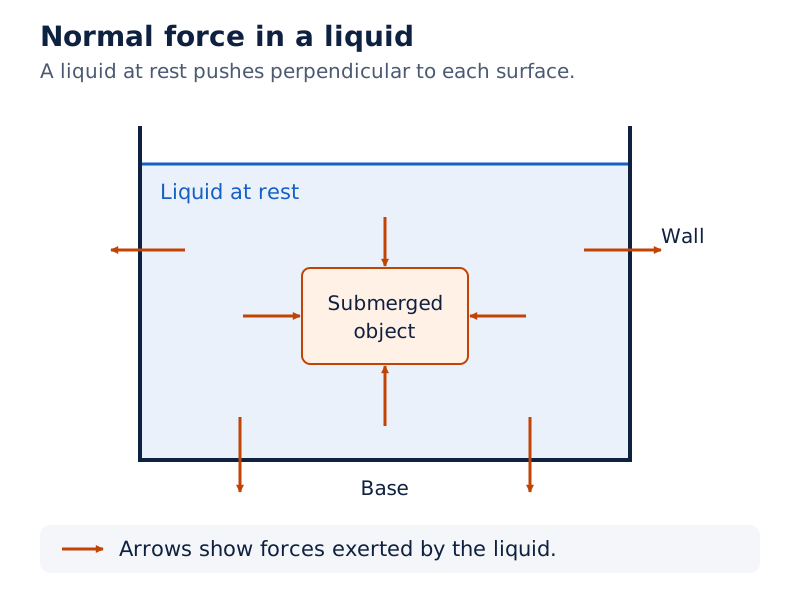
A beaker contains liquid and a small submerged object. Arrows at the object and container indicate forces perpendicular to the surfaces on which they act.
Drawn by One Young India.
What remains equal at a particular level?
At a point in a fluid at rest, pressure is the same in all directions. Within the same connected liquid in equilibrium, pressure is also the same at points in a horizontal plane. Equilibrium means that the forces are balanced and do not produce acceleration.
Consider a small horizontal portion of the liquid with equal end areas. If one end had greater pressure than the other, its force would be greater. The resulting unbalanced horizontal force would make the liquid move.
Equal pressure at equal depth does not mean equal force on unequal areas. From F = PA, a larger area experiences a larger normal force when the pressure is the same. Keep the comparison of pressures separate from the comparison of forces.
These statements concern a fluid at rest. They should not be transferred without qualification to a rapidly moving fluid. The condition of rest is part of the explanation, not an optional detail to leave out.
How is the liquid-pressure formula derived?
What forces act on an imaginary liquid column?
Imagine a vertical cylindrical portion of a stationary liquid. Its height is h and its cross-sectional area is A. A cross-section is the area exposed by a cut perpendicular to the cylinder’s length. Assume density ρ and g remain constant over this height.
Let P₁ be the pressure on the upper face and P₂ the pressure on the lower face. The upper pressure produces a downward force P₁A; the lower pressure produces an upward force P₂A. The column’s weight mg acts downwards.
What the figure shows
A vertical liquid column
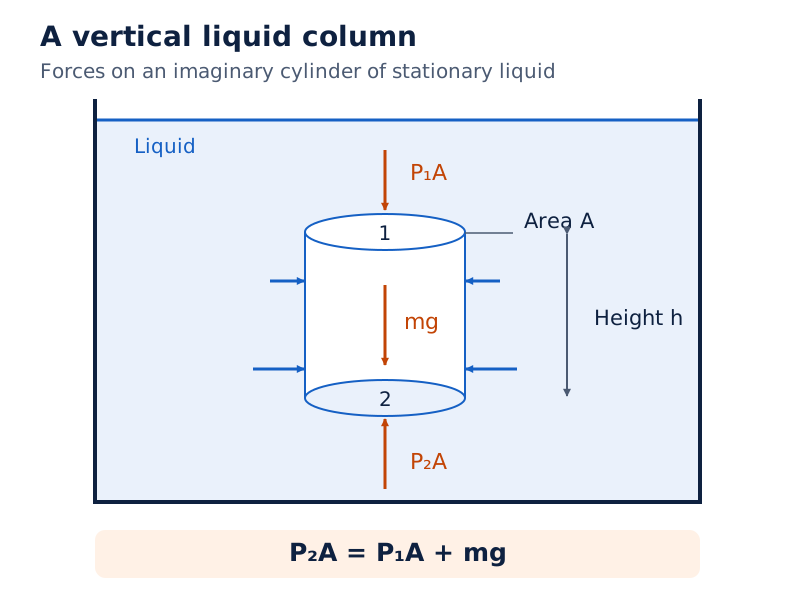
A cylinder is marked inside a liquid-filled vessel. Its upper and lower faces are labelled 1 and 2, its vertical height is h, and its weight mg points downwards. Pressure-force arrows act on its surfaces.
Drawn by One Young India.
Derivation: Pressure difference across a stationary column
- The column has volume V = Ah, because its cross-sectional area is multiplied by its vertical height.
- Its mass is m = ρAh, obtained by multiplying density by volume.
- Vertical equilibrium requires the upward force to balance both downward forces: P₂A = P₁A + mg.
- Substitute m = ρAh to obtain (P₂ − P₁)A = ρAhg. Divide both sides by the same area A.
P₂ − P₁ = ρgh
Thus, the lower face has the greater pressure. The difference supplies the upward force needed to balance the liquid column’s own weight. The horizontal forces balance each other and do not support that weight.
What does p = hρg mean?
Use the lower-case symbol p for the pressure increase caused by the liquid column above a point. Then p = hρg, which is the same multiplication as ρgh. It gives the increase relative to the pressure at the upper reference level.
The area A cancels during the derivation. This cancellation explains why liquid-column pressure depends on height, density and gravitational acceleration, but not separately on the area of the imaginary column used to derive it.
Which factors change pressure inside a stationary liquid?
How do depth and density affect pressure?
For a liquid of constant density at a place where g is fixed, liquid-column pressure is directly proportional to depth. Direct proportion means that changing one quantity by a factor changes the other by the same factor.
Consequently, deeper points experience a greater pressure increase below the surface. This refers to vertical depth. Two points equally far along differently sloping walls need not have the same depth, while points in the same horizontal plane do.
At constant depth and g, liquid-column pressure is directly proportional to density. A denser liquid produces a greater pressure increase at the same depth. If the pressure acting at the two free surfaces differs, it must also be included before comparing total pressures.
| Factor | Condition for the comparison | Effect on liquid-column pressure |
|---|---|---|
| Greater vertical depth | Same liquid density and g | Pressure increase is greater |
| Greater liquid density | Same depth and g | Pressure increase is greater |
| Greater g | Same depth and density | Pressure increase is greater |
| Different vessel shape | Same depth, density and g | No change from shape alone |
Why are dams broader at the bottom?
A dam holds back water. The lower part of its wall faces greater water pressure because it is deeper below the surface. Making the lower region broader and stronger helps it withstand this greater pressure.
The relevant cause is the increase of pressure with depth. Saying simply that there is “more water” at the bottom fails to identify the physical quantity responsible. Even when vessel shape changes, vertical depth remains the relevant distance.
Why does pressure matter to divers?
A diver goes deeper into water and encounters a larger surrounding pressure. Protective equipment, including an appropriate diver’s suit, must be considered in relation to that pressure. The pressure acts from all directions rather than only from the water directly above the diver.
The same depth dependence explains why submarine structures must withstand large surrounding pressures. Pressure is a property of the surrounding liquid at that depth; the force on a particular surface also depends on its area.
Why can differently shaped vessels have equal bottom pressure?
What is the hydrostatic paradox?
Hydrostatic means concerned with fluids at rest. The hydrostatic paradox is the result that vessels holding different amounts of the same liquid can have equal pressure at the same depth, even though their shapes and contained volumes differ.
The conditions matter: compare the same liquid, the same vertical depth, the same g and the same pressure on the free surfaces. A free surface is the exposed upper surface of the liquid. Under these conditions, the pressure formula gives the same result.
What the figure shows
Connected vessels of different shapes
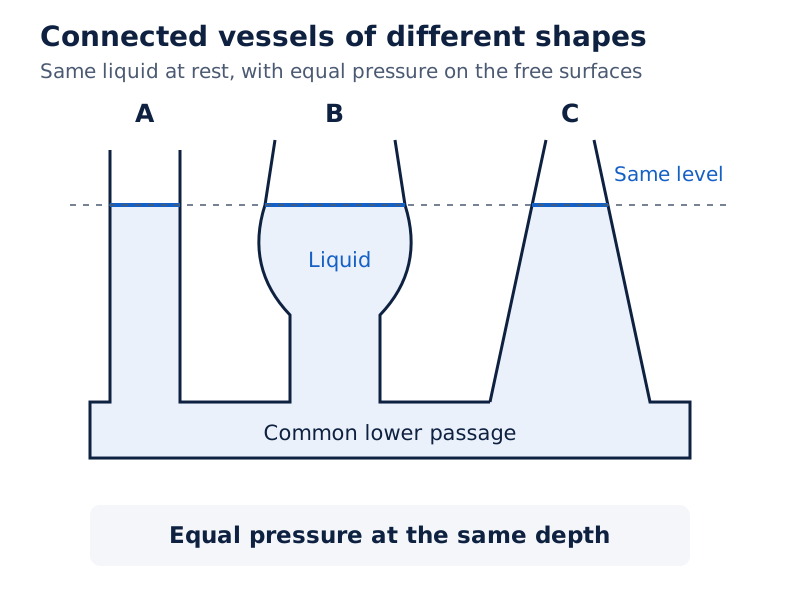
Three differently shaped vessels labelled A, B and C connect through a common lower passage. The blue liquid reaches the same horizontal level in all three vessels despite their different widths and shapes.
Drawn by One Young India.
Why do connected liquid surfaces reach one level?
When communicating vessels contain the same stationary liquid and their free surfaces are subject to equal pressure, the liquid settles to a common height. The pressure at their connected lower level must agree throughout the liquid.
If one surface stood higher, the liquid column under it would produce a greater pressure at the common lower level. The resulting difference would cause motion. Equal surface heights are therefore consistent with the condition of rest.
Do not replace pressure with total liquid weight in this argument. Different vessel shapes can contain different masses of liquid while preserving the same depth. The pressure comparison is made at a specified level, rather than between the complete contents of the vessels.
Likewise, equal bottom pressure does not by itself establish equal bottom force. To compare the forces, use the areas of the bottom surfaces as well as the common pressure. The relation between pressure and force remains F = PA.
How do liquid-column pressure and total pressure differ?
What pressure is already present at the surface?
The surface of an open lake is exposed to the atmosphere, the surrounding envelope of air. Atmospheric pressure is the pressure exerted by that air. It provides a surface pressure before the extra effect of the water’s weight is included.
Let P₀ denote the pressure at the liquid surface and P the total pressure at depth h. Then P = P₀ + ρgh. Total pressure measured relative to zero pressure is called absolute pressure.
Gauge pressure is the excess above the surrounding atmospheric pressure. In an open liquid with atmospheric pressure P₀ at its surface, gauge pressure at depth h equals P − P₀, or ρgh. It is not the whole absolute pressure.
Worked example 2. Find the total pressure on a swimmer 10 m below a lake surface. Water density is 1000 kg/m³, g = 10 m/s², and surface pressure is 1.01 × 10⁵ Pa.
Formula: p = ρgh; P = P₀ + p.
Substitute: p = 1000 × 10 × 10 = 1.00 × 10⁵ Pa. P = 1.01 × 10⁵ + 1.00 × 10⁵.
Answer: The total pressure is 2.01 × 10⁵ Pa, or 201000 Pa. The increase caused by the water alone is 1.00 × 10⁵ Pa.
How should the answer be interpreted?
The swimmer’s absolute pressure is approximately twice the surface pressure. The water-column contribution is approximately equal to the surface pressure. Distinguish the final pressure from the amount by which it has increased.
The two values have the same unit, Pa, but answer different questions. If asked for pressure “due to the liquid column”, use ρgh. If asked for total pressure, add the stated surface pressure to that contribution.
Note: The relation p = hρg does not mean that total pressure vanishes at the free surface. At zero depth, the liquid-column contribution vanishes; the applied surface pressure remains.
How can pressure differences determine the force on a window?
What changes at a large depth?
A submarine-window calculation combines liquid pressure with force per unit area. The seawater presses on the outside while air presses on the inside. The force relevant to their combined effect comes from the pressure difference across the window.
Use the following data for all three parts: depth 1000 m, seawater density 1.03 × 10³ kg/m³, g = 10 m/s², and sea-surface pressure 1.01 × 10⁵ Pa. The submarine’s interior is maintained at that same surface pressure.
Worked example 3. Calculate the absolute seawater pressure at 1000 m depth, using density 1.03 × 10³ kg/m³, g = 10 m/s² and surface pressure 1.01 × 10⁵ Pa.
Formula: p = ρgh; P = P₀ + p.
Substitute: p = 1.03 × 10³ × 10 × 1000 = 1.03 × 10⁷ Pa. P = 1.01 × 10⁵ + 1.03 × 10⁷.
Answer: P = 1.0401 × 10⁷ Pa, or 10401000 Pa.
Worked example 4. Calculate the gauge pressure at the same ocean depth of 1000 m. Take seawater density 1.03 × 10³ kg/m³ and g = 10 m/s².
Formula: p = ρgh.
Substitute: p = 1.03 × 10³ × 10 × 1000.
Answer: The gauge pressure is 1.03 × 10⁷ Pa, or 10300000 Pa.
Which pressure produces the net force?
Let ΔP, read “delta P”, denote the outside pressure minus the inside pressure. The symbol Δ indicates a difference. Since the same atmospheric contribution acts on both sides here, it cancels, leaving ΔP = ρgh.
Worked example 5. A submarine window measures 20 cm × 20 cm. The submarine is 1000 m deep in seawater of density 1.03 × 10³ kg/m³; g = 10 m/s². Interior pressure equals sea-surface pressure. Find the net inward force.
Formula: ΔP = ρgh; F = ΔPA.
Substitute: A = 0.20 × 0.20 = 0.04 m². ΔP = 1.03 × 10⁷ Pa. F = 1.03 × 10⁷ × 0.04.
Answer: The net force is 4.12 × 10⁵ N, or 412000 N, directed inwards.
Multiplying the outside absolute pressure by area gives the outside force alone. It does not account for the opposing inside force. State whether the question seeks one side’s force or the net force, meaning the resultant of both opposing forces.
How does Pascal’s law explain pressure transmission?
What happens when pressure is applied to a confined liquid?
Pascal’s law states that external pressure applied to a fluid confined in a vessel is transmitted equally and without diminution in all directions. “Without diminution” means without a decrease in the applied pressure.
The transmitted quantity is pressure, not an identical force on every surface. A confined liquid can transmit the same applied pressure to different areas. The corresponding forces depend on those areas through F = PA.
What the figure shows
Transmission of applied pressure
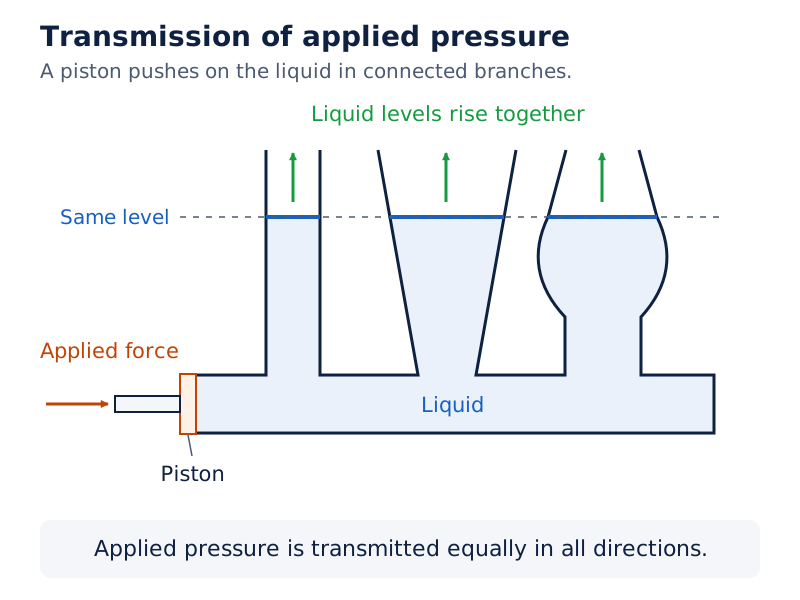
A horizontal liquid-filled passage has a piston at its left end and three differently shaped upright branches. The liquid surfaces in the branches lie at the same horizontal level. The piston provides the applied pressure.
Drawn by One Young India.
A piston is a movable close-fitting plug that can push on the fluid within a cylinder. In the connected-vessel arrangement, pushing it increases the pressure throughout the liquid. The levels in the upright branches rise together to a common height.
Derivation: Force ratio for equal transmitted pressure
Let F₁ and A₁ be the applied force and area of one piston, and F₂ and A₂ the force and area of another. Compare the transmitted pressure contribution, with common background pressure accounted for.
- The first piston applies pressure P = F₁/A₁ to the confined liquid.
- Pascal’s law gives the same transmitted pressure at the second piston, so P = F₂/A₂.
- Equate the two ratios, then multiply by A₂ to express the second force.
F₂ = F₁A₂/A₁
A larger output area gives a larger force for the same pressure. This conclusion does not contradict equal pressure transmission: equal ratios of force to area can contain unequal forces and unequal areas.
How do connected syringes illustrate the law?
Worked example 6. Two water-filled syringes without needles are joined by a tightly fitted water-filled rubber tube. Their piston diameters are 1.0 cm and 3.0 cm. Find the force on the larger piston when 10 N acts on the smaller piston. Ignore any difference in liquid-column pressure; atmospheric pressure is common to both pistons.
Formula: F₂ = F₁A₂/A₁. For circular pistons, A = πd²/4, where d is diameter and π is the constant relating a circle’s circumference to its diameter.
Substitute: A₂/A₁ = (3.0/1.0)² = 9. Therefore F₂ = 10 × 9.
Answer: The larger piston experiences 90 N from the transmitted applied pressure.
Use the square of the diameter ratio, because pressure depends on area. Comparing diameters directly would overlook the two-dimensional nature of each circular surface. Both diameters may remain in centimetres here because their identical units cancel within the ratio.
How much applied force balances a heavier load?
Worked example 7. A car of mass 1350 kg is supported by a large piston of radius 15 cm. The connected small piston has radius 5.0 cm. Find the applied force and pressure needed to support the car, taking g = 9.8 m/s² and neglecting liquid-column pressure differences.
Formula: F₂ = mg; F₁ = F₂A₁/A₂; P = F₁/A₁. Circular area A = πr², where r is the radius, the distance from the circle’s centre to its edge.
Substitute: F₂ = 1350 × 9.8 = 13230 N. The area ratio A₁/A₂ = (5.0/15)² = 1/9, so F₁ = 13230/9 = 1470 N. P = 1470/[π × (0.050)²].
Answer: The small-piston force is 1470 N, approximately 1.5 × 10³ N. The required applied pressure is approximately 1.9 × 10⁵ Pa, or 190000 Pa.
Hydraulic lifts and hydraulic brakes are examples of devices based on Pascal’s law. Their shared physical principle is the transmission of applied pressure through a confined liquid.
Glossary
- Fluid — A substance, such as a liquid or gas, that can flow and has no fixed shape of its own.
- Thrust — The force acting perpendicular to a surface, measured in newtons.
- Pressure — Normal force per unit area of the surface on which it acts.
- Pascal — The SI unit of pressure, equal to one newton per square metre.
- Density — Mass per unit volume of a substance, measured in kilograms per cubic metre.
- Weight — The gravitational force acting on a body, equal to its mass multiplied by gravitational acceleration.
- Equilibrium — A condition in which forces balance, so there is no resulting acceleration.
- Vertical depth — The downward vertical distance from a chosen reference level to a point in a fluid.
- Free surface — The exposed upper surface of a liquid, on which the surrounding pressure acts.
- Absolute pressure — Total pressure at a point measured relative to zero pressure.
- Gauge pressure — The excess of a system’s pressure above the surrounding atmospheric pressure.
- Hydrostatic paradox — Equal pressure at equal depths in the same stationary liquid despite differences in vessel shape and contained volume.
- Pascal’s law — Applied pressure in a confined fluid is transmitted equally and undiminished in all directions.
- Piston — A close-fitting movable plug inside a cylinder that can exert force on a fluid.
Common errors and misconceptions
- Misconception: Thrust and pressure are the same quantity. Correct: Thrust is a force, measured in N; pressure is normal force per area, measured in Pa.
- Misconception: A liquid pushes only downwards. Correct: A stationary liquid exerts normal forces on the sides, base and immersed surfaces; pressure at a point is the same in all directions.
- Misconception: Liquid pressure depends on the shape of the container. Correct: At fixed density, depth, g and surface pressure, changing vessel shape does not change the pressure at that depth.
- Misconception: The distance along a sloping wall is h in p = hρg. Correct: The required distance is vertical depth below the chosen reference level.
- Misconception: The expression ρgh gives total pressure in an open lake. Correct: It gives the liquid-column contribution; add the surface pressure to obtain total pressure.
- Misconception: Equal transmitted pressure means equal forces on all pistons. Correct: Forces are proportional to piston areas when the transmitted pressure is equal.
- Misconception: A square centimetre equals one hundredth of a square metre. Correct: Area requires squaring the length conversion, so 1 cm² = 10⁻⁴ m².
- Misconception: Liquids cannot change volume under any pressure. Correct: Liquids are largely incompressible; treating density as constant is an approximation appropriate to these calculations.
Exam-style questions with model answers
Q1. Define thrust and pressure, giving the SI unit of each. [2 marks]
- Thrust is the force acting perpendicular to a surface. Its SI unit is the newton, N.
- Pressure is normal force per unit area. Its SI unit is the pascal, Pa, equal to N/m².
Q2. Explain why liquid pressure acts on container walls and why pressure is equal at the same horizontal level in a connected liquid at rest. [3 marks]
- A liquid at rest exerts contact forces normal to surfaces. Its pressure therefore produces horizontal forces on vertical container walls as well as vertical forces on a horizontal base.
- Consider a small horizontal portion of liquid with equal areas at its ends. Unequal end pressures would produce unequal opposing forces.
- The resulting force would set the liquid moving. Since the connected liquid is at rest, those pressures must be equal at the same horizontal level.
Q3. Two femurs, each of cross-sectional area 10 cm², support an upper-body mass of 40 kg. Find the average pressure, taking g = 10 m/s². [3 marks]
- The supported weight supplies the normal force. With mass m = 40 kg and acceleration due to gravity g = 10 m/s², the force is F = mg = 400 N.
- Both bones support the stated mass, so use their combined area: A = 2 × 10 cm² = 20 × 10⁻⁴ m² = 0.002 m².
- The average pressure is force divided by combined area: P = F/A = 400/0.002 = 2 × 10⁵ Pa.
Q4. Derive the pressure difference across a stationary liquid column of height h, area A and constant density ρ, taking gravitational acceleration g as constant. Define any additional symbols used. [5 marks]
- Let P₁ be the upper-face pressure and P₂ the lower-face pressure. The chosen cylindrical liquid column has cross-sectional area A and vertical height h.
- Its volume is V = Ah, where V denotes volume. Its mass is m = ρV = ρAh, where m denotes mass.
- The pressure force on the lower face is P₂A upwards. The upper-face pressure force P₁A and the column’s weight mg both act downwards.
- Because the column is stationary, the vertical forces balance: P₂A = P₁A + mg. Rearranging gives (P₂ − P₁)A = mg.
- Substitute m = ρAh and cancel the area A. Therefore P₂ − P₁ = ρgh, so pressure increases with vertical depth under the stated conditions.
Q5. A swimmer is 10 m below a lake surface. Given water density 1000 kg/m³, g = 10 m/s² and surface pressure 1.01 × 10⁵ Pa, calculate the water-column contribution and total pressure. [3 marks]
- The water-column contribution is p = ρgh, where ρ is density, g is gravitational acceleration and h is vertical depth. Hence p = 1000 × 10 × 10 = 1.00 × 10⁵ Pa.
- Total pressure includes the surface pressure P₀ as well as the water-column contribution: P = P₀ + p = 1.01 × 10⁵ + 1.00 × 10⁵.
- Thus P = 2.01 × 10⁵ Pa. The water-column contribution is 1.00 × 10⁵ Pa, which is smaller than the total because surface pressure is also present.
Q6. A submarine is 1000 m deep in seawater of density 1.03 × 10³ kg/m³. Its window measures 20 cm × 20 cm. Take g = 10 m/s² and both sea-surface and interior pressure as 1.01 × 10⁵ Pa. Find the absolute outside pressure and net window force. [5 marks]
- The additional pressure caused by seawater is p = ρgh, where the symbols represent density, gravitational acceleration and depth. Substitution gives p = 1.03 × 10³ × 10 × 1000 = 1.03 × 10⁷ Pa.
- The absolute outside pressure includes sea-surface pressure: P = 1.01 × 10⁵ + 1.03 × 10⁷ = 1.0401 × 10⁷ Pa.
- The inside air opposes the outside force. The pressure difference ΔP is outside minus inside pressure, giving ΔP = 1.03 × 10⁷ Pa.
- Convert both window dimensions to metres. The window area is A = 0.20 × 0.20 = 0.04 m².
- The net force is F = ΔPA = 1.03 × 10⁷ × 0.04 = 4.12 × 10⁵ N. It acts inwards because outside pressure is greater.
Q7. State Pascal’s law and calculate the force on a 3.0 cm diameter syringe piston when 10 N acts on a connected 1.0 cm diameter piston. Both syringes and their connecting tube contain water; ignore liquid-column pressure differences and take atmospheric pressure as common to both pistons. [4 marks]
- Pascal’s law states that pressure applied to a confined fluid is transmitted equally and without diminution in all directions.
- Let F₁ and F₂ be the applied and transmitted forces, and A₁ and A₂ their piston areas. Equal transmitted pressure gives F₁/A₁ = F₂/A₂.
- Circular area is proportional to diameter squared. Therefore A₂/A₁ = (3.0/1.0)² = 9, using the given diameters in the same units.
- The larger-piston force is F₂ = F₁A₂/A₁ = 10 × 9 = 90 N. The larger force results from the larger area at the same transmitted pressure.
Q8. Explain why a dam is broader at its base and why changing vessel shape alone cannot change liquid pressure at a fixed depth. Assume the same liquid, g and surface pressure. [3 marks]
- The pressure increase below a liquid surface is p = ρgh, where ρ is liquid density, g is gravitational acceleration and h is vertical depth.
- The bottom of a dam is deeper below the water surface than its upper region. It therefore experiences greater pressure, which the broader, stronger base helps withstand.
- Vessel shape does not appear in the pressure expression. With depth, density, g and surface pressure unchanged, the pressure remains the same despite a different container shape.
Key takeaways
- Thrust is a normal force; pressure is that force divided by area, with SI unit pascal.
- For a fixed normal force, spreading the force over a larger contact area reduces pressure.
- A liquid at rest exerts normal forces on surfaces, and pressure at a point is equal in all directions.
- Liquid-column pressure equals hρg, using vertical depth, liquid density and acceleration due to gravity.
- At equal depth in the same connected stationary liquid, pressure is equal despite differences in vessel shape.
- Total pressure includes the surface pressure; the liquid-column expression supplies the increase below that surface.
- The net force across a window depends on the pressure difference between its two sides and its area.
- Pascal’s law transmits applied pressure equally; different piston areas can therefore experience different forces.
Test yourself
Why is a liquid called a fluid?
A liquid can flow and has no fixed shape of its own; gases are fluids for the same reason.
What does one pascal mean?
One pascal is one newton of normal force per square metre of surface area.
What is h in the expression p = hρg?
It is the vertical depth below the reference level, not a distance measured along a sloping wall.
Why is constant liquid density an approximation?
Liquids are largely incompressible, but their volumes and densities can change slightly with pressure.
Does equal pressure imply equal forces on unequal areas?
No. Force equals pressure multiplied by area, so the larger area experiences the larger force.
What must be added to liquid-column pressure to obtain total pressure?
Add the pressure acting at the liquid surface to the increase produced by the liquid column.
Why does the sea-surface pressure cancel in the submarine-window calculation?
The same sea-surface pressure is maintained inside, so it cancels when inside pressure is subtracted from outside pressure.
Which quantity remains undiminished in Pascal’s law?
The applied pressure is transmitted undiminished through the confined fluid; forces depend on the receiving areas.
Try it
Pressure in Fluids: ICSE Class 9 Physics Study Guide
Explore how Pascal's law and hydraulic systems apply fluid pressure principles to lift heavy loads.
1A mechanic is using a hydraulic lift where the input piston has an area of 5 cm² and the output piston has an area of 100 cm². If a force of 20 N is applied to the input piston, how does the system behave according to Pascal's law?
According to Pascal's law, pressure applied to an enclosed fluid is transmitted undiminished. The applied pressure is 20 N / 5 cm² = 4 N/cm², which on a 100 cm² piston generates 4 N/cm² * 100 cm² = 400 N.
Pascal's law states that pressure is transmitted undiminished across the fluid (P₁ = P₂), so pressure remains 4 N/cm² rather than multiplying.
Because pressure remains constant and force is distributed over a larger area (F₂ / A₂ = F₁ / A₁), the output force is amplified to 400 N.
2While the hydraulic system multiplies the input force by 20 times (from 20 N to 400 N), what happens to the distance moved by the output piston?
Although fluid pressure transmits equally, work input must equal work output in a hydraulic system.
In hydraulic systems, work input equals work output; therefore, gaining a larger output force means the output piston moves a smaller distance.
Mechanical advantage multiplies force, but to conserve work, force is traded for distance, making the output piston move less.
You have explored how Pascal's law enables force multiplication in hydraulic systems while conserving work by trading force for distance.