
Motion in One Dimension | ICSE Class 9 Physics Notes
On this page
Watch & explore
Start with a few high-quality watches, then dive into the notes below.
Try an idea before you read. Explore key 1D motion concepts, sign conventions, and graph interpretations through a 2-step scenario. Explore →
This note covers rest and motion, scalar and vector quantities, distance and displacement, speed and velocity, acceleration and retardation, distance-time and velocity-time graphs, graphical derivations of the equations of uniformly accelerated motion, numerical problems, and motion under gravity.
What are rest and motion in one dimension?
Motion in one dimension is motion along a straight line. A vertically falling ball, a car on a straight stretch of highway and a train on a straight track are examples. The line may be horizontal, vertical or inclined.
To describe motion, first choose a reference point. The distance and direction of an object from this point specify its position at a particular instant. A statement about position is incomplete unless its reference point is understood.
Definition: An object is in motion when its position relative to a reference point changes with time. It is at rest when that position does not change with time.
How are direction and time recorded?
Mark the reference point as the origin. For a horizontal line, positions to its right may be positive and positions to its left negative. For vertical motion, either upward or downward may be chosen positive. Keep the choice unchanged throughout a calculation.
An instant is a particular clock reading. A time interval is the duration between two readings. The SI unit of time is the second, written s. Use the difference between clock readings when calculating the duration of a motion.
Rest must therefore be described relative to the chosen reference. An object on the Earth can remain fixed relative to its surroundings even though the Earth moves around the Sun. The reference used determines which change of position is being described.
For straight-line motion, only two opposite directions are possible. A body can turn back and still move in one dimension, provided its entire motion remains on the same straight line.
How do scalar and vector quantities differ?
A scalar quantity is specified by its magnitude, with an appropriate unit. A vector quantity requires both magnitude and direction. Magnitude expresses the numerical size of the quantity with its unit; it does not specify which way the quantity acts or points.
Distance, time and speed are scalar quantities. Displacement, velocity and acceleration are vector quantities. In one dimension, a positive or negative sign can express a vector's direction after the positive direction has been chosen.
| Quantity | Type | Information represented |
|---|---|---|
| Distance | Scalar | Total length of the path travelled |
| Displacement | Vector | Net change of position, including direction |
| Speed | Scalar | How fast distance is covered |
| Velocity | Vector | How fast position changes and in which direction |
| Acceleration | Vector | How fast velocity changes and the direction of that change |
What does a negative sign mean?
A negative velocity indicates motion opposite to the chosen positive direction. It does not, by itself, mean that the object is slowing down. Likewise, the sign of acceleration identifies its direction, rather than directly identifying an increase or decrease in speed.
Compare the directions of velocity and acceleration to decide whether speed increases or decreases. Acceleration in the direction of velocity increases speed. Acceleration opposite to velocity decreases speed. This distinction is especially useful when a ball rises and then falls.
Note: Changing the chosen positive direction changes the signs used to describe a motion. It does not change the physical motion itself. State the direction convention before substituting signed quantities.
Why are distance and displacement different?
Distance travelled is the total length of the actual path. Displacement is the net change from the initial position to the final position, with direction. The SI unit of distance is the metre, written m. The SI unit of displacement is also the metre.
Let x₁ denote the initial position, x₂ the final position, and S the displacement along the chosen positive direction. Then S = x₂ − x₁. Capital S denotes displacement throughout the equations below, while the unit symbol s denotes seconds.
What happens when an athlete turns back?
An athlete starts at O, the origin, runs to A at 100 m and returns to B at 40 m. The outward journey is 100 m and the return portion is 60 m. Her total distance is 160 m, while her displacement is +40 m.
What the figure shows
Athlete's outward and return journey
The straight scale marks O at 0 m, B at 40 m and A at 100 m. A path arrow goes to A and returns to B; a separate displacement arrow points directly from O to B.
The magnitude of displacement cannot exceed distance travelled. They are equal when the object moves along a straight line without turning back. If it returns to the starting position, displacement is zero even though a non-zero distance has been covered.
| Comparison | Distance | Displacement |
|---|---|---|
| Dependence | Depends on the whole route | Depends on initial and final positions |
| Direction | No direction is required | Direction must be specified |
| Complete return journey | Counts the outward and return paths | Becomes zero on returning to the start |
| Straight motion without reversal | Equals the displacement magnitude | Has magnitude equal to distance |
Do not subtract the return distance when finding total distance. Subtraction belongs to the calculation of displacement because the return motion is opposite to the outward direction. Keep the two questions, path length and net position change, separate.
How are speed and velocity calculated?
Average speed describes total distance covered per unit time. Average velocity describes displacement per unit time. Let d be total distance, t the time interval and vₐᵥ the average velocity. The formulas are Average speed = d/t and vₐᵥ = S/t.
The SI unit of speed is metre per second, written m/s. The SI unit of velocity is also metre per second. Kilometres per hour, written km/h, must be converted before combining a speed with quantities expressed in metres and seconds.
One kilometre is 1000 m and one hour is 3600 s. Therefore, 1 m/s = 3.6 km/h. Multiply a numerical speed in km/h by 5/18 to obtain its value in m/s.
How do uniform motion and averages differ?
In uniform motion along a straight line, equal distances are covered in equal time intervals, however small those intervals are. With no change of direction, velocity remains constant. Unequal distances in equal intervals indicate non-uniform motion.
An average describes an entire interval. It need not equal the speed or velocity at a particular instant. For motion in one direction along a straight line, average speed equals the magnitude of average velocity. A return journey can make these values very different.
Worked example 1. Two postmen begin 210 yojanas apart and walk towards each other. One covers 9 yojanas per day and the other 5 yojanas per day. Find when they meet.
Answer: Together they cover 9 + 5 = 14 yojanas per day. The meeting time is 210 ÷ 14 = 15 days. Their respective distances are 135 yojanas and 75 yojanas.
The yojana is a historical Indian distance unit. The speed-distance-time idea appears in the Aryabhatiya of the 5th century CE; this postmen problem comes from the Ganitakaumudi of the 14th century CE. SI units are used in the modern numerical examples below.
Worked example 2. Sarang swims from one end of a 25 m pool to the other and back in 50 s. Find his average speed and average velocity.
Formula: Let L be the pool length. Then d = 2L; average speed = d/t; vₐᵥ = S/t.
Substitute: d = 2 × 25 = 50 m; t = 50 s; S = 0 m because he returns to the start.
Answer: Average speed = 50/50 = 1 m/s. Average velocity = 0/50 = 0 m/s. Zero average velocity does not imply that Sarang remained at rest.
What are acceleration and retardation?
Acceleration measures the rate of change of velocity. Let u be initial velocity, v final velocity, a acceleration and t the elapsed time. For constant acceleration, a = (v − u)/t. Over an interval, the same ratio gives average acceleration.
The SI unit of acceleration is metre per second squared, written m/s². An acceleration of 1 m/s² means that velocity changes by 1 m/s in each second. Acceleration is a vector, so its direction matters.
Uniform acceleration means equal changes of velocity in equal time intervals, however small the intervals. The velocity may increase or decrease. A body moving at constant velocity has zero acceleration, even if its speed is high.
When does acceleration reduce speed?
Retardation, or deceleration, is acceleration that opposes velocity and reduces speed. When forward motion is positive, a slowing vehicle has negative acceleration. The magnitude of retardation is stated as a positive value, while the signed acceleration is used in equations.
Worked example 3. A bus on a straight highway increases its velocity from 36 km/h to 54 km/h in 10 s. After travelling at that steady velocity, it brakes from 54 km/h to rest in 5 s. Find the average acceleration in each changing-velocity interval.
Formula: a = (v − u)/t. Choose the original direction of travel as positive.
Substitute: 36 km/h = 10 m/s and 54 km/h = 15 m/s. During speeding up, a = (15 − 10)/10. During braking, a = (0 − 15)/5.
Answer: The two accelerations are +0.5 m/s² and −3 m/s². The braking acceleration is opposite to the bus's velocity; its retardation has magnitude 3 m/s².
The interval of steady motion has zero acceleration because the initial and final velocities within that interval are equal. Its duration is not needed to calculate the accelerations during the two separate intervals given in the problem.
How do distance-time and position-time graphs describe motion?
A distance-time graph plots cumulative distance vertically and time horizontally. A position-time graph plots position from an origin instead. For motion from the origin in the positive direction without reversal, the two graphs coincide.
Do not treat either graph as a picture of the route. A curved graph can represent motion along a straight road: the curve shows how the plotted quantity changes with time, not the shape of the road.
How is a graph plotted and read?
- Draw perpendicular axes and mark the origin.
- Put time on the horizontal axis and distance or position on the vertical axis, with units.
- Choose convenient scales that include the whole set of values.
- Plot each paired time and distance or position reading accurately.
- Join the plotted points with the straight line or smooth curve appropriate to the motion.
The slope is vertical change divided by horizontal change. A straight distance-time graph gives constant speed; a horizontal line gives zero speed. For the same axis scales, a steeper straight line indicates a greater speed.
For a position-time graph, let t₁ and t₂ be two clock readings and x₁ and x₂ the corresponding positions. The line joining those points gives vₐᵥ = (x₂ − x₁)/(t₂ − t₁). For uniform motion this is also the constant velocity.
For example, positions of 40 m at 2 s and 80 m at 4 s give velocity (80 − 40)/(4 − 2) = 20 m/s. Use changes in both quantities, rather than dividing one position reading by one clock reading indiscriminately.
Worked example 4. A vehicle starts from rest and has the following positions. Describe how to plot its position-time graph.
Time in s Position in m 0 0 2 1 4 4 6 9 8 16 10 25 12 36 Answer: Use five horizontal divisions for 2 s and five vertical divisions for 5 m. Plot all seven pairs. Join them with a smooth upward-curving line. The final listed point represents 36 m at 12 s; the increasing steepness shows increasing velocity.
What the figure shows
Increasing position with time
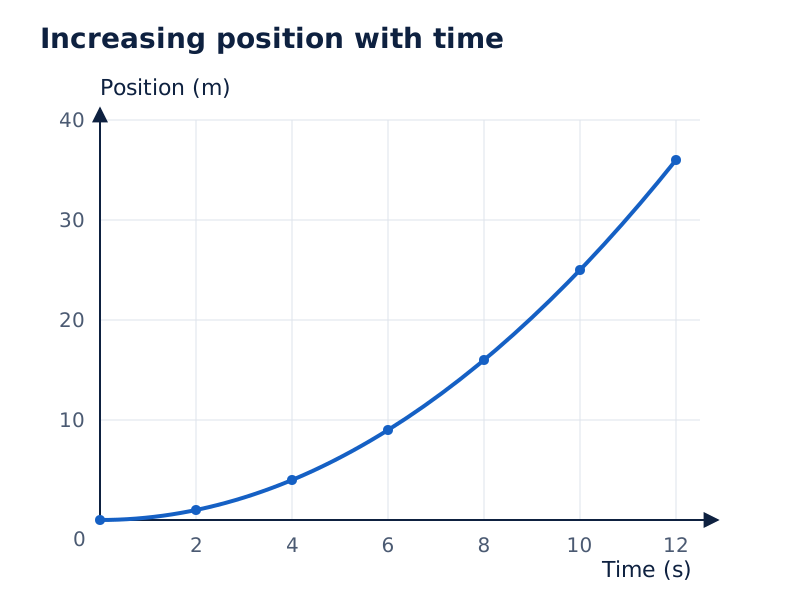
Time in seconds is on the horizontal axis and position in metres on the vertical axis. The curve starts at the origin and becomes progressively steeper as time increases.
Drawn by One Young India.
Worked example 5. A position-time graph is horizontal at 40 m throughout the time shown. Describe the motion.
Answer: The vehicle is at rest at a position 40 m from the origin. Its position does not change, so its displacement during this interval and its velocity are both zero.
Worked example 6. Objects A and B have straight position-time graphs on the same axes. Both lines rise from the origin, and B's line is steeper. Which has the greater velocity magnitude?
Answer: B has the greater velocity magnitude because it has the greater displacement in the same time interval. This comparison uses the slopes, not the lengths of the drawn lines.
What can be found from velocity-time and speed-time graphs?
A velocity-time graph has time horizontally and velocity vertically. Its height at an instant gives velocity. Its slope gives acceleration. The area between the graph and time axis over an interval gives displacement, with areas below the axis counted negatively.
A speed-time graph instead uses the non-negative magnitude of velocity. The area under it gives distance travelled. For motion in the positive direction without reversal, these two graphs have the same plotted values.
| Velocity-time line | Meaning | Acceleration |
|---|---|---|
| Horizontal above the time axis | Constant positive velocity | Zero |
| Straight and rising | Velocity increases by equal amounts in equal times | Constant and positive |
| Straight and falling while velocity is positive | The body slows down uniformly | Constant and negative |
| On the time axis | Velocity is zero throughout the interval | Zero within that interval |
What the figure shows
Three velocity-time patterns
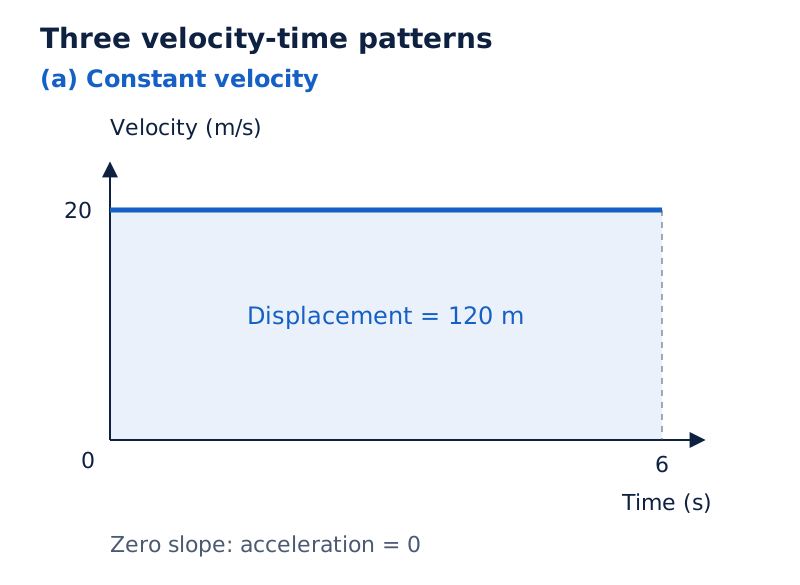
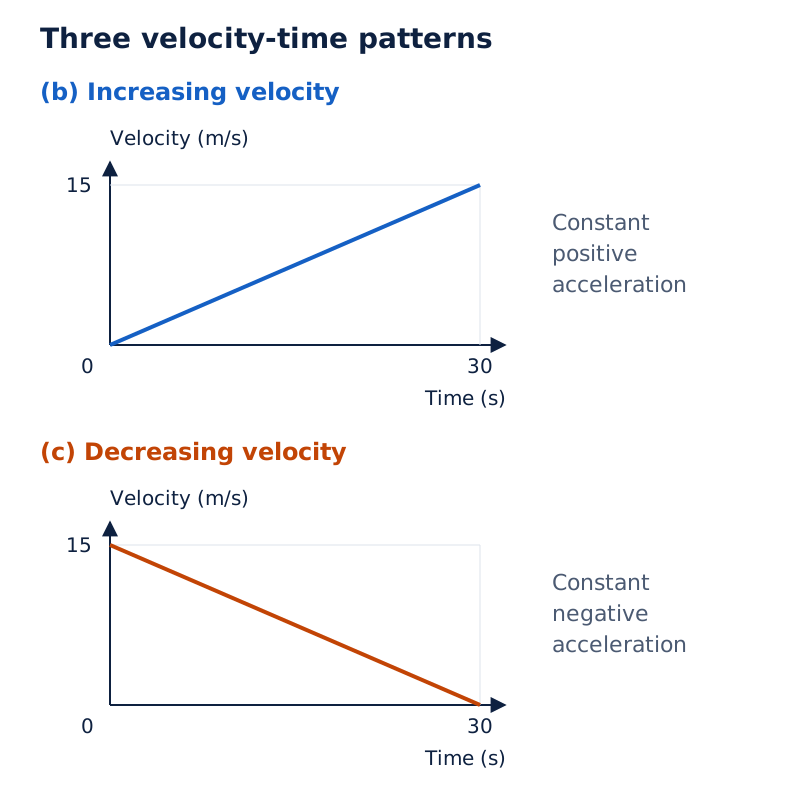
Panel (a) shows a horizontal line at 20 m/s. Panel (b) rises from zero to 15 m/s in 30 s. Panel (c) falls from 15 m/s to zero in 30 s.
Drawn by One Young India.
How are slope and area used together?
Worked example 7. A car moves at a constant velocity of 20 m/s for 6 s. Find its displacement from the area under its velocity-time graph.
Formula: For constant velocity, S = vt.
Substitute: S = 20 × 6.
Answer: The rectangular area represents 120 m of displacement. The graph has zero slope, so the acceleration is zero even though the displacement is not zero.
Worked example 8. A car's velocity increases uniformly from 5 m/s at 10 s to 10 m/s at 20 s. Find its acceleration and displacement during this interval.
Formula: Using t for the elapsed interval, a = (v − u)/t; S = ut + ½(v − u)t. The area consists of a rectangle and a triangle.
Substitute: t = 20 − 10 = 10 s; a = (10 − 5)/10; S = 5 × 10 + ½ × (10 − 5) × 10.
Answer: Acceleration = 0.5 m/s². Displacement = 50 + 25 = 75 m. The rectangular area represents the contribution from the initial velocity; the triangular area represents the additional displacement.
Check the physical units of each operation. A velocity change divided by time gives m/s². Velocity multiplied by time gives metres. This helps distinguish a slope calculation from an area calculation.
How are the first two equations derived graphically?
The equations of uniformly accelerated motion relate u, the initial velocity; v, the final velocity; a, the constant acceleration; t, the elapsed time; and S, the displacement. Their use requires constant acceleration throughout the interval considered.
Draw the velocity-time graph for positive initial velocity increasing uniformly. The construction below gives both the slope and the area. The resulting equations also apply with consistent signs when acceleration is negative.
What the figure shows
Graph for the equations of motion
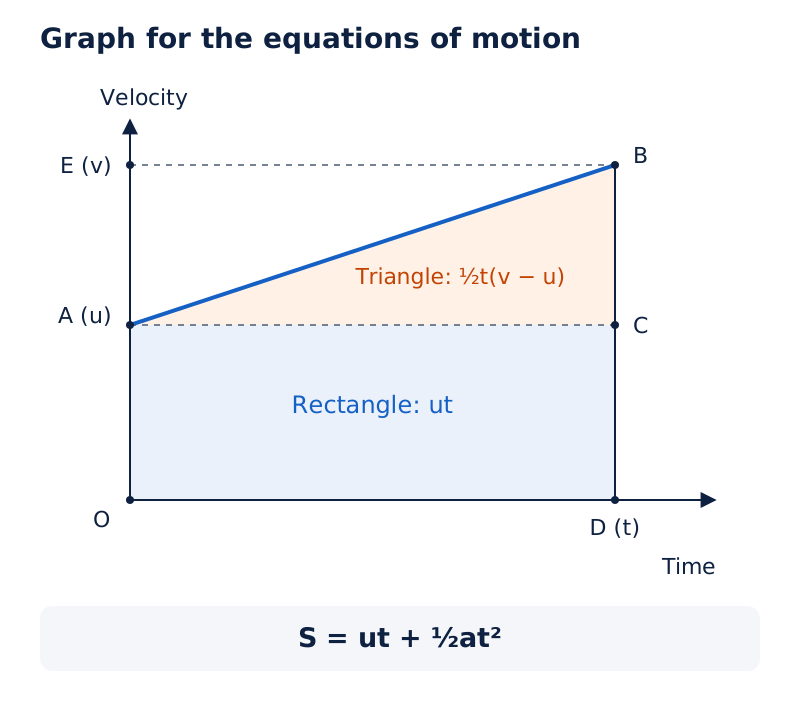
O is the origin. A lies on the velocity axis at u. B represents velocity v at time t. D lies directly below B on the time axis; C is where the horizontal through A meets BD. E lies on the velocity axis level with B.
Drawn by One Young India.
Derivation: How is final velocity related to time?
- The straight line AB has a constant slope, representing acceleration a.
- Its vertical rise BC is v − u, and its horizontal run AC is t.
- Therefore a = (v − u)/t, so at = v − u.
- Adding u to both sides gives the final velocity.
v = u + at
This equation says that final velocity is initial velocity plus the velocity change produced during the interval. The product at has units of velocity. If a is zero, the final and initial velocities are equal.
Derivation: How is displacement related to time?
- Displacement equals the area OABD between the velocity-time line and the time axis.
- Split this area into rectangle OACD and triangle ABC.
- The rectangle has area ut. The triangle has area ½ × t × (v − u).
- Substitute v − u = at into the triangular area and add the two contributions.
S = ut + ½at²
The term ut represents displacement associated with the initial velocity. The second term accounts for the effect of constant acceleration during the same interval. For a body starting from rest, u is zero and the first term vanishes.
How are the average-velocity and velocity-displacement equations derived?
The same velocity-time trapezium provides two more useful relations. One uses the mean of initial and final velocities; the other eliminates elapsed time. Both depend on the straight velocity-time line, and therefore on constant acceleration.
Derivation: How does trapezium area give displacement?
- In the preceding graph, OABD is a trapezium. Its parallel sides OA and DB have lengths representing u and v.
- The perpendicular separation of these parallel sides is OD, representing the time interval t.
- The area of a trapezium is half the sum of its parallel sides multiplied by their perpendicular separation.
- Since this graph area represents displacement, replace the lengths with their physical quantities.
S = ½(u + v)t
Dividing by t gives vₐᵥ = (u + v)/2 for uniformly accelerated motion. The endpoint mean works because velocity changes uniformly. For a general journey, calculate average velocity from total displacement divided by total elapsed time.
Derivation: How can time be eliminated?
- The slope of the same graph gives at = v − u.
- The trapezium area gives 2S = (u + v)t.
- Multiply this area equation by a and replace at with v − u.
- Then 2aS = (u + v)(v − u) = v² − u². Rearrange to obtain the required relation.
v² = u² + 2aS
This is useful when time is not given or requested. It connects the initial and final velocities with acceleration and displacement. It comes from the same graphical slope and area relations, rather than from an independent assumption about the motion.
When finding a velocity from its square, remember that the square alone does not specify direction. Use the physical situation and the chosen positive direction to assign the correct sign to the velocity.
How should equations be selected for numerical problems?
Begin by identifying the interval of motion. A journey can have successive stages with different accelerations. Apply a constant-acceleration equation separately to each suitable stage. The final velocity of one continuous stage becomes the initial velocity of the next.
| Equation | Quantity absent | Useful situation |
|---|---|---|
| v = u + at | Displacement | Velocity change and elapsed time |
| S = ut + ½at² | Final velocity | Displacement from initial conditions and time |
| S = ½(u + v)t | Acceleration | Displacement from endpoint velocities and time |
| v² = u² + 2aS | Time | Stopping distance from velocity and acceleration |
What steps keep a calculation consistent?
- Choose the positive direction and list the known quantities.
- Convert units to a consistent SI form before substitution.
- Identify the required unknown and select a suitable equation.
- Substitute signed values, calculate, and include the answer's unit.
- Check whether the result represents displacement, distance, velocity, speed or acceleration.
Worked example 9. A car brakes with constant acceleration −4 m/s² until it stops. Find its braking distance when its initial velocity is (i) 54 km/h and (ii) 108 km/h. Take the initial direction as positive.
Formula: v² = u² + 2aS. Rearranging gives S = (v² − u²)/(2a).
Substitute: v = 0 m/s, a = −4 m/s², and the initial velocities are 15 m/s and 30 m/s.
Answer: For 15 m/s, S = (0 − 225)/(−8) = 28.125 m, approximately 28.1 m. For 30 m/s, S = (0 − 900)/(−8) = 112.5 m.
The car does not reverse before stopping, so each positive displacement equals its braking distance. Doubling initial speed while keeping the same braking acceleration multiplies braking distance by four. This follows from the squared initial velocity in the equation.
Note: The calculated braking distance begins when braking starts. A driver's reaction time can add distance travelled before the brakes are applied. Do not include or assume a reaction time unless it is supplied.
How are the equations applied to motion under gravity?
Free fall is motion under gravity when air resistance is neglected. Near the Earth's surface, over heights small compared with the Earth's radius, gravitational acceleration can be treated as constant. Let g denote its magnitude, approximately 9.8 m/s².
Gravitational acceleration is downward both while an object rises and while it falls. Choosing downward as positive gives a = +g; choosing upward as positive gives a = −g. Use the value of g specified in a numerical question.
What happens to an object released from rest?
For a dropped object, initial velocity u is zero. Choosing downward positive gives v = gt and S = ½gt². These describe increasing downward velocity and downward displacement from the release point before impact.
Worked example 10. A dropped object's downward velocities at times 0 s, 1 s, 2 s, 3 s and 4 s are respectively 0, 9.8, 19.6, 29.4 and 39.2 m/s. Find its average acceleration in each successive second.
Formula: a = (v − u)/t, with t = 1 s for each interval.
Answer: The four calculations are (9.8 − 0)/1, (19.6 − 9.8)/1, (29.4 − 19.6)/1 and (39.2 − 29.4)/1. Each gives 9.8 m/s² downward. Equal velocity changes in equal intervals show uniform acceleration.
What the figure shows
A dropped object's increasing velocity
The origin is at the release point above a vertical scale. Successive marked positions carry times from 0 s to 4 s and downward velocities from 0 m/s to 39.2 m/s. The spacing between successive positions increases.
What happens during an upward throw?
An upward-moving ball slows because its velocity and gravitational acceleration are opposite. At the highest point, velocity is momentarily zero but acceleration remains downward. During the descent, velocity and acceleration point downward, so speed increases.
Worked example 11. A ball is thrown vertically upward at 20 m/s from a point 25 m above the ground. Neglect air resistance and use g = 10 m/s². Find its rise above the launch point and its time to reach the ground.
Formula: Take upward as positive. Use v² = u² + 2aS and v = u + at for the ascent, followed by S = ut + ½at² for the descent.
Substitute: During ascent, u = 20 m/s, v = 0 m/s and a = −10 m/s². Thus 0 = 400 − 20S, giving a rise of 20 m; 0 = 20 − 10t gives an ascent time of 2 s.
Answer: The highest point is 25 + 20 = 45 m above the ground. From there, u = 0 and S = −45 m. Therefore −45 = −5t², giving a descent time of 3 s. Total time = 2 + 3 = 5 s.
Keep the direction convention unchanged through the ascent and descent. Resetting elapsed time for a separate stage is legitimate when its initial velocity and displacement are also clearly identified. Distance travelled over the whole journey differs from the net displacement.
Glossary
- Reference point — A chosen fixed point relative to which an object's position is described.
- Rest — The condition in which position relative to a chosen reference point does not change with time.
- One-dimensional motion — Motion along a straight line, which may include a reversal of direction.
- Scalar — A physical quantity specified by its magnitude and appropriate unit without a direction.
- Vector — A physical quantity whose complete description requires both magnitude and direction.
- Distance — The total length of the actual path travelled during the interval considered.
- Displacement — The net change from initial to final position, including its direction.
- Average speed — Total distance travelled divided by the total time taken for that journey.
- Average velocity — Displacement during an interval divided by the duration of that interval.
- Uniform acceleration — Acceleration for which velocity changes by equal amounts in equal time intervals.
- Retardation — Acceleration directed opposite to velocity, causing the object's speed to decrease.
- Slope — The change in the vertical quantity divided by the corresponding horizontal change.
- Free fall — Motion under gravity when the effect of air resistance is neglected.
Common errors and misconceptions
- Misconception: Distance and displacement are interchangeable. Correct: Distance counts the complete path; displacement describes the net change of position and includes direction.
- Misconception: Zero average velocity means an object did not move. Correct: A return journey has zero displacement and average velocity, despite non-zero distance and average speed.
- Misconception: Negative acceleration always means slowing down. Correct: Speed decreases when acceleration opposes velocity. A negative sign specifies direction relative to the chosen axis.
- Misconception: A horizontal graph always means rest. Correct: A horizontal position-time line means rest; a horizontal velocity-time line above zero means constant positive velocity.
- Misconception: Velocity-time slope gives distance. Correct: Its slope gives acceleration, while its signed area gives displacement. Speed-time area gives distance.
- Misconception: The endpoint mean gives average velocity for every journey. Correct: Use that mean for constant acceleration; generally divide total displacement by total elapsed time.
- Misconception: Acceleration vanishes at the highest point of an upward throw. Correct: Velocity is momentarily zero there, but gravitational acceleration remains downward.
- Misconception: Speeds in km/h can be inserted directly beside times in seconds. Correct: Convert the speeds to m/s before using SI motion equations.
Exam-style questions with model answers
Q1. Distinguish between a scalar and a vector quantity. Give one example of each from motion. [2 marks]
- A scalar requires magnitude and a unit; distance is an example.
- A vector requires magnitude and direction; displacement is an example.
Q2. An athlete starts at 0 m, runs along a straight track to 100 m and returns to 40 m. Calculate her distance and displacement, taking the outward direction as positive. [3 marks]
- The outward distance is 100 m. The return portion is 100 − 40 = 60 m, so total distance travelled is 100 + 60 = 160 m.
- Displacement is final position minus initial position: 40 − 0 = +40 m, in the outward direction.
- Distance includes both portions of the path. Displacement depends on the starting and ending positions, so its magnitude is smaller here.
Q3. Sarang swims the length of a 25 m pool and returns to his starting point in 50 s. Calculate his average speed and average velocity, explaining their difference. [3 marks]
- Total distance is twice the pool length: 2 × 25 = 50 m. Average speed is total distance divided by time, so it is 50/50 = 1 m/s.
- The initial and final positions coincide. Displacement is therefore zero, and average velocity is 0/50 = 0 m/s.
- The values differ because speed uses the complete path length, whereas velocity uses net displacement over the same interval.
Q4. A bus increases its velocity from 36 km/h to 54 km/h in 10 s along a straight road. Later, it brakes from 54 km/h to rest in 5 s. Find the average acceleration in each interval. Take forward as positive. [4 marks]
- Converting to SI units gives 36 km/h = 10 m/s and 54 km/h = 15 m/s.
- Average acceleration is final velocity minus initial velocity divided by the time interval. During speeding up, it is (15 − 10)/10 = +0.5 m/s².
- During braking, it is (0 − 15)/5 = −3 m/s².
- The negative sign means that acceleration is backward, opposing the forward velocity. The magnitude of retardation is 3 m/s².
Q5. Describe the velocity-time graph for a body whose positive velocity increases uniformly from u at time zero to v after time t. Derive S = ut + ½at², defining a and S. [5 marks]
- Here a is constant acceleration and S is displacement during the time interval t.
- Plot time horizontally and velocity vertically. Join the initial point at velocity u to the final point at velocity v with a straight line.
- Its slope gives a = (v − u)/t, so v − u = at.
- The area beneath the line represents displacement. Split it into a rectangle of height u and width t, plus a triangle of base t and height v − u.
- Thus S = ut + ½t(v − u). Substituting v − u = at gives S = ut + ½at². The straight line and the derivation require constant acceleration throughout the interval.
Q6. A car moving at 54 km/h brakes uniformly with acceleration −4 m/s² until it stops. Take its initial direction as positive. Calculate the distance travelled after braking begins. [3 marks]
- Let u be initial velocity, v final velocity, a acceleration and S displacement. The data are u = 15 m/s after conversion, v = 0 m/s and a = −4 m/s².
- Use v² = u² + 2aS: 0 = 225 − 8S. Hence S = 225/8 = 28.125 m, approximately 28.1 m.
- The car keeps moving forward until it stops, so its distance equals this positive displacement.
Q7. A car's velocity-time graph is a straight line from 5 m/s at 10 s to 10 m/s at 20 s. Calculate its acceleration and displacement during this interval, explaining the graphical method. [4 marks]
- The elapsed time is 20 − 10 = 10 s. The velocity change is 10 − 5 = 5 m/s. The slope gives acceleration: 5/10 = 0.5 m/s².
- Displacement equals the area beneath the line. A rectangle contributes 5 × 10 = 50 m.
- The additional triangle contributes ½ × 10 × 5 = 25 m.
- Total displacement is 50 + 25 = 75 m. Slope gives acceleration, while area gives displacement.
Q8. A ball is thrown vertically upward at 20 m/s from 25 m above the ground. Neglect air resistance and take gravitational acceleration as 10 m/s² downward. Find its rise above the launch point and total time before impact. [5 marks]
- Choose upward as positive. Let u denote initial velocity, v final velocity, a acceleration, S displacement and t the elapsed time for each stage. During ascent, u = 20 m/s, v = 0 and a = −10 m/s².
- Using v² = u² + 2aS gives 0 = 400 − 20S, so the rise is 20 m. The highest point is therefore 45 m above the ground.
- Using v = u + at gives an ascent time of 2 s. For descent from the highest point, u = 0, S = −45 m and a = −10 m/s².
- Now S = ut + ½at² gives −45 = −5t², so descent takes 3 s.
- Total time before impact is 2 + 3 = 5 s.
Key takeaways
- Rest and motion depend on position relative to a reference point; state the origin and positive direction clearly.
- Distance measures the complete path, whereas displacement measures the directed change between initial and final positions.
- Average speed uses total distance; average velocity uses displacement. Divide each by the corresponding total time interval.
- Acceleration is the rate of change of velocity. Retardation occurs when acceleration opposes the direction of velocity.
- A distance-time slope gives speed, while a position-time slope gives velocity for a straight graph.
- Velocity-time slope gives acceleration and signed area gives displacement; the area under a speed-time graph gives distance.
- The four equations of motion apply when acceleration is constant; convert units and retain consistent signs before substitution.
- During vertical motion under gravity, acceleration stays downward even when an upward-moving ball momentarily stops at its highest point.
Test yourself
Can a body move in one dimension while reversing direction?
Yes. It remains one-dimensional motion if the outward and return portions lie along the same straight line.
When does distance equal the magnitude of displacement?
They are equal for straight-line motion without a reversal of direction during the interval considered.
Why can a moving object have zero average velocity?
It may return to its starting position, making displacement zero despite a non-zero distance travelled.
What does a horizontal position-time line above the origin mean?
The object is stationary at a fixed non-zero position relative to the chosen origin.
What does a horizontal velocity-time line above zero mean?
The object has a constant positive velocity, so it moves with zero acceleration.
Which motion equation is useful when time is absent?
Use v² = u² + 2aS, where u and v are initial and final velocities, a is constant acceleration and S is displacement.
Does negative acceleration necessarily mean that speed decreases?
No. Speed decreases when acceleration opposes velocity; the negative sign alone only identifies the acceleration's direction.
What is the acceleration at the highest point of a vertical throw?
It remains the downward acceleration due to gravity, even though velocity is momentarily zero.
Try it
ICSE Class 9 Physics: Motion in One Dimension (Concepts + Numericals That Build Understanding)
Explore key 1D motion concepts, sign conventions, and graph interpretations through a 2-step scenario.
1A car moves along a straight road where right is chosen as the positive direction. It travels 10 m to the right in 5 s, then immediately turns around and travels 10 m to the left in 5 s. What are its average speed and average velocity for the total 10 s journey?
As explained in the text, distance is the total path length (10 m + 10 m = 20 m), giving an average speed of 20 m / 10 s = 2 m/s. Displacement is the net change in position (10 m right + 10 m left = 0 m), so average velocity is 0 m / 10 s = 0 m/s.
Speed is scalar and depends on total distance, but velocity is a vector that depends on net displacement. Because the car reversed direction and returned to its starting point, its net displacement is 0, making average velocity 0 m/s.
Distance is always non-negative and accumulates over the entire path (20 m), so average speed cannot be zero. Velocity accounts for direction and net displacement (0 m), which makes average velocity 0 m/s.
2Next, you analyze the motion using graphs. An object's position–time (x–t) graph is a straight line slanting downward, and its velocity–time (v–t) graph is a horizontal line lying below the time axis. According to the text, what does this reveal about its velocity and acceleration?
The text states that the slope of an x–t graph gives velocity, and a downward-slanting line indicates negative velocity. On a v–t graph, being below the axis confirms negative velocity, and a horizontal line has zero slope, which represents zero acceleration (uniform motion).
The text states that a line slanting downward on an x–t graph and a graph lying below the time axis on a v–t graph both represent negative velocity, not positive velocity.
A straight slanting line on an x–t graph indicates uniform motion with constant non-zero velocity (the slope of x vs t), not a stationary object.
Mastering 1D motion requires tracking sign conventions carefully: distance and speed depend on total path length, while displacement, velocity, and acceleration carry directional signs reflected directly in the slopes of x–t and v–t graphs.