
Sound | ICSE Class 9 Physics Notes
On this page
Watch & explore
Start with a few high-quality watches, then dive into the notes below.
Try an idea before you read. Investigate how frequency adjustments and medium properties govern sound wave propagation and velocity. Explore →

Learnacy Labs Try it hands-on: open the Waves lab
Sound production, vibrating sources, mechanical waves, propagation through matter, compressions and rarefactions, longitudinal and transverse waves, wave graphs, frequency, wavelength, time period, sound speed, thunder and lightning, audible and inaudible frequencies, and applications of ultrasound and infrasound.
How do vibrating objects produce sound?
Sound is a form of energy produced by vibrating objects. A vibration is a repeated to and fro motion. The object producing a sound is its source. A stretched string, a membrane and an air column can all act as vibrating sources.
What does a stretched rubber band demonstrate?
Stretch a rubber band across the open side of a cardboard box and pluck it. The band vibrates while producing sound. When its vibration stops, the sound stops. This links sound production to motion of the source, rather than merely to the presence of the object.
Changing the tension by stretching or loosening the band changes the sound. A band stretched between two fingers also produces sound when plucked, although the sound is less loud than when the box is used. Musical instruments can involve more than one vibrating part.
How can a tuning fork reveal vibration?
A tuning fork is a U-shaped metal instrument with a stem and two prongs. It is usually made of steel or aluminium. Its vibration can be demonstrated without needing to see the rapid motion directly.
- Hold the tuning fork by its stem.
- Strike one prong gently against a soft rubber pad, avoiding a hard surface.
- Bring the vibrating fork near the ear and listen to the sound.
- Gently touch the water surface with a vibrating prong and observe the waves produced.
The water disturbance provides visible evidence that the prong is moving. The fork is therefore useful for connecting an audible effect with a mechanical vibration. The water is an indicator of vibration, not the original cause of the fork's sound.
In a flute, the vibrating air inside the hollow pipe produces sound. Human voices originate in the vibration of vocal cords in the larynx. The tongue, lips, mouth and nasal cavity help shape this sound into speech or music.
Why does sound need a material medium?
A medium is the material through which sound travels. Sound can propagate through solids, liquids and gases. A vacuum contains no material medium, so sound cannot propagate through it. A vibrating source alone is insufficient if no medium connects it acoustically to a listener.
How do solids and liquids transmit sound?
A gentle scratch or knock on a desk can be heard with an ear against the desk. This demonstrates transmission through a solid. Similarly, two metal spoons tapped together under water produce sound that can reach a listener through water and then air.
In the spoon activity, the spoons should not touch the sides or bottom of the container. This helps demonstrate the role of water as the medium. The sound crosses more than one material before reaching the listener.
What does the bell jar experiment show?
- Place a working electric bell inside a bell jar and listen while air is present.
- Use a vacuum pump to remove air while the bell continues operating.
- Observe that the sound becomes progressively fainter as air is removed.
- Allow air back into the jar and observe that the sound becomes louder again.
Near a vacuum, almost no sound is heard even though the bell can still be seen ringing. The source has not stopped vibrating. The change is in the medium available to carry the sound. Restoring air restores effective sound transmission.
What the figure shows
Vacuum bell jar
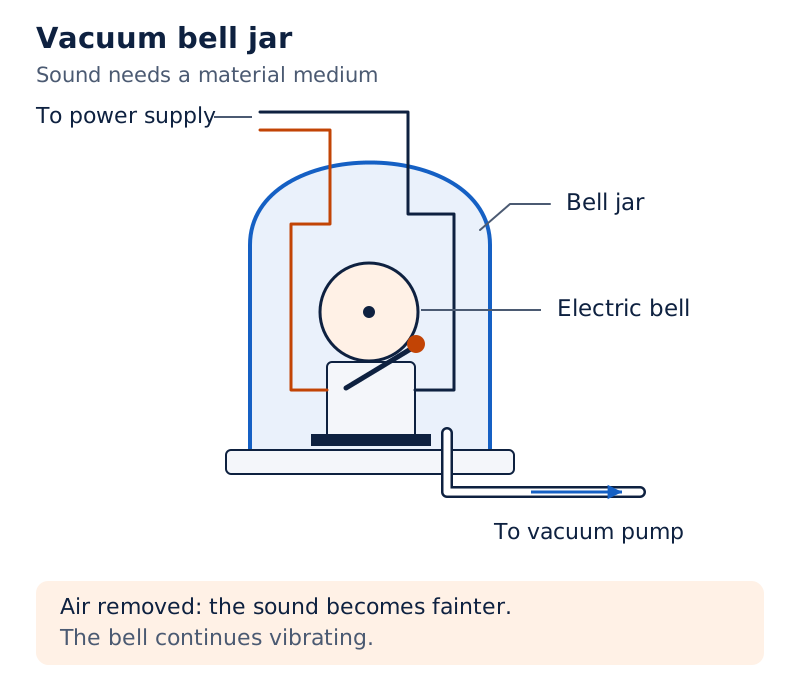
An electric bell stands inside a transparent bell jar. Labels identify the bell, the jar, the connection to the power supply and the connection to the vacuum pump.
Drawn by One Young India.
Light can travel through vacuum, whereas sound requires matter. Astronauts outside a spacecraft cannot communicate simply by speaking across the near vacuum of space. They use communication devices in their spacesuits instead of relying on direct sound transmission between them.
How do compressions and rarefactions carry sound?
Sound propagation involves a travelling disturbance in a medium. In air, vibrating particles pass the disturbance to neighbouring particles. The particles oscillate about their mean positions; they do not accompany the sound wave all the way from its source to the listener.
What happens beside an oscillating piston?
Consider an air-filled tube with a piston at one end. Before the piston oscillates, the air has an approximately uniform average density. The piston's forward and backward movements create alternating regions whose densities differ from that average.
- The piston moves forwards and pushes nearby air particles closer together.
- A region of increased density forms. This region is a compression, labelled C.
- The piston moves backwards and produces a region of decreased density. This is a rarefaction, labelled R.
- Interactions between neighbouring particles pass these disturbances onwards through the air.
- Repeated piston motion creates a succession of compressions and rarefactions travelling away from the source.
What the figure shows
Production of a sound wave
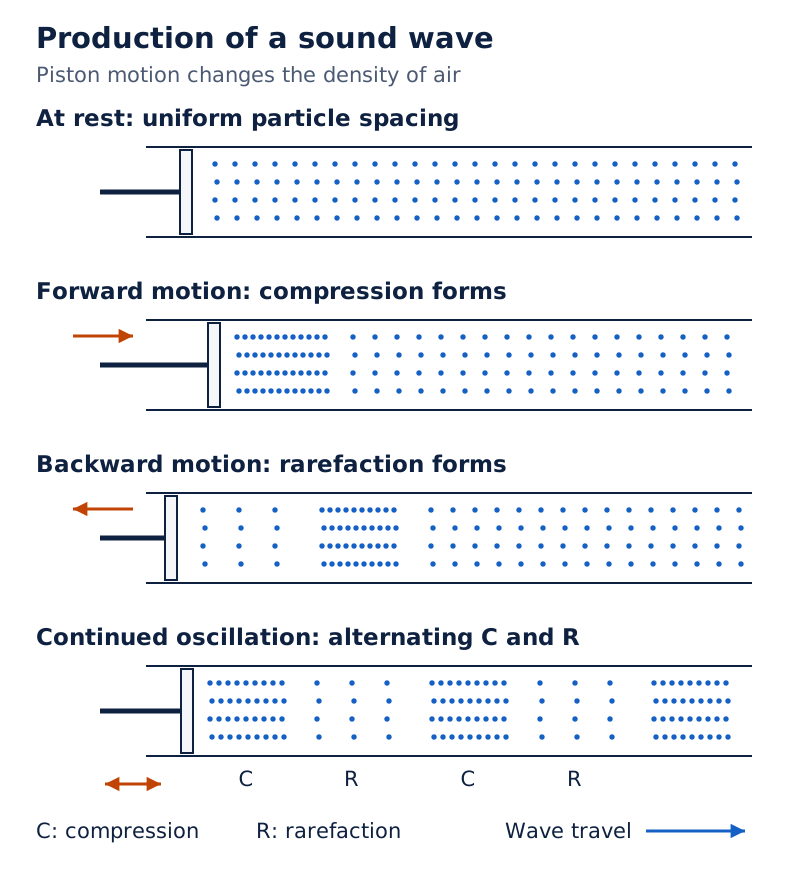
Four tube diagrams show uniform particle spacing, a compression during forward piston motion, a rarefaction during backward motion, and alternating regions labelled C and R during continued oscillation.
Drawn by One Young India.
| Feature | Compression | Rarefaction |
|---|---|---|
| Particle spacing | Closer together than average | Farther apart than average |
| Density | Above average density | Below average density |
| Formation near the piston | Forward movement | Backward movement |
| Position on a density graph | Region around a crest | Region around a trough |
A slinky illustrates the same distinction. Closely packed and spread-out turns move along it as a disturbance. A marked turn moves back and forth about its own position, rather than travelling with the disturbance along the whole spring.
Note: Sound transfers energy through the medium. It does not require a continuous flow of air from the source to the listener. A rarefaction still contains particles; it is not a vacuum.
Energy transfer can be demonstrated by making grains jump on a stretched sheet using a nearby sound source. Sound reaches the sheet, makes it vibrate and thereby moves the grains, even though the source does not touch the sheet.
How do longitudinal and transverse waves differ?
Mechanical waves require a material medium for propagation. The distinction between longitudinal and transverse mechanical waves depends on the direction of particle vibration compared with the direction in which the disturbance travels. These are two separate directions that must be compared.
In a longitudinal wave, particles vibrate parallel to the direction of propagation. Sound travelling through air is a longitudinal mechanical wave. The particles move backwards and forwards along the direction in which the successive compressions and rarefactions advance.
In a transverse wave, particle vibration is perpendicular to the direction of propagation. A drawing may therefore show an upward and downward vibration while the wave travels horizontally. The direction of wave travel is not the direction in which every particle must move.
| Basis of comparison | Longitudinal mechanical wave | Transverse mechanical wave |
|---|---|---|
| Particle vibration | Parallel to propagation | Perpendicular to propagation |
| Material medium | Required | Required |
| Illustration | Sound in air | Transverse seismic wave |
| Directional comparison | Vibration and travel lie along the same direction | Vibration and travel are at right angles |
What the figure shows
Longitudinal particle motion
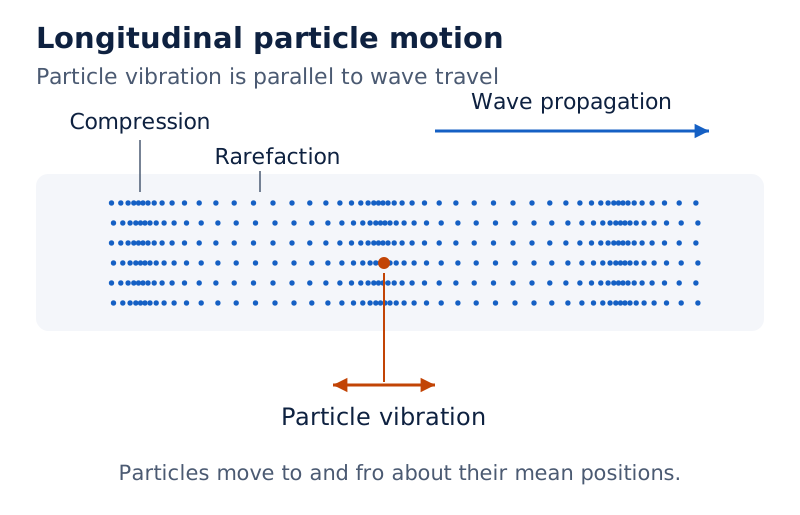
Alternating dense and sparse bands of particles extend horizontally. A horizontal double-headed arrow marks particle vibration, while a rightward arrow marks wave propagation.
Drawn by One Young India.
What the figure shows
Transverse particle motion
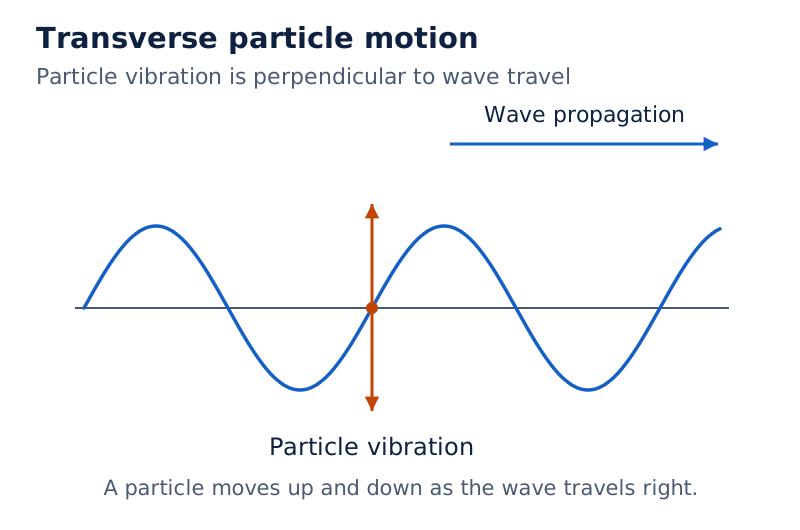
A curved wave is drawn along a horizontal line. A vertical double-headed arrow shows particle vibration, and a horizontal arrow shows wave propagation.
Drawn by One Young India.
Some waves do not need a medium. Light is a transverse wave that can travel through vacuum. Thus, transverse describes the directional character of a wave; it does not by itself mean that a wave must be mechanical. Earthquakes can produce both longitudinal and transverse seismic waves.
What do frequency, time period and wavelength measure?
Frequency, represented here by f, is the number of complete oscillations at a fixed point per unit time. One complete density oscillation can be followed from maximum density to minimum density and back to maximum. Frequency measures how often this cycle repeats.
The SI unit of frequency is hertz, symbol Hz. 1 Hz = 1 s⁻¹, meaning one complete oscillation per second. The prefix kilo means a thousand, so a kilohertz, written kHz, represents 1000 Hz. Convert kilohertz into hertz before substituting into an SI calculation.
Time period, represented by T, is the time taken for one complete oscillation. The SI unit of time period is second, symbol s. A rapidly repeating oscillation has a high frequency and a short time period.
Wavelength, represented by λ, the Greek letter lambda, is the distance between successive corresponding points in a wave. For a sound wave, measure between consecutive compression centres or consecutive rarefaction centres. The SI unit of wavelength is metre, symbol m.
Derivation: How are frequency and time period related?
Let N be the number of complete oscillations counted during an elapsed time t, measured in seconds.
- Frequency counts oscillations per second, so f = N/t.
- The time for one oscillation is the total time divided by the number of oscillations, so T = t/N.
- These ratios are reciprocals. Inverting the expression for the time period therefore gives the frequency.
f = 1/T
Equivalently, T = 1/f. These relationships concern the duration and repetition rate of the same oscillation. Do not substitute wavelength in place of time period merely because both describe one complete cycle.
Worked example 1. At a fixed position, 10 density oscillations occur in 2 s. Find the frequency and time period.
Formula: f = N/t; T = 1/f. Substitute: f = 10/2 = 5 Hz; T = 1/5 = 0.2 s. Answer: The frequency is 5 Hz and the time period is 0.2 s.
The result can also be checked directly: 2 s divided among 10 complete oscillations gives 0.2 s per oscillation. The count has no unit, but the frequency and period require their respective units in the final answer.
How should a graph of a sound wave be read?
A density-distance graph represents the density of a medium at different positions at one instant. The horizontal axis shows distance and the vertical axis shows density. The curved line records a changing physical quantity; it is not a photograph of particles moving along a curved path.
What do the highest and lowest points represent?
A horizontal average-density line separates regions above and below the undisturbed density. A crest corresponds to maximum density within a compression. A trough corresponds to minimum density within a rarefaction. These labels describe the density graph even though sound in air is longitudinal.
What the figure shows
Density and distance
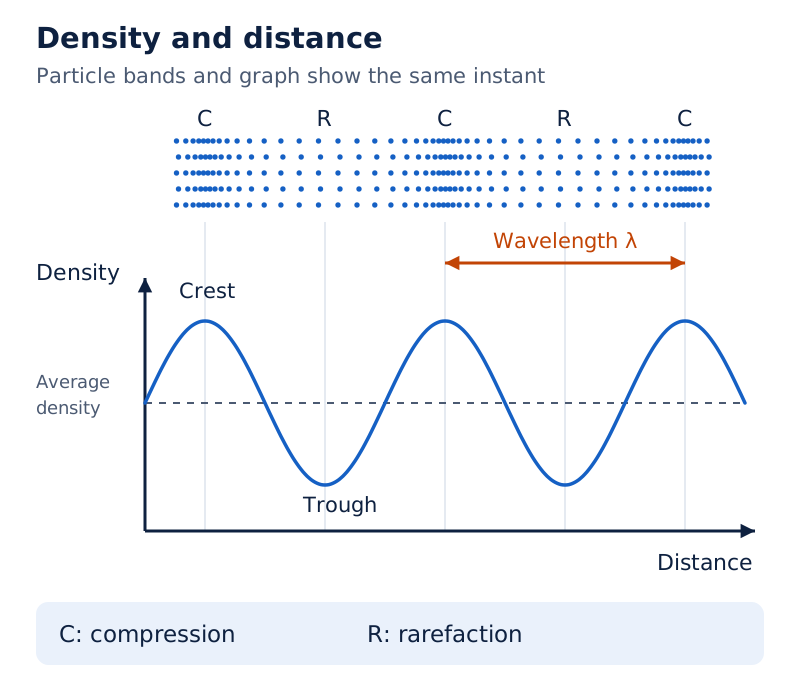
Dense and sparse particle bands labelled C and R appear above a density-distance graph. Crests align with compressions and troughs with rarefactions. A dashed horizontal line marks average density.
Drawn by One Young India.
Read wavelength horizontally between adjacent crests or adjacent troughs. The interval must represent a complete repetition. Choosing a crest and its neighbouring trough would represent only part of that repetition, so it is not a full wavelength.
The maximum change in density above or below the average is the density amplitude. This is measured vertically on a density graph. Wavelength and amplitude therefore describe different features and must not be interchanged.
How does changing the horizontal axis change the reading?
A density-time graph instead records density at one fixed location as time passes. The horizontal interval for a complete repetition then gives the time period. Always read the axis label before deciding whether a repeated horizontal interval represents distance or time.
A distance graph with closely spaced successive crests has a short wavelength. For waves travelling at the same speed, shorter wavelength corresponds to higher frequency. This frequency comparison requires the equal-speed condition; wavelength alone is not enough when the waves travel in different media.
How are wave speed, frequency and wavelength related?
Wave speed, represented here by v, is the distance travelled by the disturbance per unit time. It describes movement of the wave pattern, rather than the back and forth speed of an individual particle. The SI unit of wave speed is metre per second, written m/s.
Derivation: Why does wave speed equal frequency multiplied by wavelength?
Follow a point on a repeating wave, such as a crest, as the disturbance travels.
- During one time period T, the disturbance travels one wavelength λ.
- Speed equals distance divided by time, giving v = λ/T.
- Since f = 1/T, replacing the reciprocal of the period with frequency gives the wave relation.
v = fλ
For a known speed and frequency, rearrange to λ = v/f. For a known speed and wavelength, use f = v/λ. Use frequency in hertz, wavelength in metres and speed in metres per second so that the units remain consistent.
Worked example 2. Find the wavelengths corresponding to the human hearing limits of 20 Hz and 20 kHz in air. Take sound speed as 344 m/s.
Formula: λ = v/f. Substitute: At 20 Hz, λ = 344/20 = 17.2 m. At 20 kHz = 20000 Hz, λ = 344/20000 = 0.0172 m. Answer: The wavelengths are 17.2 m and 0.0172 m, respectively; the latter equals 1.72 cm.
Worked example 3. A sound wave in steel has wavelength 50 m, as read from the separation of successive crests in its density-distance graph. Its speed is 5000 m/s. Find frequency and time period.
Formula: f = v/λ; T = 1/f. Substitute: f = 5000/50 = 100 Hz; T = 1/100 = 0.01 s. Answer: The frequency is 100 Hz and the time period is 0.01 s.
What the figure shows
Sound wave in steel
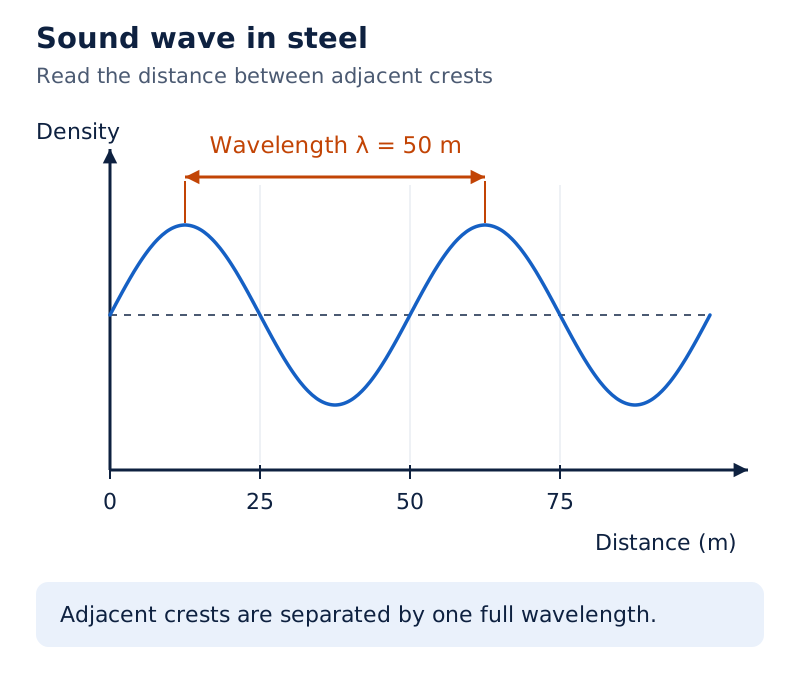
Density is plotted against distance in metres. The horizontal axis is marked 0, 25, 50 and 75. Adjacent crests are separated by 50 m, giving the wavelength used in the calculation.
Drawn by One Young India.
For a fixed medium under unchanged conditions, increasing frequency produces a shorter wavelength while sound speed remains approximately constant. A high-frequency sound does not automatically overtake a low-frequency sound travelling through the same ordinary air under the same conditions.
What factors affect the speed of sound?
The speed of sound depends on the medium and its physical conditions. Sound generally travels faster in solids than in liquids, and faster in liquids than in gases. This is a comparison of propagation through different materials, not a comparison of how loud their sources are.
How do representative media compare?
The following approximate values apply at 15 °C and atmospheric pressure. They illustrate the substantial differences between media. A numerical question may specify another temperature or another value, so use the speed supplied for that particular situation.
| State | Medium | Approximate sound speed |
|---|---|---|
| Solid | Steel | 5000 m/s |
| Liquid | Water | 1500 m/s |
| Gas | Air | 340 m/s |
The same event can therefore send sound along different paths at different speeds. A knock on a steel fence can reach a listener through steel before the sound travelling through air. The faster transmission does not imply a shorter physical distance between source and listener.
How do temperature and humidity affect air?
Increasing air temperature increases sound speed. In dry air, the approximate speed is 331 m/s at 0 °C and 344 m/s at 22 °C. These values explain why a single numerical value should not be treated as a universal constant for sound.
Increasing humidity also increases sound speed in air. Temperature and humidity belong to the conditions of the medium. They should be kept distinct from frequency, which describes the rate at which the source and wave oscillate.
Note: In ordinary air under fixed conditions, changing source frequency changes wavelength rather than propagation speed. Statements comparing frequency and wavelength must specify that the speed remains constant.
For travel calculations, let d denote distance travelled and t denote elapsed travel time. Then d = vt and t = d/v. The time in these equations is the duration of a journey, not necessarily the time period of one oscillation.
Why is lightning seen before thunder is heard?
The large difference between light speed and sound speed explains the delay between seeing lightning and hearing thunder. Light travels at about 300000 km/s, vastly faster than sound in air. For ordinary estimates of a storm's distance, the light travel time is treated as negligible.
Rapid heating and expansion of air create the disturbance heard as thunder. Light and sound from the event begin travelling towards the observer, but they arrive at different times. The later arrival of thunder does not show that sound needs to wait for the flash to arrive first.
How can the delay give an approximate distance?
If light arrival is treated as effectively instantaneous, the measured delay approximates the time taken by sound to cover the distance. Multiply this delay by the stated sound speed. Keep the units consistent and express the answer as an estimate.
Worked example 4. Thunder is heard 5 s after a lightning flash is seen. Take sound speed as 340 m/s and light speed as 300000 km/s. Assume the light arrives almost instantaneously. Estimate the distance of the lightning strike.
Formula: d = vt. Substitute: d = 340 × 5 = 1700 m. Answer: The lightning strike is approximately 1700 m, or 1.7 km, away.
This is a one-way journey from the event to the observer. There is no reflecting wall and no return journey in this calculation. Dividing the result by two would therefore introduce a path that the question does not describe.
A distant bursting balloon provides a similar comparison: it can be seen bursting before its sound arrives. Measuring the separation and the time between seeing and hearing provides an approximate sound-speed measurement. Repeated observations and an average time help account for variation in stopwatch readings.
How do sonic, infrasonic, ultrasonic and supersonic differ?
The human audible range is approximately 20 Hz to 20000 Hz, or 20 kHz. This is also called the sonic range in this classification. Hearing range varies between individuals and usually narrows with age, so these limits are approximate descriptions of human hearing.
| Frequency category | Frequency range | Human hearing |
|---|---|---|
| Infrasonic | Below 20 Hz | Below the usual audible range |
| Sonic or audible | About 20 Hz to 20000 Hz | Within the usual audible range |
| Ultrasonic | Above 20000 Hz | Above the usual audible range |
Dogs, cats, bats and dolphins can detect ultrasound, while elephants can detect infrasound. A sound being inaudible to humans does not mean that it cannot propagate or carry energy. Frequency classification concerns hearing limits, not whether a wave exists.
Why are frequency words different from speed words?
Ultrasonic describes a sound frequency above the usual human hearing range. Supersonic describes an object's speed exceeding the local speed of sound. An aircraft can be supersonic; a high-frequency sound wave is ultrasonic. These descriptions answer different questions.
Similarly, infrasonic means a frequency below 20 Hz, whereas subsonic means an object's speed is below the local sound speed. A speed comparison needs a reference sound speed in the surrounding medium. A frequency comparison needs a value in hertz.
| Pair | Quantity being classified | Reference |
|---|---|---|
| Infrasonic and ultrasonic | Sound frequency | Human audible frequency range |
| Subsonic and supersonic | Speed of an object | Local speed of sound |
A supersonic aircraft can produce a sonic boom. This loud disturbance is associated with motion faster than sound. It must not be confused with ultrasound, which is defined by frequency and is beyond the usual range of human hearing.
In general, higher frequency is perceived as higher pitch. However, frequency range and loudness are separate descriptions: calling a wave ultrasonic does not state how loud it is, and increasing loudness does not by itself make an audible sound ultrasonic.
How are ultrasound and infrasound used?
Sound outside the human audible range has practical uses because it still travels through matter and interacts with materials. Ultrasound supports medical imaging, industrial testing and object detection. Infrasound helps detect large natural events and disturbances over long distances.
What are the main applications?
| Wave category | Application | Purpose |
|---|---|---|
| Ultrasound | Ultrasonography | Imaging internal organs without surgery |
| Ultrasound | Kidney-stone treatment | Breaking stones into smaller pieces that can pass out of the body |
| Ultrasound | Industrial cleaning and welding | Cleaning delicate machine parts and joining materials |
| Ultrasound | Testing metal blocks | Detecting internal defects |
| Infrasound | Monitoring natural events | Detecting earthquakes and volcanic eruptions |
| Infrasound | Storm detection | Detecting severe storms using waves that travel long distances |
Most bats emit short bursts of ultrasound and detect waves reflected from obstacles or prey. This is echolocation: using returning sound to locate objects. Dolphins, whales and some birds also use echolocation for navigation or hunting.
How does returning sound reveal distance?
An echo is reflected sound heard after the original sound. For an out-and-back journey, the total path is twice the distance to the reflector. Let d now represent the one-way distance to the reflector and t the total return time. Then d = vt/2.
Worked example 5. A clap in an empty corridor produces an echo after 0.5 s. Sound speed in air is 340 m/s. Find the distance to the reflecting wall.
Formula: d = vt/2. Substitute: d = 340 × 0.5/2 = 85 m. Answer: The wall is 85 m away. The measured time includes the journey to the wall and back.
SONAR means sound navigation and ranging. It sends ultrasonic waves into water and analyses reflected waves to obtain information about underwater objects. The returning signal may help determine their distance, direction and speed.
Worked example 6. A naval sonar signal returns after 0.90 s. Sound speed in seawater is 1530 m/s. Find the distance to the reflecting object.
Formula: d = vt/2. Substitute: One-way time = 0.90/2 = 0.45 s; d = 1530 × 0.45 = 688.5 m. Answer: The object is 688.5 m away.
The two calculations use the same travel principle, although their media and speeds differ. The essential check is whether the measured time represents a one-way trip or a complete return trip. Inaudibility does not change the distance-time relationship.
Glossary
- Vibration — Repeated to and fro motion of an object about its mean position.
- Medium — Material through which a sound disturbance propagates from its source.
- Mechanical wave — A wave that requires a material medium for its propagation.
- Compression — A region of a sound wave where density exceeds the average density.
- Rarefaction — A region of a sound wave where density falls below the average density.
- Longitudinal wave — A wave with particle vibrations parallel to the direction of propagation.
- Transverse wave — A wave with vibrations perpendicular to the direction of wave propagation.
- Frequency — Number of complete oscillations occurring at a fixed point per unit time.
- Time period — Time required for one complete oscillation at a fixed position.
- Wavelength — Distance between consecutive corresponding points, such as neighbouring compression centres.
- Wave speed — Distance travelled by a wave disturbance through its medium per unit time.
- Infrasound — Sound with frequency below 20 Hz, below the usual human hearing range.
- Ultrasound — Sound with frequency above 20000 Hz, above the usual human hearing range.
- Supersonic — Describing an object moving faster than the local speed of sound.
- Echolocation — Locating obstacles or other objects by detecting sound reflected from them.
Common errors and misconceptions
- Misconception: Sound travels through empty space like light. Correct: Sound is mechanical and needs matter; light can propagate through vacuum.
- Misconception: Air particles travel from the source to the listener with the wave. Correct: Particles oscillate locally while the disturbance transfers energy through the medium.
- Misconception: A rarefaction is an empty gap. Correct: It contains particles at a lower density than the average density.
- Misconception: A curved density graph makes sound in air transverse. Correct: The curve represents density variation; particle vibration is parallel to propagation.
- Misconception: Frequency and time period increase together. Correct: They are reciprocals; a higher frequency corresponds to a shorter period.
- Misconception: Higher-frequency sound necessarily travels faster through the same air. Correct: Under fixed ordinary conditions, wavelength changes while sound speed remains approximately constant.
- Misconception: Ultrasonic and supersonic mean the same thing. Correct: Ultrasonic describes frequency; supersonic describes an object's speed relative to sound.
- Misconception: Every sound-distance calculation requires division by two. Correct: Divide by two for a return journey, but not for the one-way travel of thunder.
Exam-style questions with model answers
Q1. Why is sound described as a mechanical wave? State whether it can travel through vacuum. [2 marks]
- Sound requires a material medium whose particles transmit the disturbance. This requirement makes it a mechanical wave.
- It cannot propagate through vacuum because no material medium is present.
Q2. Describe the bell jar experiment and explain how its observations establish that sound needs a medium. [5 marks]
- An operating electric bell is placed inside a bell jar containing air. Its sound can initially be heard outside the jar.
- A vacuum pump gradually removes the air. The sound becomes fainter while the bell can still be seen ringing.
- When a near vacuum is reached, almost no sound is heard. The visible motion shows that the source has not simply stopped working.
- Air is allowed back into the jar. The sound becomes audible again and gradually returns to its earlier loudness.
- The changing sound transmission follows the removal and restoration of air. Sound therefore needs a material medium to travel from the vibrating source to the listener.
Q3. Explain how an oscillating piston produces a longitudinal sound wave in an air-filled tube. Distinguish particle motion from wave motion. [5 marks]
- When the piston moves forwards, nearby air particles are pushed closer together. Their density increases above the average, forming a compression.
- When the piston moves backwards, nearby air becomes less dense than average. This region is called a rarefaction.
- Repeated forward and backward movement produces alternating compressions and rarefactions. Interactions between neighbouring particles pass these disturbances along the tube.
- Each particle oscillates about its mean position parallel to the direction of propagation. The sound wave is therefore longitudinal.
- The moving pattern carries energy through the medium. Individual air particles do not travel along the whole tube with the wave, and a rarefaction does not mean that all particles have disappeared from that region.
Q4. A point in a medium undergoes 10 complete density oscillations in 2 s. Calculate frequency and time period, defining the symbols you use. [3 marks]
- Let N be the number of oscillations, t the elapsed time, f the frequency and T the time period. Here N = 10 and t = 2 s.
- The frequency is f = N/t = 10/2 = 5 Hz.
- The period is T = 1/f = 1/5 = 0.2 s. Thus five complete oscillations occur each second, and each takes one fifth of a second.
Q5. A sound wave in steel has wavelength 50 m and speed 5000 m/s. Calculate its frequency and time period. State the wave relation used. [3 marks]
- Let v denote speed, λ wavelength, f frequency and T time period. The wave relation is v = fλ.
- Rearranging gives f = v/λ = 5000/50 = 100 Hz.
- The time period is T = 1/f = 1/100 = 0.01 s. The frequency counts oscillations per second, while the period gives the duration of one oscillation; neither is the speed of individual particles.
Q6. A lightning flash is seen 5 s before thunder is heard. Assume sound speed is 340 m/s and light speed is 300000 km/s, so light travel time is negligible. Estimate the distance and explain why there is no division by two. [3 marks]
- Let d be the distance, v the sound speed and t the sound travel time. Since light arrival is effectively instantaneous, take t = 5 s.
- Using d = vt gives d = 340 × 5 = 1700 m, or 1.7 km.
- This is a one-way journey from the lightning event to the observer. There is no reflected return journey, so the distance must not be halved.
Q7. Define infrasonic and ultrasonic sound. Distinguish each from subsonic and supersonic motion, respectively, and give one application of each frequency category. [4 marks]
- Infrasonic sound has frequency below 20 Hz. Subsonic motion instead means motion slower than the local speed of sound.
- Ultrasonic sound has frequency above 20000 Hz. Supersonic motion means motion faster than the local speed of sound.
- The first pair classifies frequency, while the second pair compares speeds. They must not be used interchangeably.
- Infrasound helps detect earthquakes or volcanic eruptions. Ultrasound is used in ultrasonography to image internal organs without surgery.
Q8. A sonar signal returns from an underwater object after 0.90 s. Its speed in seawater is 1530 m/s. Calculate the object's distance, explaining how you use the measured time. [3 marks]
- The measured time includes travel from the source to the object and then back. The one-way time is therefore 0.90/2 = 0.45 s.
- Let d represent the one-way distance and v the sound speed. Distance equals speed multiplied by one-way travel time.
- Thus d = 1530 × 0.45 = 688.5 m. Using the full return time without halving would give the total path length rather than the object's distance.
Key takeaways
- Vibrating objects produce sound, and a material medium carries the disturbance from its source to a listener.
- Sound in air travels as a longitudinal wave of alternating compressions and rarefactions, with particles oscillating locally.
- Frequency counts complete oscillations per second, while time period measures the duration of one complete oscillation.
- Wave speed equals frequency multiplied by wavelength; use consistent SI units before substituting numerical values.
- Sound speed depends on the medium and its conditions, including temperature and humidity in air.
- Lightning is seen before thunder is heard because light travels much faster than sound through air.
- Infrasonic and ultrasonic describe frequency ranges; subsonic and supersonic describe speeds relative to local sound speed.
- Ultrasound supports imaging and object detection, while infrasound helps detect natural events over long distances.
Test yourself
What visible observation supports the conclusion that a sounding tuning fork is vibrating?
Its vibrating prong produces waves when it gently touches a water surface.
Why is a rarefaction not the same as a vacuum?
A rarefaction contains particles at below-average density; a vacuum has no material medium.
What changes as a sound wave passes if particles do not travel with it?
The density disturbance advances and energy is transferred while particles oscillate about their mean positions.
What must you check before reading a repeated horizontal interval on a wave graph?
Check whether the horizontal axis shows distance or time, identifying wavelength or period respectively.
If frequency increases in unchanged ordinary air, what happens to wavelength?
Wavelength decreases because the wave speed remains approximately constant under those conditions.
How does increasing humidity affect the speed of sound in air?
Increasing humidity increases sound speed; humidity is a condition of the medium.
Why does ultrasonic not mean that a sound wave travels faster than sound?
Ultrasonic describes frequency above 20000 Hz, rather than speed relative to another sound wave.
Why is a sonar return time halved when calculating an object's distance?
The recorded time includes both outward and return journeys, whereas the required distance is one way.
Try it
Analyzing Sound Wave Dynamics and Propagation
Investigate how frequency adjustments and medium properties govern sound wave propagation and velocity.
1A tuning fork vibrating at 512 Hz produces a sound wave with a wavelength of 0.65 m in uniform air. If you replace it with a tuning fork vibrating at double the frequency in the exact same air medium, how will the wave speed and wavelength respond?
In a uniform medium, the wave speed V remains constant regardless of the frequency change, which causes the wavelength to adjust rather than stay the same.
Because the sound wave remains in the same uniform medium, its speed V stays constant. According to V = fλ, doubling the frequency f causes the wavelength λ to halve to 0.325 m.
Speed is determined by the medium and remains constant here; doubling the frequency reduces the wavelength rather than doubling it.
2Next, you measure sound traveling through a solid steel rod (~5100 m/s) versus air (~330–340 m/s). Since higher density increases inertial resistance to motion, why is sound significantly faster in steel?
Under the governing relationship V = √(E / ρ), although steel is denser, its modulus of elasticity (E) is orders of magnitude greater, providing a dominant restoring force that transmits disturbances far more rapidly.
Particles of the medium do not travel from the source to the listener; they only execute simple harmonic motion about their mean equilibrium positions.
Solids still have density (ρ) that represents inertial resistance to motion, but their vastly superior elasticity overrides this resistance.
You have mastered the mechanics of sound waves, the universal wave equation V = fλ, and how medium elasticity and density dictate wave velocity.