
Analytical Chemistry | ICSE Class 10 Chemistry Notes
On this page
Watch & explore
Start with a few high-quality watches, then dive into the notes below.
This note covers qualitative analysis, salt and solution colours, tests with sodium hydroxide and ammonium hydroxide, precipitate colours and solubility, the identification of ammonium salts, and reactions of aluminium, zinc and lead and their oxides and hydroxides with alkalis.
What does analytical chemistry reveal about a salt?
Qualitative analysis identifies the substances or ions present in a sample. An ion is an electrically charged atom or group of atoms. A positively charged ion is a cation; a negatively charged ion is an anion. A salt contains cations and anions.
The tests here chiefly distinguish metal cations and the ammonium cation. A reagent is a substance used to produce a chemical change for a test. Adding a reagent may produce a solid, change a colour or release a gas. Each observation must be linked to the reagent and conditions.
Definition: A precipitate is an insoluble solid formed during a reaction in solution. Precipitation is the process of forming that solid.
Aqueous means dissolved in water. A clear solution may be coloured: clarity describes the absence of visible suspended material, whereas colour describes its appearance. A blue solution and a blue precipitate are therefore different observations.
How should chemical symbols be read?
The element symbols used below are defined here. Formulae name substances using these symbols; the lower numbers, called subscripts, count atoms or groups. An upper charge sign belongs to an ion. Thus Fe²⁺ means an iron ion carrying two positive charges, not two iron atoms.
| Symbol | Element | Symbol | Element |
|---|---|---|---|
| H | Hydrogen | O | Oxygen |
| N | Nitrogen | S | Sulphur |
| Na | Sodium | K | Potassium |
| Cl | Chlorine | Fe | Iron |
| Cu | Copper | Zn | Zinc |
| Pb | Lead | Al | Aluminium |
In a chemical equation, reactants are starting substances and products are substances formed. The arrow → means “forms”; + separates substances reacting together or produced together. A number before a formula is a coefficient, which multiplies the whole formula. The downward arrow ↓ marks a precipitate.
A balanced equation has equal numbers of atoms of each element on both sides. Ionic equations, which show the reacting ions, must also have equal total charge on both sides. Formulae must remain unchanged while coefficients are adjusted.
How do the two alkalis act as testing reagents?
An acid produces hydrogen ions, H⁺, in water. A base neutralises an acid, meaning that they react to form salt and water. An alkali is a base soluble in water. Alkalis supply hydroxide ions, written OH⁻, each containing oxygen and hydrogen and carrying one negative charge. These ions can combine with metal cations to form insoluble metal hydroxides.
Sodium hydroxide, NaOH, is also called caustic soda. Potassium hydroxide, KOH, is called caustic potash. Sodium hydroxide is used in the salt tests, while both caustic alkalis react with certain metals and their oxides and hydroxides.
Ammonium hydroxide, conventionally written NH₄OH, is aqueous ammonia. Ammonia, NH₃, is a compound of nitrogen and hydrogen. Its solution contains ammonia as well as ammonium ions, NH₄⁺, and hydroxide ions. Water has the formula H₂O. A reversible arrow, ⇌, means that reaction can occur in both directions.
NH₃ + H₂O ⇌ NH₄⁺ + OH⁻
Sodium hydroxide is a strong alkali, extensively dissociated into ions in dilute solution. Aqueous ammonia is a weak alkali, producing ions only partially. Dissociation means separation into ions; “strong” and “weak” describe ion formation, not the amount of solution poured into a test tube.
Why test drop by drop and then in excess?
Drop by drop means adding small successive quantities while observing changes. In excess means continuing to add reagent beyond the amount needed for the initial reaction. Some precipitates remain; others dissolve through a further reaction. Recording just the first stage loses useful evidence.
- Observe the salt solution before adding either reagent, recording its colour and whether it is clear.
- Add sodium hydroxide drop by drop to one portion and record any precipitate and its colour.
- Continue adding sodium hydroxide to that portion and record whether the precipitate dissolves or remains.
- Use a fresh portion for ammonium hydroxide, repeating both stages and recording the final solution colour.
Note: Test the two reagents on separate portions. A result obtained after mixing both reagents does not represent either separate test.
What can the colours of salts and solutions tell us?
The colour of a solid salt provides an initial clue, but it is not the same observation as the colour of its solution. Preliminary examination means inspecting a sample before the identifying reactions. It often provides useful information, although these observations are not conclusive.
Hydrated salts contain water of crystallisation, meaning a fixed number of water molecules within each formula unit of the crystalline salt. A formula unit is the group of atoms or ions represented by a substance’s chemical formula. Anhydrous means without that water. The dot in a hydrated salt formula separates the salt formula from its water of crystallisation.
| Salt example and formula | Solid appearance | Aqueous solution |
|---|---|---|
| Hydrated copper(II) sulphate, CuSO₄·5H₂O | Blue crystals | Blue |
| Hydrated iron(II) sulphate, FeSO₄·7H₂O | Pale green crystals | Pale green |
| Hydrated iron(III) chloride, FeCl₃·6H₂O | Yellowish-brown crystals | Yellow to yellowish-brown |
| Hydrated zinc sulphate, ZnSO₄·7H₂O | White or colourless crystals | Colourless |
| Lead(II) nitrate, Pb(NO₃)₂ | White crystals | Colourless |
The Roman numerals in iron(II) and iron(III) distinguish iron in its +2 and +3 oxidation states. For these simple metal cations, the oxidation state corresponds to the ionic charge: Fe²⁺ and Fe³⁺. Copper(II) is Cu²⁺; lead(II) is Pb²⁺; zinc ions here are Zn²⁺.
Why is an initial colour insufficient?
Zinc sulphate and lead(II) nitrate solutions are both colourless. Their initial appearance therefore cannot distinguish them. Similarly, a statement such as “the salt is white” does not identify which cation it contains. The response to a reagent adds the evidence needed for a useful conclusion.
Blue hydrated copper(II) sulphate becomes white on losing its water of crystallisation. Water restores its blue colour. This shows why the description “copper sulphate is blue” needs the substance’s form specified: the hydrated crystals, anhydrous solid and aqueous solution are distinct cases.
What happens when sodium hydroxide is added to salt solutions?
Sodium hydroxide produces characteristic hydroxide precipitates with the metal ions considered here. The following table records initial precipitation and the effect of adding excess reagent. “Insoluble in excess” means that the precipitate remains under the test conditions; it does not mean that it cannot dissolve in any reagent.
| Cation | Hydroxide formed | Drop-by-drop observation | Excess sodium hydroxide |
|---|---|---|---|
| Iron(II), Fe²⁺ | Iron(II) hydroxide, Fe(OH)₂ | Dirty green precipitate | Precipitate remains |
| Iron(III), Fe³⁺ | Iron(III) hydroxide, Fe(OH)₃ | Reddish-brown precipitate | Precipitate remains |
| Copper(II), Cu²⁺ | Copper(II) hydroxide, Cu(OH)₂ | Light blue precipitate | Precipitate remains |
| Zinc, Zn²⁺ | Zinc hydroxide, Zn(OH)₂ | White gelatinous precipitate | Dissolves; colourless solution, with warming if needed |
| Lead(II), Pb²⁺ | Lead(II) hydroxide, Pb(OH)₂ | White precipitate | Dissolves; colourless solution |
Gelatinous describes a jelly-like precipitate. The brackets in Zn(OH)₂ mean that the hydroxide group occurs twice. Fe(OH)₃ contains three hydroxide groups. These formulae account for the charge of the original cation: two hydroxide ions balance a +2 ion, and three balance a +3 ion.
Which equations represent the initial reactions?
The net ionic equations show the ions directly involved, leaving out ions that remain unchanged in solution. They apply whether the hydroxide ions are supplied by sodium hydroxide or by aqueous ammonia during the initial precipitation stage.
- Fe²⁺ + 2OH⁻ → Fe(OH)₂↓
- Fe³⁺ + 3OH⁻ → Fe(OH)₃↓
- Cu²⁺ + 2OH⁻ → Cu(OH)₂↓
- Zn²⁺ + 2OH⁻ → Zn(OH)₂↓
- Pb²⁺ + 2OH⁻ → Pb(OH)₂↓
For a full equation, zinc chloride, ZnCl₂, reacts with sodium hydroxide to form zinc hydroxide and sodium chloride, NaCl: ZnCl₂ + 2NaOH → Zn(OH)₂↓ + 2NaCl. The chloride ions are unchanged; the zinc and hydroxide ions form the solid.
Zinc and lead give the same broad pattern with sodium hydroxide: a white precipitate that dissolves in excess. This test alone therefore does not distinguish those two cations. Their different responses to excess ammonium hydroxide provide the next comparison.
How does ammonium hydroxide distinguish these cations?
Ammonium hydroxide supplies hydroxide ions for precipitation, but its excess can also have a different effect from excess sodium hydroxide. Compare the complete sequence for each cation. A white precipitate is an observation shared by more than one ion, not a sufficient identification by itself.
| Cation | Ammonium hydroxide drop by drop | Ammonium hydroxide in excess |
|---|---|---|
| Iron(II) | Dirty green iron(II) hydroxide precipitate | Precipitate remains |
| Iron(III) | Reddish-brown iron(III) hydroxide precipitate | Precipitate remains |
| Copper(II) | Light blue hydroxide precipitate | Dissolves to form a deep blue solution |
| Zinc | White gelatinous zinc hydroxide precipitate | Dissolves to form a colourless solution |
| Lead(II) | White lead(II) hydroxide precipitate | Precipitate remains |
How are zinc and lead separated by their observations?
A zinc hydroxide precipitate dissolves in excess of either reagent. A lead(II) hydroxide precipitate dissolves in excess sodium hydroxide but remains in excess ammonium hydroxide. Thus the second reagent distinguishes two cations whose sodium hydroxide results look alike.
Zinc dissolves in excess aqueous ammonia by forming a complex ion, a charged unit containing a central metal ion attached to surrounding molecules or ions. Here ammonia molecules attach to zinc. This is a further chemical reaction, so “the solid disappears” should be recorded as dissolution of the precipitate.
The ion [Zn(NH₃)₄]²⁺ is the tetraamminezinc(II) ion. “Tetraammine” indicates four attached ammonia molecules. Square brackets enclose the complex unit, and the charge outside belongs to that whole unit. Its solution is colourless.
Zn(OH)₂ + 4NH₃ → [Zn(NH₃)₄]²⁺ + 2OH⁻
Diagram
Zinc and lead comparison
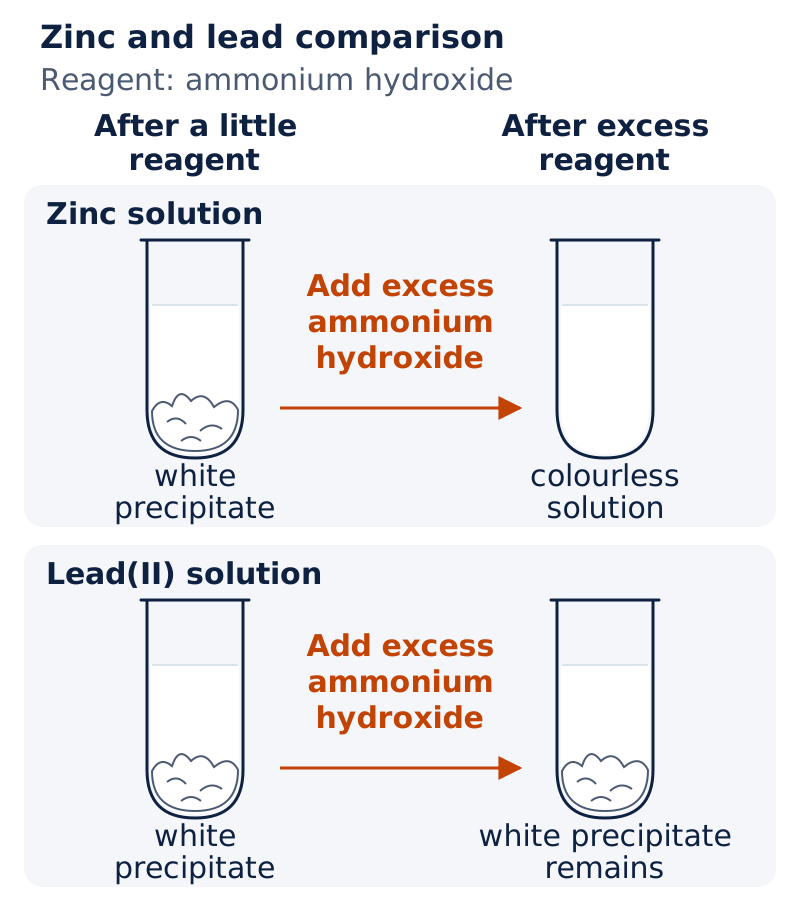
Draw two labelled pairs of test tubes, one pair for zinc solution and one for lead(II) solution. Show white precipitates after a little ammonium hydroxide. After excess reagent, label zinc “colourless solution” and lead “white precipitate remains”.
Drawn by One Young India.
Keep the reagent label next to the observation. “Soluble in excess” without the reagent’s name is incomplete for lead, because its response differs between the two alkalis. The initial white colour cannot supply that missing information.
How can iron(II), iron(III) and copper(II) be recognised?
Iron(II) and iron(III) require separate entries in a test record. Iron(II) gives a dirty green precipitate of Fe(OH)₂, whereas iron(III) gives a reddish-brown precipitate of Fe(OH)₃. Both precipitates remain in excess sodium hydroxide and excess ammonium hydroxide.
A fresh iron(II) hydroxide precipitate gradually turns brown on exposure to air. It undergoes oxidation, here a change from iron(II) to iron(III) caused by oxygen. Record the initial colour before describing the later change, rather than treating the aged precipitate as the original result.
Oxygen gas is written O₂. With water present, the overall change is 4Fe(OH)₂ + O₂ + 2H₂O → 4Fe(OH)₃. This equation accounts for the change from the green hydroxide to the brown hydroxide without suggesting that adding excess alkali dissolves either solid.
What is special about copper and aqueous ammonia?
Copper(II) gives a light blue hydroxide precipitate on adding a little alkali. With excess sodium hydroxide the precipitate remains. With excess ammonium hydroxide it dissolves, producing the characteristic deep blue solution associated with an ammonia complex of copper(II).
The tetraamminecopper(II) ion, represented here as [Cu(NH₃)₄]²⁺, contains copper(II) attached to four ammonia molecules. The school-level representation of the dissolution is Cu(OH)₂ + 4NH₃ → [Cu(NH₃)₄]²⁺ + 2OH⁻. Water associated with the dissolved complex is omitted in this abbreviated notation.
Diagram
Copper’s two stages with ammonia
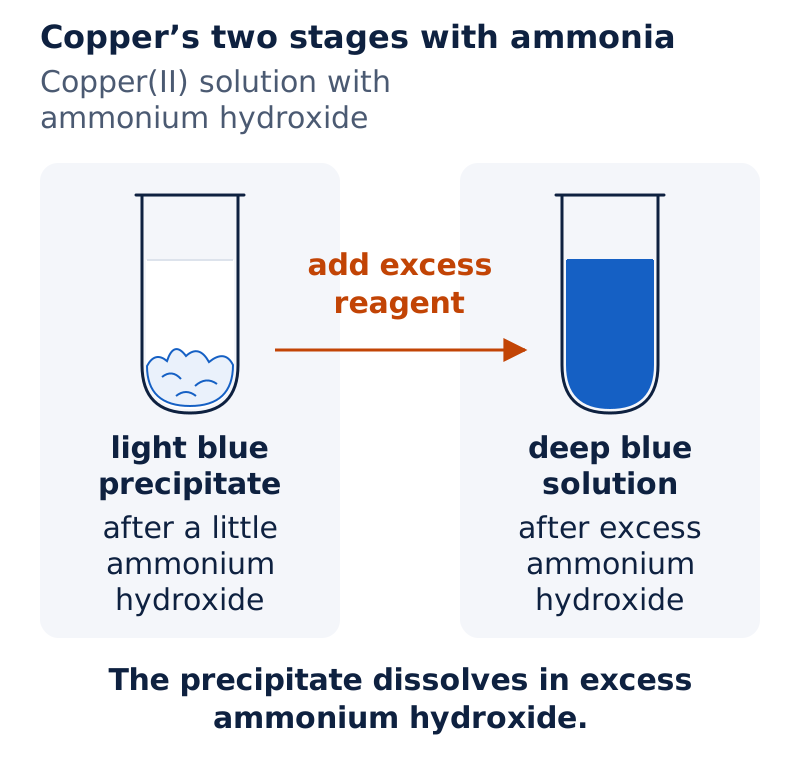
Draw a test tube labelled “light blue precipitate after a little ammonium hydroxide”. Beside it, draw a tube uniformly coloured deep blue and label it “deep blue solution after excess ammonium hydroxide”. Connect them with an arrow labelled “add excess reagent”.
Drawn by One Young India.
The final blue material is a solution, not a darker blue precipitate. The distinction matters because it records both the disappearance of the solid and the formation of a different dissolved copper-containing ion. The initial blue copper solution is also different from this deep blue ammonia complex.
How does sodium hydroxide identify ammonium salts?
An ammonium salt contains the ammonium cation, NH₄⁺. Its response to sodium hydroxide differs from the metal-hydroxide tests: warming releases ammonia gas. The useful evidence is gas evolution and the gas’s properties, rather than the formation of a characteristic coloured metal precipitate.
For ammonium sulphate, (NH₄)₂SO₄, the products are sodium sulphate, Na₂SO₄, ammonia and water. The balanced equation on warming is (NH₄)₂SO₄ + 2NaOH → Na₂SO₄ + 2NH₃ + 2H₂O. The two ammonium groups explain why two ammonia molecules appear in the equation.
The net ionic equation is NH₄⁺ + OH⁻ → NH₃ + H₂O. Ammonium and ammonia are different: the former is a charged ion within the salt; the latter is the neutral compound liberated as a gas in this test.
What observations support the identification?
Ammonia is a colourless gas with a pungent smell. It turns moist red litmus paper blue. Litmus is an indicator, a substance whose colour shows acidic or alkaline conditions. Moisture lets the ammonia dissolve and produce the alkaline conditions responsible for the colour change.
- Take a portion of the ammonium salt or its solution and add sodium hydroxide solution.
- Warm the mixture and observe the release of gas, keeping the gas observation separate from any solid appearance.
- Test the gas with moist red litmus paper; its change to blue supports identification as ammonia.
- Bring a glass rod carrying hydrochloric acid near the mouth of the tube; dense white fumes of ammonium chloride form.
Hydrochloric acid is hydrogen chloride, HCl, dissolved in water. Ammonium chloride has the formula NH₄Cl. The fumes form through NH₃ + HCl → NH₄Cl. The white appearance belongs to the ammonium chloride formed, not to the ammonia gas itself.
Note: Use sodium hydroxide for the ammonium-salt test. Ammonium hydroxide already contains ammonia, so detecting ammonia after adding it would not establish that the original salt supplied ammonium ions.
How do amphoteric oxides and hydroxides react with alkalis?
Amphoteric describes a substance that reacts with both acids and bases. Aluminium, zinc and lead form oxides and hydroxides that show this behaviour. An oxide contains oxygen combined with another element; the hydroxides here contain hydroxide groups combined with the metal.
Aluminium oxide, Al₂O₃, reacts with hydrochloric acid to form aluminium chloride, AlCl₃, and water: Al₂O₃ + 6HCl → 2AlCl₃ + 3H₂O. Its reaction with an alkali provides the other side of the amphoteric comparison. Most metal oxides are insoluble in water; that does not prevent reaction with another reagent.
Which products form with sodium hydroxide?
The following equations use conventional school formulae for sodium aluminate, NaAlO₂, sodium zincate, Na₂ZnO₂, and sodium plumbite, Na₂PbO₂. These formulae describe the products in the simplified equations; dissolved products may also be represented as hydroxide-containing complex ions.
| Starting substance | Balanced equation with sodium hydroxide |
|---|---|
| Aluminium oxide, Al₂O₃ | Al₂O₃ + 2NaOH → 2NaAlO₂ + H₂O |
| Zinc oxide, ZnO | ZnO + 2NaOH → Na₂ZnO₂ + H₂O |
| Lead(II) oxide, PbO | PbO + 2NaOH → Na₂PbO₂ + H₂O |
| Aluminium hydroxide, Al(OH)₃ | Al(OH)₃ + NaOH → NaAlO₂ + 2H₂O |
| Zinc hydroxide, Zn(OH)₂ | Zn(OH)₂ + 2NaOH → Na₂ZnO₂ + 2H₂O |
| Lead(II) hydroxide, Pb(OH)₂ | Pb(OH)₂ + 2NaOH → Na₂PbO₂ + 2H₂O |
Use excess caustic alkali, with warming where needed. Zinc hydroxide’s dissolution in excess sodium hydroxide on heating is an example. The solid reacts to form a soluble product; the observation is therefore more informative than saying that adding liquid merely makes the mixture clearer.
With potassium hydroxide, the corresponding products are potassium aluminate, KAlO₂, potassium zincate, K₂ZnO₂, and potassium plumbite, K₂PbO₂. Replace NaOH by KOH and the sodium product by its potassium counterpart in each balanced equation; the coefficients remain the same.
For example, Pb(OH)₂ + 2KOH → K₂PbO₂ + 2H₂O. These oxide and hydroxide reactions form water, without the hydrogen gas characteristic of the reactions of the metals themselves. The identity of the starting substance is therefore essential when predicting products.
How do aluminium, zinc and lead metals react with caustic alkalis?
Certain metals react with caustic alkalis to form a salt and hydrogen gas, H₂. Such reactions are not possible with all metals. Aluminium, zinc and lead are the examples considered here. Their reactions require suitable conditions, including heating with the alkali where needed. Use hot concentrated alkali for the lead reaction.
The metal and its oxide are different starting materials. Aluminium metal is Al, while aluminium oxide is Al₂O₃. Predicting gas evolution from the oxide equation would therefore be a mistake. In the simplified equations below, hydrogen is produced by the metal reactions.
| Metal | Reaction with sodium hydroxide on heating | Salt product |
|---|---|---|
| Aluminium | 2Al + 2NaOH + 2H₂O → 2NaAlO₂ + 3H₂ | Sodium aluminate |
| Zinc | Zn + 2NaOH → Na₂ZnO₂ + H₂ | Sodium zincate |
| Lead | Pb + 2NaOH → Na₂PbO₂ + H₂ | Sodium plumbite |
What changes when potassium hydroxide is used?
Potassium hydroxide produces the corresponding potassium salts. The equations are 2Al + 2KOH + 2H₂O → 2KAlO₂ + 3H₂; Zn + 2KOH → K₂ZnO₂ + H₂; and Pb + 2KOH → K₂PbO₂ + H₂. Hydrogen remains the gaseous product in each case.
Effervescence means bubbling caused by gas escaping through a liquid. It indicates gas formation but does not by itself establish the gas’s identity. Hydrogen is identified by its characteristic pop when a small collected sample is tested with a flame under supervised laboratory conditions.
Diagram
Metal versus metal oxide with alkali
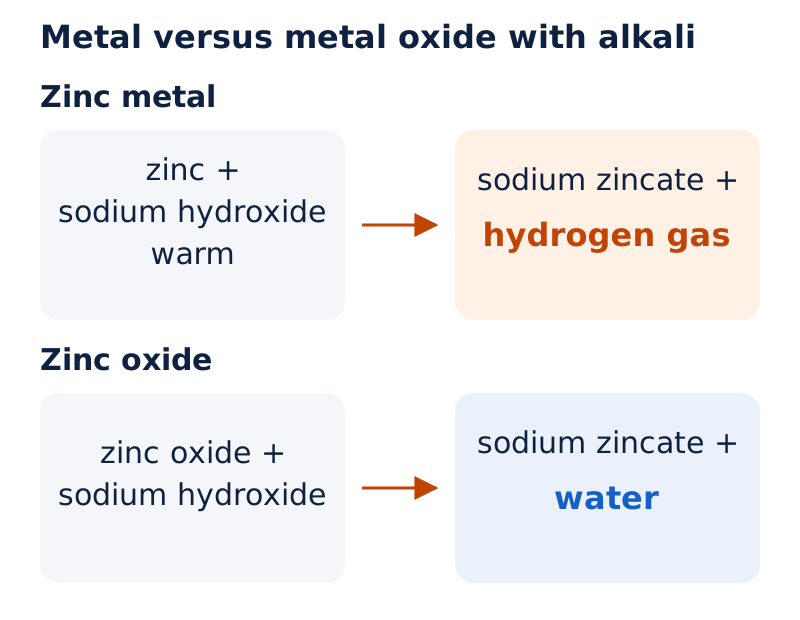
Draw two labelled reaction boxes. Write “zinc + sodium hydroxide, warm” in one and connect it to “sodium zincate + hydrogen gas”. Write “zinc oxide + sodium hydroxide” in the other and connect it to “sodium zincate + water”. Label the differing products clearly.
Drawn by One Young India.
Check aluminium’s equation particularly carefully: water occurs among the reactants, and the hydrogen coefficient is three. Counting atoms verifies the equation without changing any chemical formula. A balanced equation describes the reacting quantities; it does not imply that every metal reacts with equal ease or at the same rate.
How can observations be converted into a reliable identification?
An observation records what happens; an inference states what that evidence suggests. “A white precipitate remains in excess ammonium hydroxide” is an observation. “The cation is lead(II), among zinc and lead(II)” is an inference based on the stated alternatives and their known reactions.
Keep the range of possibilities explicit. A white precipitate alone does not prove zinc or lead. Even a correct observation becomes an unreliable identification if other possible ions have not been considered. Comparisons here apply to the named candidates under the stated test conditions.
Which sequence keeps the reasoning complete?
- Identify the candidate ions and the reagent. State whether the test concerns a salt solution, a metal, an oxide or a hydroxide.
- Record the first visible change, including the precipitate’s colour or the evolution of a gas.
- Record the effect of excess reagent or warming when that condition is part of the test.
- Use the complete pattern to distinguish the candidates, then connect the observation to the named product and balanced equation.
| Complete observation pattern | Inference among the listed metal cations |
|---|---|
| Dirty green hydroxide; remains in excess of both reagents | Iron(II) |
| Reddish-brown hydroxide; remains in excess of both reagents | Iron(III) |
| Light blue hydroxide; deep blue solution with excess ammonium hydroxide | Copper(II) |
| White hydroxide; dissolves in excess of both reagents | Zinc |
| White hydroxide; dissolves in excess sodium hydroxide but remains in excess ammonium hydroxide | Lead(II) |
For an equation, name the substances before balancing it. Check atoms of each element, then check charge if ions are shown. For an observation, specify whether the colour belongs to the original solution, the precipitate or the final solution. Those descriptions refer to different stages of the test.
A result should answer both what happened and under which condition. This prevents the common confusion between a precipitate that forms initially and one that remains after excess reagent. It also keeps the hydrogen-producing metal reactions separate from ammonia-producing ammonium-salt reactions.
Glossary
- Qualitative analysis — Identification of the substances or ions present in a sample through characteristic observations and reactions.
- Cation — A positively charged ion, such as an iron(II) ion or an ammonium ion.
- Anion — A negatively charged ion, such as the hydroxide ion supplied by an alkali.
- Reagent — A substance added to a sample to bring about a chemical change used in a test.
- Precipitate — An insoluble solid formed during a chemical reaction taking place in solution.
- Alkali — A base that dissolves in water and supplies hydroxide ions to the aqueous solution.
- Excess reagent — Reagent added beyond the amount required for the initial reaction, allowing further changes to be observed.
- Gelatinous — Having a jelly-like appearance, as used to describe certain freshly formed hydroxide precipitates.
- Complex ion — A charged unit containing a central metal ion attached to surrounding molecules or ions.
- Amphoteric — Able to react with both acids and bases, as aluminium oxide and zinc oxide do.
- Water of crystallisation — A fixed number of water molecules present within one formula unit of a crystalline salt.
- Effervescence — Bubbling observed when a gas is produced and escapes through a liquid during a reaction.
- Net ionic equation — An equation showing the reacting ions while omitting ions that remain unchanged in solution.
- Inference — A conclusion drawn from observations and the known behaviour of the substances being considered.
Common errors and misconceptions
- Misconception: Every white hydroxide precipitate identifies zinc. Correct: Lead(II) also produces a white hydroxide. Compare the behaviour in excess ammonium hydroxide before distinguishing these two ions.
- Misconception: Excess alkali dissolves every hydroxide precipitate. Correct: Iron(II), iron(III) and copper(II) hydroxides remain in excess sodium hydroxide under these test conditions.
- Misconception: Copper forms a deep blue precipitate in excess ammonium hydroxide. Correct: The initial light blue precipitate dissolves to produce a deep blue solution.
- Misconception: Ammonium and ammonia are the same particle. Correct: Ammonium is NH₄⁺, a cation; ammonia is NH₃, the neutral compound released by warming an ammonium salt with sodium hydroxide.
- Misconception: The white fumes in the ammonia test are ammonia itself. Correct: Ammonia is colourless; reaction with hydrogen chloride produces the white ammonium chloride fumes.
- Misconception: A brown aged iron hydroxide proves that the original ion was iron(III). Correct: Fresh dirty green iron(II) hydroxide turns brown on exposure to air. Record the initial observation.
- Misconception: Zinc oxide and zinc metal release the same gas with sodium hydroxide. Correct: The metal reaction produces hydrogen; the oxide reaction forms sodium zincate and water.
- Misconception: “Soluble in excess” is a complete description of lead hydroxide. Correct: Name the reagent: it dissolves in excess sodium hydroxide but remains in excess ammonium hydroxide.
Exam-style questions with model answers
Q1. A sample is known to contain either zinc ions or lead(II) ions. A little ammonium hydroxide gives a white precipitate; excess reagent dissolves it to a colourless solution. Reference data: zinc hydroxide dissolves in excess ammonium hydroxide, whereas lead(II) hydroxide remains. Identify the ion and explain why the other is excluded. [2 marks]
- The ion is zinc, because its white hydroxide precipitate dissolves in excess ammonium hydroxide to give a colourless solution.
- Lead(II) is excluded because its hydroxide would remain as a white precipitate in excess of the same reagent.
Q2. A copper(II) solution gives a light blue hydroxide precipitate with a little ammonium hydroxide. In excess reagent, that solid dissolves and a deep blue solution forms. The dissolved product contains copper(II) attached to four ammonia molecules. Describe the initial observation, final observation and chemical explanation. [3 marks]
- A little ammonium hydroxide produces a light blue precipitate of copper(II) hydroxide. The initial observation is the formation of a solid within the solution.
- Excess ammonium hydroxide dissolves that precipitate and produces a deep blue solution. The final blue material is therefore dissolved, rather than a darker precipitate.
- The dissolution forms the tetraamminecopper(II) complex, containing four ammonia molecules attached to copper(II). Its formation accounts for the characteristic final solution.
Q3. On warming ammonium sulphate, (NH₄)₂SO₄, with sodium hydroxide, NaOH, the products are sodium sulphate, Na₂SO₄, ammonia, NH₃, and water, H₂O. Ammonia dissolves in moisture to give an alkaline solution, turns moist red litmus blue and reacts with hydrogen chloride, HCl, to form white ammonium chloride fumes, NH₄Cl. Write the balanced heating equation, state the condition, give the litmus observation and write the fumes equation. [4 marks]
- The balanced equation is (NH₄)₂SO₄ + 2NaOH → Na₂SO₄ + 2NH₃ + 2H₂O. Both ammonium groups contribute ammonia to the products.
- Warm the mixture of ammonium sulphate and sodium hydroxide solution. Heating is the stated condition for releasing the ammonia in this test.
- The evolved gas turns moist red litmus paper blue, showing the alkaline effect of ammonia dissolved in the paper’s moisture.
- The fumes form by NH₃ + HCl → NH₄Cl. The white material is ammonium chloride formed from the two reacting substances.
Q4. Reference data for sodium hydroxide tests: iron(II) gives dirty green hydroxide; iron(III), reddish-brown hydroxide; copper(II), light blue hydroxide; zinc and lead(II), white hydroxides. In excess sodium hydroxide, the first three remain, while zinc and lead hydroxides dissolve to colourless solutions. Give one complete test result for each of the five cations, stating both stages. [5 marks]
- Iron(II) gives a dirty green precipitate when sodium hydroxide is added drop by drop. That hydroxide precipitate remains when more reagent is added in excess.
- Iron(III) gives a reddish-brown precipitate with a little sodium hydroxide. It also remains in excess reagent, so its colour distinguishes it from the iron(II) result.
- Copper(II) gives a light blue precipitate of its hydroxide. Adding excess sodium hydroxide does not dissolve the precipitate under the stated conditions.
- Zinc gives a white hydroxide precipitate initially. Excess sodium hydroxide dissolves it and leaves a colourless solution, so both stages must be recorded.
- Lead(II) also gives a white precipitate that dissolves in excess sodium hydroxide to a colourless solution. These data alone do not distinguish it from zinc.
Q5. Aluminium oxide, Al₂O₃, reacts with hydrochloric acid, HCl, to form aluminium chloride, AlCl₃, and water, H₂O. It reacts with sodium hydroxide, NaOH, to form sodium aluminate, NaAlO₂, and water. Aluminium metal, Al, reacts on heating with sodium hydroxide and water to form sodium aluminate and hydrogen, H₂. “Amphoteric” means reacting with both acids and bases. Write the three balanced equations, classify the oxide and distinguish the hydrogen-producing reaction from the oxide reactions. [5 marks]
- The acid reaction is Al₂O₃ + 6HCl → 2AlCl₃ + 3H₂O. Aluminium oxide forms aluminium chloride and water when it reacts with hydrochloric acid.
- The alkali reaction is Al₂O₃ + 2NaOH → 2NaAlO₂ + H₂O. Sodium aluminate and water are produced from the oxide and sodium hydroxide.
- The metal reaction is 2Al + 2NaOH + 2H₂O → 2NaAlO₂ + 3H₂, on heating. Water is a reactant in this balanced equation.
- Aluminium oxide is amphoteric because the supplied reactions show that it reacts with both hydrochloric acid and the base sodium hydroxide.
- Hydrogen is released in the aluminium metal reaction. The two aluminium oxide reactions produce water instead, so the metal and oxide cannot be treated as interchangeable reactants.
Q6. Two fresh precipitates are being compared: iron(II) hydroxide is dirty green and gradually becomes brown in air; iron(III) hydroxide is reddish-brown from the start. Both remain in excess sodium hydroxide. Explain how initial colour distinguishes them, why an aged brown precipitate is insufficient evidence, and why excess sodium hydroxide does not separate them. [3 marks]
- The initial dirty green precipitate identifies iron(II) hydroxide among these two possibilities, whereas an initially reddish-brown precipitate corresponds to iron(III) hydroxide.
- An aged brown precipitate is insufficient because the given iron(II) precipitate becomes brown in air. The initial observation must therefore be retained when interpreting the result.
- Excess sodium hydroxide does not distinguish the two hydroxides because both remain as precipitates. Their differing initial colours provide the distinguishing observation in this comparison.
Key takeaways
- Record the original solution colour, the initial precipitate and its behaviour in excess reagent as separate observations.
- Iron(II) produces dirty green hydroxide, while iron(III) produces reddish-brown hydroxide; both remain in excess of either testing reagent.
- Copper(II) hydroxide remains in excess sodium hydroxide but dissolves in excess ammonium hydroxide to a deep blue solution.
- Zinc and lead both form white hydroxides soluble in excess sodium hydroxide; excess ammonium hydroxide distinguishes them.
- Warming an ammonium salt with sodium hydroxide releases ammonia, which turns moist red litmus paper blue.
- Amphoteric oxides and hydroxides react with both acids and bases; aluminium oxide provides a clear pair of balanced examples.
- Aluminium, zinc and lead metals react with caustic alkalis to produce hydrogen; their oxide and hydroxide reactions produce water.
- Balance equations by changing coefficients, preserve the correct formulae, and check total charge when writing ionic equations.
Test yourself
What is the difference between an observation and an inference?
An observation records a visible change, such as a white precipitate. An inference uses that evidence to suggest which substance or ion is present.
Why are both a little reagent and excess reagent used?
A little reagent reveals the initial precipitate. Excess reagent shows whether that precipitate remains or dissolves through a further reaction.
How does lead(II) hydroxide behave with the two excess reagents?
It dissolves in excess sodium hydroxide but remains as a white precipitate in excess ammonium hydroxide.
What produces the deep blue solution in the copper test?
Excess aqueous ammonia forms a dissolved tetraamminecopper(II) complex after the initial light blue precipitate dissolves.
Why must the initial colour of an iron(II) hydroxide precipitate be recorded?
The fresh precipitate is dirty green but gradually turns brown on exposure to air, so an aged observation can obscure its initial identity.
What are the dense white fumes in the ammonia test?
They are ammonium chloride formed when ammonia reacts with hydrogen chloride near a glass rod carrying hydrochloric acid.
Does zinc oxide release hydrogen when it reacts with sodium hydroxide?
No. Zinc oxide forms sodium zincate and water; zinc metal forms sodium zincate and hydrogen in the corresponding simplified equation.
What does amphoteric mean, and which oxide illustrates it?
Amphoteric means reacting with both acids and bases. Aluminium oxide reacts with hydrochloric acid and also with sodium hydroxide.
Write about it
Turn a question from this chapter into a paper.
The Writing Studio has a structure guide, a rubric and citation tools for 15 formats, from essays to research papers. Drafting is free with an account. Learnacy Essential adds feedback from an AI writing coach and submission to The OYI Review.
Learnacy Essential is ₹1,499 for the year. Publication depends on review and is not guaranteed.