
Study of Acids, Bases and Salts | ICSE Class 10 Chemistry Notes
On this page
Watch & explore
Start with a few high-quality watches, then dive into the notes below.
This note covers acids, bases and alkalis, ions in aqueous solutions, indicators, the pH scale, neutralisation, normal, acid, basic and complex salts, the action of dilute acids on salts, and methods of preparing normal salts.
What are acids, bases and alkalis?
How do their characteristic properties differ?
An acid produces hydronium ions as its only positive ions when dissolved in water. A hydronium ion, written H₃O⁺, forms when a hydrogen ion combines with a water molecule. An ion is an atom or group of atoms carrying an electric charge.
A base reacts with an acid to form a salt and water. A salt is a compound made of oppositely charged ions, formed by replacing acidic hydrogen with a metal or ammonium ion. Ammonium, NH₄⁺, is a positive ion containing nitrogen and hydrogen. An atom is a small unit of an element. A molecule is the smallest particle of a substance that can exist independently and retain its chemical properties.
An alkali is a base that dissolves in water and produces hydroxide ions, OH⁻, as its only negative ions. Hydroxide ions are also called hydroxyl ions in this context.
The word aqueous means dissolved in water. Acids turn blue litmus red, while alkalis turn red litmus blue. Litmus is an indicator, a substance used to show whether a solution is acidic or basic by a colour change.
Acids have a sour taste, while bases have a bitter taste. These descriptions are properties, not instructions for testing laboratory chemicals. Alkalis are soapy to touch and corrosive, meaning that they can damage materials or living tissue. Never taste or touch them to identify them.
| Category | Characteristic behaviour | Examples and formulae |
|---|---|---|
| Acid | Produces hydronium ions in aqueous solution | Hydrochloric acid, HCl; nitric acid, HNO₃; sulphuric acid, H₂SO₄ |
| Alkali | Water-soluble base producing hydroxide ions | Sodium hydroxide, NaOH; potassium hydroxide, KOH |
| Insoluble base | Reacts with acid but does not dissolve in water | Copper(II) oxide, CuO |
The Roman numeral II in copper(II) identifies copper ions carrying two positive charges in this compound. The distinction between a base and an alkali concerns solubility, the ability to dissolve in a solvent, the substance doing the dissolving, such as water.
Definition: Every alkali is a base, but all bases do not dissolve in water. Copper(II) oxide can neutralise an acid without being an alkali.
Mineral acids, such as hydrochloric, nitric and sulphuric acids, are inorganic acids. In this classification, they are distinguished from carbon-containing organic acids, such as acetic acid, CH₃COOH, found in vinegar. The presence of hydrogen in a formula alone does not establish that a substance behaves as an acid in water.
How do acids, alkalis and salts form ions in water?
What do the symbols in an equation mean?
A chemical formula shows the elements and their proportions in a substance. For an ionic compound, a formula unit gives the simplest whole-number ratio of its ions. A subscript gives the number of atoms or groups; a superscript gives an ion's charge. H₂O denotes water, and H⁺ denotes a hydrogen ion. A positive ion is a cation; a negative ion is an anion.
In equations, + between substances means “reacts with” or separates products, while → means “forms”. A number before a formula multiplies the entire formula. The state symbols (s), (l), (g) and (aq) mean solid, liquid, gas and aqueous solution respectively.
Ionisation is the formation of ions from molecules. Hydrogen chloride forms ions when it interacts with water. Hydrogen ions do not exist alone in water: H⁺(aq) is shorthand for hydrated hydrogen ions, represented here as hydronium ions.
HCl + H₂O → H₃O⁺ + Cl⁻
Here Cl⁻ is the chloride ion. The positive hydronium ion accounts for the acidic properties of the solution. The chloride ion supplies the corresponding negative charge. Nitric acid similarly supplies nitrate ions, NO₃⁻, alongside hydronium ions.
HNO₃ + H₂O → H₃O⁺ + NO₃⁻
How does dissociation differ from ionisation?
Dissociation separates ions already present in an ionic substance. An ionic substance consists of oppositely charged ions held together by attraction. Sodium hydroxide and sodium chloride separate into their constituent ions when they dissolve in water.
NaOH(s) → Na⁺(aq) + OH⁻(aq)
NaCl(s) → Na⁺(aq) + Cl⁻(aq)
Na⁺ denotes a sodium ion, and NaCl denotes sodium chloride. Water is the dissolving medium in both equations. Sodium chloride supplies neither hydronium nor hydroxide as a constituent ion of the salt; its solution is neutral.
Potassium hydroxide similarly gives potassium ions, K⁺, and hydroxide ions: KOH(s) → K⁺(aq) + OH⁻(aq). In every dissociation equation, check both the number of atoms and the total charge on each side.
Note: “Only positive ions” does not mean an acid solution contains no negative ions. Hydrochloric acid also supplies chloride ions. Likewise, sodium hydroxide supplies sodium ions as well as hydroxide ions.
Why is water important for acidic behaviour and electrical conduction?
What does the litmus experiment demonstrate?
Dry hydrogen chloride gas does not change dry blue litmus paper. In the presence of water, it produces hydronium ions and turns moist blue litmus red. The comparison separates the presence of hydrogen in a molecule from the production of ions in solution.
The acidic character of hydrochloric acid therefore depends on its interaction with water. Writing the formula HCl is not enough to explain an observation: the state of the substance and the presence or absence of water matter.
What the figure shows
Preparation and testing of hydrogen chloride gas
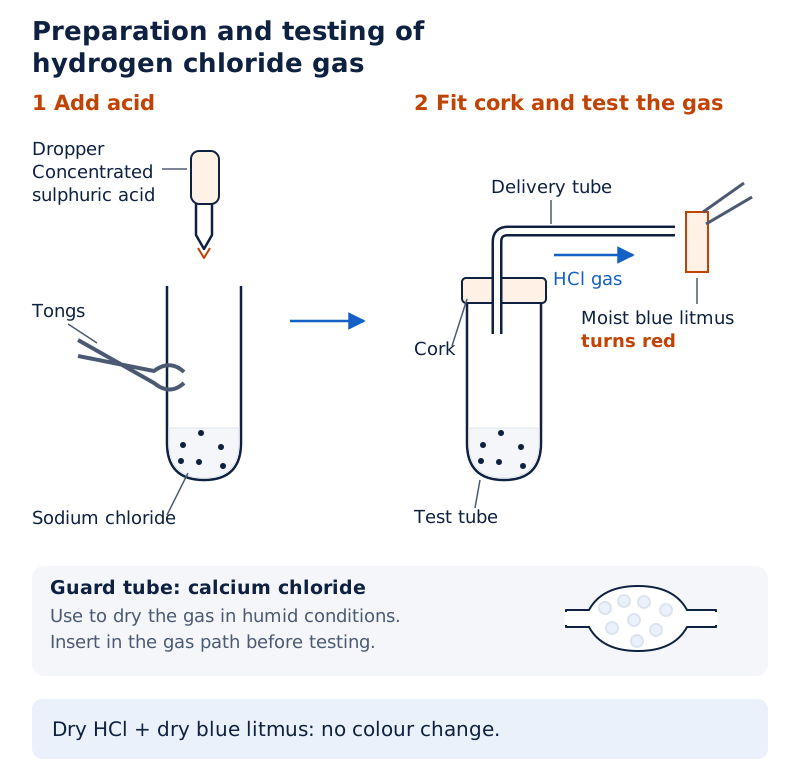
The drawing shows a dropper containing concentrated sulphuric acid above a test tube containing sodium chloride. A cork and delivery tube lead towards moist litmus paper. A pair of tongs and a guard tube containing calcium chloride are also labelled.
Drawn by One Young India.
Why does an acid solution light a bulb?
An electric current is a flow of electric charge. Acid solutions contain ions that carry charge through the liquid. A circuit, a connected path for current, containing dilute hydrochloric acid or dilute sulphuric acid can therefore allow a bulb to glow. Dilute means that relatively little dissolved substance is present per unit volume of solution.
Glucose and alcohol contain hydrogen, but their aqueous solutions do not show the same electrical conduction in this comparison. They do not produce the hydrogen ions responsible for acidic behaviour. Hydrogen content and acidic behaviour are different tests of a substance.
What the figure shows
Electrical conduction through an acid solution
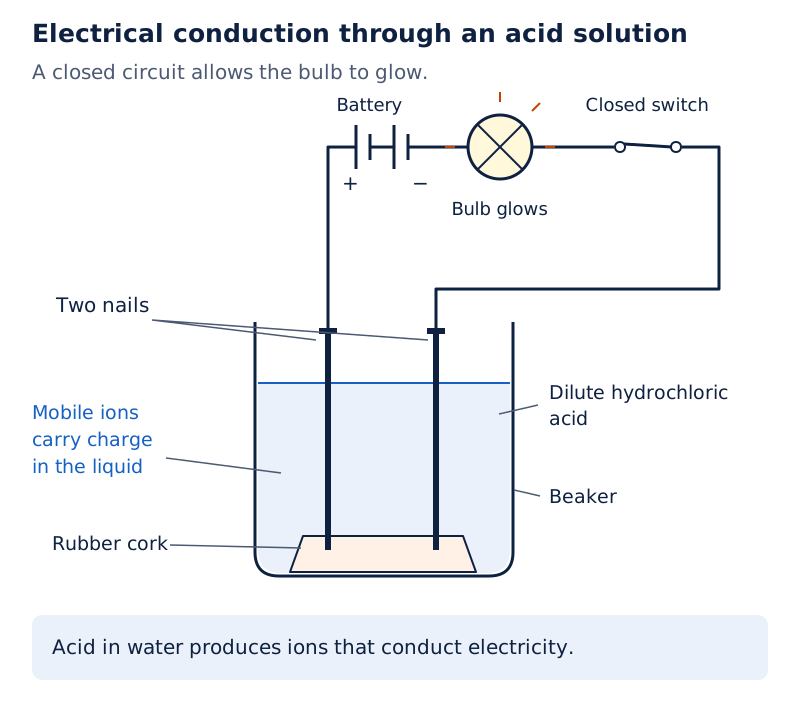
Two nails pass through a rubber cork in a beaker containing dilute hydrochloric acid. Wires connect them to a battery, bulb and switch.
Drawn by One Young India.
Mobile ions, meaning ions able to move, also explain conduction by dissolved ionic salts. Solid sodium chloride has ions held in a rigid structure, so those ions cannot move through the solid to carry current. Dissolving the salt allows ionic movement.
Compare the observations in sequence: water enables acid ionisation; ionisation produces charged particles; movement of these particles permits conduction. The bulb test demonstrates ionic conduction, while the litmus test identifies acidic or basic behaviour.
How do indicators and pH paper distinguish solutions?
Which indicator colours should be recognised?
Acid-base indicators change colour in acidic and basic media. A medium is the surrounding substance in which a reaction or test takes place. Litmus is a natural indicator; methyl orange and phenolphthalein are synthetic indicators, meaning indicators manufactured chemically.
| Indicator | Acidic solution | Alkaline solution |
|---|---|---|
| Blue litmus paper | Turns red | Remains blue |
| Red litmus paper | Remains red | Turns blue |
| Methyl orange | Red | Yellow |
| Phenolphthalein | Colourless | Pink |
A neutral solution does not change either red or blue litmus paper. Litmus solution itself is purple when neither acidic nor basic. “No change” in a single strip is therefore not enough to identify neutrality: an acid also leaves red litmus red.
When only red litmus is available for distinguishing an acid, an alkali and distilled water, first use it to identify the alkali. The alkali turns it blue. That blue paper can then distinguish the acid, which turns it red, from the water.
What additional information does the pH scale provide?
pH is a number indicating the acidic or basic nature of a solution and related to its hydrogen ion concentration. Concentration means the amount present per unit volume. The scale is generally considered from 0, very acidic, to 14, very alkaline.
A universal indicator is a mixture of several indicators that gives different colours at different hydrogen ion concentrations. Paper containing this mixture is commonly used as pH paper. Its colour is compared with the supplied colour chart to estimate pH.
| pH value | Nature of solution | Interpretation |
|---|---|---|
| Less than 7 | Acidic | Lower pH indicates higher hydronium ion concentration |
| 7 | Neutral | Neither acidic nor alkaline |
| More than 7 | Alkaline | Increasing pH towards 14 indicates increasing hydroxide ion concentration |
For solutions with pH 6 and pH 8, the first is acidic and the second alkaline. The pH 6 solution has the greater hydrogen ion concentration. These values identify the solutions' behaviour without requiring a taste or touch test.
How do dilution and neutralisation change an acid or alkali?
What happens during dilution?
Dilution means adding water to reduce concentration. When an acid is diluted, hydronium ion concentration per unit volume decreases. When an alkali is diluted, hydroxide ion concentration per unit volume decreases. Dilution spreads the dissolved material through a larger volume.
Dissolving an acid or a base in water is highly exothermic, meaning that it releases heat. Concentrated sulphuric or nitric acid must be added slowly to water with constant stirring. Concentrated means that relatively much solute, the dissolved substance, is present per unit volume of solution.
If water is added to concentrated acid, the heat generated may make the mixture splash and cause burns. Excessive local heating may also break the glass container. The order of mixing is therefore part of the chemistry of dilution, not merely a handling preference.
What happens during neutralisation?
Neutralisation is the reaction of an acid with a base to form a salt and water. The acid and base cancel each other's effects. For sodium hydroxide and hydrochloric acid, the salt formed is sodium chloride.
NaOH(aq) + HCl(aq) → NaCl(aq) + H₂O(l)
The essential ionic change is H⁺(aq) + OH⁻(aq) → H₂O(l). In terms of hydronium ions, this is H₃O⁺ + OH⁻ → 2H₂O. Sodium and chloride ions remain in solution while water forms.
Phenolphthalein makes the change visible. It is pink in sodium hydroxide solution. Adding hydrochloric acid drop by drop removes the alkaline effect and the pink colour disappears. Adding sodium hydroxide again can make the pink colour reappear.
Note: Dilution adds water; neutralisation involves a reaction with an acid or base. These are different changes even though both can reduce the pronounced acidic or alkaline behaviour of an initial solution.
A balanced equation has equal numbers of atoms of each element on both sides. Balance equations by changing the numbers before formulae, not the subscripts within them. Altering a subscript changes the chemical identity of a substance.
How do normal, acid, basic and complex salts differ?
What is meant by replacement of acidic hydrogen?
A salt is a compound formed when the replaceable hydrogen of an acid is partly or completely replaced by a metal or an ammonium group. Ammonium, NH₄⁺, is a positive ion containing nitrogen and hydrogen. Salts contain positive and negative ions.
A normal salt forms through complete replacement of the replaceable hydrogen of an acid. Sodium chloride and sodium sulphate, Na₂SO₄, are examples. The sulphate ion is SO₄²⁻. Two sodium ions balance its two negative charges in sodium sulphate.
An acid salt forms through partial replacement of the replaceable hydrogen of an acid with more than one replaceable hydrogen atom. Sodium hydrogensulphate, NaHSO₄, and sodium hydrogencarbonate, NaHCO₃, retain replaceable hydrogen in their negative ions.
Sulphuric acid illustrates the difference. Partial neutralisation with sodium hydroxide gives sodium hydrogensulphate; complete neutralisation gives sodium sulphate. The amount of alkali supplied determines whether one or both replaceable hydrogen atoms are replaced.
H₂SO₄ + NaOH → NaHSO₄ + H₂O
H₂SO₄ + 2NaOH → Na₂SO₄ + 2H₂O
What distinguishes basic and complex salts?
A basic salt results from incomplete neutralisation of a base with more than one hydroxide group and retains hydroxide in its composition. Basic lead chloride, Pb(OH)Cl, is an example; Pb denotes lead, and the formula contains both hydroxide and chloride.
A complex salt contains a complex ion: a charged group with a central metal atom or ion bonded to surrounding ions or molecules. These surrounding groups are called ligands. The complex ion remains a unit when the salt dissolves.
Potassium hexacyanidoferrate(II), K₄[Fe(CN)₆], contains potassium ions and the complex ion [Fe(CN)₆]⁴⁻. Fe denotes iron; CN⁻ is the cyanide ion, containing carbon and nitrogen. The square brackets enclose one iron centre with six cyanide ligands.
K₄[Fe(CN)₆] → 4K⁺ + [Fe(CN)₆]⁴⁻
The complex ion does not simply split into free iron(II) ions and cyanide ions on dissolving. Preserve the brackets and the charge when writing its dissociation. Four singly positive potassium ions balance the four negative charges of the complex ion.
Does salt type determine solution pH?
Structural classification and solution behaviour must be distinguished. Sodium hydrogencarbonate is an acid salt by composition, yet its aqueous solution is mildly basic. Sodium carbonate, Na₂CO₃, is a normal salt, yet its solution is also basic.
| Acid and base forming the salt | Solution behaviour | pH |
|---|---|---|
| Strong acid and strong base | Neutral | 7 |
| Strong acid and weak base | Acidic | Less than 7 |
| Weak acid and strong base | Basic | More than 7 |
Here strong and weak refer to the extent of ion formation in water when solutions of equal concentration are compared, rather than simply how concentrated a solution is. “Normal salt” describes replacement of hydrogen, so it must not be treated as a synonym for “neutral solution”.
How do dilute acids act on carbonates and hydrogencarbonates?
Which products form?
A carbonate contains the carbonate ion, CO₃²⁻. A hydrogencarbonate, also called a bicarbonate, contains HCO₃⁻. Both react with dilute acids to give a corresponding salt, carbon dioxide and water. Carbon dioxide has the formula CO₂.
With hydrochloric acid, sodium carbonate produces sodium chloride. Two units of hydrochloric acid are needed in the balanced equation. Sodium hydrogencarbonate also gives sodium chloride, but its equation requires one unit of hydrochloric acid per formula unit.
Na₂CO₃(s) + 2HCl(aq) → 2NaCl(aq) + CO₂(g) + H₂O(l)
NaHCO₃(s) + HCl(aq) → NaCl(aq) + CO₂(g) + H₂O(l)
The visible bubbling is effervescence, the escape of gas through a liquid. The bubbles alone do not identify the gas. A separate test connects the observed reaction to the carbon dioxide product predicted by the equations.
Why does limewater become milky?
Limewater is an aqueous solution of calcium hydroxide, Ca(OH)₂. Carbon dioxide reacts with it to form calcium carbonate, CaCO₃, as a white precipitate, an insoluble solid produced in a reaction. The suspended solid causes the milky appearance.
Ca(OH)₂(aq) + CO₂(g) → CaCO₃(s) + H₂O(l)
With excess carbon dioxide, the calcium carbonate reacts further to form soluble calcium hydrogencarbonate, Ca(HCO₃)₂. Excess means more gas is passed after the initial milkiness has formed. The precipitate dissolves, so the milkiness disappears.
CaCO₃(s) + CO₂(g) + H₂O(l) → Ca(HCO₃)₂(aq)
What the figure shows
Passing carbon dioxide through limewater
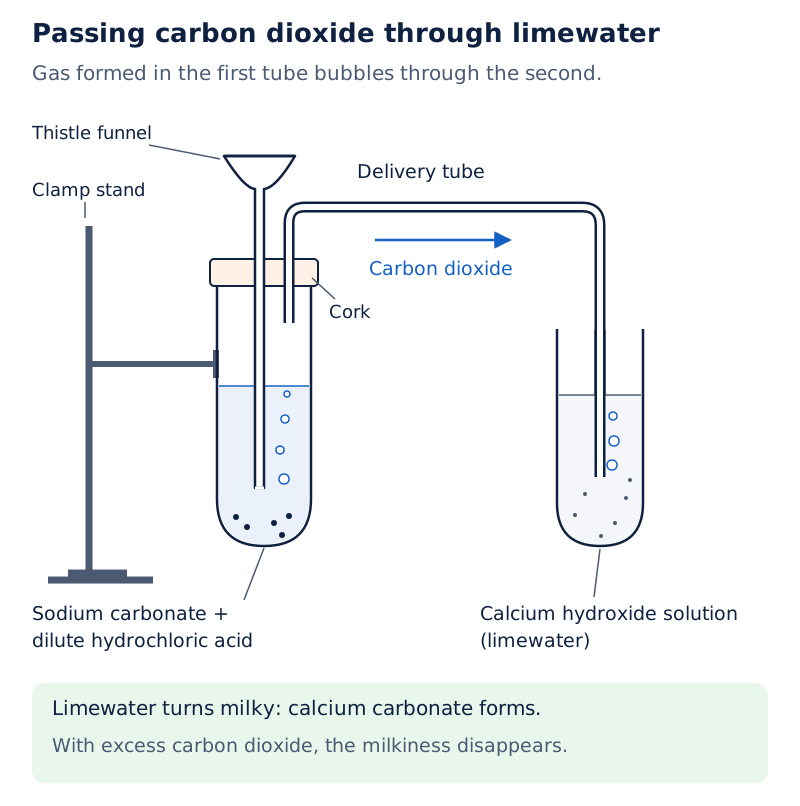
A clamped test tube contains sodium carbonate and dilute hydrochloric acid. A thistle funnel passes through its cork. A delivery tube carries gas into a second test tube labelled calcium hydroxide solution.
Drawn by One Young India.
The sequence of observations matters: effervescence in the reacting tube, milkiness in limewater, then disappearance of milkiness with excess carbon dioxide. Each observation corresponds to a different part of the chemical explanation.
How do dilute acids act on sulphites, hydrogensulphites and sulphides?
Which salts give sulphur dioxide?
A sulphite contains SO₃²⁻, while a hydrogensulphite contains HSO₃⁻. These ions are different from sulphate, SO₄²⁻. Treating sulphites or hydrogensulphites with a suitable dilute acid releases sulphur dioxide, SO₂, together with a salt and water.
For sodium sulphite, Na₂SO₃, warm dilute sulphuric acid gives sodium sulphate, water and sulphur dioxide. Warm means heat is supplied gently as required for the reaction. The sulphate product must not be confused with the sulphite reactant.
Na₂SO₃ + H₂SO₄ → Na₂SO₄ + H₂O + SO₂
Sodium hydrogensulphite, NaHSO₃, reacts with dilute hydrochloric acid in the corresponding way. The retained hydrogen in the hydrogensulphite ion changes the balancing, but sulphur dioxide remains the gaseous product.
NaHSO₃ + HCl → NaCl + H₂O + SO₂
Sulphur dioxide is colourless, with a pungent, suffocating smell like burning sulphur. It turns acidified potassium dichromate paper green. Acidified means that acid has been added to the testing reagent, the substance used for detecting a chemical.
Which salts give hydrogen sulphide?
A sulphide contains the sulphide ion, S²⁻. Sodium sulphide, Na₂S, reacts with warm dilute sulphuric acid to form sodium sulphate and hydrogen sulphide, H₂S. Unlike the sulphite equation, this equation does not produce water.
Na₂S + H₂SO₄ → Na₂SO₄ + H₂S
Hydrogen sulphide is a colourless gas with a rotten-egg smell. It blackens paper moistened with lead acetate solution because black lead sulphide forms. The smell is a descriptive property; gases should not be inhaled as an identification test.
| Salt group | Gas formed with suitable dilute acid | Useful observation |
|---|---|---|
| Carbonate or hydrogencarbonate | Carbon dioxide | Turns limewater milky; excess gas removes the milkiness |
| Sulphite or hydrogensulphite | Sulphur dioxide | Turns acidified potassium dichromate paper green |
| Sulphide | Hydrogen sulphide | Blackens moist lead acetate paper |
Sulphur dioxide also turns limewater milky. Therefore, when distinguishing these gas groups, milkiness alone is insufficient evidence for carbon dioxide. Use the salt's identity and a suitable confirmatory observation together.
How are normal salts prepared by combination and displacement?
What happens in direct combination?
Direct combination joins elements to form a compound. Sodium, Na, combines with chlorine, Cl₂, to form sodium chloride. Chlorine is written Cl₂ because its molecules contain two chlorine atoms. The balanced equation uses two sodium atoms.
2Na + Cl₂ → 2NaCl
The resulting compound contains sodium cations and chloride anions held together by electrical attraction. Sodium chloride does not consist of separate molecules; its formula expresses the simplest ratio of its ions. That ratio contains equal numbers of sodium and chloride ions.
This example shows that a salt can form without an acid and alkali being mixed. Salt is a class of compounds defined by composition; neutralisation is one route to making members of that class.
What happens in displacement?
Displacement occurs when a more reactive element replaces a less reactive element from its compound. A suitable metal can displace hydrogen from a dilute acid. Zinc, Zn, reacts with dilute sulphuric acid to form zinc sulphate, ZnSO₄, and hydrogen gas, H₂.
Zn(s) + H₂SO₄(aq) → ZnSO₄(aq) + H₂(g)
Hydrogen is usually the gas liberated when a suitable metal reacts with a dilute acid. It burns with a pop when tested using a flame in the supervised laboratory test. Do not assume every acid-metal combination behaves identically. For example, copper does not react with dilute hydrochloric acid.
Zinc also reacts with sodium hydroxide solution on warming to form sodium zincate, Na₂ZnO₂, and hydrogen. This is a reaction of a metal with an alkali, rather than an example of the acid-metal equation.
Zn + 2NaOH → Na₂ZnO₂ + H₂
Such reactions between alkalis and metals are not possible with all metals. Identify the actual reactants before predicting products. Merely seeing a metal in an equation does not determine whether the other reactant is an acid, an alkali or a salt solution.
When choosing a preparation method, start with the desired salt. Its positive ion identifies the metal needed, while its negative ion helps identify the acid or other reactant. Then check that the proposed reaction actually takes place.
How are normal salts prepared by precipitation and neutralisation?
When is precipitation suitable?
Precipitation prepares an insoluble salt by mixing suitable solutions. In double decomposition, also called double displacement, the reactants exchange ions. An insoluble product separates from the liquid while other ions remain dissolved.
Mixing sodium sulphate solution and barium chloride solution, BaCl₂, gives white barium sulphate, BaSO₄, and sodium chloride solution. Barium ions, Ba²⁺, combine with sulphate ions to form the precipitate. This method is suitable because the desired salt is insoluble.
Na₂SO₄(aq) + BaCl₂(aq) → BaSO₄(s) + 2NaCl(aq)
How does an insoluble base form a soluble salt?
An insoluble base can react with a suitable acid to form a salt and water. Copper(II) oxide reacts with dilute hydrochloric acid to form copper(II) chloride, CuCl₂. The oxide dissolves and a blue-green solution forms.
CuO(s) + 2HCl(aq) → CuCl₂(aq) + H₂O(l)
The reaction shows why an insoluble oxide can still behave as a base. Its ability to neutralise acid is distinct from its ability to dissolve in water. Solubility alone must not be used as the definition of a base.
How does titration prepare a salt from an alkali?
Titration determines the volume of one solution needed to react completely with a measured volume of another. In an acid-alkali preparation, an indicator helps locate the end-point, the observed colour change indicating completion of the intended reaction.
Sodium hydroxide and hydrochloric acid give sodium chloride and water. Suitable reacting amounts prevent an excess of either starting substance. This is neutralisation of an alkali, distinct from reacting an acid with an insoluble base.
The six preparation routes can be organised by the starting materials and the intended product. Carbonates and hydrogencarbonates supply another route to salts while releasing carbon dioxide, as their balanced equations show.
| Method | Reactants in an example | Salt obtained |
|---|---|---|
| Direct combination | Sodium and chlorine | Sodium chloride |
| Displacement | Zinc and dilute sulphuric acid | Zinc sulphate |
| Precipitation | Barium chloride and sodium sulphate solutions | Barium sulphate |
| Neutralisation of insoluble base | Copper(II) oxide and hydrochloric acid | Copper(II) chloride |
| Neutralisation of alkali | Sodium hydroxide and hydrochloric acid | Sodium chloride |
| Acid on carbonate or hydrogencarbonate | Hydrochloric acid and sodium carbonate or sodium hydrogencarbonate | Sodium chloride |
Glossary
- Acid — A substance producing hydronium ions as its only positive ions when dissolved in water.
- Base — A substance that reacts with an acid to form a salt and water.
- Alkali — A water-soluble base producing hydroxide ions as its only negative ions in aqueous solution.
- Hydronium ion — The positively charged H₃O⁺ ion formed when a hydrogen ion combines with water.
- Ionisation — Formation of ions from molecules, as when hydrogen chloride reacts with water.
- Dissociation — Separation of the constituent ions of an ionic substance when it dissolves.
- Indicator — A substance showing acidic or basic conditions through an observable change such as colour.
- pH — A number related to hydrogen ion concentration that indicates acidic, neutral or alkaline behaviour.
- Neutralisation — Reaction between an acid and a base that produces a salt and water.
- Normal salt — A salt formed by complete replacement of the replaceable hydrogen of an acid.
- Acid salt — A salt retaining replaceable hydrogen after partial replacement of the hydrogen of an acid.
- Basic salt — A salt retaining hydroxide after incomplete neutralisation of a base containing multiple hydroxide groups.
- Complex salt — A salt containing a complex ion that retains its identity when the salt dissolves.
- Precipitate — An insoluble solid formed by a chemical reaction taking place in solution.
- Titration — A method determining the volume of one solution needed to react completely with a measured volume of another.
Common errors and misconceptions
- Misconception: Every base is an alkali. Correct: An alkali is a water-soluble base. Insoluble copper(II) oxide reacts with acids but is not an alkali.
- Misconception: Every hydrogen-containing compound is acidic. Correct: Glucose and alcohol contain hydrogen but do not produce the hydrogen ions responsible for acidic behaviour in water.
- Misconception: An acid salt must have an acidic solution. Correct: Acid salt describes retained replaceable hydrogen. Sodium hydrogencarbonate is an acid salt with a mildly basic solution.
- Misconception: A normal salt must have pH 7. Correct: Normal describes complete replacement of acidic hydrogen. Sodium carbonate is a normal salt whose solution is basic.
- Misconception: Sulphate, sulphite and sulphide are interchangeable names. Correct: Their ions are SO₄²⁻, SO₃²⁻ and S²⁻ respectively; sulphites and sulphides release different gases with suitable dilute acids.
- Misconception: Limewater milkiness alone proves a gas is carbon dioxide. Correct: Sulphur dioxide can also produce milkiness. Consider the reactant and use an appropriate additional test.
- Misconception: Water should be poured into concentrated acid. Correct: Add acid slowly to water while stirring. Heat released during mixing may otherwise cause splashing and burns.
- Misconception: Every part of a complex salt separates into simple ions in water. Correct: Potassium hexacyanidoferrate(II) releases potassium ions while its complex anion retains its identity.
Exam-style questions with model answers
Q1. State what an alkali is and explain why copper(II) oxide, which is insoluble in water but neutralises acids, is not an alkali. [2 marks]
- An alkali is a base that dissolves in water and produces hydroxide ions in aqueous solution.
- Copper(II) oxide is a base because it neutralises acids, but its insolubility in water prevents it from being classified as an alkali.
Q2. Dry hydrogen chloride gas leaves dry blue litmus unchanged but turns moist blue litmus red. Explain both observations and write the ionisation equation using HCl for hydrogen chloride, H₂O for water, H₃O⁺ for hydronium and Cl⁻ for chloride. [3 marks]
- Dry hydrogen chloride does not produce the hydronium ions responsible for acidic behaviour without water. The dry blue litmus therefore does not change colour in the stated test.
- Water on moist litmus enables the formation of hydronium ions. These ions cause acidic behaviour and turn the blue litmus paper red.
- The ionisation equation is HCl + H₂O → H₃O⁺ + Cl⁻. It shows the water molecule participating in hydronium ion formation.
Q3. Solutions A and B have pH 6 and pH 8 respectively. Classify each solution, identify which has the higher hydrogen ion concentration, and state what happens to the hydroxide ion concentration per unit volume when B is diluted with water. [4 marks]
- Solution A is acidic because its pH is 6, which is below the neutral value of 7.
- Solution B is alkaline because its pH is 8, which is above the neutral value of 7.
- A has the higher hydrogen ion concentration: lower pH corresponds to greater hydrogen ion concentration in solution.
- Diluting B with water decreases its hydroxide ion concentration per unit volume because the solution occupies a larger volume.
Q4. Sodium carbonate, Na₂CO₃, reacts with dilute hydrochloric acid, HCl. The products are sodium chloride, NaCl, carbon dioxide, CO₂, and water, H₂O. State the visible change and balance the reaction. Explain initial milkiness and its disappearance when excess gas passes through limewater, Ca(OH)₂ solution, using calcium carbonate, CaCO₃, and soluble calcium hydrogencarbonate, Ca(HCO₃)₂. [5 marks]
- Effervescence occurs in the reacting mixture as carbon dioxide gas escapes through the liquid. This is the visible bubbling expected when the carbonate reacts with the dilute acid.
- The balanced reaction is Na₂CO₃ + 2HCl → 2NaCl + CO₂ + H₂O. Two units of hydrochloric acid are required for each formula unit of sodium carbonate.
- The gas initially makes limewater milky because insoluble calcium carbonate forms as a white precipitate suspended in the solution.
- The equation for this first limewater reaction is Ca(OH)₂ + CO₂ → CaCO₃ + H₂O.
- Excess carbon dioxide removes milkiness by producing soluble calcium hydrogencarbonate: CaCO₃ + CO₂ + H₂O → Ca(HCO₃)₂.
Q5. Define normal, acid, basic and complex salts. Use sodium sulphate, Na₂SO₄; sodium hydrogencarbonate, NaHCO₃; basic lead chloride, Pb(OH)Cl; and potassium hexacyanidoferrate(II), K₄[Fe(CN)₆], as examples respectively. The hydrogencarbonate retains replaceable hydrogen and its solution is mildly basic. Explain why these facts are compatible. [5 marks]
- A normal salt forms when the replaceable hydrogen of an acid is completely replaced. Sodium sulphate, Na₂SO₄, is the example produced by complete neutralisation of sulphuric acid.
- An acid salt retains replaceable hydrogen after partial replacement of an acid's hydrogen. Sodium hydrogencarbonate, NaHCO₃, is an example of this structural classification.
- A basic salt retains hydroxide after incomplete neutralisation of a base containing multiple hydroxide groups. Basic lead chloride, Pb(OH)Cl, contains hydroxide as well as chloride.
- A complex salt contains a complex ion that retains its identity on dissolving. K₄[Fe(CN)₆] supplies potassium ions and the complex anion [Fe(CN)₆]⁴⁻.
- Acid salt describes composition, whereas mildly basic describes solution behaviour. The retained hydrogen and basic solution of sodium hydrogencarbonate therefore do not contradict each other.
Q6. Sodium sulphite, Na₂SO₃, and sodium sulphide, Na₂S, are separately treated with warm dilute sulphuric acid, H₂SO₄. Both form sodium sulphate, Na₂SO₄. The sulphite also forms water, H₂O, and sulphur dioxide, SO₂; the sulphide forms hydrogen sulphide, H₂S. Write both equations and give a distinguishing paper test for each gas. [3 marks]
- The sulphite reaction is Na₂SO₃ + H₂SO₄ → Na₂SO₄ + H₂O + SO₂. Sulphur dioxide is the gaseous product, with water also formed.
- The sulphide reaction is Na₂S + H₂SO₄ → Na₂SO₄ + H₂S. Hydrogen sulphide is the gaseous product; water is not a product of this equation.
- Sulphur dioxide turns acidified potassium dichromate paper green. Hydrogen sulphide blackens moist lead acetate paper through formation of black lead sulphide.
Q7. Barium chloride solution, BaCl₂, reacts with sodium sulphate solution, Na₂SO₄, to produce insoluble white barium sulphate, BaSO₄, and sodium chloride solution, NaCl. Name the salt-preparation method, balance the equation, state the observation, and explain why the reaction is double decomposition. [4 marks]
- The preparation method is precipitation, because the desired barium sulphate salt is insoluble and forms when the two solutions react.
- The balanced equation is BaCl₂(aq) + Na₂SO₄(aq) → BaSO₄(s) + 2NaCl(aq). The state symbols distinguish dissolved substances from the solid product.
- A white precipitate of barium sulphate forms. Sodium chloride remains dissolved in the surrounding solution.
- It is double decomposition because the reactants exchange ions: barium ions combine with sulphate ions, while sodium and chloride ions remain in solution.
Q8. Name one method of preparing a normal salt for each pair: sodium and chlorine; zinc and dilute sulphuric acid; barium chloride and sodium sulphate solutions giving insoluble barium sulphate; insoluble copper(II) oxide and hydrochloric acid; sodium hydroxide and hydrochloric acid; sodium carbonate and hydrochloric acid. Give the salt formed in each case. [6 marks]
- Sodium and chlorine form sodium chloride by direct combination. Two elements combine to give the salt as the product of the reaction.
- Zinc and dilute sulphuric acid form zinc sulphate by displacement. Zinc replaces hydrogen from the acid, and hydrogen gas is released.
- Barium chloride and sodium sulphate solutions form barium sulphate by precipitation. The insoluble white salt separates through a double decomposition reaction.
- Copper(II) oxide and hydrochloric acid form copper(II) chloride by neutralisation of an insoluble base. Water is also produced in this reaction.
- Sodium hydroxide and hydrochloric acid form sodium chloride by neutralisation of an alkali. Titration determines the reacting amounts needed for this preparation.
- Sodium carbonate and hydrochloric acid form sodium chloride by the action of a dilute acid on a carbonate. Carbon dioxide and water also form.
Key takeaways
- Acids produce hydronium ions in water; alkalis are water-soluble bases that produce hydroxide ions in aqueous solution.
- Ionisation forms ions from molecules, while dissociation separates the constituent ions already present in an ionic substance.
- Litmus identifies acidic or alkaline behaviour; universal indicator and pH paper provide an estimate of pH.
- Normal and acid salts differ in the extent of replacement of acidic hydrogen, not simply in solution pH.
- Carbonates and hydrogencarbonates release carbon dioxide with dilute acids; sulphites and hydrogensulphites release sulphur dioxide.
- Sulphides release hydrogen sulphide with suitable dilute acids; the gas blackens moist lead acetate paper.
- Choose salt-preparation methods using the actual reactants and the solubility of the desired salt product.
- Add concentrated acid slowly to water with stirring because dilution releases heat and may otherwise cause splashing.
Test yourself
Why does hydrochloric acid solution conduct electricity?
It contains mobile ions that carry electric charge through the solution. Hydronium ions account for its acidic behaviour, while chloride ions are also present.
What is the difference between a cation and an anion?
A cation carries a positive charge, while an anion carries a negative charge. Sodium ions are cations; chloride ions are anions.
Why is an unchanged red litmus strip insufficient evidence for neutrality?
An acid also leaves red litmus unchanged. Use blue litmus as well: an acid turns it red, while a neutral solution does not change it.
Does an acid salt necessarily give an acidic solution?
No. Sodium hydrogencarbonate retains replaceable hydrogen and is an acid salt, but its aqueous solution is mildly basic.
What happens when excess carbon dioxide passes through milky limewater?
The calcium carbonate precipitate reacts with carbon dioxide and water to form soluble calcium hydrogencarbonate, so the milkiness disappears.
How can sulphur dioxide be distinguished from hydrogen sulphide using paper tests?
Sulphur dioxide turns acidified potassium dichromate paper green. Hydrogen sulphide blackens moist lead acetate paper by forming lead sulphide.
Why can copper(II) oxide be used to prepare a salt by neutralisation?
It is a base even though it is insoluble in water. It reacts with hydrochloric acid to form copper(II) chloride and water.
Which ions form when potassium hexacyanidoferrate(II) dissolves?
It gives potassium ions and intact hexacyanidoferrate(II) complex ions. Each formula unit supplies four K⁺ ions and one [Fe(CN)₆]⁴⁻ ion.
Write about it
Turn a question from this chapter into a paper.
The Writing Studio has a structure guide, a rubric and citation tools for 15 formats, from essays to research papers. Drafting is free with an account. Learnacy Essential adds feedback from an AI writing coach and submission to The OYI Review.
Learnacy Essential is ₹1,499 for the year. Publication depends on review and is not guaranteed.