
Study of Compounds: Ammonia | ICSE Class 10 Chemistry Notes
On this page
This note covers ammonia’s composition and properties, laboratory preparation and collection, preparation from nitrides and ammonium salts, manufacture by Haber’s process, the fountain experiment, aqueous ammonia, reactions with acids, metal oxides, chlorine and oxygen, identification tests and uses.
What is ammonia, and which properties explain its behaviour?
Ammonia is a compound of nitrogen and hydrogen with the formula NH₃. Here N represents nitrogen, H represents hydrogen, and the subscript 3 shows that one ammonia molecule contains three hydrogen atoms bonded to one nitrogen atom.
A molecule is a group of bonded atoms that acts as a unit. Ammonia is a colourless gas with a characteristic pungent, or sharply irritating, smell. It is less dense than air and very soluble in water.
How do physical properties guide collection?
Density means mass per unit volume. Because ammonia is less dense than air under the same conditions, it rises into an inverted gas jar and displaces the air downwards. Its high solubility makes collection over water unsuitable.
| Property | Meaning or observation | Practical consequence |
|---|---|---|
| Colourless | The gas itself has no visible colour. | A colour change during a test belongs to the indicator or reaction product. |
| Pungent smell | Ammonia has a sharply irritating odour. | Smell alone is not a satisfactory identification test. |
| Less dense than air | An equal volume has less mass than air under the same conditions. | Use an inverted, dry gas jar for collection. |
| Very soluble in water | Water readily absorbs the gas. | Use dry apparatus and demonstrate solubility with a fountain experiment. |
How should the reaction symbols be read?
In the equations below, + separates substances that react together or are formed together. The arrow → means “produces”; ⇌ means that a reaction can proceed in both directions. A number before a formula gives the relative number of reacting particles.
A balanced equation has equal numbers of atoms of each element on its two sides. Changing a coefficient, the number before a formula, changes the quantity represented. Changing a subscript changes the substance itself, so subscripts must remain fixed when balancing.
How is ammonia prepared, dried and collected in the laboratory?
Laboratory preparation uses ammonium chloride, NH₄Cl, and calcium hydroxide, Ca(OH)₂, also called slaked lime. In these formulae, Cl represents chlorine, Ca calcium and O oxygen. Brackets mean that the enclosed group is repeated by the subscript outside them.
Heating the mixture produces ammonia, calcium chloride, CaCl₂, and water, H₂O. The balanced equation is:
2NH₄Cl + Ca(OH)₂ → CaCl₂ + 2NH₃ + 2H₂O (heat).
What is the sequence of the preparation?
- Place a mixture of ammonium chloride and calcium hydroxide in a hard-glass test tube suitable for heating. Arrange the tube with its mouth slightly lower than its heated end.
- Heat the mixture gently. Ammonia and water vapour form; the delivery tube carries the gases away from the reaction vessel.
- Pass the gas through a drying tower containing quicklime, which is calcium oxide, CaO. This removes moisture without removing the ammonia by an acid reaction.
- Lead the dry ammonia upwards into an inverted, dry gas jar. It collects by downward displacement of air, also described as upward delivery.
- Test the collected gas using damp red litmus paper or a glass rod moistened with concentrated hydrochloric acid. The expected results are a blue litmus colour and dense white fumes, respectively.
Litmus is an acid-base indicator, a substance whose colour changes with acidic or alkaline conditions. Hydrochloric acid is hydrogen chloride dissolved in water. “Concentrated” means that a relatively large amount of the dissolved substance is present in a given amount of solution.
Why do the apparatus choices matter?
The sloping reaction tube keeps condensed water from running back onto the strongly heated part, where sudden cooling could crack the glass. The collection jar is dry because moisture would absorb ammonia. Its inverted position follows from ammonia’s lower density than air.
A drying agent removes water from a gas. Concentrated sulphuric acid is unsuitable here because it reacts with ammonia. Anhydrous calcium chloride, meaning calcium chloride without water bound into its crystals, also absorbs ammonia and is unsuitable for this preparation.
Diagram
Laboratory preparation of ammonia
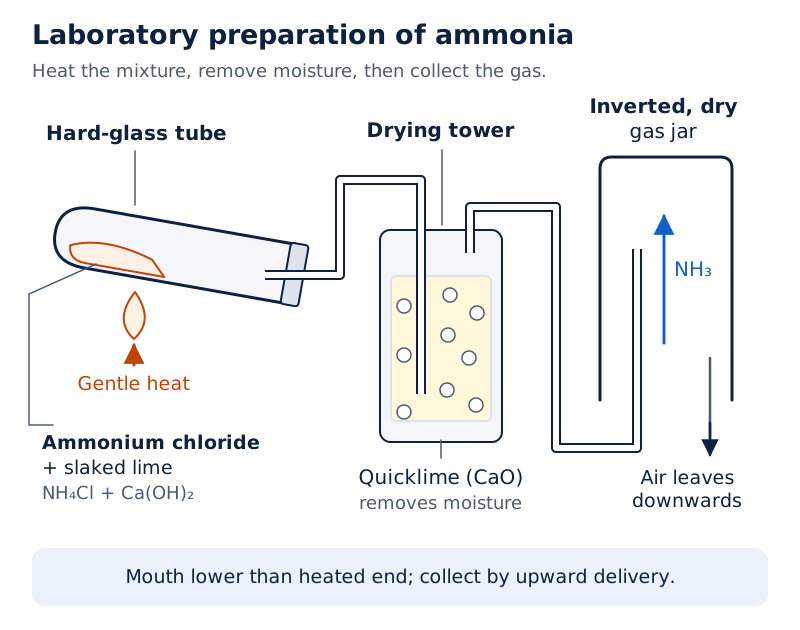
Draw the sloping heated hard-glass tube, label the ammonium chloride and slaked-lime mixture, connect it to a quicklime drying tower, and show upward delivery into an inverted dry gas jar with air leaving downwards.
Drawn by One Young India.
Note: Drying and collection solve different problems. Quicklime removes moisture; the inverted jar permits collection of a gas lighter than air. Water cannot replace air as the collecting medium because it dissolves ammonia.
How do nitrides and ammonium salts produce ammonia?
A nitride is a compound of nitrogen with a more electropositive element, such as a metal. Electropositive elements tend to lose electrons, the negatively charged particles in atoms. Magnesium nitride and aluminium nitride react with warm water to release ammonia. The other product is the corresponding metal hydroxide, a compound containing hydroxide groups.
What happens when nitrides react with water?
Magnesium nitride has the formula Mg₃N₂, where Mg represents magnesium. Magnesium hydroxide is Mg(OH)₂. Their reaction is:
Mg₃N₂ + 6H₂O → 3Mg(OH)₂ + 2NH₃ (warm water).
Aluminium nitride is AlN, where Al represents aluminium; aluminium hydroxide is Al(OH)₃. Its reaction is:
AlN + 3H₂O → Al(OH)₃ + NH₃ (warm water).
These are examples of hydrolysis, the chemical decomposition of a compound by reaction with water. Nitrogen in the nitride appears in ammonia, while the metal appears in its hydroxide. Water supplies the hydrogen needed for ammonia and the components of the hydroxide groups.
How does an alkali release ammonia from an ammonium salt?
An ammonium salt contains the ammonium ion, NH₄⁺. An ion is an electrically charged atom or group of atoms; the superscript + indicates one positive charge. A base accepts a hydrogen ion in an acid-base reaction. An alkali is a water-soluble base that supplies hydroxide ions in solution.
Warming ammonium chloride with sodium hydroxide, NaOH, releases ammonia. Here Na represents sodium, and sodium chloride is NaCl:
NH₄Cl + NaOH → NaCl + NH₃ + H₂O (warm).
Ammonium sulphate, (NH₄)₂SO₄, similarly reacts with sodium hydroxide. Here S represents sulphur, and Na₂SO₄ is sodium sulphate:
(NH₄)₂SO₄ + 2NaOH → Na₂SO₄ + 2NH₃ + 2H₂O (warm).
The evolved gas is identified by damp red litmus turning blue and white fumes with hydrogen chloride. This connects the preparation of ammonia with the detection of ammonium ions: the alkali releases a recognisable gas from the salt.
How does Haber’s process manufacture ammonia?
Haber’s process manufactures ammonia by direct combination of nitrogen gas, N₂, and hydrogen gas, H₂. Their molecules contain two atoms each. The gases react in the proportion of one volume of nitrogen to three volumes of hydrogen, measured under the same conditions.
N₂ + 3H₂ ⇌ 2NH₃.
The reaction is reversible, so ammonia can decompose back into nitrogen and hydrogen. It is also exothermic, meaning that heat is released when ammonia forms. These features explain why the operating conditions must balance reaction speed and ammonia production.
Which conditions are used, and why?
An iron catalyst, a substance that increases reaction rate without being consumed overall, enables a satisfactory rate. Conditions are around 500°C and 200 atm. Here °C means degrees Celsius, a temperature unit, and atm means atmosphere, a pressure unit.
| Condition or operation | Reason |
|---|---|
| High pressure | The forward reaction changes four gaseous molecules into two, so increased pressure favours ammonia formation. |
| Moderately high temperature | Low temperature favours ammonia at equilibrium but makes the reaction slow; a higher operating temperature provides a useful rate. |
| Iron catalyst | It speeds the approach to equilibrium without changing the equilibrium composition at a given temperature. |
| Cooling and removal of ammonia | Liquefying ammonia separates the product and encourages further formation of ammonia. |
| Recycling unreacted gases | Nitrogen and hydrogen that did not react are returned for another passage through the converter. |
Equilibrium is the state in which forward and reverse reactions occur at equal rates, leaving the overall composition unchanged. It does not mean that all nitrogen and hydrogen have reacted or that molecular reactions have stopped.
What is the manufacturing sequence?
- Supply nitrogen and hydrogen in the required one-to-three proportion and compress the gas mixture.
- Pass the mixture over the heated iron catalyst in the reaction vessel, called the converter.
- Cool the outgoing mixture so that ammonia can be liquefied and separated from the unreacted gases.
- Return the unreacted nitrogen and hydrogen to the converter, maintaining the cycle of reaction and separation.
Diagram
Haber-process flow diagram
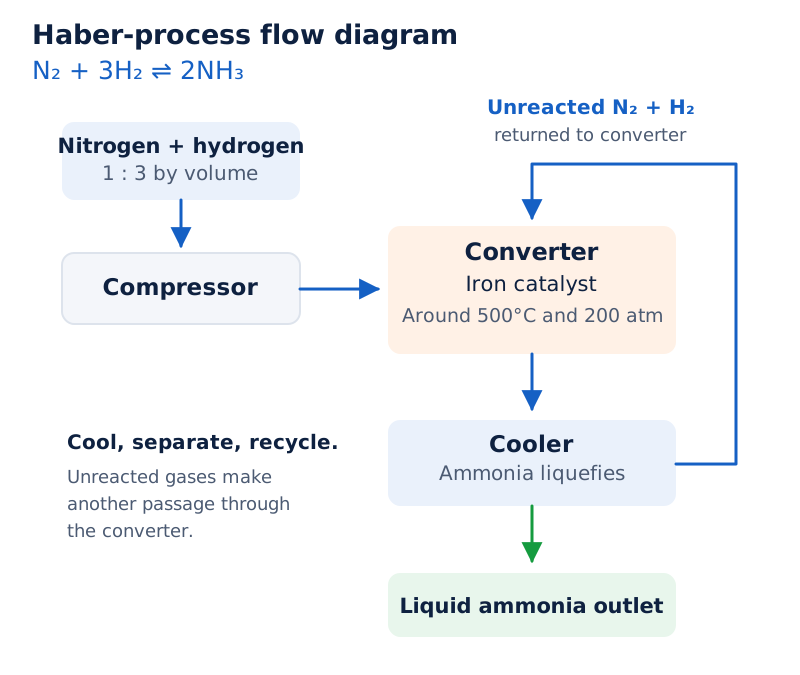
Show nitrogen and hydrogen entering a compressor, then an iron-catalyst converter. Connect this to a cooler and liquid-ammonia outlet. Draw a return arrow carrying unreacted nitrogen and hydrogen to the converter.
Drawn by One Young India.
What does the ammonia fountain experiment demonstrate?
The fountain experiment demonstrates the high solubility of ammonia in water. When an indicator is included, it also shows that the resulting solution is alkaline. A fountain forms because dissolving ammonia lowers the gas pressure inside the flask.
How is the apparatus arranged?
A dry flask filled with ammonia is inverted and closed with a stopper carrying a jet tube and a dropper containing water. The lower end of the jet tube dips into water containing red litmus. The jet points into the flask.
Atmospheric pressure is the pressure exerted by the surrounding air. Before the experiment begins, water separates the lower opening of the jet tube from the air. The water can rise through the tube when the pressure inside the flask falls sufficiently.
Why does the water enter as a fountain?
- Introduce a little water from the dropper into the ammonia-filled flask. The water rapidly dissolves some of the ammonia.
- The amount of gas remaining in the flask decreases, so its pressure falls below the pressure of the outside air.
- Atmospheric pressure pushes the water in the reservoir up the jet tube and into the flask.
- The entering water dissolves more ammonia and sprays through the jet. Red litmus becomes blue because the solution formed is alkaline.
The two observations have different meanings. The fountain is evidence of rapid gas absorption and the resulting pressure difference. The blue colour is evidence of alkalinity. The gas itself remains colourless; the indicator supplies the visible colour.
Diagram
Ammonia fountain experiment
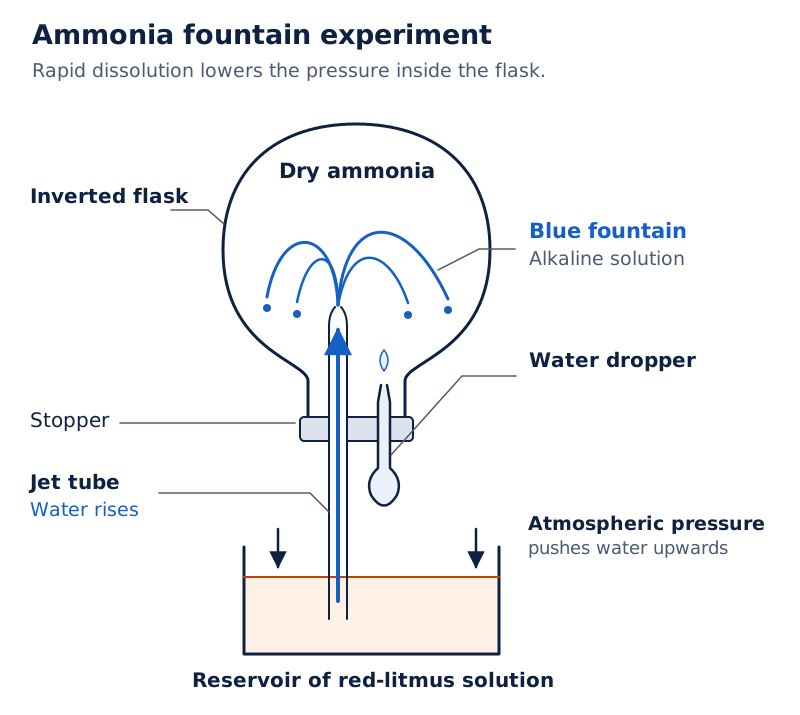
Draw an inverted flask labelled dry ammonia, a water dropper through its stopper, and a jet tube dipping into a reservoir of red-litmus solution. Show water rising through the tube and a blue fountain inside the flask.
Drawn by One Young India.
Why is aqueous ammonia alkaline, and how does it react with acids?
Aqueous ammonia means ammonia dissolved in water. Some dissolved ammonia molecules react with water to form ammonium ions, NH₄⁺, and hydroxide ions, OH⁻. The superscript − indicates one negative charge; the hydroxide ion contains one oxygen atom and one hydrogen atom.
NH₃ + H₂O ⇌ NH₄⁺ + OH⁻.
The hydroxide ions account for the solution’s alkaline character, including its action on red litmus. Ammonia is a weak base: its reaction with water is partial, so the solution contains unreacted ammonia as well as ions.
What does the name ammonium hydroxide mean?
The conventional name ammonium hydroxide and formula NH₄OH are used for aqueous ammonia in school equations. The ionic equation above gives a clearer description of what happens in water. The solution must not be confused with dry ammonia gas or a solid ammonium salt.
Weakness and dilution describe different things. “Weak” concerns the limited extent of the base’s reaction with water. “Dilute” means that relatively little dissolved substance is present in a given amount of solution. Diluting ammonia does not turn it into a strong base.
Which salts form in neutralisation reactions?
Neutralisation is an acid-base reaction. Aqueous ammonia reacts with hydrochloric acid, HCl, nitric acid, HNO₃, and sulphuric acid, H₂SO₄. Complete neutralisation gives ammonium chloride, NH₄Cl, ammonium nitrate, NH₄NO₃, and ammonium sulphate, (NH₄)₂SO₄, respectively.
| Acid | Equation using the conventional NH₄OH notation |
|---|---|
| Hydrochloric acid | NH₄OH + HCl → NH₄Cl + H₂O |
| Nitric acid | NH₄OH + HNO₃ → NH₄NO₃ + H₂O |
| Sulphuric acid | 2NH₄OH + H₂SO₄ → (NH₄)₂SO₄ + 2H₂O |
Written directly for dissolved ammonia, the same overall reactions are NH₃ + HCl → NH₄Cl, NH₃ + HNO₃ → NH₄NO₃, and 2NH₃ + H₂SO₄ → (NH₄)₂SO₄. The two notations describe the same salt formation; they should not be combined within one equation.
How does ammonia reduce hot copper(II) oxide and lead(IV) oxide?
A reducing agent causes another substance to undergo reduction. In these reactions, reduction means removal of oxygen from a metal oxide. Ammonia removes oxygen from hot copper(II) oxide and lead(IV) oxide, producing the metals, nitrogen and water.
Oxidation can mean gain of oxygen or loss of hydrogen. Ammonia loses hydrogen as it changes into nitrogen, while that hydrogen combines with oxygen from the oxide to form water. Thus ammonia is oxidised while the metal oxide is reduced.
What happens with copper(II) oxide?
Copper(II) oxide is CuO, where Cu represents copper. The Roman numeral II indicates copper’s oxidation state of +2 in the compound; an oxidation state is the formal charge assigned by electron-counting rules.
3CuO + 2NH₃ → 3Cu + N₂ + 3H₂O (heated copper(II) oxide).
The black oxide changes to reddish-brown copper. Water is formed and may appear as droplets in a cooler part of the apparatus. Both the colour change and the equation should be linked to removal of oxygen from the oxide.
What happens with lead(IV) oxide?
Lead(IV) oxide is PbO₂, where Pb represents lead and IV indicates an oxidation state of +4. Its reaction with ammonia is:
3PbO₂ + 4NH₃ → 3Pb + 2N₂ + 6H₂O (heated lead(IV) oxide).
The dark brown oxide is reduced to grey metallic lead. As with copper(II) oxide, nitrogen and water accompany the metal. The different coefficients follow from the different numbers of oxygen atoms in the two oxide formulae.
The condition of heating is part of each reaction description. Passing ammonia over an oxide and passing it over a heated oxide are not equivalent descriptions of the demonstration. Identify the reactant, condition, product and observation together.
How does ammonia react with hydrogen chloride and chlorine?
Hydrogen chloride and chlorine are different substances. Hydrogen chloride, HCl, contains hydrogen and chlorine; chlorine, Cl₂, is an elemental gas whose molecules contain two chlorine atoms. Their reactions with ammonia must therefore be learnt separately.
Why do white fumes form with hydrogen chloride?
NH₃ + HCl → NH₄Cl.
Ammonia and hydrogen chloride form ammonium chloride. Fine solid particles of ammonium chloride appear as dense white fumes. These fumes are the product of a reaction between two colourless gases, not evidence that ammonia itself is white.
A glass rod moistened with concentrated hydrochloric acid supplies hydrogen chloride near the ammonia. White fumes at the meeting point provide a useful identification test. This reaction also illustrates formation of an ammonium salt by the basic gas.
What changes when the relative supply of chlorine changes?
With ammonia in excess, meaning more ammonia is available than is consumed by the chlorine supplied, the overall products are nitrogen and ammonium chloride:
8NH₃ + 3Cl₂ → N₂ + 6NH₄Cl.
White fumes of ammonium chloride form. Part of the ammonia is oxidised to nitrogen; further ammonia reacts with the hydrogen chloride formed during the reaction. This explains why the overall equation requires eight ammonia molecules for three chlorine molecules.
With chlorine in excess, the products are nitrogen trichloride, NCl₃, and hydrogen chloride:
NH₃ + 3Cl₂ → NCl₃ + 3HCl.
Nitrogen trichloride is an unstable, explosive yellow oily liquid. This reaction is studied through its equation and observations, not attempted as a student experiment. Specifying which reactant is in excess is essential because it determines which set of products is expected.
Note: “Ammonia reacts with chlorine” is incomplete when predicting products. State ammonia in excess or chlorine in excess before choosing the equation.
How does burning ammonia differ from its catalytic oxidation?
Combustion is burning in oxygen. Ammonia does not burn readily in air, but it burns in oxygen with a greenish-yellow flame to form nitrogen and water. Oxygen gas is O₂, with two oxygen atoms in each molecule.
4NH₃ + 3O₂ → 2N₂ + 6H₂O (ignited ammonia in oxygen, without the platinum catalyst).
What happens during catalytic oxidation?
Catalytic oxidation is oxidation carried out with a catalyst. Passing ammonia mixed with excess air over heated platinum, a catalytic metal, at about 800°C produces nitric oxide, NO, and water. Nitric oxide is also called nitrogen monoxide.
4NH₃ + 5O₂ → 4NO + 6H₂O (heated platinum catalyst).
The catalyst and conditions change the useful reaction pathway. Consequently, the nitrogen-containing product is NO rather than N₂. The equation also shows a greater oxygen requirement for catalytic oxidation than for burning to nitrogen.
| Feature | Burning in oxygen | Catalytic oxidation |
|---|---|---|
| Conditions | Ignited ammonia in oxygen without platinum | Ammonia and excess air over heated platinum |
| Nitrogen-containing product | Nitrogen, N₂ | Nitric oxide, NO |
| Water formation | Water is produced. | Water is produced. |
| Observation | Greenish-yellow flame | Colourless nitric oxide forms and can become brown in air. |
The brown gas is nitrogen dioxide, NO₂. It forms when colourless nitric oxide combines with further oxygen: 2NO + O₂ → 2NO₂. Thus brown fumes are due to a subsequent reaction, not the initial colour of nitric oxide.
Catalytic oxidation is the first chemical stage in manufacturing nitric acid from ammonia. Distinguishing nitrogen from nitric oxide connects the reaction conditions with ammonia’s industrial use and prevents the two oxygen equations from being interchanged.
How does aqueous ammonia help identify dissolved metal salts?
A precipitate is an insoluble solid formed during a reaction in solution. Hydroxide ions supplied by aqueous ammonia can produce precipitates of metal hydroxides. The precipitate’s colour and its behaviour when more ammonia is added help distinguish dissolved metal ions.
What should be observed with a little reagent and with excess?
Add aqueous ammonia drop by drop first, then add excess to the same sample. Record the initial precipitate before describing whether it dissolves. A precipitate that disappears into a coloured solution has undergone a further reaction; the observation is not “no reaction”.
In the formulae below, Fe represents iron and Zn represents zinc. The nitrate group is NO₃⁻ and the sulphate group is SO₄²⁻; ²⁻ indicates two negative charges. Gelatinous means jelly-like in appearance.
| Salt solution | Initial hydroxide precipitate | Effect of excess aqueous ammonia |
|---|---|---|
| Iron(III) chloride, FeCl₃ | Reddish-brown iron(III) hydroxide, Fe(OH)₃ | Precipitate remains insoluble. |
| Iron(II) sulphate, FeSO₄ | Dirty-green iron(II) hydroxide, Fe(OH)₂ | Precipitate remains insoluble. |
| Lead(II) nitrate, Pb(NO₃)₂ | White lead(II) hydroxide, Pb(OH)₂ | Precipitate remains insoluble. |
| Zinc nitrate, Zn(NO₃)₂ | White gelatinous zinc hydroxide, Zn(OH)₂ | Dissolves to give a colourless solution. |
| Copper(II) sulphate, CuSO₄ | Pale-blue copper(II) hydroxide, Cu(OH)₂ | Dissolves to give a deep-blue solution. |
Iron(II) hydroxide turns brown on standing in air as it is oxidised.
Which equations describe the initial precipitates?
Using the conventional ammonium-hydroxide notation, the equations are:
- FeCl₃ + 3NH₄OH → Fe(OH)₃ + 3NH₄Cl.
- FeSO₄ + 2NH₄OH → Fe(OH)₂ + (NH₄)₂SO₄.
- Pb(NO₃)₂ + 2NH₄OH → Pb(OH)₂ + 2NH₄NO₃.
- Zn(NO₃)₂ + 2NH₄OH → Zn(OH)₂ + 2NH₄NO₃.
- CuSO₄ + 2NH₄OH → Cu(OH)₂ + (NH₄)₂SO₄.
Why do the zinc and copper precipitates dissolve?
Excess ammonia forms soluble complex ions, charged groups in which ammonia molecules attach to a metal ion. The zinc complex gives a colourless solution; the copper complex gives a deep-blue solution. Their formation removes the metal ions from the hydroxide precipitates.
The simplified complex formulae are [Zn(NH₃)₄]²⁺ and [Cu(NH₃)₄]²⁺. Square brackets enclose each complex, and ²⁺ indicates its two positive charges. These are called tetraamminezinc(II) and tetraamminecopper(II); “tetraammine” indicates four attached ammonia molecules.
Zn(OH)₂ + 4NH₃ ⇌ [Zn(NH₃)₄]²⁺ + 2OH⁻.
Cu(OH)₂ + 4NH₃ ⇌ [Cu(NH₃)₄]²⁺ + 2OH⁻.
The deep-blue copper result describes a solution, not a deep-blue precipitate. The lead and zinc precipitates both begin white, so their different behaviour in excess ammonia is especially useful for distinguishing them.
How is ammonia identified, and what are its main uses?
The main identification tests connect ammonia’s alkalinity and its reaction with hydrogen chloride. Damp red litmus turns blue. A glass rod moistened with concentrated hydrochloric acid produces dense white fumes of ammonium chloride near the gas.
Why must the litmus be damp?
Water on the litmus dissolves ammonia and permits hydroxide ions to form. Completely dry ammonia does not turn completely dry red litmus blue. The moisture requirement links this test directly to the aqueous equilibrium and explains why “damp” is part of the procedure.
The pungent odour can accompany these observations, but gases should not be inhaled directly for identification. Use the chemical tests to support the conclusion. For an ammonium salt, first release ammonia by warming the salt with an alkali, then apply the gas tests.
Which properties and reactions make ammonia useful?
- Fertilisers: ammonia is used to manufacture nitrogen-containing fertilisers, including ammonium salts, that supply nitrogen needed for plant growth.
- Nitric acid: catalytic oxidation of ammonia begins the sequence used to manufacture this important acid.
- Explosives: ammonia is a raw material in the manufacture of explosives through nitrogen-containing industrial chemicals.
- Refrigeration: ammonia acts as a refrigerant, a substance that absorbs heat while evaporating and releases heat elsewhere when condensed.
- Cleansing agents: aqueous ammonia is used in cleaning preparations because of its alkaline character.
Chlorofluorocarbons, abbreviated CFCs, are compounds containing chlorine, fluorine and carbon that have been used as refrigerants. They can deplete stratospheric ozone, the protective ozone layer high in the atmosphere. Ammonia is a non-ozone-depleting refrigerant alternative; this property does not mean it is non-irritant.
Glossary
- Ammonia — A colourless, pungent compound of nitrogen and hydrogen, with molecular formula NH₃.
- Density — Mass per unit volume, used to compare ammonia with air under identical conditions.
- Drying agent — A substance used to remove water vapour from a gas during preparation.
- Hydrolysis — Chemical decomposition of a compound by reaction with water, such as ammonia formation from metal nitrides.
- Ammonium ion — The positively charged group NH₄⁺ present in ammonium salts and aqueous ammonia.
- Alkali — A water-soluble base that supplies hydroxide ions in aqueous solution.
- Catalyst — A substance that increases reaction rate without being consumed in the overall reaction.
- Equilibrium — A dynamic state with equal forward and reverse reaction rates and unchanged overall composition.
- Exothermic reaction — A reaction that releases heat, such as ammonia formation from nitrogen and hydrogen.
- Weak base — A base whose reaction with water is partial, leaving unreacted base alongside ions.
- Precipitate — An insoluble solid produced when substances react with one another in solution.
- Reducing agent — A substance that causes reduction of another substance while itself undergoing oxidation.
- Complex ion — A charged group containing a central metal ion attached to surrounding molecules or ions.
- Refrigerant — A substance used to transfer heat through evaporation and condensation in a cooling system.
Common errors and misconceptions
- Misconception: Ammonia can be collected over water. Correct: Water readily dissolves it; collect the dry gas by downward displacement of air.
- Misconception: Any drying agent is suitable for ammonia. Correct: Use quicklime; concentrated sulphuric acid reacts with ammonia, and anhydrous calcium chloride absorbs it.
- Misconception: A catalyst increases the equilibrium proportion of ammonia. Correct: It speeds attainment of equilibrium without changing the equilibrium composition at a given temperature.
- Misconception: The fountain proves that ammonia is blue. Correct: Ammonia is colourless; the litmus becomes blue in the alkaline solution formed.
- Misconception: Ammonia and chlorine have the same products in all proportions. Correct: Excess ammonia gives nitrogen and ammonium chloride; excess chlorine gives nitrogen trichloride and hydrogen chloride.
- Misconception: Burning ammonia and catalytic oxidation both produce nitrogen. Correct: Burning gives nitrogen, whereas catalytic oxidation over heated platinum gives nitric oxide.
- Misconception: Excess ammonia gives a deep-blue copper precipitate. Correct: The initial pale-blue precipitate dissolves to form a deep-blue solution.
- Misconception: Dry ammonia turns dry red litmus blue. Correct: Moisture is needed so that ammonia dissolves and produces hydroxide ions.
Exam-style questions with model answers
Q1. Ammonia is less dense than air and very soluble in water. Using these properties, state its collection method and explain why collection over water is unsuitable. [2 marks]
- Collect ammonia in an inverted dry gas jar by downward displacement of air, since it is less dense than air.
- Do not collect it over water: its high solubility means that water absorbs the ammonia instead of allowing it to accumulate.
Q2. Heating ammonium chloride, NH₄Cl, with calcium hydroxide, Ca(OH)₂, produces calcium chloride, CaCl₂, ammonia, NH₃, and water, H₂O. Write the balanced equation, name the drying agent and state the damp-red-litmus result for the gas. [3 marks]
- The balanced preparation equation is 2NH₄Cl + Ca(OH)₂ → CaCl₂ + 2NH₃ + 2H₂O, with heat supplied to the solid mixture in the reaction tube.
- Use quicklime, calcium oxide, to dry the ammonia by removing the water vapour accompanying the gas.
- The gas turns damp red litmus blue because ammonia dissolves in the moisture and produces an alkaline solution.
Q3. An inverted flask contains dry ammonia. A jet tube connects it to a reservoir of red-litmus solution, and a dropper introduces water into the flask. Ammonia is very soluble in water and gives an alkaline solution. Explain the fountain, including its colour, in five linked steps. [5 marks]
- Water introduced from the dropper dissolves ammonia inside the flask. This begins the experiment by removing some ammonia from the gaseous state.
- The amount of gas in the flask decreases, lowering its pressure below the atmospheric pressure acting outside the apparatus.
- Atmospheric pressure acting on the reservoir pushes the red-litmus solution upwards through the jet tube towards the lower-pressure flask.
- The incoming water dissolves more ammonia and enters through the narrow jet as a fountain inside the inverted flask.
- The red litmus turns blue because the dissolved ammonia gives an alkaline solution. The colour belongs to the indicator, not to ammonia gas.
Q4. In Haber’s process, N₂ + 3H₂ ⇌ 2NH₃ is exothermic; operating conditions are around 500°C and 200 atm with an iron catalyst. Explain the nitrogen-to-hydrogen feed ratio, the benefit of high pressure, the temperature compromise and the role of the iron catalyst. Compare gas volumes at the same temperature and pressure. [4 marks]
- Use one volume of nitrogen to three volumes of hydrogen. The coefficients in the balanced equation give this reacting gas-volume ratio under the same conditions.
- High pressure favours ammonia formation because the forward reaction changes four gaseous molecules into two.
- Lower temperature favours the exothermic forward reaction but gives a slow rate. Around 500°C provides a practical compromise between rate and equilibrium production.
- The iron catalyst speeds attainment of equilibrium. It does not change the equilibrium composition at a given temperature.
Q5. Compare ammonia in excess with chlorine in excess. The products are N₂ and NH₄Cl in the first case, and NCl₃ and HCl in the second. Write both balanced equations, state the characteristic visible product in each case, and explain why the excess reactant must be specified. [5 marks]
- With ammonia in excess, the balanced equation is 8NH₃ + 3Cl₂ → N₂ + 6NH₄Cl. Nitrogen and ammonium chloride are the products.
- Ammonium chloride appears as dense white fumes consisting of fine solid particles. These fumes are different from the colourless nitrogen gas also produced.
- With chlorine in excess, the balanced equation is NH₃ + 3Cl₂ → NCl₃ + 3HCl. Nitrogen trichloride replaces nitrogen as the nitrogen-containing product.
- Nitrogen trichloride is a yellow oily liquid that is unstable and explosive, so this is not a student experiment to attempt.
- The excess reactant must be specified because changing the relative supply changes the products and therefore changes both the balanced equation and expected observation.
Q6. Ammonia reduces heated black copper(II) oxide, CuO, to copper, Cu, forming nitrogen, N₂, and water, H₂O. Write the balanced equation, describe the solid’s colour change and explain ammonia’s role. [3 marks]
- The balanced equation is 3CuO + 2NH₃ → 3Cu + N₂ + 3H₂O. Heating the copper(II) oxide is a required condition of this reaction.
- The black copper(II) oxide changes to reddish-brown copper as the oxide loses oxygen and the metal is formed.
- Ammonia acts as the reducing agent because it removes oxygen from copper(II) oxide, while itself being oxidised to nitrogen.
Q7. Burning ammonia in oxygen produces nitrogen and water; catalytic oxidation over heated platinum produces nitric oxide and water. Using NH₃, O₂, N₂, NO and H₂O, write both balanced equations and state the key difference in conditions. [3 marks]
- For burning ammonia in oxygen, the balanced equation is 4NH₃ + 3O₂ → 2N₂ + 6H₂O. The nitrogen-containing product is nitrogen gas.
- For catalytic oxidation, the balanced equation is 4NH₃ + 5O₂ → 4NO + 6H₂O. The nitrogen-containing product is nitric oxide.
- The catalytic reaction passes ammonia and excess air over heated platinum, whereas the burning reaction uses ignited ammonia in oxygen without that catalyst.
Q8. Aqueous ammonia gives white precipitates with lead(II) nitrate and zinc nitrate, and a pale-blue precipitate with copper(II) sulphate. State what happens to each precipitate in excess ammonia, and explain the deep-blue copper result. [4 marks]
- The white lead(II) hydroxide precipitate remains insoluble when excess aqueous ammonia is added to the lead(II) nitrate sample.
- The white zinc hydroxide precipitate dissolves in excess aqueous ammonia, leaving a colourless solution containing a soluble zinc complex.
- The pale-blue copper(II) hydroxide precipitate dissolves in excess aqueous ammonia to give a deep-blue solution.
- The deep-blue colour belongs to the dissolved copper-ammonia complex. It should be described as a solution, not as a deep-blue precipitate.
Key takeaways
- Ammonia is colourless, pungent, less dense than air and highly soluble in water, so its preparation requires dry apparatus and upward delivery.
- Heating ammonium chloride with calcium hydroxide prepares ammonia; quicklime dries the gas before collection by downward displacement of air.
- Warm water releases ammonia from magnesium and aluminium nitrides; warming ammonium salts with alkalis also releases the gas.
- Haber’s process combines nitrogen and hydrogen using high pressure, a heated iron catalyst, product separation and recycling of unreacted gases.
- The fountain results from ammonia dissolving and lowering flask pressure; the indicator colour separately demonstrates the solution’s alkaline character.
- Ammonia reduces heated copper(II) oxide and lead(IV) oxide to their metals, producing nitrogen and water.
- Chlorine reactions depend on the excess reactant, while burning and catalytic oxidation differ in conditions and nitrogen-containing products.
- Aqueous ammonia forms characteristic metal hydroxide precipitates; zinc and copper precipitates dissolve in excess, giving colourless and deep-blue solutions respectively.
Test yourself
Why is an ammonia collection jar inverted?
Ammonia is less dense than air, so it rises into the inverted jar and displaces air downwards.
Why is quicklime preferred to concentrated sulphuric acid for drying ammonia?
Quicklime removes water without reacting away the ammonia; concentrated sulphuric acid reacts with ammonia to form an ammonium salt.
What does the fountain demonstrate, and what does blue litmus demonstrate?
The fountain demonstrates ammonia’s high solubility and the resulting pressure change. Blue litmus demonstrates the alkaline nature of its aqueous solution.
Does equilibrium in Haber’s process mean that reactions have stopped?
No. Forward and reverse reactions continue at equal rates, so the overall composition remains unchanged.
Which products form when ammonia is in excess during its reaction with chlorine?
Nitrogen and ammonium chloride form; the balanced equation is 8NH₃ + 3Cl₂ → N₂ + 6NH₄Cl.
Which gas is produced by catalytic oxidation of ammonia over heated platinum?
Nitric oxide forms along with water; it can react further with oxygen to produce brown nitrogen dioxide.
How can excess aqueous ammonia distinguish lead and zinc hydroxide precipitates?
Lead hydroxide remains insoluble, while zinc hydroxide dissolves in excess aqueous ammonia to form a colourless solution.
Why is “deep-blue copper precipitate in excess ammonia” incorrect?
The initial pale-blue precipitate dissolves in excess ammonia. The final deep-blue material is a solution containing a copper-ammonia complex.
Write about it
Turn a question from this chapter into a paper.
The Writing Studio has a structure guide, a rubric and citation tools for 15 formats, from essays to research papers. Drafting is free with an account. Learnacy Essential adds feedback from an AI writing coach and submission to The OYI Review.
Learnacy Essential is ₹1,499 for the year. Publication depends on review and is not guaranteed.