
Study of Compounds: Nitric Acid | ICSE Class 10 Chemistry Notes
On this page
This note covers nitric acid and its formula, laboratory preparation and collection, manufacture by Ostwald’s process, acidic reactions, oxidation of copper, carbon and sulphur, identification by the brown-ring test, and the interpretation of balanced chemical equations.
What is nitric acid, and how should its formula be read?
Formula and chemical notation
Nitric acid has the formula HNO₃. Here H represents hydrogen, N nitrogen and O oxygen. The subscript ₃ indicates three oxygen atoms in each molecule; a molecule is a group of chemically bonded atoms. An omitted subscript means one atom.
In a chemical equation, the reactants are the starting substances and the products are the substances formed. The arrow → means “forms”. A plus sign between formulae separates substances, while a number before a formula, called a coefficient, multiplies the entire formula.
A balanced equation contains equal numbers of atoms of each element on its two sides. Changing a coefficient changes the number of particles represented. Changing a subscript changes the substance itself, so subscripts must remain unchanged while balancing.
Acid in water
An ion is an electrically charged atom or group of atoms. An aqueous solution is a solution in water. Nitric acid forms hydrogen ions, written H⁺(aq), and nitrate ions, NO₃⁻, in aqueous solution. The superscript signs indicate positive or negative charge.
Hydrogen ions combine with water molecules, H₂O, to form hydronium ions, H₃O⁺. The notation (aq) means dissolved in water; (l) means liquid. The following equation shows this ion formation explicitly.
HNO₃(aq) + H₂O(l) → H₃O⁺(aq) + NO₃⁻(aq)
Ionisation means the formation of ions from molecules. Nitric acid is a strong acid because it ionises extensively in water. It is monobasic: each molecule supplies one ionisable hydrogen ion. These descriptions concern different properties of the acid.
Definition: Concentration describes how much substance is present in a given amount of solution. A dilute nitric acid solution contains relatively little acid; a concentrated solution contains relatively much. Dilution means adding water to reduce the concentration.
An indicator changes colour with acidic or basic conditions. Blue litmus turns red in nitric acid solution, showing acidity. This observation alone does not identify nitric acid, since other acids also cause the same change.
How is nitric acid prepared from a nitrate in the laboratory?
Reactants and the displacement of a volatile acid
Laboratory preparation uses potassium nitrate, KNO₃, or sodium nitrate, NaNO₃, with concentrated sulphuric acid, H₂SO₄. The symbols K, Na and S represent potassium, sodium and sulphur respectively. A nitrate is a salt containing the nitrate ion.
A salt is an ionic compound, meaning a compound made of ions, formed when the ionisable hydrogen of an acid is replaced by a metal ion or another positive ion. In this preparation, sulphuric acid releases nitric acid from a nitrate salt on gentle heating.
Volatility is the tendency of a substance to enter the vapour state. Nitric acid is volatile compared with sulphuric acid under these conditions. The relatively non-volatile sulphuric acid remains in the heated vessel while nitric acid vapour passes towards the receiver.
The receiver is the vessel in which the product is collected. The solid salt left after this preparation is an acid sulphate, also called a hydrogen sulphate, rather than unchanged nitrate. The preparation is kept below 200 °C; °C denotes degrees Celsius, a temperature unit.
Equations and their meaning
With potassium nitrate, the remaining salt is potassium hydrogen sulphate, KHSO₄. With sodium nitrate, it is sodium hydrogen sulphate, NaHSO₄. Each hydrogen sulphate retains hydrogen within its negative ion.
KNO₃ + H₂SO₄ → KHSO₄ + HNO₃
NaNO₃ + H₂SO₄ → NaHSO₄ + HNO₃
Both equations describe gentle heating with concentrated sulphuric acid. The nitrate provides the nitrogen-containing part of the nitric acid, while the metal remains in the hydrogen sulphate. Substituting sodium nitrate for potassium nitrate changes the residual salt, but the acid collected is still nitric acid.
Note: The choice of sulphuric acid is explained by its low volatility under the preparation conditions. Do not explain the preparation merely by calling sulphuric acid “stronger”. The removal of nitric acid as vapour is central to the method.
Oxidation includes gain of oxygen or loss of hydrogen; reduction includes loss of oxygen or gain of hydrogen. An oxidising agent causes another substance to undergo oxidation and is itself reduced. This preparation releases nitric acid from a nitrate rather than demonstrating its oxidising action.
How do the apparatus, collection method and precautions fit together?
From heated mixture to cooled liquid
A retort is a vessel with a bent neck that carries vapour away from a heated mixture. An all-glass arrangement is used for nitric acid preparation because the acid and its vapour attack materials such as cork and rubber.
The nitrate and concentrated sulphuric acid are heated gently in the retort. Its neck leads into a cooled glass receiver. Condensation is the conversion of vapour into liquid; cooling the receiver helps nitric acid vapour condense and collect there.
- Place the nitrate and concentrated sulphuric acid in the glass retort and arrange the receiver at its neck.
- Support the apparatus so that vapour travels from the heated vessel towards the receiver.
- Heat gently below 200 °C, keeping the receiver cooled with cold water.
- Collect the condensed nitric acid in the receiver; the hydrogen sulphate remains in the retort.
Diagram
Laboratory preparation of nitric acid
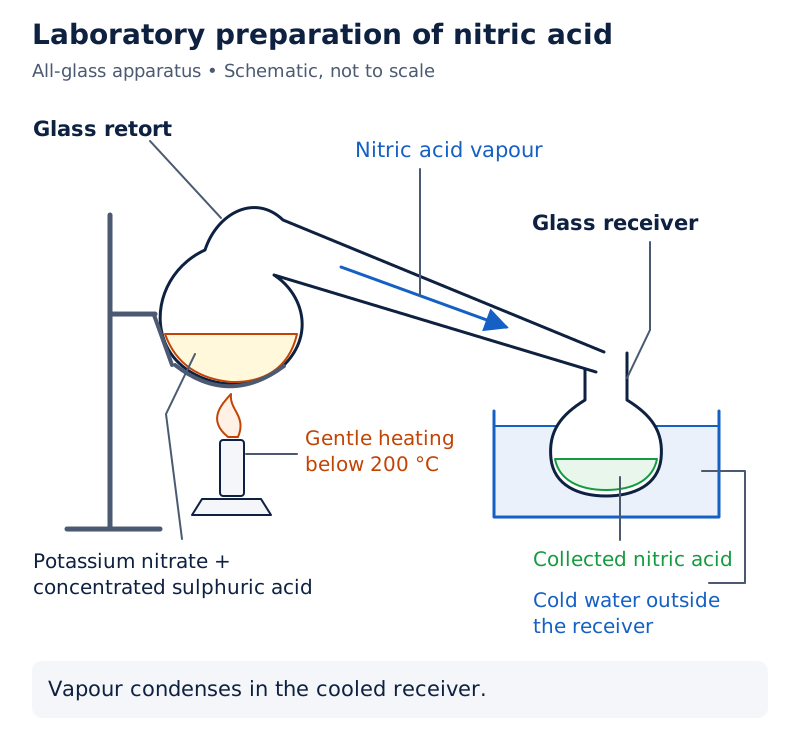
Draw a supported glass retort containing potassium nitrate and concentrated sulphuric acid, with gentle heating beneath it. Extend its neck into a glass receiver surrounded by cold water. Label the mixture, retort, heat source, receiver, cooling water and collected nitric acid.
Drawn by One Young India.
Why heating and collection need care
Thermal decomposition means breakdown caused by heating. Strong heating promotes decomposition of nitric acid into nitrogen dioxide, NO₂, water and oxygen gas, O₂. Nitrogen dioxide is brown; some can dissolve in the collected acid and give it a yellow appearance.
4HNO₃ → 4NO₂ + 2H₂O + O₂
Worked example 1. Check the atom balance in the thermal decomposition equation above. Multiply each coefficient by the relevant subscript and add contributions from every product containing that element.
Answer: Hydrogen balances as . Oxygen balances as : twelve oxygen atoms occur on each side. Nitrogen has four atoms on each side, so all three elements balance.
Pure nitric acid is colourless. Yellow coloration therefore does not mean that nitric acid itself is naturally yellow. It can indicate dissolved nitrogen dioxide. The equation also shows why excessive heating reduces the amount of unchanged acid available for collection.
The acid is collected by condensing its vapour, rather than by bubbling it through water. Contact with collection water would dilute the product. Keep the cooling water outside the receiving vessel so that cooling and collection remain separate functions.
When dilution is required, add acid slowly to water with constant stirring. Mixing concentrated nitric acid with water is exothermic, meaning that heat is released. Adding water to concentrated acid can cause local heating and splashing.
How is nitric acid manufactured by Ostwald’s process?
First stage: catalytic oxidation of ammonia
Ostwald’s process manufactures nitric acid by oxidising ammonia. Ammonia, NH₃, is a compound of nitrogen and hydrogen. In a redox reaction, oxidation and reduction occur together. Here the oxidation of ammonia is the first stage in a sequence that produces nitric acid.
A catalyst changes the rate of a reaction without being consumed overall. In the catalytic stage, ammonia reacts with oxygen from air over platinum gauze at about 800 °C. Platinum, symbol Pt, is the catalyst; gauze is a fine mesh offering a surface for reaction.
4NH₃ + 5O₂ → 4NO + 6H₂O
The product NO is nitric oxide, a colourless gas. Water is also produced. The catalyst and temperature belong with this equation because the desired formation of nitric oxide depends on the reaction conditions.
Second and third stages
On cooling, nitric oxide reacts with more oxygen to form brown nitrogen dioxide. Although both compounds contain nitrogen and oxygen, their formulae and properties differ. Nitric oxide contains one oxygen atom per molecule; nitrogen dioxide contains two.
2NO + O₂ → 2NO₂
Nitrogen dioxide is absorbed in water to form nitric acid and nitric oxide. Absorption here means taking a gas into the liquid, where reaction occurs. The nitric oxide formed can react again with oxygen.
3NO₂ + H₂O → 2HNO₃ + NO
When oxygen is included in the absorption stage, its overall equation can instead be written as follows. This incorporates the further oxidation of nitric oxide, so the two absorption equations describe compatible parts of the same process.
4NO₂ + O₂ + 2H₂O → 4HNO₃
Diagram
Reaction sequence in Ostwald’s process
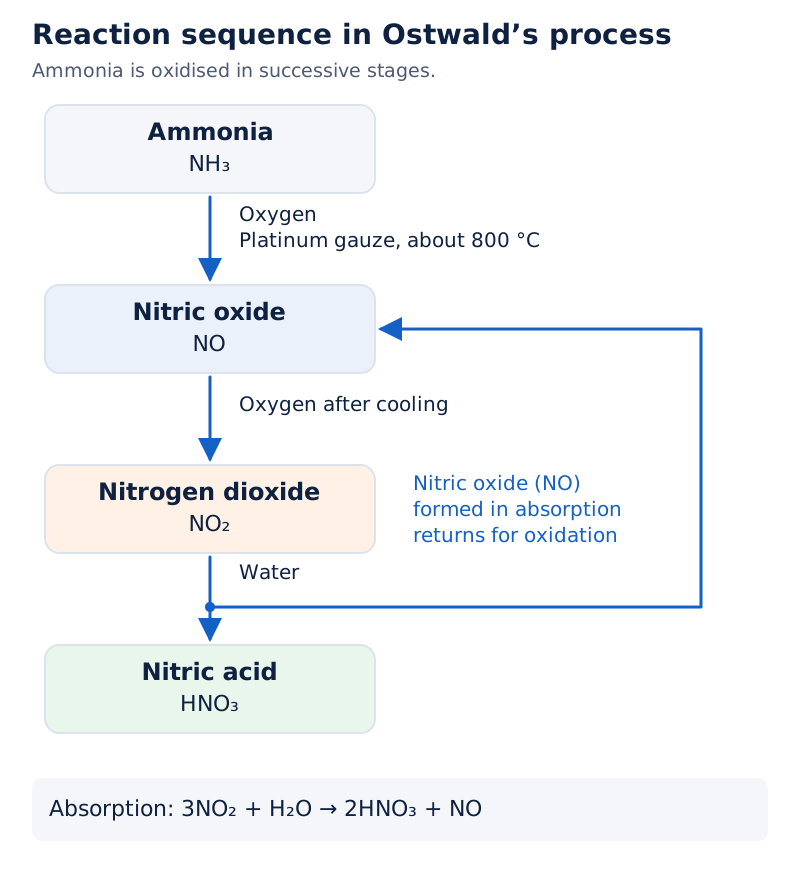
Draw four boxes labelled ammonia, nitric oxide, nitrogen dioxide and nitric acid. Connect them in that order. Label the first arrow oxygen, platinum and about 800 °C; the second oxygen after cooling; and the third water. Show nitric oxide returning for oxidation.
Drawn by One Young India.
The sequence distinguishes manufacture from laboratory preparation. Manufacture begins with ammonia and chemically oxidises its nitrogen-containing compound through successive stages. Laboratory preparation begins with a nitrate and releases nitric acid using concentrated sulphuric acid.
How does nitric acid show acidic behaviour with metals, oxides and hydroxides?
The special condition for hydrogen evolution
Nitric acid is a strong oxidising agent. With metals, its oxidising action prevents the usual collection of hydrogen: hydrogen produced is oxidised to water while the acid is reduced to an oxide of nitrogen. Magnesium and manganese provide the important exception with very dilute nitric acid.
The symbols Mg and Mn represent magnesium and manganese. With very dilute acid, they produce hydrogen gas, H₂, and their nitrate salts: magnesium nitrate, Mg(NO₃)₂, and manganese(II) nitrate, Mn(NO₃)₂. The Roman numeral II indicates a positive charge of two on the metal ion.
Mg + 2HNO₃ → Mg(NO₃)₂ + H₂
Mn + 2HNO₃ → Mn(NO₃)₂ + H₂
Both equations require very dilute nitric acid. Brackets group the nitrate ion: the subscript outside the brackets means two complete nitrate groups. Do not apply these hydrogen-producing equations to concentrated acid or to every metal.
Reactions with a basic oxide and a hydroxide
A base reacts with an acid to form salt and water. A basic oxide is an oxide that shows this behaviour; an oxide is a compound of oxygen with another element. Copper(II) oxide, CuO, is a black basic oxide. Cu represents copper.
With dilute nitric acid, copper(II) oxide dissolves to give a blue solution containing copper(II) nitrate, Cu(NO₃)₂, and water. Copper(II) means that the copper ion has a positive charge of two.
CuO + 2HNO₃ → Cu(NO₃)₂ + H₂O
A hydroxide contains the hydroxide ion, OH⁻, a negatively charged oxygen-hydrogen group. Calcium hydroxide, Ca(OH)₂, reacts with nitric acid to form calcium nitrate, Ca(NO₃)₂, and water. The symbol Ca represents calcium.
Ca(OH)₂ + 2HNO₃ → Ca(NO₃)₂ + 2H₂O
Worked example 2. Verify the coefficients in the calcium hydroxide neutralisation equation. Each bracketed nitrate group contains one nitrogen and three oxygen atoms; the outer subscript doubles both counts.
Answer: Nitrogen balances as . Hydrogen balances as . Oxygen balances as . Calcium has one atom on each side.
The totals on each side are one calcium, two nitrogen, four hydrogen and eight oxygen atoms. Thus two nitric acid molecules react with one calcium hydroxide formula unit, producing one calcium nitrate formula unit and two water molecules.
This acid-base reaction is neutralisation. Each calcium hydroxide formula unit contains two hydroxide groups, so two nitric acid molecules are needed in the balanced equation. A formula unit expresses the simplest ratio of ions in an ionic compound.
Note: Copper metal and copper(II) oxide are different reactants. The oxide reacts by acid-base behaviour to form salt and water. Copper metal reacts with nitric acid through oxidation and also forms a nitrogen oxide.
How does dilute nitric acid react with carbonates and sulphites?
Carbonates and hydrogen carbonates
A carbonate contains the carbonate ion, CO₃²⁻, which has two negative charges; C represents carbon. A hydrogen carbonate contains HCO₃⁻, a group with one negative charge. Both react with dilute nitric acid to form a nitrate, water and carbon dioxide, CO₂.
For sodium carbonate, Na₂CO₃, and sodium hydrogen carbonate, NaHCO₃, the equations are:
Na₂CO₃ + 2HNO₃ → 2NaNO₃ + H₂O + CO₂
NaHCO₃ + HNO₃ → NaNO₃ + H₂O + CO₂
Effervescence means bubbling caused by gas leaving a liquid. The carbon dioxide evolved is colourless. It turns lime water, a solution of calcium hydroxide, milky because insoluble calcium carbonate, CaCO₃, forms. An insoluble solid produced in a reaction is called a precipitate.
Ca(OH)₂ + CO₂ → CaCO₃ + H₂O
The equations differ in their acid coefficients because sodium carbonate contains two sodium ions per formula unit, whereas sodium hydrogen carbonate contains one. The nitrate products must contain the same total number of sodium atoms as the corresponding reactants.
Sulphites and hydrogen sulphites
A sulphite contains SO₃²⁻, a sulphur-oxygen ion with two negative charges. A hydrogen sulphite contains HSO₃⁻. For the acid action of very dilute nitric acid on sodium sulphite, Na₂SO₃, or sodium hydrogen sulphite, NaHSO₃, the gas product is sulphur dioxide, SO₂.
Na₂SO₃ + 2HNO₃ → 2NaNO₃ + H₂O + SO₂
NaHSO₃ + HNO₃ → NaNO₃ + H₂O + SO₂
Sulphur dioxide is a colourless gas with a pungent, suffocating smell. These equations describe acid action under very dilute conditions. They must not be transferred unchanged to hot concentrated nitric acid, whose oxidising action can convert sulphite into sulphate, containing the ion SO₄²⁻.
| Reactant family | Acid condition here | Gas in the acid reaction |
|---|---|---|
| Carbonate | Dilute nitric acid | Carbon dioxide |
| Hydrogen carbonate | Dilute nitric acid | Carbon dioxide |
| Sulphite | Very dilute nitric acid | Sulphur dioxide |
| Hydrogen sulphite | Very dilute nitric acid | Sulphur dioxide |
The two pairs have a similar acid-reaction pattern, but their gases differ. Gas identity must follow the reactant and conditions. Bubbling by itself establishes gas evolution; it does not establish whether the gas is hydrogen, carbon dioxide or sulphur dioxide.
How do dilute and concentrated nitric acid differ in their reactions with copper?
Copper with dilute nitric acid
Copper reacts with dilute nitric acid to form copper(II) nitrate, nitric oxide and water. The copper dissolves and the solution becomes blue. The gas initially produced is colourless nitric oxide; hydrogen is not the gas product in this reaction.
3Cu + 8HNO₃ → 3Cu(NO₃)₂ + 2NO + 4H₂O
Worked example 3. Check the dilute-acid equation by counting nitrogen in both copper(II) nitrate and nitric oxide. Count oxygen in all three products, including water.
Answer: Nitrogen balances as . Hydrogen balances as . Oxygen balances as . Copper has three atoms on each side.
The totals on each side are three copper, eight hydrogen, eight nitrogen and twenty-four oxygen atoms. The six oxygen atoms in each copper(II) nitrate formula unit come from its two nitrate groups.
When nitric oxide meets oxygen in air, brown nitrogen dioxide forms. This second reaction explains why brown fumes may be seen above a reaction whose initial gaseous product is colourless. Distinguish what is produced in the liquid from what appears after contact with air.
2NO + O₂ → 2NO₂
Copper with concentrated nitric acid
With concentrated nitric acid, copper forms copper(II) nitrate, nitrogen dioxide and water. Brown nitrogen dioxide is therefore produced directly. The change in acid concentration changes the nitrogen oxide shown in the reaction equation.
Cu + 4HNO₃ → Cu(NO₃)₂ + 2NO₂ + 2H₂O
| Feature | Dilute nitric acid | Concentrated nitric acid |
|---|---|---|
| Metal reacting | Copper | Copper |
| Salt formed | Copper(II) nitrate | Copper(II) nitrate |
| Initial nitrogen oxide | Nitric oxide, NO | Nitrogen dioxide, NO₂ |
| Initial gas colour | Colourless | Brown |
| Effect of exposure to air | NO forms brown NO₂ | NO₂ is already present |
Nitric acid has an oxidising role in both reactions. The nitrate salt and nitrogen oxide must both be included among the products. An equation showing copper nitrate and hydrogen would miss the acid’s oxidising behaviour and give the wrong gas.
Read the coefficients together with the formulae. In the dilute-acid equation, three copper atoms correspond to three copper nitrate formula units. In the concentrated-acid equation, one copper atom corresponds to one formula unit. Neither equation permits changing the nitrate formula to make balancing easier.
Note: Brown fumes do not by themselves prove that concentrated nitric acid was used. Dilute nitric acid produces nitric oxide with copper, and that gas becomes brown nitrogen dioxide on contact with air.
How does concentrated nitric acid oxidise carbon and sulphur?
Carbon gains oxygen
With hot concentrated nitric acid, carbon is oxidised to carbon dioxide. Nitric acid is reduced to nitrogen dioxide, and water is formed. Carbon is a non-metal, so this reaction should not be represented as the formation of a metal nitrate.
C + 4HNO₃ → CO₂ + 4NO₂ + 2H₂O
The products include two different gases. Carbon dioxide is colourless, while nitrogen dioxide is brown. The brown appearance is evidence of nitrogen dioxide, not a colour change in carbon dioxide. Keep the identities of the gases separate when describing the observation.
Carbon gains oxygen as it becomes carbon dioxide. That makes carbon the substance oxidised and nitric acid the oxidising agent. Nitric acid supplies the oxidising action while its nitrogen-containing product has changed from nitric acid to nitrogen dioxide.
Sulphur becomes sulphuric acid
With hot concentrated nitric acid, sulphur is oxidised to sulphuric acid. Nitrogen dioxide and water are also formed. This is different from the acid action on a sulphite: sulphur is an element, while a sulphite is an ionic compound containing sulphur and oxygen.
S + 6HNO₃ → H₂SO₄ + 6NO₂ + 2H₂O
Do not substitute sulphur dioxide for sulphuric acid in this equation. The hot concentrated acid has an oxidising role, and the product containing sulphur is H₂SO₄. Brown nitrogen dioxide accompanies the reaction.
| Substance oxidised | Condition | Product containing that element |
|---|---|---|
| Carbon | Hot concentrated nitric acid | Carbon dioxide |
| Sulphur | Hot concentrated nitric acid | Sulphuric acid |
These reactions illustrate why a single rule such as “nitric acid gives a nitrate” is insufficient. Identify the starting substance, its chemical family and the acid concentration before choosing products. Metal nitrate formation describes the copper reactions, but carbon and sulphur have different oxidation products.
How does the brown-ring test help identify nitric acid?
Reagents, layers and observation
The brown-ring test detects nitrate ions. A reagent is a substance used to bring about a chemical test. The reagents here are freshly prepared iron(II) sulphate solution, also called ferrous sulphate, FeSO₄, and concentrated sulphuric acid. Fe represents iron; iron(II) ions have two positive charges.
For a dilute nitric acid sample, add freshly prepared ferrous sulphate solution. Carefully introduce concentrated sulphuric acid down the side of the inclined test tube so that the liquids form separate layers. Do not shake the layered mixture.
A dark brown ring appears at the junction, or boundary, between the layers. The ring is a localised coloured region in the liquid. It should not be confused with the brown nitrogen dioxide fumes observed during some nitric acid reactions.
- Use a dilute sample so that the test is carried out in aqueous solution.
- Add freshly prepared ferrous sulphate solution to supply iron(II) ions.
- Introduce concentrated sulphuric acid carefully along the test-tube wall and retain the layers.
- Observe the dark brown ring at the junction of the liquids.
What produces the brown ring?
In the acidic mixture, iron(II) ions reduce nitrate to nitric oxide. The nitric oxide then combines with iron(II) to produce the brown nitroso ferrous sulphate complex. A complex is a species in which surrounding molecules or ions are attached to a central metal ion.
The test identifies nitrate, rather than uniquely identifying a bottle as nitric acid. A nitrate salt can also give the brown ring. Acidity and nitrate detection answer different questions, so litmus and the brown-ring test supply different pieces of evidence.
What the figure shows
Formation of the brown ring
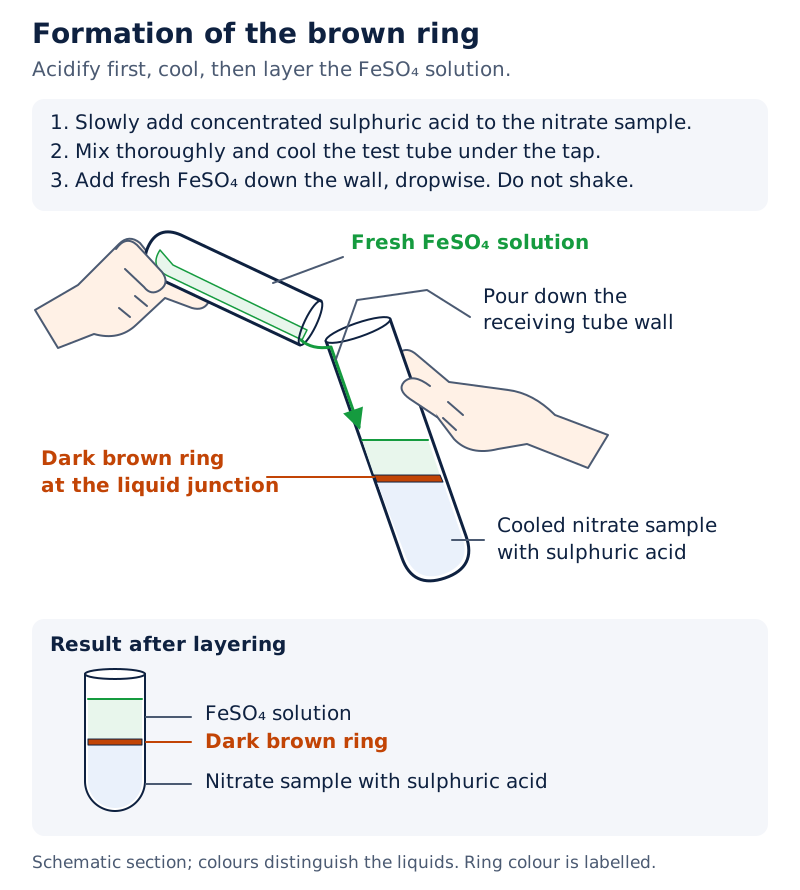
The drawing shows hands holding two inclined test tubes. A liquid labelled FeSO₄ is being poured into the receiving tube. A narrow band in that tube is labelled “Dark brown ring”.
Drawn by One Young India.
The test can also be arranged by acidifying the sample with sulphuric acid, cooling it, and then adding ferrous sulphate along the side without shaking. In either order, careful layering allows the brown region to be seen at the junction.
How can reaction equations, conditions and observations be checked together?
Check the chemical situation before balancing
A reaction equation contains more than a set of formulae to memorise. The reactant identity and the conditions determine which products belong in it. Balancing is useful only after those products have been chosen correctly.
- Identify whether the starting substance is a nitrate salt, metal, oxide, hydroxide, carbonate, sulphite or non-metal.
- State whether the nitric acid is very dilute, dilute or concentrated, and include heating where the reaction requires it.
- Write the correct product formulae before adjusting coefficients.
- Count atoms on both sides, then connect each observed gas or colour with the product responsible.
Check atoms without changing formulae
Consider copper with concentrated nitric acid. The established products are copper(II) nitrate, nitrogen dioxide and water. In Cu(NO₃)₂, the outside subscript multiplies everything within the brackets: one formula unit contains one copper atom, two nitrogen atoms and six oxygen atoms.
Using the balanced equation Cu + 4HNO₃ → Cu(NO₃)₂ + 2NO₂ + 2H₂O gives the following atom check. The table counts atoms represented by the complete equation, including the coefficients.
| Element | Atoms on reactant side | Atoms on product side |
|---|---|---|
| Copper | 1 | 1 |
| Hydrogen | 4 | 4 |
| Nitrogen | 4 | 4 |
| Oxygen | 12 | 12 |
A correct atom count does not replace a condition check. For dilute nitric acid and copper, the initial gas is nitric oxide, so the concentrated-acid equation is not the correct description even though it balances perfectly.
Finally, separate an observation, such as brown fumes or a blue solution, from an inference, such as the identification of nitrogen dioxide or copper(II) nitrate. Explain the connection explicitly. This keeps the written account tied to both the reaction and what can be observed.
Glossary
- Nitric acid — The acid HNO₃, which forms hydrogen and nitrate ions in aqueous solution.
- Nitrate — A salt containing NO₃⁻ ions, including sodium nitrate and potassium nitrate.
- Monobasic acid — An acid whose molecule supplies one ionisable hydrogen ion in aqueous solution.
- Concentration — The amount of a substance present in a given amount of solution.
- Volatility — The tendency of a substance to enter the vapour state under specified conditions.
- Condensation — Conversion of a vapour into liquid, used when collecting nitric acid.
- Catalyst — A substance that changes reaction rate without being consumed in the overall reaction.
- Oxidising agent — A substance that causes another substance to undergo oxidation and is itself reduced.
- Neutralisation — A reaction between an acid and a base producing salt and water.
- Effervescence — Bubbling observed when a gas forms and escapes from a liquid.
- Thermal decomposition — Breakdown of a substance through heating, as in the decomposition of nitric acid.
- Brown-ring test — A nitrate test using ferrous sulphate and concentrated sulphuric acid to form a brown ring.
Common errors and misconceptions
- Misconception: Strong and concentrated mean the same thing. Correct: Strength concerns ionisation in water, while concentration concerns the amount of acid in the solution.
- Misconception: Pure nitric acid is yellow. Correct: Pure nitric acid is colourless; dissolved nitrogen dioxide can give the collected acid a yellow appearance.
- Misconception: Every metal produces hydrogen with nitric acid. Correct: Its oxidising action prevents this generalisation; magnesium and manganese produce hydrogen with very dilute acid.
- Misconception: Copper with dilute nitric acid initially produces brown nitrogen dioxide. Correct: Its initial gas product is colourless nitric oxide, which becomes nitrogen dioxide in air.
- Misconception: Carbon and sulphur form nitrate salts with hot concentrated nitric acid. Correct: Carbon forms carbon dioxide and sulphur forms sulphuric acid.
- Misconception: A brown ring proves that an unknown solution is nitric acid. Correct: The test detects nitrate; nitrate salts also respond.
- Misconception: Subscripts can be altered to balance equations. Correct: Change coefficients while retaining the correct formulae, because changing a subscript changes the substance.
Exam-style questions with model answers
Q1. Nitric acid is described as both strong and monobasic. Define these two descriptions, explaining what each refers to. [2 marks]
- Strong means that nitric acid ionises extensively when dissolved in water.
- Monobasic means that each nitric acid molecule supplies one ionisable hydrogen ion.
Q2. Potassium nitrate, KNO₃, is heated gently below 200 °C with concentrated sulphuric acid, H₂SO₄. The products are potassium hydrogen sulphate, KHSO₄, and nitric acid, HNO₃. Write the balanced equation, explain the choice of sulphuric acid, and explain how the nitric acid is collected. [3 marks]
- The balanced equation is KNO₃ + H₂SO₄ → KHSO₄ + HNO₃, with gentle heating below 200 °C as specified.
- Sulphuric acid is relatively non-volatile under these conditions, so nitric acid passes from the heated mixture as vapour.
- The vapour enters a cooled glass receiver and condenses to liquid nitric acid; potassium hydrogen sulphate remains in the heated vessel.
Q3. Copper, Cu, reacts separately with dilute and concentrated nitric acid, HNO₃. In both reactions it forms copper(II) nitrate, Cu(NO₃)₂, and water, H₂O. The initial gases are nitric oxide, NO, with dilute acid and nitrogen dioxide, NO₂, with concentrated acid. Write both balanced equations, describe the initial gases, and explain the change when NO meets oxygen, O₂. [4 marks]
- For dilute acid, the balanced equation is 3Cu + 8HNO₃ → 3Cu(NO₃)₂ + 2NO + 4H₂O.
- For concentrated acid, the balanced equation is Cu + 4HNO₃ → Cu(NO₃)₂ + 2NO₂ + 2H₂O.
- Nitric oxide is initially colourless, whereas nitrogen dioxide is brown. The initial gas therefore differs between the two reactions.
- In air, nitric oxide reacts with oxygen to form brown nitrogen dioxide: 2NO + O₂ → 2NO₂.
Q4. In Ostwald’s process, ammonia, NH₃, reacts with oxygen, O₂, to form nitric oxide, NO, and water, H₂O. NO then forms nitrogen dioxide, NO₂, with oxygen. NO₂ reacts with water to form nitric acid, HNO₃, and NO. Write the three balanced equations and give the catalyst and approximate temperature for the first stage. [4 marks]
- The first-stage equation is 4NH₃ + 5O₂ → 4NO + 6H₂O; it forms nitric oxide from ammonia.
- The first stage uses platinum gauze as catalyst at about 800 °C to obtain the required oxidation product.
- After cooling, nitric oxide reacts with further oxygen: 2NO + O₂ → 2NO₂.
- The absorption equation is 3NO₂ + H₂O → 2HNO₃ + NO. The nitric oxide formed can undergo oxidation again.
Q5. A dilute nitric acid sample is tested using freshly prepared ferrous sulphate solution and concentrated sulphuric acid. Describe the brown-ring test in five points: initial addition, layering, observation, chemical explanation and the limit of the conclusion. [5 marks]
- Add freshly prepared ferrous sulphate solution to the dilute nitric acid sample. This supplies the iron(II) ions required for the test.
- Introduce concentrated sulphuric acid carefully down the side of the inclined test tube, retaining separate liquid layers without shaking them together.
- A dark brown ring forms at the junction between the layers. The observation is a coloured region in the liquid, rather than brown fumes.
- Iron(II) reduces nitrate to nitric oxide, which then combines with iron(II) to form the brown nitroso ferrous sulphate complex.
- The observation establishes the presence of nitrate. It does not uniquely identify nitric acid because nitrate salts also give the brown-ring test.
Q6. Carbon, C, and sulphur, S, react separately with hot concentrated nitric acid, HNO₃. Carbon forms carbon dioxide, CO₂; sulphur forms sulphuric acid, H₂SO₄. Both reactions also form nitrogen dioxide, NO₂, and water, H₂O. Give five points: two balanced equations, the role of nitric acid, the product causing brown fumes, and why a general metal-nitrate product rule does not apply. [5 marks]
- Carbon reacts according to C + 4HNO₃ → CO₂ + 4NO₂ + 2H₂O, with hot concentrated nitric acid as specified.
- Sulphur reacts according to S + 6HNO₃ → H₂SO₄ + 6NO₂ + 2H₂O. Its sulphur-containing product is sulphuric acid.
- Nitric acid acts as the oxidising agent in both reactions. Carbon and sulphur are oxidised while nitric acid is reduced to nitrogen dioxide.
- Nitrogen dioxide produces the brown fumes in both cases. Carbon dioxide is colourless, so it does not account for the brown appearance.
- Carbon and sulphur are non-metals in these reactions. Their stated oxidation products are carbon dioxide and sulphuric acid, so neither equation requires a metal nitrate.
Q7. Magnesium, Mg, reacts with very dilute nitric acid, HNO₃, to form magnesium nitrate, Mg(NO₃)₂, and hydrogen, H₂. Manganese, Mn, behaves similarly and forms manganese(II) nitrate, Mn(NO₃)₂. Write both balanced equations and explain why they cannot be used as a general rule for all metals and all nitric acid concentrations. [3 marks]
- The magnesium equation is Mg + 2HNO₃ → Mg(NO₃)₂ + H₂. The specified very dilute acid condition is essential.
- The manganese equation is Mn + 2HNO₃ → Mn(NO₃)₂ + H₂, again with very dilute nitric acid.
- Nitric acid is a strong oxidising agent and oxidises hydrogen to water in the general metal reaction. These stated exceptions do not justify predicting hydrogen from every metal or concentration.
Q8. Sodium carbonate, Na₂CO₃, and sodium hydrogen carbonate, NaHCO₃, react separately with dilute nitric acid, HNO₃. Both form sodium nitrate, NaNO₃, water, H₂O, and carbon dioxide, CO₂. Write the two balanced equations, name the visible gas-evolution observation, and explain the test using lime water, which contains calcium hydroxide, Ca(OH)₂, and forms calcium carbonate, CaCO₃. [4 marks]
- Sodium carbonate reacts according to Na₂CO₃ + 2HNO₃ → 2NaNO₃ + H₂O + CO₂.
- Sodium hydrogen carbonate reacts according to NaHCO₃ + HNO₃ → NaNO₃ + H₂O + CO₂.
- Effervescence, meaning bubbles of escaping gas, is observed as carbon dioxide is evolved from the reacting mixture.
- Carbon dioxide turns lime water milky by forming insoluble calcium carbonate: Ca(OH)₂ + CO₂ → CaCO₃ + H₂O.
Key takeaways
- Nitric acid forms hydrogen and nitrate ions in water; strong, monobasic and concentrated describe different properties.
- Laboratory preparation heats a nitrate with concentrated sulphuric acid gently, then collects nitric acid by condensation.
- Ostwald’s process converts ammonia successively into nitric oxide, nitrogen dioxide and nitric acid under the required conditions.
- Magnesium and manganese produce hydrogen with very dilute nitric acid, an essential condition attached to these exceptions.
- Copper produces nitric oxide with dilute nitric acid and nitrogen dioxide with concentrated nitric acid.
- Hot concentrated nitric acid oxidises carbon to carbon dioxide and sulphur to sulphuric acid.
- The brown-ring test detects nitrate ions; acidity alone and a brown ring answer different identification questions.
- Check reactants, concentration, heating, products and observations before checking that the equation has equal atom counts.
Test yourself
Why is a cooled receiver used in laboratory preparation?
Cooling causes nitric acid vapour to condense, allowing the acid to collect as a liquid.
Which condition must accompany the magnesium and manganese equations that produce hydrogen?
The nitric acid must be very dilute; these equations must not be generalised to concentrated acid.
Why can dilute nitric acid reacting with copper eventually produce brown fumes?
Its initial nitric oxide is colourless, but oxygen in air converts it to brown nitrogen dioxide.
What remains in the retort when potassium nitrate is used under the stated preparation conditions?
Potassium hydrogen sulphate remains while nitric acid passes towards the cooled receiver as vapour.
What does sulphur form with hot concentrated nitric acid?
Sulphur forms sulphuric acid; nitrogen dioxide and water are also produced in the reaction.
What is the difference between the brown ring and brown nitrogen dioxide fumes?
The ring is a coloured complex at a liquid boundary; the fumes are gaseous nitrogen dioxide.
Why should a formula’s subscripts remain unchanged while balancing?
Subscripts identify a substance’s composition. Balance the numbers of particles by changing coefficients instead.
Why does blue litmus turning red not prove that a sample is nitric acid?
The change indicates acidity, but other acids also turn blue litmus red.
Write about it
Turn a question from this chapter into a paper.
The Writing Studio has a structure guide, a rubric and citation tools for 15 formats, from essays to research papers. Drafting is free with an account. Learnacy Essential adds feedback from an AI writing coach and submission to The OYI Review.
Learnacy Essential is ₹1,499 for the year. Publication depends on review and is not guaranteed.