
Application of Derivatives | CBSE Class 12 Maths Notes
On this page
Watch & explore
Start with a few high-quality watches, then dive into the notes below.
This Mathematics note covers rates of change, related rates, marginal cost and revenue, increasing and decreasing functions, critical points, local maxima and minima, derivative tests, absolute extrema on closed intervals, and optimisation of numerical and geometrical quantities.
How does a derivative describe a rate of change?
A derivative measures how one quantity changes with respect to another. Let be the independent variable, the dependent variable, and the function relating them. For , the derivative represents the rate of change of with respect to .
At a specified input , where denotes the particular value being considered, the instantaneous rate is . First obtain the derivative as a function; then substitute the required input. Substituting a numerical value before differentiating can remove the variable whose change is being studied.
Result: Related rates through the chain rule
Let denote time, with both quantities depending on it. Their related rates satisfy . If , this can be rearranged as . The denominator condition is necessary for division.
For a circle, let denote its area, its radius, and the ratio of a circle's circumference to its diameter. The area formula gives the following numbered derivation.
- Write the geometrical relation:
- Differentiate with respect to radius:
- If the radius varies with time, apply the chain rule:
The variable of differentiation matters. The second step describes area change per unit change in radius. The third describes area change per unit time. A time rate requires information about how quickly the radius changes.
Worked example 1. Circular waves spread at . Find the rate at which their enclosed area grows when the radius is .
Answer:
- Use for enclosed area, for radius and for time:
- Differentiate before substituting:
- Insert the given radius and speed:
The positive result means that the enclosed area is increasing.
How are rates connected when several dimensions change?
Related-rate problems begin with a geometrical equation connecting the changing quantities. Differentiate that equation with respect to the common time variable. A decreasing dimension has a negative time derivative, while an increasing dimension has a positive one.
The numerical dimensions given in a question usually describe one instant. They do not make those dimensions constant throughout the motion. Retaining the variables during differentiation ensures that every changing factor contributes to the answer.
How can volume determine a surface-area rate?
Worked example 2. A cube's volume increases at . Find its surface-area rate when an edge is . Let denote edge length, volume, surface area and time.
Answer:
- Express both geometrical quantities using the same edge:
- Differentiate the volume equation:
- Solve for the edge rate:
- Differentiate surface area and substitute the edge rate:
- Evaluate at the given edge length:
The surface area is increasing. The volume rate and surface-area rate describe different quantities and therefore have different units.
Why must both changing factors be differentiated?
Worked example 3. A rectangle's length decreases at , while its width increases at . Find its perimeter and area rates when the length is and width is .
Answer:
- Let be length, width, perimeter, area and time. The signed rates are
- Differentiate :
- Apply the product rule to :
- Evaluate at the stated instant:
The perimeter decreases, although the area increases. The two results answer different questions about the same changing rectangle.
What do marginal cost and marginal revenue measure?
Marginal cost is the instantaneous rate of change of total cost with respect to output. Let denote total cost in rupees when units are produced. Its marginal cost is , the derivative with respect to the number of units.
Marginal revenue similarly measures the rate of change of total revenue with respect to the number of items sold. If denotes total revenue in rupees from selling units, its marginal revenue is .
How is a marginal quantity evaluated?
Worked example 4. The total cost in rupees of producing units is . Find marginal cost at an output of units.
Answer:
- Differentiate each term of the given cost function:
- Substitute the specified output:
- Calculate the terms and add:
- Round the monetary rate to two decimal places:
The constant term in total cost contributes zero to the derivative. Keep the exact value until the final rounding step.
Worked example 5. Revenue from selling units is rupees. Find marginal revenue when units are sold.
Answer:
- Differentiate the revenue function:
- Use the output level specified in the question:
- Complete the arithmetic:
The result gives the revenue rate at that output level. It is obtained from the derivative, whereas total revenue is obtained from the original function.
Interpretation completes a marginal-rate answer. State which quantity changes, which input it changes with, and the output level at which the derivative has been evaluated. A correct derivative without that final substitution does not yet answer a question about a specified output.
How does the first derivative identify increasing and decreasing functions?
Let be an interval within the domain of a real-valued function . Let and be any two inputs in that interval. A function is strictly increasing when larger inputs give larger outputs: implies .
It is strictly decreasing when implies . A constant function has the same value throughout the interval. Being increasing or decreasing at a point means having that behaviour on some open interval containing the point.
What the figure shows
Reading a parabola
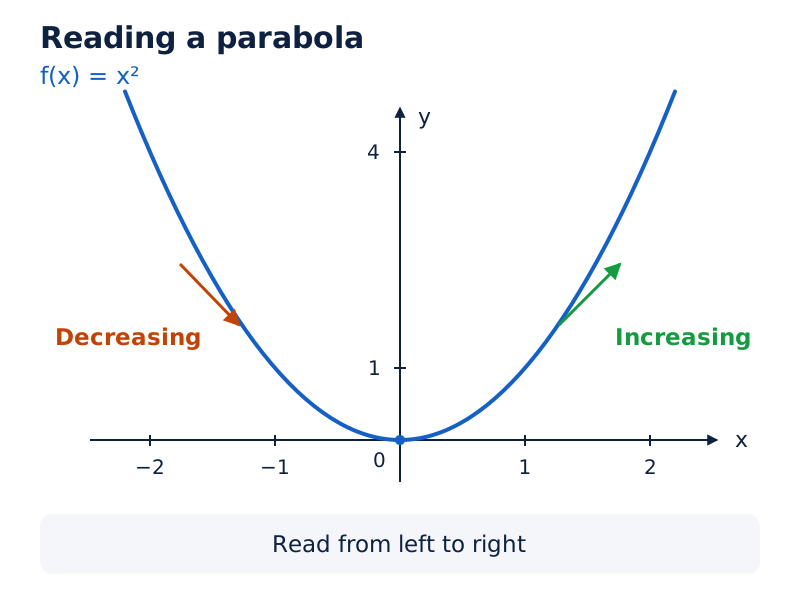
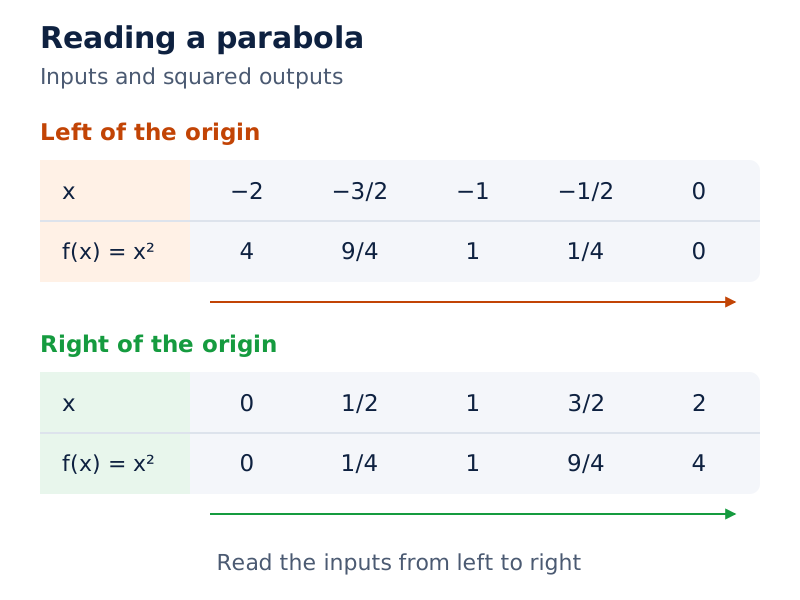
The graph of has its vertex at the origin. The left branch falls towards the origin when read from left to right; the right branch rises away from it. Tables beside the graph show corresponding inputs and squared outputs.
Drawn by One Young India. See Fig. 6.1 in your NCERT textbook
Theorem: Derivative signs determine monotonicity
Let and denote interval endpoints, with . Suppose is continuous on and differentiable on . Its behaviour follows from the derivative throughout the interior.
| Derivative condition | Conclusion on the interval |
|---|---|
| at every interior point | The function is increasing. |
| at every interior point | The function is decreasing. |
| at every interior point | The function is constant. |
Derivation: Why a positive derivative gives increasing values
- Choose arbitrary inputs in the interval with . The mean value theorem supplies a point , an intermediate input, satisfying .
- Apply that theorem:
- Both factors on the right are positive, so
- Rearrange to obtain
The comparison holds for any two ordered inputs. This proves increasing behaviour throughout the interval, rather than merely at a sampled point. The negative-derivative and zero-derivative conclusions follow by the corresponding sign comparisons.
Worked example 6. Show that is increasing for all real inputs.
Answer:
- Differentiate:
- Complete the square:
- Since , conclude
The derivative is positive everywhere, so the function is increasing on , where denotes the set of all real numbers.
How do sign charts locate intervals of increase and decrease?
A derivative may change sign as the input varies. In that case, a function can increase on one interval and decrease on another. A sign chart records the derivative's sign separately on each interval determined by its zeros and points where it is undefined.
Begin with the function's domain. Differentiate, factor where possible, and locate all relevant separating points. Determine the sign of each factor between consecutive separating points. Finally, translate a positive derivative into increasing behaviour and a negative derivative into decreasing behaviour.
How is a polynomial sign chart constructed?
Worked example 7. Find the intervals of increase and decrease of , defined for all real inputs.
Answer:
- Differentiate and factor:
- Find the zeros of the derivative:
- For , both variable factors are negative; their product is positive. Thus .
- For , the first factor is negative and the second positive. Thus .
- For , both factors are positive. Thus .
The function increases on and , and decreases on . The symbols and indicate unbounded interval ends.
| Input interval | Derivative sign | Function behaviour |
|---|---|---|
| Positive | Increasing | |
| Negative | Decreasing | |
| Positive | Increasing |
How does the given domain affect a trigonometric example?
Worked example 8. Determine the behaviour of on , where is an angle measured in radians.
Answer:
- Differentiate:
- On , , so . The function decreases there.
- On , , so . The function increases there.
It is neither increasing nor decreasing throughout the entire interval , because its direction of change reverses.
Keep interval conclusions separate. A function's behaviour on one part of its domain does not establish its behaviour on the whole domain. Solving the derivative equation identifies boundaries to investigate; the signs between those boundaries supply the actual conclusion.
What is the difference between local and absolute extrema?
An absolute maximum is the greatest value attained by a function on the entire interval under consideration. An absolute minimum is its least attained value. The interval is part of the problem: changing it can change whether these values exist and where they occur.
Let be a function on an interval , and let be an input in that interval. An absolute maximum satisfies for every ; an absolute minimum satisfies for every .
How does a neighbourhood change the comparison?
For a local extremum, compare nearby inputs instead of the whole domain. Let be an interior point and a positive number describing a neighbourhood. A local maximum satisfies for nearby inputs in . Reverse the inequality for a local minimum.
The point of extremum is the input ; the corresponding extreme value is . Keep these distinct in the final answer. Finding an input where a test succeeds is not the same as calculating the function's value there.
What the figure shows
Local hills and valleys
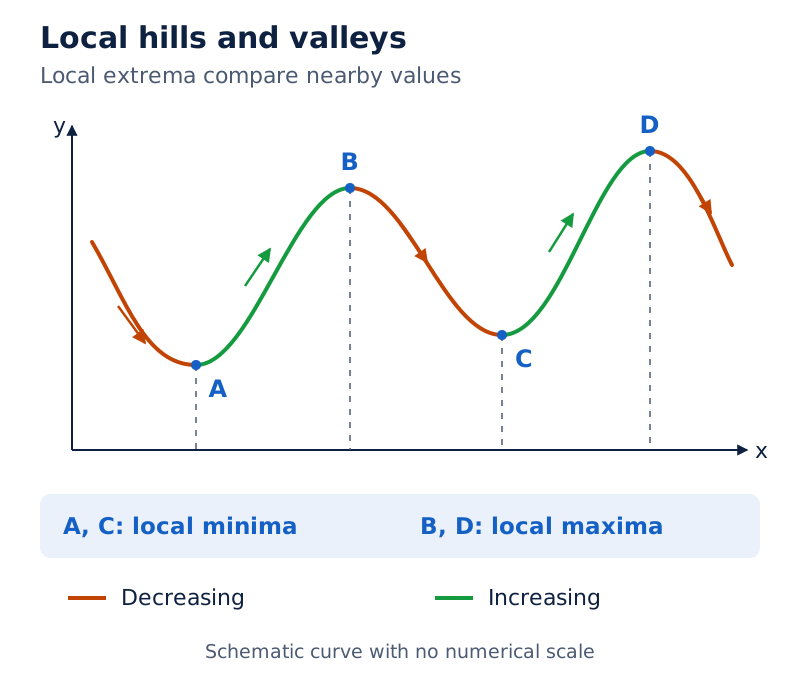
The curve has valleys labelled and , and hills labelled and . These letters name points on the graph. Dashed vertical lines mark their horizontal positions, while labels along the curve identify increasing and decreasing portions.
Drawn by One Young India. See Fig. 6.11 in your NCERT textbook
Why does the domain matter?
For on all real inputs, the minimum value is , attained at , and there is no maximum. On the restricted interval , however, its maximum value is , attained at .
The function on has neither a maximum nor a minimum. The endpoints are excluded. Including them gives the domain , where the minimum is and maximum is .
Note: A local maximum need not be the absolute maximum, and a local minimum need not be the absolute minimum. Local tests compare neighbouring values; an absolute conclusion requires comparison over the specified domain.
How do critical points and the first derivative test locate local extrema?
A critical point is an input in the function's domain at which the derivative is zero or does not exist. Such points need investigation, but the definition alone does not classify them as maxima or minima.
Theorem: A necessary condition for an interior extremum
If a function has a local maximum or minimum at an interior input , then either or the function is not differentiable there. The converse need not hold. For , the derivative is zero at , but the origin is not a local extremum.
Theorem: The first derivative sign-change test
Suppose is continuous at a critical point in an open interval. Examine its derivative at inputs sufficiently close to, and on either side of, that point.
| Sign on the left | Sign on the right | Conclusion |
|---|---|---|
| Positive | Negative | A local maximum occurs at . |
| Negative | Positive | A local minimum occurs at . |
| The same nonzero sign | The same nonzero sign | There is no local extremum at . |
Worked example 9. Find all local extrema of on the real line.
Answer:
- Differentiate and factor:
- Set the derivative to zero:
- At , the derivative changes from positive to negative. This gives a local maximum.
- Evaluate its value:
- At , the derivative changes from negative to positive. This gives a local minimum.
- Evaluate its value:
The local maximum value is at ; the local minimum value is at .
Nondifferentiability does not exclude an extremum. The function , where denotes absolute value, has derivative on the negative side and on the positive side. It is continuous at the origin, so the sign change gives a local minimum value of there.
When can the second derivative test classify a critical point?
The second derivative, written , is the derivative of the first derivative. It provides a convenient way to classify many points where the first derivative vanishes. Apply it after finding candidate inputs, rather than using its sign alone.
Theorem: The second derivative test
At an interior candidate , suppose the function is twice differentiable and . If , the function has a local maximum there. If , it has a local minimum there.
If both and , the test is inconclusive. Return to the first derivative test. A failed test is not evidence that an extremum is absent.
Worked example 10. Find the local maximum and minimum values of .
Answer:
- Find and factor the first derivative:
- Solve the critical-point equation:
- Differentiate again:
- At the origin, , so there is a local maximum with
- At , calculate . The local minimum value is
- At , calculate . The local minimum value is
There is one local maximum and two local minima. The two local minimum values are different because each is compared with its own nearby values.
What happens when the second derivative vanishes?
Worked example 11. Examine for local extrema.
Answer:
- Calculate the first derivative:
- The only critical input is . Differentiate again:
- The second derivative test fails. However, on both sides of .
- There is no sign change, so is neither a local maximum nor a local minimum. The function has no other critical points.
The graph continues to increase through the critical point; this is a point of inflexion in this example.
How are absolute maximum and minimum values found on a closed interval?
A local derivative test alone cannot establish the greatest or least value on an entire closed interval. The endpoints can supply the absolute extrema even when interior critical points exist. Evaluate the original function at every relevant candidate.
Theorem: Extreme values on a closed interval
A function continuous on a closed interval attains an absolute maximum and an absolute minimum at least once in that interval. Here and denote its endpoints. Continuity and inclusion of both endpoints are essential hypotheses of this guarantee.
If an absolute extremum occurs at an interior point where the function is differentiable, its derivative is zero there. A continuous function can also have a relevant critical point where it is not differentiable. Such points must not disappear from the candidate list.
What is the complete comparison procedure?
- Find all critical points inside the given interval, including points where the derivative does not exist but the function is defined.
- Add both endpoints of the interval to the list of candidates.
- Calculate the original function's value at every listed candidate.
- Compare these values. The greatest is the absolute maximum and the least is the absolute minimum.
Worked example 12. Find the absolute maximum and minimum of on .
Answer:
- Differentiate and factor:
- The critical inputs and both lie inside the interval. Add its endpoints and .
- Evaluate the first endpoint:
- Evaluate both critical points:
- Evaluate the second endpoint:
- Compare all four outputs:
The absolute minimum is at , and the absolute maximum is at .
Compare outputs, not inputs. The largest candidate input need not give the largest function value. In this example it does, but that conclusion follows from the calculated values. The interior critical points alone would have missed both absolute extrema.
How are practical optimisation problems converted into functions?
An optimisation problem asks for the greatest or least possible value under stated conditions. Identify the quantity to optimise, write it as a function of one variable, and record the variable's feasible domain. Use the constraint to eliminate other variables before differentiating.
After solving the derivative equation, reject values outside the feasible domain. Establish whether the remaining candidate gives the required maximum or minimum. Finally, return to the original quantities, because a derivative calculation may produce an intermediate variable rather than the requested answer.
How does a fixed sum determine two numbers?
Worked example 13. Find two positive numbers whose sum is and whose sum of squares is minimum.
Answer:
- Let be the first number. The second is , with . Let denote their sum of squares.
- Form the function:
- Differentiate and solve:
- The derivative is negative before this input and positive after it throughout the feasible domain. Also, , confirming a local minimum.
- Calculate the second number:
The required numbers are both . The derivative signs establish the minimum across the whole feasible domain.
How does geometry restrict a box problem?
Worked example 14. Equal squares are removed from the corners of a by rectangular sheet. The sides are folded to form an open box. Find the greatest volume.
Answer:
- Let be the side length of each removed square in metres, and the resulting volume. Positive dimensions require .
- Write the volume from height, breadth and length:
- Differentiate and factor:
- Solve , obtaining or . Reject , which makes a base dimension negative.
- Check the feasible candidate:
- Throughout the feasible interval, is positive before and negative after it. The candidate therefore gives the greatest feasible volume.
- Substitute into the original product:
The squares should have side , giving maximum volume .
What the figure shows
Forming an open box
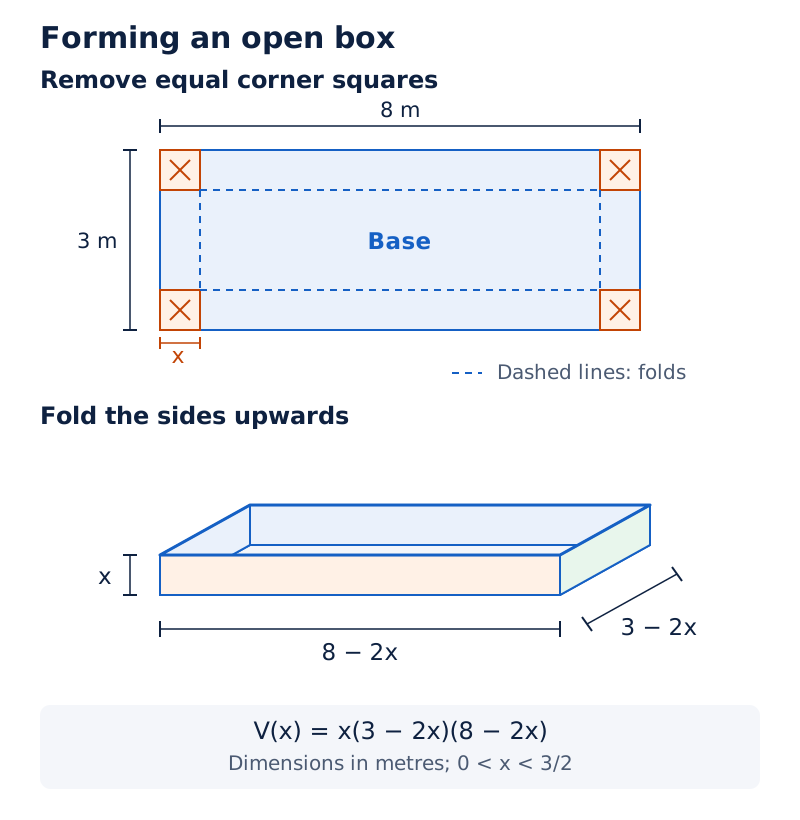
The first drawing shows a rectangular sheet with corner squares marked for removal. The second shows the folded box, with height and base dimensions and .
Drawn by One Young India. See Fig. 6.23 in your NCERT textbook
Glossary
- Derivative — The instantaneous rate of change of one variable with respect to another variable.
- Related rates — Rates of quantities connected by an equation and differentiated with respect to a common variable.
- Marginal cost — The instantaneous rate of change of total cost with respect to the level of output.
- Marginal revenue — The instantaneous rate of change of total revenue with respect to the number of items sold.
- Increasing function — A function whose output rises as its input increases through the interval under consideration.
- Decreasing function — A function whose output falls as its input increases through the interval under consideration.
- Monotonic function — A function that is increasing or decreasing throughout the interval being considered.
- Critical point — An input in the function's domain where its derivative vanishes or the function is not differentiable.
- Local maximum — A function value at an interior point that is at least as large as nearby values.
- Local minimum — A function value at an interior point that is no larger than nearby values.
- Absolute maximum — The greatest function value actually attained anywhere in the specified interval or domain.
- Absolute minimum — The least function value actually attained anywhere in the specified interval or domain.
- First derivative test — A test classifying critical points by the derivative's signs immediately to their left and right.
- Second derivative test — A test using the second derivative's sign at a point where the first derivative vanishes.
Common errors and misconceptions
- Misconception: An area derivative with respect to radius is automatically an area rate per second. Correct: The time rate also requires the radius's time derivative through the chain rule.
- Misconception: A decreasing length has a positive derivative because length is positive. Correct: A decreasing length has a negative time derivative; the sign describes change, not the length itself.
- Misconception: Every zero of the first derivative gives a maximum or minimum. Correct: It gives a critical point to investigate. The cubic function has neither at the origin.
- Misconception: A function cannot have an extremum where its derivative is undefined. Correct: The continuous function has its minimum at the nondifferentiable point .
- Misconception: A zero second derivative proves there is no extremum. Correct: The second derivative test is inconclusive when both derivatives vanish; use the first derivative test.
- Misconception: Interior critical points are sufficient for finding absolute extrema on a closed interval. Correct: Include both endpoints and compare the original function at every candidate.
- Misconception: Every solution of an optimisation derivative equation is physically possible. Correct: Check the feasible domain and reject candidates that violate the dimensions or constraints in the question.
- Misconception: The input giving an extremum is the extreme value. Correct: Substitute that input into the original function to obtain the maximum or minimum value.
Exam-style questions with model answers
Q1. Revenue from selling units is rupees. Find marginal revenue when . [2 marks]
- Marginal revenue is the derivative of total revenue with respect to output:
- At the given output,
Q2. For , show that a zero first derivative need not give a local extremum at . [2 marks]
- Differentiate:
- The derivative is positive on both sides of the origin. There is no sign change, so the function has neither a local maximum nor a local minimum there.
Q3. A cube's volume increases at . Find its surface-area rate when an edge measures . [3 marks]
- Let denote edge length, volume, surface area and time. Write
- Differentiate volume with respect to time and use the given rate:
- Differentiate surface area and substitute the edge rate:
- At the stated edge length, Thus, the surface area is increasing at this rate.
Q4. Find the increasing and decreasing intervals of , defined for all real inputs. [4 marks]
- Differentiate and factor the polynomial:
- The derivative vanishes at and . These inputs divide the real line into three intervals on which its sign can be determined.
- Both factors are negative on , their signs differ on , and both are positive on .
- Therefore, the derivative is positive on the outer intervals and negative on the middle interval. The function increases on and , and decreases on .
Q5. Use the first derivative test to find the local extrema and their values for . [4 marks]
- Differentiate and solve the critical-point equation:
- The derivative is positive before , negative between and , and positive after .
- The positive-to-negative change at gives a local maximum. Its value is
- The negative-to-positive change at gives a local minimum. Its value is These are all the local extrema because the polynomial has no other critical points.
Q6. Find the absolute maximum and minimum values of on . Explain why checking critical points alone is insufficient. [5 marks]
- The polynomial is continuous on the given closed interval, so it attains an absolute maximum and minimum there. The candidates include interior critical points and both endpoints.
- Differentiate and factor: The interior critical inputs are and .
- Calculate the endpoint values from the original function:
- Calculate the critical-point values:
- Comparison gives absolute minimum at and absolute maximum at . Checking only the interior critical points would miss both answers, because both absolute extrema occur at endpoints. No other interior critical points exist for this polynomial.
Q7. Find two positive numbers whose sum is and whose sum of squares is minimum. Justify that your answer gives the minimum over all feasible values. [5 marks]
- Let be the first number. The constraint makes the second number . Positivity restricts the variable to .
- Let denote the sum of squares. Express it in one variable:
- Differentiate and solve: This candidate lies within the feasible interval.
- The derivative is negative for smaller feasible inputs and positive for larger ones. The sum therefore decreases towards this point and increases after it, proving the required minimum over the whole feasible domain.
- The second number is . Hence both numbers are . The second derivative also confirms a local minimum.
Q8. Equal squares are cut from the four corners of a by sheet, and the sides are folded to form an open box. Find the cut size and greatest possible volume. [6 marks]
- Let denote each square's side length in metres, and the box volume. The dimensions are , , and , requiring .
- Form and expand the volume:
- Differentiate and solve: Reject , which is outside the feasible domain.
- At the remaining candidate, Moreover, the first derivative is positive before this input and negative after it within the feasible domain, so this gives the greatest volume.
- Substitute into the original product:
- Cut squares of side to obtain this maximum volume. The resulting box has positive height, length and breadth.
Key takeaways
- A derivative describes change with respect to a specified variable; use the chain rule when that variable itself changes with time.
- A positive time derivative indicates an instantaneous increase, and a negative time derivative indicates an instantaneous decrease. A quantity that increases or decreases throughout an interval can still have a zero derivative at an isolated point.
- Determine increasing and decreasing intervals from the first derivative's sign throughout each relevant part of the domain.
- A critical point is a candidate for an extremum, including points where the function is defined but not differentiable.
- The first derivative's change from positive to negative gives a local maximum; the reverse change gives a local minimum.
- The second derivative test requires a zero first derivative; a zero second derivative leaves the test inconclusive.
- For absolute extrema on a closed interval, compare function values at every critical point and at both endpoints.
- In optimisation, form a function of one variable, restrict its domain, justify the extremum, and interpret the final answer.
Test yourself
What information converts an area rate with respect to radius into an area rate with respect to time?
The radius's time rate is also needed; multiply the radius derivative of area by that time rate.
What does a negative time derivative of length indicate?
It indicates that the length is decreasing as time increases, rather than that the length itself is negative.
What is marginal cost?
It is the instantaneous rate of change of total cost with respect to the level of output.
What distinguishes a critical point from a point of local maximum?
A critical point requires further investigation; a local maximum must have a value at least as large as nearby values.
What derivative sign change gives a local minimum?
A change from negative on the left to positive on the right gives a local minimum under the first derivative test's conditions.
What should be done when both first and second derivatives vanish at a candidate?
The second derivative test is inconclusive, so examine the first derivative's signs on either side of the candidate.
Which values must be compared for absolute extrema of a continuous function on a closed interval?
Compare the original function at all interior critical points and at both endpoints of the interval.
Why must an optimisation answer be checked against the feasible domain?
A solution of the derivative equation may violate the original constraints, such as requiring a negative geometrical dimension.