
Vector Algebra | CBSE Class 12 Maths Notes
On this page
Watch & explore
Start with a few high-quality watches, then dive into the notes below.
These Class 12 Mathematics notes cover scalars and vectors, types of vectors, addition, scalar multiplication, components, direction cosines, vectors joining points, section formulae, scalar and vector products, projections, and areas of triangles and parallelograms.
What distinguishes a vector from a scalar?
A scalar is specified by a numerical magnitude. Length, mass, time, distance, speed, area, volume and temperature are scalar quantities. A vector has both magnitude and direction. Displacement, velocity, acceleration, force and momentum are vector quantities.
The distinction concerns the quantity itself. Speed tells us how fast an object moves, whereas velocity also specifies its direction. Similarly, distance records length travelled, while displacement describes the directed change from an initial position to a final position.
How is a vector represented?
Let be an initial point and a terminal point. The directed segment , also denoted by , represents a vector. Its arrow points from the initial point towards the terminal point.
The magnitude is the distance between these endpoints. It is a non-negative real number: . The vector and its magnitude are different objects; removing the arrow changes what the notation represents.
Definition: A vector is a quantity with magnitude and direction, represented geometrically by a directed line segment.
What the figure shows
Directed lines and a directed segment
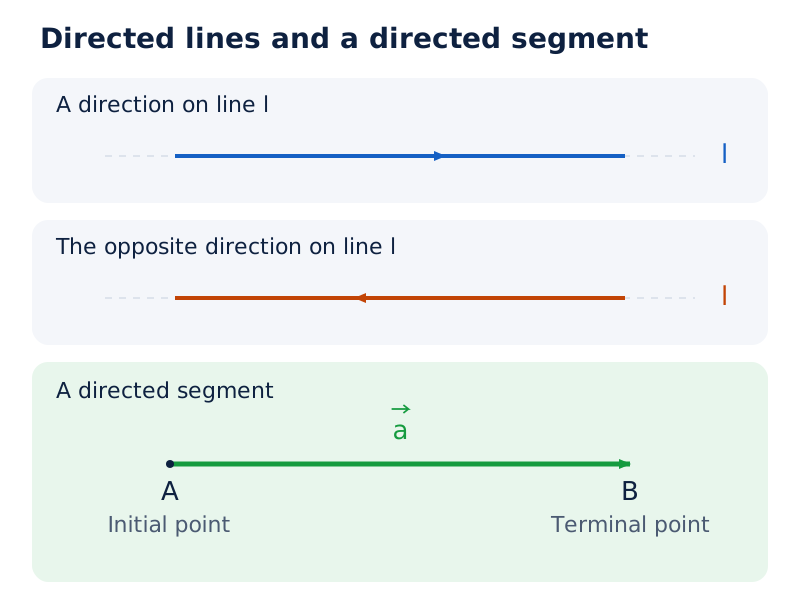
The first two drawings show opposite directions on a line labelled . The third marks initial point , terminal point , and the vector along the directed segment.
Drawn by One Young India. See Fig. 10.1 in your NCERT textbook
The vectors used here are free vectors. A parallel displacement of their representative segments preserves the vectors because both length and direction remain unchanged. This freedom allows vectors to be repositioned when constructing their sum.
| Scalar quantity | Vector quantity | Distinction |
|---|---|---|
| Distance | Displacement | Displacement includes the direction of the change in position. |
| Speed | Velocity | Velocity includes the direction of motion. |
| Mass | Weight | Weight is a force and has direction. |
How are different types of vectors identified?
Vector classifications describe different features. Some concern magnitude, others concern direction, and others concern the initial point. Check the relevant feature before deciding whether vectors are equal, collinear or coinitial.
Which properties define each type?
| Type | Defining property | Consequence |
|---|---|---|
| Zero vector | Its initial and terminal points coincide. | Its magnitude is zero, with no definite direction. |
| Unit vector | Its magnitude is one unit. | It specifies a direction without retaining the original magnitude. |
| Coinitial vectors | They share an initial point. | Their lengths and directions may differ. |
| Collinear vectors | They are parallel to the same line. | They may point in the same or opposite directions. |
| Equal vectors | They have equal magnitudes and the same direction. | Their initial points need not coincide. |
| Negative vector | It has the original magnitude and opposite direction. | Reversing a directed segment gives its negative. |
Write the zero vector as . For the endpoints already defined, . This relation reverses the arrow while keeping the length unchanged. A negative vector does not have a negative magnitude.
The zero vector is exceptional because it has no unique direction. It therefore cannot be used to obtain a unit vector by division by its magnitude. Statements involving an angle between vectors also require attention to this exception.
Note: Equal magnitude alone does not establish equality of vectors. Equal magnitude together with collinearity is still insufficient if the arrows point in opposite directions.
Coinitiality and equality answer different questions. Coinitiality locates the tails of the arrows. Equality compares their lengths and directions. Translating a free vector can change where its representative segment starts without changing the vector itself.
How do addition and subtraction combine vectors?
The triangle law adds vectors by placing them head to tail. Let be a third point after and . Moving from the first point to the second, then to the third, gives the same net displacement as moving directly from the first to the third.
The vector equation is . The resultant starts at the first initial point and ends at the final terminal point. Its magnitude is not generally the sum of the two individual magnitudes.
What the figure shows
Triangle law of addition
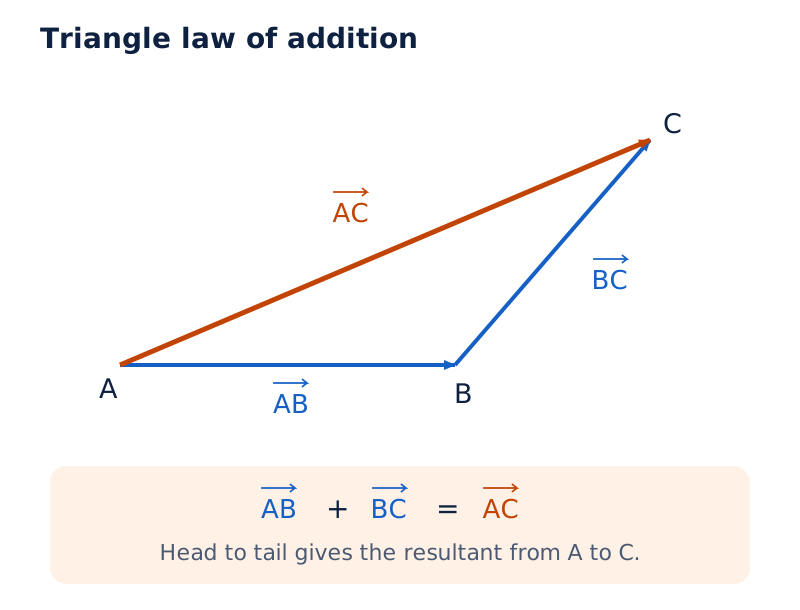
The drawing places at the left, to its right, and above and to the right. Arrows run from to , from to , and directly from to .
Drawn by One Young India. See Fig. 10.7 in your NCERT textbook
Property: Commutative and associative addition
For vectors , and , the following laws allow the order and grouping of additions to change:
The parallelogram law gives the same resultant. When two vectors form adjacent sides from a common initial point, their sum is the diagonal from that point to the opposite vertex. Opposite sides supply equal translated vectors, linking this construction to the triangle law.
How do zero and negative vectors enter?
The zero vector is the additive identity: . The negative vector is the additive inverse: . Subtraction means adding the negative: .
- Apply the triangle law: .
- Add the return displacement to both sides: .
- Use opposite vectors: .
- Conclude that a closed triangular journey has zero resultant: .
How do scalar multiplication and components describe a vector?
Let be a real scalar. Multiplication produces the vector , whose magnitude is . A positive multiplier preserves direction, a negative multiplier reverses it, and a zero multiplier produces the zero vector.
In a right handed rectangular coordinate system, let , and be unit vectors along the positive first, second and third coordinate axes respectively. Write the corresponding scalar components of as , and .
Then . The numbers are scalar components; the separate terms , and are vector components. The mutually perpendicular axes give .
Property: Component operations and distributivity
Let be the corresponding components of , and let be another real scalar. Addition and subtraction operate on matching components. Scalar multiplication multiplies every component by the same scalar.
Two vectors are equal exactly when their corresponding scalar components agree. For nonzero collinear vectors, one is a nonzero scalar multiple of the other. Comparing multiples avoids dividing by components that might be zero.
Worked example 1. Compare and : do they have equal magnitudes, and are they equal vectors?
Answer:
- Square and add the first vector's components: .
- Repeat for the second: .
- Compare corresponding components: along the first axis and along the second.
- Thus , but . Equal lengths do not establish equal directions.
How is a unit vector found in a specified direction?
For a nonzero vector , denote its unit vector by . Dividing every component by the positive magnitude preserves direction and reduces the length to one: .
If a required vector has magnitude , where is a positive real number, multiply this unit vector by that magnitude. The required vector is . Normalisation must precede rescaling unless the original vector already has unit magnitude.
What does normalisation do to the components?
Worked example 2. Find a unit vector in the direction of .
Answer:
- Calculate the squared length: .
- Take the positive square root: .
- Divide the complete vector: .
- Check the length: , so .
Worked example 3. Find a vector of magnitude units in the direction of .
Answer:
- Find the original magnitude: .
- Normalise: .
- Multiply by the required magnitude: .
- Verify the squared magnitude: , giving magnitude units.
For a sum of vectors, first form the resultant, then divide by its magnitude. Normalising the original vectors separately can change their relative lengths and does not generally give the unit vector of their sum. A zero resultant has no specified unit direction.
Note: A vector parallel to a given nonzero vector can point either way. A vector in the same direction requires the positive multiple of its unit vector.
How are direction ratios and direction cosines related?
Let be the coordinate origin and a point, where are its coordinates. Its position vector is . Write its magnitude as .
For a nonzero position vector, let be its angles with the positive coordinate axes, respectively. Their cosines are the direction cosines, denoted by : , , .
Result: The sum of squared direction cosines is one
- The component projections give , and , with .
- Squaring and adding gives .
- The magnitude formula gives .
- Substitution yields .
The scalar components are direction ratios. They are proportional to the direction cosines but are not generally normalised. In contrast, is a unit vector in the specified direction.
Worked example 4. Find the direction ratios and direction cosines of .
Answer:
- Read the direction ratios from the components: .
- Calculate the magnitude: .
- Divide each component by the magnitude: , , .
- Check normalisation: .
The sign of a component remains in its direction cosine. A negative component gives a negative cosine with the corresponding positive axis. Squaring is appropriate for checking the length, but it must not erase the sign in the final direction.
How are joining vectors and section formulae calculated?
Let and be points; the subscripted quantities are their respective coordinates. The directed vector from the first point to the second is the second position vector minus the first.
Worked example 5. Find the vector from to .
Answer:
- Identify as the initial point and as the terminal point.
- Subtract first coordinates from second coordinates: .
- Simplify each component: .
Derivation: Internal section formula
Let be the position vectors of , respectively. Suppose divides the segment internally in the ratio , where here are positive ratio terms and .
- The directed parts have the same direction: .
- Replace joining vectors by position-vector differences: .
- Collect the unknown position vector: .
- Divide by the positive denominator: .
The opposite endpoint receives each weight. The first ratio term multiplies the second endpoint's position vector. For the midpoint the weights are equal, giving .
For external division in the positive ratio , the position vector is , provided . The denominator condition matters: equal positive weights do not define a finite external division point.
Worked example 6. Let and , where are given vectors. Divide the join in the ratio , internally and externally.
Answer:
- For internal division use .
- Substitute and combine: .
- For external division use .
- Substitute and simplify: .
How does the scalar product determine angles and perpendicularity?
Let be the angle between nonzero vectors and , with . Their scalar product, also called the dot product, is . Its value is a real number.
If either vector is zero, the angle is undefined and the dot product is defined to be zero. For two nonzero vectors, a zero dot product is equivalent to perpendicularity. Also, .
Property: Dot products in components
The axis unit vectors have self-products equal to one and mutual products equal to zero. Expanding by distributivity therefore gives . Matching components contribute; mixed-axis terms vanish.
For any third vector , . The dot product is commutative: . A scalar multiplier can be taken outside the product.
To find an angle, use . Calculate both magnitudes even when their components look similar. The sign of the dot product is retained when finding the cosine.
Worked example 7. Find the angle between and .
Answer:
- Multiply matching components and add: .
- Find the magnitudes: and .
- Substitute: .
- Hence , with the inverse cosine selecting the angle in .
Perpendicularity is often easier to prove than an angle is to calculate. Show that the dot product is zero, then confirm that both vectors are nonzero. This avoids applying an angle criterion to the zero vector.
How are projections and magnitude identities obtained?
A projection records the component of a vector along a chosen direction. Let be a unit vector along a directed line. The scalar projection of on that direction is .
For a nonzero vector , its unit direction is . Hence the scalar projection of on is . This signed scalar should be distinguished from the non-negative length of a projection vector.
Worked example 8. Find the projection of on .
Answer:
- Calculate the dot product: .
- Calculate the direction vector's magnitude: .
- Divide by that magnitude: the projection is .
- Rationalise: .
Identity: Magnitudes of a sum and difference
- Express the square of a length as a self-product: .
- Expand: .
- Use commutativity and the self-product rule: .
Choose the non-negative square root when recovering a magnitude. The squared identity applies to vectors, whereas direct addition or subtraction of their lengths generally does not give the required magnitude.
Result: Scalar-product and triangle inequalities
Since , the scalar-product bound is . If either vector is zero, the bound also holds. Substituting this bound into the sum identity proves the triangle inequality.
- Start with .
- Bound the middle term: .
- Recognise a square: .
- Take non-negative square roots: .
How is the vector product calculated and directed?
The vector product, or cross product, returns a vector perpendicular to the two input vectors. For nonzero, nonparallel vectors, let be the unit normal chosen by the right hand rule from towards .
Then . Curl the right hand's fingers from the first vector towards the second through their included angle; the thumb indicates the direction of the product.
If either input is zero, the product is defined as . For nonzero vectors, it is zero exactly when they are parallel or antiparallel. In those cases there is no nonzero cross product to normalise.
Property: Order changes the sign of a cross product
The relation makes the operation anticommutative. Cyclic axis products are , , and . Reversing each order changes its sign.
Each axis unit vector crossed with itself gives zero. Cross products distribute over addition: . This rule and the axis products yield the component formula.
How is the determinant expanded?
Worked example 9. Find for and .
Answer:
- First component: .
- Second component, including the minus sign: .
- Third component: . Thus .
- Take the magnitude: .
To find a unit normal, divide a nonzero cross product by its magnitude. Reversing the order produces the opposite unit normal. Both are perpendicular to the original vectors, but their orientations differ.
How does the cross product give triangle and parallelogram areas?
Let and represent two adjacent sides from a common vertex. Their cross-product magnitude equals base multiplied by perpendicular height. It therefore gives the area of the parallelogram, while half of it gives the corresponding triangle's area.
Derivation: Area from adjacent sides
Write for the perpendicular height to the base represented by , and for the parallelogram's area. The included angle between the side vectors is .
- The perpendicular height is .
- Multiply base and height: .
- Use the cross-product magnitude: .
- The corresponding triangle has area .
Use side vectors, not vertex position vectors directly. When coordinates of vertices are supplied, subtract coordinates to obtain two sides from one chosen vertex, then calculate the cross product.
What the figure shows
Triangle and parallelogram areas
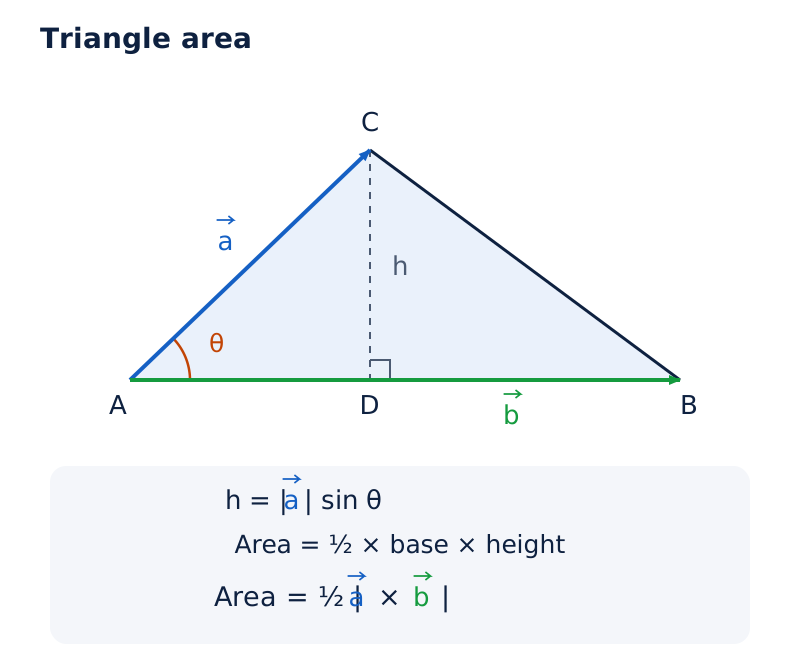
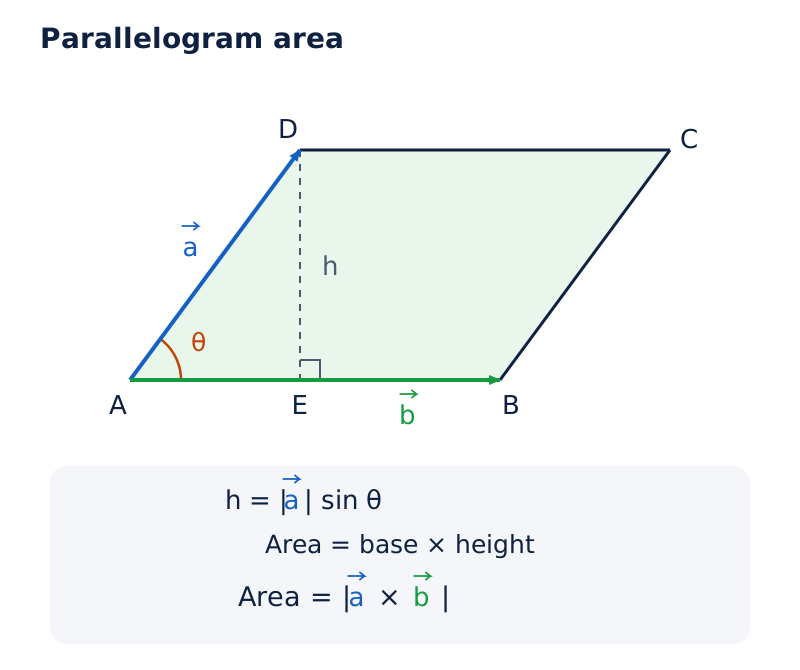
In the triangle, are vertices and is the foot of the perpendicular from to base . In the parallelogram, are vertices and is the foot of the perpendicular from to . Both drawings label the included angle at .
Drawn by One Young India. See Figs. 10.26 and 10.27 in your NCERT textbook
Worked example 10. Find the area of the triangle with vertices , and .
Answer:
- Subtract coordinates: , .
- Expand the cross product: .
- Simplify: .
- Find its magnitude: .
- Halve this value: the triangle's area is square units.
Reversing the two side vectors reverses the normal but leaves its magnitude unchanged. Area is a non-negative scalar, so retain the magnitude bars in the area formula. For collinear side vectors, the cross product and enclosed area are zero.
Glossary
- Scalar — A quantity specified by magnitude, such as mass, time, distance or speed.
- Vector — A quantity possessing both magnitude and direction, represented by a directed line segment.
- Magnitude — The non-negative length of the directed segment representing a vector.
- Position vector — A vector directed from the chosen origin to the point whose position is specified.
- Zero vector — A vector with coincident initial and terminal points, zero magnitude and no definite direction.
- Unit vector — A vector of magnitude one, used to specify a direction.
- Coinitial vectors — Two or more vectors whose representative directed segments share the same initial point.
- Collinear vectors — Vectors parallel to the same line, with either the same or opposite directions.
- Equal vectors — Vectors with identical magnitudes and directions, irrespective of their initial points.
- Direction cosines — Cosines of the angles a nonzero vector makes with the positive coordinate axes.
- Direction ratios — Numbers proportional to direction cosines; a vector's scalar components provide such ratios.
- Scalar product — A real number obtained by multiplying two magnitudes and the cosine of their included angle.
- Scalar projection — The signed component of a vector along a specified directed line or nonzero vector.
- Vector product — A vector normal to the input vectors, with magnitude determined by their lengths and included angle.
Common errors and misconceptions
- Misconception: Equal magnitudes imply equal vectors. Correct: Equality also requires the same direction, or equivalently equality of all corresponding components.
- Misconception: The negative of a vector has negative length. Correct: Its length is unchanged; its direction is reversed.
- Misconception: Every vector can be normalised. Correct: The zero vector has zero magnitude, so division by that magnitude is undefined.
- Misconception: The vector from to is obtained by subtracting the coordinates of from those of . Correct: Subtract initial coordinates from terminal coordinates.
- Misconception: Internal division weights match the nearest endpoint in the written order. Correct: For , the numerator is , using the position vectors defined above.
- Misconception: A zero dot product means one vector is zero. Correct: Two nonzero perpendicular vectors also have zero dot product.
- Misconception: A cross product is unchanged when its factors are swapped. Correct: Swapping the order reverses its sign, although its magnitude remains unchanged.
- Misconception: Triangle area equals the full cross-product magnitude. Correct: Triangle area is half that magnitude; the full magnitude gives the parallelogram's area.
Exam-style questions with model answers
Q1. Define equal vectors and explain whether two collinear vectors of equal magnitude must be equal. [2 marks]
- Equal vectors have the same magnitude and the same direction, regardless of their initial points.
- Collinear vectors of equal magnitude need not be equal: they may point in opposite directions. In that case one is the negative of the other.
Q2. Find the unit vector in the direction of the sum of and . [3 marks]
- Add corresponding components to form the resultant, denoted by : .
- Calculate its length before normalising: .
- Divide each component by this positive magnitude. The required unit vector is . Its squared magnitude is , and the positive divisor preserves the direction of the sum.
Q3. Find given , and . [3 marks]
- Use the difference identity derived from the scalar product: . The dot-product term accounts for the relative directions.
- Substitute every given value: .
- Take the non-negative square root because a magnitude is a length: . Subtracting the two original magnitudes would not calculate the magnitude of their vector difference.
Q4. For and , prove that and are perpendicular. [4 marks]
- Form the sum by adding matching components: .
- Form the difference: .
- Compute their scalar product: .
- Both calculated vectors are nonzero. Their zero scalar product therefore proves perpendicularity, using the dot-product criterion for two nonzero vectors.
Q5. Let and be the position vectors of endpoints and . A point divides their segment internally in the positive ratio . Derive its position vector and obtain the midpoint formula. [5 marks]
- Denote the unknown position vector by . Internal division means the vectors along the two parts point in the same direction. Their lengths satisfy the specified ratio, so .
- Express each directed segment as terminal position vector minus initial position vector: and .
- Substitute into the ratio equation and expand: .
- Collect the terms containing the unknown vector: . Since both ratio terms are positive, divide by their sum to obtain .
- For a midpoint, the two parts have equal lengths, so . Substitution and cancellation give , the average of the endpoint position vectors.
Q6. Find a unit vector perpendicular to both and , where and . State the other possible unit vector. [5 marks]
- Calculate the two input vectors: and . Their components determine the plane to which the required vector is normal.
- Call their cross product . Its first component is ; its second is ; its third is .
- Thus , with magnitude .
- Divide by this magnitude. One required unit vector is . Its squared magnitude is , and its direction is perpendicular to both inputs by the cross-product construction.
- The other unit normal points in the opposite direction: . It is obtained by reversing the order of the cross product.
Q7. Find the area of a parallelogram whose adjacent sides are and . [3 marks]
- Use the magnitude of the cross product of adjacent sides. Expand by components: .
- Simplify each coefficient: . The minus sign preceding the middle minor changes its value to positive one.
- Calculate the magnitude: the area is square units. No halving is required because the figure is a parallelogram.
Key takeaways
- Vectors require both magnitude and direction; equality of magnitudes alone does not establish equality of vectors.
- Vector addition follows triangle and parallelogram constructions, while subtraction is addition of the negative vector.
- Normalise a nonzero vector by dividing every component by its positive magnitude, preserving its direction.
- Direction cosines are normalised component ratios, and the sum of their squares equals one.
- A joining vector uses terminal coordinates minus initial coordinates; internal division weights the opposite endpoint.
- The scalar product returns a number and determines angles, signed projections and perpendicularity of nonzero vectors.
- The cross product returns a normal vector; reversing the order reverses its direction without changing its magnitude.
- Cross-product magnitude gives parallelogram area; half that magnitude gives triangle area for adjacent side vectors.
Test yourself
Can equal free vectors have different initial points?
Yes. Equality requires matching magnitudes and directions, rather than matching initial points.
Why is there no unit vector obtained by normalising the zero vector?
Its magnitude is zero, and division by zero is undefined. It also has no definite direction.
What happens when a nonzero vector is multiplied by a negative scalar?
Its direction reverses, and its magnitude is multiplied by the scalar's absolute value.
What is the vector sum of the sides of a triangle taken in order?
The sum is the zero vector because the directed path returns to its initial point.
For direction cosines , what relation must hold?
They satisfy , because they are the components of a unit vector.
What does a zero dot product tell you when both vectors are nonzero?
It tells you that the vectors are perpendicular to each other.
What does a zero cross product tell you when both vectors are nonzero?
The vectors are parallel or antiparallel, so they are collinear.
How do the two unit normals to a plane differ?
They have equal unit magnitudes and opposite directions; each is the negative of the other.