
Integrals | CBSE Class 12 Maths Notes
On this page
Watch & explore
Start with a few high-quality watches, then dive into the notes below.

This Mathematics note covers antiderivatives, indefinite integrals, standard formulae, substitution, trigonometric identities, partial fractions, integration by parts, definite integrals, the fundamental theorems of calculus, and the use of symmetry and interval properties in evaluating integrals.
What does integration mean, and why is a constant needed?
Integration reverses differentiation: it finds a function when its derivative is given. It also provides a way to calculate areas bounded by curves under suitable conditions. These two ideas lead to indefinite and definite integrals.
How is an antiderivative written?
Let be the independent variable, the given function, and an antiderivative of that function. A prime denotes differentiation with respect to the argument; denotes the operation of differentiation with respect to . The defining relation is .
Definition: An indefinite integral represents the family of antiderivatives: . Here is an arbitrary real constant, is the integral sign, and identifies the variable of integration.
The expression is the integrand. Because the derivative of a constant is zero, adding a constant does not change the derivative. Conversely, functions with the same derivative on an interval differ by a constant on that interval.
Property: integration and differentiation are inverse processes
- Begin with an antiderivative:
- Write the family of primitives:
- Differentiate this expression:
Result: Differentiating an indefinite integral recovers its integrand; integrating a derivative recovers the original function together with an arbitrary constant.
Worked example 1. Find the antiderivative of that satisfies .
- Integrate each term:
- Use the supplied value:
- Therefore , giving
- Check both requirements:
Answer: . The additional condition selects one member of the family.
A request for an antiderivative permits one suitable function. A request for the indefinite integral requires the whole family. An initial value, such as the one above, determines the constant instead of leaving it arbitrary.
Which standard integrals and linearity rules should you know?
Standard integrals come from reversing familiar differentiation formulae. Use each formula on an interval where its expressions are defined. Let denote a real exponent, a constant parameter, and the base of natural logarithms. Throughout this note, denotes the natural logarithm.
The functions denote sine, cosine, tangent, cotangent, secant and cosecant. Inverse-function notation such as and denotes inverse sine and inverse tangent, not reciprocals. Trigonometric arguments are measured in radians.
| Type | Integral |
|---|---|
| Power, with | |
| Reciprocal, with | |
| Sine and cosine | ; |
| Squared secant and cosecant | ; |
| Secant-tangent product | |
| Cosecant-cotangent product | |
| Natural exponential | |
| Exponential, with , | |
| Inverse tangent form | |
| Inverse sine form, with |
Property: integration is linear
Let be another integrable function and a fixed real multiplier. Integrate a sum term by term, and take constant multipliers outside the integral. The same rules extend to finite sums.
These equalities describe antiderivative families, with the arbitrary constant understood. Combine the constants from separate terms into one final constant. Linearity applies to sums and constant multiples; it supplies no corresponding rule for multiplying two indefinite integrals.
Note: The power formula excludes . Substituting that exponent would divide by zero. Use the logarithmic formula for the reciprocal function, retaining its absolute-value bars on intervals that may contain negative arguments.
How does substitution reverse the chain rule?
Substitution changes the variable so that an unfamiliar integral becomes a standard one. A useful clue is a composite function accompanied by the derivative of its inner expression. Change the integrand and the differential together, then return to the original variable for an indefinite integral.
Result: the change-of-variable formula
Let be a new variable and a differentiable substitution function. If , then , where is the differential of the new variable. The corresponding formula is .
Worked example 2. Find .
- Choose the inner expression as the new variable:
- Differentiate the substitution:
- Replace the complete integrand and differential:
- Restore the original variable:
- Differentiate to check:
Answer: . The factor outside the sine supplies exactly the required differential.
For a linear inner expression, let denote a nonzero constant. The formula includes the reciprocal multiplier because differentiation of the inner expression introduces that constant.
Which trigonometric integrals become logarithms?
| Integrand | Antiderivative family |
|---|---|
For the tangent integral, write tangent as sine divided by cosine and substitute the cosine. Its derivative supplies a minus sign. This illustrates why recognising a derivative in the numerator is more useful than memorising an unexplained change of variable.
How do trigonometric identities simplify an integral?
Trigonometric identities can turn powers or products into sums of simpler functions. The transformation happens before integration. A squared cosine suggests a double-angle identity, while products involving different angles suggest a product-to-sum identity.
Identity: reduce a squared cosine
The identity replaces the squared expression with a constant and a cosine. Integrate these terms separately, remembering the factor introduced by the doubled angle.
Worked example 3. Find .
- Replace the integrand using the identity:
- Separate the terms:
- Integrate, including the inner derivative factor:
- Differentiate the result:
Answer: .
How can a product become a sum?
For the product , use with and . This gives . Both terms now have standard antiderivatives. The negative sign arises because .
An odd power of sine can also be split into a single sine factor and an even power. For instance, . The remaining sine factor supplies the differential when cosine becomes the new variable.
Two methods may produce antiderivatives that look different. Equivalent answers have the same derivative on the interval and may differ by a constant. Simplify with identities or differentiate before deciding that two expressions disagree.
How are quadratic expressions reduced to standard forms?
Completing the square reveals which standard integral applies to a quadratic expression. The sign between the square and the constant matters: in a quadratic denominator, a sum of squares leads to an inverse tangent, whereas a difference of squares leads to logarithms. Under a square root, leads to an inverse sine, while and lead to logarithms.
Which particular-function formulae are useful?
In this table, take the parameter to be positive. Use each formula only where its integrand is real and defined. The square-root denominators require a positive radicand.
| Integrand form | Integral |
|---|---|
| Difference of squares | |
| Reversed difference | |
| Sum of squares | |
| Root of a reversed difference | |
| Root of a difference | |
| Root of a sum |
Worked example 4. Find .
- Complete the square:
- Choose , so . Then
- Apply the sum-of-squares formula:
- Restore the variable:
- Check the derivative:
Answer: .
When a numerator is linear, first compare it with the derivative of the quadratic below it. Express it as a constant multiple of that derivative plus a constant remainder. The first part produces a logarithm; the remaining part uses completing the square.
How does partial fraction decomposition help integrate rational functions?
A rational function is a ratio of polynomials. Let denote the numerator polynomial and the denominator polynomial, with . The fraction is proper when the numerator has lower degree than the denominator.
An improper rational fraction must first be divided to obtain a polynomial plus a proper fraction. Integrate the polynomial directly. Decompose the proper fraction according to the linear and quadratic factors of its denominator.
How do denominator factors determine the decomposition?
Let , and denote constants to be determined, and let , and denote fixed real parameters. These constants are decomposition coefficients, distinct from the final integration constant.
| Denominator pattern | Required terms |
|---|---|
| Distinct factors , with | |
| Repeated factor | |
| Linear factor and irreducible quadratic |
In the last row, the coefficient letters are placeholders within that row; the numerator of the quadratic term must allow both a linear term and a constant. An identity obtained after clearing denominators determines the unknown coefficients.
Worked example 5. Find , away from the denominator's zeros.
- Set up the proper decomposition:
- Clear denominators and compare coefficients:
- Subtract the coefficient equations:
- Integrate separately:
- Check by combining the derivative terms:
Answer: .
A repeated factor needs every power up to its multiplicity. Omitting the lower power can prevent the decomposition from matching the original numerator. Coefficient comparison checks the algebra before any integration is attempted.
How is integration by parts derived and applied?
Integration by parts reverses the product rule. It is useful when differentiating one factor simplifies it and integrating the other factor is manageable. A product alone does not guarantee that this method will make the integral easier.
Derivation: the integration-by-parts formula
Let and be differentiable functions of the variable, with and their differentials.
- Write the product rule:
- Integrate the equality, with a final arbitrary constant understood:
- Rearrange into the working formula:
Result: The new integral contains the derivative of the first function and an antiderivative of the second function.
Worked example 6. Find .
- Choose the algebraic factor first:
- Differentiate and integrate the chosen factors:
- Apply the formula:
- Evaluate the remaining integral:
- Check by differentiation:
Answer: .
How should the first function be chosen?
A polynomial is usually a useful first function because differentiation lowers its degree. With a logarithm or inverse trigonometric function, choosing that function first can be more useful. The deciding test is whether the remaining integral becomes simpler.
For a lone logarithm, treat the second factor as the constant function. For exponential-trigonometric products, applying parts twice can reproduce the original integral; collect it algebraically. Add the constant of integration at the end, rather than introducing unnecessary constants in intermediate antiderivatives.
Which further integrals follow from parts and standard forms?
The product rule also gives a useful exponential pattern: . Recognising a function together with its derivative can avoid a longer calculation. Check the entire bracket, including its signs, before using this result.
How are square-root integrals evaluated?
For positive parameter , square-root integrals can be obtained by parts, taking the second function as the constant function. Suitable trigonometric substitutions provide another route. Choose a real interval on which the square roots and substituted expressions are valid.
| Form | Antiderivative |
|---|---|
Worked example 7. Find .
- Complete the square:
- Put , so :
- Use the formula for with :
- Replace the new variable:
- Check in the new variable:
Answer: .
The same square completion works for radicals in denominators. Distinguish carefully between integrating a square root and integrating its reciprocal: their formulae have different algebraic terms, despite the similar expressions inside the radical.
What do definite integrals and the fundamental theorems mean?
A definite integral has specified limits and a unique value. In , the letters and now denote the lower and upper endpoints. They are fixed bounds, rather than the parameters used in earlier standard formulae.
Theorem: differentiation of the area function
Let be continuous on , the closed interval from the lower endpoint to the upper endpoint. Define the area function by , where now names the function and is a dummy integration variable.
The first fundamental theorem gives for all , with one-sided derivatives at the endpoints. For a positive function, the area function measures the area accumulated under the curve from the fixed lower endpoint to the variable upper endpoint. Continuity is part of the theorem's hypothesis.
What the figure shows
The area function
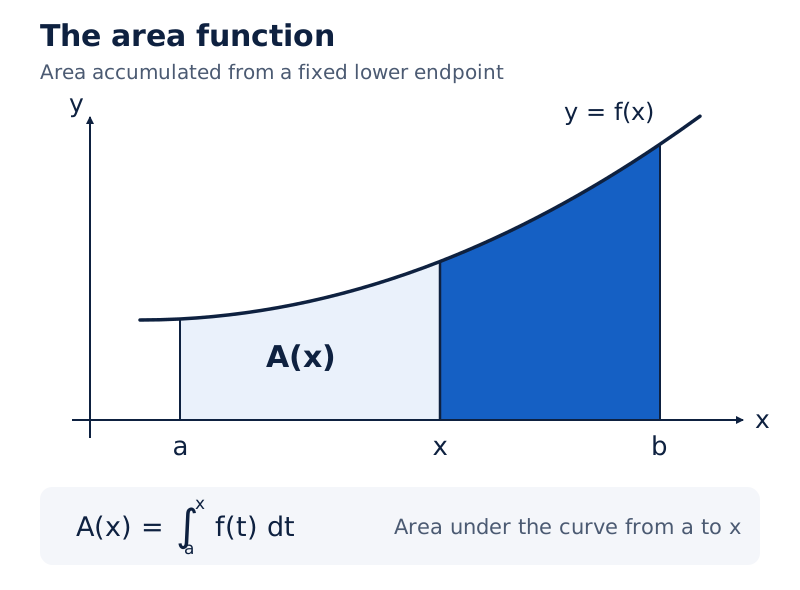
The curve , with denoting vertical height, lies above the horizontal axis. Vertical boundaries mark , and . The lighter shaded region from to is labelled ; darker shading continues to .
Drawn by One Young India. See Fig. 7.1 in your NCERT textbook
Theorem: evaluate a definite integral using an antiderivative
If the function is continuous on the closed interval and is an antiderivative, then . The bracket notation means evaluation at the upper endpoint followed by subtraction of the lower-endpoint value.
Worked example 8. Evaluate .
- The polynomial is continuous throughout the interval. An antiderivative is
- Evaluate at the upper endpoint:
- Evaluate at the lower endpoint:
- Subtract in the correct order:
Answer: . No arbitrary constant remains in this definite value.
The constant cancels because the same antiderivative is evaluated at both endpoints. Before applying the theorem, check that the integrand is defined and continuous across the complete interval; endpoint substitution alone does not establish that requirement.
How should limits change during definite integration by substitution?
There are two consistent ways to use substitution in a definite integral. Either find an antiderivative, return to the original variable and use the original limits, or retain the new variable and transform both limits before evaluating.
How are the transformed endpoints found?
Insert each original endpoint into the substitution separately. The resulting values become the new lower and upper limits. Carry the differential factor through the transformation, and preserve the order of the new endpoints unless a sign change accompanies their reversal.
Worked example 9. Evaluate . Here denotes the circle constant, and inverse tangent takes its principal value.
- Choose the inverse tangent as the variable:
- Transform the lower endpoint:
- Transform the upper endpoint:
- Integrate in the new variable:
- Evaluate the endpoint difference:
Answer: . The transformed integrand and the transformed limits use the same variable.
Check. Differentiate the corresponding antiderivative by the chain rule: This derivative confirms the substitution independently of the endpoint arithmetic.
Note: Keeping the new variable while inserting the old limits mixes two coordinate descriptions. Returning to the original variable and changing the limits are alternative complete methods; neither may be left half finished.
One advantage of transformed limits is that there is no need to substitute back after integration. This is especially convenient when the new integrand and its endpoints are simpler than the original expressions.
How do interval properties and reflection shorten definite integrals?
Definite-integral properties can simplify a problem before any antiderivative is found. The variable inside a definite integral is a dummy variable: changing its letter consistently does not change the value. The endpoints and function still specify the same calculation.
Property: reverse, split or reflect the interval
Let be an intermediate point of the interval. Under the continuity assumptions used here, the following relations hold. Reflection pairs each point with the point equally far from the other endpoint.
| Operation | Property |
|---|---|
| Reverse endpoints | |
| Equal endpoints | |
| Split an interval | |
| Reflect an interval |
Derivation: reflection of the variable
- Set the reflected variable and differential:
- Transform both endpoints:
- Substitute and reverse the limits:
- Rename the dummy variable:
Result: Adding an integral to its reflected form can simplify a complicated numerator.
Worked example 10. Evaluate , where names the required integral.
- Reflect about the interval midpoint:
- Add the original and reflected expressions:
- The denominator is positive, so cancellation gives
- Divide by the coefficient of the unknown integral:
Answer: . Reflection exchanges the two fourth powers.
How do symmetry and absolute values affect definite integrals?
On an interval symmetric about zero, parity can eliminate much of the work. In this section, is a positive endpoint magnitude. Check the whole integrand, including any denominator, before classifying the function as even or odd.
Property: even and odd functions on symmetric intervals
An even function satisfies , giving . An odd function satisfies , giving , when the integral exists under the stated assumptions.
For example, the product is odd: sine changes sign and cosine does not. Its integral over the symmetric interval therefore vanishes. The symmetry of both the function and the interval is essential.
Why must an absolute-value integral be split?
Absolute value makes a negative expression nonnegative, so first find its zeros and determine its sign between successive zeros. Split the integral at the sign changes. Remove the bars using the appropriate positive or negative expression on each subinterval.
Worked example 11. Evaluate .
- Factor the expression to locate its zeros:
- Its signs are nonnegative on , nonpositive on , and nonnegative on . Therefore
- Use the antiderivative :
- Evaluate the three contributions:
- Add the nonnegative contributions:
Answer: . The absolute value prevents the negative middle contribution from cancelling positive contributions.
There is also symmetry about the midpoint of . If , its integral is twice that over . If , the two halves cancel. These are reflection properties, not assumptions about the function's appearance.
Glossary
- Antiderivative — A function whose derivative equals the specified function throughout the interval being considered.
- Indefinite integral — The family of all antiderivatives of a function, represented with an arbitrary additive constant.
- Integrand — The function or expression placed inside the integral sign for integration.
- Variable of integration — The variable with respect to which integration is performed, identified by the differential.
- Constant of integration — An arbitrary real constant accounting for antiderivatives that differ only by an additive constant.
- Substitution — A change of variable that transforms an integral into a form that is easier to evaluate.
- Proper rational fraction — A ratio of polynomials whose numerator has smaller degree than its denominator.
- Partial fractions — Simpler rational expressions whose sum reproduces the original proper rational function.
- Integration by parts — An integration method derived from the product rule that transfers differentiation between chosen factors.
- Definite integral — An integral with specified lower and upper limits that determines a unique value.
- Area function — A function describing accumulated area up to a variable endpoint for a positive continuous integrand.
- Even function — A function whose value is unchanged when its argument is replaced by its negative.
- Odd function — A function whose value changes sign when its argument is replaced by its negative.
Common errors and misconceptions
- Misconception: One primitive is the complete indefinite integral. Correct: Include the arbitrary constant unless an additional condition has determined it.
- Misconception: The power formula applies to . Correct: That exponent is excluded; use .
- Misconception: Substitution only changes the expression inside the function. Correct: Transform the differential as well, including every constant factor and sign.
- Misconception: Any choice of first function makes parts equally useful. Correct: Choose factors so that the remaining integral becomes simpler.
- Misconception: Original limits may be applied directly to an antiderivative in a new variable. Correct: Change the limits or first substitute back.
- Misconception: A definite integral needs an arbitrary constant in its final value. Correct: The same constant cancels between the two endpoint evaluations.
- Misconception: Absolute-value bars may be dropped throughout an interval. Correct: Determine signs and split the interval wherever the expression changes sign.
- Misconception: Oddness alone makes any definite integral vanish. Correct: The limits must also be symmetric about zero, and the integral must exist.
Exam-style questions with model answers
Q1. Find an antiderivative of and verify it by differentiation. [2 marks]
- The derivative of contains an extra constant multiplier: .
- Divide by that multiplier: . Thus one antiderivative is .
Q2. Find if and . [3 marks]
- Integrate the given derivative term by term. The power rule and the integral of a constant give , where the last term represents the arbitrary integration constant.
- Use the supplied initial value: , so .
- The required function is . Checking gives both and , so the derivative and initial condition are satisfied.
Q3. Evaluate , showing the square completion and substitution. [3 marks]
- Complete the square in the denominator: . It is positive for every real value of the variable.
- Put , giving . The integral becomes , which is the standard sum-of-squares form.
- Apply the inverse tangent formula and substitute back: . Differentiation gives , confirming the scale factor and the completed-square denominator.
Q4. Find by parts and check the result. [3 marks]
- Choose and . Then and . Differentiating the algebraic factor reduces it to a constant.
- Apply parts: . The remaining integral is a standard trigonometric integral.
- The answer is . Its derivative is . This cancellation verifies the sign of the cosine term.
Q5. Evaluate by substitution, showing both new limits. [4 marks]
- Set . Its differential is , so the denominator supplies exactly the derivative required for this substitution.
- The lower limit becomes when .
- The upper limit becomes when .
- Evaluate entirely in the new variable: . There is no need to substitute back because the transformed limits already correspond to the transformed variable.
Q6. Evaluate using reflection, explaining each step. [5 marks]
- The denominator is positive on the complete interval because sine and cosine do not vanish together. The integrand is therefore continuous, and the reflection property applies.
- Replace the variable by its reflected value . This exchanges sine and cosine, while the endpoints return to their original order after the differential sign is included. Hence .
- Add this expression to the original integral. The numerator becomes exactly the denominator, giving .
- Evaluate the constant integral: .
- Dividing both sides by the coefficient gives . This method finds the value without constructing an antiderivative of the original fraction.
Q7. Evaluate , showing the sign intervals and every contribution. [5 marks]
- Factor the expression as . Its zeros in the interval are , and . The signs are respectively positive, negative and positive between successive zeros and the upper endpoint.
- Remove the absolute value separately on each interval: . The middle contribution uses the negative of the original expression.
- Use , giving , , and .
- The contributions are , and .
- Adding them gives . Each contribution is nonnegative, as required by the absolute-value integrand; allowing cancellation across the middle interval would solve a different integral.
Key takeaways
- An indefinite integral represents an antiderivative family; an extra condition can determine its arbitrary constant and select one function.
- Recognise standard derivatives, simplify the integrand, and preserve domain restrictions before choosing a more elaborate integration method.
- Substitution must transform the differential alongside the integrand; a missing derivative factor changes the answer.
- Partial fractions depend on denominator factors, while an improper rational function first requires polynomial division.
- Integration by parts is useful when the chosen first function becomes simpler after differentiation.
- The fundamental theorem evaluates a definite integral by subtracting the lower-endpoint antiderivative value from the upper-endpoint value.
- Reflection and parity can simplify definite integrals, provided their function conditions and interval conditions are both satisfied.
- Absolute-value integrals require a sign analysis and interval splitting before the separate contributions can be combined.
Test yourself
Why do indefinite integrals include an arbitrary constant?
Constants differentiate to zero, so antiderivatives differing by a constant give the same derivative.
Which exponent is excluded from the power integration rule?
The exponent is excluded; the reciprocal function instead has the logarithmic antiderivative .
What substitution suits ?
Use , so ; the transformed integrand is the standard sine function.
When is a rational fraction proper?
It is proper when the numerator polynomial has lower degree than the denominator polynomial.
What happens to a definite integral when its limits are reversed?
Reversing the endpoints changes the sign of the integral: .
When does an odd function have zero integral over a symmetric interval?
When the integral exists on , oddness makes the two halves cancel exactly.
Why split an integral containing an absolute value?
The expression inside the bars may change sign, requiring different formulae on different subintervals.
Why is no arbitrary constant left in a definite-integral answer?
The same constant occurs at both endpoints and cancels when their values are subtracted.