
Probability | CBSE Class 12 Maths Notes
On this page
Watch & explore
Start with a few high-quality watches, then dive into the notes below.
These Class 12 Mathematics notes cover conditional probability, its properties, the multiplication rule, independent events, complements, partitions of a sample space, total probability, Bayes’ theorem and random variables, with worked calculations involving coins, dice, cards, coloured balls and manufacturing.
What does conditional probability mean?
How does new information change the sample space?
A random experiment has uncertain outcomes. Its sample space, denoted by , is the set of possible outcomes. An event is a subset of that space. Let and denote two events, and let mean the probability of event .
The notation means the intersection: both events occur. The notation means the union: at least one occurs. The complement contains outcomes in which does not occur. These meanings remain the same throughout probability calculations.
When we learn that has occurred, outcomes outside are no longer relevant to the conditional calculation. The outcomes favourable to within this reduced space are precisely those belonging to . This is the basis of conditional probability.
Definition: The conditional probability of given , written , is The event after the vertical bar is the information already given.
If outcomes are equally likely, let denote the number belonging to both events and the number belonging to the conditioning event. Counting within the reduced space gives
What happens in the three-coin experiment?
Let stand for a head and for a tail. For three fair coins with equally likely ordered outcomes, the sample space is
Worked example 1. Three fair coins are tossed. Find the probability of at least two heads, given that the first coin shows a tail.
Answer: Let mean at least two heads and mean a tail on the first coin.
- List the conditioning outcomes: , so .
- Find the favourable intersection: , so .
- Apply the definition:
Before receiving the information, four of the eight outcomes have at least two heads. After conditioning, only one of the four retained outcomes qualifies. The probability therefore changes because the calculation refers to a different collection of possible outcomes.
Which properties does conditional probability satisfy?
Property: certainty and the probability range
Once an event of nonzero probability is known to have occurred, both the original sample space and itself are certain. Conditional probability also stays between zero and one:
The denominator is fixed by the information given. For example, the intersection of the sample space with is itself. Substituting that intersection into the conditional-probability definition gives the same probability in the numerator and denominator.
Property: addition under a fixed condition
Let and denote any two events in the same sample space. Provided , the conditional addition rule is
- Apply the definition to the union:
- Distribute the intersection across the union:
- Use the ordinary addition rule in the numerator:
- Divide each term by the same denominator:
If and are disjoint, they have no common outcome. Their intersection is the empty set, denoted by , and the overlap term vanishes. The probabilities of the two events can then be added directly under the same condition.
Property: the conditional complement rule
The complement must be taken for the event whose probability is sought while retaining the given condition. The complement rule follows from certainty and disjoint addition.
- An event and its complement cover the sample space:
- They are disjoint, so conditional addition gives
- Rearrange to obtain
Note: Replacing the conditioning event by its complement asks a different question. The complement rule above keeps fixed throughout; it changes whether occurs within that same reduced space.
How do we solve conditional problems with equally likely outcomes?
The first task is to translate the words into events. Identify the information already known, then find which outcomes satisfy both that information and the event being asked about. For equally likely outcomes, the answer is a ratio of those two counts.
A useful working order is to write the conditioning set before counting favourable outcomes. This prevents the original sample-space size from being used after the problem has restricted the possible outcomes. The same method applies to numbered cards, repeated dice throws and coin tosses.
How does a restriction change a card calculation?
Worked example 2. Ten cards numbered from to are thoroughly mixed, and one is selected randomly. Given that its number is greater than , find the probability that it is even.
Answer: Let mean an even number and mean a number greater than .
- Write the conditioning set:
- Keep the even members of that set:
- Express the relevant probabilities in the original space:
- Divide to obtain
The card numbered is even, but it does not satisfy the condition. Including it among favourable outcomes would count a possibility that the question has already excluded. Both the numerator and denominator must refer to compatible events.
Why must ordered dice outcomes be retained?
Worked example 3. A fair die is thrown twice, with all ordered outcomes equally likely. Given that the sum is , find the probability that appeared at least once.
Answer: Let mean at least one , and mean a sum of .
- List the possible ordered pairs under the condition:
- Select the pairs containing :
- Calculate
- Use conditional probability:
The first entry records the first throw and the second entry records the second. Reversing two different entries gives a different elementary outcome. Maintaining that order makes the counting agree with the actual experiment.
How is conditional probability used when outcomes are not equally likely?
The probability-ratio definition does not require all elementary outcomes to have equal probability. What changes is how we calculate the probabilities of the condition and the intersection. We add the assigned probabilities of their outcomes instead of using their counts alone.
What does the coin-and-die tree show?
Consider an experiment that begins with a fair coin. If it shows a head, toss the coin again; if it shows a tail, throw a fair die. A pair such as records two coin results, whereas records a tail followed by a die result.
What the figure shows
Coin-and-die outcomes
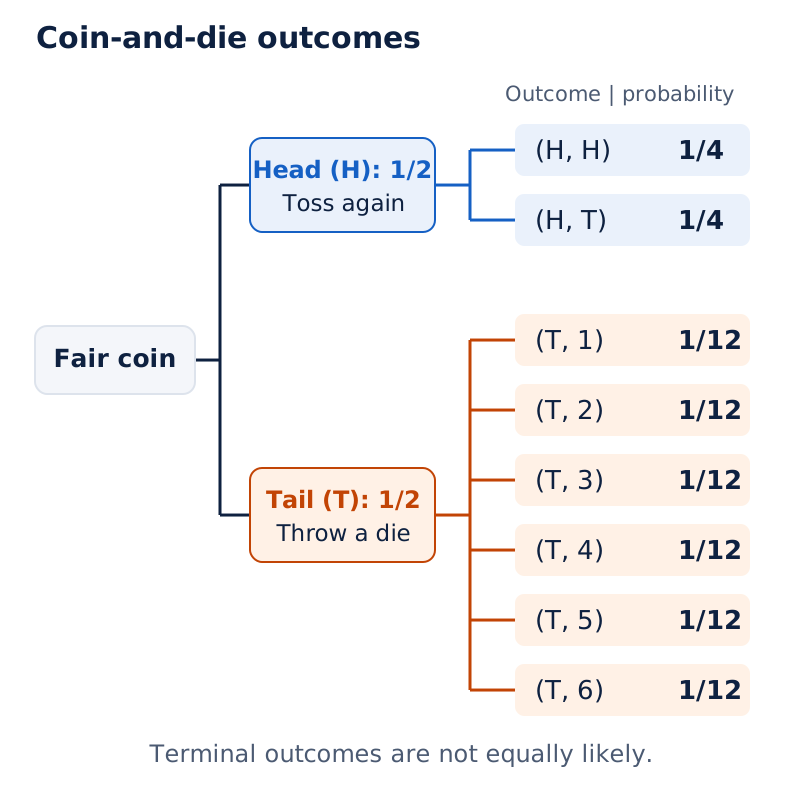
The tree splits into head and tail. The head path ends at two coin outcomes; the tail path ends at six numbered die outcomes. The probability version labels each coin-pair outcome and each tail-and-die outcome .
Drawn by One Young India. See Figs. 13.1 and 13.2 in your NCERT textbook
The tree has eight terminal outcomes, but they do not receive equal probabilities. The two coin-pair outcomes each have a greater probability than any one tail-and-die outcome. Counting all eight as equally likely would therefore misrepresent this experiment.
Worked example 4. In this experiment, find the probability that the die shows a number greater than , given that there is at least one tail.
Answer: Let mean a die result greater than , and let mean at least one tail.
- Calculate each type of terminal probability: For each die result , where is an integer from to ,
- The conditioning event consists of and all six outcomes beginning with . Their probabilities are and each, respectively.
- Add the probabilities of those outcomes:
- The favourable outcomes are and , both within :
- Divide using the general definition:
The condition retains seven outcomes, but their unequal probabilities prevent a simple favourable-count ratio. The essential question is how much probability belongs to each retained outcome. The conditional formula itself remains unchanged.
How does the multiplication theorem handle successive events?
Theorem: multiplication of probabilities
The event means that both events occur. The multiplication theorem expresses its probability through one event and a conditional probability for the other. It follows directly by rearranging the definition of conditional probability.
- Begin with
- Multiply both sides by the denominator:
- Reverse the conditioning when :
Choosing the order is a matter of which conditional probability is available. In successive draws, chronological order usually makes the changing contents easy to track. Removing an object changes the collection used for the next draw when there is no replacement.
Worked example 5. An urn contains black and white balls. Two balls are drawn randomly, one after another without replacement. Find the probability that both are black.
Answer: Let mean a black first ball and a black second ball.
- Count the original total and first-draw probability:
- After a black first draw, black balls remain among balls:
- Apply the multiplication theorem:
How does the rule extend to three events?
Let denote a third event. The last factor must condition on both preceding events together. When the relevant conditioning probabilities are nonzero,
Worked example 6. Three cards are drawn successively without replacement from a well-shuffled standard pack of cards containing four kings and four aces. Find the probability that the first two cards are kings and the third is an ace.
Answer: Let and mean a king on the first and second draws, and an ace on the third.
- Initially four kings are available:
- After one king is removed, three remain:
- After two kings are removed, all four aces remain among fifty cards:
- Multiply and simplify:
Each factor describes the next required event under the preceding successful draws. The ace count stays unchanged because the removed cards were kings, while the total number of available cards decreases at each stage.
How can we recognise independent events?
Two events are independent when the occurrence of one does not change the probability of the other. With nonzero conditioning probabilities, this means
Result: the product test for independence
The product definition is It avoids division by an event probability. If this equality fails, the events are dependent. To test independence, calculate the intersection probability and the product separately before comparing them.
Worked example 7. A fair die is thrown. Let be the event that the result is a multiple of , and the event that it is even. Determine whether they are independent.
Answer: All six die outcomes are equally likely.
- List the events and their intersection:
- Find their probabilities:
- Compute the product:
- Compare: . Hence the events are independent, despite sharing the outcome .
How does independence differ from mutual exclusion?
| Feature | Independent events | Mutually exclusive events |
|---|---|---|
| Meaning | One event does not affect the probability of the other. | The events have no common outcome. |
| Mathematical test | ||
| When both probabilities are nonzero | The intersection has nonzero probability. | The intersection has zero probability. |
Two mutually exclusive events with nonzero probabilities cannot be independent. If one occurs, the other cannot occur. Conversely, independent events with nonzero probabilities cannot be mutually exclusive, because the product of those probabilities is nonzero.
Independence concerns probabilities, while mutual exclusion concerns whether the event sets overlap. Do not infer independence from the wording alone when probabilities or outcome sets are available. The product comparison supplies a direct mathematical check.
How do complements and groups of events affect independence?
Result: independence is preserved by complements
If and are independent, so are and , and , and and . This allows a problem involving non-occurrence to be handled using the same independence assumption.
What the figure shows
Events and their complements
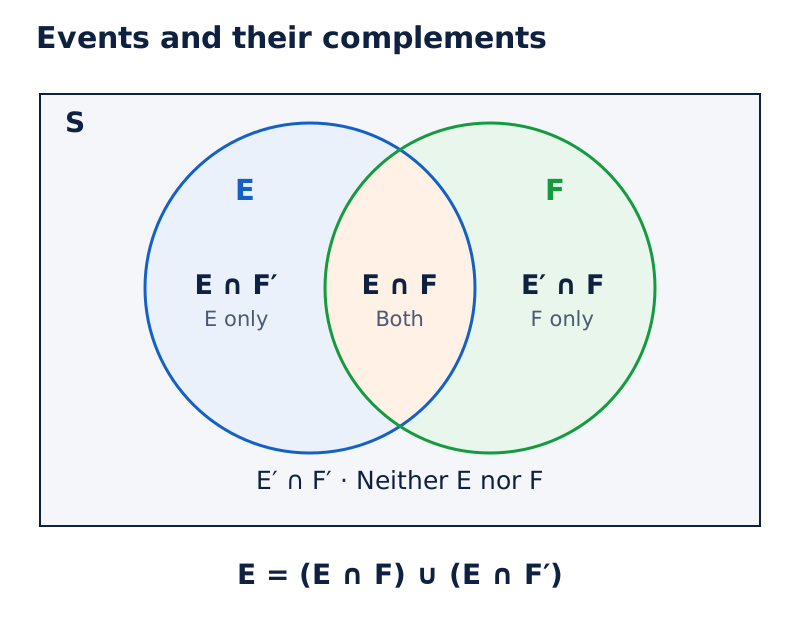
A rectangle labelled contains overlapping circles labelled and . The diagram labels the overlap, the portions belonging to just one circle, and the region outside both circles using intersections and complements.
Drawn by One Young India. See Fig. 13.3 in your NCERT textbook
Derivation: independence of an event and a complement
- Split into two disjoint parts:
- Add their probabilities and rearrange:
- Substitute independence:
- Factor and use the complement rule:
The product test now establishes the required independence. Interchanging the event labels and applying the same argument gives the corresponding results for the other complement pairs.
How do we calculate at least one occurrence?
For independent events and , “at least one” includes either event alone as well as both together. Start with the addition rule, then use independence and the complement probabilities to obtain a convenient expression.
- Apply addition:
- Use independence:
- Factor the terms involving the second event:
- Use the first complement probability:
- Replace the remaining first-event probability:
- Factor again:
- Use the second complement probability:
What must be checked for three events?
Let denote a third event. Mutual independence requires all three pairwise conditions and the three-event condition:
If any one of these requirements fails, the three events are not mutually independent. Checking the pairs alone does not complete the definition. The probability of the simultaneous occurrence of all three must also satisfy its product condition.
How does a partition lead to the theorem of total probability?
What is a partition of the sample space?
Let be events, where is the number of events in the collection. They form a partition when they are pairwise disjoint, collectively exhaustive and each has nonzero probability. Let and denote indices identifying events in this collection.
The conditions are The large union symbol means the union of all the indexed events. Exactly one member of this collection occurs in an outcome of the experiment.
What the figure shows
Partition and an intersecting event
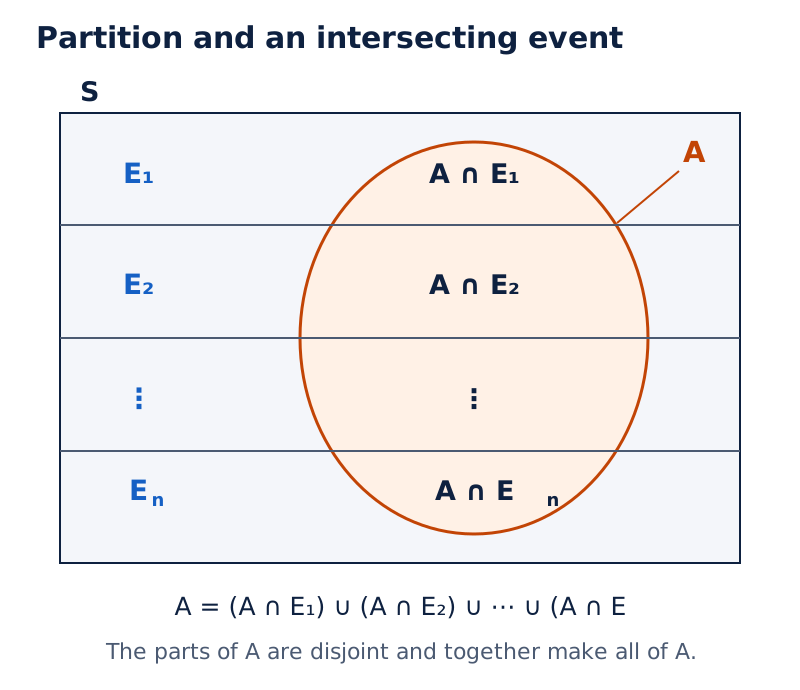
A rectangle labelled is divided into regions labelled with indexed events. A shaded oval labelled crosses several regions, showing the parts of lying within the partition.
Drawn by One Young India. See Fig. 13.4 in your NCERT textbook
Theorem: total probability
For an event , the theorem of total probability states The summation symbol instructs us to add the displayed product for every partition event, from the first through the last.
- Intersect with the whole sample space and then the partition:
- Distribute the intersection:
- These parts are disjoint, so add their probabilities:
- Use the multiplication rule in every term:
Weighting matters: a conditional probability describes what happens within one case. Its contribution to the overall probability also depends on how likely that case is. The total is obtained by adding all these weighted contributions.
How is the theorem used with two cases?
Worked example 8. A construction job faces a strike with probability . The probability of timely completion is if there is a strike and if there is no strike. Find the probability of timely completion.
Answer: Let mean timely completion and mean a strike.
- Find the other case probability:
- Use the given conditional values:
- Weight the two possibilities:
- Substitute and add:
A strike and no strike exhaust the possibilities and cannot occur together. This makes them suitable partition events. Timely completion, however, can occur under either case, so both contributions belong in the calculation.
How does Bayes’ theorem reverse a conditional probability?
Total probability moves from possible cases to the probability of an observed event. Bayes’ theorem asks which case occurred after the event is known. The events forming the partition are called hypotheses, because each describes a possible explanation of the observed result.
The probability is the prior probability of hypothesis . The conditional probability , after event is known, is its posterior probability. Reversing the order around the conditioning bar changes the question being answered.
Theorem: Bayes’ formula and its proof
Suppose the partition events have nonzero probabilities and . Then
- Start with conditional probability for the hypothesis:
- Expand the numerator using multiplication:
- Replace the denominator using total probability:
The numerator measures the joint occurrence of the selected hypothesis and the observation. The denominator includes the observation arising through every possible hypothesis. Omitting a possible case would leave part of the observed event out of the denominator.
How do we infer which bag was selected?
Worked example 9. Bag I contains red and black balls. Bag II contains red and black balls. Choose either bag with equal probability, then draw a ball randomly. Given that it is red, find the probability that Bag II was chosen.
Answer: Let and mean choosing Bag I and Bag II respectively, and mean drawing red.
- State the bag probabilities:
- Find the red probabilities within each bag:
- Compute the total probability of red:
- Compute the required joint probability:
- Divide to obtain the posterior probability:
The question asks for the bag given the colour. The probability of red given Bag II is one ingredient, but is not the requested answer. The calculation must also account for the chance of obtaining red from Bag I.
How do we organise a Bayes problem with several sources?
When an observed item may come from several sources, organise two kinds of data separately: how frequently each source supplies an item, and how frequently that source produces the observed kind of item. These become the prior and conditional probabilities in the calculation.
How should manufacturing data be arranged?
Worked example 10. Machines A, B and C produce , and of a factory’s bolts respectively. Their respective defective rates are , and . A randomly chosen bolt is defective. Find the probability that machine B produced it.
Answer: Let denote production by machines A, B and C respectively. Let mean a defective bolt.
Machine Production probability Conditional defective probability A B C
- Compute the defective contribution from machine A:
- Compute the contribution from machine B:
- Compute the contribution from machine C:
- Add all contributions:
- Divide the required contribution by the total:
The production shares belong to the entire output; the defective rates describe the output of each machine separately. Multiplying the two probabilities makes their bases compatible. Each product then represents a contribution to the defective probability for the whole factory.
What distinguishes the three probabilities?
The prior probability refers to machine B before inspecting the bolt. The conditional defective probability refers to defects among bolts already known to come from machine B. The posterior probability refers to machine B among bolts already known to be defective.
These statements describe different selections, even though they use the same two events. Defining the events before substituting numbers keeps those meanings visible. A complete Bayes solution identifies the partition, calculates the full observation probability and then selects the appropriate numerator.
What is a random variable?
Definition: A random variable is a real-valued function whose domain is the sample space of a random experiment. It assigns a real number to each outcome, rather than naming an event or listing a set of outcomes.
How can one experiment define different random variables?
Consider tossing a coin twice, with . Let denote the number of heads. Let denote the number of heads minus the number of tails. Both are random variables on the same sample space, but their rules differ.
| Outcome | Value of | Value of |
|---|---|---|
The notation means the value assigned by the function to the outcome . Different outcomes can receive the same value: the two mixed outcomes both contain one head. A random variable therefore need not assign distinct numbers to distinct outcomes.
The assignment rule is essential. Merely specifying a coin-toss experiment does not uniquely determine its random variable. The number of heads and the difference between heads and tails are different numerical descriptions of those same outcomes.
Glossary
- Sample space — The set of all possible outcomes associated with a random experiment.
- Event — A subset of the sample space containing outcomes described by a specified condition.
- Conditional probability — The probability of an event when another event of nonzero probability is known to have occurred.
- Intersection — The event containing outcomes common to the events being considered together.
- Complement — The event containing all sample-space outcomes outside the specified original event.
- Independent events — Events whose joint probability equals the product of their individual probabilities.
- Mutually exclusive events — Events that have no common outcome and therefore cannot occur together.
- Exhaustive events — A collection of events whose union covers the entire sample space.
- Partition — Pairwise disjoint, exhaustive events with nonzero probabilities, dividing the sample space into separate cases.
- Hypotheses — The partition events representing possible cases when applying Bayes’ theorem to an observed event.
- Prior probability — The probability assigned to a hypothesis before conditioning on the observed event.
- Posterior probability — The conditional probability of a hypothesis given that the observed event has occurred.
- Random variable — A real-valued function defined on the sample space of a random experiment.
Common errors and misconceptions
- Misconception: Conditional probability keeps the original sample space for counting. Correct: Restrict attention to the given event, and count favourable outcomes within it when those outcomes are equally likely.
- Misconception: The two directions of a conditional probability are interchangeable. Correct: conditions on , whereas conditions on ; their denominators may differ.
- Misconception: Any finite list of outcomes can be used with a favourable-count ratio. Correct: That shortcut requires equally likely outcomes. Otherwise add the assigned outcome probabilities.
- Misconception: Independent and mutually exclusive mean the same thing. Correct: Independence uses a product equality; mutual exclusion means no common outcome. With nonzero event probabilities, the two properties are incompatible.
- Misconception: Successive draws without replacement use the same counts at every stage. Correct: Remove the previously drawn objects before calculating the next conditional probability.
- Misconception: Pairwise independence completes the check for three mutually independent events. Correct: The three-event intersection must also equal the product of the three individual probabilities.
- Misconception: Bayes’ denominator needs only the hypothesis being investigated. Correct: It must include the observed event arising through every member of the partition.
- Misconception: Conditioning on a zero-probability event gives zero. Correct: The conditional-probability ratio used here is undefined when its denominator is zero.
Exam-style questions with model answers
Q1. Events and satisfy , and . Find . [2 marks]
- The conditioning event is , which has nonzero probability. Therefore use
- Substitute and simplify:
Q2. A fair die is thrown. Let and . Test whether the events are independent, and explain whether they are mutually exclusive. [3 marks]
- The six possible results are equally likely. Counting the members of the two events gives
- The common outcome is , so
- The product is . It equals the intersection probability, so the events are independent.
- They are not mutually exclusive because the common outcome belongs to both events. Independence does not require their event sets to be disjoint.
Q3. An urn contains black and white balls. Two balls are drawn randomly without replacement. Calculate the probability that both are black, explaining the second-draw probability. [3 marks]
- Let mean that the first ball is black and that the second is black. The urn initially contains balls, so .
- Given a black first draw, one black ball has been removed. Thus black balls remain among balls, giving .
- Apply the multiplication theorem and simplify:
Q4. A construction job faces a strike with probability . Timely completion has probability during a strike and without a strike. Find the probability of timely completion. [3 marks]
- Let mean timely completion and mean a strike. The complementary case has probability .
- A strike and no strike form disjoint, exhaustive cases. Weight the probability of timely completion within each case by the probability of that case:
- Substitution gives Both routes to timely completion have been included.
Q5. Bag I contains red and black balls, and Bag II contains red and black balls. A bag is chosen with equal probability and a ball is drawn randomly. It is red. Find the probability that it came from Bag II. [5 marks]
- Let and mean the selection of Bags I and II, and let mean a red ball. The bag events form a partition with .
- There are seven balls in Bag I and eleven in Bag II. Therefore and .
- Find the total probability of the observation by including both bags:
- The joint probability of choosing Bag II and drawing red is
- Condition this joint probability on the observed red ball: This is the probability of the bag given the colour, which is the direction requested.
Q6. Machines A, B and C supply , and of bolts. Their defective rates are , and respectively. A random bolt is defective. Find the probability that machine B supplied it. [5 marks]
- Let mean the bolt came from machines A, B and C, and let mean a defective bolt. These source events are mutually exclusive and exhaustive.
- Express the source probabilities as , and . The corresponding defective probabilities conditional on those sources are , and .
- Multiply within each source:
- Add these disjoint contributions to obtain the entire defective probability:
- Bayes’ theorem divides machine B’s contribution by the total: This accounts for both its output share and its defective rate.
Q7. Let and be independent events in the same sample space, so . Prove that and the complement are independent. [3 marks]
- The parts of inside and outside are disjoint and together make up :
- Add their probabilities, then isolate the required intersection:
- Use the stated independence and factor the result:
- Since , this becomes . It is exactly the product condition for independence of the required pair.
Key takeaways
- Conditional probability uses the given event as the reduced sample space and requires that event to have nonzero probability.
- Counting favourable outcomes works directly when the outcomes being counted are equally likely; otherwise use their assigned probabilities.
- The multiplication theorem combines a first-event probability with conditional probabilities that reflect what has already occurred.
- Independence is a product relation between probabilities; mutual exclusion means that the event sets have no common outcome.
- For three mutually independent events, check every pairwise product condition and the product condition for the three-event intersection.
- Total probability adds the contributions of disjoint, exhaustive cases, weighting each conditional probability by its case probability.
- Bayes’ theorem finds the probability of a hypothesis after an observation by dividing its joint contribution by the observation probability.
- A random variable assigns a real number to each outcome, and different assignment rules can describe the same experiment.
Test yourself
What must be true of the conditioning event before the conditional-probability ratio can be used?
Its probability must be nonzero, because that probability is the denominator of the defining ratio.
For events and , with , what is the complement rule for given ?
The rule is . The conditioning event remains the same on both sides.
Why is favourable-outcome counting unsuitable for the coin-and-die experiment?
Its terminal outcomes have unequal probabilities. Add the probabilities of the relevant outcomes before forming the conditional ratio.
Can mutually exclusive events with nonzero probabilities be independent?
No. Their intersection probability is zero, whereas the product of their nonzero probabilities is positive.
What three requirements define a partition used in total probability?
The events are pairwise disjoint, together cover the sample space, and each has nonzero probability.
What is the difference between prior and posterior probabilities?
A prior probability describes a hypothesis before conditioning. A posterior probability describes that hypothesis after the observed event is known.
If three events satisfy the pairwise product conditions, what additional condition is required for mutual independence?
The probability that all three occur together must also equal the product of their three individual probabilities.
Must a random variable assign different values to different outcomes?
No. In two coin tosses, counting heads assigns one to each of the two mixed outcomes.