
Application of Integrals | CBSE Class 12 Maths Notes
On this page
Watch & explore
Start with a few high-quality watches, then dive into the notes below.

These Class 12 Mathematics notes cover area by definite integration, vertical and horizontal strips, signed integrals, circles, ellipses, parabolic regions, polynomial curves, trigonometric curves, symmetry and the calculation of total area when a graph crosses an axis.
How does a definite integral measure an area?
A curved boundary does not generally fit the familiar area formula for a rectangle or triangle. Definite integration calculates its area by adding the contributions of very thin strips. The essential decision is to identify the region before choosing the integral.
Let denote horizontal position, vertical position, and the function giving the curve's height. Suppose is continuous and non-negative between the horizontal coordinates and , where . The other boundaries are the horizontal axis and the vertical lines through these coordinates.
Definition: An elementary area is the area of a very thin strip used to build the required region by integration.
Result: Area from vertical strips
Write for the total area, for an elementary area and for the strip's infinitesimal width. Each vertical strip extends from the horizontal axis to the curve.
- Identify the strip height:
- Multiply height by width to form the elementary area:
- Add the strips from the left boundary to the right boundary:
Interpretation: The limits locate the region along the horizontal axis. The integrand supplies the height at each position. The differential identifies the direction in which the strips are added.
What the figure shows
Vertical strips under a curve
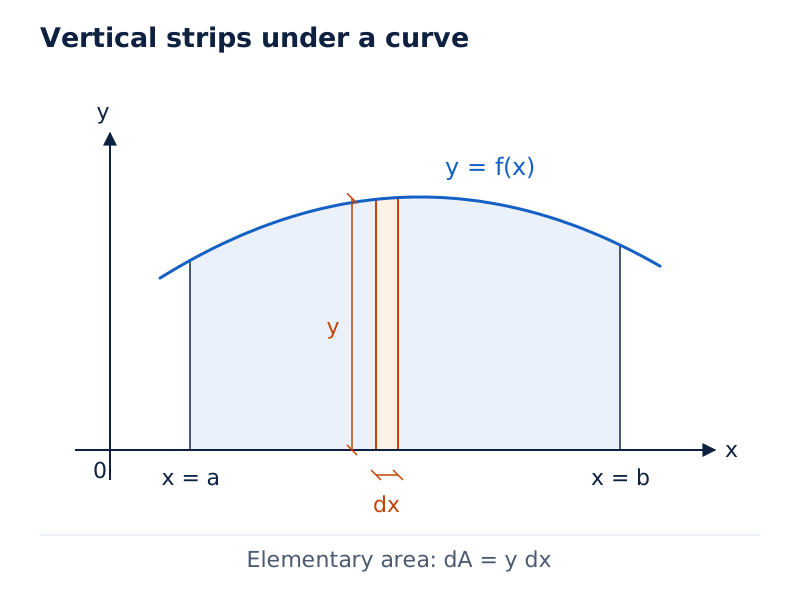
The shaded region lies above the horizontal axis, below , and between and . A narrow vertical strip is labelled with height and width .
Drawn by One Young India. See Fig. 8.1 in your NCERT textbook
What must be checked before integration?
The equation alone does not specify the complete region. Read the stated lines and axes as part of the question. Then check whether the curve remains above the horizontal axis over the entire interval. That sign check determines whether the integral already represents geometric area.
An antiderivative reverses differentiation. If denotes an antiderivative of , the evaluation notation means its upper-limit value minus its lower-limit value: . Use this order consistently when evaluating each definite integral.
When should an area be calculated using horizontal strips?
A horizontal strip is useful when the curve is conveniently written with horizontal position as a function of vertical position. Let denote that function, so . Suppose the curve lies to the right of the vertical axis over the required interval.
Let and be the lower and upper vertical coordinates, with , and let be the strip's infinitesimal thickness. The strip extends from the vertical axis to the curve, so its length is the horizontal coordinate of the curve.
Result: Area from horizontal strips
- Write the length in terms of vertical position:
- Form the elementary area using length and thickness:
- Add the strips from the lower boundary to the upper boundary:
Choice of variable: Horizontal strips use vertical-coordinate limits. A change from vertical strips to horizontal strips therefore changes both the function being integrated and the limits.
What the figure shows
Horizontal strips beside the vertical axis
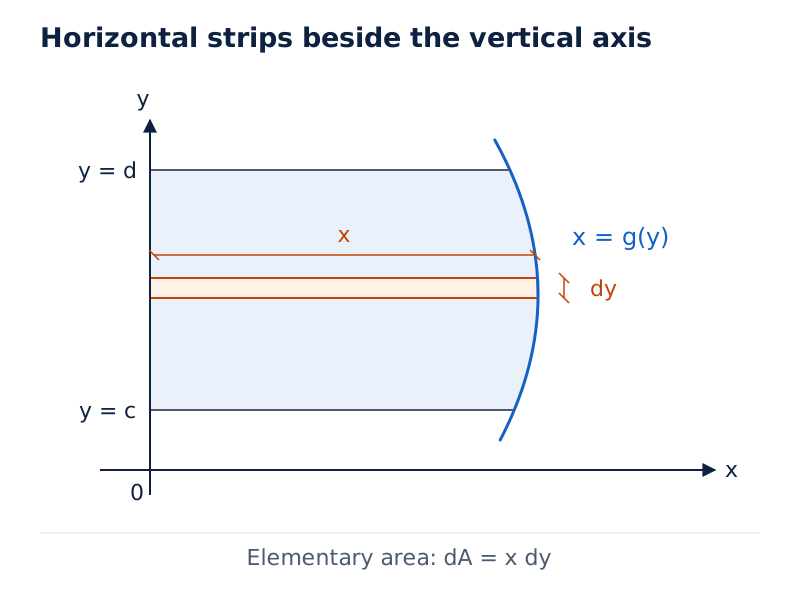
The shaded region is bounded on the left by the vertical axis and on the right by . Its horizontal boundaries are and , with a strip of length and thickness .
Drawn by One Young India. See Fig. 8.2 in your NCERT textbook
Worked example 1. Find the area bounded by the parabola , the vertical axis and the line .
- The parabola meets the vertical axis at the origin. Rearrange its equation:
- The required region runs upwards from the origin to the given horizontal line. Therefore
- Integrate the square of the vertical coordinate:
- Substitute both endpoints and simplify:
Answer: square units.
The lower limit comes from the intersection of the parabola and the vertical axis. It is not an extra boundary supplied by guesswork. Horizontal strips give the entire enclosed region directly, without selecting a square-root branch.
Why is geometric area different from a signed integral?
A signed integral retains the sign of the function. Contributions below the horizontal axis are negative, while contributions above it are positive. A geometric area measures the size of a region, so negative contributions must be converted into positive areas.
Result: Add the magnitudes of separate regions
For a curve entirely below the horizontal axis between the limits, the definite integral is negative. Its absolute value gives the enclosed area. The notation means absolute value, or numerical magnitude.
- If throughout the interval, use
- If throughout the interval, reverse the sign of the integral:
- If the curve changes sign, divide the interval at the crossing points and add the absolute values of the separate integrals.
Cancellation is the reason a single integral can fail to give total area. A positive contribution and a negative contribution can partly or completely cancel. Taking the absolute value after that cancellation cannot restore the area that was lost.
What the figure shows
Regions on opposite sides of an axis
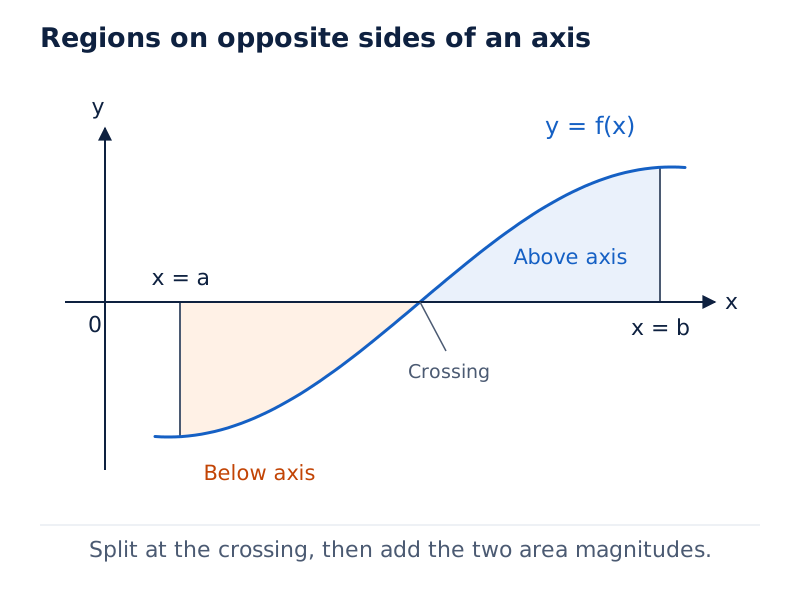
The shaded curve first lies below the horizontal axis, then crosses it and encloses a shaded region above it. Vertical boundary lines mark the two ends of the complete interval.
Drawn by One Young India. See Fig. 8.4 in your NCERT textbook
How should the sign check be organised?
| Position of the graph | Integral contribution | Area calculation |
|---|---|---|
| Above the horizontal axis | Non-negative | Keep the contribution |
| Below the horizontal axis | Non-positive | Take its magnitude |
| On both sides of the axis | Contributions may cancel | Split first, then add magnitudes |
Find the axis intersections by setting the function equal to zero. Check the sign on each resulting interval. This establishes the pieces to integrate before any antiderivative is evaluated, and makes the final addition a sum of geometric areas.
How is the area of a circle derived by integration?
For the circle centred at the origin, let now denote its positive radius. Its equation is . Reflection in either coordinate axis leaves the circle unchanged, so the first-quadrant region occupies one quarter of the complete circle.
This symmetry reduces the work. Instead of integrating the upper and lower semicircles separately, calculate the first-quadrant area and multiply by four. The square root must be positive in this quadrant because the vertical coordinate is non-negative.
Derivation: Area enclosed by a circle
- Solve for the upper branch on the first quadrant:
- Integrate the quarter-circle region and account for all four quadrants:
- Use the antiderivative, where denotes the inverse sine function and is the circle constant:
- At the upper limit the square-root term vanishes and the inverse sine is ; at the lower limit both terms vanish. Thus
Result: The circle's area is , while its first-quadrant area is . The factor of four belongs to the full circle, not to a question requesting just one quadrant.
What the figure shows
A quarter-circle with a vertical strip
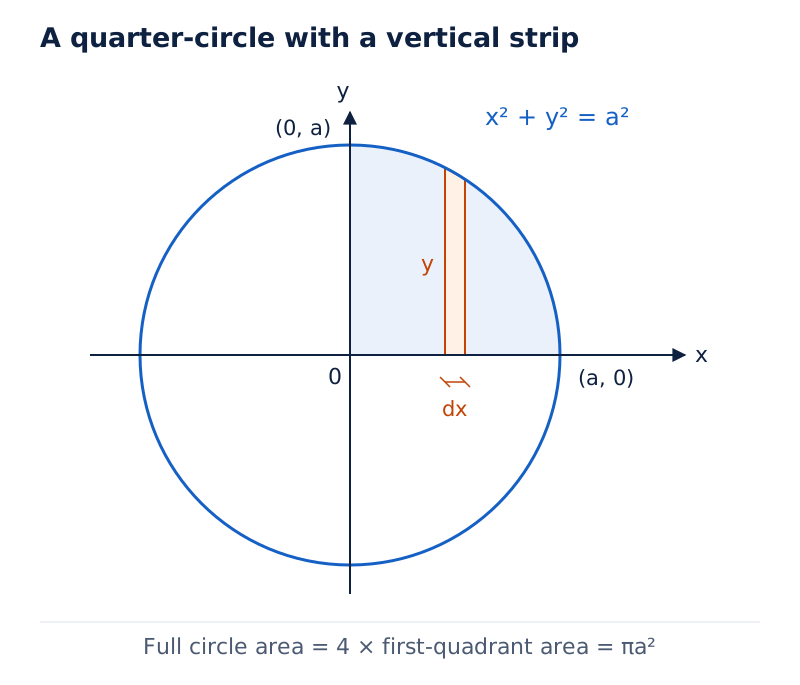
A circle centred at the origin meets the positive axes at and . The first quadrant is shaded, with a vertical strip extending from the horizontal axis to the arc.
Drawn by One Young India. See Fig. 8.5 in your NCERT textbook
Worked example 2. Find the first-quadrant area bounded by and the lines and .
- Select the positive branch:
- Use the given horizontal limits:
- Integrate:
- Evaluate both endpoints:
Answer: square units.
The same circle can be treated with horizontal strips. In that approach the positive horizontal coordinate supplies the strip length, and the vertical coordinate runs from the origin to the radius. The geometry and the resulting total area remain unchanged.
How is the area of an ellipse obtained and applied?
For the standard ellipse, let and denote the positive horizontal and vertical semi-axis lengths, respectively. Its equation is . The denominators are the squares of those lengths, not the lengths themselves.
The ellipse is symmetric about both coordinate axes. A vertical strip in its first quadrant has positive height, and the horizontal coordinate runs from the origin to the horizontal semi-axis length. Four copies of that quadrant make the full enclosed region.
Derivation: Area enclosed by an ellipse
- Rearrange the equation to obtain the upper branch:
- Use symmetry and take the constant factor outside the integral:
- Integrate the remaining square root:
- Evaluate the limits and simplify:
Result: Multiply the two positive semi-axis lengths by the circle constant. Their order in the product does not affect the answer, so the formula also applies when the vertical semi-axis is the longer one.
What the figure shows
Ellipse with a shaded first quadrant
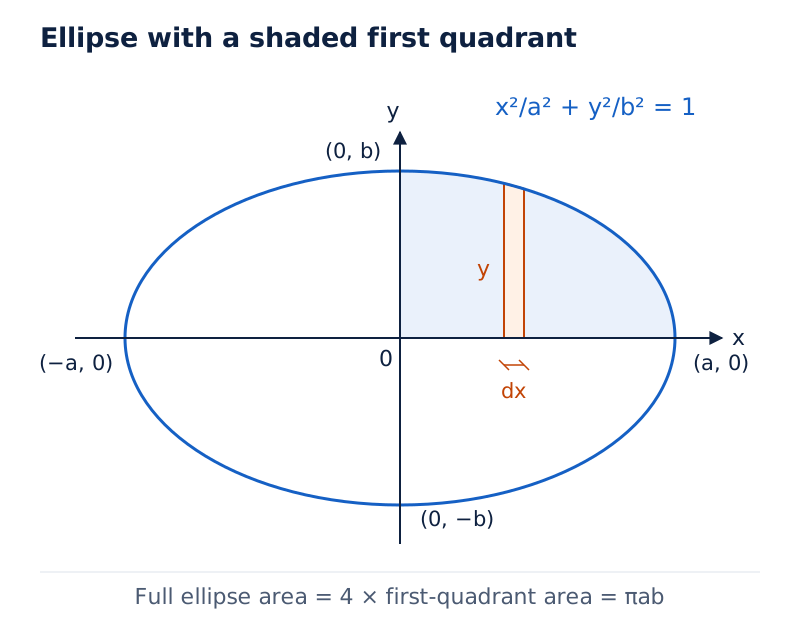
The ellipse meets the horizontal axis at and , and the vertical axis at and . A vertical strip appears inside the shaded first quadrant.
Drawn by One Young India. See Fig. 8.7 in your NCERT textbook
Worked example 3. Find the area enclosed by .
- Read the squared horizontal semi-axis:
- Read the squared vertical semi-axis:
- Apply the derived ellipse formula:
Answer: square units.
Worked example 4. Find the area enclosed by .
- Identify the horizontal semi-axis:
- Identify the vertical semi-axis:
- Substitute the lengths into the area formula:
Answer: square units.
These examples distinguish semi-axes from the full widths of the ellipse. Using full axis lengths would count too much area. Likewise, multiplying the two denominators would use squared lengths in place of lengths and would not implement the derived formula.
How are areas under positive polynomial curves calculated?
For a polynomial curve that stays above the horizontal axis on the given interval, the area is obtained directly from a definite integral. There is no sign correction to make, but both endpoints still have to be substituted into the antiderivative.
The order of work is geometric first and algebraic second. Identify the vertical boundaries, confirm the graph's sign, write the integral and then integrate. The two examples below use positive horizontal coordinates, where the specified powers are positive.
What does the power rule contribute?
For a non-negative integer exponent , the definite integral of uses as its antiderivative. The exponent increases by one, and the new power is divided by that increased exponent.
Worked example 5. Find the area bounded by , the lines and , and the horizontal axis.
- The height is non-negative throughout the specified interval, so
- Integrate using the power rule:
- Substitute the upper and lower limits separately:
- Subtract the two values:
Answer: square units.
Worked example 6. Find the area bounded by , the lines and , and the horizontal axis.
- The height is positive on the interval. Set up
- Increase the exponent and divide by the new exponent:
- Evaluate at both limits:
- Calculate the powers and subtract:
Answer: square units.
The lower endpoint contributes a non-zero quantity in both examples. Omitting it changes the answer even though the correct antiderivative has been found. Keep the square-bracket notation until both substitutions have been written explicitly.
These are areas under curves between specified lines. They do not require a full enclosed circle or ellipse, and no symmetry multiplier is involved. The limits already describe the complete horizontal extent of each requested region.
How do you find area when a straight line crosses the axis?
A straight line can enclose one region below the horizontal axis and another above it within the same pair of vertical boundaries. The integral over the whole interval then gives their signed difference. The requested total area instead requires their positive magnitudes to be added.
Where must the interval be divided?
The dividing point is the line's horizontal-axis intercept. Find it by setting its vertical coordinate equal to zero. Then place it between the supplied endpoints and check which part of the line lies below the axis.
Worked example 7. Find the area bounded by , the horizontal axis, and the ordinates and .
- Find the crossing point:
- The line is below the axis before this point and above it afterwards. Therefore
- Let be the antiderivative used for both pieces:
- Evaluate it at all three endpoints:
- The first piece has signed integral so its area is .
- The second piece has area
- Add the positive areas:
Answer: square units.
What the figure shows
A line with two shaded regions
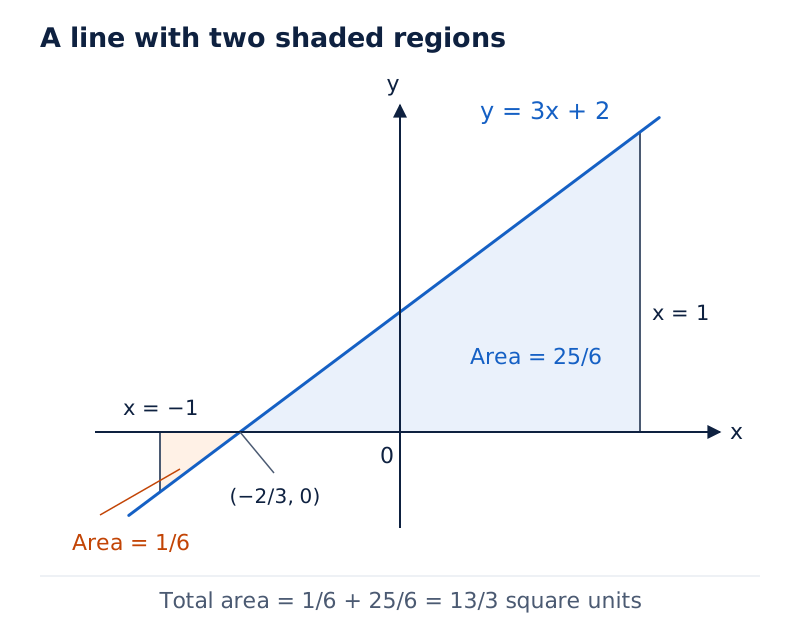
The line crosses the horizontal axis at . A small shaded triangle lies below the axis next to , and a larger shaded triangle lies above it towards .
Drawn by One Young India. See Fig. 8.9 in your NCERT textbook
The negative sign before the first integral converts its negative value into a positive area. It does not change the equation of the line. Keeping these ideas separate prevents the common mistake of adding the signed contributions and calling the result geometric area.
How is total area found under a cosine curve?
A trigonometric curve can change sign more than once over the stated interval. Before integrating, locate every axis crossing inside the interval. Here the horizontal coordinate is an angle measured in radians, so the given multiples of the circle constant are used directly.
For the cosine curve over one complete period, the graph begins above the axis, goes below it in the middle, and returns above it at the end. Its three regions must be accounted for separately, even though one antiderivative evaluates all of them.
How do the three regions contribute?
Worked example 8. Find the area bounded by , the horizontal axis, and the lines and .
- The internal crossings are and . The sign pattern is positive, negative, positive.
- Write one integral for each sign interval:
- Use sine as the antiderivative of cosine:
- Substitute each pair of endpoints:
- Add the three positive contributions:
Answer: square units.
What the figure shows
Cosine regions over a complete period
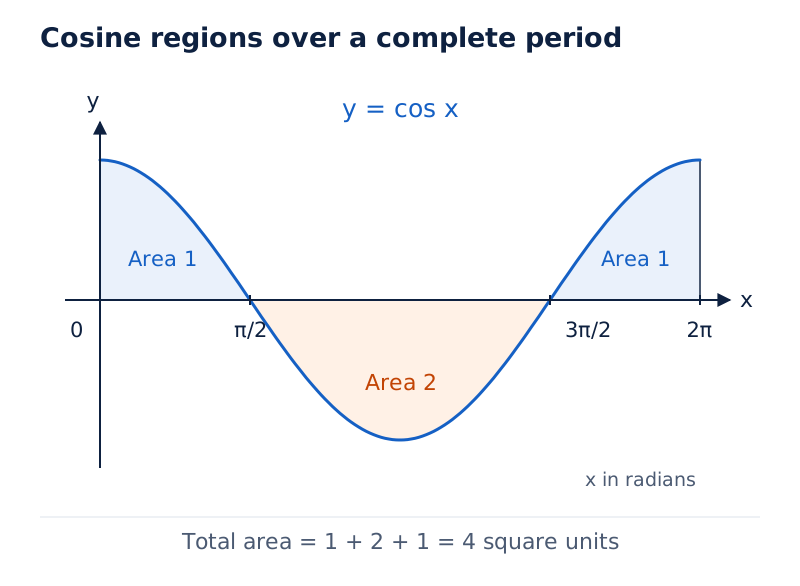
The shaded graph is above the horizontal axis initially and finally, with a trough below the axis in the middle. Crossings are marked at and , between the endpoints and .
Drawn by One Young India. See Fig. 8.10 in your NCERT textbook
The middle contribution has magnitude two, while each outer contribution has magnitude one. This is visible algebraically in the endpoint substitutions. A negative signed integral in the middle is expected; it is converted to a positive area by the preceding minus sign.
Using just the integral over the whole period would allow the middle region to cancel the two outer regions. The graph makes clear why a zero signed result would not mean that there is no shaded area.
How does the sine example reinforce the sign rule?
The sine curve offers a simpler division of one complete period into sign intervals. It starts on the horizontal axis, stays above it during the first half, then lies below it during the second half. The internal crossing separates the two required area contributions.
What changes when the antiderivative is negative cosine?
The antiderivative sign and the area sign correction do different jobs. Negative cosine is the antiderivative of sine. A separate minus sign before the lower-region integral converts that region's signed contribution into its geometric area.
Worked example 9. Find the area bounded by , the horizontal axis, and the lines and .
- The curve crosses the axis internally at . It is positive before that point and negative after it.
- Split the interval and correct the lower-region sign:
- Integrate both pieces:
- Evaluate the first signed integral:
- Evaluate the second signed integral:
- Subtract the negative contribution to obtain total area:
Answer: square units.
There are two regions of equal area in this calculation. Their signed contributions cancel when combined without an area correction, but their geometric areas add. The same distinction explained the cosine example, despite its different arrangement of crossing points.
Use the zeros of the function to organise the solution instead of assuming that all periodic curves require the same subdivision. Sine and cosine over the same full-period interval have different internal zeros and therefore different natural sets of integrals.
Once the intervals and signs are correct, the remaining task is ordinary endpoint evaluation. Write the cosine values with their signs before simplifying; this avoids losing a negative sign inside another subtraction.
How are cubic and modulus curves handled across the origin?
Both odd powers and modulus expressions can require separate sign intervals. The origin is an axis crossing in the examples below. However, a crossing at the origin does not by itself justify doubling one side's area: the supplied endpoints must also be considered.
Why do unequal endpoints prevent a simple doubling?
Worked example 10. Find the area bounded by , the horizontal axis, and the lines and .
- The cubic is negative to the left of the origin and positive to its right. Thus
- Integrate each piece:
- Substitute the actual endpoints:
- Add the resulting areas:
Answer: square units.
The negative-side region reaches farther from the origin, so its area exceeds the positive-side region. This example tests both sign handling and careful use of the given limits. Replacing the endpoints by a symmetric pair would answer a different question.
How should a modulus expression be rewritten?
Worked example 11. Find the area bounded by , the horizontal axis, and the lines and .
- Use the definition of absolute value:
- The first branch lies below the axis. Convert its contribution to area:
- Cancel the two negative signs in the first term and integrate:
- Evaluate and add:
Answer: square units.
The presence of a modulus inside a product does not make the entire product non-negative. The horizontal coordinate outside the modulus remains negative on the left. Rewrite the function on each interval before deciding the sign of its integral.
Glossary
- Definite integral — An integral evaluated between specified limits, retaining the signs of contributions from the function.
- Geometric area — The non-negative measure of a region, obtained by adding the magnitudes of its separate parts.
- Elementary area — The area of a very thin strip used to construct a region through integration.
- Vertical strip — A thin strip whose height is measured vertically and whose width advances horizontally.
- Horizontal strip — A thin strip whose length is measured horizontally and whose thickness advances vertically.
- Ordinate boundary — A vertical boundary line at a specified horizontal coordinate in an area problem.
- Antiderivative — A function whose derivative equals the function being integrated in the area calculation.
- Limits of integration — The starting and ending values of the variable over which the strips are added.
- Axis crossing — A point where a curve passes through an axis and may change its sign.
- Absolute value — The non-negative magnitude used to convert a negative signed contribution into geometric area.
- Symmetry — A property allowing reflected equal regions to be calculated from one representative part.
- Semi-axis — Half an axis of an ellipse, measured from its centre to the corresponding endpoint.
Common errors and misconceptions
- Misconception: A definite integral always equals geometric area. Correct: An integral retains signs; split a region at sign changes and add the magnitudes.
- Misconception: Taking the absolute value of the final integral handles every axis crossing. Correct: Cancellation has already occurred; take magnitudes of the separate contributions.
- Misconception: Horizontal strips use the original horizontal-coordinate limits. Correct: Integration with respect to the vertical coordinate requires the corresponding vertical limits.
- Misconception: The denominators in an ellipse equation are its semi-axis lengths. Correct: In standard form, they are the squares of those positive lengths.
- Misconception: Every circle-area question requires multiplication by four. Correct: Multiply a quadrant by four only when the whole circle is requested.
- Misconception: The product is non-negative because it contains a modulus. Correct: It equals for negative horizontal coordinates.
- Misconception: Symmetry about the origin permits doubling for any endpoints. Correct: The selected intervals must also correspond; the cubic example has unequal endpoint distances.
Exam-style questions with model answers
Q1. A continuous curve lies below the horizontal axis throughout , where . State the area bounded by the curve, that axis and the endpoint ordinates, and explain the sign. [2 marks]
- The integral is non-positive because the function is non-positive throughout the specified interval.
- If denotes area, then . The minus sign converts the signed contribution into a non-negative geometric area.
Q2. Find the area enclosed by , using the standard ellipse-area formula. [2 marks]
- The positive horizontal and vertical semi-axis lengths are and .
- Writing for area, substitute into the formula: square units.
Q3. Find the area bounded by , the vertical axis and the line , using integration. [3 marks]
- Use horizontal strips because the equation rearranges directly to . Each strip extends from the vertical axis to the parabola.
- The parabola meets the vertical axis at the origin, so the vertical limits are and . Writing for area gives .
- Integrate and evaluate both limits: square units. The integral is already non-negative because the curve lies to the right of the vertical axis.
Q4. Find the first-quadrant area bounded by and the lines and , using integration. [3 marks]
- In the first quadrant, take the positive branch . The requested region is a quarter-circle, so no whole-circle multiplier is required.
- Writing for the area, set up .
- Integrate to get .
- At the upper endpoint the radical term vanishes; both lower-endpoint terms vanish. Hence square units.
Q5. Find the total area bounded by , the horizontal axis, and the ordinates and . Explain why the integral must be split. [5 marks]
- The crossing is found from , giving . This lies inside the given interval. The line is below the axis before this point and above it afterwards.
- The total area, denoted by , must add positive magnitudes: .
- Choose the antiderivative . Its endpoint values are , , and .
- The first signed contribution is , giving area . The second contribution is positive and equals .
- Therefore square units. Splitting prevents the small lower region from cancelling part of the upper region. Each region contributes its own positive amount to the final sum.
Q6. Using integration, find the total area between and the horizontal axis from to , with angles in radians. Show the separate contributions. [5 marks]
- The internal zeros occur at and . The graph is above the axis on the first and last subintervals and below it on the middle subinterval.
- Let denote the total area. The correct setup is .
- The antiderivative is . The first signed contribution is .
- The middle signed contribution is , so its geometric area is . The last is .
- Adding the positive magnitudes gives square units. Retaining the middle contribution's negative sign would calculate cancellation instead of the total enclosed area.
Q7. Find the area bounded by , the horizontal axis, and the ordinates and . [3 marks]
- The cubic changes sign at the origin, so write the area as .
- Apply the power rule separately: .
- Substitute the given endpoints to obtain square units.
- The unequal endpoint distances mean the selected regions cannot be treated as equal halves, despite the cubic's symmetry about the origin.
Q8. Find the area bounded by , the horizontal axis, and the lines and . [3 marks]
- For negative horizontal coordinates, , so . For non-negative horizontal coordinates, , so .
- The first branch lies below the axis. Therefore the geometric area is .
- Integrate the resulting positive heights: .
- Evaluating both pieces gives square units. The modulus inside the product does not remove the sign of the other factor.
Key takeaways
- Identify the complete region before integrating: the curve, the relevant axis and every stated boundary line determine the required limits.
- Vertical strips use horizontal-coordinate limits, while horizontal strips use vertical-coordinate limits and the corresponding expression for strip length.
- A signed integral can contain cancellation, so split at sign changes before adding the positive areas of separate regions.
- Circle and ellipse symmetry allows a first-quadrant integral to generate the complete enclosed area by multiplication by four.
- Read ellipse semi-axis lengths by taking positive square roots of the denominators in its standard equation.
- Evaluate an antiderivative at both endpoints of every interval, keeping negative values visible until the subtraction is complete.
- Rewrite modulus functions on their separate intervals before deciding which graph segments lie above or below the axis.
- Use symmetry only when the requested region respects it; unequal endpoint distances can select unequal areas on opposite sides.
Test yourself
What is the elementary area for a vertical strip of height and width ?
It is , the product of the strip's height and infinitesimal width.
What determines the limits when integrating horizontal strips?
The lower and upper vertical coordinates of the required region determine the integration limits.
Why can a zero signed integral still correspond to a positive area?
Positive and negative contributions can cancel, although their separate geometric areas are both positive.
What area is enclosed by an ellipse with positive semi-axis lengths and ?
The enclosed area is , using the semi-axis lengths rather than the full axes.
Where does cross the horizontal axis?
The crossing is , which separates the negative and positive parts of the line.
Which internal points split the cosine-area problem on ?
The points and divide the interval into three sign regions.
What expression equals when ?
It equals , because the modulus reverses the negative inner value before multiplication.
What is the first-quadrant area of ?
The area is square units, one quarter of the complete circle's area.
Write about it
Turn a question from this chapter into a paper.
The Writing Studio has a structure guide, a rubric and citation tools for 15 formats, from essays to research papers. Drafting is free with an account. Learnacy Essential adds feedback from an AI writing coach and submission to The OYI Review.
Learnacy Essential is ₹1,499 for the year. Publication depends on review and is not guaranteed.