
Politics of Planned Development | CBSE Class 12 Political Science Notes
On this page
Try an idea before you read. Apply your understanding of post-Independence development planning to these real-world scenarios. Explore →
This note covers competing ideas of development, the Orissa steel-plant dispute, growth and justice, the Bombay Plan, the Planning Commission, Five Year Plans, agricultural priorities, rapid industrialisation, savings, the limitations of early planning and the replacement of the Planning Commission by NITI Aayog.
Why is economic development a political question?
Growth and justice
After Independence, India faced the challenge of securing economic development for the well-being of all. Building a nation and establishing democracy were accompanied by the difficult, continuing task of improving economic conditions. Success in economic development was much more limited because this challenge was tougher and more enduring.
Almost everyone agreed that development should combine economic growth with social and economic justice. There was also agreement that government needed to play a key role. Development could not simply be left to businessmen, industrialists and farmers acting on their own.
Agreement on these broad aims did not settle how they should be pursued. Should a central institution plan for the whole country? Should government run important industries? How much weight should justice receive when its requirements differed from those of economic growth?
Why expertise is not enough
Such choices distribute benefits and burdens among social groups. They also involve balancing the interests of present and future generations. Advice from economists, environmentalists and mining specialists is important, but technical knowledge alone cannot decide whose interests should receive priority.
In a democracy, major development decisions should be taken, or at least approved, by the people. The final decision must be political, made by people’s representatives who remain in touch with public feelings. Most such choices require political judgement, consultation among parties and public approval.
Definition: Political contestation over development is disagreement about its meaning, priorities and distribution of benefits, including the role government should play in securing growth with justice.
Development decisions are connected through a shared model or vision. Choosing agricultural investment, industrial expansion or state ownership therefore has consequences beyond an isolated project. The continuing disagreement over these choices makes development part of political history.
What does the Orissa steel-plant case reveal about competing interests?
Different meanings of development
The Orissa steel-plant case concerns a state with one of India’s largest reserves of untapped iron ore. Growing global demand for steel made it an attractive investment destination. The state government signed a Memorandum of Understanding (MoU) with international and domestic steel makers.
The government expected capital investment and employment. However, the iron ore lay in some of the state’s most underdeveloped, predominantly tribal districts. Tribal residents feared losing homes and livelihoods, while environmentalists feared pollution from mining and industry.
| Group | Main interest or concern |
|---|---|
| State government | Attract capital and create employment through steel investment. |
| Tribal population | Avoid displacement from homes and loss of livelihoods. |
| Environmentalists | Prevent pollution associated with mining and industrial activity. |
| Central government | Avoid discouraging investment in the country by refusing industry. |
An industrialist planning a steel plant, an urban steel consumer and an Adivasi living in the region could understand development differently. Saying that everyone wanted development would not remove their conflicting interests. The political question was whose needs should count as the state’s needs.
The protest report
A report dated 23 June 2006 described people facing displacement by the proposed POSCO-India steel plant in Jagatsinghpur district demonstrating outside the company’s office in Bhubaneswar. They demanded cancellation of the agreement signed with the Orissa government one year earlier.
More than 100 men and women from Dhinkia, Nuagaon and Gadakujanga gram panchayats took part. Police prevented them from entering the office premises. The Rashtriya Yuva Sangathan and Nabanirman Samiti organised the demonstration.
The protesters opposed a plant established at the cost of their lives and livelihoods. Their objection illustrates why an expected increase in investment does not settle a development dispute. A democratic decision must also confront the fears of those who bear its costs.
How did ideas of modernisation shape development choices?
The West as a benchmark
During the first decade after Independence, many people treated the industrialised West as the standard of development. Becoming developed was commonly associated with becoming modern, and becoming modern with resembling Western industrial societies. This view influenced both ordinary people and experts.
The associated idea of modernisation involved the breakdown of traditional social structures and the rise of capitalism and liberalism. Growth, material progress and scientific rationality were also linked with modernity. Countries could then be classified as developed, developing or underdeveloped.
This was an influential understanding of development, rather than a resolution of all disagreements about it. The Orissa example shows why a shared desire for progress could coexist with different expectations about its meaning and consequences.
Two models before independent India
At Independence, India had two major models of modern development before it: the liberal-capitalist model associated with much of Europe and the United States, and the socialist model associated with the Soviet Union.
Many Indian leaders were deeply impressed by the Soviet model. They included leaders of the Communist Party of India, leaders of the Socialist Party and Nehru within the Congress. Very few supported American-style capitalist development.
Nationalist leaders believed that an independent government’s economic responsibilities had to extend beyond the colonial government’s narrowly commercial functions. Reducing poverty and redistributing economic and social resources were seen primarily as government responsibilities.
However, different priorities remained. Some preferred industrialisation; others emphasised agricultural development and especially the reduction of rural poverty. Agreement that government should act therefore left open the question of where it should direct its efforts.
How do Left and Right approaches differ on the economy?
State regulation and market competition
The terms Left and Right describe positions on social change and on the state’s role in economic redistribution. They help explain why parties may agree that progress is desirable while disagreeing about the institutions and policies needed to achieve it.
The Left often favours state control of the economy and prefers state regulation to free competition. The Right holds that free competition and a market economy alone ensure progress, and that government should not intervene unnecessarily in economic activity.
| Question | Left approach | Right approach |
|---|---|---|
| What should guide economic activity? | Often favours state control and regulation. | Favours free competition and the market economy. |
| How is government intervention viewed? | Supports an active state role in economic redistribution. | Opposes unnecessary government intervention in the economy. |
| What explains the disagreement? | Preference for state regulation over free competition. | Belief that free competition and the market economy alone ensure progress. |
Why these distinctions matter for planning
The early development debate included questions about centralised planning and government ownership of key industries. The distinction between Left and Right helps organise these questions. It does not remove the need to examine the actual choices made by particular groups.
In India, support for planning extended across a broad political range. A section of major industrialists also called for state initiatives. The existence of this support matters because private business interests cannot simply be assumed to have rejected every form of planning.
Note: The Left often favours state control. This is an ideological tendency; support for planning in India extended across ideological divisions.
The central issue was not merely whether development should occur. It was how to combine growth, redistribution, public responsibility and private economic activity within a development strategy.
Why did planning gain support before and after Independence?
International experience
Planning gained considerable public support around the world in the 1940s and 1950s as a way of rebuilding economies. The experience of the Great Depression in Europe helped create this climate, as did the inter-war reconstruction of Japan and Germany.
Especially influential was the Soviet Union’s spectacular economic growth despite heavy difficulties during the 1930s and 1940s. These experiences strengthened the view that government could deliberately shape development instead of leaving it entirely to private economic actors.
The Bombay Plan
In 1944, a section of India’s large industrialists prepared a joint proposal for a planned economy. Known as the Bombay Plan, it called for the state to take major initiatives in industrial and other economic investment.
This challenges the assumption that industrialists necessarily sought an economy free from state control over capital flows. In this case, leading private investors themselves supported a substantial government role. Planning was consequently not an idea promoted by Left groups alone.
The agreement was broad: development could not be left solely to private actors, and government needed a design or plan. Such agreement made planning an obvious choice across much of the political spectrum after Independence.
This did not eliminate the earlier dispute between industry and agriculture, or settle every question about state ownership. Support for making a plan and agreement about all its priorities were different matters. The later Five Year Plans reflected choices within this wider consensus.
Diagram
Support for planning
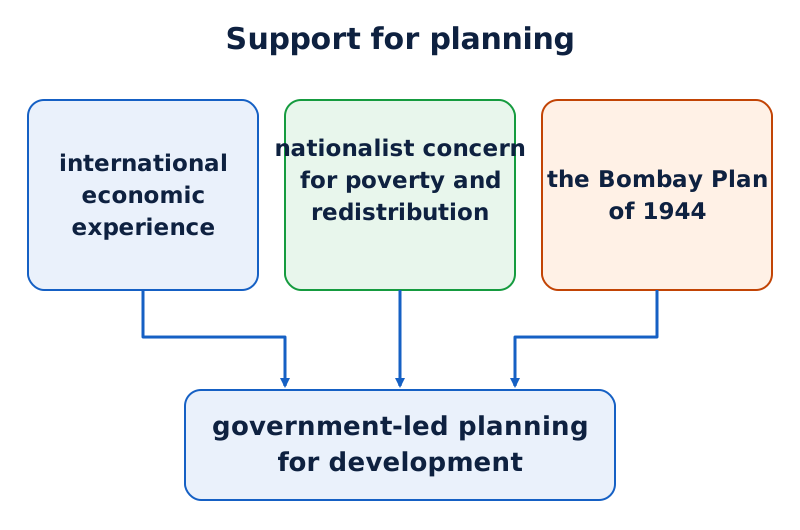
Draw three boxes labelled international economic experience, nationalist concern for poverty and redistribution, and the Bombay Plan of 1944. Link them to a central box labelled government-led planning for development.
Drawn by One Young India.
What was the Planning Commission’s role and institutional status?
Creation and authority
The Government of India established the Planning Commission through a simple resolution in March 1950. It was not a body created by the Constitution. Its advisory status must be distinguished from the considerable influence it came to exercise over economic strategy.
The Prime Minister served as its Chairperson. The Commission became the central and most influential machinery for deciding India’s development path. Nevertheless, its recommendations took effect only after approval by the Union Cabinet.
Welfare objectives
The Planning Commission’s founding resolution of March 1950 referred to Fundamental Rights and the Directive Principles of State Policy. It connected planning with a social order based on social, economic and political justice, rather than treating higher production as the sole purpose of economic policy.
| Objective | Meaning for economic policy |
|---|---|
| Adequate livelihood | Men and women should equally have adequate means of livelihood. |
| Common good | Ownership and control of community resources should serve the common good. |
| Prevent harmful concentration | The economy should not concentrate wealth and means of production to the common detriment. |
These objectives connect planning with redistribution. They direct attention to who controls resources and whether economic arrangements benefit the wider community. An account of the Commission should therefore include both its institutional status and the welfare purposes identified in its founding resolution.
Cartoon: Planning Commission (Ninan; NCERT Class 12, page 48, unnumbered). A group sits on a cloud labelled “Planning Commission” above a village scene with people, huts and cattle. The cartoon’s words say, “How lucky they are to have us planning for them!”
The government replaced the Planning Commission in 2015 with NITI Aayog, the National Institution for Transforming India. The new institution came into existence on 1 January 2015. The creation of the Commission and its later replacement are separate events.
How did Five Year Plans organise development expenditure?
A longer planning horizon
India’s Planning Commission adopted Five Year Plans (FYPs), following the Soviet example. Under this system, the Government of India prepared a document setting out planned income and expenditure for the next five years.
The central and state government budgets were divided into non-plan expenditure and plan expenditure. Non-plan budgets covered routine items on a yearly basis. Plan budgets followed the priorities fixed for the five-year period.
The advantage of this arrangement was a longer perspective. It allowed government to concentrate on the larger economic picture and undertake interventions over time, rather than viewing every development choice only through a single year’s routine expenditure.
The planning sequence
- The government prepared a document covering its income and expenditure over the next five years.
- The plan identified development priorities to guide expenditure over that period.
- Central and state budgets distinguished annual routine items from expenditure associated with the plan.
- Government could then direct long-term economic intervention towards the priorities in the five-year programme.
This is a description of the early planning framework. Its purpose was to connect budget decisions with a broader development strategy. The distinction concerned the basis and time horizon of expenditure, rather than a claim that routine government activities were unimportant.
Diagram
Early budget structure
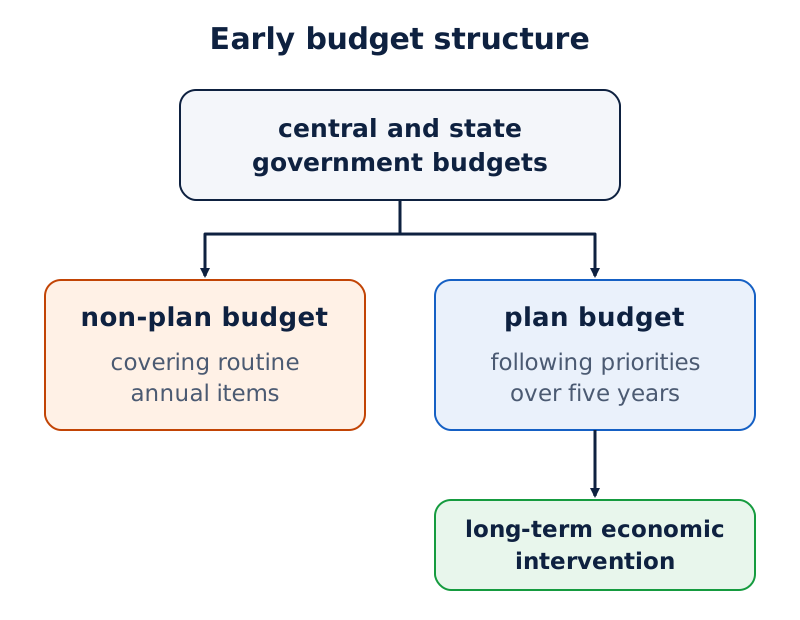
Draw a box labelled central and state government budgets. Divide it into non-plan budget, covering routine annual items, and plan budget, following priorities over five years. Link the plan branch to long-term economic intervention.
Drawn by One Young India.
A plan could still be criticised for the priorities it selected. Preparing a five-year document did not by itself resolve disagreements about agricultural investment, industrial expansion or the distribution of the gains from development.
How did public enthusiasm for planning change over time?
Plans as public events
The draft First Five Year Plan and the actual Plan Document, released in December 1951, generated considerable excitement. Academics, journalists, public and private employees, industrialists, farmers and politicians discussed the proposals. Planning became a subject of extensive public debate.
Enthusiasm reached its peak with the launch of the Second Five Year Plan in 1956. It continued somewhat into the Third Five Year Plan, launched in 1961. The changing response shows that planning was also a public and political experience.
| Date | Development in planning |
|---|---|
| December 1951 | The actual First Plan Document was released amid widespread discussion. |
| 1956 | The Second Plan began, with enthusiasm for planning at its peak. |
| 1961 | The Third Plan began; some earlier enthusiasm continued. |
| 1966 | The Fourth Plan was due, but an acute economic crisis accompanied declining novelty. |
The plan holiday
By the time the Fourth Plan was due to start, planning’s novelty had declined considerably. India also faced an acute economic crisis. The government decided to take a plan holiday.
Criticism concerned both the planning process and the priorities chosen. Yet the early plans had already firmly established the foundations of India’s economic development. Recognising these foundations does not require dismissing the criticisms or treating every planned outcome as a success.
What the figure shows
Stamps depicting development
The opening montage contains stamps showing dams, locomotives, a refinery, a tractor, fertiliser works, an electric train, wheat and aircraft production. Issued mostly between 1955 and 1968, the stamps presented a vision of planned development.
Reference: NCERT Class 12, page 44, unnumbered
The stamps connect that vision with visible projects and productive activity. Public enthusiasm, government planning and investment in economic capacity were closely associated during this early period.
Why did the First Five Year Plan prioritise agriculture?
Recovery from poverty and Partition
The First Five Year Plan, 1951 to 1956, aimed to move India out of a cycle of poverty. It concentrated mainly on the agrarian sector. Agriculture had suffered most severely from Partition and therefore required urgent attention.
K. N. Raj, a young economist involved in drafting the plan, argued that India should “hasten slowly” during the first two decades. His concern was that a very rapid rate of development might put democracy at risk.
This approach joined economic policy to political judgement. The pace of development mattered as well as its direction. The argument for patience did not mean abandoning development; it meant considering whether the chosen speed could endanger democratic life.
Irrigation and the distribution of land
The First Plan included investment in dams and irrigation. Large projects such as the Bhakhra Nangal Dam received substantial allocations. These investments formed part of the agricultural emphasis of the early programme.
The Plan also identified the existing pattern of land distribution as the principal obstacle to agricultural growth. It treated land reforms as a key to national development. Agricultural progress was therefore linked with changes in rural economic relationships as well as investment.
These priorities brought growth and justice together. Irrigation expenditure addressed the productive needs of agriculture, while concern over land distribution directed attention to the organisation of rural resources. The First Plan’s agricultural orientation cannot be reduced to building dams alone.
Its broad aim was to tackle poverty through development suited to the country’s immediate conditions. The agricultural damage associated with Partition, the distribution of land and concern for democracy’s survival shaped its particular emphasis.
Why were savings important, and what limited their growth?
Raising resources for development
Planners wanted to raise national income and saw higher savings as central to that effort. Their difficulty was that basic spending was already very low during the 1950s. Reducing people’s spending further was therefore not a practical way to obtain the resources they wanted.
They instead sought to increase savings. This was also difficult because the country’s total capital stock was rather low in relation to the number of people available for employment. The ambition to develop had to confront these limited economic resources.
A qualified outcome
People’s savings did increase during the first phase of planning, up to the end of the Third Five Year Plan. However, the rise was less spectacular than planners had initially expected. An increase should therefore not be described as complete fulfilment of the original hopes.
The proportion of savings in the country subsequently fell consistently from the early 1960s to the early 1970s. The amount saved and the proportion of savings are different measures, and the two stated periods partly overlap.
Note: Savings rose during the first phase of planning up to the end of the Third Plan, but less than initially expected. The proportion of savings fell consistently from the early 1960s to the early 1970s. These statements concern different measures and partly overlapping periods.
This record illustrates the gap between a planning objective and its realised outcome. The government could seek more resources for development, but low spending and limited capital constrained the process. The early rise in savings was real, yet fell short of the expected scale.
The savings problem also explains why investment choices mattered. Plans had to assign priorities while operating within the economic limitations of a country seeking to escape poverty.
How did the Second Plan differ from the First Plan?
Mahalanobis and structural transformation
The Second Five Year Plan stressed heavy industry and rapid structural transformation. A team of economists and planners led by P. C. Mahalanobis drafted it. Instead of the First Plan’s emphasis on patience, it sought simultaneous changes across many areas.
Mahalanobis, who lived from 1893 to 1972, was an internationally recognised scientist and statistician. He founded the Indian Statistical Institute in 1931. As the architect of the Second Plan, he supported rapid industrialisation and an active public sector.
Before the Plan was finalised, the Congress session at Avadi, near the then Madras city, adopted a socialist pattern of society as its goal. This goal was reflected in the Second Plan.
| Basis of comparison | First Plan | Second Plan |
|---|---|---|
| Leading emphasis | Agriculture, irrigation and land reforms. | Heavy industry and rapid industrialisation. |
| Approach to change | Patience, associated with K. N. Raj’s advice. | Quick structural transformation across several areas. |
| Economist associated with drafting | K. N. Raj was involved in drafting. | P. C. Mahalanobis led the drafting team. |
| Important investment areas | Dams and irrigation, including Bhakhra Nangal. | Electricity, railways, steel, machinery and communication. |
Protection and the public sector
The government imposed substantial tariffs on imports to protect domestic industry. The protected environment helped both public and private industries grow. Industrial development under the Second Plan therefore included benefits for both sectors.
As savings and investment grew, a large part of industrial development in electricity, railways, steel, machinery and communication could occur in the public sector. This drive for industrialisation marked a turning point in India’s development.
The contrast between the plans concerns priorities and pace. Both belonged to the wider project of planned development, but the Second Plan placed much greater emphasis on rapid industrial transformation.
What limitations and tensions emerged from rapid industrialisation?
Technology and food
India’s technological backwardness created a serious limitation. Obtaining technology from the world market required precious foreign exchange. Rapid industrial development consequently depended on acquiring resources that were costly for the country.
Industry also attracted more investment than agriculture. This raised the possibility of a food shortage. Planners found it very difficult to balance the two sectors. The problem was therefore not simply whether industry should develop, but how industrial priorities affected agricultural needs.
The Third Plan was not significantly different from the Second. Critics argued that the strategies displayed an unmistakable urban bias. Others thought industry had wrongly received priority over agriculture, while some preferred agriculture-related industries to heavy industry.
Contradictions within the Congress approach
An interpretation by Francine Frankel identifies two contradictory tendencies in the early Congress. Its national executive endorsed socialist principles, including state ownership, regulation and control of key sectors, to improve productivity and restrain economic concentration.
At the same time, the national Congress government pursued liberal economic policies and incentives for private investment, justified by the sole criterion of maximising production. The tension concerned both the instruments of development and the balance between output and redistribution.
This interpretation should be understood as an argument about competing tendencies within policy. It does not establish that one of those tendencies wholly displaced the other. The coexistence of state-led industrial development and encouragement to private industry is central to the issue.
Early planning thus had achievements and limitations together. It established foundations for development and promoted industrial capacity, but faced resource constraints, disappointing savings growth and difficult sectoral choices. Disagreement over growth and justice continued rather than disappearing with the adoption of planning.
Glossary
- Political contestation — Disagreement over development choices, their priorities and the interests that government should protect.
- Economic justice — A concern with livelihood, resource distribution and preventing harmful concentration of economic power.
- Modernisation — A process associated with changing traditional structures, material progress, scientific rationality, capitalism and liberalism.
- Left — An ideological position often favouring state control and regulation rather than free economic competition.
- Right — An ideological position favouring free competition and markets while opposing unnecessary government economic intervention.
- Planning — Government preparation of a development design that sets economic priorities beyond private decisions alone.
- Bombay Plan — A 1944 proposal by industrialists supporting a planned economy and major state investment initiatives.
- Planning Commission — An advisory institution created by government resolution, with recommendations requiring approval from the Union Cabinet.
- Five Year Plan — A government document setting out planned income, expenditure and development priorities over five years.
- Non-plan budget — The part of the early budget framework covering routine expenditure on a yearly basis.
- Plan holiday — A pause before the next Five Year Plan, adopted amid an acute economic crisis.
- Urban bias — A criticism that development strategies favoured urban priorities while agriculture received insufficient relative attention.
- NITI Aayog — National Institution for Transforming India, which replaced the Planning Commission and began on 1 January 2015.
Common errors and misconceptions
- Misconception: Everyone agrees on what development means. Correct: Industrialists, consumers and tribal residents may have conflicting needs and expectations.
- Misconception: Experts alone should decide major development disputes. Correct: Expert advice matters, but final decisions in a democracy require political judgement and popular approval.
- Misconception: Indian industrialists uniformly opposed planning. Correct: A section of major industrialists proposed the Bombay Plan in 1944 and supported state investment initiatives.
- Misconception: The Constitution created the Planning Commission. Correct: A government resolution established it in March 1950; Cabinet approval was required for its recommendations.
- Misconception: The First Plan concentrated chiefly on heavy industry. Correct: It prioritised agriculture, irrigation and land reforms; heavy industry was the Second Plan’s emphasis.
- Misconception: Import protection benefited only state-owned industries. Correct: The protected environment helped both public and private domestic industries grow.
- Misconception: Savings growth met all early expectations. Correct: Savings rose less spectacularly than expected, and their proportion later declined consistently during the stated period.
- Misconception: Planning settled the agriculture versus industry debate. Correct: Balancing the sectors remained difficult, and critics questioned industrial priority and urban bias.
Exam-style questions with model answers
Q1. A government resolution created the Planning Commission in March 1950, and its recommendations required Union Cabinet approval. Explain its institutional status and authority. [2 marks]
- It was an advisory institution created by a government resolution, rather than by the Constitution.
- Its recommendations became effective only after the Union Cabinet approved them; it could not make them effective on its own.
Q2. In 1944, a section of major industrialists proposed the Bombay Plan, calling for a planned economy and major state initiatives in industrial and other investment. What assumption about industrialists does this challenge? [2 marks]
- It challenges the assumption that industrialists necessarily opposed planning and wanted an economy without state control.
- These industrialists themselves supported government investment initiatives, showing that planning attracted support beyond Left political groups.
Q3. In the Orissa steel dispute, the state government expected investment and jobs, tribal residents feared displacement, environmentalists feared pollution, and the central government feared discouraging investment. Major decisions in a democracy require public approval and representatives’ judgement, informed by expert advice. Explain why experts alone could not resolve this dispute. [4 marks]
- The groups attached different meanings to development: investment and employment could coexist with fears of displacement and pollution.
- A decision required weighing the gains of some groups against the costs borne by others.
- Expert advice could inform discussion of mining, the economy and the environment, but could not alone settle whose interests should take priority.
- The final choice required political judgement by representatives in touch with people, with major decisions taken or approved by the public.
Q4. Seeking to overcome poverty, the First Plan focused on agriculture after Partition, funded dams and irrigation, identified land distribution as a principal obstacle, and treated land reforms as central to development. Explain its agricultural strategy using these facts. [4 marks]
- Its agricultural emphasis responded to the severe damage that Partition had caused to the sector.
- Investment in dams and irrigation directed resources towards agriculture’s productive requirements.
- Identifying land distribution as a principal obstacle showed that investment alone was not the whole strategy.
- Land reforms addressed the organisation of rural resources. The Plan therefore connected agricultural growth with changes in land distribution while seeking to move the economy out of poverty.
Q5. Compare these approaches: the First Plan prioritised agriculture, dams, irrigation and land reforms; K. N. Raj advised patience because rapid development might endanger democracy. The Second Plan, drafted under P. C. Mahalanobis, stressed heavy industry, simultaneous structural change, import protection benefiting both sectors, and public investment in electricity, railways, steel, machinery and communication. [6 marks]
- The First Plan placed agriculture at the centre of its development strategy, while the Second Plan emphasised heavy industry.
- The First invested in dams and irrigation and treated land reforms as essential. Its concern included both agricultural production and rural resource distribution.
- K. N. Raj’s advice favoured a cautious pace because very rapid development might endanger democracy.
- The Mahalanobis-led Second Plan sought quicker structural transformation by pursuing change across several areas simultaneously.
- Import protection supported domestic industrial expansion and benefited both public and private industries.
- The Second Plan assigned an active role to the public sector in electricity, railways, steel, machinery and communication. The difference was therefore one of priorities, pace and investment direction within planned development.
Q6. India had to buy technology using precious foreign exchange. Industry attracted more investment than agriculture, raising fears of food shortages. Critics identified urban bias, questioned industrial priority and favoured agriculture-related industries. Explain the limitations of the industrial strategy shown by this information. [4 marks]
- Technological backwardness created dependence on purchases from the world market, placing pressure on precious foreign exchange.
- The greater investment attracted by industry made balancing industrial growth with agricultural requirements difficult.
- The possibility of food shortages highlighted the consequences of giving insufficient relative attention to agriculture.
- Critics identified an unmistakable urban bias in the strategy, meaning that it favoured urban priorities. Others objected to prioritising industry over agriculture or preferred agriculture-related industries to heavy industry.
Q7. A plan described government income and expenditure over five years; central and state non-plan budgets covered annual routine items and plan budgets followed five-year priorities. The First Plan document stimulated public discussion in December 1951; enthusiasm peaked in 1956, continued somewhat in 1961, and declined by 1966, when acute crisis led to a plan holiday. Explain the framework, its advantage and this change in public response. [6 marks]
- The planning framework linked government income and expenditure to a five-year development programme rather than considering all expenditure only annually.
- Central and state budgets distinguished routine yearly non-plan spending from spending directed by the five-year plan’s priorities.
- This arrangement enabled a broader economic perspective and longer-term government intervention.
- The First Plan document’s release in December 1951 generated public discussion, showing that planning attracted interest beyond government offices.
- Enthusiasm peaked with the Second Plan in 1956 and continued somewhat when the Third Plan began in 1961.
- By 1966, planning had lost much of its novelty, and acute economic crisis contributed to the decision to take a plan holiday.
Q8. Francine Frankel contrasts a Congress executive favouring state ownership, regulation and control to improve productivity and curb economic concentration with a Congress government encouraging private investment to maximise production. Explain the contradiction in this interpretation. [4 marks]
- The Congress national executive endorsed socialist methods: state ownership, regulation and control over key sectors of the economy.
- The executive sought both improved productivity and a curb on economic concentration, combining production with redistribution.
- The national Congress government pursued liberal economic policies and incentives for private investment, contrasting with the executive’s emphasis on state ownership and control.
- The government justified these incentives solely by maximising production, contrasting with the executive’s additional objective of curbing economic concentration.
Key takeaways
- Development involves political choices because growth, justice, livelihoods and environmental concerns can pull policy in different directions.
- Planning won broad support, including the Bombay Plan’s call for major state investment initiatives in 1944.
- The Planning Commission was advisory, chaired by the Prime Minister, and dependent on Cabinet approval for its recommendations.
- Five Year Plans connected expenditure with longer-term priorities, while the early budget framework distinguished plan and non-plan spending.
- The First Plan prioritised agriculture, irrigation and land reforms; the Second emphasised heavy industry and rapid structural transformation.
- Industrial protection benefited public and private industries, but technology imports and food concerns exposed difficult investment choices.
- Early planning established development foundations, while savings disappointments, sectoral tensions and criticisms of urban bias persisted.
- NITI Aayog replaced the Planning Commission and came into existence on 1 January 2015.
Test yourself
Why does agreement on development still allow political conflict?
Different groups may want different outcomes, while investment gains can accompany fears of displacement, pollution or unequal resource distribution.
Which two models of modern development were before India at Independence?
The liberal-capitalist model associated with much of Europe and the United States, and the socialist model associated with the Soviet Union.
What did the Bombay Plan seek from the state?
It wanted major state initiatives in industrial and other economic investment within a planned economy.
How was the Planning Commission created?
A simple Government of India resolution established it in March 1950; it was not created by the Constitution.
Why did K. N. Raj favour a slower pace?
He feared that a very fast rate of development might endanger democracy during the early decades.
What did the First Plan identify as the principal obstacle to agricultural growth?
It identified the pattern of land distribution and therefore treated land reforms as central to development.
What goal did the Congress adopt at Avadi before the Second Plan was finalised?
It adopted a socialist pattern of society as its goal, which was reflected in the Second Plan.
Why was a plan holiday chosen when the Fourth Plan was due?
Planning’s novelty had declined considerably, and the country faced an acute economic crisis at that time.
Try it
Politics of Planned Development | Class 12 Political Science Notes
Apply your understanding of post-Independence development planning to these real-world scenarios.
1The government of a mineral-rich tribal district wants to approve a major mining project that will create 50,000 jobs but displace 20,000 Adivasi families. As a policy advisor, you must identify the core dilemma. Which statement best captures the political nature of this development choice?
This ignores the text's key insight: development is never a simple technical question. The text explicitly states that tribal families feared displacement while the central government worried about losing investor confidence—this is a political choice about who gains and who loses.
Correct. The text uses the exact example of a steel plant meaning one thing to the industrialist, another to the city consumer, and something 'very different to the Adivasi family living on the land where the ore is found.' This illustrates that development produces contradiction, conflict, and debate.
This only considers one side. The text shows the central government worried that blocking industry would make 'investors lose confidence in the country.' The dilemma involves balancing multiple legitimate concerns, not choosing one extreme.
2India in 1950 needed to decide how to develop its economy. The government was committed to both economic growth and social fairness. Why was the Planning Commission established, and what approach did it reflect?
This contradicts the text. It clearly states that leaders 'agreed that this task could not be left only to businessmen, industrialists and farmers,' so 'the government would play a leading role in ensuring both growth and justice.'
Correct. The text states the Planning Commission was 'set up on 15 March 1950 to design India's development' and became 'the most influential machinery for planning India's growth.' The text also explains that the government would lead development 'keeping every section of society in mind,' combining growth with justice.
The text explicitly contrasts this with colonial governance. It states that nationalist leaders were clear that free India's government would have to do 'far more than the colonial government, which had mostly limited itself to narrow commercial tasks'—reducing poverty and redistributing wealth were now the government's responsibility.